- 598 -
메주 제조 시
Bacillus subtilis
의 첨가가 재래식 된장의 발효에 미치는 영향이창호1,2․김원찬3․이인구3․박희동1,†
1
경북대학교 식품공학과,
2(재)경북바이오산업연구원,
3경북대학교 농화학과
Effects of Inoculation of Bacillus subtilis Cells on the Fermentation of Korean Traditional Soy Paste ( Doenjang )
Chang-Ho Rhee1,2, Won-Chan Kim3, In-Koo Rhee3, Heui-Dong Park1,†
1
Deptartment of Food Science and Technology, Kyungpook National University, Daegu 702-701, Korea
2Gyeongbuk Institute for Bio Industry, Andong, 760-380, Korea
3
Deptartmrnt of Agricultural Chemistry, Kyungpook National University, Daegu 702-701, Korea
Abstract
Korean traditional soy paste (Doenjang) was fermented for 90 days using, as a starter, a Meju prepared by inoculation of Bacillus subtilis cells. Changes in physiochemical and functional properties were investigated during fermentation.
Amylase and protease activities increased and showed maximal levels (4.11 and 7.75 units/mL, respectively) after 60 days of fermentation. Both enzyme activities then fell. Inhibitory activities of the soy paste against tyrosinase and angiotensin converting enzyme (ACE) increased during the fermentation period. Antimutagenic activities during fermentation were determined using the S. enterica serovar Typhimurium TA100 and TA98 analysis system. No significant differences in activity were observed in soy pastes prepared with or without B. subtilis. Antimutagenic activities against the activities of N-methyl-N'-nitro-N-nitrosoguanidine (MNNG) and 4-nitro-O-phenylenediamine (NPD) increased and reached 70.33% and 60.22%, respectively, after 90 days of fermentation, as assessed using the tester strain TA100. Against the actions of NPD and 4-nitroquinoline-1-oxide (NQO), antimutagenic activities also increased during fermentation and reached 50.84% and 47.01%, respectively, as assessed using the tester strain TA98. The genistin content was much higher (187.48 g/g) in soy paste prepared using B. subtilis inoculation than the level (31.30 g/g) seen in soy paste prepared without bacterial inoculation, although the contents of daidzein and genistein were slightly reduced under such circumstances.
Key words :Bacillus subtilis, Doenjang, antimutagenic activity, ACE inhibitory effect, genistin, soy paste
서 론
1)
우리의 전통된장은 청국장과 간장과 같이 대두를 이용하 여 발효된 식품으로 고유한 풍미를 지니고 있으며, 영양적 으로 우수한 단백질 공급원으로서 저장성이 매우 우수하다 (1). 된장은 전통적인 맛과 향을 지닌 대두 발효 식품으로 탄수화물 원료에 Aspergillus sp.의 균을 이용하여 대두와 함께 제조하는 것으로 우리 식생활에 필수 불가결한 식품이 다(2). 특히, 된장은 콩이나 콩 가공식품을 이용하여 제조한
†
Corresponding author. E-mail:[email protected], Phone:82-53-950-5774, Fax:82-53-950-5774
것으로 콩에 존재하는 여러 가지 건강 기능성을 나타내는 성분인 isoflavone, trypsin inhibitor, phenolics, maillard 반응 산물, globulin, peptide 등이 암, 혈관계 질환, 골다공증, 신장 질환 등의 각종 성인병 예방 및 치료 효과(3-5)가 있고 발효 중 생성되는 리놀렌산과 펩타이드들이 각각 항암성과 항고 혈압성을 나타내는 것으로 알려지면서 그 수요가 점점 증가 하고 있는 추세이다(6).
콩을 이용한 발효 식품인 된장의 기능성에 관한 연구가
증가하고 있는 추세이다. 이미 일본에서는 일본의 된장
(Miso) 및 간장 (Shoyu)에서 항암 (anti-tumor), 항 돌연변이
(anti-mutagenic) 및 항산화 (anti-oxidizing) 물질이 발견된다
는 보고(7-11)가 있으며, 대표적인 식물자원인 대두를 발효
하여 만든 된장의 경우 ACE 저해 효과를 비롯한 다양한 생리 활성 기능이 밝혀지면서(4) 우리나라의 전통 된장에 관한 연구가 활발히 진행되고 있다. 된장의 기능성에 관한 연구로는 항돌연변이(2,3,6), 항암(1,7) 및 혈전 용해능이 보고되고 있으며, 또한 면역증진(10), 혈압강하(11,12), 고 지혈증과 당뇨 개선(13), 아질산염 소거능(14) 및 항산화능 (15,16)을 가지는 생체 조절 기능의 성분이 밝혀지고 있다.
장류의 기능성은 아직 자세한 생성 기작과 생리적 효과 가 규명되지 않았지만 주로 메주 제조와 된장 발효에 관여 하는 미생물, 원료 대두 및 발효에 관여하는 미생물이 생산 하는 2차대사 산물에 의한 것으로 알려지고 있다(17). 지금 까지의 된장에 관한 연구로는 된장 발효에 관여하는 미생물 을 이용한 단백질 분해력, 당화력, 향기의 생성 능력 그리고 일반적인 화학 성분의 변화에 관한 연구 결과(2,14,15)가 있다. 또한 최근에는 된장의 분말화, 저염 장류의 제조와 안정성, 영양가와 기능성의 강화 등으로 활발히 진행되고 있으나(18,19), 메주를 제조할 때 자연적인 방법으로 발효 시키지 않고 미생물 starter를 접종하여 메주를 제조하고 이를 이용하여 담금한 된장의 생리기능성에 관한 연구는 거의 전무한 실정이다. 따라서 본 연구에서는 새로운 기능 성을 가지는 전통 발효 된장의 산업적 생산에 응용하고자 Bacillus subtilis 를 메주 starter로 접종하여 발효시킨 메주를 이용하여 된장을 담근 후 일정기간 숙성시킨 다음 각종 효소 활성, tyrosinase 저해 활성, ACE 저해활성, 항돌연변이 활성 및 생리 기능 물질의 함량을 측정하였다.
재료 및 방법
재료 및 사용균주
본 실험의 재료인 대두는 2002 년도 경북 군위에서 생산 된 태광 콩을 구입하여 사용하였으며 식염은 순도 97%
이상인 정제염을 구입하여 사용하였다. 메주 제조 시 사용 한 균주는 경북대학교 응용생명과학부 생화학연구실에서 분리하여 보관중인 Bacillus subtilis 를 사용하였다.
메주 및 된장의 제조
메주의 제조는 원료 대두를 증자한 후 냉각한 다음 B.
subtilis 를 LB 배지 (1.0% tryptone, 0.5% yeast extract, 1.0%
NaCl)를 사용하여 37℃에서 150 rpm으로 24시간 배양한 다음 원료 대두 1 kg 당 종 배양액 0.5% (v/w)를 접종하여 메주의 무게가 1.0 - 1.2 kg이 되도록 균일한 크기로 성형하 여 20℃ 온도에서 1 개월간 배양하여 제조하였다. 된장의 제조는 메주 50 kg에 소금 23 kg을 물 78 kg에 완전히 용해하 여 최종 염 농도가 15 ± 1% 되도록 조절하여 실온에서 90일간 숙성시켰다.
이화학적 성분의 분석
된장 발효 과정중의 이화학적 성분의 분석으로 pH는 pH meter (Mettler Toledo Co., Model 340, Switzerland)로 측정 하였다. 산도는 식품공전에 준하여 중화 적정법으로 측정 하였으며 아미노산도는 0.5% 페놀프탈레인용액을 지시약 으로 하여 포르몰(formol) 적정법으로 측정하였다(20). NaCl 농도는 Mohr법(21), 환원당 측정은 DNS (Dinitrosalicyclic acid)법(22)으로 550 nm에서 흡광도를 측정하였다.
Amylase와 protease 활성의 측정
된장 시료 10 g에 증류수를 첨가하여 200 mL로 정용한 후, 30℃의 진탕항온수조에서 4시간 동안 추출하여 4℃에서 2시간 방치한 다음 12,000 × g에서 10분간 원심분리하여 얻은 상징액을 조효소액으로 하여 amylase와 protease의 활 성측정에 사용하였다.
Amylase의 활성은 50 mM sodium phosphate 완충용액 (pH 7.5)에 용해한 soluble starch 0.5 mL에 0.4 mL의 sodium phosphate 완충용액 (pH 7.5)을 첨가하여 30℃에서 5분 간 방치한 다음, 여기에 조효소액 0.1 mL를 첨가하여 30℃에서 30분 반응시켰다. 이 때 생성된 환원당의 함량은 DNS법 (22)으로 측정하였다. 활성의 단위는 상기의 반응조건에서 1분당 생성하는 1 μmol의 환원당을 1 unit로 하였으며, 생성된 환원당의 양을 glucose의 양 (g)으로 환산하여 표시하였다.
Protease의 활성은 조효소액 1.0 mL에 50 mM NaOH- borate 완충용액 (pH 10.0)에 용해한 0.6% casein 5 mL를 첨가하여 반응을 정지시킨 다음 37℃에서 20분간 방치시킨 후 여과하여 사용하였다. 반응산물의 양은 Hull의 방법(23) 을 사용하여 280 nm에서 흡광도를 측정하였다. 활성의 단 위는 상기의 반응조건에서 1분당 생성하는 1 μg의 tyrosine 을 1 unit로 하였으며, 생성된 반응산물의 양을 tyrosine의 양 (μg/mL)으로 환산하여 나타내었다.
Tyrosinase 활성 저해능 측정
Tyrosinase 활성 저해능 측정(24)은 475 nm에서 단위 시 간당 변화된 초기 흡광도의 변화값 (S
Abs)과 효소액 대신에 증류수를 0.1 mL를 첨가하여 흡광도를 측정한 값 (B
Abs), 시료 용액 대신에 증류수를 0.5 mL 첨가하여 동일한 방법으 로 흡광도를 측정한 값 (C
Abs)을 측정하여 다음의 식에 의해 계산하였다.
Inhibitory effect(%) = 1 - [S
Abs- B
Abs/ C
Abs] × 100
ACE (angiotensin converting enzyme) 저해 활성 측정시료의 조제는 된장 시료 20 g에 증류수를 20 mL를 첨가
하여 95℃ 항온수조에서 20분 방치한 후, 증류수를 20 mL를
첨가하여 10,000 × g에서 20분 원심분리하여 얻은 상징액을
시료로 사용하였다. ACE 저해 활성의 측정은 Cushman과
Cheung의 방법(25)에 준하여 실시하였다. 시료 50 μg에 기 질 50 μL를 첨가한 후, 37℃에서 5분 방치하였다. 여기에 ACE 용액을 50 μL를 첨가하고 다시 37℃에서 1시간 반응시 킨 후, 1 N HCl 용액 250 μL를 첨가하여 반응을 정지시켰다.
다시 여기에 ethyl acetate 1.5 μL를 가하여 15 초 동안 균질화 한 후, 5,000×g에서 10분 원심분리하여 얻은 상징액 1 μL를 취하였다. 이 상징액을 80℃에서 1시간 가열하여 완전히 건조시킨 후, 1 M NaCl 용액을 3 mL를 첨가하여 용해한 다음 228 nm에서 흡광도를 측정하여 다음의 식에 의해 계산하였다.
Inhibition ratio (%) = [(B-A)/(B-C)] × 100 B : 시료대신 증류수 첨가 시 흡광도 A : 시료 첨가 시 흡광도
C : 반응 정지 후 시료 첨가 시 흡광도
항돌연변이 활성의 측정시료 된장 20 g에 증류수 100 mL를 첨가하여 균질화한 후, 80℃ 항온수조에서 3시간 열수 추출한 다음 원심분리하 여 얻은 상징액을 건고시킨 후 증류수를 첨가하여 시료로 사용하였다. 시료의 돌연변이 및 항돌연변이 활성 측정은 Ames test를 개량한 preincubation method(26-28)에 따라 히 스티딘 영양 요구주로서 point mutant인 Salmonella enterica serovar Typhimurium TA100 (hisG46, rfa, △uvrB)과 frame shift mutant인 Salmonella enterica serovar Typhimurium TA98 (hisD3052, rfa, △uvrB)을 사용하여 시료에 의한 His
+복귀 돌연변이 정도를 조사하였다. 변이원으로는 S.
enterica serovar Typhimurium TA100인 경우에는 MNNG (N-methyl-N'-nitro-N-nitrosoguanidine)와 NPD (4-nitro-O- phenyl- enediamine)를 plate 당 각각 5 μg와 15 μg되게 사용 하였으며 S. enterica serovar Typhimurium TA98인 경우에 는 NPD와 NQO (4-nitroquinoline-1-oxide)를 각각 2.5 μg와 0.25 μg되게 사용하였다. 항돌연변이 활성은 minimal glucose agar상에서 생육하는 His
+복귀 돌연변이 콜로니를 계수하고 다음 식으로 환산하여 His
+복귀 돌연변이 저해율 (inhibition ratio)로서 나타내었다.
Inhibition ratio (%) = [(a-b)/(a-c)] × 100
a : 변이원에 의해 유도된 His
+복귀 돌연변이 콜로니 수 b : 변이원과 시료처리 시 유도된 His
+복귀 돌연변이
콜로니 수
c : 변이원과 시료 무처리 시 유도된 His
+복귀 돌연변이 콜로니 수
시료의 돌연변이원성 조사를 위하여 변이원을 첨가하지 않고 시료만을 첨가하여 상기의 항돌연변이 활성 실험과 동일한 방법으로 행하였다. 돌연변이 활성은 시료에 의한
His
+복귀 돌연변이율로서 무처리 시 유도된 His
+복귀 돌연 변이 콜로니 수에 대한 시료 처리 시 유도된 His
+복귀 돌연 변이 콜로니 수의 %로 나타내었다. 돌연변이 및 항돌연변 이 활성 조사는 3구 3회 반복으로 실험하여 평균값으로 나타내었다.
Isoflavone 함량 분석
된장 시료를 80℃에서 2일간 건조하여 분쇄기로 분쇄한 후, 분쇄한 된장 시료 10 g에 100% 메탄올 50 mL를 첨가하 여 80℃에서 3시간 동안 환류 추출한 다음 추출액을 0.45 μ m filter로 여과하여 HPLC로 genistin, daidzin, genistein 및 daidzein을 정량하였다(29). HPLC 분석을 위한 column은 RP C18 (4.6× 250 mm, Waters Co., USA)을 사용하였으며, 이동상은 0.55% acetic acid를 함유한 H
2O와 0.11% acetic acid를 함유한 acetonitrile (이 때 acetonitrile은 35분 동안 5%에서 100%까지 증가하도록 농도구배를 줌)이다. Flow rate는 0.8 mL/min으로 조절하였으며 UV detector를 사용하 여 254 nm에서 검출하였다.
통계처리 및 분석
전체적인 분석실험은 각 군당 3반복으로 시행하였으며 실험결과는 Statistical Package for Social Sciences (SPSS, 10.0) program을 이용하여 통계 처리하였다. 모든 측정치는 실험군당 평균값과 표준오차를 계산한 후 평균값 또는 평균 값 ± 표준오차로 표시하였다. 각 군간 평균값의 통계적 유의성은 One Way ANOVA 분석을 한 후 p<0.05 수준에서 Duncan의 다중범위 검정법 (Multiple Range Test)에 의하여 검정하였다.
결과 및 고찰
된장의 이화학적 특성
메주 제조 시 B. subtilis 를 starter로 접종하여 제조한 메주 를 이용하여 된장을 담금한 후, 숙성기간에 따라 시료를 채취하여 이화학적 성분을 분석한 결과는 Table 1과 같다.
된장의 pH와 총산은 숙성에 관여하는 미생물의 발효 대사 와 밀접한 관련이 있어 발효의 한 지표로 사용된다(18,19).
메주의 제조방법의 차이에 관계없이 된장 숙성기간이 길어
질수록 pH는 감소하는 경향을 나타내었으며 감소하는 비
율은 거의 유사한 수준이었으며 총산의 변화는 숙성기간이
증가함에 따라 증가하는 경향을 나타내었다. NaCl의 함량
은 된장 숙성 45일까지는 증가하는 경향을 나타내었으며
그 이후의 기간에는 거의 일정한 농도를 유지하였다. 된장
숙성 초기에 NaCl의 농도가 낮게 나타난 이유는 메주 내부
로 NaCl의 확산이 불완전하여 평형화가 이루어지지 않았기
때문이며 숙성기간이 길어질수록 NaCl의 함량이 높게 나타
난 이유는 발효 환경에 의한 수분의 소실이 원인인 것으로 추측된다.
Table 1. Effects of inoculation of
B. subtilis
cells in the soy koji on the physicochemical properties of the soy paste during fermentationStarter Fermentation time (days) pH Acidity
(%) NaCl
(%)
None
0 6.52 0.09 0.00
15 6.24 0.38 12.41
30 6.20 0.49 14.50
45 6.13 0.60 15.38
60 6.02 0.72 15.39
75 5.91 0.80 15.37
90 5.87 0.96 15.33
B. subtilis
0 6.53 0.12 0.00
15 6.27 0.35 12.24
30 6.22 0.43 14.36
45 6.15 0.56 15.41
60 6.04 0.69 15.39
75 5.93 0.78 15.31
90 5.86 0.95 15.35
Amylase 활성과 환원당 함량의 변화
된장 발효에 있어서 amylase의 활성은 총당과 환원당의 변화에 영향을 미치며 된장 숙성중의 amylase의 경시적 변화 (Fig. 1A)는 B. subtilis 를 starter로 첨가한 실험구가 대조구 보다 높게 나타났으며, 숙성이 진행됨에 증가하여 숙성 60일 후 활성이 4.11 unit/mL로 가장 높게 나타났다.
환원당 함량 (Fig. 1B)은 숙성 30일 후 급격히 증가하여
0 1 2 3 4 5
0 15 30 45 60 75 90 Fermentation time (days)
Activity (U/ml)
0 2 4 6 8
0 15 30 45 60 75 90 Fermentation time (days)
Reducing sugar (%)
A B
Fig. 1. Changes in the amylase activity and reducing sugar content during the fermentation of soy paste.
The fermentation was carried out for 90 days using the soy koji prepared with (■) or without (○) inoculation of B. subtilis cells. During the fermentation, changes in the amylase activity (A) and reducing content (B) were monitored every 15 days.
숙성 60일 후 B. subtilis 를 starter로 첨가한 실험구가 6.67%로 가장 높게 나타났으며 그 이후에는 감소하는 경향 을 나타내었다. 이러한 결과는 숙성이 진행됨에 따라 amylase의 활성이 비교적 높게 나타나 환원당 함량이 최대 를 나타내었고, 그 후 된장 숙성에 관여하는 미생물의 영양 원, 알코올 발효, 유기산 발효의 기질로 당이 이용되었기 때문에 환원당 함량이 감소된 것으로 생각된다. 이는 된장 숙성 중반기에 환원당 함량이 증가하였다가 숙성이 진행됨 에 따라 감소하였다는 Lee 등(30)의 보고와 유사한 결과를 나타내었다.
Protease 활성과 아미노산도의 변화
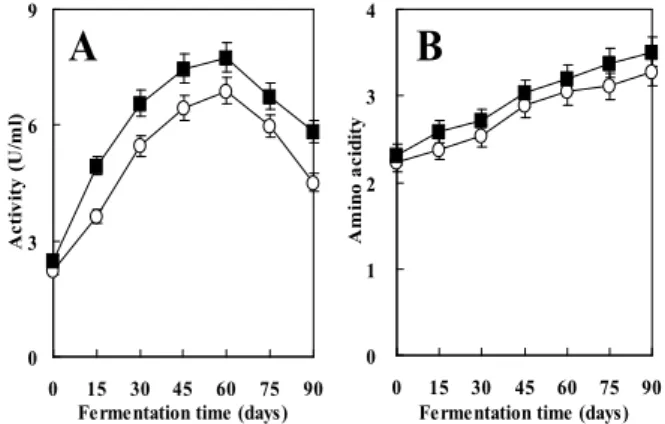
된장의 protease의 활성은 단백질을 분해하여 특유의 구 수한 맛 성분을 생산하고 이들의 숙성 정도를 나타내는 유리 아미노산 함량에 많은 영향을 준다. 숙성 중 protease의 활성 변화 (Fig. 2A)는 숙성이 진행됨에 따라 B. subtilis 를 starter로 첨가한 실험구와 대조구 모두 증가하여 숙성 60일 후 실험구의 protease의 활성이 7.75 unit/mL로 가장 높게 나타났으며 숙성이 더욱 진행됨에 따라 감소하는 경향을 나타내었다. 그리고 B. subtilis 를 starter로 첨가하여 제조한 경우가 전통적인 방법으로 메주를 제조한 경우 보다 활성이 높게 나타났다. 이러한 결과는 Kim 등(31)이 보고한 Bacillus sp. SP-KSW3를 starter로 이용하여 제조한 된장 숙성 중 발효시간에 따른 protease 활성보다 높게 나타났다.
아미노산도의 변화 (Fig. 2B)는 된장 숙성기간이 길어질수 록 증가하는 경향을 나타내었으며 B. subtilis 를 starter로 첨가하여 제조한 된장이 대조구 보다 높게 나타났다.
0 1 2 3 4
0 15 30 45 60 75 90 Fermentation time (days)
Amino acidity
0 3 6 9
0 15 30 45 60 75 90 Fermentation time (days)
Activity (U/ml)
A B
Fig. 2. Changes in the protease activity and amino acidity during the fermentation of soy paste.
The fermentation was carried out for 90 days using the soy koji prepared with (■) or without (○) inoculation of B. subtilis cells. During the fermentation, changes in the protease activity (A) and amino acidity (B) were monitored every 15 days.
Tyrosinase 활성 저해능과 angiotensin converting enzyme 저해 활성의 변화
B. subtilis 를 starter로 사용하여 제조한 메주를 이용하여
된장을 담금한 후, 숙성기간에 따른 tyrosinase의 저해 활성
을 측정한 결과(Fig. 3A), 실험구와 대조구에서 큰 차이를 나타내지 않았으며, 숙성기간이 경과함에 따라 증가하는 경향을 나타내었다. Tyrosinase는 동, 식물 및 곰팡이 등에 널리 존재하는 검정색 색소인 멜라닌의 합성에 가장 중요한 효소로서 tyrosine으로부터 quinone이 생성된 후에 아미노 산 또는 단백질과 중합반응에 의해 melanin이 합성된다 (32,33). 이 때 생성된 melanin은 사람의 피부에 색소가 비정 상적으로 생성되어 나타나는 원인 물질로서 화학적 물리적 으로 매우 안정하여 생성된 색소를 분해하기란 매우 어렵 다. 그리고 현재 tyrosinase 저해제로 여러 가지가 사용되고 있으나(34-37), 안전성과 경제성 등의 문제점을 안고 있기
때문에 B. subtilis 를 첨가하여 제조한 된장은 숙성이 진행됨
에 따라 tyrosinase의 저해 활성이 증가하기 때문에 된장 섭취시 tyrosinase의 활성을 저해 할수 있으리라 사료된다.
안지오텐신 전환효소의 활성 저해 효과를 측정한 결과 (Fig. 3B), 실험구와 대조구에서 큰 차이를 나타내지 않았으 며 숙성이 진행됨에 따라 증가하는 경향을 나타내었다.
ACE는 혈압 상승과 동시에 생체 내에서 혈압을 저하시키 는 bradykinin을 분해하며 지방산의 산화 촉진과 과산화가 를 증가시킴으로서 동맥경화의 위험율을 높이는 것으로 알려져 있는(38,39) 성분으로 최근 우리나라에서도 식품으 로부터 ACE 활성 저해 효과에 대하여 많은 연구가 이루어 지고 있으나, 식품내에 존재하는 ACE 저해 활성 물질은 혈압 강하제와 비교 시 낮은 활성을 나타내지만 항상 섭취 하는 전통 발효 식품 중 하나인 된장에 존재한다는 점에서 유용성이 기대되어진다(40-42).
0 10 20 30 40 50
0 15 30 45 60 75 90 Fermentation time (days)
ACE inhibition (%)
0 5 10 15 20 25
0 15 30 45 60 75 90 Fermentation time (days)
Tyrosinase inhibition (%) A B
Fig. 3. Changes in the tyrosinase and ACE inhibitory effects during the fermentation of soy paste.
The fermentation was carried out for 90 days using the soy koji prepared with (■) or without (○) inoculation of B. subtilis cells. During the fermentation, changes in the tyrosinase (A) and ACE inhibitory effects (B) were monitored every 15 days.
항돌연변이 활성의 변화
전통 발효 식품인 된장이 항돌연변이 활성을 가지고 있 다고 확인(18,19)되었기에 된장 제조시 Bacillus subtilis 를 starter로 접종하여 제조한 메주를 이용하여 된장을 담금한 후, 된장 숙성시 항돌연변이 활성에 어떤 영향을 미치는지
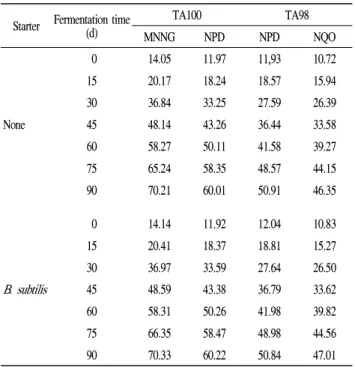
를 조사하기 위하여 숙성기간별로 물 추출하여 Salmonella enterica serovar Typhimurium TA98과 TA100을 사용하여 변이원인 MNNG, NPD 및 NQO에 대한 항돌연변이 활성을 조사한 결과 (Table 2), Salmonella enterica serovar Typhimurium TA100은 변이원 MNNG와 NPD에 대한 항 돌연변이 활성은 Bacillus subtilis 를 starter로 사용한 실험구 와 대조구는 큰 차이를 나타내지는 않았지만 숙성기간이 길어질수록 증가하는 경향을 나타내었으며, S. enterica serovar Typhimurium TA98에 대하여 변이원 NPD와 NQO 에 대한 항돌연변이 활성은 S. enterica serovar Typhimurium TA100과 마찬가지로 숙성기간이 증가할수록 증가하는 경 향을 나타내었다. 된장의 물 추출물은 변이원의 종류와 사용균주에 따라 활성에 차이를 나타내었다. 이러한 결과 는 변이원의 종류에 따라 작용기작의 차이와 사용 균주의 유전자형이 활성에 영향을 미치는 것으로 사료된다.
Table 2. Effects of inoculation of
B. subtilis
cells in the soy koji on the antimutagenic activities of the soy paste during fermentationStarter Fermentation time (d) TA100 TA98
MNNG NPD NPD NQO
None
0 14.05 11.97 11,93 10.72
15 20.17 18.24 18.57 15.94
30 36.84 33.25 27.59 26.39
45 48.14 43.26 36.44 33.58
60 58.27 50.11 41.58 39.27
75 65.24 58.35 48.57 44.15
90 70.21 60.01 50.91 46.35
B. subtilis
0 14.14 11.92 12.04 10.83
15 20.41 18.37 18.81 15.27
30 36.97 33.59 27.64 26.50
45 48.59 43.38 36.79 33.62
60 58.31 50.26 41.98 39.82
75 66.35 58.47 48.98 44.56
90 70.33 60.22 50.84 47.01
The fermentation was carried out for 90 days using the soy koji prepared with or without inoculation of B. subtilis cells. During the fermentation, the antimutagenic activity was tested using the soy paste extracts against MNNG and NPD in S. enterica serovar Typhimurium strain TA100 as well as against NPD and NQO in S. enterica serovar Typhimurium strain TA98.
Isoflavone의 함량
된장 또한 대두를 이용하여 생산하는 제품이기 때문에
된장 제조 시 메주 제조방법을 다르게 하여 제조한 후 90일
간 발효 숙성시켜 isoflavone류의 함량을 측정한 결과(Table
3), 실험구와 대조구 모두 glucoside의 일종인 daidzin은 검
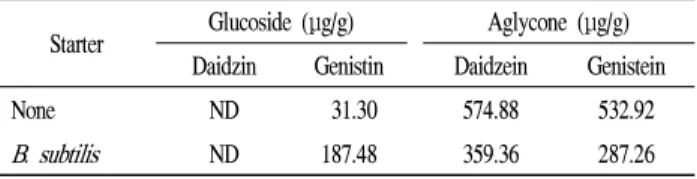
출되지 않았으며, genistin의 경우 대조구보다 B. subtilis 를
starter로 접종하여 제조한 메주를 이용하여 제조한 된장의
함량이 187.48 μg/g으로 약 6배 정도 높게 나타났다.
Aglycone의 일종인 daidzein과 genistein의 함량은 glucoside 와는 다르게 대조구가 실험구보다 많은 함량을 나타내었으 며 숙성기간이 길어질수록 증가하였다. Daidzein의 함량은 각각 574.88 μg/g과 359.36 μg/g, genistein의 경우 각각 532.92 μg/g과 287.26 μg/g으로 나타났다. 대두의 여러 가지 생리활성물질 중 isoflavone류는 phytoestrogen 으로 estrogen 과 유사한 생리활성을 가지는 phytochemical이다. 이러한 isoflavone류 중에서 생리활성의 기초를 이루는 화합물은 주로 genistein, daidzein과 같은 isoflavones aglycone (당과 결합하고 있지 않은 형태의 isoflavonoid)류로 알려져 있다 (43,44). 대두에 존재하는 isoflavone류 중 isoflavone glycoside의 일종인 daidzin, genistin이 전체 isoflavonoid의 60 - 70%로 가장 많은 부분을 차지하고 있는 것으로 알려져 있으며, 다양한 생리활성과 기능성을 갖는 aglycone 형태의 화합물인 daidzein, genistein 함량은 각각의 배당체의 약 10 - 30분의 1에 불과한 것으로 알려져 있다(45). Aglycone 인 genistein을 섭취한 경우와 배당체인 genistin을 섭취한 경우 genistein이 더 빨리 흡수되는 현상을 보여 aglycone의 생체 이용률이 우수함이 알려져 있다(46,47).
Table 3. Effects of inoculation of
B. subtilis
cells in the soy koji on the isoflavone contents in the soy paste after fermentationStarter Glucoside (μg/g) Aglycone (μg/g) Daidzin Genistin Daidzein Genistein
None ND 31.30 574.88 532.92
B. subtilis
ND 187.48 359.36 287.26요 약
Bacillus subtilis 를 메주 제조 시 starter로 접종하여 발효시 킨 메주를 이용하여 된장을 담근 후 일정기간 숙성시킨 다음 된장의 이화학적 성질 등의 변화를 측정하였다.
Amylase와 protease의 활성은 숙성 60일 후 4.11 unit/mL와 7.75 unit/mL로 가장 높게 나타났으며 숙성이 더욱 진행됨 에 따라 감소하는 경향을 나타내었다. Tyrosinase의 저해 활성과 ACE 저해 활성은 숙성기간이 경과함에 따라 증가 하는 경향을 나타내었다. 항 돌연변이 활성은 숙성기간이 길어질수록 증가하는 경향을 나타내었으며, Salmonella enterica serovar Typhimurium TA100에 대하여 변이원 MNNG와 NPD에 대한 항 돌연변이 활성은 70.33%와 60.22%로 나타났으며, TA98에 대하여 변이원 NPD와 NQO 에 대한 항 돌연변이 활성은 50.84와 47.01%를 나타내었다.
90일간 발효 숙성시킨 된장의 isoflavon의 함량은 genistin의 경우 Bacillus subtilis 를 첨가하여 제조한 경우가 187.48 μg/g 으로 높게 나타났다. Daidzein과 genistein은 전통적으로 제
조한 메주를 이용한 된장에서 각각 574.88 μg/g과 532.92 μ g/g으로 가장 높게 나타났다.
참고문헌