INTRODUCTION
낙상은 현 위치보다 낮은 위치로 본인의 의사와 관계없이 넘어지거나 주저앉는 것으로 정의된다(Tinetti & Speechley, 1989). 매년 4명의 노인들 중에 1명 이상은 낙상하는 것으로 알려졌다(Stevens et al., 2012). 낙상 원인의 내재적 요인 중 하 나인 신체 균형 조절 능력의 약화는 신체 기동력 제한에 영향 을 주어 낙상을 발생시킨다(Mahoney, 1998; Gauchard, Gangloff, Jeanel, & Perrin, 2003). 균형성은 시각계, 체성 감각계, 전정계 를 통하여 들어오는 감각정보의 복합적인 기능의 결과이다. 노 화는 이들 기능을 약화시켜 궁극적으로 낙상의 빈도를 높인다 (Wolgson et al., 1992). 노인들의 균형성 부족은 낙상 위험을 배
가시키기(Gauchard et al., 2003; Rao, 2005) 때문에 노인 낙상은 균형 능력에 좌우된다고 해도 과언이 아니다(Johnell & Kanis, 2006). 신체의 균형을 유지하는 능력은 안정성을 측정함으로 써 정량화할 수 있다. 자세의 안정성과 밀접한 관련이 있는 압 력중심(CoP: center of pressure)은 신체가 지지면에 작용하는 합 수직력의 작용점으로 정의되기 때문에 자세의 안정성을 판 단하는 자료로 활용되며, 낙상과 관련해 신체의 안정성을 정 량화하는 변인 중에 하나로 활용되고 있다(Palmieri, Ingersoll, Stone, & Krause, 2002; Ryu, Yoo, Park, & Yoon, 2012; Teasdale
& Simoneau, 2001).
Ferine, Gryfe, Holiday, & Liewellyn (1982)는 눈감고 선 상태에 서 낙상 경험 노인과 비 낙상 노인들 간에 CoP를 비교한 결과
Complexity Comparison of Center of Pressure between Fallers and Non-fallers during Gait
보행 시 낙상 유무에 따른 압력중심점의 복잡성 비교Sang Kyoon Park
1, Sihyun Ryu
2, Jongbin Kim
2, Sukhoon Yoon
3, Jiseon Ryu
41Department of Physical Education, College of Sport Science of Korea National Sport University, Seoul, South Korea
2Motion Innovation Centre, Korea National Sport University, Seoul, South Korea
3Department of Community Sport, Korea National Sport University, Seoul, South Korea
4Department of Health and Exercise Science, College of Lifetime Sport of Korea National Sport University, Seoul, South Korea
Received : 29 April 2019 Revised : 02 May 2019 Accepted : 07 May 2019
Corresponding Author
Jiseon RyuDepartment of Health and Exercise Science, College of Lifetime Sport of Korea National Sport University, 1239, Yangjae, Songpa-gu, Seoul, 05541, South Korea
Tel : +82-2-410-6822 Fax : +82-2-410-6927 Email : [email protected]
Objective: The purpose of this study was to investigate the effect of the falls on the center of pressure (CoP) complexity during gait using non-linear approximate entropy (ApEn).
Method: 20 elderly women with experience of falling (age = 72.55 ± 5.42 yrs; height = 154.40 ± 4.26 cm; body weight = 57.40 ± 6.21 kg; preferred gait speed = 0.52 ± 0.17 m/s) and 20 elderly women with no experience of falling (age = 71.90 ± 2.90 yrs; height = 155.28 ± 4.73 cm; body weight = 56.70 ± 5.241 kg; preferred gait speed = 0.56 ± 0.13 m/s) were recruited for the study.
While they were walking at their preferred gait speed on a treadmill (instrumented dual belt treadmills, Bertec, USA) with a force plate CoP data were collected for the 20 strides. The complexity of the CoP was analyzed using the ApEn technique.
Results: The ApEn of the medial-lateral CoP in the fallers showed smaller about 16% compared to the non-fallers (p<.05). The ApEn of the antero-posterior CoP of the fallers showed smaller about 12% compared to the non-fallers, but the difference was not statistically significant.
Conclusion: Based on the results of this study, the reduction of the medio-lateral CoP complexity in the elderly gait would be an index to determine the potential fall.
Keywords: Complexity, Center of pressure, Approximate entropy, Fall, Gait
낙상 경험 노인들에게 CoP의 평균 동요 속도가 유의하게 큰 값을 보였다고 주장하였고, Maki, Holliday, & Topper (1994)는 눈감은 상태에서 CoP의 좌우 동요 크기는 낙상 경험이 없는 노인들조차 미래 낙상을 예측할 수 있는 정확한 요인이라고 주장하였다. Collins & De Luca (1995)은 정적 직립 상태에서 노 인들의 자세 변동을 CoP 범위를 통해 관찰한 결과 변동 범위 가 큰 노인일수록 잠재적 낙상 위험이 높다고 주장하였으며, Stel, Smit, Pluijm, & Lips (2003)은 시야를 제약하는 조건에서 CoP를 측정한 결과 낙상의 독립적인 예측 변인으로 신체 좌 우 동요를 꼽았다. 또한 Melzer, Kurz, & Oddsson (2010)은 눈감 은 직립 상태에서 평균 좌우 CoP 범위와 면적은 낙상자들이 비 낙상자들보다 큰 값을 보였다고 보고하였다. 그 밖에 많은 연구자들이 지면반력기를 이용하여 산출한 CoP로 낙상을 판 단하고 예측하는 연구를 수행하였다(Bergland, Jarnlo, & Laake, 2003; Melzer & Oddsson, 2004; Piirtola & Era, 2006). 이와 같 이 선행 연구들은 CoP 동요 범위를 통해 자세의 안정성을 판 단한 후 잠재적 낙상관련 예측 변인으로 제시하였다.
한편 몇몇 연구들은 CoP를 비선형 분석을 통해 근 신경 조 절과정의 변화를 관찰해 통찰력을 얻고자 하였다(Dingwell &
Cusumano, 2000). Pincus (1991)는 직립 자세에서 압력중심 궤 적에 대한 복잡성을 ApEn (approximate entropy)를 이용해 연 구한 결과 3세에서 5세까지, 8~25세인 젊은 성인에 이르기까 지 ApEn 값이 증가하였고, 젊은 성인에서 노인까지 ApEn 값 이 감소한다고 보고하였다. 위 결과에 따라 자세 계의 복잡성 은 생애에 걸쳐 역 U자형의 형태를 지닌다고 주장하였다.
Yamada (1995)는 CoP 시계열의 최대 Lyapunov 지수 추정을 통해 CoP 운동은 케오틱(비선형)이라고 제안했다. Schmit, Riley, Dalvi, Sahay, & Shockley (2006)은 직립 상태에서 파키슨 환자 들의 CoP 변동은 건강한 노인들에 비해 예측이 쉽고 복잡하지 않다고 보고하였다. Seigle, Ramdani, & Bernard (2009)은 RQA (recurrence quantification analysis)을 활용해 CoP 복잡성을 분 석한 결과 연령 함수로서 CoP 복잡성은 정적 상태에서 감소한 다고 보고하였으며, Ko & Newell (2016)은 연령과 자세 과업(정 적 직립 대 리듬미컬한 스웨이) 함수로 CoP의 복잡성을 조사 하기 위해 노인과 젊은 사람들을 대상으로 지면반력기 위에서 발목을 이용한 일정한 표적 조건과(constant target condition) 사인 표적 조건(sine-wave target condition)에서 20초 동안 CoP 복잡성을 관찰하였다. 그 결과 CoP의 복잡성은 정적 상태에서 는 노인들이 젊은 사람보다 낮고, 동적 상태에서는 노인들이 높다고 보고하였다. 이상과 같이 CoP와 관련된 연구는 선형과 비선형 분석에서 활발하게 이용되고 있지만, 낙상 경험을 가 진 노인들은 보행 시 CoP 복잡성의 특징을 비선형 기법을 이 용해 규명하고, 이를 통해 미래 낙상 위험을 예방하는 중재적 목표(Melzer, Benjuya, & Kaplanski, 2004)로 관찰된 연구는 다소 미진한 실정이다. 시스템의 복잡성은 예상하거나 혹은 예상치
못한 동요에 대해 적응할 수 있는 반응들(adaptive responses) 을 발생하기 위한 능력을 나타내는 지표(Lipsitz, 2002)로 비선 형 동력학의 많은 도구 중에 ApEn은 노이즈 시계열, 특히 짧 은 시간 동안 동력학적 복잡계의 정보를 제공할 수 있는 장점 을 가지고 있다(Kim, 2008). 따라서 낙상에 상대적으로 쉽게 노 출되는 노인들의 보행 동작의 복잡성을 분석해 낙상을 예측하 고 예방할 수 있는 통찰력을 제공할 필요성이 요구된다.
이에 본 연구는 낙상 경험이 보행 동작의 CoP 복잡성에 미 치는 영향을 ApEn 비선형 기법을 통해 정량화하고자 하였다.
METHOD
1. 연구 대상자본 연구의 대상자는 낙상 경험이 있는 65세 이상 20명의 노 인 집단(연령=72.55±5.42세; 신장=154.40±4.26 cm; 체중=57.40
±6.21 kg; 선호보행속도=0.52±0.17 m/s; 실험 전 낙상 발생시 기=15.25±8.8 months; 낙상 발생빈도수=1.70±1.26 times)과 낙상 집단과 연령이 비슷한 20명의 낙상 경험이 없는 노인 집단(연령=71.90±2.90세; 신장=155.28±4.73 cm; 체중=56.70±
5.24 kg; 선호보행속도=0.56±0.13 m/s) 총 여성 40명을 선정하 였다. 낙상 경험 집단은 최근 3개월간 하지 손상과 하지에 어 떤 질환이나 수술 경험이 없지만, 최근 2년 내 보행 시 최소 1회 이상의 낙상을 경험한 여성 노인들로 이루어졌다. 비 낙상 집단은 최근 3개월간 하지 손상과 평생 하지에 수술 경험과 관절 질병을 진단받은 적이 없으며, 또한 낙상을 전혀 경험하 지 않은 노인들로 구성되었다. 본 연구에 참여한 모든 대상자 는 시각과 전정기관에 이상이 없는 자들로 서울 소재 노인정 에서 동원되었으며, 이들은 대학 생명윤리위원회(Korea Sport University Institutional Review Board)에서 승인된 동의서에 동 의한 후 실험에 참여하였다.
2. 자료 수집
본 연구의 자료 수집은 4개의 마커를 갖고 있는 L자 모양의 프레임을 트레드밀 후방의 오른쪽에 놓아 전역 좌표 시스템 (room coordinate system)을 구축한 후 진행되었으며, 축 방향 은 상방 수직 쪽을 +Z, 운동 방향 쪽을 +Y, +Y에서 +Z 방향으 로 크로스(cross)한 쪽을 좌우 운동 방향인 +X 축으로 설정하 였다. 대상자들이 평소에 걷고 있는 속도로 압력판(force plat- form)이 장착된 트레드밀(instrumented dual belt treadmills, Bertec, USA)에서 보행을 실시하였으며, 완전한 보행 패턴이라 고 여겨진 순간 대상자들이 인지하지 못한 상태에서 오른발 20 스트라이드에 대한 힘(Fx, Fy, and Fz)과 모멘트(Mx, My, and Mz) 자료를 1,000 Hz로 수집하였다. 자료 수집에 앞서 모든 대상자
는 트레드밀 보행 상황에 적응할 때까지 충분한 연습(warm- up) 시간을 가졌다.
3. 자료 분석
분석 구간은 첫 스트라이드의 오른발이 트레드밀에 착지하 는 순간부터 트레드밀에서 이지하는 순간까지 오른발의 20 스 트라이드에 대하여 분석하였으며, CoP는 다음과 같이 산출하 였다.
CoPx = − / CoPy = /
본 연구에서 CoP 값은 비선형 분석 결과를 왜곡시킬 수 있 다고 간주하여 필터링을 실시하지 않았다(Kantz & Schreiber, 1997; Buzzi, Stergiou, Kurz, Hageman, & Heidel, 2003; Ryu, 2006, 2008). CoP의 복잡성은 Approximate Entropy (ApEn) 기법을 이 용해 분석하였다. ApEn은 상태 공간 내에서 일련의 데이터 점 들의 확실한 거리는 다음 증가분에 대해 상대적으로 비슷함을 나타내는 로그 확률이다. 비교점에 대해 같은 거리로 남아있 을 가능성이 큰 것은 ApEn 값이 낮고 반면에 데이터 점들 사 이에 큰 거리를 나타내는 것은 높다.
ApEn (m, r, N)은 N 입력 데이터 점들 u(1), u(2),...u(N)과 두 입 력 파라메터 m, r이다. 입력 파라메터 m은 비교될 반복 데이터 의 길이(pattern length)이고 r은 허용(tolerance)오차 (유사성 기 준)이다. ApEn은 다음과 같이 계산된다(Costa, Peng, Goldberger, Hausdorff, 2003; Stergiou, 2004).
= , . . , . . , 은 길이 N의 시계열을 나타낸다고 하면, m-길이 벡터들은 다음과 같이 나타낼 수 있다.
= , , . .
은 의 r 내에서 벡터 라고 하면, ! = / " − # + 1 은 어떤 벡터 은 의 r 내에 있 는 확률이다.
Φ = " − # + 1 ' log !
+ ,
ApEn은 다음과 같이 정의된다.
ApEn m, r = lim+→5Φ − Φ
본 연구에서 m=2, r=0.2로 설정하였다(Stergiou, 2004).
ApEn은 즉 시계열 데이터에 대한 복잡성(주기성)의 양과 변 동의 예측 불가능성을 정량화하기 위해 사용되는 기법으로 0
에서 정수로 이어지며, 큰 값은 복잡성이 높다. 즉 주기성이 낮다(Preatoni et al., 2014). 본 연구에서 CoP 신호의 결정론 유 무 판단은 phase randomized Fourier surrogate method을 이 용했다. 원 자료를 퓨리에 변환시켜 무작위로 할당된 위상 항 을 곱한 후 다시 역 퓨리에 변환(inverse Fourier transformation) 으로 자료를 얻었으며, 원자료 ApEn과 역 퓨리에 변환 자료가 ApEn의 차이가 있으면 원 신호는 선형적인 잡음이 아니라 비선형적이거나 결정론계 신호로 해석하였다(Theiler, Eubank, Longtin, Galdrikian, & Farmer, 1992; Schreiber & Schmitz, 2000;
Jeong, 2001).
4. 통계 처리
통계적 검증은 두 조건에서 비모수 검증을 실시하였다 (Preatoni, Ferrario, Dona, Hamill, & Rodano, 2010). 원자료와 surrogate 자료 간의 ApEn에 대한 유의성 검증은 Wilcoxon signed rank test를 활용했고, 원자료에 대한 낙상자와 비 낙상 자 간에 ApEn은 Mann-whitey를 활용하였다. 이때, 통계적 유 의수준은 α=0.05로 설정하였다.
RESULTS
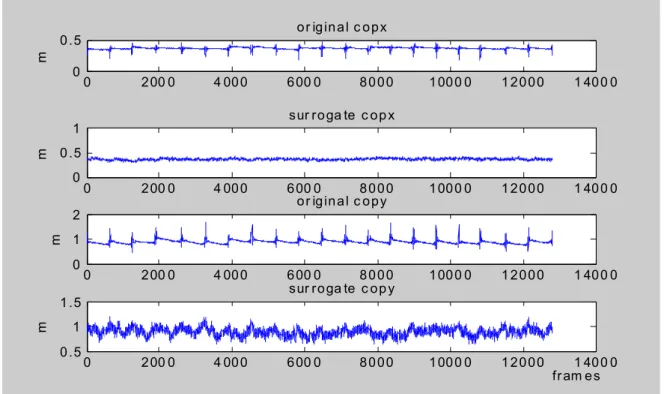
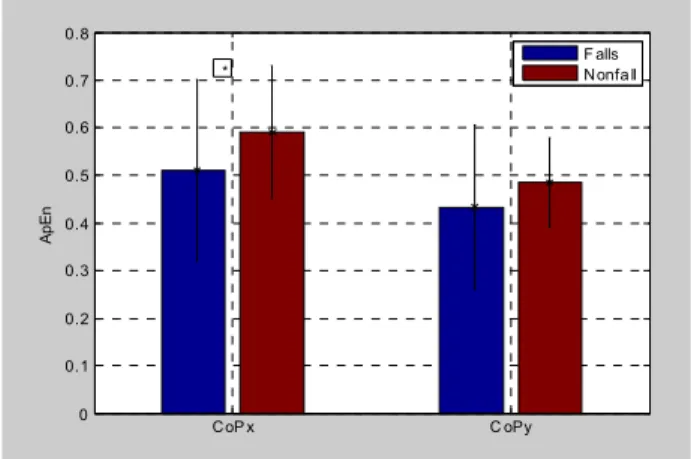
낙상 집단 중 한 개인의 보행 20 스트라이드에 대한 CoPx, CoPy와 이들의 surrogate 자료는 (Figure 1)과 같다. 이때, 낙상 집단과 비 낙상 집단의 보행 시 CoP 자료의 비선형 결정론을 판단하기 위해 적용된 surrogate method을 통해 생성된 자료 와 CoP의 원자료에 대한 ApEn 값과 이들의 통계적 결과는 (Table 1, Figure 2)와 같다. 또한 CoP 원자료에 대한 ApEn 값과 이들의 낙상자 집단과 비 낙상자 집단 간 통계적 검증 결과는 (Table 2, Figure 3)과 같다.
각 개인의 CoP에 대한 원 자료의 ApEn 값과 이들 원자료에 대한 surrogate counterparts의 ApEn 값을 비교한 결과 원자 료에 대한 ApEn 값이 낙상 집단과 비 낙상 집단 모두 유의하 게 작은 값을 보였다. 낙상 집단의 경우 CoPx는 surrogation 후 ApEn 중앙 값이 248%, CoPy는 260% 증가하였다. 비 낙상 집단의 경우에는 CoPx와 CoPy의 ApEn 값이 각각 197%, 220%
증가하였다.
낙상 집단과 비 낙상 집단의 CoP의 복잡성 지표인 ApEn를 분석한 결과 CoPx가 낙상 집단이 비 낙상 집단보다 중앙차 값 이 16% 정도 적은 수치를 보여 집단 간 유의한 차이를 보였 다(
p
=.044). 그러나 CoPy의 ApEn 값은 역시 낙상 집단이 비 낙상 집단보다 중간 값이 약 12% 정도 적은 값을 보였지만 통계적으로 유의한 차이는 보이지 않았다.Table 1. ApEn in original CoP and their surrogate data and statistic results between fallers and non-fallers
Fallers Non-Fallers
CoPx CoPy CoPx CoPy
Orig. Surro. Orig. Surro. Orig. Surro. Orig. Surro.
Median 0.510 1.779 0.434 1.5639 0.591 1.757 0.485 1.555
IQR 0.192 0.2466 0.174 0.3139 0.139 0.3890 0.094 0.4033
p
.001 .001 .001 .001IQR: Iinterquartile range
Table 2. ApEn values of CoP between fall and non-fall groups and their statistic test results
CoPx CoPy
Fallers Nonfallers Fallers Nonfallers Median .510 .591 .434 .485
IQR .192 .139 .174 .094
p
.044 .409IQR: Iinterquartile range
0 2 00 0 4 00 0 6 00 0 8 0 0 0 1 00 0 0 1 2 0 0 0 1 40 0 0
0 0 .5
1 sur r o ga te c o p x
m
0 2 00 0 4 00 0 6 00 0 8 0 0 0 1 00 0 0 1 2 0 0 0 1 40 0 0
0 1 2
o r ig in a l c o p y
m
0 2 00 0 4 00 0 6 00 0 8 0 0 0 1 00 0 0 1 2 0 0 0 1 40 0 0
0 .5 1 1 .5
sur r o ga te c o p y
m
fr am e s
0 2 00 0 4 00 0 6 00 0 8 0 0 0 1 00 0 0 1 2 0 0 0 1 40 0 0
0
0 .5 o r ig in a l c o p x
m
Figure 1. Example of CoP and their surrogate data for an individual of the fall group.
Figure 2. Original CoP and their surrogate data between fallers and non-fallers.
F alls C o P x F a lls C oP y N o n fa lls C o P x N on f a lls C oP y 0
0 . 5 1 1 . 5 2 2 . 5
ApEn
O rig i n S ur r o ga te
* * * *
DISCUSSION
이 연구에서는 보행 시 낙상자 집단과 비 낙상자 집단의 CoP 시계열 자료를 ApEn을 이용해 복잡성을 비교하였다. 두 집단 간 CoP의 복잡성 차이를 규명하기 전에 CoP의 자료가 신경운동 동력학(neuromotor dynamics)의 비선형 특성(Newell, Deutsch, Sosnoff, & Mayer-Kresss, 2006)을 지니고 있는가 보 기 위하여 자료의 Surrogation 과정을 통해 자료를 생성한 후 ApEn를 산출해 원 CoP 자료의 ApEn과 비교하였다. 낙상과 비 낙상 집단의 CoPx, CoPy 모두 원 시계열 자료와 surrogate 자 료 사이의 ApEn 값은 유의한 차이를 보였다. 따라서 본 연구 CoP 자료는 노이즈 뿐만 아니라 신경 근골격계의 조직(neuro- musculo-skeletal system)에 대한 기능적 정보를 가지고 있는 것으로 판단된다(Preatoni et al., 2014). 이와 같은 판단은 CoP 시계열 자료를 최대 Lyapunov 지수 추정을 통해 CoP 운동은 케오틱(비선형)이라고 제안한 Yamada (1995)의 주장과 일치하 며, 또한 surrogate로 생성된 자료의 복잡성 증가율은 선행 연 구들의 결과와 일치하였다(Preatoni et al., 2014; Newell et al., 2006).
압력중심(COP)의 가변성은 안정성을 떨어뜨리고 노인의 경 우 낙상 위험이 높다는 연구들이 있다(Maki et al., 1994; Yoon, 2016). Melzer et al. (2004)들은 좁은 스탠스 상황에서 좌우 CoP 변위가 큰 노인들은 그렇지 않은 노인들보다 3배 가량 낙상을 유발할 가능성이 크다고 주장하였다. CoP는 그 동안 낙상을 예측하는 변인으로 활용되었다.
본 연구는 보행 시 낙상자들과 비 낙상자들 간의 CoP 복잡 성을 비교하기 위해 ApEn을 살펴본 결과 전후 CoP는 유의한 차이를 보이지 않았지만, 좌우 CoP는 두 집단 간 유의한 차이 를 보였다. 즉 낙상 집단이 복잡성이 낮은(규칙성이 높음) 경 향을 보였다. 복잡성의 상실은 적응 능력의 감소와 관련 있다
는 선행 연구(Goldberger, 1996)를 토대로 판단할 때 낙상 집 단은 보행 환경에 대한 적응력과 적응에 대한 유연성이 낮아 낙상을 경험한 것으로 판단된다(Lipsitz, 2002; Preatoni et al., 2014; Ryu, 2014). 즉 보행 시 새로운 운동 환경을 익히고, 실 제 운동 수행에 필요한 적당한 패턴을 점진적으로 선정해 외 부 환경에 대처할 수 있는 능력 부족으로 적응에 한계가 있어 (Preatoni et al., 2010) 움직임이 원활하지 않다고 판단된다.
시스템의 복잡성 상실은 시스템을 구성하는 개별 구조 성분의 감소 혹은 성분 내 커플링의 변경이라 할 수 있다 (Vaillancourt & Newell, 2002; Lipsitz, 2002). 이에 낙상은 세포, 운동 단위, 근 등의 자유도 감소와 이들 사이의 커플링 손실을 가중시킨다고 판단된다(Vaillancourt & Newell, 2002). CoP의 변화는 전신 CoM 운동에 대한 중추신경계의 반응을 반영한 다. 즉 CoP는 균형성 위치에 신체중심을 유지시키기 위한 발 생되는 힘으로 기술(Patterson, Papa, Knebl, & Bugnariu, 2018) 되기 때문에 움직임 시 CoP에 영향을 주는 요인들은 다양할 수 있다.
몇몇 연구에서는 보행 시 발목의 과 회내의 움직임 동안에 후족부가 지면과 접촉 간에 발생하는 형태의 영향을 받으므로 이동 안정성 평가에서 CoP의 변화를 보기 위해서는 발목의 변 화 분석이 중요하다고 하였다(Nigg, 1986; Zachazewski, Magee, Quillen, & Saunders, 1998). Wolfson, Judge, Whipple, & King (1995)과 Whipple, Wolfson, & Amerman (1987)은 낙상자들의 무릎과 발목 근력은 비 낙상자들보다 유의하게 낮은 것으로 보고하였으며, 특히 발목은 가장 크게 감소한 것으로 보고하 였다. 따라서 보행 시 안정성과 관련 있는 좌우 CoP의 복잡성 을 높이기 위해서는 발목 움직임에 영향을 미치는 근 등을 강 화할 필요가 있다고 판단된다. 본 연구 결과 낙상 경험 집단이 좌우 CoP의 복잡성이 낮은 것은 신경성 환자들이 보행속도가 정상인보다 낮음에도 신체의 국부적 복잡성이 낮아(주기성이 높음) 잠재적 부상 유발이 크다는 선행 연구 결과(Dingwell &
Cusumano, 2000; Ryu, 2014)와 직립 상태에서 파키슨 환자들 의 CoP 변동은 건강한 노인들에 비해 더 예측가능하고 덜 복 잡하다고 보고한(Schmit et al., 2006) 내용과 같은 맥락이라 할 수 있다.
CONCLUSION
본 연구 결과를 바탕으로 노인 보행 시 좌우 CoP의 복잡성 감소는 잠재적 낙상을 판단하는 지표로 활용하기에 충분하다 고 판단된다. 향후 본 연구와 관련된 후속 연구를 수행할 때는 스트라이드 길이, 스트라이드 율의 시공간적 복잡성을 조사할 필요성이 요구되며, 또한 복잡성 감소의 원인을 찾기 위한 실 증적 연구의 필요성을 제언한다.
C oP x C oPy
0 0.1 0.2 0.3 0.4 0.5 0.6 0.7 0.8
ApEn
F alls N onfa ll
*
Figure 3. ApEn values of CoP between fall and non-fall groups.
REFERENCES
Bergland, A., Jarnlo, G. B. & Laake, K. (2003). Predictor of falls in the elderly by location.
Aging Clinical Experimental Research
,15
, 43-50.Buzzi, U. H., Stergiou, N., Kurz, M. J., Hageman, P. A. & Heidel, J.
(2003). Nonlinear dynamics indicates aging affects variability during gait.
Clinical Biomechanics
,18
, 435-443.Collins, J. J. & De Luca, C. J. (1995). The effects of visual input on open-loop and closed-loop postural control mechanisms.
Experimental Brain Research
,103
(1), 151-163.Costa, M. & Peng, C. K., Goldberger, A. L. & Hausdorff, J. M.
(2003). Multiscale entropy analysis of human gait dynamics.
Physica A
,330
, 53-60.Dingwell J. B. & Cusumano, J. P. (2000). Nonlinear time series analysis of normal and pathological human walking.
Chaos
,10
(4), 848-863.Ferine, G. R., Gryfe, C. I., Holiday, P. J. & Liewellyn, A. (1982). The relationship of postural sway in standing to the incidence of falls in geriatric subjects.
Age and Aging
,11
(1), 11-16.Gauchard, G. C., Gangloff, P. Jeanel, C. & Perrin, P. P. (2003).
Physical activity improve gaze and posture control in the elderly.
Neuroscience Research
,45
(4), 409-417.Goldberger, A. L. (1996). Nonlinear dynamics for clinicians: chaos theory, fractals, and complexity at the bedside.
Lancet
,347
, 1312-1314.Jeong, J. S. (2001). webzine.kps.or.kr/contents/data/webzine/.../
15124415231.
Johnell, O. & Kanis, J. A. (2006). An estimate of the worldwide prevalence and disability associated with osteoporotic frac- tures.
Osteoporosis International
,17
, 1726-1733.Kantz, H. & Schreiber, S. (1997).
Nonlinear time series analysis
. Cambrige University Press, Cambridge, UK.Kim, I. H. (2008).
Nonlinear dynamical analysis of electroen- cephalogram in adolescents with attention-deficit/hyper- activity disorder during cognitve task
. A dissertation for the degree of doctor science. Graduate school of Kongju National University.Ko, J. H. & Newell, K. M. (2016). Aging and the complexity of center of pressure in static and dynamic postural tasks.
Neuroscience Letters
,610
, 104-109.Lipsitz, L. A. (2002). Dynamics of stability: The physiologic basis of functional health and frailty.
Journals of Gerontology Series A: Biological Sciences and Medical Sciences
,57A
(3), B115-B125.Mahoney, J. E. (1998). Immobility and falls.
Clinics in Geriatric Medicine
,14
, 699-726.Maki, B. E., Holliday, P. J. & Topper, A. K. (1994). A prospective study of postural balance and risk of falling in an ambulatory and independent elderly population.
Journal of Gerontology
,49
, 72-84.Melzer, I., Benjuya, N. & Kaplanski, J. (2004). Postural stability in the elderly: a comparison between fallers and non-fallers.
Age and Ageing
,33
(6), 602-607.Melzer, I. & Oddsson, L. I. (2004). The effect of a cognitive task on voluntary step execution in healthy elderly and young individuals.
Journal of American Geriatrics Society
,52
(8), 1255-1262.Melzer, I., Kurz, I. & Oddsson, L. I. E. (2010). A retrospective analysis of balance control parameters in elderly fallers and non-fallers.
Clinical Biomechanics
,25
, 984-988.Newell, K. M., Deutsch, K. M., Sosnoff, J. J. & Mayer-Kresss, G.
(2006).
Variability in motor output as noise: A default and erroneous proposition? Movement system variability
(pp.3 -23) Champaign, IL: Human Kinetics.Nigg, B. M. (1986).
Biomechanics of running shoes
: Champaign, Ill.: Human Kinetics Publishers.Palmieri, R. M., Ingersoll, C. D., Stone, M. B. & Krause, B. A. (2002).
Center-of-pressure parameters used in the assessment of postural control.
Journal of Sport Rehabilitation
,11
(1), 51 -66.Patterson, R., Papa, E., Knebl, J. & Bugnariu, N. (2018). Evaluation of a more sensitive measure for prediction of changes in dynamic postural stability and fall risk.
Proceeding of 8th World Congress of Biomechanics
. www.wcb2018.com.Piirtola, M. & Era, P. (2006). Force platform measurements as predictors of falls among older people.
Gerontology
,52
(1), 1-16.Pincus, S. M. (1991). Approximate entropy as a measure of system complexity.
Proceedings of the National Academy of Sciences of the United States of America
,88
, 2297-2301.Preatoni, E., Ferrario, M., Dona, G., Hamill, J. & Rodano, R. (2010).
Motor variability in sports: A non-linear analysis of race walking.
Journal of sports Sciences
,28
(12), 1327-1336.Preatoni, E., Hamill, J., Harrison, A. J., Hayes, K., Emmerik, V. R., Wilson, C. & Rodano, R. (2014). Movement variability and skills monitoring in sports.
Sports Biomechanics
,12
(2), 69 -92.Rao, S. S. (2005). Prevention of falls in older patients.
American
Family Physician
,72
, 81-88.Ryu, J. S. (2006). The elderly's coupling pattern between the foot and the tibia and its variability during walking.
The Korean Journal of Physical Education
,45
(1), 747-756.Ryu, J. S. (2008). Dynamic stability analysis of patients with degenerative osteoarthritise during walking.
Korean Journal of Sport Biomechanics
,18
(1), 21-30.Ryu, J. S., Yoo, S. H., Park, S. K. & Yoon, S. H. (2012). Com- parisons between Skilled and Less-Skilled Players' Balance in Hakdariseogi.
Korean Journal of Sport Biomechanics
,22
(1), 55-63.Ryu, J. S. (2014). Variability of GRF components between increa- sed running times during prolonged run.
Korean Journal of Sport Biomechanics
,24
(4), 359-365.Schmit, J. M., Riley, M. A., Dalvi, A., Sahay, P. K. & Shockley, K. D.
(2006). Deterministic center of pressure patterns characterize postural instability in Parkinson's disease.
Experimental Brain Research
,168
, 357-367.Schreiber, T. & Schmitz, A. (2000). Surrogate time series.
Physical Review Letters
,142
, 346-382.Seigle, B., Ramdani, S. & Bernard, P. L. (2009). Dynamical struc- ture of center of pressure fluctuations in elderly people.
Gait
& Posture, 30
, 223-226.Stel, V. S., Smit, J. H., Pluijm, S. M. & Lips, P. (2003) Balance and mobility performance as treatable risk factors for recurrent falling in older persons.
Journal of Clinical Epidemiology
,56
, 659-668.Stergiou, N. (2004). Innovative analyses of human movement,
Human Kinetics
, 76-84.Stevens, J. A., Ballesteros, M. F., Mack, K. A., Rudd, R. A., DeCaro, E. & Adler, G. (2012). Gender difference in seeking care for falls in the aged Medicare population.
American Journal of Preventive Medicine
,43
, 59-62.Teasdale, N. & Simoneau, M. (2001). Attentional demands for postural control: the effects of aging and sensory reintegra- tion.
Gait & Posture
,14
, 203-210.Theiler, J., Eubank, S., Longtin, A., Galdrikian, B. & Farmer, J. D.
(1992). Testing for nonlinearity in time series: The method of surrogate data.
Physica A
,D58
, 77-94.Tinetti, M. E. & Speechley, M. (1989). Prevention of the falls among the elderly.
The New England Journal of Medicine
,320
(16), 1055-1059.Vaillancourt, D. E. & Newell, K. M. (2002). Changing complexity in human behavior and physiology through aging and disease.
Neurobiology of Aging
,23
, 1-11.Whipple, R. H., Wolfson, L. I. & Amerman, P. M. (1987). The relationship of knee and ankle weakness to falls in nursing home residents: an isokinetic study.
Journal of the American Geriatrics Society
,35
, 13-20.Wolfson, L., Judge, J., Whipple, R. & King, M. (1995). Strength is major factor in balance, gait, and the occurrence of falls.
Journals of Gerontology Series A: Biological Sciences and Medical Sciences
,50
, 64-67.Wolgson, L., Whipple, R., Derby, C. A., Amerman, P., Murphy, T., Tobin, N. J. & Nashner, L. A. (1992). A dynamic posturo- graphy study of balance in healthy elderly.
Neurology
,42
(11), 2069-2075.Yamada, N. (1995). Chaotic swaying of the upright posture.
Human Movement Science
,14
, 711-726.Yoon, S. T. (2016). Effect of body weights and Wearing Positions of Bag on Stance time and COP Variables during Level Walking.
Journal of Marine Sport Studies
,6
(2), 1-7.Zachazewski, J., Magee, D. J., Quillen, W. S. & Saunders, W. B.
(1998). Athletic Injuries and Rehabilitation.