Rice occupies the largest areas worldwide and is one of the most important food crops, for over one-half of the world population, especially in Asian countries (Singh et al., 2005).
However, rice consumption has been continuously decreasing due to westernization of the eating habits of Koreans (Mo et al., 2013). The reported average South Korean per capita rice consumption was 69.8 kg in 2012 and 60.8 kg in 2017 (Statistics Korea, 2017). Therefore, to expand the consumption of rice, processed foods which use wheat flour as a main ingredient are to be substituted by rice flour (Mo et al., 2013).
Rice flour is generally made through the wet-milling method (Suksomboon & Naivikul, 2006), but it leads to the generation a large amount of wastewater (Yeh, 2004).
On the other hand, in the dry-milling method, cleaned rice grains can be directly ground to obtain rice flour. Moreover, no soaking is necessary in the dry-milling method, which is relatively simple and has a lower production cost compared to the wet-milling method. Given the considerable
differences in the milling costs between dry and wet milling, the production of rice flour via dry milling using the most suitable rice varieties would significantly reduce the milling costs and promote the profits and overall development of the processed rice food industry (Kwak et al., 2017). The viviparous germination of rice flour varieties production has been reported to be disadvantageous due to long rainy periods, which results in lower rice yield and quality. Viviparous germination is induced and completed 30-35 days after the heading stage at an above-ground average temperature of 20°C for three days and affects negatively seed vigor, germination percentage and seedling emergence rate (Shon et al., 2014). The economic losses accrued are heavy because of the down-gradation of rice quality (Mohapatra & Kariali, 2016). Thus, to ensure the resources needed for mass consumption of rice flour by stable production, the development of rice flour varieties suitable for dry milling with low viviparous germination is necessary. Recently, exceedingly limited research exists
Influence of Different Transplanting Dates on Amylopectin Branch-chain-length and Pasting Properties of Rice Flour Varieties
Chae-Min Han
1,†, Jong-Hee Shin
1, Sang-Kuk Kim
1, Tae-Young Kwon
1, and Jong-Sang KIM
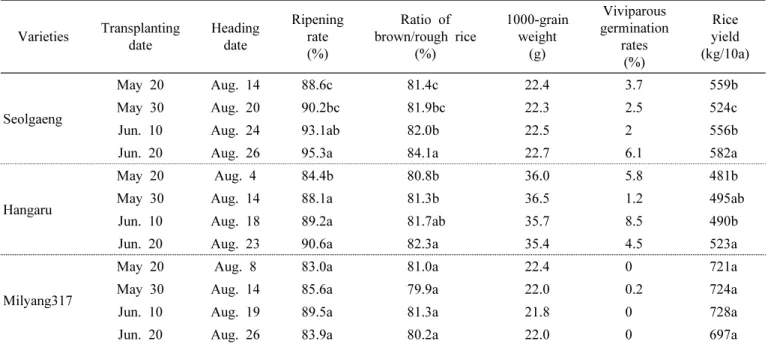
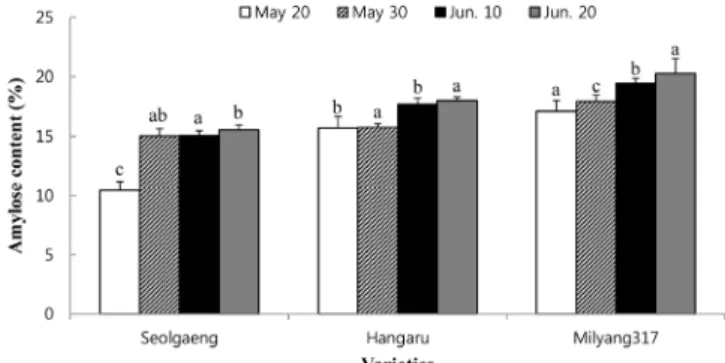
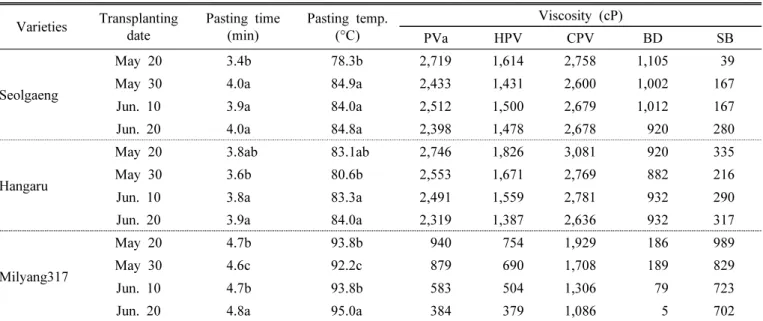
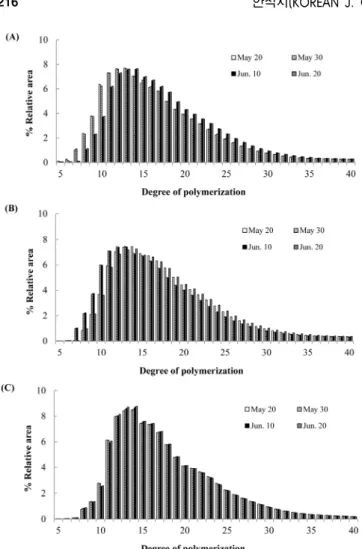
2ABSTRACT This study was conducted to examine the influence of different transplanting dates on rice quality and starch properties (morphology and pasting properties) of rice varieties that may be used for the production of rice flour. Three rice flour varieties, ‘Seolgaeng’, ‘Hangaru’, and ‘Milyang317’, were transplanted on May 20, May 30, June 10, and June 20. The peak viscosity decreased with a delay in the transplanting date. However, the amylose content increased with a delay in the transplanting date, whereas that of protein decreased. Amylopectin short-branch chain content increased in the rice varieties that were transplanted on May 30. The morphology of the starch granule of the varieties was determined by SEM. No apparent external difference in the starch granules was observed for the different transplanting dates. These results indicate that the transplanting date influenced the amylopectin structure and pasting properties, which led to changes in the physicochemical characteristics of rice starch.
Keywords : amylopectin structure, rice, rice flour, transplanting date
DOI : https://doi.org/10.7740/kjcs.2018.63.3.210Original Research Article
ⓒ 본 학회지의 저작권은 한국작물학회지에 있으며, 이의 무단전재나 복제를 금합니다.
This is an Open-Access article distributed under the terms of the Creative Commons Attribution Non-Commercial License (http://creativecommons.org/licenses/by-nc/3.0) which permits unrestricted non-commercial use, distribution, and reproduction in any medium, provided the original work is properly cited.
1)
Division of Crops Research, Gyeongsangbuk-do Provincial Agricultural Research & Extension Services, Daegu 41404, Korea
2)
Major in Food Biomaterials, School of Food Science & Biotechnology, Kyungpook National University, Daegu 41566, Korea
†