• 검색 결과가 없습니다.

Effects of Proprioceptive Neuromuscular Facilitation Exercise on Forced Expiratory Volume at One Second, Pain, and Functional Disability Index of Chronic Low Back Pain Patients

N/A
N/A
Protected

Academic year: 2021

Share "Effects of Proprioceptive Neuromuscular Facilitation Exercise on Forced Expiratory Volume at One Second, Pain, and Functional Disability Index of Chronic Low Back Pain Patients"

Copied!
9
0
0

로드 중.... (전체 텍스트 보기)

전체 글

(1)

| Abstract |

Purpose: This study investigates how abdominal muscular exercise based on proprioceptive neuromuscular facilitation (PNF) can affect chronic low back pain patients in terms of their pulmonary function, pain, and functional disability indexes.

Methods: Fourteen target subjects with chronic low back were randomly assigned to the control group (n = 7) that performed abdominal muscle exercises and the experimental group (n = 7) that performed PNF abdominal muscular exercises. The exercises were performed five times a week for six weeks. To check the change in pulmonary function, the forced expiratory volume at one second (FEV1) and visible analogue scale (VAS) were measured to check the pain level. The disability level caused by back pain was measured by the Oswestry Disability Index (ODI). A paired t-test was applied to compare the differences between the groups before and after the intervention, and an independent t-test was used to compare the differences between the groups. The level of statistical significance was set as α = 0.05.

Results: Before and after the intervention, the experimental group showed a significant change in FEV1 (p < 0.01), and both the experimental and the control groups showed significant changes in VAS and ODI (p < 0.01). A comparison of the differences between the groups indicated that the experimental group showed more significant changes in FEV1 (p < 0.05).

Conclusion: According to the study results, PNF abdominal muscular exercise effectively improved pulmonary function, pain, and functional disability indexes in subjects with chronic back pain. The proposed program can be applied to chronic back pain patients as a useful therapy.

†Corresponding Author : Beom-Ryong Kim ([email protected]) PNF and Movement, 2016; 14(3): 185-193

https://doi.org/10.21598/JKPNFA.2016.14.3.185

Print ISSN: 2508-6227 Online ISSN: 2508-6472

Original Article Open Access

고유수용성신경근촉진법 운동이 만성허리통증환자의 1초간 노력성 날숨량과 통증 및 기능장애지수에 미치는 영향

봉순녕⋅김용정

1

⋅강미경

1

⋅김범룡

1†3)

서남대학교 대학원,

1

대자인병원 재활센터

Effects of Proprioceptive Neuromuscular Facilitation Exercise on Forced Expiratory Volume at One Second, Pain, and Functional Disability Index of Chronic Low Back Pain Patients

Soon-Young Bong⋅Yong-Jeong Kim

1

⋅Mi-Gyeong Kang

1

⋅Beom-Ryong Kim

1†

Department of Physical Therapy, Graduate School of Seonam University

1
Department of Physical Therapy, Design Hospital

Received: October 24, 2016 / Revised: November 16, 2016 / Accepted: November 16, 2016

ⓒ 2016 Journal of Korea Proprioceptive Neuromuscular Facilitation Association

This is an Open Access article distributed under the terms of the Creative Commons Attribution Non-Commercial License

(http://creativecommons.org/licenses/by-nc/3.0) which permits unrestricted non-commercial use, distribution, and reproduction

in any medium, provided the original work is properly cited.

(2)

ԹՀԾ ք ՘ՖՎԨթնլԨՕշվխյխնռԨ┚ԹԼઊԨ┚Ի㌶

Key Words: Low back pain, Oswestry disability index (ODI), Proprioceptive neuromuscular facilitation (PNF), Pulmonary function, Visible analogue scale (VAS)

Ⅰ. 서 론

현대인의 대표적 근골격계 질환 중 하나가 허리통 증 (low back pain)으로 유병률은 약 60∼90%에 이르며, 전 인류의 80%가 적어도 한번 이상은 허리통증을 경 험하게 된다 (O’Sullivan, 2000). 이중에 완전히 회복되 지 않은 15%정도의 사람들이 만성허리통증을 겪는다 (Lee et al., 2014). 허리통증은 잘못된 생활양식으로 허리에 무리한 힘과 지나친 긴장이 유발되어 발생된 다 . 특히 몸통의 안정화를 담당하는 근력 약화를 중재 하는 것은 허리통증환자의 신체 기능 회복에 있어 중 요한 문제로 제시되고 있다(Kang & Choi, 2013).

허리안정화를 담당하고 있는 심부근육은 배가로근 (transverse abdominis), 배속빗근(internal oblique abdominis), 배바깥빗근(external oblique abdominis) 그리고 뭇갈래 근 (multifidus)과 같이 몸 속 깊이 위치하여 척추의 분절 적 안정성(segmental stability)을 높여주는 근육이 있으 며, 대근육으로는 배곧은근(rectus abdominis)이나 척 추세움근(erector spinae)과 같이 몸의 겉에 위치하여 힘과 토크를 발생시키는 근육이 있다(Panjabi et al., 1989). Lee 등(2001)은 산업체 현장에서 허리통증과 관련된 다양한 원인을 연구하였는데, 만성허리통증과 관련된 사람들이 복부근육의 약화와 높은 관련성이 있는 것으로 보고하였고, Nourbakhsh와 Arab (2002)의 연구에서도 복부근육의 약화는 허리통증과 관련이 있 다는 결과를 보고 하였다. 이와 같이 허리주위 근육 중 복부근육의 약화는 허리통증의 원인임을 알 수 있 으며, 복부근육의 약화는 골반전만경사와 허리부분의 전만을 증가시켜 허리통증을 유발할 수 있다(Rone- Adams, 2004). 또한 복부근육의 수축은 복강 내 압력을 증가시켜, 가로막의 상승으로 공기를 체외로 배출시 키며 , 기도 청결을 위한 기침동작 시에도 복부근육의

수축이 필요한데 , 만성허리통증환자는 복부근육의 약 화로 어려움 있다 (Bach et al., 1993). Lee 등(2008)은 만성허리통증환자를 대상으로 1초간 노력성 날숨량 과 복부근육의 근활성도를 측정한 결과 정상성인에 비해 낮았으며 , 허리안정화운동을 실시한 결과 폐 기 능과 복부근육의 근활성도의 유의한 향상과 함께 통 증의 감소를 보였다.

일반적으로 복부근육을 강화시키기 위해서 다양한 기구와 도구들을 이용한 윗몸일으키기 운동이 적용되 고 있다(Hildenbrand & Noble, 2004). 이와 같은 운동방 법이 복부근육을 강화시키는데 도움이 될 수 있지만 과도하게 몸통을 구부리는 운동은 골다공증으로 인한 척추 압박 골절 (Ralston et al., 1990), 척추 내 압력 증가로 인한 디스크탈출(Nachemson, 1981) 등의 문제를 발생 시킬 수 있다. 하지만 고유수용성신경근촉진법 (proprioceptive neuromuscular facilitation, PNF)은 누운 자세 , 옆으로 누운 자세, 앉은 자세 등에서 척추에 높은 부하를 줄이고 , 손상을 예방할 수 있는 중립자세에서 등척성과 등장성 운동을 시행 할 수 있으며 , 팔과 다리 를 이용한 운동이 복부 근육을 간접적으로 활성화 시 킬 수 있다 . 또한 PNF는 근육과 힘줄의 고유수용기를 자극함으로써 기능을 향상시키고, 근력, 지구력, 그리 고 안정성을 증가시키는 치료기법이며, 이 치료기법 의 패턴들은 나선형, 즉 대각선적 패턴으로 이루어지 는데 , 이 때 사용되는 패턴에는 굽힘과 폄, 벌림과 모 음 , 안쪽과 가쪽돌림 요소가 포함되어 보편적으로 실 시되는 단일 면과 단일 방향의 훈련 프로그램보다 근 수행력을 증진시키는데 더 적당하다고 알려져 있다 (Kofotolis et al., 2002).

PNF가 허리통증 치료에 효과적이라고 보고한 선행

연구들을 보면, Jeon과 Lee (2009)는 누운 자세에서

들어올리기(lifting)와 내려치기(chopping)를 실시하여

(3)

৞␞἖⎧ḯ῞঻ૺ⨇⛂ᦓԨ⎲თ⑲Ԩᛊḯ㋆ᚪ⺳⚛㍖⒎⑖ԨԹ⨆ंԨ๶ᔣḯԨඞἦᓇ৺Ԩ⺳⚛ԨᤍԨମྣ⒣≞⚾἖⋎Ԩ᣶⭖ྒԨ⋿㊣ ք ԹՀԿ

통증과 기능장애 및 균형능력에 향상된 경과를 보고 하였고, Kim 등(2012)은 엉덩관절과 무릎관절을 굽힘 자세에서 PNF기법을 적용하여 복부근육 두께와 기능 적 활동에 향상된 결과를 보였으며, Kim 등(2014)은 선 자세에서 PNF 통합패턴을 적용한 결과 통증과 기 능장애 및 공포회피반응에 향상된 결과를 보였다. 이 와 같은 연구들은 허리통증인 근골격계 환자에게 PNF 를 사용하여 중재했다는 점에서 의의가 있지만 , 복부 근육을 강화시킬 수 있는 패턴들을 다양한 자세에서 적용한다면 더욱 효과적인 결과를 얻을 것이라 생각 된다.

이에 본 연구에서는 만성허리통증환자를 대상으로 고유수용성신경근촉진법을 이용한 복부근육 강화운 동이 폐 기능과 통증 및 기능장애지수에 미치는 효과 를 알아보고자 한다.

Ⅱ. 연구 방법

1. 연구기간 및 대상

연구 대상자는 2016년 3월부터 2016년 8월까지 6개 월 간 전라북도 J시 소재 D병원에 내원한 12주 이상의 요통을 호소한 50∼60세 연령범위의 만성허리통증환

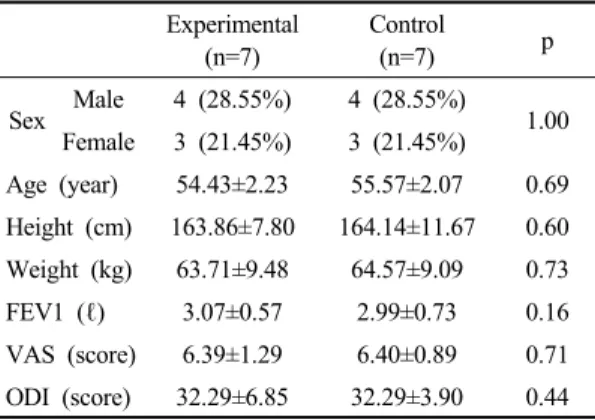
자로 , 급성통증이나 지속적으로 심한통증을 가진 자, 척추분리증이나 전방전위증이 있는 자 , 신경학적으로 감각이상이나 근육마비가 있는 자, 정신적인 문제나 이해력이 부족하여 운동수행 능력이 어려운 자는 연 구대상에서 제외하였으며, 본 연구의 목적을 이해하 고 연구에 참여하기로 동의한 14명을 대상으로 하였 다. 이들을 각각 난수표를 이용하여 뽑혀진 숫자에 의하여 환자를 배정하는 방법으로 복부근육 강화운동 을 실시한 대조군(n=7)과 PNF 복부근육 강화운동을 실시한 실험군 (n=7)으로 무작위 배정하였다(Table 1).

2. 실험 방법

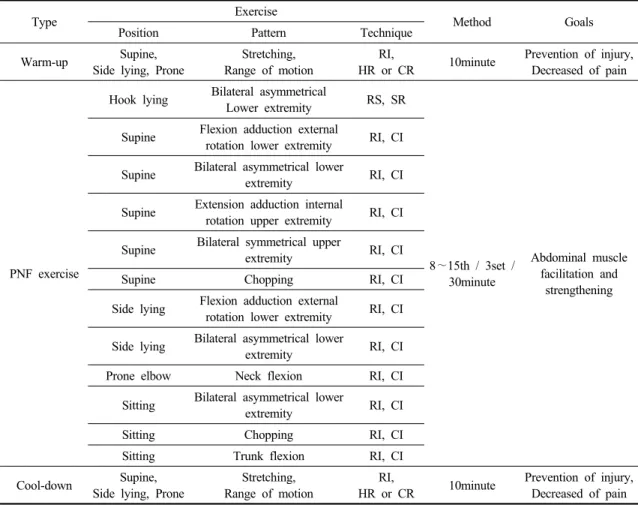
1) PNF 복부근육 강화운동 프로그램

PNF 복부근육 강화운동은 복부근육의 촉진과 강화 를 위하여 다양한 자세에서 환자의 수준에 맞게 패턴과 기법을 활용하여 중재하였다 . 세트 간에는 15∼20초 정 도의 휴식을 취하게 하고 , 빠르게 다음 운동으로 넘어가 게 하였다 . 준비운동 10분, 본 운동 30분, 정리운동 10분 총 50분으로 구성, 주 5회 6주간 시행하였다(Table 2).

2) 복부근육 강화운동 프로그램

복부근육 강화운동은 복부근육의 강화를 위하여 다양한 방법으로 환자의 수준에 맞게 중재하였다.

PNF 복부근육 강화운동 군과 동일하게 세트 간에는 15∼20초 정도의 휴식을 취하게 하고, 빠르게 다음 운동으로 넘어가게 하였다. 또한 준비운동 10분, 본 운동 30분, 정리운동 10분 총 50분으로 구성, 주 5회 6주간 시행하였다(Table 3).

3) 측정항목 및 방법

(1) 1초간 노력성 날숨량 측정

1초간 노력성 날숨량(forced expiratory volume at one second, FEV1) 측정은 폐 기능 검사기(SCHILLER SP-260, Medical Supply Co. Ltd, Switzerland)을 사용하 였다. 측정방법은 대상자에게 검사방법에 대한 충분 Experimental

(n=7)

Control

(n=7) p

Sex Male 4 (28.55%) 4 (28.55%) Female 3 (21.45%) 3 (21.45%) 1.00

Age (year) 54.43±2.23 55.57±2.07 0.69 Height (cm) 163.86±7.80 164.14±11.67 0.60 Weight (kg) 63.71±9.48 64.57±9.09 0.73 FEV1 (ℓ) 3.07±0.57 2.99±0.73 0.16 VAS (score) 6.39±1.29 6.40±0.89 0.71 ODI (score) 32.29±6.85 32.29±3.90 0.44 Values are presented as mean±standard deviation FEV1: forced expiratory volume at one second VAS: visual analogue scale

ODI: Oswestry disability index.

Table 1. General characteristics of study subjects (n=14)

(4)

ԹՀՀ ք ՘ՖՎԨթնլԨՕշվխյխնռԨ┚ԹԼઊԨ┚Ի㌶

한 설명과 측정시범을 통하여 충분한 교육이 이루어 진 상태에서 측정을 실시하였다. 측정지표는 최대 노 력성 날숨을 시작한 후 1초간 내쉰 1초간 노력성 날숨 량을 측정하였다. 폐 기능 검사는 앉은 자세에서 3회 반복 측정하여 평균값을 기록하였다. 검사 재검사 간 신뢰도는 r=0.98이다(Izzo et al., 2016).

(2) 통증의 측정

통증의 정도를 측정하기 위해 시각적 상사척도

(visible analogue scale, VAS)를 이용하여 대상자가 직 접 체크하는 방식을 택하였다 . 통증이 전혀 없는 상태 는 0, 통증이 최대로 있는 상태는 10으로 하여 10개의 구간이 표시된 종이 위에 직접 체크하도록 하였다.

검사 재검사 간 신뢰도는 r=0.96이다(Lingjaerde &

Føreland, 1998).

(3) 기능장애지수 측정

오스웨스트리 허리통증 장애지수 (Oswestry disability

Type Exercise

Method Goals

Position Pattern Technique

Warm-up Supine, Side lying, Prone

Stretching, Range of motion

RI,

HR or CR 10minute Prevention of injury, Decreased of pain

PNF exercise

Hook lying Bilateral asymmetrical

Lower extremity RS, SR

8∼15th / 3set / 30minute

Abdominal muscle facilitation and

strengthening Supine Flexion adduction external

rotation lower extremity RI, CI Supine Bilateral asymmetrical lower

extremity RI, CI Supine Extension adduction internal

rotation upper extremity RI, CI Supine Bilateral symmetrical upper

extremity RI, CI

Supine Chopping RI, CI

Side lying Flexion adduction external

rotation lower extremity RI, CI Side lying Bilateral asymmetrical lower

extremity RI, CI

Prone elbow Neck flexion RI, CI

Sitting Bilateral asymmetrical lower

extremity RI, CI

Sitting Chopping RI, CI

Sitting Trunk flexion RI, CI

Cool-down Supine, Side lying, Prone

Stretching, Range of motion

RI,

HR or CR 10minute Prevention of injury, Decreased of pain RI: rhythmic initiation

CI: combination of isotonics RS: rhythmic stabilization SR: stabilizing reversal HR: hold-relax CR: contract-relax.

Table 2. PNF abdominal muscle strengthening exercise program

(5)

৞␞἖⎧ḯ῞঻ૺ⨇⛂ᦓԨ⎲თ⑲Ԩᛊḯ㋆ᚪ⺳⚛㍖⒎⑖ԨԹ⨆ंԨ๶ᔣḯԨඞἦᓇ৺Ԩ⺳⚛ԨᤍԨମྣ⒣≞⚾἖⋎Ԩ᣶⭖ྒԨ⋿㊣ ք ԹՀՁ

index, ODI)는 허리 통증으로 인한 장애 정도를 평가하 기 위한 것으로 통증 강도, 개인적 관리, 들기, 걷기, 앉아 있기 , 서 있기, 잠자기, 성생활, 사회생활, 여행의 10개 문항으로 각 항목의 수행 능력에 따라 0점에서 5점으로 6가지 단계로 기술한다(Fairbank, 2014). ODI 는 점수가 높을수록 장애가 심한 것을 뜻하며 총 점수 를 답한 항목의 수로 나누고 100을 곱하여 계산한다.

3. 자료 처리

본 연구를 위한 자료처리 방법은 Window용 통계프 로그램 SPSS/PC Statistics 18.0 software (SPSS Inc, Chicago, USA)을 이용하여 통계 처리하였다. 연구대 상자의 일반적인 특성을 백분율과 Shapiro-wilk로 정 규성 검정을 하였고, PNF 복부근육 강화운동에 따른 중재 전과 후의 집단 내 1초간 노력성 날숨량과 통증 및 기능장애지수에 변화를 비교하기 위하여 대응표본 t-검정(paired t-test)을 실시하였으며, 실험군과 대조군 의 집단 간의 차이를 비교하기 위해 독립표본 t-검정

(independent t-test)으로 검정하였다. 모든 통계학적 유 의수준은 α=0.05로 설정하였다.

Ⅲ. 연구 결과

1. 1초간 노력성 날숨량 변화 비교

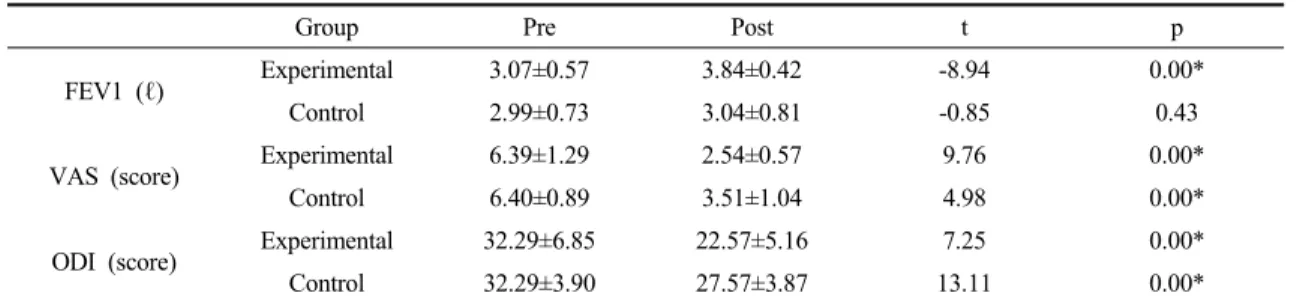
집단 내 1초간 노력성 날숨량(FEV1)의 변화는 실험 군에서 유의한 차이가 있었고(p<0.01), 대조군에서는 유의한 차이가 없었다 (Table 4). 중재 후 집단 간 1초간 노력성 날숨량 (FEV1)의 변화에서는 실험군과 대조군 사이에서 유의한 차이가 있었다(p<0.05)(Table 5).

2. 통증 변화 비교

집단 내 통증(VAS)의 변화는 실험군에서 유의한 차이가 있었고(p<0.01), 대조군에서도 유의한 차이가 있었다(p<0.01)(Table 4). 중재 후 집단 간 통증(VAS)의

Type Exercise

Method Goals

Position Pattern Technique

Warm-up

Supine, Side lying,

Prone

Stretching, Range of motion

Static,

Passive 10minute Prevention of injury, Decreased of pain

Core exercise

Hook lying Drawing-in maneuver Static

8∼15th / 3set / 30minute

Abdominal muscle strengthening

Hook lying Curl up Concentric

Hook lying Oblique curl up Concentric

Hook lying Bicycle Concentric

Hook lying Knee up crunch Concentric

Supine Jackknife Concentric

Hook lying Knee up cross Concentric Hook lying Heel touch Concentric Hook lying Knee touch Concentric

Supine Legs lower Concentric

Side lying Side plank Static

Prone elbow Plank Static

Cool-down

Supine, Side lying,

Prone

Stretching, Range of motion

Static,

Passive 10minute Prevention of injury,

Decreased of pain

Table 3. Abdominal muscle strengthening exercise program

(6)

ԹՁԸ ք ՘ՖՎԨթնլԨՕշվխյխնռԨ┚ԹԼઊԨ┚Ի㌶

변화에서는 실험군과 대조군사이에서 유의한 차이가 없었다(Table 5).

3. 기능장애지수 변화 비교

집단 내 기능장애지수(ODI)의 변화는 실험군에서 유의한 차이가 있었고(p<0.01), 대조군에서도 유의한 차이가 있었다 (p<0.01)(Table 4). 중재 후 집단 간 기능 장애지수(ODI)의 변화에서는 실험군과 대조군사이에 서 유의한 차이가 없었다(Table 5).

Ⅳ. 고 찰

척추 안정성과 만성허리통증사이의 관계는 지난 수십 년에 걸쳐 연구의 초점이 되고 있으며, 만성허리 통증을 개선하기 위한 중재방법 중 몸통안정화운동은 움직임의 조절능력과 근육의 장력을 회복하기 적합하 기 때문에 현재 임상에서 대표적으로 사용되어지고 있다(Lee et al., 2013). 본 연구는 PNF 복부근육 강화운 동이 1초간 노력성 날숨량(FEV1)과 통증(VAS) 및 기

능장애지수(ODI)에 미치는 영향에 대하여 다음과 같 은 논의들을 하고자 한다.

Kim 등(2009)은 만성허리통증을 가지고 있는 환자 의 간병인들을 대상으로 앉은 자세에서 복부근육 강 화운동을 5일간 실시한 결과 VAS의 감소와 FEV1의 유의한 향상을 위해서는 최소 5일 동안의 복부근육 강화운동이 필요하다고 하였으며, Lee (2012)는 20대 여대생을 대상으로 바로 누운 자세와 선 자세에서 복 부근육 수축 유무에 따라 FEV1을 측정한 결과 선 자세 에서 복부근육을 수축시켰을 때 FEV1의 유의한 향상 을 얻었다. 하지만, Yun 등(2013)은 뇌졸중 환자를 대 상으로 복부근육 강화운동을 실시한 결과 대조군에 비해 복부근육 활성도와 폐 기능 검사에서 노력성 폐 활량 (forced vital capacity, FVC)에는 유의한 향상을 보 였지만 , FEV1은 통계적으로 유의한 차이를 얻지 못하 였다. 그러나 뇌졸중 환자를 대상으로 실시한 Kang 등(2015)의 연구에서는 복부근육 강화운동을 실시한 실험군이 몸통 안정성에 초점을 둔 대조군에 비해서 FEV1에서 향상된 결과를 얻었다. 위 선행 연구들에서 알 수 있듯이 폐 기능 특히 FEV1을 향상시키기 위해서

Group Pre Post t p

FEV1 (ℓ) Experimental 3.07±0.57 3.84±0.42 -8.94 0.00*

Control 2.99±0.73 3.04±0.81 -0.85 0.43

VAS (score) Experimental 6.39±1.29 2.54±0.57 9.76 0.00*

Control 6.40±0.89 3.51±1.04 4.98 0.00*

ODI (score) Experimental 32.29±6.85 22.57±5.16 7.25 0.00*

Control 32.29±3.90 27.57±3.87 13.11 0.00*

Values are presented as mean±standard deviation.

*p<0.01.

Table 4. The comparison of variable on pre and post in group

Experimental Control t p

FEV1 (ℓ) 3.84±0.42 3.04±0.81 -2.32 0.04*

VAS (score) 2.54±0.57 3.51±1.04 2.18 0.05

ODI (score) 22.57±5.16 27.57±3.87 2.05 0.06

Values are presented as mean±standard deviation.

*p<0.05.

Table 5. The comparison of changes in variables between post-test in both group

(7)

৞␞἖⎧ḯ῞঻ૺ⨇⛂ᦓԨ⎲თ⑲Ԩᛊḯ㋆ᚪ⺳⚛㍖⒎⑖ԨԹ⨆ंԨ๶ᔣḯԨඞἦᓇ৺Ԩ⺳⚛ԨᤍԨମྣ⒣≞⚾἖⋎Ԩ᣶⭖ྒԨ⋿㊣ ք ԹՁԹ

는 복부근육 강화운동이 필요함을 알 수 있다 . 본 연구 에서도 PNF 복부근육 강화운동을 실시한 실험군에서 FEV1은 중재 전보다 후에 유의하게 개선되었다 (p<0.01). 또한 집단 간 비교에서도 대조군에 비해 PNF 복부근육 강화운동을 실시한 실험군에서 유의한 차이 를 보여(p<0.01), 선행 연구와 같이 운동의 방법에는 다소 차이가 있었지만 복부근육의 촉진과 강화를 위 하여 다양한 자세에서 패턴과 기법을 활용한 PNF 복 부근육 강화운동을 지지하는 결과를 도출할 수 있었 다 . 그 이유는 반복된 PNF 복부근육 강화운동으로 인 해 노력성 날숨근육인 배곧은근, 배바깥빗근, 배속빗 근, 배가로근의 수축력과 근력 증가에 따른 운동조절 과 학습에 의한 효과라 사료된다.

Kim 등(2011)은 20대 초반의 대학생 중 전문의로부 터 허리통증을 진단받은 만성허리통증 환자 34명을 대상으로 주 2회 5주간 허리안정화운동을 실시한 결 과 VAS의 감소에 향상된 결과를 보였고, Lee 등(2012) 은 만성허리통증을 가진 생산직 근로자 40명을 대상 으로 PNF 운동군과 짐볼 운동군으로 무작위 배정하여 주 4회 6주간 중재한 결과 두 운동군에서 VAS가 중재 전과 후 유의한 향상을 보였고, 집단 간 비교에서는 2주, 4주에는 PNF 운동군과 짐볼 운동군 간에 유의한 차이가 없었지만 중재 6주 때부터 짐볼 운동군에 비해 PNF 운동군에서 유의한 향상을 보였으며, Kang과 Park(2013)은 외래 허리통증환자 14명을 대상으로 주 3회 8주간 PNF의 압축(approximation)활용한 허리안정 화운동을 실시한 결과 중재전과 후에 VAS가 유의한 향상을 보였다. 본 연구에서는 PNF 복부근육 강화운 동을 실시한 실험군과 복부근육 강화운동을 실시한 대조군에서 VAS은 중재 전보다 후에 유의하게 개선 되었다(p<0.01). 그러나 집단 간 비교에서는 대조군에 비해 PNF 복부근육 강화운동을 실시한 실험군에서 유의한 차이를 보이지 않았다. 이와 같은 결과는 두 군의 복부근육 강화운동을 통한 복부근육의 활성화는 골반전만경사와 허리부분의 전만 감소로 인해 척추에 가해지는 부하를 줄여주어 통증이 경감된 것으로 사 료된다.

Jeon과 Lee (2009)는 만성허리통증환자 30명을 대상 으로 주 3회 6주간 PNF의 내려치기와 들어올리기 패 턴운동을 실시한 PNF 운동군에서 ODI가 중재 전⋅후 와 집단 간 비교에서 모두 유의한 향상을 보였고, Kim 등(2011)은 만성허리통증환자 30명을 대상으로 대조 군Ⅰ , 일반적 허리주위 안정화 운동군Ⅱ, PNF 기법을 활용한 허리주위 안정화 운동군Ⅲ으로 무작위 배정하 여 주 5회 4주간 중재한 결과 운동군Ⅱ⋅Ⅲ에서 ODI 가 중재 전과 후 유의한 향상을 보였고, 사후검정에서 대조군과 운동군Ⅱ⋅Ⅲ에서 유의한 차이가 있었으며 , Kim 등(2014)은 만성허리통증을 진단 받은 환자 24명 을 대상으로 주 5회 6주간 PNF의 스프린터(Sprinter)와 스케이트(skater) 운동을 실시한 PNF 운동군에서 ODI 가 중재 전⋅후와 집단 간 비교에서 모두 유의한 향상 을 보였다 . 본 연구에서는 PNF 복부근육 강화운동을 실시한 실험군과 복부근육 강화운동을 실시한 대조군 에서 ODI은 중재 전보다 후에 유의하게 개선되었다 (p<0.01). 그러나 집단 간 비교에서는 대조군에 비해 PNF 복부근육 강화운동을 실시한 실험군에서 유의한 차이를 보이지 않았다 . 이와 같은 결과는 두 군의 복부 근육 강화운동이 심부 안정근육을 강화시키고 복부근 육의 기능 회복에 영향을 미침으로써 척추의 주변조 직과 관절낭, 인대 등의 통증 수용조직 자극전달을 감소시키는 작용을 하여 통증을 동반한 허리통증기능 장애에 효과적인 것을 알 수 있다 (Kisner & Colby, 2002).

본 연구의 PNF 복부근육 강화운동은 노력성 날숨

근육인 복부근육 강화로 1초간 노력성 날숨량을 높이

는데 효과적이었고, 능동적 수축으로 인해 복부근육

의 근력향상은 몸의 안정성이 강화된 요소로써 허리

통증을 완화시킬 뿐만 아니라 반복되는 재발을 막고 ,

허리통증 예방을 하는데 매우 중요한 요소임을 확인

하였으며, 이러한 결과를 바탕으로 향후에도 임상에

서 PNF을 활용한 복부근육을 강화하기 위한 꾸준한

연구가 필요할 것으로 사료된다.

(8)

ԹՁԺ ք ՘ՖՎԨթնլԨՕշվխյխնռԨ┚ԹԼઊԨ┚Ի㌶

Ⅴ. 결 론

본 연구는 만성허리통증을 호소하는 대상자에게 고유수용성신경근촉진법을 이용한 복부근육 강화운 동과 일반적 복부근육 강화운동을 적용한 결과 폐 기 능 향상과 통증 감소 및 기능장애지수에 효과가 있었 다. 하지만 집단 간 비교에서는 대조군에 비해 PNF 복부근육 강화운동을 실시한 실험군에서 폐 기능은 향상이 있었지만, 통증 감소와 기능장애지수에서 향 상을 보이지 않았다. 따라서 만성허리통증환자에게 일반적으로 적용되는 복부근육 강화운동도 좋지만 폐 기능의 향상까지도 고려한다면 PNF 복부근육 강화운 동을 유용하게 적용할 수 있을 것으로 여겨진다.

References

Bach JR, Smith WH, Michaels J, et al. Airway secretion clearance by mechanical exsufflation for post-poliomyelitis ventilator-assisted individuals. Archives of Physical Medicine and Rehabilitation. 1993;74(2):170-177.

Fairbank JC. Oswestry disability index. Journal of Neurosurgery Spine. 2014;20(2):239-241.

Hildenbrand K, Noble L. Abdominal muscle activity while performing trunk-flexion exercises using the Ab roller, ABslide, FitBall, and conventionally performed trunk curls. Journal of athletic training. 2004;39(1):37-43.

Izzo A, Perrotta F, Cennamo A, et al. Spirometry in elderly laryngectomized patients: a feasibility study.

International Journal of Surgery. 2016;33(1):4-8.

Jeon HJ, Lee MH. The effects of PNF technique versus trunk exercise program on the pain, disability, and balance in chronic LBP patients. The Korea Contents Association. 2009;9(12):665-673.

Kang JI, Choi H. The effect of pelvic stability exercise program on pain and hip joint of patients with chronic low back pain involving sacroiliac joint pain. Journal

of Digital Convergence. 2013;11(4):331-338.

Kang JI, Kim BR, Park SK, et al. Effects of deep abdominal muscle strengthening exercises on pulmonary function and the ability to balance in stroke patients. The Journal of Korean Physical Therapy. 2015;27(4):

258-263.

Kang TW, Park YS. Effect of sling exercise with PNF basic procedure for pain and balance ability of patients with chronic low back pain. Journal of the Korean Proprioceptive Neuromuscular Facilitation Association.

2013;11(1):1-6.

Kim GD, Lee YJ, Choi WS, et al. Effects of lumbar stabilization exercise using PNF techniques on thickness of lumbar deep muscle and functional activity in chronic low back pain patients. The Korea Contents Association.

2012;12(3):233-243.

Kim GY, Ahn CS, Kim SS. The effects of 3-dimensional lumbar stabilization exercise have an effect on the improvement of pain and static or dynamic balance ability in 20’s age group with low back pain. Journal of the Korean Society of Physical Medicine. 2011;

6(2):235-246.

Kim K, Kim EK, Lee DK. Effects of PNF patterns exercise on pain, functional disability and fear avoidance belief in chronic low back pain patients. The journal of Korean Society of Physical Therapy. 2014;26(2):

110-116.

Kim KS, Kwon OY, Yi CH. Effect of abdominal drawing-In maneuver on peak expiratory flow, forced expiratory volume in 1 second and pain during forced expiratory pulmonary function test in patients with chronic low back pain. Korean Research Society of Physical Therapy. 2009;16(1):10-17.

Kisner C, Colby LA. Therapeutic exercise: foundations and techniques, 4th ed. Philadelphia. F.A. Davis Company.

2002.

Kofotolis N, Vrabas IS, Kalogeropoulou E, et al. Proprioceptive

(9)

৞␞἖⎧ḯ῞঻ૺ⨇⛂ᦓԨ⎲თ⑲Ԩᛊḯ㋆ᚪ⺳⚛㍖⒎⑖ԨԹ⨆ंԨ๶ᔣḯԨඞἦᓇ৺Ԩ⺳⚛ԨᤍԨମྣ⒣≞⚾἖⋎Ԩ᣶⭖ྒԨ⋿㊣ ք ԹՁԻ

neuromuscular facilitation versus isokinetic training for strength, endurance and jumping performance.

Journal of Human Movement Studies. 2002;42 (2):155-165.

Lee BG, Jee YS, Ko IG, et al. Effects of combined exercises of walking and lumber stabilization on pulmonary function and lumbar deep muscles of patients with chronic low back pain. Korean Journal of Health Promotion. 2008;8(3):168-177.

Lee BK. The effect of the forced pulmonary function of young female, by changes in lung function related to postures and by transverse abdominis activation in standing position. Journal of the Korean Society of Physical Medicine. 2012;7(3):267-274.

Lee CW, Kim JS, Lee IS. The effects of combination patterns of proprioceptive neuromuscular facilitation and ball exercise on pain and balance in chronic low back pain patients. Journal of the Korean Society of Physical Medicine. 2012;7(1):1-9.

Lee CW, Kim HS, Lee IS. The effect of horse-riding exercise on the balance ability in the chronic low back pain patients. Journal of The Korean Society of Integrative Medicine. 2014;2(1):101-108.

Lee P, Helewa A, Goldsmith CH, et al. Low back pain: prevalence and risk factors in an industrial setting. The Journal of Rheumatology. 2001;28(2):346-351.

Lee SJ, Lee GC, Bae WS, et al. The effect of transverse abdominal exercise for 3weeks for lumbar muscle strength and pain relief on chronic low back pain patients. Korean Society of Integrative Medicine.

2013;1(3):9-17.

Lingjaerde O, Føreland AR. Direct assessment of improvement in winter depression with a visual analogue scale:

high reliability and validity. Psychiatry Research.

1998;81(3):387-392.

Nachemson AL. Disc pressure measurements. Spine. 1981;

6(1):93-97.

Nourbakhsh MR, Arab AM. Relationship between mechanical factors and incidence of low back pain. The Journal of orthopaedic and sports physical therapy.

2002;32(9):447-460.

O’Sullivan PB. Lumbar segmental ‘instability’: clinical presentation and specific stabilizing exercise management. Manual Therapy. 2000;5(1):2-12.

Panjabi M, Abumi K, Duranceau J, et al. Spinal stability and intersegmental muscle forces. A biomechanical model. Spine. 1989;14(2):194-200.

Ralston SH, Urquhart GD, Brzeski M, et al. Prevalence of vertebral compression fractures due to osteoporosis in ankylosing spondylitis. British Medical Journal.

1990;300(6724):563-565.

Rone-Adams SA, Shamus E, Hileman M. Physical therapists evaluation of the trunk flexors in patients with low back pain. The Internet Journal of Allied Health Sciences and Practice. 2004;2(2):1-9.

Yun JH, Kim TS, Lee BK. The effects of combined complex exercise with abdominal drawing-in maneuver on expiratory abdominal muscles activation and forced pulmonary function for post stroke patients. Journal of the Korean Society of Physical Medicine.

2013;8(4):513-523.

수치

Table 1. General characteristics of study subjects (n=14)
Table 2. PNF abdominal muscle strengthening exercise program
Table 4. The comparison of variable on pre and post in group

참조

관련 문서

Background: The purpose of this study is on finding the effects of the lumbar stabilization exercise applied with the proprioceptive neuromuscular facilitation technique (PNF) to

PURPOSE: The purpose of this study is to examine the effect of proprioceptive neuromuscular facilitation (PNF) neck flexion exercise and the Shaker exercises on the activity of

Purpose: The study aimed to determine the effect of proprioceptive neuromuscular facilitation (PNF) lower trapezius muscle strengthening exercise on pain, cervical range of

Purpose: The study aimed to determine the effect of proprioceptive neuromuscular facilitation (PNF) lower trapezius muscle strengthening exercise on pain, cervical range of

Purpose: This study aims to determine the effect of Jeonbuk tri-pull taping and proprioceptive neuromuscular facilitation (PNF) exercise on the shoulder’s active range of

Purpose: We sought to examine whether using the rhythmic stabilization (RS) technique before proprioceptive neuromuscular facilitation (PNF) wrist taping affected pain

Purpose: The current study aims to identify the effects of proprioceptive neuromuscular facilitation (PNF) on pain and grip strength in patients with cervical

Conclusion: Proprioceptive neuromuscular facilitation exercises have confirmed that lower extremity function improves after exercise interventions in chronic stroke