| Abstract |
Purpose: This study investigated the effects of proprioceptive neuromuscular facilitation (PNF) exercise on the range of motion (ROM), pain, and functional activity of patients who received total knee arthroplasty (TKA). The purpose of this study was to provide fundamental data regarding the use of PNF exercise among patients with musculoskeletal disease.
Methods: Fourteen patients who received TKA were randomly divided into an experimental group (n=7) that took part in PNF exercise and a control group (n=7) that performed general rehabilitation exercise. Both groups performed the respective exercises for 30 minutes, five times a week for 2 weeks. For the measurement of ROM, the range of knee flexion was measured using a clinometer smartphone application. A visual analogue scale (VAS) was used for the measurement of the level of pain. The timed up and go test (TUG) was conducted to measure functional activity. A paired t-test was performed to compare within-group changes before and after the PNF exercise. Differences between the experimental group and control group were analyzed by an independent t-test. For all tests, the level of statistical significance was set at α=0.05.
Results: After the exercise, there was a significant within-group change in VAS and TUG scores in the experimental group and control group (p<0.01). There was also a significant between-group difference in VAS and TUG scores after the intervention (p<0.05).
Conclusion: General rehabilitation exercise is commonly applied as a treatment for TKA patients and is relatively effective.
The application of PNF exercise may be useful in such patients, considering its effects on ROM improvement, pain reduction, and functional enhancement.
†Corresponding Author : Beom-Ryong Kim ([email protected])
Original Article Open Access
고유수용성신경근촉진법 운동이 무릎관절 전치환술환자의 관절가동범위와 통증 및 기능적 활동에 미치는 영향
김창헌⋅강태우
1⋅김범룡
†1)대자인병원 재활센터
1
원광대학교병원 물리치료실
The Effect of Proprioceptive Neuromuscular Facilitation Exercise on the Range of Motion, Pain, and Functional Activity of Total Knee Arthroplasty Patients
Chang-Heon Kim⋅Tae-Woo Kang
1⋅Beom-Ryong Kim
†Department of Physical Therapy, Design Hospital
1
Department of Physical Therapy, Wonkwang University Hospital
Received: January 3, 2018 / Revised: February 9, 2018 / Accepted: February 9, 2018
ⓒ 2018 Journal of Korea Proprioceptive Neuromuscular Facilitation Association
This is an Open Access article distributed under the terms of the Creative Commons Attribution Non-Commercial License
(http://creativecommons.org/licenses/by-nc/3.0) which permits unrestricted non-commercial use, distribution, and reproduction
in any medium, provided the original work is properly cited.
Key Words: Functional activity, Proprioceptive neuromuscular facilitation (PNF), Range of motion (ROM), Total knee arthroplasty (TKA), Visible analogue scale (VAS)
Ⅰ. 서 론
오랫동안 무릎통증으로 고통 받은 무릎관절염 (knee osteoarthritis) 환자에게 일반적으로 시행되는 무 릎관절 전치환술(total knee arthroplasty)에서 중요한 목 표는 통증 감소와 무릎관절 가동범위(range of motion, ROM)의 회복이다. 선행연구에 따르면 무릎관절 전치 환술 후 통증과 넙다리네갈래근의 기능장애로 인해 무릎관절 가동범위가 무릎관절 전치환술 후 약 1개월 동안 일시적으로 감소를 보였으며, 무릎관절 가동범 위 감소가 환자의 기능적 활동과 만족도 감소에 유의 한 상관관계가 있음을 보고하였다(Mizner et al., 2005;
Zhou et al., 2015). 현재 수술을 통해서 얻은 수동적 무릎관절 가동범위를 통증 없이 유지하기는 쉽지 않 기 때문에 무릎관절 전치환술 후 통증완화와 관절가 동범위 감소를 예방하기 위한 새로운 중재 전략이 필 요하다.
무릎관절 전치환술환자에 대한 다양한 연구를 살 펴보면, 간섭파와 레이저치료(Oh, 2014) 및 신경근전 기자극치료(Jo, 2016)를 통해서 통증감소와 근력 및 균형에 향상을 보였으며, Park과 Kim (2013)은 무릎관 절 전치환술 환자의 하지의 근활성도와 균형 향상을 위해 근전도 -생체되먹임을 적용하였다. 또한, Bae 등 (2014)은 슬링운동을 통한 근력강화와 신장운동을 통 해 근력과 관절가동범위 향상을 보고하였고, Bae 등 (2013)은 조기 근력과 신장운동을 통해 고유수용성 감각 향상과 통증 감소에 향상을 보고하였으며, Yun 과 Lee (2015)는 세라밴드를 활용한 근력운동을 실시 한 결과 통증 감소와 관절가동범위 향상을 보고하였 다. 이와 같이 무릎관절 전치환술과정에서 넙다리네 갈래근 절개로 인한 근력의 감소와 통증이 증가된 환 자에게 통증을 줄이고, 보행능력을 향상시키기 위해 서는 전기치료와 다양한 운동치료의 필요성이 강조되
며(Rahmann et al., 2009), 무릎관절 전치환술 수술 후 무릎관절 주위의 근력강화운동은 인공관절의 수명을 연장할 뿐만 아니라 관절가동범위의 회복과 기능적 활동 수행을 위해 중요하게 작용한다(MacDonald et al., 2000).
물리치료의 개념(concept) 중 근육, 건(힘줄), 인대, 관절 내의 고유수용기를 자극하여 기능을 향상시킬 수 있는 고유수용성신경근촉진법(proprioceptive neuromuscular facilitation, PNF)이 있으며(Klein et al., 2002), 통증 감소와(Kim & Kim, 2017) 근력 및 관절가 동범위를 증가시키고 (Song et al., 2017), 신체의 기능적 움직임을 향상시키는 기법으로(Jeong & Kim, 2017;
Kim & Lee, 2017) 뇌졸중과 같은 중추신경계 환자뿐만 아니라(Jeong et al., 2016) 근육, 뼈, 관절의 근골격계 환자의 치료에 널리 사용되고 있다(Bong et al., 2016;
Kim et al., 2016).
이와 같이 PNF 적용은 통증을 감소시키고 관절가
동범위와 근력 및 기능적 움직임의 향상에 긍정적
인 방법으로 보고되고 있다. 그러므로 무릎관절 전
치환술로 통증과 관절가동범위 저하로 활동에 어려
움을 겪는 환자들을 위하여 무릎관절 전치환술 환
자에게 PNF을 치료적인 방법으로 이용될 수 있으
며, 지금까지 무릎관절 전치환술 환자에게 적용한
선행 연구는 미비한 상태이다. 따라서 본 연구에서
는 PNF 운동을 통해서 무릎관절 전치환술환자를
위하여 관절가동범위와 통증 및 기능적 활동에 어
떠한 영향을 미치는지 알아보고, 근골격계 환자를
위한 PNF 운동의 기초자료를 제공하는데 본 연구에
목적이 있다.
Ⅱ. 연구 방법
1. 연구대상
본 연구는 2017년 3월부터 6월까지 J시 소재 D병원 에서 무릎관절 전치환술을 받은 환자 14명을 대상으로 하였다 . 본 연구에 대한 충분한 설명을 듣고 적극적으 로 참여 하기를 동의한 환자를 대상으로 하였다. 이들 을 각각 PNF 운동을 적용한 실험군(n=7)과 일반적 운동 을 적용한 대조군(n=7)으로 무작위 배정하였다.
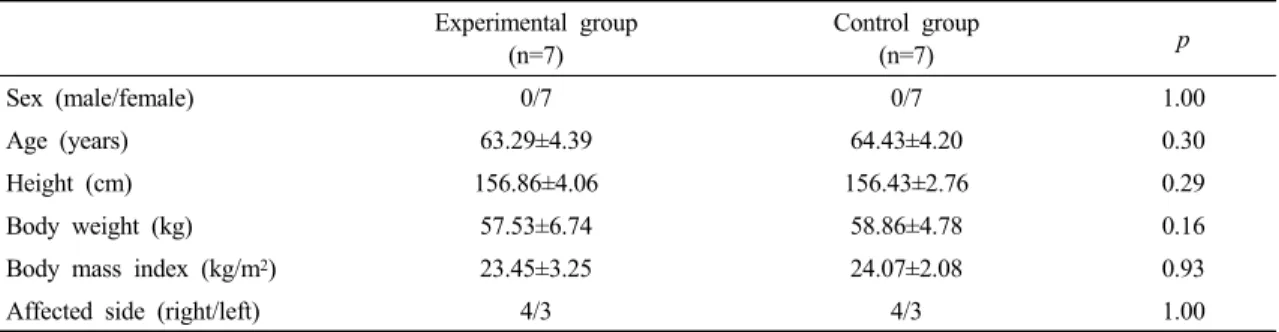
본 연구의 대상자 선정의 포함 기준은 최초의 무릎 관절 외과 수술한 자, 수술 후 7일이 경과한 자로 독립 적으로 10m 보행이 가능한 자로 하였으며, 과거에 엉 덩 또는 무릎관절 전치환술을 받은 자, 무릎관절 전치 환술의 재수술을 받은 자 , 심⋅혈관 및 호흡기 질환이 있는 자는 대상자에서 제외하였다 . 연구 대상자의 일 반적 특성은 다음과 같다(Table 1).
2. 실험 방법
1) 운동 프로그램
실험에 참여한 물리치료사는 수술 후 정형외과환 자 치료에 3년 이상의 경력을 가진 물리치료사로 하였 다 . 모든 참가자들은 수술 후 7일이 경과한 후 오전에 는 냉찜질 20분, 간섭파 전기 자극치료 15분, 초음파 치료 5분, 총 40분으로 구성된 전통적 물리치료를 받았
으며, 실험은 전통적 물리치료 외에 제공되었다. 참가 자들은 무작위 배정된 상태에서 실험군은 PNF 운동, 대조군은 일반적 운동으로 각각 30분으로 구성되어, 주 5회 2주간 시행되었다.
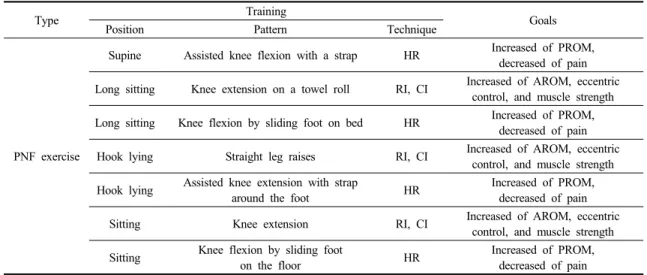
각각의 운동 프로그램은 환자의 요구사항을 근거 로 기능적인 문제와 관련된 검사 및 측정을 통해 필요 한 운동을 Jogi 등(2016)이 제시한 운동 프로그램을 바탕으로 PNF 운동과 일반적 운동으로 재구성하였다.
운동은 관절가동범위 확보와 통증 감소 및 근력 향상 을 목표로 하였다 . PNF 운동과 일반적 운동은 다음과 같다(Table 2, 3).
2) 측정항목 및 방법
(1) 무릎 굽힘 관절가동범위 측정
무릎 굽힘 관절가동범위를 측정하기 위해 스마트 폰 클리노미터 어플리케이션(smartphone clinometer application)을 이용하여 측정하였다. 클리노미터는 여러 스마트폰에서 저렴한 비용으로 쉽게 사용할 수 있으며, 평가자들은 스마트폰에 클리노미터를 다운 로드하여 측정 전에 연습하도록 지시하였다. 대상자 는 엎드려 누운 자세에서 측정하고자 하는 다리의 대퇴부를 고정하였다 . 대상자는 최대한 무릎을 굽히 게 하고 정강뼈와 평행하게 스마트폰을 고정하여 측 정하였고, 3회 반복 측정하여 평균값을 기록하였다.
측정자 간 신뢰도는 r=0.80∼0.89으로 관절가동범위 를 측정하기에 적합한 도구이다(Werner et al., 2014).
Experimental group (n=7)
Control group
(n=7) p
Sex (male/female) 0/7 0/7 1.00
Age (years) 63.29±4.39 64.43±4.20 0.30
Height (cm) 156.86±4.06 156.43±2.76 0.29
Body weight (kg) 57.53±6.74 58.86±4.78 0.16
Body mass index (kg/m
2) 23.45±3.25 24.07±2.08 0.93
Affected side (right/left) 4/3 4/3 1.00
Values are presented as mean±standard deviations.
Table 1. General characteristics of the participants (N = 14)
(2) 통증의 측정
통증의 정도를 측정하기 위해 시각적 상사척도 (visible analogue scale, VAS)를 이용하여 병원생활과 정 중 최대로 통증을 경험한 정도를 대상자가 직접 체크하는 방식을 택하였다. 통증이 전혀 없는 상태는 0, 통증이 최대로 있는 상태는 10으로 하여 10개의 구간이 표시된 종이 위에 직접 체크하도록 하였다.
검사 재검사 간 신뢰도는 r=0.96이다(Lingjaerde &
Føreland, 1998).
(3) 기능적 활동 측정
기능적 활동을 측정하기 위하여 의자에서 일어나 걷기 검사(timed up and go test, TUG)를 시행하였다.
의자에서 일어나 걷기 검사는 보행과 균형능력을 빠 르게 측정 할 수 있는 검사방법으로, 평편한 바닥에 46cm 높이의 팔걸이가 있는 의자에 편안하게 앉은
Type Training
Goals
Position Pattern Technique
Traditional exercise
Supine Assisted knee flexion with a strap Stretching Increased of PROM, decreased of pain Long sitting Knee extension on a towel roll Isotonic Increased of AROM, eccentric
control, and muscle strength Long sitting Knee flexion by sliding foot on bed Stretching Increased of PROM,
decreased of pain Hook lying Straight leg raises Isotonic Increased of AROM, eccentric
control, and muscle strength Hook lying Assisted knee extension with strap
around the foot Stretching Increased of PROM, decreased of pain Sitting Knee extension Isotonic Increased of AROM, eccentric
control, and muscle strength Sitting Knee flexion by sliding foot
on the floor Stretching Increased of PROM, decreased of pain PROM : passive range of motion, AROM : active range of motion.
Table 3. Traditional exercise program
Type Training
Goals
Position Pattern Technique
PNF exercise
Supine Assisted knee flexion with a strap HR Increased of PROM, decreased of pain Long sitting Knee extension on a towel roll RI, CI Increased of AROM, eccentric
control, and muscle strength Long sitting Knee flexion by sliding foot on bed HR Increased of PROM,
decreased of pain Hook lying Straight leg raises RI, CI Increased of AROM, eccentric
control, and muscle strength Hook lying Assisted knee extension with strap
around the foot HR Increased of PROM,
decreased of pain Sitting Knee extension RI, CI Increased of AROM, eccentric
control, and muscle strength Sitting Knee flexion by sliding foot
on the floor HR Increased of PROM,
decreased of pain PNF : proprioceptive neuromuscular facilitation, HR : hold-relax, RI : rhythmic initiation
CI : combination of isotonics, PROM : passive range of motion, AROM : active range of motion
Table 2. PNF exercise program
상태에서 대상자는 시작이라는 신호와 함께 의자에서 일어나서 의자에서 3m 떨어진 지점의 반환점을 수술 측 방향으로 최대한 빠른 걸음으로 돌아 다시 의자에 앉을 때까지 소요된 시간을 측정하는 방법으로 3회 반복 측정하여 평균시간을 기록하였다. 이 검사 도구 는 측정자간, 측정자내 신뢰도는 r=0.98∼0.99로 신뢰 도가 높은 도구이다(Podisadle & Richardson, 1991).
3. 자료 처리
본 연구를 위한 자료처리 방법은 Window용 통계프로 그램 SPSS/PC Statistics 18.0 software (SPSS Inc, Chicago, USA)을 이용하여 통계 처리하였다. 연구 대상자의 일반 적인 특성을 Shapiro-wilk로 정규성 검정을 하였고, PNF 운동에 따른 운동 전과 후의 집단 내 관절가동범위와
통증 및 의자에서 일어나 걷기 검사에 변화를 비교하기 위하여 대응표본 t-검정(paired t-test)을 실시하였으며, 실험군과 대조군의 집단 간의 차이를 비교하기 위해 독립표본 t-검정(independent t-test)으로 검정하였다. 모 든 통계학적 유의수준은 α=0.05로 설정하였다.
Ⅲ. 연구 결과
1. 무릎 굽힘 관절가동범위 변화 비교
집단 내 무릎 굽힘 관절가동범위(ROM)의 변화는 실험군에서 유의하게 증가하였고(t=-15.14; p<0.01), 대조군에서도 유의하게 증가하였다(t=-13.06; p<0.01).
중재 후 집단 간 무릎 굽힘 관절가동범위(ROM)의 변 화에서는 실험군과 대조군사이에서 유의한 차이가 있
Experimental group (n=7)
Control
group (n=7) t p 95% CI
timed up and go test (second)
Pre 12.87±1.03 12.14±0.74
Post 10.09±1.08 9.64±0.74 0.90 0.38 -0.63∼1.53
t(p) 16.70(0.00
**) 5.92(0.00
**) Data are mean±standard deviation.
*p<0.05, **p<0.01.
Table 6. The comparison of changes in timed up and go test within and between group Experimental
group (n=7)
Control
group (n=7) t p 95% CI
visual analogue scale (scores)
Pre 8.26±0.56 8.38±0.75
Post 4.13±0.73 5.11±0.61 -2.72 0.02
*-1.77∼-0.20
t(p) 11.46(0.00
**) 7.17(0.00
**) Data are mean±standard deviation.
*p<0.05, **p<0.01.
Table 5. The comparison of changes in visual analogue scale within and between group Experimental
group (n=7)
Control
group (n=7) t p 95% CI
Knee flexion range of motion (°)
Pre 71.86±4.98 70.71±3.25
Post 102.86±4.95 97.28±3.25 2.49 0.03
*0.70∼10.45
t(p) -15.14(0.00
**) -13.06(0.00
**) Data are mean±standard deviation.
*p<0.05, **p<0.01.