
Louis Henry Severance (1838–1913) In-Sok Yeo Department of Medical History, Yonsei University College of Medicine, Seoul, Korea.
3
0
0
전체 글
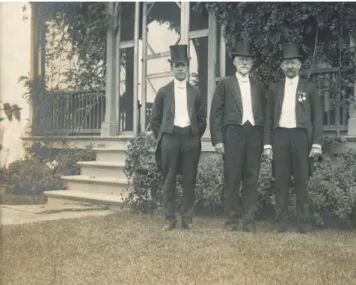
(2) Louis Henry Severance (1838–1913). SEVERANCE MEETS KOREA Korea became a meaningful name to Severance for first time on April 30, 1900. On that day, he was attending the Ecumenical Conference of Missions held in Carnegie Hall, New York, along with L. E. Holden, president of the College of Wooster. There, he heard a presentation entitled ‘Comity in Medical Mission’ by Dr. Oliver R. Avison, who had come from Korea. The main points of Avison’s presentation were as follows: seven missionary doctors are serving in Seoul, Korea. The small medical clinics throughout the city are staffed with one or two doctors due to manpower constraints, and the operation thereof is inefficient. Avison stated that if a large-scale hospital where all missionary doctors could work together is established in Seoul, the effect of medical missionary activities could be much greater.2 Severance who was deeply impressed by the presentation of Avison made up his mind to establish a hospital in Seoul. After the presentation, Severance met separately with Avison and talked more about the situation in Seoul and the necessity of a hospital. At that time, Avison showed a hospital design prepared by Henry B. Gordon, his friend and an architect from Toronto, and said that the hospital could accommodate 40 patients and about 10000 dollars would be required for the construction of hospital. Severance showed no intentions to offer a donation on the spot; after a while, however, he endowed the Northern Presbyterian mission with a hospital construction fund of 10000 dollars without notifying Avison. At the end of May 1900, Avison met Severance at the general assembly of the Northern Presbyterian Church held in Saint Louis, and expressed gratitude to him for his donation. Severance replied, “You are no happier to receive it than I am to give it.”3 Although Severance made a big donation for the construction of a hospital, there were many obstacles to the completion of the new hospital. Firstly, missionaries who were serving in Korea, especially Pyongyang, opposed building a new hospital. Fig. 1. Mr. Severance’s visit to Severance Hospital in Seoul (1907). From the left Dr. Ludlow, Mr. Severance, Dr. Avison.. 264. on the grounds that Christianity and churches may be regarded simply as charities, if a large and luxurious hospital is built.4 Thus, they insisted that only 5000 dollars should be used for the construction of hospital and the rest of 5000 dollars for missionary work. The New York mission that did not know the local situation accepted their claim and decided to use the donation by dividing it in half. Avison appealed to the mission headquarter in opposition of the unfair decision, and informed Severance of this situation. On hearing the news, Severance complained to the mission of the decision. He said that he would donate only the amount of 5000 dollars for use in building a hospital, because his donation was for the construction of hospital and no other purpose. As a result, all 10000 dollars would be used to build a new hospital as originally planned. Secondly, there was difficulty in selecting a hospital site. Emperor Gojong, who learned of the construction of hospital, tried to help with the selection of a hospital site, but the site selection was delayed due to uncooperative bureaucrats. Severance worried about the delayed establishment of the hospital and donated an additional 5000 dollars for purchasing a site to hasten the building process, obviating the need for government assistance. Although there were many problems during its construction, Severance Hospital, the first modern western-style hospital in Korea, finally opened its doors on September 23, 1904.5 Mr. Severance, a donor, did not attend the opening ceremony of the hospital. He visited a new hospital with Dr. Alfred Irving Ludlow (1875– 1961), his family practitioner in September 1907 (Fig. 1), three years after the hospital opened (Fig. 2). He paid a visit to the hospital as part of his tour of the Presbyterian mission stations in Asia.6 Severance contributed to school buildings in Seoul, as well as several cities in China. The purpose of visiting Seoul was to check on its condition and to make up for deficiencies, in addition to looking around the new hospital building. While he was satisfied with the established hospital, he also discovered insufficient parts. For example, the new hospital building had rooms for medical treatment, but did not have spaces for the education of medical students. For this reason, Severance donated another 30000 dollars so that a school building could be constructed in 1913.7 Additionally, Severance knew that Avison. Fig. 2. Severance Hospital (1904). https://doi.org/10.3349/ymj.2017.58.2.263.
(3) In-Sok Yeo. was struggling with running the hospital, so he dispatched Dr. J. W. Hirst (1864–1952) through the Mission Board at his own expense.8 Therewith, Severance Hospital could attain internal stability in both medical treatment and education, thanks to an excellent assistant who was dispatched by Severance. Dr. Ludlow, an excellent surgeon who graduated from the School of Medicine at Case Western Reserve University and served as a professor at the same university, participated in an operation at the new hospital during his stay in Seoul. Upon this opportunity, he volunteered for a missionary after returning to America. He left behind remarkable achievements in medical treatment, research, and education as a surgeon from his start in Severance Hospital until his retirement.9 Severance Hospital was founded with a great deal of influence from the treatment and education systems of the School of Medicine at Case Western Reserve University, where Dr. Ludlow graduated, and University of Toronto’s Faculty of Medicine, where Dr. Avison graduated. Severance continued to support overseas missionary work with great interest even after he returned to America. Although he supported many institutions, he loved the hospital and medical school in Seoul more than any other place, and took great pride in Severance Hospital.10 Severance died on June 25, 1913, at the age of 75. Even after his passing, his aid for the hospital and medical school in Seoul did not end. His son John and his daughter Prentiss continued to support Severance Hospital following their father’s wishes. In 1924, they contributed 100000 dollars of which only 50000 dollars were deposited into school funds and the remaining 50000 dollars were used to build a new. https://doi.org/10.3349/ymj.2017.58.2.263. ward, which was named Severance-Prentiss Wing.11 In addition, they assisted in improving the facilities of Severance Hospital by making a donation at every chance. John and Prentiss had no offspring. With this in mind, they raised Severance Funds to maintain support for Severance Hospital, even after they passed away. The determination and action of one figure helped establish a hospital in a strange land far away, a hundred years ago, thrusting his name into existence as an ineffaceable and beautiful name in Korean society.. REFERENCES 1. White S. Missionary review of the world 1913;36:896. 2. Avison, OR. Memoirs of Life in Korea. Seoul: Doctor’s Weekly; 2012. p.147. 3. Avison, OR. Memoirs of Life in Korea. Seoul: Doctor’s Weekly; 2012. p.151. 4. Letters of S. A. Moffet, 1902. 7. 3. 5. Letters of J. W. Hirst, 1904. 10. 7. 6. Observations on Medical progress in the Orient. Irving Ludlow. pp.27. illus. Cleveland Med. Jr. Oct.-Nov. (Reprint—Cleveland1910.) (U.) 1908. 7. Notes and Personals. Korea Mission Field 1913;9:212. 8. Hirst JW. A Life Sketch of O.R. Avison, M.D., L.L.D. J Severance Union Med Coll 1933;1:1-4. 9. Kim CB. The First Fellow of American College of Surgeons to Come to Korea: Dr. Alfred Irving Ludlow. Yonsei Med J 2015;56:1171-3. 10. Allen DP. “Louis H. Severance,” The Oberlin Alumni Magazine, October 1913. p.4. 11. Activities of Severance Union Medical College and Severance Hospital. 1927-1928. Seoul, Korea. p.1-2.. 265.
(4)
수치
관련 문서
Department of Naval Architecture and Ocean Engineering, Seoul National University of College
Department of Naval Architecture and Ocean Engineering, Seoul National University of College
Department of Naval Architecture and Ocean Engineering, Seoul National University of College of Engineering.. 학부 4학년 교과목“창의적
Department of Naval Architecture and Ocean Engineering, Seoul National University of College of Engineering.. Ship Motion & Wave Load
Department of Naval Architecture and Ocean Engineering, Seoul National University of College of Engineering@. 서울대학교 조선해양공학과 학부4학년
Department of Naval Architecture and Ocean Engineering, Seoul National University of College
Department of Naval Architecture and Ocean Engineering, Seoul National University of College of
In this paper, it was examined whether there is a possibility that the medical institution might be mistaken as a specialized hospital designated by the Ministry of Health
