REVIEW ARTICLE
비스테로이드소염제를 투약하는 환자에서 소화성궤양의 예방
추성준, 윤규태, 김준성
가톨릭대학교 의과대학 인천성모병원 소화기내과
Prevention of Non-steroidal Anti-inflammatory Drug-induced Peptic Ulcers
Seong Jun Chu, Kyu-Tae Yoon and Joon Sung Kim
Division of Gastroenterology, Department of Internal Medicine, Incheon St. Mary’s Hospital, College of Medicine, The Catholic University of Korea, Seoul, Korea
Nonsteroidal anti-inflammatory drugs (NSAID) are some of the most commonly prescribed medications in clinical practice. The long-term use of NSAIDs is one of the main causes of peptic ulcers and the increased risk of upper gastrointestinal tract complica- tions, such as perforation and bleeding. Thus, the prevention of NSAID-induced peptic ulcers is an important clinical issue.
Previous studies have evaluated various strategies for preventing ulcers in patients requiring prolonged NSAID use. The Korean clinical practice guidelines have been published recently based on the evidence of the currently available data. This review de- scribes the strategies for the prevention of peptic ulcers due to NSAID. An assessment of the risk factors for peptic ulcers from NSAID is recommended to identify patients who should be considered for primary prophylaxis. The risk of NSAID-induced peptic ulcers can be reduced by the concomitant use of proton pump inhibitors (PPI), misoprostol, and histamine-2 receptor antagonists.
Selective cyclooxygenase-2 inhibitors can be used with caution due to concerns regarding cardiovascular toxicity. Attempts should be made to use the lowest dose and shortest duration of the NSAID. (Korean J Gastroenterol 2020;76:232-237)
Key Words: Anti-inflammatory agents, non-steroidal; Peptic ulcer; Primary prevention
Received October 7, 2020. Revised October 21, 2020. Accepted October 24, 2020.
CC This is an open access article distributed under the terms of the Creative Commons Attribution Non-Commercial License (http://creativecommons.org/licenses/
by-nc/4.0) which permits unrestricted non-commercial use, distribution, and reproduction in any medium, provided the original work is properly cited.
Copyright © 2020. Korean Society of Gastroenterology.
교신저자: 김준성, 21431, 인천시 부평구 동수로 56, 가톨릭대학교 의과대학 인천성모병원 소화기내과
Correspondence to: Joon Sung Kim, Division of Gastroenterology, Department of Internal Medicine, Incheon St. Mary's Hospital, College of Medicine, The Catholic University of Korea, 56 Dongsu-ro, Bupyeong-gu, Incheon 21431, Korea. Tel: +82-32-280-5052, Fax: +82-32-280-5082, E-mail: [email protected], ORCID:
https://orcid.org/0000-0001-9158-1012 Financial support: None. Conflict of interest: None.
서 론
아스피린을 포함한 비스테로이드소염제(NSAID)는 위 및 십이지장 점막의 손상을 일으켜서 약제로 인한 유병률 및 사 망률과 관련이 높은 것으로 알려져 있다.1 인구의 고령화가 진행되어 근골격계 질환 및 심뇌혈관 질환의 유병률이 높아지 면서 NSAID의 투약은 증가하고 있다.2,3 이들 고령 환자에서 는 위점막 방어 기전도 약해져서 NSAID로 인한 소화성궤양 의 합병증 발생이 더 잘 일어난다.4또 고령 환자의 경우 만성 질환 및 통증으로 NSAID를 중단하기 어려운 경우가 많아서 지속적으로 궤양이 발생할 위험이 있다. NSAID에 의한 통증
경감 효과와 NSAID가 기존의 무통성궤양을 악화시키는 경우 가 있어서 NSAID로 인한 소화성궤양은 무증상이면서 출혈 및 천공 등의 합병증이 동반되는 경우가 많다.5 서양에서는
Helicobacter pylori
(H. pylori
)에 의한 소화성궤양 및 합병 증은 감소하고 있지만 아스피린을 포함한 NSAID에 의한 소 화성궤양의 발생 및 합병증은 변화가 없거나 증가하고 있 다.6,7 국내에서도 소화성궤양으로 진단받은 환자에서H. py- lori
의 유병률은 지속적으로 감소하고 있으나 NSAID나 아스 피린을 투약하는 환자는 증가하는 것으로 보고된다.4외국의 가이드라인에서는 NSAID를 장기간 투약하는 환자 에서 궤양 발생의 위험인자를 조사하여 고위험군, 중등위험
군, 저위험군으로 분류하고 심뇌혈관의 위험도를 고위험군과 저위험군으로 분류하여 관리하도록 권고한다.8,9 그러나 국내 에서는 외국과 비교하여
H. pylori
의 유병률 및 위암의 유병 률이 높고 또 내시경에 대한 접근성이 좋아서 외국의 진료지 침을 국내에 적용하기에 제한점이 있었다. 최근에 국내의 약 제 연관 소화성궤양의 임상진료지침이 발표되었는데,10 이번 임상진료지침은 총 9개의 권고문으로 구성되며 그중 NSAID 와 관련된 권고문은 총 4개를 포함하고 있다. 본고에서는 NSAID와 관련된 소화성궤양 발생의 위험인자와 예방에 관련 된 내용을 소개하려고 하며 이번에 발표된 국내 임상진료지침 내용 중 NSAID와 관련된 내용을 같이 소개하고자 한다.본 론
1. NSAID 관련 소화성궤양 및 합병증 발생의 위험인자 NSAID를 투약하는 34,701명의 환자를 전향적으로 조사한 Laine 등11의 연구에서 소화성궤양 및 합병증의 위험인자를 65세 이상의 고령, 소화성궤양의 과거력, 아스피린의 병용 투여 로 보고하였다. 그러나 국내 연구에서는 60세 이상을 NSAID 관련 소화성궤양의 위험인자로 보고하고 있어, 고위험군에 해 당하는 구체적 연령에 대해서는 이견이 있다.12 미국 심장학회 의 가이드라인에서는 NSAID를 투약하는 환자에서 소화성궤 양 및 합병증의 위험인자로는 1) 소화성궤양의 과거력, 2) 이제 항혈소판제 요법(dual antiplatelet therapy), 3) 항응고제의 병용 투여, 4) 60세 이상, 5) 스테로이드의 병용 투여인 것으로 발표하였다.8다른 미국의 가이드라인에서는 1) 소화성궤양의 과거력, 2) 65세 이상, 3) 고용량 NSAID 투약, 4) 아스피린, 스테 로이드, 항응고제의 병용 투여를 위험인자로 보고하였다.9이와 같이 미국의 두 가이드라인에서도 고령의 정의가 다른 것을 확인할 수 있다. 이와 별도로 최근 메타분석에서 선택적 seroto- nin 재흡수 억제제(selective serotonin reuptake inhibitors) 는 OR은 2.36 (95% CI 1.44-3.85)으로 위장관 출혈과 연관이 있으며 NSAID와 병용 투여 시 위장관 출혈의 OR은 6.33 (95%
CI 3.40-11.8)으로 증가하는 것으로 보고하였다.13
국내 가이드라인에서는 고위험인자로 고령, 궤양의 과거 력, 고용량의 NSAID 투약 및 아스피린, 항혈소판제, 항응고 제 혹은 스테로이드의 병용 투약으로 정의하였다.10 NSAID와 관련된 소화성궤양 및 합병증의 고위험인자 중 고령의 정의에 대해서는 가이드라인 및 연구마다 조금씩 차이가 있어 구체적 인 연령을 이번 가이드라인에서는 기술하지 않았다.
2. NSAID의 종류에 따른 소화성궤양의 발생
NSAID는 크게 비선택적 NSAID와 선택적 NSAID인 cy- clooxygenase-2 (COX-2) 차단제(celecoxib)로 분류된다.
NSAID는 종류와 상관없이 위장관 점막에 손상을 일으킬 수 있지만 그 종류에 따라서 손상의 정도에는 차이가 있다. 2013년 발표된 메타분석에서는 NSAID의 종류에 따른 위장관 합병증 의 발생을 비교하였다.14그 결과 위약과 비교하였을 때 diclo- fenac의 adjusted rate ratio는 1.89 (95% CI 1.2-3.1), ibu- profen은 3.97 (95% CI 2.2-7.1), naproxen은 4.2 (95% CI 2.7-6.6)인 것으로 나타났다. 또 다른 메타분석에서는 in- domethacin의 RR은 2.25, naproxen 은 1.83, diclofenac은 1.73, piroxicand은 1.66, tenoxicam은 1.43, ibuprofen은 1.19, meloxican은 1.24였다.15 이 연구에서는 NSAID의 투약 기간이 길수록 소화성궤양 합병증이 잘 발생하는 것으로 보고 하였다. 이들 연구를 종합하면 NSAID 중에서 aceclofenac, celecoxib, ibuprofen의 소화성궤양 발생 위험이 가장 낮으 며 diclofenac, meloxicam, ketoprofen이 중간의 위험을 나 타내며 prioxicam과 ketorolac의 소화성궤양 발생 위험이 가 장 높다.16
3. NSAID 투약자에서 H. pylori 감염의 역할
소화성궤양을 유발하는 대표적인 인자는
H. pylori
감염과 NSAID 투약이다. 이 두 인자가 동시에 있는 경우에는 소화성 궤양의 위험이 증가한다.17 NSAID 투약 환자에서H. pylori
균 감염이 동반된 경우 소화성궤양의 합병률이 60배 정도 높 고 출혈이 발생할 위험은 6배 높다.18 NSAID 투약자에서H.
pylori
균 감염이 있는 경우에 소화성궤양의 위험이 1.8배로 높다는 연구도 있다.17 그러나 제균 치료가 NSAID 장기 투약 자에서 소화성궤양의 발생을 줄여주는지에 대해서는 논란이 있다. 여러 연구에서 NSAID를 처음 투약하는 환자에서 제균 치료가 효과적이나 이미 NSAID를 장기간 투약하는 환자에서 는 제균 치료를 해도 여러 소화기 합병증의 발생을 줄여주지 는 못하는 것으로 발표하였다.19-25 따라서 이런 연구를 토대로 이번 가이드라인에서는 NSAID 투약 전에 소화성궤양의 과거 력이 있는 환자는H. pylori
감염 검사 및 제균 치료를 하도록 권고하고 있다.10사실 소화성궤양의 과거력이 있는 환자는 약 물의 투약 여부와 상관없이 궤양 발생의 예방을 위해서 제균 치료가 권고된다. 그럼에도 NSAID 장기 투약이 예상되는 환 자에게서H. pylori
균 검사 및 치료의 중요성을 상기시키기 위해서 이번 권고문을 선정하게 되었다. 국내에서 NSAID를 투약하는 환자에서 제균 치료를 시행하는 것이 비용 효과면에 서 더 효율적인 것으로 보고한 연구도 있어서 추후 비용 효과 와 관련된 연구들이 더 필요할 것으로 생각된다.264. 선택적 COX-2 차단제
NSAID는 COX를 억제하여 arachidonic acid가 prosta- glandin, prostacyclin, thromboxane으로 변환하는 것을 억
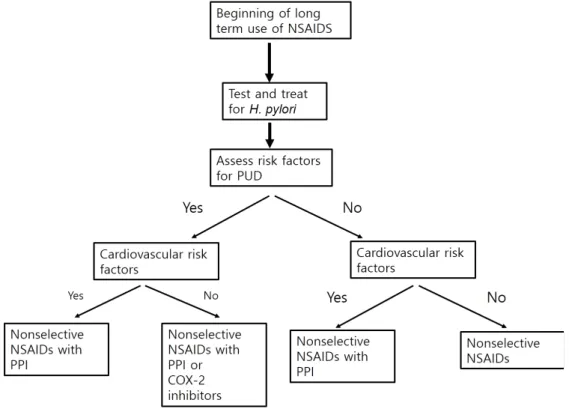
Fig. 1. Algorithm for preventing ulcers in patients requiring prolonged nonsteroidal anti-inflammatory drugs. NSAIDs, non-steroidal anti-inflammatory drugs; H. pylori, Helicobacter pylori; PUD, peptic ulcer disease; PPI, proton pump inhibitors; COX-2, cyclooxygenase-2.
제한다.27 COX는 COX-1과 COX-2로 구성되는데, COX-1은 위 및 십이지장의 방어 기전에 중요한 역할을 하며 COX-2는 항염증 작용에 관여한다.28 선택적 COX-2 차단제인 celecox- ib는 COX-1을 억제하지 않아서 이론적으로는 COX-1과 COX-2를 모두 억제하는 비선택적 NSAID와 비교하여 소화 성궤양의 발생이 적을 것으로 예상된다.14 아스피린을 투약하 는 환자에서 celecoxib을 투약하는 군과 naproxen과 lanso- prazole을 투약하는 군을 비교하였을 때 위 십이지장 궤양 발 생에는 차이가 없는 것으로 나타났다.29 또 다른 연구에서는 4,484명의 환자에게 celecoxib을 투여한 군과 diclofenac과 omeprazole을 병용 투여한 군을 비교하였는데, 그 결과 cel- ecoxib을 투여한 군에서 위장관 합병증의 발생이 더 적은 것 으로 보고하였다.30 다른 연구에서는 celecoxib나 비선택적 NSAID를 투약하면서 상부위장관 합병증이 있는 1,382명의 환자를 나이와 성별을 조정한 22,957명의 대조군과 비교하였 고,31 그 결과 proton pump inhibitor (PPI)나 misoprostol의 병용 투여와 celecoxib의 투여가 상부위장관 합병증을 감소 시키는 데 도움이 되는 것으로 나타났다. 이 연구에서는 cele- coxib와 PPI의 병용 투여가 비선택적 NSAID와 PPI의 병용 투여보다 더 효과적인 것으로 나타났다. 그러나 celecoxib은 심뇌혈관 고위험 환자에서는 사용에 주의가 필요하다. 한 메 타분석에서 COX-2 차단제가 비선택적 NSAID에 비해서 심 근경색의 위험도를 53% 올리며 심혈관 질환의 위험도를 올리
는 경향을 보였다.32국내 가이드라인에서도 심혈관계 질환 위 험성이 낮은 경우 선택적 COX-2 차단제를 사용할 것을 권고 한다(Fig. 1).10
5. NSAID로 인한 소화성궤양의 치료
NSAID를 투약하는 환자에서 소화성궤양이 발생한 경우에 는 우선 NSAID의 투약을 중단할 것이 권고된다. 이와 함께 PPI와 histamine-2 receptor antagonist (H2RA)와 같이 표 준적인 소화성궤양 치료를 시행한다. PPI는 산분비의 마지막 단계를 차단하므로 산분비억제작용이 H2RA에 비해 강력해 현재 궤양 치료에 있어서 첫 번째 약제로 고려된다.33,34 다른 소화성궤양 환자들과 마찬가지로
H. pylori
감염 여부를 조사 하여 균 감염이 있다면 제균 치료를 시행한다.35 NSAID의 투 약을 중단할 수 없어서 계속 투약하는 환자에게는 PPI를 투여 하는 것이 H2RA, misoprostol, sucralfate를 투여하는 것보 다 효과적이다.36-396. NSAID로 인한 소화성궤양의 예방
비선택적 NSAID를 투약하는 환자에서 소화성궤양을 예방 하기 위해서는 우선적으로 PPI의 병용 투여를 고려할 수 있 다. PPI는 비선택적 비스테로이드 소염제를 투약하는 환자에 서 궤양의 새로운 발생 뿐만 아니라 궤양의 재발도 감소시키 는 효과가 있다.40,41 최근 골관절염 또는 류마티스 관절염이
있는 환자에게 celecoxib, ibuprofen, naproxen과 함께 eso- meprazole을 투여한 후 34개월간 추적 관찰을 하였다.42 그 결과 소화기 합병증의 발생은 각각 0.7%, 0.9%, 0.7%로 매우 낮은 것으로 나타나서 PPI의 병용 투여가 효과가 있음을 시사 하였다. 다른 연구에서는 NSAID를 투약하는 환자 중에서 고 령이거나 과거 궤양의 기왕력이 있는 고위험군에게 esome- prazole의 궤양 예방 효과를 조사하였다.41 1,429명의 환자에 게 esomeprazole 20 mg 또는 40 mg 및 위약을 6개월간 투약한 후에 내시경으로 궤양의 발생을 조사한 결과 esome- prazole을 20 mg, 40 mg을 투약하는 군에서는 궤양의 발생 이 5.2%, 4.6%로 감소하는 것으로 나타났다. NSAID를 투약 하는 환자에서 prostaglandin E analog인 misoprostol을 투 여하면 소화성궤양의 합병증을 감소시켜주는 것으로 알려져 있다.43 NSAID를 투약하는 8,843명의 환자에게 misoprostol 과 위약을 비교한 결과 misoprostol을 투약하는 군에서 출혈, 천공과 같은 소화기 합병증의 발생이 40% 감소하는 것으로 나타났다.44 그러나 이 연구에서 misoprostol을 투약하는 군 에서 20%는 부작용으로 약 투약을 중단한 것으로 나타났다.
Misoprostol과 PPI를 비교하면 misoprostol을 투약한 군의 7%에서 위십이지장 점막의 결손이 관찰되었으며 lansopra- zole 15 mg, 30 mg을 투약한 환자에서는 20%, 18%에서 결 손이 관찰되었다.45 그러나 misoprostol을 투약한 군에서 부 작용을 호소하는 경우가 더 많았다. 즉 misoprostol은 소화성 궤양의 예방 효과는 있지만 설사나 복통 등의 부작용이 많아 서 장기간 투약이 어려운 경우가 많아서 PPI에 비해서 선호되 지는 않는다. 이번 국내 가이드라인에서도 NSAID 장기 투약 자에서 궤양 예방을 위해서 misoprostol을 투여할 수는 있지 만 부작용에 주의해야 한다고 권고하고 있다.10
결 론
비스테로이드 소염제나 아스피린을 투약하는 환자에서 소화 성궤양이 잘 발생하는 위험인자에는 환자의 소화성궤양의 과거 력,
H. pylori
감염 여부, NSAID의 종류와 용량, 환자의 나이와 병용 약물의 투여가 연관 있는 것으로 알려져 있다. 따라서 환자에게 이런 위험인자가 있다면 NSAID의 장기 투약을 시작 하기 전에H. pylori
균 감염을 확인하고 제균 치료를 시행하는 것이 중요하다. NSAID를 사용하는 경우에는 최소 용량으로 최단 기간 동안 사용하는 것이 권고된다. 장기간 복용이 필요한 환자에서는 소화성궤양 발생의 위험인자들이 있으면 PPI, mi- soprostol, H2RA와의 병용 요법을 고려한다. 또 고위험군에서 는 심혈관 질환의 위험인자가 없다면 celecoxib의 투여를 고려 해 볼 수 있으며 심혈관 질환의 위험인자가 있으면 비선택적 NSAID와 PPI의 병용 투여를 고려할 수 있다.REFERENCES
1. Wallace JL. Nonsteroidal anti-inflammatory drugs and gastro- enteropathy: the second hundred years. Gastroenterology 1997;
112:1000-1016.
2. Abraham NS. Gastrointestinal bleeding in cardiac patients: epi- demiology and evolving clinical paradigms. Curr Opin Gastro- enterol 2014;30:609-614.
3. Wongrakpanich S, Wongrakpanich A, Melhado K, Rangaswami J. A comprehensive review of non-steroidal anti-inflammatory drug use in the elderly. Aging Dis 2018;9:143-150.
4. Shim YK, Kim N. Nonsteroidal anti-inflammatory drug and aspir- in-induced peptic ulcer disease. Korean J Gastroenterol 2016;
67:300-312.
5. Armstrong CP, Blower AL. Non-steroidal anti-inflammatory drugs and life threatening complications of peptic ulceration. Gut 1987;28:527-532.
6. Manuel D, Cutler A, Goldstein J, Fennerty MB, Brown K.
Decreasing prevalence combined with increasing eradication of Helicobacter pylori infection in the United States has not resulted in fewer hospital admissions for peptic ulcer disease-related complications. Aliment Pharmacol Ther 2007;25:1423-1427.
7. Post PN, Kuipers EJ, Meijer GA. Declining incidence of peptic ulcer but not of its complications: a nation-wide study in The Netherlands. Aliment Pharmacol Ther 2006;23:1587-1593.
8. Bhatt DL, Scheiman J, Abraham NS, et al. ACCF/ACG/AHA 2008 expert consensus document on reducing the gastrointestinal risks of antiplatelet therapy and NSAID use: a report of the American College of Cardiology Foundation Task Force on Clinical Expert Consensus Documents. J Am Coll Cardiol 2008;
52:1502-1517.
9. Lanza FL, Chan FK, Quigley EM; Practice Parameters Committee of the American College of Gastroenterology. Guidelines for pre- vention of NSAID-related ulcer complications. Am J Gastroenterol 2009;104:728-738.
10. Joo MK, Park CH, Kim JS, et al. Clinical guidelines for drug-in- duced peptic ulcer, 2020 revised edition. Korean J Gastroenterol 2020;76:108-133.
11. Laine L, Curtis SP, Cryer B, Kaur A, Cannon CP. Risk factors for NSAID-associated upper GI clinical events in a long-term pro- spective study of 34 701 arthritis patients. Aliment Pharmacol Ther 2010;32:1240-1248.
12. Lee HL, Han DS, Kim JB, et al. Importance of age and other risk factors in NSAID-induced gastropathy. Korean J Gastroenterol 2004;44:246-251.
13. Loke YK, Trivedi AN, Singh S. Meta-analysis: gastrointestinal bleeding due to interaction between selective serotonin uptake inhibitors and non-steroidal anti-inflammatory drugs. Aliment Pharmacol Ther 2008;27:31-40.
14. Coxib and traditional NSAID Trialists' (CNT) Collaboration, Bhala N, Emberson J, et al. Vascular and upper gastrointestinal effects of non-steroidal anti-inflammatory drugs: meta-analyses of individual participant data from randomised trials. Lancet 2013;382:769-779.
15. Richy F, Bruyere O, Ethgen O, et al. Time dependent risk of gastro- intestinal complications induced by non-steroidal anti-in-
flammatory drug use: a consensus statement using a meta-ana- lytic approach. Ann Rheum Dis 2004;63:759-766.
16. Henry D, Lim LL, Garcia Rodriguez LA, et al. Variability in risk of gastrointestinal complications with individual non-steroidal an- ti-inflammatory drugs: results of a collaborative meta-analysis.
BMJ 1996;312:1563-1566.
17. Papatheodoridis GV, Sougioultzis S, Archimandritis AJ. Effects of Helicobacter pylori and nonsteroidal anti-inflammatory drugs on peptic ulcer disease: a systematic review. Clin Gastroenterol Hepatol 2006;4:130-142.
18. Huang JQ, Sridhar S, Hunt RH. Role of Helicobacter pylori in- fection and non-steroidal anti-inflammatory drugs in peptic-ulcer disease: a meta-analysis. Lancet 2002;359:14-22.
19. Kiltz U, Zochling J, Schmidt WE, Braun J. Use of NSAIDs and in- fection with Helicobacter pylori--what does the rheumatologist need to know?. Rheumatology (Oxford) 2008;47:1342-1347.
20. Chan FK, Sung JJ, Chung SC, et al. Randomised trial of erad- ication of Helicobacter pylori before non-steroidal anti-in- flammatory drug therapy to prevent peptic ulcers. Lancet 1997;
350:975-979.
21. Chan FK, To KF, Wu JC, et al. Eradication of Helicobacter pylori and risk of peptic ulcers in patients starting long-term treatment with non-steroidal anti-inflammatory drugs: a randomised trial.
Lancet 2002;359:9-13.
22. Labenz J, Blum AL, Bolten WW, et al. Primary prevention of diclo- fenac associated ulcers and dyspepsia by omeprazole or triple therapy in Helicobacter pylori positive patients: a randomised, double blind, placebo controlled, clinical trial. Gut 2002;51:
329-335.
23. Hawkey CJ, Tulassay Z, Szczepanski L, et al. Randomised con- trolled trial of Helicobacter pylori eradication in patients on non-steroidal anti-inflammatory drugs: HELP NSAIDs study.
Helicobacter eradication for lesion prevention. Lancet 1998;
352:1016-1021.
24. Lai KC, Lau CS, Ip WY, et al. Effect of treatment of Helicobacter pylori on the prevention of gastroduodenal ulcers in patients re- ceiving long-term NSAIDs: a double-blind, placebo-controlled trial. Aliment Pharmacol Ther 2003;17:799-805.
25. de Leest HT, Steen KS, Lems WF, et al. Eradication of Helicobacter pylori does not reduce the incidence of gastro- duodenal ulcers in patients on long-term NSAID treatment: dou- ble-blind, randomized, placebo-controlled trial. Helicobacter 2007;12:477-485.
26. Song HJ, Kwon JW, Kim N, Park YS. Cost effectiveness associated with Helicobacter pylori screening and eradication in patients taking nonsteroidal anti-inflammatory drugs and/or aspirin. Gut Liver 2013;7:182-189.
27. Zidar N, Odar K, Glavac D, Jerse M, Zupanc T, Stajer D.
Cyclooxygenase in normal human tissues--is COX-1 really a con- stitutive isoform, and COX-2 an inducible isoform?. J Cell Mol Med 2009;13:3753-3763.
28. Feldman M, McMahon AT. Do cyclooxygenase-2 inhibitors pro- vide benefits similar to those of traditional nonsteroidal anti-in- flammatory drugs, with less gastrointestinal toxicity?. Ann Intern Med 2000;132:134-143.
29. Goldstein JL, Cryer B, Amer F, Hunt B. Celecoxib plus aspirin ver-
sus naproxen and lansoprazole plus aspirin: a randomized, dou- ble-blind, endoscopic trial. Clin Gastroenterol Hepatol 2007;5:
1167-1174.
30. Laine L, Curtis SP, Cryer B, Kaur A, Cannon CP; MEDAL Steering Committee. Assessment of upper gastrointestinal safety of etor- icoxib and diclofenac in patients with osteoarthritis and rheuma- toid arthritis in the multinational etoricoxib and diclofenac arthri- tis long-term (MEDAL) programme: a randomised comparison.
Lancet 2007;369:465-473.
31. Targownik LE, Metge CJ, Leung S, Chateau DG. The relative effi- cacies of gastroprotective strategies in chronic users of non- steroidal anti-inflammatory drugs. Gastroenterology 2008;134:
937-944.
32. Farkouh ME, Greenberg BP. An evidence-based review of the car- diovascular risks of nonsteroidal anti-inflammatory drugs. Am J Cardiol 2009;103:1227-1237.
33. Bhatt DL, Scheiman J, Abraham NS, et al. ACCF/ACG/AHA 2008 expert consensus document on reducing the gastro- intestinal risks of antiplatelet therapy and NSAID use: a report of the American College of Cardiology Foundation Task Force on clinical expert consensus documents. Circulation 2008;
118:1894-1909.
34. Satoh K, Yoshino J, Akamatsu T, et al. Evidence-based clinical practice guidelines for peptic ulcer disease 2015. J Gastroenterol 2016;51:177-194.
35. Fallone CA, Chiba N, van Zanten SV, et al. The Toronto consensus for the treatment of Helicobacter pylori infection in adults.
Gastroenterology 2016;151:51-69.e14.
36. Yeomans ND, Tulassay Z, Juhász L, et al. A comparison of omepra- zole with ranitidine for ulcers associated with nonsteroidal anti- inflammatory drugs. Acid suppression trial: ranitidine versus omeprazole for NSAID-associated ulcer treatment (ASTRONAUT) study group. N Engl J Med 1998;338:719-726.
37. Agrawal NM, Campbell DR, Safdi MA, Lukasik NL, Huang B, Haber MM. Superiority of lansoprazole vs ranitidine in healing non- steroidal anti-inflammatory drug-associated gastric ulcers: re- sults of a double-blind, randomized, multicenter study. NSAID- associated gastric ulcer study group. Arch Intern Med 2000;
160:1455-1461.
38. Hawkey CJ, Karrasch JA, Szczepañski L, et al. Omeprazole com- pared with misoprostol for ulcers associated with nonsteroidal antiinflammatory drugs. Omeprazole versus misoprostol for NSAID-induced ulcer management (OMNIUM) Study Group. N Engl J Med 1998;338:727-734.
39. Bianchi Porro G, Lazzaroni M, Manzionna G, Petrillo M.
Omeprazole and sucralfate in the treatment of NSAID-induced gastric and duodenal ulcer. Aliment Pharmacol Ther 1998;12:
355-360.
40. Kim JJ, Kim N, Lee BH, et al. Risk factors for development and re- currence of peptic ulcer disease. Korean J Gastroenterol 2010;
56:220-228.
41. Scheiman JM, Yeomans ND, Talley NJ, et al. Prevention of ulcers by esomeprazole in at-risk patients using non-selective NSAIDs and COX-2 inhibitors. Am J Gastroenterol 2006;101:701-710.
42. Yeomans ND, Graham DY, Husni ME, et al. Randomised clinical trial: gastrointestinal events in arthritis patients treated with cel-
ecoxib, ibuprofen or naproxen in the PRECISION trial. Aliment Pharmacol Ther 2018;47:1453-1463.
43. Raskin JB, White RH, Jackson JE, et al. Misoprostol dosage in the prevention of nonsteroidal anti-inflammatory drug-induced gas- tric and duodenal ulcers: a comparison of three regimens. Ann Intern Med 1995;123:344-350.
44. Silverstein FE, Graham DY, Senior JR, et al. Misoprostol reduces serious gastrointestinal complications in patients with rheuma-
toid arthritis receiving nonsteroidal anti-inflammatory drugs. A randomized, double-blind, placebo-controlled trial. Ann Intern Med 1995;123:241-249.
45. Graham DY, Agrawal NM, Campbell DR, et al. Ulcer prevention in long-term users of nonsteroidal anti-inflammatory drugs: results of a double-blind, randomized, multicenter, active- and place- bo-controlled study of misoprostol vs lansoprazole. Arch Intern Med 2002;162:169-175.