Copyright © 2012 Korean Neurological Association 79
Print ISSN 1738-6586 / On-line ISSN 2005-5013 http://dx.doi.org/10.3988/jcn.2012.8.1.79 CASE REPORT
J Clin Neurol 2012;8:79-82
Introduction
Streptococcus suis (S. suis), a Gram-positive facultative anaer- obe, is a major porcine pathogen that can be transmitted to hu- mans by close contact with pigs.1 Meningitis is the most-com- mon presentation of S. suis infection, followed by sepsis, which has a higher mortality rate, particularly for splenecto- mized patients. Other clinical manifestations include enteritis, endocarditis, arthritis, endophthalmitis, uveitis, and spondylo- discitis.2,3 Permanent hearing loss or vestibular dysfunction are commonly occurring sequelae of S. suis infection, especially in patients with meningitis.2
Since the first described human case of S. suis infection in Denmark in 1968,4 more than 700 cases have been reported worldwide.5 The association between human infection and con- tact with pigs has been noted since the discovery of the dis- ease,6 and most of the reported human S. suis cases originate
from southeast Asia, which is characterized by a high density of pigs and the consumption of uncooked or lightly cooked pig products. Pig farming and consuming pig products are also common in Korea, but there have been no reports of human in- fection with S. suis. The present report is the first human case of S. suis infection in Korea. Distinctive complications of men- ingitis are also presented and discussed.
Case Report
A 57-year-old, previously healthy man suffered from fevers, chills, and abdominal pain for 5 days. Examination at a local hospital revealed hearing impairment and an increased C-reac- tive protein level. He was referred to our hospital for the treat- ment of a persistent fever, headaches, hearing impairment, and dizziness. The medical history was nonspecific, except that he had reared pigs for several years until 2 years previously. At the time of admission, he had a body temperature of 36.9oC, a pulse rate of 68 beats/min, a blood pressure of 140/80 mm Hg, and a respiration rate of 20/min. A physical examination re- vealed neck stiffness and signs of meningeal irritation. Neither a cardiac murmur nor skin abnormalities were noted. A neuro-
Meningitis Caused by Streptococcus suis:
Case Report and Review of the Literature
Seong-Min Choi, Bang-Hoon Cho, Kang-Ho Choi, Tai-Seung Nam, Joon-Tae Kim, Man-Seok Park, Byeong C. Kim, Myeong-Kyu Kim, Ki-Hyun Cho
Department of Neurology, Chonnam National University Medical School, Gwangju, Korea
Received May 3, 2010 Revised July 30, 2010 Accepted July 30, 2010 Correspondence Byeong C. Kim, MD Department of Neurology, Chonnam National University Medical School, 42 Jebong-ro, Dong-gu, Gwangju 501-757, Korea Tel +82-62-220-6274
Fax +82-62-228-3461
E-mail [email protected]
BackgroundzzHuman infection with Streptococcus suis (S. suis), a zoonotic pathogen, has been reported mainly in pig-rearing and pork-consuming countries. Meningitis is the most-common clinical manifestation and is often associated with deafness and vestibular dysfunction.
Case ReportzzA 57-year-old man was referred to the hospital with headaches, fevers, chills, and hearing impairment. Meningitis was confirmed and S. suis was isolated from the cerebrospinal fluid. Spondylodiscitis occurred after 2 weeks of antibiotic treatment, and was successfully treated with a prolonged course of antibiotics for another 4 weeks. His hearing loss was irrevers- ible despite the improvement of other symptoms.
ConclusionszzWe report the first human case of S. suis infection in Korea. In patients presenting with meningitis, S. suis should be considered if the characteristic features of prominent and early
hearing loss are present. J Clin Neurol 2012;8:79-82
Key Wordszz Streptococcus suis, meningitis, hearing impairment, spondylodiscitis.
Open Access
cc This is an Open Access article distributed under the terms of the Cre- ative Commons Attribution Non-Commercial License (http://creative- commons.org/licenses/by-nc/3.0) which permits unrestricted non-com- mercial use, distribution, and reproduction in any medium, provided the ori- ginal work is properly cited.
Streptococcus suis Meningitis
80 J Clin Neurol 2012;8:79-82
logical examination revealed a drowsy mental status and hear- ing impairment. No other focal neurologic signs were noted.
Routine laboratory tests showed a leukocyte count of 8.3×
103/mm3 with 67.4% neutrophils, a platelet count of 100×103/ mm3, and a C-reactive protein level of 15.4 mg/dL. Serologic tests for syphilis and human immunodeficiency virus were neg- ative. Blood was drawn for culture. An enhanced brain comput- ed-tomography scan showed no abnormal findings. The cere- brospinal fluid (CSF) had a slight turbid color, a high opening pressure (250 mmH2O), an increased leukocyte count (380/
mm3: neutrophils, 25%; lymphocytes, 25%; and monocytes, 50%), an increased protein level (86 mg/dL), and a decreased glucose level (CSF glucose, 21 mg/dL; blood glucose, 129 mg/
dL). Gram staining, acid-fast bacillus staining, KOH mount, In- dia ink preparation, and tuberculosis polymerase chain reaction of CSF were negative. The blood cultures were also negative.
The CSF culture grew small alpha-hemolytic colonies on blood agar plates. The organisms, which were Gram-positive
cocci in chains, were catalase-negative and were identified as S.
suis by the VITEK 2 Gram-positive card system (BioMérieux).
The strain was sensitive to penicillin, ampicillin, ciprofloxacin, nitrofurantoin, imipenem, teicoplanin, and vancomycin.
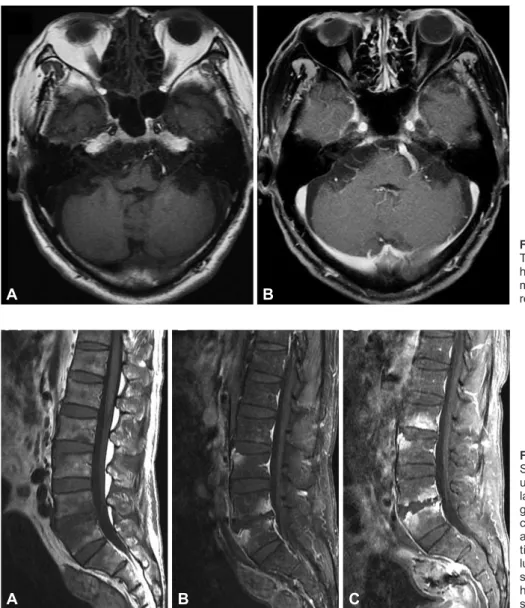
Before isolating S. suis, vancomycin and cefotaxime were started for the treatment of bacterial meningitis. A steroid in- jection was added to help resolve the meningeal inflammation and hearing impairment. The patient’s consciousness and men- ingitis symptoms gradually improved, but the hearing impair- ment and dizziness did not. Magnetic resonance imaging (MRI) performed 3 days after admission revealed no abnor- malities of the inner ear or brain parenchyma (Fig. 1). Audi- ometry carried out 6 and 14 days after admission revealed bi- lateral moderate-to-severe sensorineural hearing loss, especially in the high-frequency range. After completion of a 14-day course of antibiotic therapy, his symptoms - with the exception of hear- ing loss and dizziness - were improved. A follow-up CSF ex- amination showed improved pleocytosis (leukocyte count, 9/
Fig. 2. Lumbar spine MRI of the patient.
Sagittal T1-weighted (A) and gadolini- um-enhanced (B) images show irregu- lar, patchy, marrow signal changes and gadolinium enhancement with erosive change of vertebral endplates and mild anterior paraspinal inflammatory soft- tissue thickening at the 4th and 5th lumbar vertebral bodies. The follow-up sagittal T1-weighted gadolinium-en- hanced image (C) revealed progres- sion of the same lesion.
A B C
B
Fig. 1. Brain MRI of the patient. Axial T1-weighted (A) and gadolinium-en- hanced (B) images showing no abnor- malities in the inner ear and brain pa- renchyma.
A
Choi SM et al.
www.thejcn.com 81 mm3).
The patient complained of lower-back pain on the 20th day of admission. A physical examination revealed knocking ten- derness in the lumbar area. Lumbar spine MRI revealed spon- dylodiscitis (Fig. 2A). The CSF parameters were as follows:
leukocyte count, 13/mm3; protein level, 49 mg/dL; and glu- cose level, 55 mg/dL (blood glucose, 129 mg/dL). Ceftriaxone was given intravenously under the impression of a relapse, but this aggravated the back pain. Follow-up lumbar spine MRI performed 1 week later showed progression of the spondylo- discitis (Fig. 2B). Staining and culture of a tissue specimen ob- tained from the lumbar inflammation area revealed only inflam- mation. Ceftriaxone was changed to ampicillin plus sulbactam, which results in the back pain gradually subsiding. The patient was discharged in a stable condition after completion of a 4-week course of antibiotic therapy. The lower-back pain had completely resolved 1 month after discharge, but his hearing loss persisted.
Discussion
This is the first report of human infection with S. suis in Korea.
Human S. suis infection is usually - but not always - acquired through occupational or household exposure to contaminated pigs or pig meat.5 The proportion of S. suis meningitis patients with a history of pig exposure was 41% in Thailand3 and 33% in Vietnam.7 In addition to pigs, S. suis can be isolated from ruminants, cats, dogs, and horses.5 The patient described here- in had a history of rearing pigs for several years, but he had not been in close contact with pigs or other animals for the previ- ous 2 years. He had no other known predisposing factors, such as asplenia, diabetes mellitus, alcoholism, malignancy, or struc- tural heart disease.2 Although most reports are sporadic cases of infection, like our case, an outbreak of S. suis infection did occur in Sichuan Province, China between July and August 2005.8 The clinical course of patients in that outbreak was more fulminant than in previous reports, and 38 of the 215 affected patients died.
Meningitis is the most-common clinical manifestation of S.
suis infection,5 and the presenting features of meningitis are generally similar to those of other types of bacterial pyogenic meningitis. Little is known about how S. suis invades the host and how it crosses the blood-brain barrier, but sepsis is known to be the second-most-common manifestation and a major cause of S.-suis-related death.8 S. suis was identified in the CSF in our patient, but not in repeated blood cultures. Furthermore, he had no signs of sepsis. In a previous report of S. suis menin- gitis, the pathogen was isolated from the CSF in 66.7% of the cases, from blood in 50%, and from both the CSF and blood in 25%.3 Early hearing impairment and vestibular dysfunction are
characteristic features in patients with S. suis meningitis.2 Hearing loss is usually sensorineural, occurring in the high-fre- quency range,5 and causes deafness in more than one-half of patients, as in our case.2 Hemorrhagic labyrinthitis, which is evi- dent on MRI, was recently suggested as the cause of deafness in patients with S. suis meningitis.9 However, we could not find any signal changes in the cochlea or vestibule on MRI in our patient. Thus, we believe that hemorrhagic labyrinthitis is not a unique pathogenic characteristic of deafness in S. suis men- ingitis. Spondylodiscitis is also one of the less-common mani- festations, and some patients need surgery for its treatment.5,7,10 Spondylodiscitis in our patient occurred somewhat later than did the meningitis and hearing loss, and it was successfully treated with antibiotics (no surgery was required).
Previous work has shown that S. suis is susceptible to peni- cillin, ceftriaxone, and vancomycin.11 The treatment principles of S. suis meningitis are the same as those for other causes of bacterial meningitis.5 The meningitis symptoms in our patient initially responded well to cefotaxime and vancomycin. Spon- dylodiscitis occurred after the completion of 2 weeks of treat- ment, and it responded not to ceftriaxone but to prolonged treat- ment with ampicillin plus sulbactam. Some patients with S. suis meningitis described in previous reports have experienced re- lapse after 2 weeks of treatment with penicillin or ceftriaxone.
Such cases of relapse occurred within 1 week of antibiotic ces- sation and responded to prolonged treatment for 4-6 weeks.3,5,12 Clinicians should be aware that the treatment recommenda- tions may not be successful for all patients and may therefore need to be individually tailored.
While S. suis can be cultured from CSF or blood samples with the aid of standard microbiological techniques, it is often misidentified or even undiagnosed.13 In patients presenting with meningitis, S. suis should be considered regardless of the patient’s occupational background if the characteristic features of prominent and early hearing loss are present. Moreover, in- creased awareness among clinicians and appropriate education of people who handle pigs or pork-derived products are need- ed so that they appreciate the importance of S. suis as a human pathogen.
Conflicts of Interest
The authors have no financial conflicts of interest.
REFERENCES
1. Perch B, Kristjansen P, Skadhauge K. Group R streptococci patho- genic for man. Two cases of meningitis and one fatal case of sepsis.
Acta Pathol Microbiol Scand 1968;74:69-76.
2. Wertheim HF, Nghia HD, Taylor W, Schultsz C. Streptococcus suis:
an emerging human pathogen. Clin Infect Dis 2009;48:617-625.
3. Suankratay C, Intalapaporn P, Nunthapisud P, Arunyingmongkol K, Wilde H. Streptococcus suis meningitis in Thailand. Southeast Asian J Trop Med Public Health 2004;35:868-876.
Streptococcus suis Meningitis
82 J Clin Neurol 2012;8:79-82
4. Perch B, Kjemes E. Group R streptococci in man. Group R strepto- cocci as aetiological agent in a case of purulent meningitis. Acta Pathol Microbiol Scand B Microbiol Immunol 1971;79:549-550.
5. Huang YT, Teng LJ, Ho SW, Hsueh PR. Streptococcus suis infection.
J Microbiol Immunol Infect 2005;38:306-313.
6. Lun ZR, Wang QP, Chen XG, Li AX, Zhu XQ. Streptococcus suis:
an emerging zoonotic pathogen. Lancet Infect Dis 2007;7:201-209.
7. Mai NT, Hoa NT, Nga TV, Linh le D, Chau TT, Sinh DX, et al. Strepto- coccus suis meningitis in adults in Vietnam. Clin Infect Dis 2008;46:
659-667.
8. World Health Organization. Outbreak associated with Streptococcus suis in pigs, China. Wkly Epidemiol Rec 2005;80:269-270.
9. Gottschalk M. Porcine Streptococcus suis strains as potential sources of infections in humans: an underdiagnosed problem in North Ameri-
ca? J Swine health Prod 2004;12:197-199.
10. Poggenborg R, Gaïni S, Kjaeldgaard P, Christensen JJ. Streptococcus suis: meningitis, spondylodiscitis and bacteraemia with a serotype 14 strain. Scand J Infect Dis 2008;40:346-349.
11. Gottschalk M, Segura M, Xu J. Streptococcus suis infections in hu- mans: the Chinese experience and the situation in North America. Anim Health Res Rev 2007;8:29-45.
12. Tan JH, Yeh BI, Seet CS. Deafness due to haemorrhagic labyrinthitis and a review of relapses in Streptococcus suis meningitis. Singapore Med J 2010;51:e30-e33.
13. Tsai HC, Lee SS, Wann SR, Huang TS, Chen YS, Liu YC. Streptococ- cus suis meningitis with ventriculoperitoneal shunt infection and spon- dylodiscitis. J Formos Med Assoc 2005;104:948-950.