645
Open Access
Introduction
As cardiac dysfunction increases, the synthesis and release of cardiac natriuretic peptides gradually rises in concert with
th other neurohormonal responses observed in heart fail- ure.
1)Therefore, it has been proposed that increased B-type natriuretic peptide (BNP) and/or N-terminal pro-BNP (NT- proBNP) be used as a marker for symptomatic ventricular
Received: March 29, 2010 / Accepted: May 26, 2010
Correspondence: Byung-Su Yoo, MD, Department of Cardiology, Wonju College of Medicine, Yonsei University, 162 Ilsan-dong, Wonju 220-701, Korea Tel: 82-33-741-0917, Fax: 82-33-741-1219, E-mail: [email protected]
cc
This is an Open Access article distributed under the terms of the Creative Commons Attribution Non-Commercial License (http://creativecommons.org/licens- es/by-nc/3.0) which permits unrestricted non-commercial use, distribution, and reproduction in any medium, provided the origi-nal work is properly cited.
N-Terminal Pro-B-type Natriuretic Peptide Levels in the Korean General Population
Kyung-Hoon Lee, MD
1, Jang-Young Kim, MD
2, Sang-Baek Koh, MD
3,4, Seung-Hwan Lee, MD
2, Junghan Yoon, MD
2, Sang-Woo Han, MD
2, Jong-Ku Park, MD
3,4, Kyung-Hoon Choe, MD
2and Byung-Su Yoo, MD
21
Division of Cardiology, Gachon University of Medicine and Science, Gil Medical Center, Incheon,
2
Departments of Cardiology,
3Preventive Medicine and
4Institute of Genomic Cohort, Wonju College of Medicine, Yonsei University, Wonju, Korea
ABSTRACT
Background and Objectives: B-type natriuretic peptide (BNP) or N-terminal pro-BNP (NT-proBNP) levels may serve as a useful marker of cardiovascular risk for screening of the general population. We evaluated reference levels and distribution of NT-proBNP in the Korean general population based on a large cohort study. Subjects and Methods: We included 1,518 adult subjects (ages 40-69) of a community-based cohort from the Korea Rural Genomic Cohort (KRGC) Study. Thorough biochemi- cal and clinical data were recorded for all subjects. Levels of NT-proBNP from all participants were determined. In order to determine normal reference levels, subjects with factors known to influence NT-proBNP levels were excluded. Results: The characteristics of the cohort are described below; subjects were 41.2% male, and the mean age was 54.8 ± 8.4 years. The distri- bution of risk factors for cardiovascular disease in the cohort included hypertension (25%), left ventricular hypertrophy by electrocardiography (ECG-LVH) (15%), hypercholestolemia (4.5%), smoking (32%), diabetes (10.9%), history of coronary heart disease (4.9%), history of heart failure (0.9%), symptoms of heart failure (6.1%), elevated serum creatinine (≥1.5, 3.7%), and severe obesity (body mass index >30 kg/m
2, 4.6%). The levels of NT-proBNP of all subjects are shown below; the mean was 60.1 ± 42.1, and the median was 36.5 pg/mL. In addition, the levels of NT-proBNP of normal subjects (which did not have any risk factors, n=224) are shown below; the mean was 40.8, and the median was 32.1 pg/mL. In normal subjects, the NT- proBNP level was slightly higher in females (25.7 ± 24.8 vs. 46.9 ± 35.4, p<0.001). NT-proBNP level increased with age in both the normal population and the total population. There were no significant differences in NT-proBNP levels in subjects who smoked, or had diabetes mellitus, hypertension or ECG-LVH. However, in subjects with a history of congestive heart failure (CHF) (58.5 ± 103.29 vs. 213.8 ± 258.8, p<0.005), elevated serum creatinine levels (≥1.5 mg/dL, 146.2 ± 98.2 vs. 54.3 ± 38.1, p<
0.001), or who were older (≥60, 48.4 vs. 84.2 ± 139.5 pg/mL, p<0.05), the BNP level was higher. In addition, patients with more than 3 risk factors for CHF had higher BNP levels (risk 0: 40.8 ± 34.0, 1-2: 57.4 ± 93.2, ≥3: 85.0 ± 152.9 pg/mL). NT-proBNP lev- els were also related with age, sex, urine albumin, serum Cr, and high sensitivity C-reactive protein (p<0.05). Conclusion: We determined the reference value and distribution of NT-proBNP in the Korean adult general population. We also found that ad- justments for the independent effects of age, sex and renal function appear necessary when determining cardiac risk based on proBNP levels. (Korean Circ J 2010;40:645-650)
KEY WORDS: Natriuretic peptides; Cohort studies; Population surveillance; Reference values.
dysfunction.
2-5)In addition, irrespective of the degree of left ventricular dysfunction, blood BNP or NT-proBNP levels have been shown to be elevated in patients with many cardi- ac disorders, including previous myocardial infarction, cardio- myopathy, valvular heart disease, hypertensive heart disease, and atrial fibrillation.
6-9)The Framingham study demonstrat- ed that subjects with higher plasma BNP levels exhibited an increased incidence of congestive heart failure (CHF).
10)It is therefore possible that BNP or NT-proBNP levels may serve as a useful marker of cardiovascular risk in screening of the gen- eral population.
11)12)However, recent reports have shown that in the general population, the plasma BNP or NT-proBNP le- vel is affected by many extracardiac factors including age, obesity, and genetics.
13-15)However there are few studies on the normal reference levels and distribution of NT-proBNP in the Korean general population.
Therefore, by using our large and well-characterized cohort sample, we sought to establish reference levels of NT-proBNP for healthy individualsand to identify the factors influencing NT-proBNP levels in the general Korean population.
Subjects and Methods
Study subjects
Subjects were selected from the Korean Genomic Rural Co- hort, an ongoing epidemiologic study conducted on a repre- sentative senior population (age >40 years) of Koreans. Of 3,508 Korean adult subjects 1,437 were men {(mean age; 56.9±
7.9) and 2,071 were women (mean age; 55.8±8.1)}. We includ- ed 1,518 adult subjects from 3 of 5 total cohort areas for the NT-proBNP assay. Thorough biochemical and clinical data were recorded for all of the participants. Subjects each respond- ed to a questionnaire on their medico-social history and life style characteristics.
In addition, all subjects filled out a heart failure question- naire about their medical history, symptoms, and drug his- tory. Symptoms of heart failure were determined from ques- tions on ankle swelling and dyspnea grade.
16)All subjects pro- vided their informed consent, and the protocol was approved by the Ethics Committee of Yonsei University, Wonju College of Medicine, Wonju, Korea.
Definitions of the normal population and the at-risk population
We defined “normal subjects” as follows: No history of coro- nary heart disease (myocardial infarction and/or angina pec- toris), stroke, CHF, diabetes mellitus (medical record or chemi- cal examination), renal dysfunction (≥1.5 mg/dL); and no his- tory of cardiovascular symptoms including dyspnea (>grade III), chronic lung disease, chest pain, edema, electrocardiogram (ECG) abnormality, or hypertension (hypertension: systolic blood pressure ≥140 mmHg or diastolic blood pressure ≥90
mmHg, or having a antihypertensive medication history). We included age in evaluating factors that affect NT-proBNP level.
Laboratory measurements
Blood samples were collected to analyze biochemical mark- ers including plasma NT-proBNP, plasma creatinine, and rou- tine chemistry. All blood samples were collected with the par- ticipant in a sitting position and after at least 15 minutes of rest.
Blood samples for analyses of the biochemical markers were immediately centrifuged at 4°C and plasma samples were stor- ed in disposable tubes containing aprotinin (a kallikrein in- hibitor) in a -80°C freezer. Plasma concentrations of NT-pro BNP were measured by a novel, highly sensitive and specific immunoassay, based on a sandwich format using unextracted EDTA plasma (Roche). The intra-assay and interassay coeffi- cient of variation for serum in NT-proBNP assays ranged be- tween 2.3% and 5.4%.
Statistical analysis
For continuous variables, results were expressed as mean
±SD. Because the variability of NT-proBNP increased with its mean level, the natural log transformation was used in the regression analyses to satisfy modeling assumptions.
Two sample t-tests were performed to compare the mean or geometric mean values of variables in normal patients, to all other patients. Tests were also performed to compare the mean or geometric mean values of variables between men and wom- en. Pearson’s correlation coefficient was used to establish the as- sociation between serum NT-proBNP concentrations and clinical and laboratory parameters. Multivariate stepwise lo- gistic regression analyses were performed to identify indepen- dent predictors of serum NT-proBNP level. All analyses were done using the Windows-based SPSS statistical package (ver- sion 10.0, Chicago, IL, USA), and p<0.05 were considered of significant.
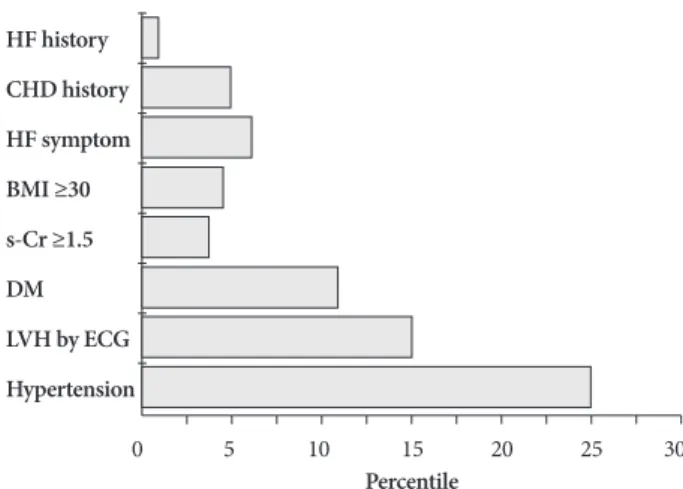
Fig. 1. Prevalence of risk factors for congestive heart failure in co- hort subjects. CHD: coronary heart disease, HF: heart failure, BMI:
body mass index, DM: diabetes mellitus, LVH: left ventricular hy- pertrophy, ECG: electrocardiogram, s-Cr: serum creatinine.
HF history CHD history HF symptom BMI ≥30 s-Cr ≥1.5 DM LVH by ECG Hypertension
Percentile
0 5 10 15 20 25 30
Results
Characteristics of the study population
Of 1,518 subjects, 627 were male (41.3%), and the mean age was 54.8±8.4 years. Risk factors for CHF included hyperten- sion (25%), left ventricular hypertrophy (LVH) by ECG (15%), hypercholestolemia (4.5%), smoking (32%), diabetes mellitus (DM) (10.9%), history of coronary heart disease (4.9%), his- tory of CHF (0.9%) heart failure symptoms (6.1%), elevated serum Cr (≥1.5, 3.7%), and obesity {(body mass index (BMI) ≥ 30, 4.6%} (Fig. 1). Of 1,518 subjects, the ‘normal’ population having no risk factors was 224 (14.8%, mean age 52.2±6.8), and the population of subjects with risk factors was 1,294 (85.2%, mean age 55.7±9.3).
The reference levels and distribution of N-terminal pro-B-type natriuretic peptide
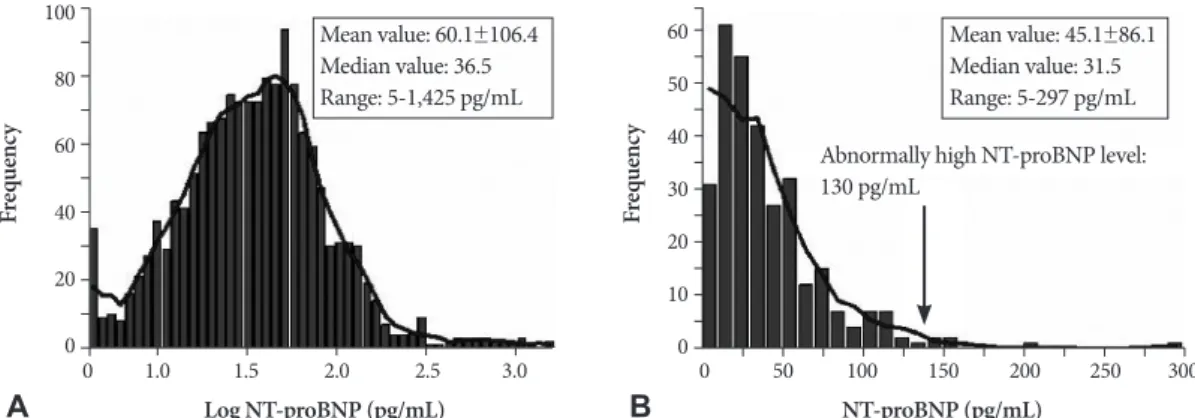
Plasma NT-proBNP levels were found to range widely, with a distribution skewed lower, towards a normal distribution af- ter log transformation (Fig. 2A). The mean level of NT-pro BNP for all subjects was was 60.1±42.1, the median level was 36.5 pg/mL, and the range was 5-1,425 pg/mL (Fig. 2A). Addi- tionally, the mean level of NT-proBNP for normal subjects was 45.1±86.1, the median level was 31.5 pg/mL, and the range was 5-297 pg/mL. In normal subjects, the level for 97.5% of was 130 pg/mL (Fig. 2B).
The correlation of N-terminal pro-B-type natriuretic peptide levels with clinical factors
In the total population, NT-proBNP levels were not signifi- cantly different between men and women (59.6±128.2 vs. 60.4
±88.6, p>0.05). However in normal subjects the mean plasma NT-proBNP level was slightly higher in females (25.7±24.8 vs.
46.9±35.4, p<0.001) (Fig. 3). The mean plasma NT-proBNP level increased with age in both groups. The mean plasma NT- proBNP level broke down by age as follows in the total popula- tion: for groups 40-49, 50-59, and 60-69, levels were 36.2±49.1, 57.5±102.2 and 84.2±139.4 pg/mL, respectively (p<0.01). We
Fig. 2. The distribution of NT-proBNP levels from cohort study. A: total population. B: normal population. NT-proBNP: N-terminal pro-B-type natriuretic peptide.
A B
100
80
60
40
20
0
60 50 40 30 20 10 0
Fr eq ue nc y Fr eq ue nc y
Log NT-proBNP (pg/mL) NT-proBNP (pg/mL)
Abnormally high NT-proBNP level:
130 pg/mL Mean value: 60.1±106.4
Median value: 36.5 Range: 5-1,425 pg/mL
Mean value: 45.1±86.1 Median value: 31.5 Range: 5-297 pg/mL
3.0 250 300
2.5 200
2.0 150
1.5 100
1.0 50
0 0
evaluated the mean level of NT-proBNP according to presence of risk factors. There were no significant differences in subjects who smoked, or had DM, hypertension or left ventricular hy- pertrophy by electrocardiography (ECG-LVH). However, NT- proBNP levels were higher in patients who had a history of CHF (213.8±258.8 vs. 58.5±103.29, p<0.001) (Fig. 4B), a high Fig. 4. The effect of risk factors (A) and presence of CHF (B) on NT-pro BNP levels. Data represent mean±SE. *p<0.05,
†p<0.005 among different groups in the same population. CHF: congested heart failure, NT-proBNP: N-terminal pro-B-type natriuretic peptide, SE:
standard error.
80
60
40
20
0
200
150
100
50
0
N T- pr oB N P (p g/ m L)
†
0 1-2 ≥3 CHF (-) CHF (+)
*
A B
80
60
40
20
0
N T- pr oB N P (p g/ m L)
Total Normal Total Normal
Male Female
*
,Fig. 3. The effect of gender on NT-proBNP levels in the normal pop- ulation and total population. Data represent mean±SE. *p<0.05,
†
p<0.005 among different groups in the same population. NT-proB- NP: N-terminal pro-B-type natriuretic peptide. SE: standard error.
†