useful biomarker for diagnosis of heart failure and monitoring treatment [2]. BNP is a biologically active hormone composed of 32 amino acids produced in the myocardium [2]. BNP increases in response to an increased myocardial wall stress [3]. Plasma BNP levels of 100 pg/mL and 400 pg/mL are helpful for exclusion and consideration of heart failure in untreated patients with symptoms of a heart failure, respectively [1, 3].
Various commercial BNP tests are performed using automated analyzers in many clinical laboratories [2]. The point of care (POC) test continues to be needed because it can reduce the clinical po- tential decision time in emergency situations by providing test re- sults within approximately one hour [1]. However, the POC test should be verified to have a good correlation and precision com- pared to those in the clinical laboratory assays [1].
A new SelexOnTM B-type natriuretic peptide assay (SelexOn
INTRODUCTION
Heart failure is a major global cause of disease and death [1]. B- type natriuretic peptide (BNP) is currently regarded as a clinically
현장검사용 SelexOn TM B형 나트륨이뇨펩티드 면역분석기의 성능 평가
Performance Evaluation of a Point of Care SelexOn
TMB-Type Natriuretic Peptide Immunoassay
제갈동욱1,2·이승옥1,3·최현유3·조세운3·박해일1,4
Dong Wook Jekarl, M.D.1,2, Seungok Lee, M.D.1,3, Hyunyu Choi, B.S.3, Se Woon Cho, M.T.3, Hae-il Park, M.D.1,4
가톨릭대학교 의과대학 진단검사의학교실1, 가톨릭대학교 서울성모병원 진단검사의학과2, 가톨릭대학교 인천성모병원 진단검사의학과3,
가톨릭대학교 부천성모병원 진단검사의학과4
Department of Laboratory Medicine1, College of Medicine, The Catholic University of Korea, Seoul; Department of Laboratory Medicine2, The Catholic University of Korea, Seoul St. Mary’s Hospital, Seoul; Department of Laboratory Medicine3, The Catholic University of Korea, Incheon St.
Mary’s Hospital, Incheon; Department of Laboratory Medicine4, The Catholic University of Korea, Bucheon St. Mary’s Hospital, Bucheon, Korea Lab Med Online
Vol. 10, No. 3: 207-213, July 2020
https://doi.org/10.3343/lmo.2020.10.3.207 임상화학
Corresponding author: Seungok Lee, M.D., Ph.D.
https://orcid.org/0000-0003-4538-8427
Department of Laboratory Medicine, College of Medicine, The Catholic University of Korea, Incheon St. Mary’s Hospital, 56 Dongsu-ro, Bupyung- gu, Incheon 21431, Korea
Tel: +82-32-280-5512, Fax: +82-32-280-5520, E-mail: [email protected] Received: July 30, 2019
Revision received: January 9, 2020 Accepted: January 13, 2020
This article is available from https://www.labmedonline.org 2020, Laboratory Medicine Online
This is an Open Access article distributed under the terms of the Creative Commons Attribution Non-Commercial License (https://creativecommons.org/licenses/by-nc/4.0/) which permits unrestricted non-commercial use, distribution, and reproduction in any medium, provided the original work is properly cited.
Background: This study was conducted to evaluate the analytical performance of the SelexOnTM B-type natriuretic peptide (BNP) assay (Osang Healthcare Inc., Korea), a new rapid lateral flow immunoassay for point of care (POC) testing using whole blood.
Methods: The imprecision, linearity, and method comparison of SelexOnTM BNP assay were evaluated. Two commercial BNP assays, the ADVIA Centaur® BNP (Siemens Health Care diagnostics Inc., USA) and the Triage® BNP assays (Alere, USA), were included for method comparison using 100 whole blood samples from patients. The reference interval was verified using 120 residual samples from health examination participants.
Results: The SelexOn BNP had total CVs of 20.3%, 13.3%, and 10.3% in BNP concentrations of 89.44 pg/mL, 480.71 pg/mL, and 1,201.84 pg/
mL of control materials, respectively. Linearity was observed from 56 pg/mL to 1544 pg/mL. The SelexOn BNP (y) regression equation was y=0.9706x-21.68 with Centaur BNP (x) (r=0.930) and y=0.7600x+0.0506 with Triage BNP (x) (r=0.845), respectively. The predicted mean differ- ence (%) of the SelexOn BNP at the clinical decision levels (100 pg/mL) was up to 25% lower than the two comparative methods. The SelexOn BNP levels were below 50 pg/mL in 114 (95%) of the 120 samples.
Conclusions: The SelexOn BNP using EDTA was developed as a POC test for differential diagnosis or treatment monitoring for acute heart fail- ure. However, clinical decision values must be improved to be compatible with other BNP methods.
Key Words: Point of care testing, B-type natriuretic peptide, Lateral flow immunoassay
2017-03-16 https://crossmark-cdn.crossref.org/widget/v2.0/logos/CROSSMARK_Color_square.svg
208 www.labmedonline.org
BNP) (Osang Healthcare Inc., Anyang, Korea) was recently devel- oped for POC testing. It consists of a single-use, disposable Selex- OnTM cartridge and a portable automated analyzer system. The principle for quantifying BNP is a rapid sandwich immunoassay using gold particles conjugated with a specific antibody on a test cartridge using lateral flow with K2EDTA-anticoagulated whole blood. The camera inside the analyzer detects the signal line in- tensity. The integrated software converts the signal intensity to a quantitative result by comparing with an internal calibration curve (Fig. 1).
MATERIALS AND METHODS
We evaluated the analytical performance of the SelexOn BNP compared to two BNP assays based on the Clinical and Labora- tory Standards Institute (CLSI) guidelines. This study was approved by the Catholic Medical Center Institutional Review Board (OC16- DISI0012).
1. Imprecision
Imprecision was evaluated according to the CLSI guideline EP15- A3 [4]. Low, medium, and high levels of the quality control materi- als were provided by the manufacturer. The control materials were measured in five replicates a day for five days. Repeatability and
within-laboratory imprecision at each level were assessed. Within- laboratory imprecision was compared to the desirable impreci- sion specification (15%) recommended by Apple et al. [5]. In addi- tion, two K2EDTA-anticoagulated whole blood samples near a clinical decision level of 100 pg/mL were measured in 20 repli- cates a day per sample to obtain repeatability since BNP should be measured within 4 h of collection at room temperature [5].
2. Linearity
Linearity was evaluated according to CLSI guideline EP6-A [6].
The claimed measuring interval ranged from 50 pg/mL to 2,000 pg/mL. Two patient samples with low (L) and high levels (H) were mixed as follows: 0.75*L+0.25*H, 0.5*L+0.5*H, 0.25*L+0.75*H. Each sample was measured three times using the SelexOn, and the mean values were compared to the expected values. Linear fit, second order, and third order polynomial regression analyses were per- formed. The regression equation was obtained (y, measured con- centration; x, expected concentration) using a linear fit model.
3. Method comparison
Method comparison was performed according to CLSI guide- line EP9-A3 [7]. Two BNP assays, the ADVIA Centaur® XPT BNP (Centaur BNP) (Siemens Health Care Diagnostics Inc., Tarrytown, NY, USA) and the Triage® BNP test (Triage BNP) (Alere, San Di- Fig. 1. The SelexonTM B-type natriuretic peptide (BNP) assay system. (A) The disposable cartridge uses a lateral flow immunoassay to detect BNP.
Control and test lines are visible on the nitro-cellulose membrane. The control line indicates that the sample has migrated across the membrane as intended. (B) The camera inside the analyzer detects the signal line intensity. The integrated software converts the signal intensity to a quantitative result and shows it on the display.
A B
Control zone Test zone Control zone Test zone
Control zone Test zone Control zone Test zone
Fig. 1. The Selexon TM B-type natriuretic peptide (BNP) assay system. (A) The disposable cartridge uses a lateral flow immunoassay to detect BNP. Control and test lines are visible on the nitro-
cellulose membrane. The control line indicates that the sample has migrated across the membrane as intended. (B) The camera inside the analyzer detects the signal line intensity. The integrated software converts the signal intensity to a quantitative result and shows it on the display.
A B
Control zone Test zone Control zone Test zone
Control zone Test zone Control zone Test zone
Fig. 1. The Selexon TM B-type natriuretic peptide (BNP) assay system. (A) The disposable cartridge uses a lateral flow immunoassay to detect BNP. Control and test lines are visible on the nitro-
cellulose membrane. The control line indicates that the sample has migrated across the membrane as intended. (B) The camera inside the analyzer detects the signal line intensity. The integrated
software converts the signal intensity to a quantitative result and shows it on the display.
A B
ego, CA, USA), were selected. The Centaur BNP is an automated sandwich immunoassay using EDTA plasma for central laboratory testing. The Triage BNP is a fluorescence immunoassay using EDTA plasma or whole blood for POC testing. K2EDTA-anticoagulated whole blood in a plastic tube was used to perform the SelexOn BNP and the Triage BNP, and the corresponding EDTA plasma was used to perform the Centaur BNP. Regression equations be- tween the compared assays were obtained using the Passing-Bablok fit.
4. Reference interval verification
A total of 120 EDTA whole blood residual samples obtained from individuals (aged from 22 years to 75 years; mean, 57 years), including 48 males (aged from 24 years to 75 years; mean, 60 years) and 72 females (aged from 22 years to 74 years; mean, 54 years) who participated in a health examination program without a med- ical history of cardiovascular disease or renal disease, were included to verify the reference interval (RI) of 100 pg/mL as a clinical deci- sion point claimed by the manufacturer [1, 3, 8].
5. Statistics
Analyze-it version 5.20 (Analyze-it Software, Ltd., Leeds, UK) was used to analyze imprecision, linearity, and method compari- son.
RESULTS
1. Imprecision
The repeatabilities were 15.8%, 9.0%, and 8.1% for three mean BNP control levels of 89 pg/mL, 481 pg/mL, and 1,202 pg/mL, re- spectively (Table 1). The total CV was 20.3% at 89.44 pg/mL, ex- ceeding the desirable imprecision specification (15%), 9.0% at
480.71 pg/mL and 8.1% 1201.84 pg/mL, which met the desirable imprecision specification advised by Apple et al. [5]. However, mean BNP levels in two clinical samples were 91 pg/mL and 116 pg/mL, with repeatabilities of 4.6% and 6.9%, which were lower than 15.8% of the 89 pg/mL for the control material.
2. Linearity
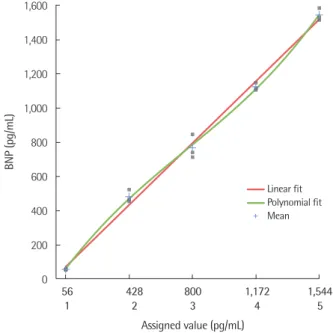
Linearity was observed from 56 pg/mL to 1544 pg/mL (Fig. 2).
The regression equation between the measured (y) and the assigned values (x) was y=16.38 + 0.9728x based on a linear fit (R2=0.992, recovery rate: 95.8%-112.6%). The expected bias for non-linearity between the linear fit and the nonlinear (third order polynomial) fit was -20.6% (95% CI, -78.3% to 37.1%), 8.5% (0.1% to 16.8%), -1.1%
(-4.6% to 2.4%), -3.9% (-6.9% to -0.8%), and 1.9% (-0.2% to 4.0%) at 56 pg/mL, 428 pg/mL, 800 pg/mL, 1,172 pg/mL, and 1,544 pg/mL, respectively.
3. Method comparison
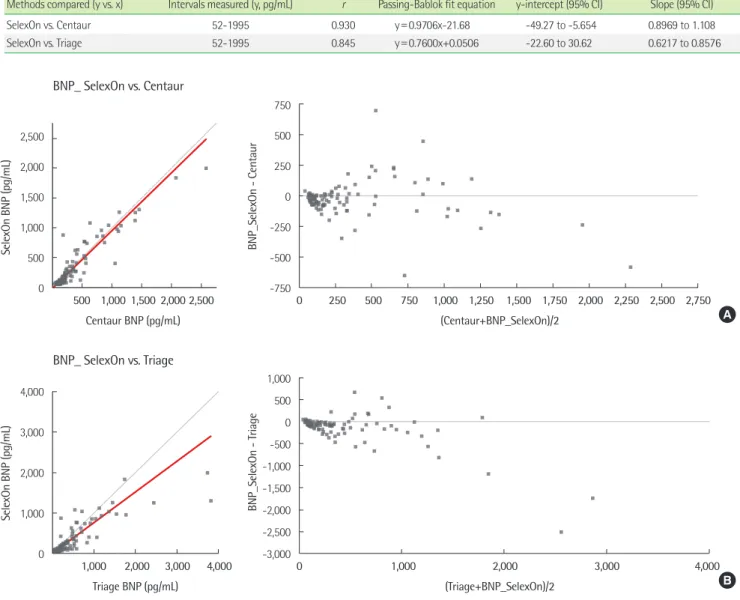
A total of 100 patient specimens within the measuring range in- structed by the SelexOn BNP manufacturer (50 pg/mL to 2,000 pg/mL) were available for method comparison (Table 2 and Fig.
3). The SelexOn BNP (y) showed correlation coefficients of 0.930 with the Centaur BNP (x) and 0.845 with the Triage BNP (x). The
Table 1. Precision of the SelexOnTM B-type natriuretic peptide (SelexOn BNP) assay
Material Mean BNP (pg/mL)
Repeatability Within-laboratory
SD CV SD CV
Control 1* 89 14 15.8% 18 20.3%
Control 2 481 43 9.0% 64 13.3%
Control 3 1,202 98 8.1% 124 10.3%
Sample 1† 91 4 4.6% - -
Sample 2 116 8 6.9% - -
*CLSI guideline EP15-A3 (five repeats a day for five days) for control materials.
†20 repeats a day for the K2EDTA-whole blood samples.
Fig. 2. Linearity of the SelexOnTM B-type natriuretic peptide assay. The red and green regression lines represent the linear and polynomial fits, respectively. The regression equation between the measured (y) and the assigned values (x) was y=16.38+0.9728x based on a linear fit (R2=0.992).
561 428
2 800
3 1172
4 1544
5 0
200 400 600 800 1000 1200 1400 1600
BNP, pg/mL
Assigned value, pg/mL
Linear fit Polynomial fit Mean
Fig. 2 . Linearity of the SelexOnTM B-type natriuretic peptide assay. The red and green regression lines represent the linear and polynomial fits, respectively. The regression equation between the measured (y) and the assigned values (x) was y = 16.38 + 0.9728x based on a linear fit (R2 = 0.992).
561 428
2 800
3 1172
4 1544
5 0
200 400 600 800 1000 1200 1400 1600
BNP, pg/mL
Assigned value, pg/mL
Linear fit Polynomial fit Mean
Fig. 2 . Linearity of the SelexOnTMB-type natriuretic peptide assay. The red and green regression lines represent the linear and polynomial fits, respectively. The regression equation between the measured
1,600 1,400 1,200 1,000 800 600 400 200 0
BNP (pg/mL)
Assigned value (pg/mL)
56 428 800 1,172 1,544
1 2 3 4 5
Linear fit Polynomial fit Mean
210 www.labmedonline.org
Table 2. Method comparison of the SelexOnTM BNP with the Centaur® BNP and the Triage® BNP assays (N=100)
Methods compared (y vs. x) Intervals measured (y, pg/mL) r Passing-Bablok fit equation y-intercept (95% CI) Slope (95% CI)
SelexOn vs. Centaur 52-1995 0.930 y=0.9706x-21.68 -49.27 to -5.654 0.8969 to 1.108
SelexOn vs. Triage 52-1995 0.845 y=0.7600x+0.0506 -22.60 to 30.62 0.6217 to 0.8576
Table 3. Distribution of BNP results from non-heart failure samples participating in the health examination program (N=120) Age group
All (%) All ages (N=120) <45 years (N=22) 45-54 years (N=22) 55-64 years (N=37) 65-75 years (N=39)
BNP (pg/mL) Male Female Male Female Male Female Male Female Male Female
<50 114 (95) 45 69 3 18 9 10 14 22 19 19
50-74 1 (0.8) 1 0 - - - 1
75-100 2 (1.7) 1 1 1 - - 1 -
101-160 3 (2.5) 1 2 - - 1 1 - 1
Fig. 3. Scatter plot of method comparison for the SelexOn BNP, the Centaur BNP, and the Triage BNP assays. The red line represents the linear re- gression equation by the Passing-Bablok fit (left) and difference plots (right). The SelexOn BNP (y) regression equation was (A) y=0.9706x-21.68 with Centaur BNP (x) (r=0.930), and (B) y=0.7600x+0.0506 with Triage BNP (x) (r=0.845).
0 1000 2000 3000 4000
0 1000 2000 3000 4000
SelexOn BNP, pg/mL
Triage BNP, pg/mL -3000
-2500 -2000 -1500 -1000 -500 0 500 1000
0 1000 2000 3000 4000
BNP_SelexOn -Triage
(Triage + BNP_SelexOn) / 2
(B) BNP_ SelexOn vs. Triage
0 1000 2000 3000 4000
0 1000 2000 3000 4000
SelexOn BNP, pg/mL
Triage BNP, pg/mL -3000
-2500 -2000 -1500 -1000 -500 0 500 1000
0 1000 2000 3000 4000
BNP_SelexOn -Triage
(Triage + BNP_SelexOn) / 2
(B) BNP_ SelexOn vs. Triage
-750 -500 -250 0 250 500 750
0 250 500 750 1000 1250 1500 1750 2000 2250 2500 2750
BNP_SelexOn -Centaur
(Centaur + BNP_SelexOn) / 2 0
500 1000 1500 2000 2500
0 500 1000 1500 2000 2500
SelexOn BNP, pg/mL
Centaur BNP, pg/mL
(A) BNP_ SelexOn vs. Centaur
Fig. 3 . Scatter plot of method comparison for the SelexOn BNP, the Centaur BNP, and the Triage BNP assays. The red line represents the linear regression equation by the Passing-Bablok fit (left) and difference plots (right). The SelexOn BNP (y) regression equation was (A) y = 0.9706x - 21.68 with Centaur BNP (x) (
r
= 0.930), and (B) y = 0.7600x + 0.0506 with Triage BNP (x) (r
= 0.845).-750 -500 -250 0 250 500 750
0 250 500 750 1000 1250 1500 1750 2000 2250 2500 2750
BNP_SelexOn -Centaur
(Centaur + BNP_SelexOn) / 2 0
500 1000 1500 2000 2500
0 500 1000 1500 2000 2500
SelexOn BNP, pg/mL
Centaur BNP, pg/mL
(A) BNP_ SelexOn vs. Centaur
Fig. 3 . Scatter plot of method comparison for the SelexOn BNP, the Centaur BNP, and the Triage BNP assays. The red line represents the linear regression equation by the Passing-Bablok fit (left) and difference plots (right). The SelexOn BNP (y) regression equation was (A) y = 0.9706x - 21.68 with Centaur BNP (x) (
r
= 0.930), and (B) y = 0.7600x + 0.0506 with Triage BNP (x) (r
= 0.845).2,500 2,000 1,500 1,000 500 0
SelexOn BNP (pg/mL)
Centaur BNP (pg/mL) 500 1,000 1,500 2,000 2,500
750 500 250 0 -250 -500 -750
BNP_SelexOn - Centaur
(Centaur+BNP_SelexOn)/2
0 250 500 750 1,000 1,250 1,500 1,750 2,000 2,250 2,500 2,750 BNP_ SelexOn vs. Centaur
A
4,000 3,000 2,000 1,000 0
SelexOn BNP (pg/mL)
Triage BNP (pg/mL)
1,000 2,000 3,000 4,000
1,000 500 0 -500 -1,000 -1,500 -2,000 -2,500 -3,000
BNP_SelexOn - Triage
(Triage+BNP_SelexOn)/2
0 1,000 2,000 3,000 4,000
BNP_ SelexOn vs. Triage
B
regression equations were y=0.9706x-21.68 with the Centaur BNP and y=0.7600x+0.0506 with the Triage BNP, respectively. The predicted mean difference (%) ((y–x)/y×100) of the SelexOn BNP (y) was -24.63% at 100 pg/mL and -8.63% at 400 pg/mL, respec-
tively, compared to the Centaur BNP (x). The predicted mean dif- ference (%) of the SelexOn BNP (y) was -24.0% at 100 pg/mL and -24.0% at 400 pg/mL, respectively, compared to the Triage BNP (x).
4. Verification of reference interval
Out of the 120 samples, 95.0% were less than 50 pg/mL, 96.3%
were less than 75 pg/mL, and 97.5% were less than 100 pg/mL.
The distribution of BNP results by age and gender have been sum- marized in Table 3. Of the 120 individuals across all ages, 45 males and 69 females showed BNP results below 50 pg/mL.
DISCUSSION
We evaluated the analytical performance of the SelexOn BNP for imprecision, linearity, method comparison, and verification of reference interval based on CLSI guidelines.
The total imprecision in the control material ranged from 10.3%
to 20.3%, and the CV (20.3%) at 89 pg/mL exceeded 15% of a de- sirable specification for imprecision [5, 9]. Although repeatability was only evaluated in consideration of BNP stability in whole blood [5], similar low concentration clinical samples had lower repeat- ability (4.6%-6.9%) than control (15.8%). This may be because the substrate of the manufacturer-provided control material was not the same as that of the clinical sample. On the basis of the intra- individual biological variation (CVI), the goal for imprecision should be less than or equal to half of the CVI [5, 10]. BNP has a very wide intra-individual biological variation (CVI, 30%-50%) like other hor- mones, and the total imprecision of the SelexOn BNP is consid- ered less than the minimum requirement of analytical imprecision goal (25%) [9-12, 14].
BNP usually increases in heart failure, and patients with a higher BNP value (≥100 pg/mL) in the acute setting should be evaluated via further work-up to rule out heart failure [1, 3, 13]. If the BNP level rises above 35 pg/mL in patients with a suspected heart fail- ure in the non-acute setting, additional echocardiography should be recommended for heart failure [13]. BNP can also increase in various cardiac and non-cardiac conditions like acute coronary syndrome, acute myocardial infarction, pulmonary embolism, hy- perthyroidism, renal failure, or septic shock [11, 13]. Therefore, BNP is reportedly a useful biomarker for ruling out rather than di- agnosing heart failure because BNP at clinical decision levels has high negative predictive values in both the acute and the non-acute settings [13]. In addition, High BNP during heart failure follow-up and monitoring is also reportedly associated with adverse out- comes [13].
Here, the correlation between the SelexOn BNP with the other
two BNP assays was not high (r=0.930 for the Centaur BNP; r= 0.845 for the Triage BNP), and the predicted mean difference (%) of the SelexOn BNP at clinical decision levels the 100 pg/mL and 400 pg/mL was up to 25% lower than that in the two comparable assays. The substantial differences between methods agree with the previous BNP immunoassay comparison studies [1, 2, 10, 14, 15]. Similar results have been reported in previous studies com- paring the Triage and the Centaur BNPs [10, 14]. The main puta- tive cause of the non-harmonized BNP assays is that there are no primary reference materials for BNP measurements; many manu- facturers use different antibodies and calibrators for BNP immu- noassays [1, 2, 16]. Therefore, it is important to identify and har- monize the systematic differences in BNP assays, and more ap- propriate clinical decision thresholds may be necessary for the in- dividual BNP assay [2, 14]. If the BNP assay has a negative system- atic bias, it may be interpreted as a false negative in disease differ- ential diagnosis at low concentrations near 100 pg/mL. Our re- sults suggest that calibration adjustments may be necessary to im- prove the negative systematic bias of the SelexOn BNP. Variations between lots can have a significant impact on the test results for cartridge-type POT tests, but the lot-to-lot variability was not eval- uated in the present study.
In the reference interval verification, most (95% of the 120 indi- viduals) with the SelexOn BNP exhibited values below 50 pg/mL.
There was no difference observed between gender and age in the ratio outside the reference interval for the clinical decision point, but further study will be needed for stratified reference intervals.
The BNP reference intervals for the healthy elderly are higher than the clinical decision level used for the heart failure guidelines [13, 17, 18]. Therefore, for the elderly, data should be interpreted in re- lation with the clinical symptoms [17, 18].
In summary, the SelexOn BNP using EDTA whole blood was developed as a POC test for differential diagnosis or treatment monitoring for acute heart failure. However, harmonization should be further strengthened to ensure that clinical decision values are compatible with other BNP methods.
요 약
배경: 이 연구는 전혈을 이용한 현장검사용 새로운 신속 측방유동 면역분석법인 SelexOnTM B형 나트륨이뇨펩티드(B-type natriuretic peptide, BNP) 검사(Osang Healthcare, Korea)의 분석적 성능을
212 www.labmedonline.org 평가하기 위해 수행되었다.
방법: SelexOnTM BNP 검사의 비정밀도, 직선성 및 검사법 비교를 평가하였다. 방법 비교를 위해서는 두 가지 상업용 BNP 분석법인 ADVIA Centaur® BNP (Siemens Healthcare diagnostics Inc., USA) 와 Triage® BNP (Alere, USA) 검사를 100명의 환자 전혈을 이용하 여 실시하였다. 참고구간은 건강검진 참가자 120명의 잔여 검체로 검정하였다.
결과: SelexOn BNP는 BNP 농도가 각각 89.44 pg/mL, 480.71 pg/
mL 및 1,201.84 pg/mL인 경우 총 변이계수(CV)가 20.3%, 13.3% 및 10.3%였다. 직선성은 평가된 56 pg/mL-1,544 pg/mL범위에서 관찰 되었다. SelexOn BNP (y)의 회귀 방정식은 각각 Centaur BNP (x)와 y=0.9706x-21.68 (r=0.930), Triage BNP (x)와 y=0.7600x+0.0506 (r=0.845)이었다. 임상적 의사결정농도(100 pg/mL)에서 SelexOn
BNP의 예측 값은 두 개의 비교 가능한 분석법보다 최대 25% 낮았
다. 120 검체 중 114 (95%) 검체에서 SelexOn BNP 수치가 50 pg/
mL 미만이었다.
결론: SelexOn BNP가 EDTA 전혈을 사용하여 신속하게 급성 심 부전의 감별 진단과 치료 모니터링을 위한 현장검사로 사용되기 위해서는 다른 BNP 분석법과 호환가능한 임상적 의사결정농도를 갖도록 더욱 향상되어야 할 것이다.
Conflicts of Interest
None declared.
Acknowledgements
This research was supported by a grant of the Korea Health Tech- nology R&D Project through the Korea Health Industry Develop- ment Institute (KHIDI), funded by the Ministry of Health & Wel- fare, Republic of Korea (grant number: HI16C0821).
This research was supported by a Grant of Translational R&D Project through the Institute for Bio-Medical Convergence, Incheon St. Mary’s Hospital, The Catholic University of Korea.
We are grateful to Sang Gil Bae, Hyeji You, and Seon-Hwa Kim for excellent technical assistance.
REFERENCES
1. Fu S, Ping P, Zhu Q, Ye P, Luo L. Brain natriuretic peptide and its bio- chemical, analytical, and clinical issues in heart failure: A narrative re- view. Front Physiol 2018;9:692.
2. Semenov AG, Tamm NN, Apple FS, Schulz KM, Love SA, Ler R, et al.
Searching for a BNP standard: Glycosylated proBNP as a common cal- ibrator enables improved comparability of commercial BNP immuno- assays. Clin Biochem 2017;50:181-5.
3. Dickstein K, Cohen-Solal A, Filippatos G, McMurray JJ, Ponikowski P, Poole-Wilson PA, et al. ESC guidelines for the diagnosis and treatment of acute and chronic heart failure 2008: The task force for the diagno- sis and treatment of acute and chronic heart failure 2008 of the Euro- pean Society of Cardiology. Developed in collaboration with the Heart Failure Association of the ESC (HFA) and endorsed by the European Society of Intensive Care Medicine (ESICM). Eur J Heart Fail 2008;10:
933-89.
4. Clinical and Laboratory Standards Institute. User verification of preci- sion and estimation of bias; Approved guideline—Third edition. CLSI document EP15-A3. Wayne, PA: Clinical and Laboratory Standards In- stitute, 2014.
5. Apple FS, Panteghini M, Ravkilde J, Mair J, Wu AH, Tate J, et al. Qual- ity specifications for B-type natriuretic peptide assays. Clin Chem 2005;
51:486-93.
6. Clinical and Laboratory Standards Institute. Evaluation of the linearity of quantitative measurement procedures: A statistical approach; Ap- proved guideline. CLSI document EP06-A. Wayne, PA: Clinical and Laboratory Standards Institute, 2003.
7. Clinical and Laboratory Standards Institute. Measurement procedure comparison and bias estimation using patient samples; Approved guide- line—Third edition. CLSI document EP09-A3. Wayne, PA: Clinical and Laboratory Standards Institute, 2013.
8. Clinical and Laboratory Standards Institute. Defining, establishing, and verifying reference intervals in the clinical laboratory; Approved guideline—Third edition. CLSI document EP28-A3c. Wayne, PA: Clini- cal and Laboratory Standards Institute, 2010.
9. Plebani M and Siest G. Natriuretic peptides and evidence-based qual- ity specifications. Clin Chem Lab Med 2006;44:355-7.
10. Wu AH, Packer M, Smith A, Bijou R, Fink D, Mair J, et al. Analytical and clinical evaluation of the Bayer ADVIA Centaur automated B-type natriuretic peptide assay in patients with heart failure: a multisite study.
Clin Chem 2004;50:867-73.
11. Clerico A, Carlo Zucchelli G, Pilo A, Passino C, Emdin M. Clinical rele- vance of biological variation: the lesson of brain natriuretic peptide (BNP) and NT-proBNP assay. Clin Chem Lab Med 2006;44:366-78.
12. Bruins S, Fokkema MR, Römer JW, Dejongste MJ, van der Dijs FP, van den Ouweland JM, et al. High intraindividual variation of B-type natri-
uretic peptide (BNP) and amino-terminal proBNP in patients with sta- ble chronic heart failure. Clin Chem 2004;50:2052-8.
13. Ponikowski P, Voors AA, Anker SD, Bueno H, Cleland JGF, Coats AJS, et al. 2016 ESC Guidelines for the diagnosis and treatment of acute and chronic heart failure: The task force for the diagnosis and treatment of acute and chronic heart failure of the European Society of Cardiology (ESC). Developed with the special contribution of the Heart Failure Association (HFA) of the ESC. Eur Heart J 2016;37:2129-200.
14. Prontera C, Zaninotto M, Giovannini S, Zucchelli GC, Pilo A, Sciacov- elli L, et al. Proficiency testing project for brain natriuretic peptide (BNP) and the N-terminal part of the propeptide of BNP (NT-proBNP) immu- noassays: The CardioOrmocheck study. Clin Chem Lab Med 2009;47:
762-8.
15. Kang SY, Suh JT, Kim MH, Lee WI, Lee HJ. Evaluation of BNP assays with Access 2 and AxSYM BNP in comparison with Point-of-Care Tri- age BNP assay. Korean J Lab Med 2005;25:300-5.
16. Clerico A, Zaninotto M, Passino C, Plebani M. New issues on measure- ment of B-type natriuretic peptides. Clin Chem Lab Med 2017;56:32-9.
17. Alehagen U, Goetze JP, Dahlström U. Reference intervals and decision limits for B-type natriuretic peptide (BNP) and its precursor (Nt-proBNP) in the elderly. Clin Chim Acta 2007;382:8-14.
18. Keyzer JM, Hoffmann JJ, Ringoir L, Nabbe KC, Widdershoven JW, Pop VJ. Age- and gender-specific brain natriuretic peptide (BNP) reference ranges in primary care. Clin Chem Lab Med 2014;52:1341-6.