INTRODUCTION
It is estimated that more than 10% of adults have chronic kidney disease (CKD), and its prevalence is gradually increas- ing (1). Patients with chronic kidney disease are at increased risk of cardiovascular death (2). Left ventricular (LV) systolic dysfunction is a common terminal pathway for a variety of heart diseases. The presence of LV systolic dysfunction is asso- ciated with high morbidity and mortality in CKD patients (3). However, LV systolic dysfunction is difficult to identify based solely on the clinical history and physical examination, because neither is specific nor sensitive (4, 5). Although echocar- diography is the current “gold standard” for evaluation of car- diac dysfunction (3), it is expensive and not always readily available.
Recently, brain natriuretic peptide (BNP) and N-terminal pro-brain natriuretic peptide (NT-proBNP) have been exten- sively studied as useful biochemical markers of ventricular dysfunction and heart failure in the general population (5-8).
The kidney appears to play an important role in the clearance of NT-proBNP. Several studies have demonstrated that im- paired renal function increases NT-proBNP levels, indepen- dent of ventricular function (9, 10). Therefore, diagnostic value of NT-proBNP to predict LV systolic function in patients with
significant renal impairment remains unclear. Moreover, poten- tial cut points of NT-proBNP to detect LV systolic dysfunc- tion in patients with CKD has not been systematically eval- uated. For these reasons, we undertook this study to evaluate whether NT-proBNP levels could predict ventricular dysfunc- tion in patients with established CKD.
MATERIALS AND METHODS Patients
We enrolled retrospectively adult patients with CKD who visited the outpatient clinic of the Department of Nephrology or the emergency room between March 2003 and March 2005 on whom we performed both NT-proBNP measurement and echocardiography. We excluded patients undergoing dialysis or those with a glomerular filtration rate (GFR) greater 60 mL/min/1.73 m2. A total of 274 patients were identified. We then excluded 18 patients who were finally diagnosed as hav- ing pulmonary diseases such as pulmonary thromboembolism or pneumonia. This left a final set of 256 patients to be ana- lyzed. The causes of CKD were diabetic nephropathy (155 patients), hypertensive nephrosclerosis (34 patients), chronic
S63
Jung Eun Lee, So Yeon Choi, Wooseong Huh, Seong Woo Park*, Dae Joong Kim, Ha Young Oh, and Yoon-Goo Kim
Divisions of Nephrology and Cardiology*, Department of Medicine, Samsung Medical Center, Sungkyunkwan University School of Medicine, Seoul, Korea
Address for correspondence Yoon-Goo Kim, M.D.
Division of Nephrology, Samsung Medical Center, Sungkyunkwan University School of Medicine, 50 Irwon-dong, Gangnam-gu, Seoul 135-710, Korea Tel : +82.2-3410-3442, Fax : +82.2-3410-0067 E-mail : [email protected]
*This work was supported by a grant from IN-SUNG Foundation for Medical Research and Samsung Medical Center.
DOI: 10.3346/jkms.2009.24.S1.S63
N-terminal Pro-Brain Natriuretic Peptide Levels Predict Left Ventricular Systolic Function in Patients with Chronic Kidney Disease
N-terminal pro-brain natriuretic peptide (NT-proBNP) can be a useful marker for left ventricular (LV) dysfunction in patients without kidney disease. This study was con- ducted to clarify the relationship between NT-proBNP and LV systolic function in pa- tients with decreased renal function. We studied 256 chronic kidney disease (CKD) patients, patients on dialysis were excluded. The median glomerular filtration rate was 24 (13-36) mL/min/1.73 m2and the median NT-proBNP was 4,849 (1,310- 19,009) pg/mL. The prevalence of LV systolic dysfunction increased from the lower to the upper NT-proBNP quartiles (I, 17%; II, 34%; III, 61%; and IV, 72%; p<0.001 for trend). The NT-proBNP quartile was an independent predictor of LV systolic dys- function after adjustment for renal function, compared with quartile I: II, odds ratio (OR) 3.99 (95% confidence interval [CI],1.34-11.93); III, OR 11.28 (95% CI, 3.74-33.95);
and IV, OR 36.97 (95% CI, 11.47-119.1). Area under the curve and optimum cut points for NT-proBNP to detect LV systolic dysfunction were 0.781 and 2,165 pg/mL in CKD stage 3, 0.812 and 4,740 pg/mL in CKD stage 4, and 0.745 and 15,892 pg/
mL in CKD stage 5. The NT-proBNP level was a predictor of LV systolic dysfunction in CKD patients. Optimum cut points should be stratified according to renal function.
Key Words : Biological Markers; Kidney Failure, Chronic; Ventricular Dysfunction, Left; Pro-brain Natriuretic Peptide (1-76)
Received : 27 August 2008 Accepted : 17 December 2008
glomerulonephritis (25 patients), autosomal dominant poly- cystic kidney disease (five patients), other causes (four patients) and unknown causes (33 patients). 78 patients were enrolled in outpatient clinics and others were enrolled in emergency room.
Clinical variables
Patients’ demographic and clinical information were obtained by chart review. A diagnosis of diabetes, hypertension, and coronary artery disease (CAD) were included if they were iden- tified in the patient’s history and/or by physical examination.
CAD was defined as documented myocardial infarction, coro- nary artery bypass graft surgery, or percutaneous coronary inter- vention. The GFR was estimated using the abbreviated Mod- ification of Diet in Renal Disease formula (1). Each estimat- ed GFR was categorized into one of three groups as less than 15 mL/min/1.73 m2(CKD stage 5), 15-29 mL/min/1.73 m2 (CKD stage 4), and 30-59 mL/min/1.73 m2(CKD stage 3) (1).
Echocardiographic measurement and definition
Echocardiography was performed as per our standard lab- oratory protocol by one of five expert sonographers. Findings were analyzed to quantify LV ejection fraction (EF) and LV mass. LV mass was determined by using the formula of Dev- ereux et al. (11) which was adjusted for height. Left ventric- ular hypertrophy (LVH) was considered to be present when the LV mass index was greater than two standard deviations
above the mean of the respective gender control group. The EF was calculated by the Simpson method, using end-dias- tolic volume and end-systolic volume measurements. LV sys- tolic dysfunction was defined as an LV EF of 50% or less.
Assay for NT-proBNP
Blood samples were drawn routinely in lithium heparin tubes and centrifuged at 1,000 g for 12 min. The plasma was used for measurement of NT-proBNP using a commercially available immunoassay (Elecsys proBNP; Roche Diagnostic Corp, Indianapolis, IN, U.S.A.) on an Elecsys 1,010 analyz- er according to the manufacturer’s directions. The measur- able range of the NT-proBNP assay was up to 35,000 pg/mL.
Statistical analysis
Data for continuous variables were expressed as median and interquartile ranges. Categorical variables were expressed as absolute numbers and percentages. Comparisons between three or more data groups were analyzed by a nonparametric (Krus- kal-Wallis) test for continuous variables and by a likelihood ratio test for trends for categorical variables. To assess the inde- pendent contribution to LV systolic dysfunction, we used logis- tic regression. A p value of less than 0.05 was considered to be statistically significant. Separate receiver operating char- acteristic (ROC) curves were generated for NT-proBNP and detection of LV systolic dysfunction, as a function of GFR categories. All statistical analyses for this study were conduct-
Values expressed as median (interquartile range). Categorical data expressed as number (percent).
*We could not assess information regarding these variables in some patients (less than 10% of the study patients). Thus, the sums of numbers given do not equal 256.
NYHA, New York Heart Association; LE, lower extremity; GFR, glomerular filtration rate; LV MI, left ventricular mass index; LV EF, left ventricular ejection fraction; LVH, left ventricular hypertrophy; NT- proBNP, N-terminal pro-brain natriuretic peptide.
Variables Quartile I Quartile II Quartile III Quartile IV
(40-1,303 pg/mL) (1,331-4,773 pg/mL) (4,925-18,392 pg/mL) (19,215-35,000 pg/mL) p
No of Patients 64 64 64 64 -
Age (yr) 65 (58-73) 67 (54-77) 67 (61-73) 63 (53-74) NS
Men 39 (61%) 40 (63%) 40 (63%) 30 (47%) NS
*NYHA class O or I/II/III/IV 42/5/10/3 31/11/15/2 20/7/18/15 14/8/14/18 <0.001
*Orthopnea (yes/no) 9/52 8/52 17/40 29/30 <0.001
*LE edema (yes/no) 10/52 15/44 25/37 37/24 <0.001
Diabetes 34 (53%) 31 (48%) 36 (56%) 46 (72%) 0.004
Hypertension 45 (70%) 43 (67%) 48 (75%) 49 (77%) 0.036
Coronary artery disease 9 (14%) 21 (33%) 26 (41%) 20 (31%) <0.001
Hemoglobin (g/dL) 10.3 (9.0-12.0) 9.6 (8.4-11.2) 10.8 (9.3-12.4) 9.3 (8.4-10.7) 0.012
GFR (mL/min/1.73 m2) 30 (20-43) 25 (16-37) 22 (13-38) 18 (9-28) <0.001
CKD stage 3/4/5 32/21/11 23/27/14 21/23/20 11/22/31 <0.001
LV MI (gm/m2) 148 (118-178) 146 (114-175) 169 (144-202) 181 (154-221) <0.001
LV EF (%) 62 (55-68) 58 (44-67) 45 (30-58) 40 (34-52) <0.001
*LVH (yes/no) 34/20 41/19 53/7 52/9 <0.001
LV EF <40% 2 (3%) 14 (22%) 27 (42%) 33 (52%) <0.001
LV EF <50% 11 (17%) 22 (34%) 39 (61%) 46 (72%) <0.001
Table 1. Clinical characteristics and echocardiographic findings according to NT-proBNP quartiles
ed with SPSS 11.0 for Windows.
RESULTS
The demographics of the study patients were as follows. The median age was 66 (58-74) yr. There were 149 men and 107 women. The most prominent symptoms were shortness of breath in 111 patients, chest discomfort in 45 patients, periph- eral edema in 18 patients, and other symptoms in 59 patients.
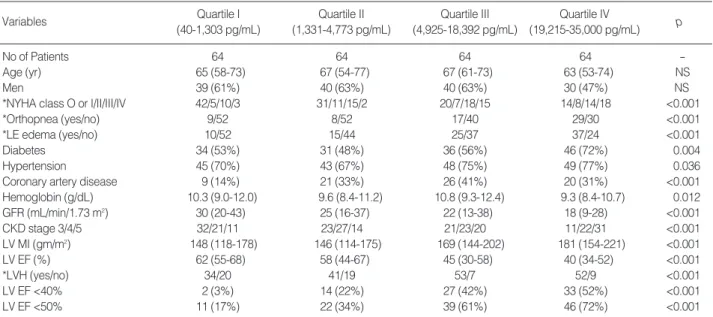
Twenty-three patients were asymptomatic. The median GFR was 24 (13-36) mL/min/1.73 m2and the median NT-proB- NP level was 4,849 (1,310-19,009) pg/mL. LVH was present in 77% of the patients and 118 (46%) had LV systolic dys- function. Clinical and echocardiographic findings stratified by NT-proBNP quartiles are listed in Table 1. Patients in the upper NT-proBNP quartiles showed higher New York Heart Association function classes. Orthopnea and lower ex- tremity edema were observed more often in patients in upper NT-proBNP quartiles. Diabetes, hypertension, and CAD were also more prevalent in the upper NT-proBNP quartiles. Medi- an estimated GFR and median LV EF decreased from the lower to the upper NT-proBNP quartiles. The prevalence of LV sys- tolic dysfunction increased from 17% in the lowest quartile
to 72% in the highest quartile.
We classified patients by CKD stage, with 87 (34%) patients with CKD stage 3, 93 (36%) with CKD stage 4, and 76 (30%) with CKD stage 5. Table 2 shows clinical and echocardio- graphic findings according to CKD stages. Orthopnea and lower extremity edema were observed more often in patients with advanced stage of CKD.
Fig. 1 shows median NT-proBNP levels according to LV systolic function and CKD stage. The median NT-proBNP level increased progressively with lower LV EF in each CKD stages (all p<0.001 for trend). Also the median NT-proBNP level increased from CKD stage 3 to stage 5 in each LV EF groups (all p<0.001 for trend). Of note is that CKD stage 5 patients with normal LV systolic function had NT-proBNP levels similar to those in CKD stage 3 patients with LV EF of less than 40% (8,859 [1,672-21,831]pg/mL vs. 8,026
[2,605-17,994]pg/mL).
Multiple logistic regression analyses were performed to deter- mine whether the NT-proBNP level could independently pre- dict the presence of LV systolic dysfunction. The NT-proB- NP quartile was found to be an independent predictor of LV systolic dysfunction after adjustment for age, gender, CAD, diabetes, hypertension, GFR, hemoglobin levels, and LVH.
The odds ratio of having LV systolic dysfunction increased
Variables CKD stage 3 CKD stage 4 CKD stage 5 p
No of Patients 87 93 76
*NYHA class
O or I/II/III/IV 50/10/20/7 25/6/24/15 32/15/13/16 0.005
*Orthopnea (yes/no) 14/73 22/53 27/48 0.001
*LE edema (yes/no) 19/68 29/56 39/33 0.001
*LVH (yes/no) 51/21 64/23 65/11 0.001
LV EF <50% 45 (52%) 46 (50%) 27 (36%) 0.042 Data expressed as number (percent).
*We could not assess information regarding these variables in some patients. Thus, the sums of numbers given do not equal 256.
NYHA, New York Heart Association; LE, lower extremity; LVH, left ven- tricular hypertrophy; LV EF, left ventricular ejection fraction.
Table 2. Clinical characteristics and echocardiographic findings according to CKD stages
LV EF <50% LV EF <40%
Odds ratio (95% CI) p Odds ratio (95% CI) p
NT-proBNP
Quartile I 1 1
Quartile II 3.99 (1.34-11.93) 0.013 28.08 (2.63-299.1) 0.006
Quartile III 11.28 (3.74-33.95) <0.001 56.39 (5.58-569.5) 0.001
Quartile IV 36.97 (11.47-119.1) <0.001 256.6 (22.57-2915) <0.001
These models also included age, gender, coronary artery disease, diabetes, hypertension, glomerular filtration rate, hemoglobin, and left ventricular hypertrophy.
LV EF, left ventricular ejection fraction; NT-proBNP, N-terminal pro-brain natriuretic peptide.
Table 3. Multiple logistic regression models-association between NT-proBNP quartiles and LV systolic function
Fig. 1. Median NT-proBNP level according to left ventricular systolic function and CKD stage (p<0.01 for both inter-CKD stages and inter- LV EF groups).
Plasma NT-proBNP (pg/mL)
35,000 30,000 25,000 20,000 15,000 10,000 5,000
0 CKD stage 3 Stage 4 Stage 5
LVEF ≤40%
LVEF 40-50%
LVEF >50%
progressively in the higher NT-proBNP quartiles. Patients in the highest quartile had nearly 37-fold increased odds of having LV systolic dysfunction, compared with those in the lowest quartile (odds ratio 36.97; 95% CI, 11.47 to 119.1).
The NT-proBNP quartile was also an independent predic- tor of having an LV EF less than 40%.
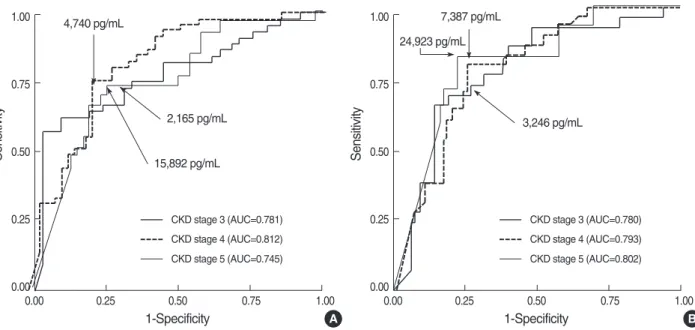
ROC curves for NT-proBNP to detect LV systolic dysfunc- tion (LV EF ≤50%), and for each of the CKD stages, are pre- sented in Fig. 2A. AUC and optimum cut points were 0.781 and 2,165 pg/mL, 0.812 and 4,740 pg/mL, and 0.745 and 15,892 pg/mL in patients with CKD stage 3, 4, and 5. Using these levels, the sensitivity and specificity of NT-proBNP were 73% and 69%, 76% and 77%, and 74% and 74% in CKD stage 3, 4, and 5, respectively. AUC to detect severe LV sys- tolic dysfunction (LV EF ≤40%) were 0.780, 0.793, and 0.802 for CKD stage 3, 4, and 5, respectively (Fig. 2B). Opti- mum cut points for NT-proBNP increased progressively with CKD stage.
DISCUSSION
This study demonstrates that NT-proBNP was an indepen- dent predictor of LV systolic dysfunction in patients with established CKD. Although NT-proBNP level was increased with decreasing GFR, the NT-proBNP level was negatively associated with LV EF independent of renal dysfunction. Opti- mum cut points of NT-proBNP to detect LV systolic dysfunc- tion were much higher in CKD patients than those reported in the general population and these were increased progres- sively with lower renal function. These results suggest that even in patients with advanced renal dysfunction, the mea-
surement of NT-proBNP level might be of benefit in predict- ing LV systolic function in the setting of suspected heart fail- ure and that the NT-proBNP level should be interpreted along with values for renal function in order to predict LV systolic dysfunction. If cut points without adjustment for renal func- tion are applied, the usefulness of NT-proBNP levels is lim- ited in CKD patients.
The diagnostic and prognostic roles of NT-proBNP have been well established in a variety of cardiac diseases (9, 10, 12-15). Most investigators have excluded CKD patients from their studies because of potentially elevated levels of the pep- tide (9, 10, 12-15). However, an easily measurable biomarker for cardiac disease is sorely needed in CKD patients, because symptoms mimicking congestive heart failure occur very often among them (3). Our study suggests that NT-proBNP mea- surement might be used as a screening tool in CKD patients with clinically suspected LV systolic dysfunction. Compared with patients in the lowest NT-proBNP quartile, patients in the upper quartiles had an increased probability of LV systolic dysfunction, based on multivariate analysis.
Previous studies investigating the clinical implications of NT-proBNP measurement in CKD patients showed that NT- proBNP quartile were associated with LVH and coronary artery disease in stable pre-ESRD patients (16-19). In our current study, the prevalence of LVH increased in the higher NT-proB- NP quartiles. However, after adjustment for the GFR, levels of NT-proBNP alone could not predict the presence of LVH (data not shown). A thickened LV wall might lead to an in- creased secretion of NT-proBNP in CKD patients, just as in subjects without kidney disease (11). We presume that the effect of LVH on the NT-proBNP level was much smaller than the effect of impaired renal function or LV systolic dysfunc-
Fig. 2. Receiver operating characteristic curves for NT-proBNP to detect LV EF ≤50% (A) and LV EF ≤40% (B) in each stages of CKD.
A
Sensitivity
1.00
0.75
0.50
0.25
0.00
0.00 0.25 0.50 0.75 1.00
1-Specificity 2,165 pg/mL 4,740 pg/mL
15,892 pg/mL
CKD stage 3 (AUC=0.781) CKD stage 4 (AUC=0.812) CKD stage 5 (AUC=0.745)
B
Sensitivity
1.00
0.75
0.50
0.25
0.00
0.00 0.25 0.50 0.75 1.00
1-Specificity 3,246 pg/mL 24,923 pg/mL
CKD stage 3 (AUC=0.780) CKD stage 4 (AUC=0.793) CKD stage 5 (AUC=0.802) 7,387 pg/mL
tion. Accordingly, NT-proBNP was not an independent pre- dictor of LVH in our patients with a high prevalence of LV systolic dysfunction and advanced renal dysfunction. Previ- ous studies showed lower prevalence of LV systolic function than our study and the relation between LV systolic function and NT-proBNP levels were not evaluated systemically. Alt- hough a few studies have shown that NT-proBNP level was associated with LV systolic function in CKD patients, inde- pendent association were not evaluated (20, 21).
It is well established that impaired renal function is asso- ciated with an elevated NT-proBNP level (9, 10, 14, 18). The NT-proBNP level is likely to increase corresponding to the severity of renal dysfunction by several possible mechanisms.
Decreased renal clearance may play a role, at least in part (22).
Concomitant anemia and cardiac overload may contribute to an increase in the NT-proBNP level in CKD patients, in the same manner as for the BNP level (22). Elevated NT-proB- NP may also reflect silent myocardial infarction, LVH or dias- tolic dysfunction (18, 23).
The high prevalence of LV dysfunction seen in our study is noteworthy. There were 46% of patients with LV systolic dysfunction and 77% of patients with LVH. Higher preva- lence of LV systolic dysfunction than in previous studies on CKD patients (16-18) could be explained that we included patients who need emergent treatment and most patients were symptomatic.
Several limitations apply to this study. First, we did not consider volume status or silent myocardial ischemia. Both might be associated with NT-proBNP levels in CKD patients.
However, it is difficult to evaluate the exact volume status or assess silent myocardial ischemia based solely on clinical findings. Second, the NT-proBNP assay used in the study has an upper limit of 35,000 pg/mL. 14% of our study patients had a NT-proBNP level equal or greater to this. Therefore, we could not analyze direct correlations of the NT-proBNP level with GFR or LVEF. Instead, we stratified by quartiles to analyze the relationship between NT-proBNP levels and LV systolic function. Third, the fact that our study patients were relatively old limits the generalizability of our finding in the whole CKD patients. Fourth, GFRs estimated using the abbreviated MDRD study equation were used to classi- fy CKD stages. Although, the MDRD study equation has been used widely in large epidemiologic studies and in clin- ical practice, it has not been validated for the Korean popu- lation.
In summary, although the NT-proBNP level is increased in the majority of patients with renal dysfunction, higher NT- proBNP levels were associated with a higher prevalence of LV systolic dysfunction, independent of renal function. The measurement of NT-proBNP levels might be of benefit in the prediction of LV systolic function in CKD patients with suspected congestive heart failure. However, renal function must be taken into consideration when NT-proBNP mea- surement is used as a diagnostic tool. A prospective study is
needed to determine the diagnostic value and optimal cut- off levels for NT-proBNP for predicting LV dysfunction in CKD patients.
REFERENCES
1. National Kidney Foundation. K/DOQI clinical practice guidelines for chronic kidney disease: evaluation, classification, and stratifica- tion. Am J Kidney Dis 2002; 39 (2 Suppl 1): S1-266.
2. Mann JF, Gerstein HC, Pogue J, Bosch J, Yusuf S. Renal insufficien- cy as a predictor of cardiovascular outcomes and the impact of ramipril:
the HOPE randomized trial. Ann Intern Med 2001; 134: 629-36.
3. K/DOQI Workgroup. K/DOQI clinical practice guidelines for car- diovascular disease in dialysis patients. Am J Kidney Dis 2005; 45 (4 Suppl 3): S1-153.
4. Stevenson LW, Perloff JK. The limited reliability of physical signs for estimating hemodynamics in chronic heart failure. JAMA 1989;
261: 884-8.
5. Maisel AS, Krishnaswamy P, Nowak RM, McCord J, Hollander JE, Duc P, Omland T, Storrow AB, Abraham WT, Wu AH, Clopton P, Steg PG, Westheim A, Knudsen CW, Perez A, Kazanegra R, Her- rmann HC, McCullough PA. Rapid measurement of B-type natriuret- ic peptide in the emergency diagnosis of heart failure. N Engl J Med 2002; 347: 161-7.
6. Groenning BA, Raymond I, Hildebrandt PR, Nilsson JC, Baumann M, Pedersen F. Diagnostic and prognostic evaluation of left ventric- ular systolic heart failure by plasma N-terminal pro-brain natriuret- ic peptide concentrations in a large sample of the general population.
Heart 2004; 90: 297-303.
7. Hobbs FD, Davis RC, Roalfe AK, Hare R, Davies MK, Kenkre JE.
Reliability of N-terminal pro-brain natriuretic peptide assay in diag- nosis of heart failure: cohort study in representative and high risk community populations. BMJ 2002; 324: 1498.
8. Davis M, Espiner E, Richards G, Billings J, Town I, Neill A, Drennan C, Richards M, Turner J, Yandle T. Plasma brain natriuretic peptide in assessment of acute dyspnoea. Lancet 1994; 343: 440-4.
9. Kragelund C, Gronning B, Kober L, Hildebrandt P, Steffensen R. N- terminal pro-B-type natriuretic peptide and long-term mortality in stable coronary heart disease. N Engl J Med 2005; 352: 666-75.
10. Luchner A, Hengstenberg C, Lowel H, Trawinski J, Baumann M, Riegger GA, Schunkert H, Holmer S. N-terminal pro-brain natriuretic peptide after myocardial infarction: a marker of cardio-renal func- tion. Hypertension 2002; 39: 99-104.
11. Devereux RB, Casale PN, Kligfield P, Eisenberg RR, Miller D, Campo E, Alonso DR. Performance of primary and derived M-mode echocar- diographic measurements for detection of left ventricular hypertrophy in necropsied subjects and in patients with systemic hypertension, mitral regurgitation and dilated cardiomyopathy. Am J Cardiol 1986; 57:
1388-93.
12. Hartmann F, Packer M, Coats AJ, Fowler MB, Krum H, Mohacsi P, Rouleau JL, Tendera M, Castaigne A, Anker SD, Amann-Zalan I, Hoersch S, Katus HA. Prognostic impact of plasma N-terminal pro- brain natriuretic peptide in severe chronic congestive heart failure: a
substudy of the Carvedilol Prospective Randomized Cumulative Sur- vival (COPERNICUS) trial. Circulation 2004; 110: 1780-6.
13. Ndrepepa G, Braun S, Mehilli J, von Beckerath N, Vogt W, Schomig A, Kastrati A. Plasma levels of N-terminal pro-brain natriuretic pep- tide in patients with coronary artery disease and relation to clinical presentation, angiographic severity, and left ventricular ejection frac- tion. Am J Cardiol 2005; 95: 553-7.
14. James SK, Lindahl B, Siegbahn A, Stridsberg M, Venge P, Armstrong P, Barnathan ES, Califf R, Topol EJ, Simoons ML, Wallentin L. N- terminal pro-brain natriuretic peptide and other risk markers for the separate prediction of mortality and subsequent myocardial infarc- tion in patients with unstable coronary artery disease: a Global Uti- lization of Strategies To Open occluded arteries (GUSTO)-IV substudy.
Circulation 2003; 108: 275-81.
15. Mutlu B, Bayrak F, Kahveci G, Degertekin M, Eroglu E, Basaran Y.
Usefulness of N-terminal pro-B-type natriuretic peptide to predict clinical course in patients with hypertrophic cardiomyopathy. Am J Cardiol 2006; 98: 1504-6.
16. Vickery S, Price CP, John RI, Abbas NA, Webb MC, Kempson ME, Lamb EJ. B-type natriuretic peptide (BNP) and amino-terminal proB- NP in patients with CKD: relationship to renal function and left ven- tricular hypertrophy. Am J Kidney Dis. 2005; 46: 610-20.
17. Khan IA, Fink J, Nass C, Chen H, Christenson R, deFilippi CR. N- terminal pro-b-type natriuretic peptide and b-type natriuretic peptide for identifying coronary artery disease and left ventricular hyper- trophy in ambulatory chronic kidney disease patients. Am J Cardiol
2006; 97: 1530-4.
18. DeFilippi CR, Fink JC, Nass CM, Chen H, Christenson R. N-termi- nal pro-B-type natriuretic peptide for predicting coronary disease and left ventricular hypertrophy in asymptomatic CKD not requiring dial- ysis. Am J Kidney Dis 2005; 46: 35-44.
19. DeFilippi C, van Kimmenade RR, Pinto YM. Amino-terminal pro- B-type natriuretic peptide testing in renal disease. Am J Cardiol 2008;
101: 82-8.
20. Baek H, Kim JA, Choi SY, Do YS, Jang EH, Kim JI, Do JH, Choi SC, Lee JE, Huh W, Kim DJ, Oh HY, Park SW, Ki CS, Kim YG.
Brain natriuretic peptide (BNP), N-terminal pro-BNP (NT-proBNP) and cardiac troponin T (cTnT) as markers of cardiac diseases in stable hemodialysis patients. Korean J Nephrol 2007: 26: 212-9.
21. Choi SY, Kim JA, Lee JE, Do YS, Jang EH, Bae HJ, Kim JI, Do JH, Choi SC, Kim DJ, Huh W, Oh HY, Park SW, Jeon E, Ki CS, Kim YG.
Plasma levels of N-terminal pro-brain natriuretic peptide (NT-proB- NP) and left ventricular function in patients with chronic renal fail- ure. Korean J Nephrol 2006; 25: 413-21.
22. Takami Y, Horio T, Iwashima Y, Takiuchi S, Kamide K, Yoshihara F, Nakamura S, Nakahama H, Inenaga T, Kangawa K, Kawano Y.
Diagnostic and prognostic value of plasma brain natriuretic peptide in non-dialysis-dependent CRF. Am J Kidney Dis 2004; 44: 420-8.
23. Ambrosi P, Oddoze C, Habib G. Utility of B-natriuretic peptide in de- tecting diastolic dysfunction: comparison with Doppler velocity record- ings. Circulation 2002; 106: e70.