• 검색 결과가 없습니다.

N-Terminal Pro-B-type Natriuretic Peptide Is Useful to Predict Cardiac Complications Following Lung Resection Surgery

N/A
N/A
Protected

Academic year: 2021

Share "N-Terminal Pro-B-type Natriuretic Peptide Is Useful to Predict Cardiac Complications Following Lung Resection Surgery"

Copied!
7
0
0

로드 중.... (전체 텍스트 보기)

전체 글

(1)

DOI:10.5090/kjtcs.2011.44.1.44 ISSN: 2233-601X (Print) ISSN: 2093-6516 (Online)

*Department of Thoracic and Cardiovascular Surgery, Yonsei University College of Medicine

†This article was presented at the 2

nd

annual meeting of the Korean association for thoracic surgical oncology in 2009.

Received: February 22, 2010, Revised: August 24, 2010, Accepted: September 13, 2010

Corresponding author: Kyung Young Chung, Department of Thoracic and Cardiovascular Surgery, Yonsei University College of Medicine, 134, Sinchon-dong, Seodaemun-gu, Seoul 120-752, Korea

(Tel) 82-2-2228-2140 (Fax) 82-2-393-6012 (E-mail) [email protected]

C

The Korean Society for Thoracic and Cardiovascular Surgery. 2011. All right reserved.

CC

This is an open access article distributed under the terms of the Creative Commons Attribution Non-Commercial License (http://creative- commons.org/licenses/by-nc/3.0) which permits unrestricted non-commercial use, distribution, and reproduction in any medium, provided the original work is properly cited.

N-Terminal Pro-B-type Natriuretic Peptide Is Useful to Predict Cardiac Complications Following Lung Resection Surgery

Chang Young Lee, M.D.*, Mi Kyung Bae, M.D.*, Jin Gu Lee, M.D.*, Kwan-Wook Kim, M.D.*, In Kyu Park, M.D., Ph.D.*, Kyung Young Chung, M.D.*

Background: Cardiovascular complications are major causes of morbidity and mortality following non-cardiac thoracic operations. Recent studies have demonstrated that elevation of N-Terminal Pro-B-type natriuretic peptide (NT-proBNP) levels can predict cardiac complications following non-cardiac major surgery as well as cardiac surgery. However, there is little information on the correlation between lung resection surgery and NT-proBNP levels. We evaluated the role of NT-proBNP as a potential marker for the risk stratification of cardiac complications following lung resection surgery. Material and Methods: Prospectively collected data of 98 patients, who underwent elective lung resection from August 2007 to February 2008, were analyzed. Postoperative adverse cardiac events were categorized as myocardial injury, ECG evidence of ischemia or arrhythmia, heart failure, or cardiac death.

Results: Postoperative cardiac complications were documented in 9 patients (9/98, 9.2%): Atrial fibrillation in 3, ECG-evidenced ischemia in 2 and heart failure in 4. Preoperative median NT-proBNP levels was significantly higher in patients who developed postoperative cardiac complications than in the rest (200.2 ng/L versus 45.0 ng/L, p=0.009). NT-proBNP levels predicted adverse cardiac events with an area under the receiver operating character- istic curve of 0.76 [95% confidence interval (CI) 0.545∼0.988, p=0.01]. A preoperative NT-proBNP value of 160 ng/L was found to be the best cut-off value for detecting postoperative cardiac complication with a positive pre- dictive value of 0.857 and a negative predictive value of 0.978. Other factors related to cardiac complications by univariate analysis were a higher American Society of Anesthesiologists grade, a higher NYHA functional class and a history of hypertension. In multivariate analysis, however, high preoperative NT-proBNP level (>160 ng/L) only remained significant. Conclusion: An elevated preoperative NT-proBNP level is identified as an independent pre- dictor of cardiac complications following lung resection surgery.

Key words: 1. Cardiac 2. Complication 3. Lung surgery 4. Prognosis

INTRODUCTION

Cardiovascular complications are major causes of morbidity

and mortality following non-cardiac thoracic operations [1]. In

order to improve risk stratification and predictability of poten-

tial postoperative complications, various tools, such as revised

(2)

cardiac risk index (RCRI) or American College of Cardiolo- gy/American Heart Association clinical risk factors, have been developed. These tools, however, cannot entirely replace a physician’s judgment for individual patients, particularly be- cause of the complexity of these diagnostic tools and the lack of evidentiary support for their usefulness [2].

Therefore, simple and reliable method for identifying high-risk patients is necessary. It would allow a more tar- geted and more cost-effective application of prophylactic interventions. It would also enable us to detect postoperative cardiac complications earlier through vigilant surveillance over selected high-risk patients.

Cardiac natriuretic peptides including brain natriuretic pep- tide (BNP) and N-terminal proBNP (NT-proBNP) have re- cently emerged as potentially useful biomarkers in the diag- nosis and prognostic stratification of heart failure patients as well as patients in other clinical settings such as liver cir- rhosis or chronic renal failure [3,4]. More recently, it has been reported that these biomarkers are elevated in patients who experience perioperative cardiac complications following major cardiac and non-cardiac surgery [5-7]. However, there is little information on the correlation between lung resection surgery and NT-proBNP levels.

We evaluated the role of NT-proBNP as a potential marker for the risk stratification of cardiac complications following lung resection surgery.

MATERIAL AND METHODS 1) Study sample

One hundred one consecutive patients, who underwent elective lung resection surgery at our institute from August 2007 to February 2008, were enrolled in this prospective study. Among them, three patients were excluded due to newly developed arrhythmia during anesthesia or significant hypotension related to perioperative bleeding because the ob- jective of this study was to observe the net effect of pulmo- nary resection on the development of cardiac complications.

Thus, 98 patients constituted the study cohort. Twenty-six pa- tients had a history of hypertension and 6 of them had been taking beta-blocker. Five patients out of seven patients who had a history of coronary artery occlusive disease had re-

ceived a percutaneous coronary artery intervention (PCI) or coronary artery bypass graft (CABG). All patients underwent elective lung resection surgery and had been free from major acute clinical events for at least two months before surgery.

Patients were assessed prior to surgery by an attending anes- thesiologist for American Society of Anesthesiologists (ASA) score. The study protocol was approved by the local Institutional Review Board.

2) Data collection

Preoperative data collection encompassed patient demo- graphic data, medical and surgical histories, preoperative medications, 12-lead electrocardiography (ECG), pulmonary function tests, and the data on renal and hepatic function.

Preoperative blood samples were also obtained to measure se- rum NT-proBNP level. The Revised Cardiac Risk Index (RCRI) was calculated from preoperative variables [8]. All patients remained under continuous ECG monitoring for at least 24 hours following surgery and underwent daily clinical cardiologic evaluations before discharge. All data was col- lected prospectively.

3) Postoperative cardiac events

The occurrence of cardiac-related death or cardiac compli- cations requiring treatment (myocardial injury, ECG evidence of ischemia or arrhythmia, or heart failure) before discharge was evaluated. Acute postoperative myocardial injury was de- fined as the evidence of myocardial cell necrosis (Troponin T

>0.1 mg/L). ECG evidence of ischemia was defined as the development of T-wave inversion of greater than 2 mm, and ST segment deviation of greater than 2 mm in at least two contiguous chest leads or greater than 1 mm in at least two contiguous limb leads. Arrhythmia was defined as a new sus- tained abnormal cardiac rhythm. All ECGs were analyzed by a cardiologist. Heart failure was defined as an occurrence of symptoms of congestive heart failure (orthopnea or dyspnea on exertions, venous distention, cardiomegaly, ankle edema, etc.) without the evidence of pneumonia.

4) Serum NT-proBNP assays

To measure the serum NT-proBNP levels, blood samples

were obtained 12 hours before and after the operation. Before

(3)

the preoperative blood sample, patients were asked to lie qui- etly in the supine position to eliminate any potential effects of posture and exercise on serum NT-proBNP levels.

NT-proBNP was assayed by a semiautomated analyzer (Elecsys-1010, Roche Diagnostics, Germany) using an electro- chemiluminescence immunoassay kit (Elecsys NT-proBNP Test, Roche Diagnostics, Mannheim, Germany).

5) Statistical analysis

Categorical data are presented as absolute values and percentage. Continuous variables are presented as the mean and standard deviation. Fisher’s exact test was used to test differences between two independent categorical data.

Differences between two independent groups of continuous data were evaluated using Mann-Whitney U-test. To establish a NT-proBNP cut-off value with appropriate sensitivity and specificity, receiver operating characteristic (ROC) curves were plotted and the area under the curve was estimated.

Linear logistic regression was used to test the cardiac event predictability of elevated NT-proBNP levels and other se- lected parameters. A p-value less than 0.05 was considered significant. All statistical analyses were performed with the Statistical Package for Social Science (SPSS 12.0, Chicago, IL, USA).

RESULTS

There were 60 male and 38 female patients, and their mean age was 61.1±12.0 years. Twenty seven patients (23.5%) suffered from postoperative complications. Eight pa- tients had pulmonary complications such as pneumonia, acute lung injury or bronchopleural fistula, and one patient suffered from chylothorax. Prolonged air leakage (air leakage >5 days) occurred in 8 patients. Nine patients (9.2%) experienced cardiac complications following lung resection surgery. Atrial fibrillation occurred in 3 patients, ischemic change requiring vasodilator therapy in 2 patients, and heart failure in 3 pa- tients including one patient with simultaneous pneumonia.

One patient had simultaneous atrial fibrillation and heart failure.

All cardiac events occurred within a week after the operation. ECG changes were identified in 9 patients (5 with

T-wave or ST segment abnormalities and 4 with new onset atrial fibrillation). All patients with atrial fibrillation were treated with antiarrhythmic agent. Among 5 patients with T wave or ST segment abnormalities, two were treated with vasodilator immediately after the operation. All of these five patients’ ECGs recovered to their preoperative state within 7 days. Acute myocardial injury did not occur in any patient.

Postoperative heart failure requiring inotropic agents oc- curred in 4 patients. All of them suffered from oliguria, leg edema and dyspnea without the evidence of pneumonia on a chest X-ray. Notably, ejection fractions determined with echo- cardiography decreased over 10% and ejection fractions were below 40% in 2 patients.

The relationship between preoperative and postoperative NT-proBNP levels and postoperative cardiac complications is demonstrated in Table 1.

In patients with cardiac complications, both preoperative and postoperative NT-proBNP median values were signifi- cantly higher than in patients not experiencing cardiac com- plications (Table 1).

The areas under the ROC curve, which signifies the utility of preoperative and postoperative NT-proBNP in predicting cardiac complications following lung resection surgery, were 0.76 [95% confidence interval (CI) 0.545∼0.988, p=0.01]

and 0.82 (95% CI 0.626∼1.024, p=0.001), respectively (Fig.

1). The value of 160 ng/L was found to be the single best cutoff point for preoperative NT-proBNP in predicting the de- velopment of cardiac complications. A preoperative NT-pro- BNP value of 160 ng/L carried a positive predictive value of 0.857 and a negative predictive value of 0.978 for detecting postoperative cardiac complications.

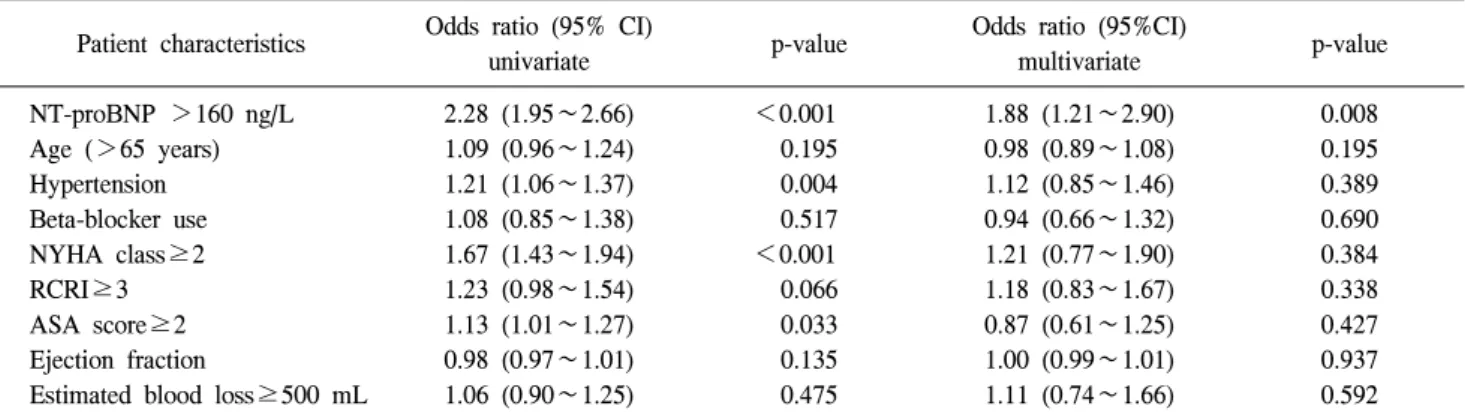
The univariate predictors for postoperative complications included a poor NYHA functional class (≥2), a history of hypertension, a higher ASA score (≥2) and higher NT-pro- BNP (>160 ng/L). In the multivariate analysis, only the pre- operative NT-proBNP remained significant as a predictor for postoperative cardiac complications (Table 2).

DISCUSSION

In this study, preoperative serum NT-proBNP was indicated

as an independent predictor for cardiac complications follow-

(4)

Table 1. Clinical and demographic characteristics of patients with or without postoperative cardiac complications Patient characteristics Patients with postoperative

cardiac complications (n=9)

Patients without postoperative

cardiac complications (n=89) p-value Male

Age median Smoking status Never Former Current

History of hypertension Use of beta-blocker CAD

Prior CABG or PCI Creatintine

RCRI≥3 NYHA class≥2 ASA grade≥2 LVEF, % median FEV1, % predicted Type of operation Pneumonectomy Bilobectomy Lobectomy Segmentectomy VATS

Estimated blood loss (mL), median NT-pro BNP (ng/L)

Preoperative, median Postoperative, median

7 (77.8%) 69 (57∼78)

2 (22.2%) 6 (66.6%) 1 (11.1%) 6 (66.7%) 1 (11.1%) 2 (22.2%) 1 (11.1%) 0.9 (0.6∼1.9)

2 (22.2%) 6 (66.7%) 8 (89%) 60.0 (31.0∼69.0) 81.7 (44.7∼89.8)

2 (22.2%) 2 (22.2%) 4 (44.4%) 1 (11.1%) 3 (33.3%) 150 (0∼900)

200.2 (21.6∼1,722.0) 674.6 (45.2∼1,932.0)

53 (59.6%) 65 (15∼77)

35 (39.3%) 20 (22.5%) 34 (38.2%) 20 (22.5%) 8 (9.0%) 5 (5.6%) 4 (4.5%) 0.8 (0.6∼1.8)

5 (5.6%) 5 (5.6%) 46 (52%) 65.0 (28.0∼73.0) 81.9 (51.4∼96.8)

6 (6.7%) 12 (13.5%) 66 (74.2%) 5 (5.6%) 36 (40.4%) 200 (50∼1,500)

45.0 (10.6∼355.4) 190.2 (40.1∼1,397.0)

0.287 0.012 0.253

0.004 0.448 0.067 0.390 0.226 0.067 0.001 0.039 0.227 0.874

0.108 0.477 0.061 0.515 0.679 0.042

0.009 0.001 CAD=Coronary artery disease; CABG=Coronary artery bypass graft; PCI=Percutaneous coronary intervention; RCRI=Revised Cardiac Risk; Index=NYHA, New York heart association; ASA=American society of anesthesiologists; LVEF=Left ventricular ejection frac- tion; FEV1=Forced expiratory ventilation in 1 second; VATS=Video assisted thoracoscopic surgery.

Fig. 1. ROC curve for preoperative NT-proBNP (solid line) and postoperative NT-proBNP (dashed line). ROC=Receiver operating characteristic.

ing lung resection surgery by a multivariate analysis.

Cardiac complications occur frequently after lung resection surgery. Atrial fibrillation is the most common cardiovascular complications after thoracic surgery, with a reported incidence of 8% to 20% after lobectomy and up to 40% after pneumo- nectomy [8,9]. These events contribute significantly to mor- bidity, mortality and the increased cost of medical care.

Hence, a proactive approach for identifying patients with a higher risk for these complications is necessary.

Various tools have been developed to improve risk strat- ification and predictability for postoperative complications.

The most widely used risk assessment tool for predicting ma-

jor cardiac complications after non cardiac surgery is the re-

vised cardiac risk index (RCRI) [2]. The six independent risk

(5)

Table 2. Univariate and multivariate analysis for predictors of adverse cardiac outcome using logistic regression Patient characteristics Odds ratio (95% CI)

univariate p-value Odds ratio (95%CI)

multivariate p-value

NT-proBNP >160 ng/L Age (>65 years) Hypertension Beta-blocker use NYHA class≥2 RCRI≥3 ASA score≥2 Ejection fraction

Estimated blood loss≥500 mL

2.28 (1.95∼2.66) 1.09 (0.96∼1.24) 1.21 (1.06∼1.37) 1.08 (0.85∼1.38) 1.67 (1.43∼1.94) 1.23 (0.98∼1.54) 1.13 (1.01∼1.27) 0.98 (0.97∼1.01) 1.06 (0.90∼1.25)

<0.001 0.195 0.004 0.517

<0.001 0.066 0.033 0.135 0.475

1.88 (1.21∼2.90) 0.98 (0.89∼1.08) 1.12 (0.85∼1.46) 0.94 (0.66∼1.32) 1.21 (0.77∼1.90) 1.18 (0.83∼1.67) 0.87 (0.61∼1.25) 1.00 (0.99∼1.01) 1.11 (0.74∼1.66)

0.008 0.195 0.389 0.690 0.384 0.338 0.427 0.937 0.592 NYHA=New York heart association; RCRI=Revised cardiac risk index; ASA=American society of anesthesiologists.

predictors in the index include ischemic heart disease, heart failure, cerebrovascular disease, chronic renal insufficiency (serum creatinine level>2 mg/dL), insulin-dependent diabe- tes mellitus, and high-risk surgery. Patients can be classified as low (zero or one risk factor), intermediate (two factors), or high (three or more factors) risk groups with corresponding postoperative cardiac complication rates of approximately 1%, 5%, and 10%, respectively. However, RCRI may not always be precise in predicting postoperative cardiac complications.

In our study, a high RCRI score (RCRI≥3) was not asso- ciated with postoperative cardiac complications (Table 2).

Many surgeons utilize various preoperative imaging studies for cardiac function (including i.e. echocardiography, mag- netic resonance imaging, and radionuclide studies) to evaluate left ventricular (LV) function [10-13]. It is generally agreed that depressed LV function is associated with a higher risk of postoperative cardiac complications, but it remains debatable whether these tests provide additional information to routine clinical evaluation [14]. Halm et al. [10] reported that an LV ejection fraction of less than 40% was associated with post- operative cardiac complications, particularly heart failure.

However, our study demonstrated that the LV ejection frac- tion did not correlate with the risk of postoperative cardiac complications after lung resection surgery (Table 2).

It has been suggested that NT-proBNP levels could be a useful markers of left ventricular dysfunction in both sympto- matic and asymptomatic patients. Plasma levels of atriuretic peptides have been reported to be elevated not only in pa- tients with advanced heart failure or acute myocardial in-

farction, but also in other clinical settings such as liver cir- rhosis or chronic renal failure. Recently, several reports re- garding the correlation between NT-proBNP and cardiac com- plications following major cardiac and non-cardiac surgery have been published. However, there is little information on the correlation between lung resection surgery and NT-proBNP levels. Cardinale et al. [15] recently demon- strated that NT-proBNP is a strong independent predictor of postoperative atrial fibrillation in patients undergoing thoracic surgery for lung cancer. However, other cardiac complications were not evaluated in that study, and the comparison of the predictability of adverse cardiac outcomes between NT-proBNP and other risk factors was not elucidated.

Our study took into account various cardiac complications

(including atrial fibrillation), and demonstrated that preope-

rative NT-proBNP levels were an independent predictor of

the adverse outcomes by a multivariate analysis, after adjust-

ing other risk factors such as revised cardiac risk index

which is most widely used for predicting major cardiac

complications. This finding carries important clinical im-

plications, and may enable us to accurately stratify patients

according to their risk of adverse outcomes. Awareness of

preoperative NT-proBNP levels in patients who are under-

going lung resection surgery may help preventing the occur-

rence of cardiac complications after surgery. Assessment of

NT-proBNP levels may offer a simple and cost-effective

means of identifying high-risk patients, and may benefit the

patients by getting around invasive and costly preoperative

work-up.

(6)

There is no consensus on the cut-off value for abnormal NT-proBNP concentrations. When using the chemiluminescent kit from Roche Diagnostics, the upper 97.5 percentile level is identified as 155 ng/L for men and 84 ng/L for women under 50 years of age. Between 50 and 65 years, the upper limit comes up to 222 ng/L for men and 194 ng/L for women.

According to the studies in different clinical settings, the sug- gested cut-off values of NT-proBNP ranged from lower than 100 ng/L to higher than 1,000 ng/L [16-19]. We suggested a cut-off value of 160 ng/L for NT-proBNP, but this value may need further evaluation before clinical application.

As mentioned above, NT-proBNP level increases in various clinical conditions such as left ventricular hypertrophy (LVH), left atrial enlargement or compensated heart failure. Lung re- section, which may be a precipitating factor in patients with increased NT-proBNP level, brings a transient, but a sig- nificant extent of, pressure load to the heart. We assume that this abrupt hemodynamic change may bring about ischemic change on ECG in patient with LVH, atrial fibrillation in pa- tient with left atrial enlargement, and symptomatic heart fail- ure in patient with compensated heart failure.

In addition to preoperative measurements, we also checked NT-proBNP levels 12 hours after surgery. Postoperative NT- proBNP levels were also useful to identify the high-risk patients. When both preoperative and postoperative NT-pro- BNP levels were integrated, the sensitivity of NT-proBNP in- creased from 0.667 to 0.778. These findings suggest that both preoperative and postoperative elevation of NT-proBNP levels can predict cardiac complications for patients undergoing lung resection surgery.

Our study had several limitations. Firstly, although NT-pro- BNP and other preoperative parameters were collected pro- spectively, the occurrence of cardiac complications was ana- lyzed retrospectively. Thus, it is possible that some patients may have had very transient episodes of arrhythmia which went unnoticed. Secondly, only a small number of patients in a single center was enrolled in this study. Thirdly, we exam- ined only one biologic marker. Presumably, further studies on other preoperative biologic markers may be necessary in pa- tients with low NT-proBNP levels to improve sensitivity and positive predictive value of the preoperative assessment for the delineation of the patients with a higher risk of post-

operative cardiac events.

CONCLUSION

Elevated preoperative NT-proBNP level is identified as an independent predictor for cardiac complications following lung resection surgery. This correlation may enable us to plan adequate treatments in advance, and to detect cardiac compli- cations as early as possible through the monitoring of post- operative NT-proBNP levels in selected high-risk patients.

Further studies are necessary to support our observation, and to clarify the relationship between NT–proBNP levels and ex- isting methods of risk stratification.

REFERENCES

1. Karamichalis JM, Putnam JB Jr, Lambright ES. Cardiovas- cular complications after lung surgery. Thorac Surg Clin 2006;16:253-60.

2. Cohn SL. Preoperative cardiac evaluation of lung resection candidates. Thorac Surg Clin 2008;18:45-59.

3. Clerico A, Emdin M. Diagnostic accuracy and prognostic relevance of the measurement of cardiac natriuretic peptides:

a review. Clin Chem 2004;50:33-50.

4. Phua J, Lim TK, Lee KH. B-type natriuretic peptide: issues for intensivist and pulmonologist. Crit Care Med 2005;33:

2094-103.

5. Yeh HM, Lau HP, Lin JM, Sun WZ, Wang MJ, Lai LP.

Preoperative plasma N-terminal pro-brain natriuretic peptide as a marker of cardiac risk in patients undergoing elective non-cardiac surgery. Br J Surg 2005;92:1041-5.

6. Cuthbertson BH, Amiri AR, Croal BL, et al. Utility of B-type natriuretic peptide in predicting perioperative cardiac events in patients undergoing major non-cardiac surgery. Br J Anaesth 2007;99:170-6.

7. Wazni OM, Martin DO, Marrouche NF, et al. Plasma B-type natriuretic peptide levels predict postoperative atrial fi- brillation in patients undergoing cardiac surgery. Circulation 2004;110:124-7.

8. Roselli EE, Murthy SC, Rice TW, et al. Atrial fibrillation complicating lung cancer resection. J Thorac Cardiovasc Surg 2005;130:438-44.

9. Asamura H, Naruke T, Tsuchiya R, Goya T, Kondo H, Suemasu K. What are the risk factors for arrhythmias after thoracic operations? A retrospective multivariate analysis of 267 consecutive thoracic operations. J Thorac Cardiovasc Surg 1993;106:1104-10.

10. Halm EA, Browner WS, Tubau JF, Tateo IM, Mangano DT.

(7)

Echocardiography for assessing cardiac risk in patients hav- ing noncardiac surgery. Study of Perioperative Ischemia Research Group. Ann Intern Med 1996;125:433-41.

11. Pedersen T, Kelbaek H, Munck O. Cardiopulmonary compli- cations in high-risk surgical patients: the value of pre- operative radionuclide cardiography. Acta Anaesthesiol Scand 1990;34:183-9.

12. Leppo J, Plaja J, Gionet M, Tumolo J, Paraskos JA, Cutler BS. Noninvasive evaluation of cardiac risk before elective vascular surgery. J Am Coll Cardiol 1987;9:269-76.

13. Kontos MC, Brath LK, Akosah KO, Mohanty PK. Cardiac complications in noncardiac surgery: relative value of rest- ing two-dimensional echocardiography and dipyridamole thallium imaging. Am Heart J 1996;132:559-66.

14. Eagle KA, Brundage BH, Chaitman BR, et al. Guidelines for perioperative cardiovascular evaluation for noncardiac sur- gery. Report of the American College of Cardiology/Ameri- can Heart Association Task Force on Practice Guidelines (Committee on Perioperative Cardiovascular Evaluation for Noncardiac Surgery). J Am Coll Cardiol 1996;27:910-48.

15. Cardinale D, Colombo A, Sandri MT, et al. Increased peri-

operative N-terminal pro-B-type natriuretic peptide levels predict atrial fibrillation after thoracic surgery for lung cancer. Circulation 2007;115:1339-44.

16. Hunt PJ, Richards AM, Nicholls MG, Yandle TG, Doughty RN, Espiner EA. Immunoreactive amino-terminal pro-brain natriuretic peptide (NT-PROBNP): a new marker of cardiac impairment. Clin Endocrinol (Oxf) 1997;47:287-96.

17. Talwar S, Squire IB, Davies JE, Barnett DB, Ng LL.

Plasma N-terminal pro-brain natriuretic peptide and the ECG in the assessment of left-ventricular systolic dysfunction in a high risk population. Eur Heart J 1999;20:1736-44.

18. Richards AM, Nicholls MG, Yandle TG, et al. Plasma N-terminal pro-brain natriuretic peptide and adrenomedullin:

new neurohormonal predictors of left ventricular function and prognosis after myocardial infarction. Circulation 1998;

97:1921-9.

19. Jernberg T, Stridsberg M, Venge P, Lindahl B. N-terminal

pro brain natriuretic peptide on admission for early risk

stratification of patients with chest pain and no ST-segment

elevation. J Am Coll Cardiol 2002;40:437-45.

수치

Table 1. Clinical and demographic characteristics of patients with or without postoperative cardiac complications  Patient  characteristics Patients  with  postoperative
Table 2. Univariate and multivariate analysis for predictors of adverse cardiac outcome using logistic regression Patient  characteristics Odds  ratio  (95%  CI)

참조

관련 문서