• 검색 결과가 없습니다.

Effect of Valsartan on N-Terminal Pro-Brain Natriuretic Peptide in Patient With Stable Chronic Heart Failure: Comparison With Enalapril

N/A
N/A
Protected

Academic year: 2021

Share "Effect of Valsartan on N-Terminal Pro-Brain Natriuretic Peptide in Patient With Stable Chronic Heart Failure: Comparison With Enalapril"

Copied!
7
0
0

로드 중.... (전체 텍스트 보기)

전체 글

(1)

61

Open Access

Effect of Valsartan on N-Terminal Pro-Brain Natriuretic Peptide in Patient With Stable Chronic Heart Failure:

Comparison With Enalapril

Young Soo Lee, MD

1,2

, Kee Sik Kim, MD

1,2

, Jin Bae Lee, MD

1,2

, Jae Kean Ryu, MD

1,2

, Ji Yong Choi, MD

1,2

, Byong-Kyu Kim, MD

1,2

, Sung Gug Chang, MD

1,2

, Seung Ho Hur, MD

3

, Bong Ryeol Lee, MD

4

, Byung Chun Jung, MD

4

, Geu Ru Hong, MD

5

,

Byung Soo Kim, MD

6

, Tae Ho Park, MD

7

, Young Dae Kim, MD

7

, Tae Ik Kim, MD

8

and Dong Soo Kim, MD

9

1

Department of Cardiology and

2

Institute for Atherosclerosis and CVD, Catholic University of Daegu, Daegu,

3

Department of Cardiology, Keimyung University College of Medicine, Daegu,

4

Department of Cardiology, Fatima General Hospital, Daegu,

5

Department of Cardiology, Yeungnam University College of Medicine, Daegu,

6

Department of Cardiology, DaeDong Hospital, Busan,

7

Department of Cardiology, Dong-A University College of Medicine, Busan,

8

Department of Cardiology, Maryknoll Medical Center, Busan,

9

Department of Cardiology, Busan Paik Hospital, Busan, Korea

ABSTRACT

Background and Objectives: The plasma concentration of N-terminal pro-brain natriuretic peptide (NT-pro-BNP) is a st- rong prognostic indicator for patients with heart failure (HF) across all stages of the condition. Several clinical trials have de- monstrated convincingly that neurohormonal modulation on the renin angiotensin system (RAS) decreases plasma NT-pro- BNP level and results in favorable outcomes. But there are still limited comparative data on the neuro-hormonal modulatory effects of two RAS inhibitors: angiotensin converting enzyme inhibitor and angiotensin receptor blocker. Subjects and Methods:

This study was a prospective, multi-center, randomized, open-label, controlled, and non-inferiority study involving 445 patients with left ventricular ejection fraction (LVEF) less than 45%. Patients were assigned to receive either valsartan (target dose of 160 mg bid) or enalapril (target dose of 10 mg bid) for 12 months. We compared plasma NT-pro-BNP, high sensitive C-reactive pro- tein (hs-CRP) level and echocardiographic parameters before and after treatment with valsartan or enalapril. Results: The NT-pro-BNP and hs-CRP levels were significantly decreased after 12 months of treatment with valsartan and enalapril. The per- centage change was similar between both groups. LVEF improved and left ventricular internal dimensions were decreased in both groups, and there were no significant differences between two groups. Conclusion: Valsartan is as effective on improv- ing plasma NT-pro-BNP level as enalapril in patients with stable chronic HF. (Korean Circ J 2011;41:61-67)

KEY WORDS: Brain natriuretic peptide; Angiotensin-converting enzyme inhibitors; Angiotensin receptor blocker;

Congestive heart failure.

Received: May 9, 2010

Revision Received: June 22, 2010 Accepted: July 6, 2010

Correspondence: Kee Sik Kim, MD, Department of Cardiology, Catho- lic University of Daegu, 3056-6 Daemyeong-4-dong, Nam-gu, Daegu 705-718, Korea

Tel: 82-53-650-3010, Fax: 82-53-621-3166 E-mail: [email protected]

• The authors have no financial conflicts of interest.

cc
This is an Open Access article distributed under the terms of the Cre- ative Commons Attribution Non-Commercial License (http://creativecom- mons.org/licenses/by-nc/3.0) which permits unrestricted non-commer- cial use, distribution, and reproduction in any medium, provided the origi- nal work is properly cited.

Introduction

Activation of the renin-angiotensin-aldosterone system (RAS)

promotes structural remodeling of the heart and the progress- ion of heart failure (HF).

1)2)

Angiotensin converting enzyme inhibitors (ACE inhibitor) act principally by blocking the for- mation of angiotensin II.

3)

In the CONSENSUS and SOLVD studies, enalapril significantly reduced mortality and hospitaliz- ations for HF in patients with chronic congestive HF and re- duced ejection fractions.

4)5)

On the other hand, angiotensin re- ceptor blocker (ARB) selectively inhibits angiotensin II type 1 receptors. In the Val-HeFT study, valsartan improved symp- toms of HF, left ventricular (LV) function, LV dilation and reduced the risk of hospitalization for HF.

6)

Neurohormone activation is characteristic of HF, and eleva-

tion of circulating N-terminal pro-brain natriuretic peptide

(NT-pro-BNP) levels, and other neurohormones is directly

(2)

related to mortality and morbidity.

7)8)

In addition, plasma NT- pro-BNP, secreted mainly from the ventricle, has been known as a useful prognostic indicator in patients with HF.

9)10)

In the present study, we evaluated the effects of valsartan on plasma NT-pro-BNP levels, and cardiac remodeling in HF pa- tients with HF, compared to patients treated with enalapril.

Subjects and Methods

Patient population

This was a multi-center, prospective, randomized, and open labeled design study. Patients with stable, symptomatic HF {New York Heart Association (NYHA) functional class II or III} who were on prescribed HF therapy with LV ejection frac- tion (LVEF) <45% were enrolled from March 2004 to Febru- ary 2006 at 10 clinical centers in the Youngnam province of South Korea. Patients were excluded from the study if they had congenital heart disease, unstable angina, recent acute myocardial infarction, primary hepatic failure, renal failure (serum creatinine >2.5 mg/dL), life-threatening ventricular arrhythmia or active cancer.

Patients with stenotic valvular heart disease were also ex- cluded. In addition, patients receiving any ARB or ACE inhi- bitor within 1 month of study enrollment were excluded. This study was approved by the ethics review board at each insti- tution. All patients provided written informed consent before enrollment in this study.

Study protocol

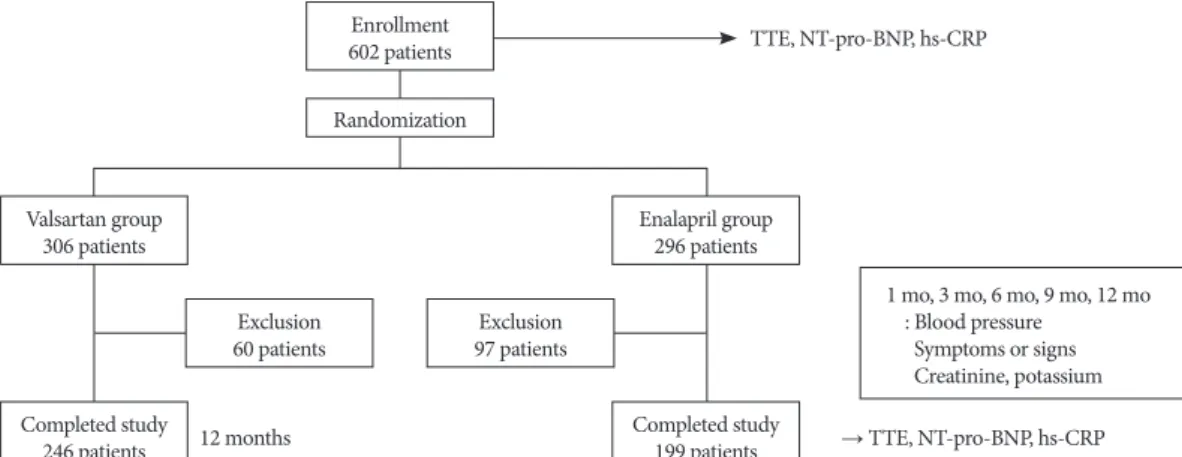
Six hundred and two (n=602) stable HF outpatients were randomly assigned to two groups {Valsartan group (n=306) and enalapril group (n=296)}. The starting dose is 40 mg and 5 mg for valsartan and enalapril respectively, and then in- creased to a maximum dose of 320 mg or 20 mg, according to systolic blood pressure (>90 mmHg), absence of any sign or symptom of hypotension, and absence of serum creatitine

>50% from baseline. If the patient satisfied one of above three

criteria, the dosage of drugs was reduced to the previous le- vel. All concomitant drugs to control HF were allowed, except ARB or ACE inhibitors.

We performed echocardiography, NT-pro-BNP and high sensitive C-reactive protein (hs-CRP) levels before and after 12 months of treatment. Also, we evaluated drug tolerance, such as blood pressure, symptom or sign, serum creatinine and po- tassium levels at 1, 3, 6, 9, and 12 months (Fig. 1).

Echocardiography

Following the recommendations of the American Society of Echocardiography,

11)

LVEF was assessed using the Simpson’s biplane equation for calculating volumes. The LV dimension and left atrial diameter for assessing cardiac remodeling were measured in the parasternal long axis view with an M-mode at each center.

Measurement of plasma N-terminal pro brain natriuretic peptide level

Blood samples were drawn after participants had been in the sitting position for 10 minutes. Specimens were placed in 5 mL ethylenediaminetetraacetic acid tubes, immediately centrifuged and frozen at -80°C. Plasma NT-pro-BNP levels were measured by an automated system (Elecsys 2010, Roche Diagnostics, Indianapolis, Ind), with identical methodology at each center.

Statistical analysis

The Statistical Package for the Social Sciences (SPSS) 12.0 (SPSS inc., Chicago, IL, USA) statistical software package was used for all calculations. Data are presented as mean±stand- ard deviation for continuous variables, and as percentages for the categorical data. Changes in NYHA functional class were assessed using Wilcoxon matched pairs signed rank test. Dif- ferences between each group were analyzed by the unpaired Student t-test and by paired Students t-test between before (baseline) and after (12 months) treatment. Linear correlation

TTE, NT-pro-BNP, hs-CRP Enrollment

602 patients

Randomization

Valsartan group

306 patients Enalapril group

296 patients

Completed study

246 patients Completed study

199 patients 12 months

Fig. 1. Study design. TTE: transthoracic echocardiography, NT-pro-BNP: N-terminal pro-brain natriuretic peptide, hs-CRP: high sensitive C- reactive protein.

→ TTE, NT-pro-BNP, hs-CRP 1 mo, 3 mo, 6 mo, 9 mo, 12 mo : Blood pressure

Symptoms or signs Creatinine, potassium Exclusion

60 patients Exclusion

97 patients

(3)

analysis (Pearson) was used to test correlations between chan- ges in NT-pro-BNP level and change in LV end diastolic dimen- sion (LVEDD) and LVEF. Categorical data were analyzed us- ing the Chi-square test. A p<0.05 was regarded as statistically significant.

Results

Demographic characteristics

Among the enrolled patients, 60 patients in the valsartan

group and 97 patients in the enalapril group withdrew from the study because of coughing, angioedema, dizziness, hyperka- lemia, renal insufficiency and hypotension. Specifically, 9 pa- tients in the valsartan group (2.9%) and 29 patients in the enala- pril group (9.8%) were intolerant to study drugs because of severe coughing. Two hundreds forty six patients were includ- ed in the analysis (mean dose 99.4 mg) in the valsartan group and 199 patients (mean dose 10.7 mg) in the enalapril group.

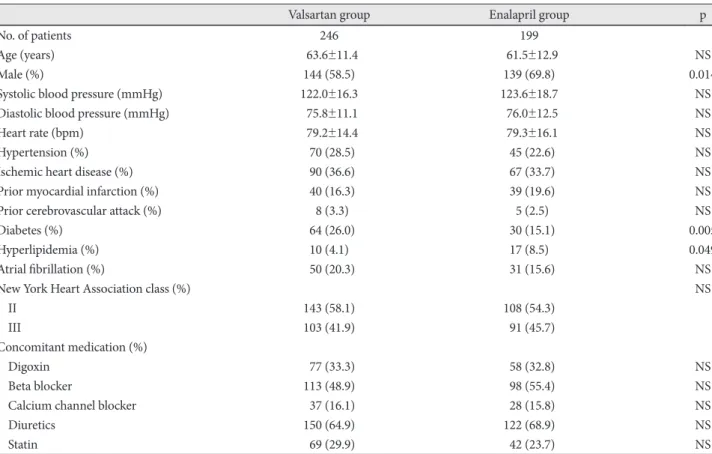
Table 1 presents the demographic characteristics of the st- udy population. The proportion of male in the enalapril group Table 1. Demographic characteristics of subjects

Valsartan group Enalapril group p

No. of patients Age (years) Male (%)

Systolic blood pressure (mmHg) Diastolic blood pressure (mmHg) Heart rate (bpm)

Hypertension (%) Ischemic heart disease (%) Prior myocardial infarction (%) Prior cerebrovascular attack (%) Diabetes (%)

Hyperlipidemia (%) Atrial fibrillation (%)

New York Heart Association class (%) II

III

Concomitant medication (%) Digoxin

Beta blocker

Calcium channel blocker Diuretics

Statin

246 063.6±11.4

144 (58.5) 122.0±16.3 075.8±11.1 079.2±14.4 070 (28.5) 090 (36.6) 040 (16.3) 08 (3.3) 064 (26.0)

10 (4.1) 050 (20.3) 143 (58.1) 103 (41.9) 077 (33.3) 113 (48.9) 037 (16.1) 150 (64.9) 069 (29.9)

199 061.5±12.9

139 (69.8) 123.6±18.7 076.0±12.5 079.3±16.1 045 (22.6) 067 (33.7) 039 (19.6) 05 (2.5) 030 (15.1)

17 (8.5) 031 (15.6) 108 (54.3) 091 (45.7) 058 (32.8) 098 (55.4) 028 (15.8) 122 (68.9) 042 (23.7)

NS 0.014

NS NS NS NS NS NS NS 0.005 0.049 NS NS

NS NS NS NS NS Table 2. Biochemical and echocardiographic parameters

Valsartan group Enalapril group p

Hemoglobin (g/dL) White blood cell (10

3

/mm

3

) Blood urea nitrogen (mg/dL) Creatinine (mg/dL) Sodium (mg/dL) Potassium (mg/dL) pro-BNP (pg/mL) hs-CRP (mg/dL) LVEF (%) LVESD (mm) LVEDD (mm) LA diameter (mm)

12.8±2.10 7.73±2.52 18.5±7.20 1.05±0.30 140.1±4.300

4.15±0.63 3,769.7±5,748.2

2.29±6.33 35.1±8.20 49.2±10.2 59.4±9.90 44.8±7.70

13.4±2.00 8.36±2.97 17.7±6.60 1.09±0.29 140.6±3.700

4.20±0.62 3,211.3±6,047.5

1.89±3.10 34.5±8.70 47.9±9.10 57.8±8.40 42.8±7.40

0.001

0.017

0.014

NS

NS

NS

NS

NS

NS

NS

NS

0.011

BNP: brain natriuretic peptide, hs-CRP: high sensitive C-reactive protein, LVEF: left ventricle ejection fraction, LVES/DD: left ventricular end

systolic/diastolic dimension, LA: left atrium

(4)

was higher. The incidence of diabetes was higher in the val- sartan group. The systolic and diastolic blood pressure of pa- tients in both groups was significantly decreased after receiv- ing study medication (valsartan: 122.0/75.8 mmHg vs. 117.3/

72.8 mmHg, enalapril: 123.6/76.0 mmHg vs. 120.3/74.3 mmHg, respectively, p<0.05). However, the percentage change in sys- tolic and diastolic blood pressure was not different between both groups.

Table 2 summarizes the baseline biochemical and echocar- diographic parameters. The level of serum creatinine and po- tassium were not different between both groups. The level of serum uric acid in the enalapril group was significantly increas- ed, compared to the valsartan group. The LA diameter was sig- nificantly higher in the valsartan group.

Comparison of New York Heat Association functional class

Fig. 2 summaries the change in the NYHA functional class of the patients. Patients in both groups improved after 12 mon- ths of treatment, compared to the baseline values (p<0.001).

Comparison of echocardiographic findings

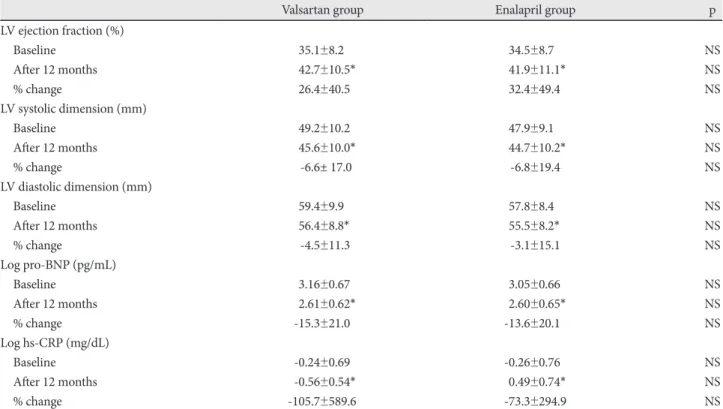
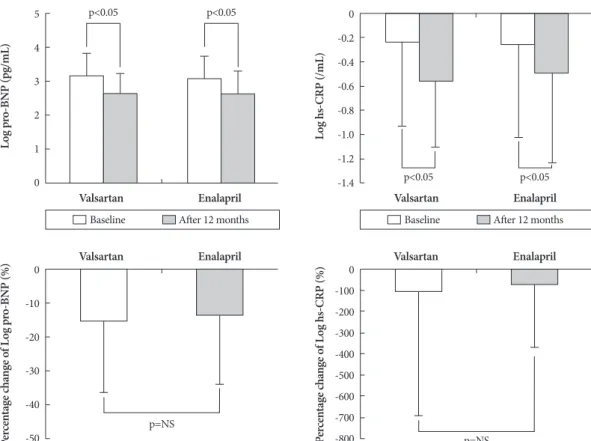
The LVEF and LVEDD in both groups were significantly improved 12 months after treatment initiation. However, the percentage changes before and after treatment was not differ- ent in both groups (Table 3)(Fig. 3). Changes in LVEF and LVEDD were significantly correlated with change in NT-pro- BNP level (Fig. 4).

Fig. 2. Changes in NYHA functional class during treatment in the two groups. NYHA: New York Heart Association.

IV

III

II

I

0

Valsartan

N YH A

Baseline 12 months p<0.001

p=NS

0 0

103 9

143 107

0 130

IV

III

II

I

0

Enalapril

N YH A

Baseline 12 months p<0.001

0 0

91 14

108 86

0 99

Table 3. Change of echocardiographic parameters, pro-BNP level, and hs-CRP level

Valsartan group Enalapril group p

LV ejection fraction (%) Baseline

After 12 months

% change

LV systolic dimension (mm) Baseline

After 12 months

% change

LV diastolic dimension (mm) Baseline

After 12 months

% change

Log pro-BNP (pg/mL) Baseline

After 12 months

% change Log hs-CRP (mg/dL)

Baseline After 12 months

% change

0-35.1±8.2 0-42.7±10.5*

0-26.4±40.5 0-49.2±10.2 0-45.6±10.0*

00-6.6± 17.0 0-59.4±9.9 0-56.4±8.8*

00-4.5±11.3 0-3.16±0.67 0-2.61±0.62*

0-15.3±21.0 0-0.24±0.69 0-0.56±0.54*

-105.7±589.6

-34.5±8.7 -41.9±11.1*

-32.4±49.4 -47.9±9.1 -44.7±10.2*

0-6.8±19.4 -57.8±8.4 -55.5±8.2*

0-3.1±15.1 -3.05±0.66 -2.60±0.65*

-13.6±20.1 -0.26±0.76 -0.49±0.74*

-73.3±294.9

NS NS NS NS NS NS NS NS NS NS NS NS NS NS NS

*p<0.05 compared to baseline. BNP: brain natriuretic peptide, hs-CRP: high sensitive C-reactive protein, LV: left ventricle

(5)

Comparison of plasma N-terminal pro-brain natriuretic peptide and high sensitive C-reactive protein levels

Plasma NT-pro-BNP and hs-CRP levels in both groups were significantly reduced after 12 months of treatment. The percen- tage change demonstrated no difference between both groups (Table 3)(Fig. 3).

Discussion

The main finding of this study was that treatment of valsar- tan significantly improved plasma NT-pro-BNP level and echo- cardiographic parameters in patients with HF, compared to

treatment with enalapril.

The plasma level of NT-pro-BNP, which is secreted mainly from the ventricle, is a well-established powerful risk marker in HF. Several authors have reported that plasma NT-pro-BNP is a prognostic predictor of morbidity and mortality in patients with HF.

12-14)

In addition, Maeda et al.

15)

mentioned that sustain- ed high plasma level of NT-pro-BNP after standard treatment was an independent risk factor for mortality in patients with HF. Moreover, treatment of HF guided by plasma NT-pro-BNP concentration has been reported to reduce cardiovascular events.

16)

ACE inhibitors and ARB reduce the mortality of patients with HF partly by preventing LV remodeling, and plasma Fig. 3. Change of NT-pro-BNP and high sensitive C-reactive protein before and after treatment. NT-pro-BNP: N-terminal pro-brain natriuretic peptide, hs-CRP: high sensitive C-reactive protein.

5

4

3

2

1

0

0

-10

-20

-30

-40

-50

0 -100 -200 -300 -400 -500 -600 -700 -800 0 -0.2 -0.4 -0.6 -0.8 -1.0 -1.2 -1.4

Lo g p ro -B N P (p g/ m L) Pe rc en ta ge ch an ge o f Lo g p ro -B N P (% ) Pe rc en ta ge ch an ge o f Lo g h s-C RP (% ) Lo g h s-C RP (/ m L)

Valsartan Enalapril

Valsartan Enalapril Valsartan Enalapril Valsartan Enalapril p<0.05

p=NS

p=NS p<0.05

p<0.05 p<0.05

Baseline After 12 months Baseline After 12 months

Fig. 4. Change of NT-pro-BNP according to change of left ventricular ejection faction (LVEF) and LV end diastolic dimension (LVEDD). NT-pro- BNP: N-terminal pro-brain natriuretic peptide, hs-CRP: high sensitive C-reactive protein.

25.0

0.0

-25.0

-50.0

-75.0

25.0

0.0

-25.0

-50.0

-75.0

Ch an ge o f Lo g p ro -B N P (% ) Ch an ge o f Lo g p ro -C RP (% )

-100 0 100 200 300 -40.0 -20.0 0 20.0 40.0 60.0 80.0 Y=-15.554+0.297X r=0.20, p<0.001 Y=-12.367-0.128X

r=0.320, p<0.001

Change of LVEF (%) Change of LVEDD (%)

(6)

NT-pro-BNP may be a useful marker of LV remodeling.

17)

Tsutamoto et al.

13)

demonstrated that perindopril significantly reduced plasma NT-pro-BNP and increased LVEF in patients with chronic HF. In Val-HeFT, valsartan significantly reduced plasma NT-pro-BNP after 24 months of therapy.

18)

In our st- udy, there are consistent results on plasma NT-pro-BNP lev- els and LV remodeling at 12 months after enalapril and val- sartan treatment.

Kasama et al.

19)

stated that plasma NT-pro-BNP and LV vol- ume were significantly decreased 6 months after valsartan treatment in patients with HF, but not after enalapril treatment.

In contrast, the percentage change of plasma NT-pro-BNP is not different between both drugs in the present study. We hy- pothesize that this difference may be due to study drug dosage.

We tried to escalate to the target dosage of the study drugs (av- erage dose per day 99.4 mg in valsartan vs. 10.7 mg in enala- pril), which is higher that that used in previously reported studies. Plasma NT-pro-BNP concentration is reported to cor- relate with LVEF abnormalities and LV end diastolic pressure, as well as with LV mass.

20)

In the present study, change of plas- ma NT-pro-BNP is significantly correlated to change in LV- EF and LVEDD after 12 months. Because NT-pro-BNP has been suggested to be a marker for ventricular remodeling,

21)

th- ese findings suggest that valsartan and enalapril might have re- versed ventricular remodeling.

The prevalence of ACE inhibitor induced cough has been known to be different between races.

22)

Woo et al.

23)

found that ACE inhibitor-related cough in the Hong Kong popula- tion was significantly higher than the primarily white Auckland population (53% vs. 18%, respectively). Nishizawa et al.

24)

re- ported a 45% incidence of ACE inhibitor-induced cough among Asian women associated with 15% treatment cessa- tion, and about a 30% incidence among Asian men with 5%

treatment cessation. In our study, ACE inhibitor was discon- tinued in about 10% of patients due to severe cough. Howev- er, the prevalence of cough varied with method of data collec- tion, analysis and symptom reporting.

25)

There is a major limitation to this study. We did not run a core laboratory for assessment of NT-pro-BNP level and echocar- diographic parameter despite this being a multi-center and prospective study. However, we measured the NT-pro-BNP level by same ELISA method and echocardiographic param- eters by recommendation.

In conclusion, the results suggest that RAS inhibitor can significantly improve plasma NT-pro-BNP levels, echocardio- graphic parameters and clinical findings in patients with HF.

Valsartan, the most commonly used angiotenisn receptor bloc- ker, is as effective as enalapril in the treatment of patients with stable chronic HF.

Acknowledgments

This study was sponsored by Norvatis Korea.

REFERENCES

1) Harrap SB, Dominiczak AF, Fraser R, et al. Plasma angiotensin II, predisposition to hypertension, and left ventricular size in healthy yo- ung adults. Circulation 1996;93:1148-54.

2) Kasama S, Toyama T, Kumakura H, et al. Spironolactone improves car- diac sympathetic nerve activity and symptoms in patients with conges- tive heart failure. J Nucl Med 2002;43:1279-85.

3) Curtiss C, Cohn JN, Vrobel T, Franciosa JA. Role of the renin-angio- tensin system in the systemic vasoconstriction of chronic congestive he- art failure. Circulation 1978;58:763-70.

4) The CONSENSUS Trial Study Group. Effects of enalapril on mortali- ty in severe congestive heart failure. Results of the cooperative north Sc- andinavian enalapril survival study (CONSENSUS). N Engl J Med 1987;316:1429-35.

5) The SOLVD Investigators. Effect of enalapril on survival in patients with reduced left ventricular ejection fractions and congestive heart fa- ilure. N Engl J Med 1991;325:293-302.

6) Cohn JN, Tognoni G, for the Valsartan Heart Failure Trial Investiga- tors. A randomized trial of the angiotensin-receptor blocker valsartan in chronic heart failure. N Engl J Med 2001;345:1667-75.

7) Koglin J, Pehlivanli S, Schwaiblmair M, Vogeser M, Cremer P, von- Scheidt W. Role of brain natriuretic peptide in risk stratification of pa- tients with congestive heart failure. J Am Coll Cardiol 2001;38:1934-41.

8) Kim SH, Kim JS, Baek KK, et al. Role of NT-proBNP in evaluation of functional status in congestive heart failure. Korean Circ J 2004;34:

894-9.

9) Yasue H, Yoshimura M, Sumida H, et al. Localization and mecha- nism of secretion of NT-pro-natriuretic peptide in comparison with those of A-type natriuretic peptide in normal subjects and patients with heart failure. Circulation 1994;90:195-203.

10) Tsutamoto T, Wada A, Maeda K, et al. Attenuation of compensation of endogenous cardiac natriuretic peptide system in chronic heart failure:

prognostic role of plasma brain natriuretic peptide concentration in pa- tients with chronic symptomatic left ventricular dysfunction. Circula- tion 1997;96:509-16.

11) Lang RM, Bierig M, Devereux RB, et al. Recommendations for cham- ber quantification: a report from the American Society of Echocar- diography’s Guidelines and Standards Committee and the Chamber Quantification Writing Group, developed in conjunction with the Eu- ropean Association of Echocardiography, a branch of the European So- ciety of Cardiology. J Am Soc Echocardiogr 2005;18:1440-63.

12) McDonagh TA, Robb SD, Murdoch DR, et al. Biochemical detection of left-ventricular systolic dysfunction. Lancet 1998;351:9-13.

13) Tsutamoto T, Wada A, Maeda K, et al. Plasma brain natriuretic peptide level as a biochemical marker of morbidity and mortality in patients with asymptomatic or minimally symptomatic left ventricular dysfunc- tion. Eur Heart J 1999;20:1799-807.

14) Chung IH, Yoo BS, Ryu HY, et al. The relationship between the early fol- low-up BNP level and congestive status or prognosis in acute heart failure. Korean Circ J 2006;36:200-7.

15) Maeda K, Tsutamoto T, Wada A, et al. High levels of plasma brain na- triuretic peptide and interleukin-6 after optimized treatment for heart failure are independent risk factors for morbidity and mortality in pa- tients with congestive heart failure. J Am Coll Cardiol 2000;36:

1587-93.

16) Troughton RW, Frampton CM, Yandle TG, Espiner EA, Nicholls MG, Richards AM. Treatment of heart failure guided by plasma aminoter- minal brain natriuretic peptide (N-BNP) concentrations. Lancet 2000;

355:1126-30.

17) Nagaya N, Nishikimi T, Goto Y, et al. Plasma brain natriuretic peptide is a biochemical marker for the prediction of progressive ventricular re- modeling after acute myocardial infarction. Am Heart J 1998;135:

21-8.

18) Latini R, Masson S, Anand I, et al. Effects of valsartan on circulating

brain natriuretic peptide and norepinephrine in symptomatic chronic

heart failure: the Valsartan Heart Failure Trial (Val-HeFT). Circula-

(7)

tion 2002;106:2454-8.

19) Kasama S, Toyama T, Hatori T, et al. Comparative effects of valsartan and enalapril on cardiac sympathetic nerve activity and plasma brain natriuretic peptide in patients with congestive heart failure. Heart 2006;92:625-30.

20) Kohno M, Horio T, Yokokawa K, et al. Brain natriuretic peptide as a cardiac hormone in essential hypertension. Am J Med 1992;92:29-34.

21) Levin ER, Gardner DG, Samson WK. Natriuretic peptides. N Engl J Med 1998;339:321-8.

22) Tseng DS, Kwong J, Rezvani F, Coates AO. Angiotensin-converting

enzyme-related cough among Chinese-Americans. Am J Med 2010;

123:183. e11-5.

23) Woo KS, Norris RM, Nicholls G. Racial differences in incidence of cough with angiotensin-converting enzyme inhibitors (a tale of two cities). Am J Cardiol 1995;75:967-8.

24) Nishizawa A. Angiotensin-converting enzyme inhibitor induced cough among Asians. Proc UCLA Health 2000;4:35-8.

25) Yeo WW, Ramsay LE. Persistent dry cough with enalapril: incidence

depends on the method used. J Hum Hypertens 1990;4:517-20.

수치

Fig. 1. Study design. TTE: transthoracic echocardiography, NT-pro-BNP: N-terminal pro-brain natriuretic peptide, hs-CRP: high sensitive C- C-reactive protein.
Table 1 presents the demographic characteristics of the st- st-udy population. The proportion of male in the enalapril group  Table 1
Fig. 2 summaries the change in the NYHA functional class  of the patients. Patients in both groups improved after 12  mon-ths of treatment, compared to the baseline values (p&lt;0.001).
Fig. 4. Change of NT-pro-BNP according to change of left ventricular ejection faction (LVEF) and LV end diastolic dimension (LVEDD)

참조

관련 문서