• 검색 결과가 없습니다.

Estragole Exhibits Anti-inflammatory Activity with the Regulation of NF-κB and Nrf-2 Signaling Pathways in LPS-induced RAW 264.7 cells

N/A
N/A
Protected

Academic year: 2022

Share "Estragole Exhibits Anti-inflammatory Activity with the Regulation of NF-κB and Nrf-2 Signaling Pathways in LPS-induced RAW 264.7 cells"

Copied!
8
0
0

로드 중.... (전체 텍스트 보기)

전체 글

(1)

https://doi.org/10.20307/nps.2018.24.1.13

13

Estragole Exhibits Anti-inflammatory Activity with the Regulation of NF- κB and Nrf-2 Signaling Pathways in LPS-induced RAW 264.7 cells

Anupom Roy

1

, Hee-Juhn Park

2

, Hyun Ah Jung

3,

*, and Jae Sue Choi

1,

*

1

Department of Food and Life Science, Pukyong National University, Busan 608-737, Republic of Korea

2

Department of Pharmaceutical Engineering, Sangji University, Wonju 220-702, Republic of Korea

3

Department of Food Science and Human Nutrition, Chonbuk National University, Jeonju 561-756, Republic of Korea

Abstract − Estragole is a naturally occurring phenylpropanoid obtained from essential oils found in a broad diversity of plants. Although the phenylpropanoids show many biological activities, clear regulation of the inflammatory signaling pathways has not yet been determined. Here, we scrutinized the anti-inflammatory effect of estragole. The anti-inflammatory effect of estragole was determined through the inhibitory mechanisms of inducible nitric oxide synthase (iNOS), cyclooxygenase (COX-2), nuclear factor kappa B (NF-κB), and mitogen- activated protein kinases (MAPK) pathways and the activation of nuclear factor erythroid 2-related factor 2 (Nrf- 2)/heme oxygenase (HO)-1 pathways in lipopolysaccharide (LPS)-stimulated RAW 264.7 cells. Estragole significantly inhibited NO production, iNOS and COX-2 expression as well as LPS-induced NF-κB and MAPK activation. Furthermore, estragole suppressed LPS-induced intracellular ROS production but up-regulated the stress response gene HO-1 via the activation of transcription factor Nrf-2. These findings demonstrate that estragole inhibits the LPS-induced expression of inflammatory mediators via the down-regulation of iNOS, COX- 2, NF-κB, and MAPK pathways, as well as the up-regulation of the Nrf-2/HO-1 pathway, indicating that this phenylpropanoid has potential therapeutic and preventive applications in various inflammatory diseases.

Keywords − Essential oils, Estragole, Anti-inflammation, Nrf-2, HO-1, RAW 264.7 cells

Introduction

Inflammation is a complex physiological and patho- logical process activated in response to infection or tissue trauma. Inflammation can be caused by several elements such as microbial infections, chemicals, and immunological reactions. It is a protective response that affects immune cells, blood vessels, and molecular mediators. The treatment of inflammatory diseases focuses on the suppression of a few inflammatory mediators or signaling pathways including nitric oxide (NO), inducible nitric oxide synthase (iNOS), cyclooxygenase (COX-2), prostaglandin E

2

(PGE

2

), nuclear factor κB (NF-κB), mitogen-activated protein kinase (MAPK), reactive oxygen species (ROS), and pro- inflammatory cytokines (TNF- α, IL-6, and IL-1β).

1

During inflammation, macrophages play essential roles,

producing inflammatory cytokines when activated by endotoxin. NO is a vital cellular signaling molecule involved in many physiological and pathological processes.

NO is produced as a metabolic by-product when L- arginine is converted into L-citrulline by the interference of nitric oxide synthase (NOS). There are three isoforms of NOS, neuronal NOS (nNOS), endothelial NOS (eNOS), and iNOS.

2

During the inflammatory disease condition, iNOS produces an excessive amount of NO.

Eventually, NO and iNOS are the important targets for the treatment of inflammatory diseases. NF- κB is a transcription factor that plays a fundamental role in the inflammatory and acute response.

3

Normally, NF- κB subunits are inactive and bound to I κB. Phosphorylation of IκB activates NF- κB to enter the nucleus and activate gene expression.

4

NF- κB is one of the key regulators of proinflammatory gene expression and mediates the synthesis of cytokines such as TNF- α, IL-1β, IL-6, and IL-8.

5

It also regulates the transcription of other inflam- matory mediators such as COX-2 or iNOS.

5

Therefore, NF- κB is a vital target for the treatment of inflammatory diseases. MAPKs are protein chains that regulate NF- κB

*Author for correspondence

Jae Sue Choi, Department of Food and Life Science, Pukyong National University, Busan 608-737, the Republic of Korea.

Tel: +82-51-629-5845; E-mail: [email protected]

Hyun Ah Jung, Department of Food Science and Human Nutrition, Chonbuk National University, Jeonju 561-756, Republic of Korea.

Tel: +82-63-270-4882; E-mail: [email protected]

(2)

activation. These MAPKs include the extracellular signal- regulated kinases 1/2 (ERK 1/2), c-Jun amino-terminal kinases 1/2/3 (JNK 1/2/3), and p38 isoforms ( α, β, γ, and δ).

6

Recently, HO-1 has been reported to implicate in inhibition of the excessive production of pro- inflammatory cytokines and ROS in LPS-stimulated RAW 264.7 cells.

7

At the transcription level, HO-1 induction is regulated by a transcription factor called nuclear factor erythroid 2-related factor 2 (Nrf-2). Nrf-2 contributes to the anti-inflammatory process through the regulation of the gene expression of HO-1 and is a drug target for the treatment of inflammatory diseases.

8

Essential oils are volatile, concentrated hydrophobic, natural, complex compounds extracted from aromatic plants and are characterized by their strong odor. Essential oils were first used in the Middle Ages by Arabs and are known for their antiseptic, i.e. bactericidal, fungicidal, and virucidal, and medicinal properties as well as their smell.

9

Essential oils were used in embalmment, preservation of foods, and as antimicrobial, analgesic, sedative, anti- inflammatory, spasmolytic, and anesthetic compounds.

9

Estragole is a phenylpropene and a colorless natural primary constituent of the essential oil of tarragon.

9

In addition, we have previously reported that the Korean mint herb Agastache rugosa contained essential oil components of eugenol, methyl eugenol, and estragole through gas chromatographic analysis.

10

Estragole was the major compound obtained from Agastache rugosa, with 148 ± 1.73 µg/g dry weight.

10

In a preliminary study, we demonstrated that Agastache rugose extract showed anti- inflammatory activity through the inhibition of NO production in LPS-stimulated RAW 264.7 cells. Previous studies have shown that estragole has several biological activities including antioxidant,

11

antimicrobials,

12

anxi- olytics,

13

induction of contraction of skeletal muscles,

14

and anti-inflammatory.

15,16

Although estragole shows many biological activities, clear regulation of the inflammatory signaling pathways has not yet been determined.

The aim of this study is to focus on the anti- inflammatory activity of estragole through the inhibition of iNOS, COX-2, NF- κB, and MAPKs expression and the induction of Nrf-2/HO-1 expression in LPS-stimulated RAW 264.7 cells.

Experimental

Chemicals and reagents − Estragole, LPS from Escherichia coli, Griess reagent, 3-[4,5-dimethylthiazol-2- yl]-2,5-di-phenyl tetrazolium bromide (MTT), dimethyl sulfoxide (DMSO), 2',7'-dichlorodihydrofluorescein diacetate

(DCFH-DA), 2-amino-5,6-dihydro-6-methyl-4H-1,3-thiazine hydrochloride (AMT), 6-hydroxy-2,5,7,8-tetramethylchro- man-2-carboxylic acid (Trolox), phenylmethylsulfonyl fluoride (PMSF), fetal bovine serum (FBS), and anti- biotics were purchased from Sigma-Aldrich Co. (St.

Louis, MO, USA), and Dulbecco’s modified Eagle’s medium (DMEM) was from Hyclone (Logan, UT, USA).

Various primary antibodies (iNOS, COX-2, NF- κB (p65), p-ERK, ERK, p-JNK, JNK, p-p38, p38, HO-1, Nrf-2, and β-actin) and secondary antibodies were obtained from Cell Signaling Technology Inc. (Beverly, MA, USA) and Santa Cruz Biotechnology, Inc. (Santa Cruz, CA, USA).

Polyvinylchloride fluoride (PVDF) membrane (Immobilon- P) was obtained from Millipore Co. (Billerica, MA, USA).

Super-signal

®

West Pico Chemiluminescent Substrate was obtained from Pierce Biotechnology, Inc. (Rockford, IL, USA). All other chemicals and solvents were purchased from Sigma-Aldrich Co. unless stated otherwise.

Cell culture − Murine RAW 264.7 macrophage cells were obtained from the American Type Culture Collection (ATCC Rockville, MD, USA). RAW 264.7 cells were cultured in DMEM supplemented with 10% heat- inactivated FBS, 1% penicillin-streptomycin, and 0.1%

amphotericin B. The cells were incubated in a humidified atmosphere of 5% CO

2

at 37

o

C.

Cell viability − Cell viability was assessed using 3- [4,5-dimethylthiazol-2-yl]-2,5-di-phenyl tetrazolium bromide (MTT) assay. Briefly, RAW 264.7 cells were seeded into 96-well plates at a density of 1 × 10

4

cells per well and incubated at 37

o

C for 24 h. The cells were then treated with various sample concentrations. After incubation for an additional 24 h at 37

o

C, 100 μL MTT (0.5 mg/mL in PBS) was added to each well, and the incubation continued for another 2 h. The resulting color was assayed at 540 nm using a microplate spectrophotometer (Molecular Devices, Sunnyvale, CA, USA).

NO production − The nitrite concentration in the medium was measured using Griess reagent as an indicator of NO production. Briefly, RAW 264.7 cells (2 × 10

4

cells/well in a 24-well plate with 500 mL culture medium) were pretreated with various concentration of samples for 2 h and incubated for 18 h with LPS (1 μg/

mL). After incubation, the nitrate concentration of the supernatants (100 μL/well) was measured after adding 100 μL of Griess reagent. The absorbance values of the mixtures were determined using a microplate spectropho- tometer at 540 nm. The iNOS inhibitor AMT was used as a positive control.

Measurement of intracellular ROS − The intracellular

ROS scavenging activity of estragole was measured using

(3)

the DCFH-DA fluorescent probe. Cells plated on a black 96-well plate at a density of 1 × 10

4

cells/well were co- treated with various concentrations of the above four compounds and LPS (1 µg/mL) for 2 h. Cells were treated with 20 µM DCFH-DA for 30 min at 37

o

C. The fluorescence intensity was measured at an excitation wavelength of 485 nm and an emission wavelength of 528 nm using a fluorescence microplate reader (Dual Scanning SPECTRAmax, Molecular Devices, Sunnyvale, CA, USA).

Western blot analysis − Western blotting was used to measure the protein expression of iNOS, COX-2, MAPKs, HO-1, and Nrf-2. First, RAW 264.7 cells (5 × 10

4

cells/mL) were cultured in 100-mm culture dishes in the presence or absence of LPS (1.0 µg/mL), with or without test samples for 18 h. Afterward, the cells were washed twice with ice-cold PBS and lysed with cell lysis buffer (50 mM Tris-HCl, 150 mM NaCl, 1% Nonidet P- 40, 1% Tween 20, 0.1% sodium dodecyl sulfate (SDS), 1 mM Na

3

VO

4

, 10 µg/mL leupeptin, 50 mM NaF, and 1 mM PMSF, pH 7.5) on ice for 30 min. Cell extracts were obtained at 14,000 × g at 4

o

C for 20 min. The protein amount was determined by Protein Bradford assay. Cytosolic proteins were electrophoretically separated on SDS-PAGE and transferred to PVDF membranes. The membranes were immediately blocked with nonfat dry milk (50 g/L) in Tris-buffered saline containing 0.1%

Tween-20 (pH 7.4) (TBST) buffer at room temperature for 1 h. The membranes were then washed three times (10 min) in TBST buffer, incubated with primary antibody, and then diluted 1:1000 in nonfat dry milk (50 g/L) in TBST buffer at 4

o

C overnight. After three washes with TBST buffer (10 min), the membranes were incubated with horseradish peroxidase (HRP)-conjugated secondary antibody diluted 1:2000 in nonfat dry milk (50 g/L) in TBST buffer at room temperature for 2 h. After washing three times in TBST buffer for 10 min, the antibody labeling was visualized with the Supersignal West Pico Chemiluminescent Substrate (Pierce, Rockford, IL, USA) according to the manufacturer’s instructions and was then exposed to X-ray film (GE Healthcare Ltd., Amersham, United Kingdom). Pre-stained blue markers were used for molecular weight determination. Bands were quantified by densitometry analysis using an ATTO CS analyzer.

Statistical analysis − Data are expressed as the mean ± standard deviation (SD) of at least three independent experiments unless otherwise indicated. Data were com- pared using one-way ANOVA. P values < 0.05, 0.01, and 0.001 were considered statistically significant. All analyses were performed using SPSS for windows, version 23

(SPSS Inc., Chicago, IL, USA).

Result and Discussion

Effect of estragole on RAW 264.7 cell viability − The effect of estragole was tested in the MTT cell viability assay using RAW 264.7 cells. Cell viability was tested to determine the appropriate concentration ranges of the selected compounds. Estragole did not show cytotoxicity to RAW 264.7 cells at doses of 84.5, 168.5, 337, and 674 µM (data not shown). These non-toxic concentrations were used for the following experiments.

Effect on NO production − Nitrite concentration was determined in the culture media using Griess reagent to evaluate the anti-inflammatory activity of estragole on NO production in LPS-stimulated RAW 264.7 cells.

Treatment of RAW 264.7 cells with the selected com- pound significantly suppressed LPS-induced NO produc- tion (Fig. 1). The results clearly indicated that estragole dos-dependently inhibited LPS-induced NO production in RAW 264.7 cells. AMT, a positive iNOS inhibitor, significantly inhibited LPS-induced NO production.

Effect on the production of iNOS and COX-2 − The expression of iNOS was determined by Western blot to evaluate the cause of decreased NO production. COX-2 expression was also determined to exhibit the inhibition Fig. 1. Inhibitory effect of estragole on the production of nitric oxide (NO) in LPS-stimulated RAW264.7 cells. Cells were pretreated with different concentrations of estragole for 2 h and stimulated with LPS (1 μg/mL) for 24 h. NO production was measured by Griess reaction. Data are presented as the mean ± standard deviation of three independent experiments.

###
p < 0.001 indicates significant differences from the control

group. * p < 0.05, **p < 0.01, and ***p < 0.001 indicate significant

differences from the LPS-treated group.

(4)

of PGE

2

production. RAW 264.7 cells were pretreated with the selected concentrations of estragole for 2 h and stimulated with LPS (1 µg/mL) for 18 h. Western blot analysis was used to measure the iNOS and COX-2 protein levels. As expected, the iNOS expression was significantly inhibited by estragole after exposure to LPS for 18 h (Fig. 2). In contrast, estragole showed significant inhibitory activity against COX-2 at 674 µM concentration.

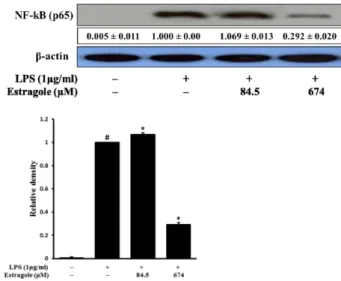
Effect on the activation of NF- κB − To evaluate the transcriptional controls of estragole, the effect of estragole on the transcriptional activation of NF- κB in LPS-induced RAW 264.7 cells was measured. Fig. 4 clearly shows that the number of p65 (NF- κB) subunits in the nucleus was rapidly increased after LPS treatment in the control group and significantly inhibited in the sample treated group.

These results indicate that LPS induced the translocation of NF- κB to the nucleus, and pretreatment with estragole significantly suppressed this process (Fig. 3).

Effect on MAPK signaling pathways − The phosphory- lation levels of MAPKs were analyzed in LPS-treated RAW 264.7 cells by Western blotting because MAPK signaling molecules also play a critical role in regulating

Fig. 2. Inhibitory effect of estragole on the expression of iNOS and COX-2 in LPS-stimulated RAW264.7 cells. Cells were pretreated with the indicated concentration of estragole for 2 h and stimulated with LPS (1 μg/mL) for 18 h. Data was detected by Western blot analysis with the designated antibodies. β-Actin was used as an internal control. The results presented are representative of three independent experiments.

#

p < 0.05 indicates significant differences from the control group. *p < 0.05 indicates significant differences from the LPS-treated group.

Fig. 3. Inhibitory effect of estragole on the expression of NF-κB

(total protein) in LPS-stimulated RAW264.7 cells. Cells were

pretreated with the indicated concentrations of estragole for 2 h

and stimulated with LPS (1 μg/mL) for 18 h. Data was detected

by Western blot analysis with the designated antibodies. β-Actin

was used as an internal control. The results presented are

representative of three independent experiments.

#

p < 0.05 indicates

significant differences from the control group. *p < 0.05 indicates

significant differences from the LPS-treated group.

(5)

the LPS-induced inflammatory process. The phos- phorylation of MAPKs is also closely related to the regulation of NF- κB activation. Fig. 4 depicts the inhibitory activity of estragole on ERK, JNK, and p38 phosphorylation after 2 h of LPS stimulation in RAW 264.7 cells. These results demonstrated that estragole significantly inhibits the phosphorylation of ERK, JNK, and p38 in LPS-treated RAW 264.7 cells.

Effect on intracellular ROS production − It has been suggested that inflammation is mediated by cellular oxidative stress. Therefore, the inhibitory effect of estragole on LPS-induced ROS generation in RAW 264.7 cells was investigated. The cells were treated with LPS to generate ROS, and DCFH-DA was used to detect ROS generation in a fluorescent microplate reader. As demon- strated in Fig. 5, estragole exhibited significant inhibitory activity against ROS generation compared to the positive

control (Trolox).

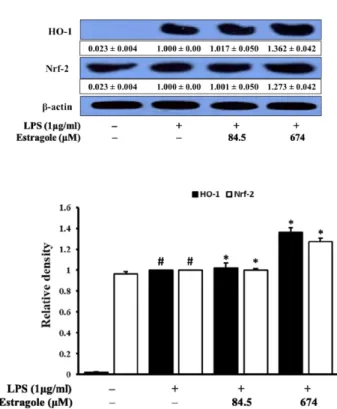
Effect on the regulation of HO-1 − HO-1 is a cytoprotective enzyme that provides cellular protection against oxidative stress. Therefore, the effect of estragole on the up-regulation of HO-1 protein expression was determined by Western blot. As shown in Fig. 6, treatment with estragole led to a significant increase in HO-1 protein expression, clearly indicating the upregulation of HO-1 protein expression of estragole in LPS-treated RAW 264.7 cells.

Effect on the regulation of Nrf-2 − Nrf-2 is a transcription factor that regulates the expression of HO-1 to protect against oxidative damage at the site of inflammation. Therefore, Nrf-2 protein expression was also investigated by Western blot in LPS-induced RAW 264.7 cells. As shown in Fig. 6, estragole significantly up- regulated Nrf-2 expression in LPS-treated RAW 264.7 cells compared to the non-treated group.

Discussion

Estragole is an essential oil compound obtained from various aromatic plants. Generally, essential oil-containing plants are located in warm countries, such as those around the Mediterranean and tropical countries, and they can play an important part in the traditional pharmacopeia.

9

Fig. 4. Inhibitory effect of estragole on the expression of MAPKs

in LPS-stimulated RAW264.7 cells. Cells were pretreated with the indicated concentrations of estragole for 2 h and stimulated with LPS (1 μg/mL) for 18 h. Data was detected by Western blot analysis with the designated antibodies. β-Actin was used as an internal control. The results presented are representative of three independent experiments. #p < 0.05 indicates significant differences from the control group. *p < 0.05 indicates significant differences from the LPS-treated group.

Fig. 5. Inhibitory effect of estragole on the production of ROS in LPS-stimulated RAW264.7 cells. Cells pretreated with different concentrations of estragole for 2 h were stimulated with LPS (1 μg/mL) for 24 h. ROS levels were measured by DCFH-DA with fluorescent analysis. Data are presented as the mean ± standard deviation of three independent experiments.

###

p < 0.01 indicates significant differences from the control group. * p <

0.05, **p < 0.01, and ***p < 0.001 indicate significant differences

from the LPS-treated group.

(6)

Essentials oils are liquid, limpid, volatile, rarely colored, lipid-soluble, and soluble in organic solvents. Despite their wide use as fragrances, it is important to focus on their mode of biological action for application in human health. Estragole is a phenylpropene and members of the phenylpropanoid class of chemical compounds. Although, it has been reported that estragole exhibits an anti- inflammatory activity on paw edema induced by carrageenan and dextran in mice,

16

no detailed information in available about the molecular mechanism in vitro.

The MTT assay is a sensitive, accurate, and colorimetric assay for testing cell metabolic activity and is widely used for the measurement of cytotoxicity.

17

In the present study, RAW 264.7 cells were treated with various concentrations of estragole for 24 h to test cell viability using the MTT assay. The results clearly indicated that estragole did not exhibit any cytotoxicity in the selected concentrations against RAW 264.7 cells. Therefore, these results strongly suggest that the concentrations of estragole are safe for the evaluation of anti-inflammatory activity in LPS-induced RAW 264.7 cells.

It has been previously shown that NO and PGE

2

are vital mediators of inflammation, and NO has an important role in many body functions. Thus, the overproduction of NO can lead to inflammatory disorders.

18,19

iNOS regulates NO production from arginine in response to many inflammatory stimuli. The inducible enzyme COX-2 is responsible for the development of many chronic inflammatory diseases. Therefore, inhibition of NO and PGE

2

production and inhibition of iNOS and COX-2 protein expression might have crucial therapeutic value for the prevention of inflammatory diseases. This study revealed that estragole significantly inhibited NO produc- tion compared to the positive control. In the case of iNOS inhibition, estragole significantly suppressed iNOS protein expression. Likewise, estragole exhibited COX-2 inhibitory activity at 674 µM concentration. Unfortunately, the present study did not demonstrate the inhibition of PGE

2

production in LPS-induced RAW 264.7 cells. Further studies are required to evaluate the inhibition of PGE

2

production for estragole in LPS-induced RAW 264.7 cells.

Recent studies have shown that LPS-induced inflam- mation is highly associated with different intracellular signaling pathways, such as NF- κB and MAPKs pathways.

NF- κB is an important regulator of a number of proinflammatory genes such as iNOS, COX-2, TNF- α, IL-1 β, and IL-6 in LPS-induced inflammation.

20-22

Predo- minantly, the inactive NF- κB complex with IêB resides in the cytoplasm, and I κB is rapidly phosphorylated in response to proinflammatory stimuli.

23

Free NF- κB rapidly translocates to the nucleus and promotes the transcription of the target genes, which are responsible for inflamma- tion. Therefore, NF- κB could be an effective therapeutic target for treating inflammatory diseases. The present data show that estragole significantly inhibited NF- κB protein expression in LPS-induced RAW 264.7 cells. In addition, further studies may be necessary to evaluate the inhibitory activities of cellular cytokines in LPS-induced RAW 264.7 cells.

The MAPK families consist of ERK1/2, JNK, and p38 that control cellular signal transduction in response to inflammation.

24

LPS is a recognized activator of MAPK in macrophages. During inflammation, the p38 and JNK pathways are known as the stress-activated protein kinase pathways.

25

These MAPK signaling pathways subsequently activate NF- κB. The NF-κB inactivation mechanism is also related to inhibition of the phosphorylation of ERK1/

2, JNK, and p38. Western blot analysis demonstrated that estragole exhibited significant inhibitory activity toward the phosphorylation of ERK1/2, JNK, and p38.

Fig. 6. Inhibitory effect of estragole on the expression of HO-1

and Nrf-2 in LPS-stimulated RAW264.7 cells. Cells were

pretreated with the indicated concentration of estragole for 2 h

and stimulated with LPS (1 μg/mL) for 18 h. Data was detected

by Western blot analysis with the designated antibodies. β-Actin

was used as an internal control. The results presented were

representative of three independent experiments.

#

p < 0.05

indicates significant differences from the control group. *p < 0.05

indicates significant differences from the LPS-treated group.

(7)

The uncontrolled production of free radicals in cellular systems can damage cellular components like cellular macromolecules, DNA, lipids, and proteins in the cell.

ROS generation is an important factor in the pathogenesis of inflammation.

26

LPS can facilitate the cellular ROS level, which is associated with the expression of inflammatory signaling pathways mediated by NF- κB.

27

Numerous studies have revealed that oxidative stress strongly affects the activation of NF- κB.

28

The antioxidant can inhibit the production of proinflammatory cytokines including IL-8.

29

In the present study, pretreatment of estragole significantly reduced LPS-activated ROS pro- duction in RAW 264.7 cells.

The inducible HO-1 enzyme is a stress-responsive protein that acts against oxidative stress. It is currently believed that HO-1 has anti-inflammatory activities.

30

HO-1 degrades heme through a catalyzation process and produces iron, carbon monoxide, and biliverdin. This biliverdin is then converted into bilirubin, which is a strong antioxidant. Strong evidence indicates that the induction of HO-1 inhibits the LPS-induced inflammatory response activated by Nrf-2 pathways.

31, 32

Transcription factor Nrf-2 activation is the primary defense against cellular oxidative stress. Nrf-2 translocates to the nucleus after dissociation from keap1, binds to the antioxidant response element (ARE), and then regulates the transcrip- tion of HO-1 protein in LPS-induced RAW 264.7 cells.

33

HO-1 is known as an antioxidant protein. Inducible HO-1 inhibits the excessive production of TNF- α and IL-1β through Nrf-2 activation in response to LPS-induced RAW 264.7 cells.

34

This study revealed that the tested compound significantly up-regulates HO-1 protein ex- pression. Likewise, Nrf-2 protein expression was also significantly up-regulated by the selected compound.

Taken together, the results of the in vitro cell line assay for MTT, NO production, ROS generation; the Western blot analysis for the inhibition of iNOS, COX-2, NF- κB, and MAPKs protein expression; the up-regulation of the HO-1/Nrf-2 signaling pathways revealed that the selected phenylpropene, estragole, may be useful for the develop- ment of anti-inflammatory therapeutics.

Conclusion

In conclusion, these findings demonstrated that estragole significantly inhibits the production of inflammatory mediators and up-regulate antioxidant protein expression in LPS-stimulated RAW 264.7 cells. Moreover, the inhibitory actions of estragole are likely associated with the regulation of NF- κB, MAPKs, and HO-1/Nrf-2

signaling pathways. Verification of the anti-inflammatory actions of estragole and the justifying relative mechanisms in the in vivo models will be beneficial for the application of estragole as a therapeutic agent for inflammatory diseases.

Acknowledgments

This work was supported by a Research Grant of Pukyong National University (Granted in 2017).

References

(1) Joung, E. -J.; Lee, B.; Gwon, W. -G.; Shin, T.; Jung, B. -M.; Yoon, N. -Y.; Choi, J. S.; Oh, C. -W.; Kim, H. -R. Int. Immunopharmacol. 2005, 29, 693-700.

(2) Laroux, F. S.; Pavlick, K. P.; Hines, I. N.; Kawachi, S.; Harada, H.;

Bharwani, S.; Hoffman, J. M.; Grisham, M. B. Acta Physiol. Scand. 2001, 173, 113-118.

(3) Giuliani, C.; Napolitano, G.; Bucci, I.; Montani, V.; Monaco, F. Clin.

Ter. 2001, 152, 249-253.

(4) May, M. J.; Ghosh, S. Immunol. Today 1998, 19, 80-88.

(5) Tak, P. P.; Firestein, G. S. J. Clin. Invest. 2001, 107, 7-11.

(6) Cargnello, M.; Roux, P. P. Microbiol. Mol. Biol. Rev. 2011, 75, 50- 83.

(7) Chen, H. -G.; Xie, K. -L.; Han, H. -Z.; Wang, W. -N.; Liu, D. -Q.;

Wang, G. -L.; Yu, Y. -H. Int. J. Surg. 2013, 11, 1060-1066.

(8) Taha, R.; Blaise, G. Funct. Food Health Dis. 2014, 4, 510-523.

(9) Bakkali, F.; Averbeck, S.; Averbeck, D.; Idaomar, M. Food Chem.

Toxicol. 2008, 46, 446-475.

(10) Choi, J. S.; Song, B. M.; Park, H. J. Kor. J. Pharmacogn. 2016, 47, 192-196.

(11) Donati, M.; Mondin, A.; Chen, Z.; Miranda, F. M.; do Nascimento, B. B. Jr.; Schirato, G.; Pastore, P.; Froldi, G. Nat. Prod. Res. 2015, 29, 939-946.

(12) Friedman, M.; Henika, P. R.; Mandrell, R. E. J. Food Prot. 2002, 65, 1545-1560.

(13) Cosentino, R. M.; Norte, M. C.; Lazarini, C. A. Phytother. Res.

2004, 18, 921-924.

(14) Albuquerque, A. A.; Sorenson, A. L.; Leal-Cardoso, J. H. J.

Ethnopharmacol. 1995, 49, 41-49.

(15) Ponte, E. L.; Sousa, P. L.; Rocha, M. V.; Soares, P. M.; Coelho-de- Souza, A. N.; Leal-Cardoso, J. H.; Assreuy, A. M. Pharmacol. Rep. 2012, 64, 984-990.

(16) Rodrigues, L. B.; Oliveira Brito Pereira Bezerra Martins, A.;

Cesário, F. R.; Ferreira e Castro, F.; de Albuquerque, T. R.; Martins Fernandes, M. N.; Fernandes da Silva, B. A.; Quintans Júnior, L. J.; da Costa, J. G.; Melo Coutinho, H. D.; Barbosa, R.; Alencar de Menezes, I.

R. Chem. Biol. Interact. 2016, 257, 14-25.

(17) Keiser, K.; Johnson, C. C.; Tipton, D. A. J. Endod. 2000, 26, 288- 291.

(18) Meda, L.; Cassatella, M. A.; Szendrei, G. I.; Otvos, L. Jr.; Baron, P.; Villalba, M.; Ferrari, D.; Rossi, F. Nature 1995, 374, 647-650.

(19) Dandona, P.; Chaudhuri, A.; Dhindsa, S. Diabetes Care 2010, 33, 1686-1687.

(20) Marks-Konczalik, J.; Chu, S. C.; Moss, J. J. Biol. Chem. 1998, 273, 22201-22208.

(21) Islam, M. N.; Choi, R. J.; Jin, S. E.; Kim, Y. S.; Ahn, B. R.; Zhao, D.; Jung, H. A.; Choi, J. S. J. Ethnopharmacol. 2012, 144, 175-181.

(22) Chen, J. -J.; Huang, W. -C.; Chen, C. -C. Mol. Biol. Cell. 2005, 16,

5579-5591.

(8)

(23) Rajapakse, N.; Kim, M. M.; Mendis, E.; Kim, S. K. Immunology 2008, 123, 348-357.

(24) Kaminska, B. Biochem. Biophys. Acta 2005, 1754, 253-262.

(25) Xia, Z.; Dickens, M.; Raingeaud, J.; Davis, R. J.; Greenberg, M. E.

Science 1995, 24, 1326-1331.

(26) Hancock, J. T.; Desikan, R.; Neill, S. J. Biochem. Soc. Trans. 2001, 29, 345-350.

(27) Choi, S. Y.; Hwang, J. H.; Ko, H. C.; Park, J. G.; Kim, S. J. J.

Ethnopharmacol. 2007, 113, 149-155.

(28) Siomek, A. Acta Biochem. Pol. 2012, 59, 323-331.

(29) Ryan, K. A.; Simth, M. F. Jr.; Sanders, M. K.; Ernst, P. B. Infect.

Immun. 2004, 72, 2123-2130.

(30) Kim, J. -H.; Choo, Y. -Y.; Tae, N.; Min, B. -S.; Lee, J. -H. Int.

Immunopharmacol. 2014, 22, 420-426.

(31) Lee, I. -S.; Lim, J.; Gal, J.; Kang, J. -C.; Kim, H. -J.; Kang, B. -Y.;

Choi, H. -J. Neurochem. Int. 2011, 58, 153-160.

(32) Paine, A.; Eiz-Vesper, B.; Blasczyk, R.; Immenschuh, S. Biochem.

Pharmacol. 2010, 80, 1895-1903.

(33) Lee, M. -Y.; Lee, J. -A.; Seo, C.-S.; Ha, H.; Lee, H.; Son, J. -K.;

Shin, H. -K. Food Chem. Toxicol. 2011, 49, 1047-1055.

(34) Tsoyi, K.; Lee, T. Y.; Lee, Y. S.; Kim, H. J.; Seo, H. G.; Lee, J. H.;

Chang, K. C. Mol. Pharmacol. 2009, 76, 173-182.

Received August 4, 2017

Revised October 7, 2017

Accepted October 11, 2017

수치

Fig. 3. Inhibitory effect of estragole on the expression of NF-κB (total protein) in LPS-stimulated RAW264.7 cells
Fig. 5. Inhibitory effect of estragole on the production of ROS in LPS-stimulated RAW264.7 cells
Fig. 6. Inhibitory effect of estragole on the expression of HO-1 and Nrf-2 in LPS-stimulated RAW264.7 cells

참조

관련 문서

Effects of Chondrus nipponicus Yendo ethanol extract on LPS-induced iNOS, COX-2, and NF-κB p65 expression in RAW 264.7 cells.. The level of NF-κB p65 in nuclear protein

Western blot indicated that MC suppressed the induction of MAPKs, NF-κB &amp; phospho-IκB activity in HMC-1 cells.. Luciferase assay indicated that MC suppressed the PMA

Methods: We ex- amined the effects of KP on NO production, nitric oxide syn- thase (iNOS) and HO-1 expression, NF-κB, Nrf2 and MAPK activation in mouse peritoneal

Protein expressions of inducible nitric oxide synthase, and cyclooxygenase-2 (COX-2) and p65 subunit of nuclear factor-κ B (NF-κ B) were determined by Western blot analysis.

Figure 3. Effects of LO on the LPS-induced iNOS and COX-2 protein expression in RAW 264.7 macrophages. The protein levels of iNOS and COX-2 were determined by Western

4 Inhibition of LPS-induced iNOS and COX-2 protein (A) and mRNA (B) expression by the addition of EtOAc fraction of fermented Bat Faeces to RAW 264.7 macrophage cells..

특히 iNOS 는 외부자극이나 pro-inflammatory cytokine 등에 의해 자극을 받게 되면 다량의 NO 를 생산하 Anti-inflammatory Effect of Sargassum coreanum Ethanolic

(A) Expression of iNOS and COX-2 at protein levels determined by Western blot analysis with cell lysates using anti-iNOS and anti-COX-2 antibodies and an