24(1) : 28-35 (2018)
https://doi.org/10.20307/nps.2018.24.1.28
28
Pulegone Exhibits Anti-inflammatory Activities through the Regulation of NF- κB and Nrf-2 Signaling Pathways in LPS-stimulated RAW 264.7 cells
Anupom Roy
1, Hee-Juhn Park
2, Qudeer Ahmed Abdul
1, Hyun Ah Jung
3,*, and Jae Sue Choi
1,*
1
Department of Food and Life Science, Pukyong National University, Busan 608-737, Republic of Korea
2
Department of Pharmaceutical Engineering, Sangji University, Wonju 220-702, Republic of Korea
3
Department of Food Science and Human Nutrition, Chonbuk National University, Jeonju 561-756, Republic of Korea
Abstract − Pulegone is a naturally occurring organic compound obtained from essential oils from a variety of plants. The aim of this study was to investigate the anti-inflammatory effects through the inhibitory mechanism of inducible nitric oxide synthase (iNOS), cyclooxygenase (COX-2), nuclear factor kappa B (NF-κB), mitogen- activated protein kinases (MAPK) pathways and the activation of nuclear factor erythroid 2-related factor 2 (Nrf2)/ heme oxygenase (HO)-1 pathways in lipopolysaccharide (LPS)-stimulated RAW264.7 cells. Results revealed that pulegone significantly inhibited NO production as well as iNOS and COX-2 expressions. Meanwhile, western blot analysis showed that pulegone down-regulated LPS-induced NF-κB and MAPKs activation in RAW 264.7 cells. Furthermore, the selected compound suppressed LPS-induced intracellular ROS production in RAW 264.7 cells, while the expression of stress response gene, HO-1, and its transcriptional activator, Nrf-2 was upregulated upon pulegone treatment. Taking together, these findings provided that pulegone inhibited the LPS- induced expression of inflammatory mediators via the down-regulation iNOS, COX-2, NF- κB, and MAPKs signaling pathways as well as up-regulation of Nrf-2/HO-1 indicating that pulegone has a potential therapeutic and preventive application in various inflammatory diseases.
Keywords − Pulegone, Anti-inflammation, HO-1, Nrf-2, NF-κB
Introduction
Inflammation is an essential biological response of the body to various harmful stimuli which leads to the generation of pro-inflammatory cytokines and mediators.
It is the result of several contributing factors such as microbial pathogen, chemicals, irritant and immunological disorders. Although, inflammation is a beneficial host- response upon tissue injury, but upon long persistence, it may result in chronic conditions such as cancer, cardio- vascular disease, diabetes, pulmonary disorders, neurological disease, and arthritis.
1The treatment of inflammatory diseases focuses on the suppression of inflammatory mediators such as NO as well as the inhibition of the complex network of signaling pathways including, inducible nitric oxide synthase (iNOS), cyclooxygenase (COX-2),
nuclear factor κB (NF-κB), mitogen-activated protein kinase (MAPK), reactive oxygen species (ROS), and pro- inflammatory cytokines (TNF- α, IL-6, and IL-1β).
2NF- κB is a transcription factor which plays a fundamental role in the inflammatory and acute inflam- matory responses.
3In normal cellular homeostatic conditions, NF- κB subunits are inactive and bound with IêB inside cytoplasm. Phosphorylation and desecration of IêB activates NF- κB to translocate toward nucleus and where it begins the transcription of several of key inflammatory genes.
4Furthermore, NF- κB is also involve in the regulation of proinflammatory gene expression which mediates the synthesis of cytokines such as TNF- α, IL-1 β, IL-6 and IL-8.
5It also regulates the transcription of COX-2 or iNOS.
5MAPKs, extracellular signal-regulated kinase (ERK), c-Jun N-terminal kinase (JNK) and p38 MAPK, have been associated with the transcriptional regulation of inflammatory genes via NF- κB activation.
6Heme oxygenase-1 (HO-1) is a key anti-oxidant enzyme that catalyzes the degradation of heme and produces biliverdin, ferrous iron, and carbon monoxide. The depletion of heme and generation of biliverdin together with ferrous
*Author for correspondence
Jae Sue Choi, Department of Food and Life Science, Pukyong National University, Busan 608-737, the Republic of Korea.
Tel: +82-51-629-5845; E-mail: [email protected]
Hyun Ah Jung, Department of Food Science and Human Nutrition, Chonbuk National University, Jeonju 561-756, Republic of Korea.
Tel: +82-63-270-4882; E-mail: [email protected]
iron, and carbon monoxide contribute to the anti- inflammatory effects of HO-1.
7Recent studies showed that HO-1 inhibits the excessive production of pro- inflammatory cytokines as well as reactive oxygen species (ROS) in LPS-stimulated RAW 264.7 cells.
8At the transcription level, HO-1 induction is regulated by a transcription factor called nuclear transcription factor-E2- related factor 2 (Nrf-2). Activation of Nrf-2 regulates the expression of HO-1 and enhances the anti-oxidative ability of cells and therefore, becomes a drug target for the treatment of inflammatory diseases.
9Essential oils are volatile, concentrated hydrophobic, natural, complex compounds mainly extracted from aromatic plants. They are characterized by strong odor.
Essential oils were first developed in Middle Ages by Arabs and known for their antiseptic abilities such as anti- bacterial, anti-fungal, and anti-viral, and medicinal properties and their smell.
10Essential oils have been used in embalmment, preservation of foods and as antimicrobial, analgesic, sedative, anti-inflammatory, spasmolytic and for anesthetic purposes.
10Pulegone (Fig. 1), a naturally occurring organic compound obtained from the essential oils several of plants such as Nepeta cataria (catnip), Mentha piperita, and pennyroyal.
10,11Previously, we identified that pulegone essential oil from Korean herb Agastache rugosa through the gas chromatographic analysis.
12Pulegone classified as a monoterpene with characteristic colorless oily liquid and delivers a pleasant odor similar to pennyroyal, peppermint, and camphor. It is used in flavoring agents, in perfumery, and in aro- matherapy.
13Earlier reports showed that pulegone exhibit multiple biological activities including antioxidant,
14antimicrobial,
14insecticidal,
14and anticholinesterase activity.
15Although pulegone showed various biological activities, however, the mechanism of its anti-inflammatory actions
remain to clarify yet. Therefore, the aim of this study was to focus on the anti-inflammatory activities of pulegone through the inhibition of iNOS, COX-2, NF- κB, and MAPKs expression and the induction of Nrf2/HO-1 expression in LPS-stimulated RAW 264.7 cells.
Experimental
Chemicals and reagents – Pulegone, LPS from Escherichia coli, Griess reagent, 3-[4,5-dimethylthiazol-2- yl]-2,5-di-phenyl tetrazolium bromide (MTT), dimethyl sulfoxide (DMSO), 2 7-dichlorodihydrofluorescein diacetate (DCFH-DA), 2-amino-5,6-dihydro-6-methyl-4H-1,3-thiazine hydrochloride (AMT), 6-hydroxy-2,5,7,8-tetramethylchro- man-2-carboxylic acid (Trolox), phenylmethylsulfonyl fluoride (PMSF), fetal bovine serum (FBS) and antibiotics were purchased from Sigma-Aldrich Co. (St. Louis, MO, USA), and Dulbecco’s modified Eagle’s medium (DMEM) from Hyclone (Logan, UT, USA). Various primary antibodies (iNOS, COX-2, NF- κB (p65), p-ERK, ERK, p-JNK, JNK, p-p38, p38, HO-1, Nrf-2 and β-actin) and secondary antibodies were obtained from Cell signaling Technology Inc. (Beverly, MA, USA) and Santa Cruz Biotechnology Inc. (Santa Cruz, CA, USA) and diluted 1:1000. Polyvinylchloride fluoride (PVDF) membrane (Immobilon-P) was obtained from Millipore Co. (Billerica, MA, USA). Super-signal
®West Pico Chemiluminescent Substrate was obtained from Pierce Biotechnology, Inc.
(Rockford, IL, USA). All other chemicals and solvents were purchased from Sigma-Aldrich Co., unless stated otherwise.
Cell culture – Marine RAW 264.7 cells were obtained from the American Type Culture Collection (ATCC Rockville, MD, USA). RAW 264.7 cells were cultured in DMEM supplemented with 10% heat-inactivated FBS, and 1% penicillin-streptomycin and 0.1% amphotericin B.
The cells were incubated in humidified atmosphere with 5% CO
2at 37
oC.
Cell viability – Cell viability was assessed using the MTT assay. Briefly, RAW 264.7 cells were seeded into 96-well plates at a density of 1 × 10
4cells per well and incubated at 37
oC for 24 h. The cells were then treated with the pulegone at various concentrations. After incubation for an additional 24 h at 37
oC, 100 μl MTT (0.5 mg/ml in PBS) was added to each well and the incubation continued for another 2 hours. The resulting color was assayed at 540 nm using a microplate spectrophotometer (Molecular Devices, Sunnyvale, CA, USA).
NO production – The nitrite concentration in the
medium was measured using Griess reagent as an
Fig. 1. The structure of pulegone.
indicator of NO production. Briefly, RAW 264.7 cells (2
× 10
4cells/well in a 24-well plate with 500 μl culture medium) were pretreated with various concentration of samples for 2 hours and incubated for 18 hours with LPS (1 μg/ml). After incubation, the nitrate concentration of the supernatants (100 μl/well) was measured by adding 100 μl Griess reagent. The absorbance values of mixtures were determined using a micro-plate spectrophotometer (Molecular devices) at 540 nm. The iNOS inhibitor, AMT was used as a positive control.
Measurement of intracellular ROS – The intracellular ROS scavenging activity of pulegone was measured using fluorescent probe DCFH-DA. Cells plated in a black 96- well plate at a density of 1 × 10
4cells/well were co- treated with various concentration of the pulegone and LPS (1.0 µg/ml) for 2 h. Cells were treated with 20 µM DCFH-DA for 30 min at 37
oC. The fluorescence intensity was measured at excitation wavelength of 485 nm and an emission wavelength of 528 nm using of fluorescence microplate reader (Dual Scanning SPECTRAmax, Mole- cular Devices).
Western blot analysis – Western blotting was used to measure the protein expression of iNOS, COX-2, MAPKs, HO-1, and Nrf-2 according to the procedure of Jung et al.
(2017).
16Statistical analysis – Data were expressed as the means
± standard deviations (SDs) of at least three independent experiments unless otherwise indicated. Data were com- pared using one-way ANOVA. P values < 0.05, 0.01, and 0.001 were considered statistically significant. All analyzes were performed using SPSS for windows, version 23 (SPSS Inc., Chicago, IL, USA).
Result
Effects of pulegone on RAW 264.7 cell viability – Cytotoxicity test was conducted using range of concentrations of pulegone in RAW 264.7 cells. As represented in Fig. 2, incubation of the RAW 264.7 cell with pulegone (6.25 – 50 µg/mL) did not induced any cytotoxic effects when compared with the control.
Additionally, cell viability was more than 95% at most of the concentrations. Therefore, pulegone upto 50 µg/mL seemed to be not toxic to RAW 264.7 cells and these non- toxic concentrations were used for respective anti- inflammatory assays.
Effects on NO production – LPS-stimulated NO generation is important part of inflammatory signaling pathway. In this study, NO production was measured with non-toxic concentrations of pulegone in LPS-activated
RAW 264.7 cells. As shown in Fig. 3, LPS induction greatly enhanced NO production. However, pulegone pretreatment at the indicated concentrations dose-depen- dently inhibited NO production. Moreover, pulegone particularly at 12.5 - 50 µg/mL significantly suppressed NO production compared to LPS-treated cells. AMT, positive control, significantly inhibited LPS-induced NO release from RAW 264.7 cells (Fig. 3).
Effects on the production of iNOS and COX-2 – To further investigate the whether the anti-inflammatory potential of pulegone was due to the inhibition of NO, Fig. 2. Cell viability of pulegone measured by the MTT assay.
Values represent the mean ± SD of three independent experiments.
Fig. 3. Inhibitory effects of pulegone on the production of NO in LPS-stimulated RAW264.7 cells. Cells were pretreated with different concentrations of pulegone for 2 h and then stimulated with LPS (1.0 μg/ml) for 24 h. The culture media were used to measure the amount of nitrite to determine NO production. Data are presented as mean ± SD of three independent experiments.
###
p < 0.001 indicates significant difference from the control
group.
*p < 0.05,
**p < 0.01, and
***p < 0.001 indicate significant
difference from the LPS-treated group.
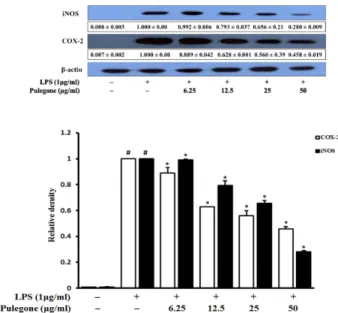
Western blot analysis was performed. According to Fig. 4, LPS exposure significantly up-regulated iNOS and COX- 2 expression compared to non-treated cells. However, pulegone treatment in a dose response manner down- regulated iNOS and COX-2 expressions. Interestingly, higher concentration exhibited promising down-regulatory effects against iNOS and COX-2 protein expression.
Effects on the activation of NF- κB – To determine whether pulegone affects LPS-induced activation and translocation of NF- κB, the phosphorylation of p65 subunit was examined by immunoblotting. Fig. 5 clearly shown that LPS treatment sharply enhanced phosphory- lation of p65. Whereas, pulegone exhibited moderate down-regulatory effects on translocation of p65 (NF- κB).
Effects on MAPK signaling pathways – The phos- phorylation levels of MAPKs were analyzed in LPS- treated RAW 264.7 cells by Western blotting. MAPKs including ERK, JNK, and p38 signaling also play a vital part in regulating the LPS-induced inflammatory process.
Furthermore, phosphorylation of MAPKs is also closely linked to the regulation of NF- κB activation. As Fig. 6 depicted that the inhibitory activities of pulegone on ERK, JNK, and p38 phosphorylation after 2 h of LPS stimulation in RAW 264.7 cells. These results demons- trated that the tested compound significantly down-
regulated phosphorylation of ERK, JNK, and p38 in LPS- treated RAW 264.7 cells. The inhibition of the phosphory- Fig. 4. Inhibitory effects of pulegone on the expression of iNOS
and COX-2 in LPS-stimulated RAW264.7 cells. Cells were pretreated with the indicated concentration of pulegone for 2 h and stimulated with LPS (1.0 μg/ml) for 18 h. The expression of iNOS, COX-2, and β-actin was detected by Western blot using corresponding antibodies. The results presented are represen- tative of three independent experiments.
#p < 0.05 indicates a significant difference from the control group.
*p < 0.05 indicates a significant difference from the LPS-treated group.
Fig. 5. Inhibitory effects of pulegone on the expression of NF-κB in LPS-stimulated RAW264.7 cells. Cells were pretreated with the indicated concentration of pulegone for 2 h and stimulated with LPS (1.0 μg/ml) for 18 h. The expression of NF-κB and β- actin was detected by Western blot using corresponding antibodies.
The results presented are representative of three independent experiments.
#p < 0.05 indicates a significant difference from the control group.
*p < 0.05 indicates a significant difference from the LPS-treated group.
Fig. 6. Inhibitory effects of pulegone on the expression of MAPKs in LPS-stimulated RAW264.7 cells. Cells were pretreated with the indicated concentration of pulegone for 2 h and stimulated with LPS (1.0 μg/ml) for 18 h. The expression of MAPKs was detected by Western blot using corresponding antibodies. The results presented are representative of three independent experiments.
#
p < 0.05 indicates a significant difference from the control group.
*