서 론
전자담배는 propylene glycol, glycerin, nicotine, 착향료로 구성되어 있으며 이를 열을 가해 용해시키는 니코틴이 포함된 연무제이다.1) 2003년 개발된 이래로 세계적으로 전자담배 사용이 증가하고 있 다.2,3) 2014년 기준 전세계 전자담배 시장은 30억 달러 규모이며, 점차
더 큰 규모로 성장할 것으로 예상하고 있다.1) 우리나라 전자담배 사 용률도 증가하고 있어, 2015년도 국민건강영양조사 자료에 따르면, 성인 흡연율은 전년 대비 감소추세였으나, 전자담배 평생 사용률은 전년 대비 남녀 각각 6.4%, 1.3% 증가하였다.4) 전자담배는 기존의 흡 연 담배의 대체제로서 혹은 담배를 끊기 위한 방법으로 사용되기 시작하여, 기존의 담배를 끊기 어렵거나, 끊기를 꺼리는 흡연자들에
Received April 19, 2018 Revised March 17, 2019 Accepted May 20, 2019
Corresponding author Soyeun Kim Tel: +82-2-970-2285, Fax: +82-2-970-2114 E-mail: [email protected]
ORCID: http://orcid.org/0000-0002-5214-1839
Copyright © 2019 The Korean Academy of Family Medicine
This is an open-access article distributed under the terms of the Creative Commons At- tribution Non-Commercial License (http://creativecommons.org/licenses/by-nc/4.0) which permits unrestricted noncommercial use, distribution, and reproduction in any medium, provided the original work is properly cited.
Original Article
https://doi.org/10.21215/kjfp.2019.9.4.324 eISSN 2233-9116
Korean J Fam Pract. 2019;9(4):324-330
Korean Journal of Family Practice
KJFP
흡연자들 중 전자담배 사용자의 특성: 제6기 국민건강영양조사, 2013-2015
김윤아, 이지원, 김정효, 김재열, 고영진, 김소연*
한국원자력의학원 가정의학과
The Characteristics of Electronic Cigarette User among Korean Smokers: The Sixth Korean National Health and Nutrition Examination Survey, 2013-2015
Youn A Kim, Jiwon Lee, Jeonghyo Kim, Jaeyeol Kim, Young-Jin Ko, Soyeun Kim*
Department of Family Medicine, Korean Cancer Center Hospital, Seoul, Korea
Background: Although the electronic cigarette (e-cigarette) market is growing rapidly, few studies have been conducted on e-cigarettes in South Korea. This study aims to analyze the general characteristics of Korean adult smokers with e-cigarette use.
Methods: This study used data from the 6th National Health and Nutrition Survey (NHANS). Multivariate logistic regression analysis was conducted to examine subjects’ general characteristics and a questionnaire related to smoking cessation, stress perception, and depression. A frequency analysis of reasons for using e-cigarettes was conducted of 318 subjects of the 2015 NHANS who were smokers and used e-cigarettes.
Results: The study found that smokers with experience using e-cigarettes were younger and had a higher income level (odds ratio [OR], 1.45; 95%
confidence interval [CI], 1.03–2.05) than smokers without e-cigarette experience. Professional, management, and office worker groups were associated with e-cigarette use (OR, 1.40; 95% CI, 1.10–1.77). Willingness to quit smoking was also higher in subjects with experience using e-cigarettes (OR, 1.35; 95% CI, 1.09–1.68). The most common reason for smoking cessation in both groups was concern about their own and their family’s health. About 50% of smokers with experience using e-cigarettes thought e-cigarettes would be more helpful for smoking cessation than regular cigarettes.
Conclusion: Although the safety and rationale of using e-cigarettes as a smoking cessation aid are unproven, many smokers consider them a method of smoking cessation. It is necessary to provide correct information on e-cigarettes.
Keywords: Electronic Cigarettes; E-Cigarettes; Smoking Cessation; Cigarette Smoking
김윤아 외. 전자 담배사용 경험있는 흡연자의 특성 Korean Journal of Family Practice
KJFP
게 대중화되고 있다.5-8) 또한, Soneji 등9)은 메타 분석을 통하여, 청소 년 및 젊은 성인에서 전자담배에 노출되는 것은 오히려 향후 흡연 시 작으로 이어질 수 있다는 연구 결과를 보여주었다.
전자담배의 안전성과 금연 효과가 입증되기 이전에 전자담배는 판매 초기부터 금연 보조제로 광고되어 왔다. 하지만, 전자담배의 건 강에 대한 안전성에 대한 논쟁은 아직 끊이지 않고 있다. 전자담배에 는 기존 담배에 비하여 그 양이 적기는 하지만, formaldehyde, acetal- dehyde, acrolein, toluene, nitrosonornicotine, 4-(nitrosomethyl-amino)- 1-(3-pyridyl)-butanone 등의 기존 담배에 포함되어 있던 독성 물질이 포함되어 있다.10) 전자담배 사용자에서 호흡기 질환, 폐기능 저하가 관찰되었으며,11-13) 전자담배 카트리지 표면에서 호흡기, 소화기, 피부 의 발암물질로 작용할 수 있는 물질이 생성될 수 있다고 보고되었
다.14-16) 전자담배는 연기가 없어 간접흡연을 줄일 수 있다고 생각할
수 있으나, 기존 연구에서 전자담배 사용자 주변 공기에서 흡연 시에 발생하는 물질들이 검출되었다.17,18) 또한 금연 보조제로서의 효과에 대해서도 논란이 있다. 전자담배를 사용한 군에서 금연 성공율이 높다고 보고한 연구들이 있으나, 소규모 연구이거나,19) 대조군이 적 절하지 않았다는 한계가 있었다.20) 2016년도에 62개의 단면 연구를 모아서 분석한 체계적 문헌 연구에서도 전자담배의 금연 효과에 대 해 결론에 이르지 못하였다.21)
국내에서 전자담배 시장이 빠른 속도로 커지고 있는 상황에서, 아 직 한국인을 대상으로 한 전자담배에 관한 연구가 많이 이루어져 있 지 않다. 본 연구는 전자담배 사용하는 흡연자에 관한 일반적 특성 (생활습관, 흡연 및 금연에 대한 행태, 정신건강관련 특성 등)과 전자 담배 사용과 관련이 있는 요인들을 분석하고자 하였다.
방 법
1. 연구 대상 및 연구 자료
본 연구는 국민건강영양조사 제6기(2013–2015년)의 원시 자료를 이용하였다. 국민건강영양조사는 국민의 건강수준, 건강행태, 식품 및 영양섭취 실태에 대한 전국 규모의 건강 및 영양조사이다. 국민건 강영양조사는 질병관리본부에서 층화 집락 추출방식으로 추출된 가구를 대상으로 가구원 확인조사, 건강설문조사, 검진 조사, 영양 조사를 통해 조사자료를 수집하고 있다. 건강설문조사는 조사방법 에 따라 가구조사, 건강면접조사, 건강행태조사로 구분할 수 있다.
이 중 건강행태조사에서는 흡연, 음주, 신체활동, 정신건강, 안전의 식, 비만 및 체중조절, 구강건강, 여성건강, 기타 건강 염려, 약물복용 등에 대한 조사항목으로 구성되며 이 중 제6기(2013–2015년) 조사항 목에서는 전자담배와 관련한 설문이 포함되었다. 조사항목에는 ‘전
자담배 평생 사용 여부(성인)’, ‘전자담배 최근 한 달간 사용 여부’가 포함되며 제6기 3차(2015년) 설문조사에는 ‘전자담배 사용 이유’가 포함되었다. 국민건강영양조사 제6기(2013–2015년) 대상자는 22,948 명이었으며, 이 중 20세 이상 성인은 18,034명이었다. 이 중에서 현재 흡연자라고 응답한 2,333명에 대하여 전자담배를 사용해 본적이 있 는 대상자 741명과 전자담배를 사용한 적이 없는 1,592명으로 나누 어 분석하였다.
2. 연구 변수
전자담배 사용군과 사용한 적이 없는 군의 일반적 특성에 대한 분석을 하기 위하여, 국민건강영양조사의 건강설문 조사 자료를 이 용하였다. 인구사회학적 변수로 성별, 나이를 사용하였고, 음주에 대 해서는 술을 전혀 마시지 않는 군, 월 1회 미만, 월 1회 이상 음주군으 로 나누었다. 소득수준은 가구당 소득을 전체 분석 대상자의 4분위 로 나누었으며, 교육 수준은 초등학교 이하, 중, 고등학교 졸업, 대학 교 졸업 이상으로 나누어 분석하였다. 결혼 여부, 직업 군도 변수로 사용하였다.
향후 흡연 행태 및 금연과 관련된 요인 분석을 위하여, 현재 흡연 량을 ‘10개피 이내, 10–20개피, 20개피 이상’으로 나누어 분석하였으 며, 금연 계획에 대한 설문(1개월 이내 금연, 6개월 이내, 6개월 이상), 금연 이유 설문을 사용하였다. 제6기 국민건강영양조사 2차(2014년 도)에는 소변 니코틴 농도가 포함되어 있어, 흡연자(1,178명)에 대한 니코틴 농도의 평균의 차이를 두 군에서 분석하였다.
정신건강변수로 “평소 일상생활 중에 스트레스를 어느 정도 느끼 고 있습니까?”라는 질문에 ‘거의 느끼지 않음, 조금 느끼는 편, 많이 느끼는 편, 대단히 많이 느낌’으로 응답한 내용을 분석하였다. 우울 증 설문조사인 Patient Health Questionnaire-9 결과를 이용하여 분석 하였다. 수면 양상에 대하여는 “하루에 보통 몇 시간 주무십니까?”
라는 질문에 대한 응답을 ‘4시간 이내, 5–6시간, 7–8시간, 9시간 이상’
으로 나누어 분석하였다.
제6기 국민건강영양조사 3차(2015년) 설문에는 전자담배 사용 여 부 이외에도 ‘전자담배사용이유’ 설문이 포함되어 있어 이에 대한 빈 도 분석을 하였다.
3. 분석 방법
연구 대상자들의 일반적인 특성에 대한 분석과 금연 관련 설문, 스트레스 인지 정도, 우울감에 대한 분석은 chi-square test를 이용하 였다. 전자담배 사용에 유의한 관계를 보이는 변수들에 대하여, 다 변량 로지스틱 회귀분석을 실시하였다. 2015년도 국민건강영양조사 대상자 중 흡연자 이면서 전자담배를 사용한 318명에 대하여, 전자
Original Article
Korean Journal of Family Practice
Youn A Kim, et al. The Characteristics of Electronic Cigarette User
Korean Journal of Family Practice
KJFP
담배 사용 이유에 관한 빈도 분석을 시행하였다.
P값이 0.05 미만일 때 유의한 것으로 간주하였다. 통계 처리는 통 계 프로그램 STATA ver. 13.0 (Stata Co., College Station, TX, USA)을 이 용하였다.
결 과
1. 연구 대상자의 일반적인 특성
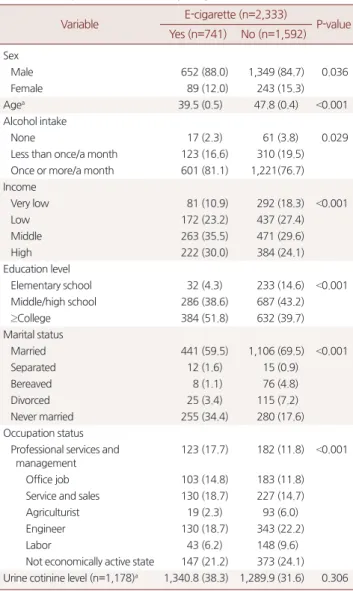
흡연자 2,333명 중 전자담배를 사용해본 사람은 741명, 사용해본 적 없는 사람은 1,592명이었다. 두 군 모두 남성이 80% 이상이었다. 연
령은 전자담배를 사용한 군이 39세, 사용한 적 없는 군이 47.8세로 차이가 있었다. 전자담배를 사용한 군이 소득 수준 상위 50% 해당하 는 비율이 약 65%로 전자담배 사용하지 않은 군의 비율 약 54%보다 높았다. 교육 수준도 전자담배 사용해본 군이 대학교 이상 졸업 51%, 사용하지 않은 군이 39%로 차이가 있었다. 양군 모두에서 미혼이거 나, 혼자 살고 있는 경우의 비율이 높았으며, 전자담배 사용군이 미 혼 비율이 더 높았다. 직업군에서도 양 군의 차이가 관찰되었다. 전 체 연구 대상자 중 국민건강영양조사 제6기 2차(2014년)에 소변 코티 닌 농도 측정이 되어 있는 흡연자 1,178명을 대상으로 비교하였을 때 전자담배 사용자와 비사용자 간의 소변 코티닌 농도도 차이가 없었 다(Table 1).
2. 전자담배 사용자와 비사용자 간에서 흡연 행태, 금연 관련 차이
궐련 담배 사용량을 하루 10개피 미만, 10–20개피, 20개피 이상 피 우는 군으로 나누어 분석하였을 때, 전자담배 사용자와 비사용자 사이에 궐련 담배 흡연량에 차이가 없었다(P=0.111). 하지만, 금연 계 획이 있다고 대답한 비율은 전자담배 사용 군에서 더 높았다(77.9%
vs. 69.3%, P<0.001). 금연 이유에 대해 응답한 사람은 2,333명 중 1,101 명이었으며, 본인과 가족의 건강이 걱정되어서라는 응답이 두 군 모 Table 1. Participant characteristics by e-cigarette use
Variable E-cigarette (n=2,333)
P-value Yes (n=741) No (n=1,592) Sex
Male 652 (88.0) 1,349 (84.7) 0.036
Female 89 (12.0) 243 (15.3)
Agea 39.5 (0.5) 47.8 (0.4) <0.001
Alcohol intake
None 17 (2.3) 61 (3.8) 0.029
Less than once/a month 123 (16.6) 310 (19.5) Once or more/a month 601 (81.1) 1,221(76.7) Income
Very low 81 (10.9) 292 (18.3) <0.001
Low 172 (23.2) 437 (27.4)
Middle 263 (35.5) 471 (29.6)
High 222 (30.0) 384 (24.1)
Education level
Elementary school 32 (4.3) 233 (14.6) <0.001
Middle/high school 286 (38.6) 687 (43.2)
≥College 384 (51.8) 632 (39.7)
Marital status
Married 441 (59.5) 1,106 (69.5) <0.001
Separated 12 (1.6) 15 (0.9)
Bereaved 8 (1.1) 76 (4.8)
Divorced 25 (3.4) 115 (7.2)
Never married 255 (34.4) 280 (17.6)
Occupation status Professional services and management
123 (17.7) 182 (11.8) <0.001
Office job 103 (14.8) 183 (11.8)
Service and sales 130 (18.7) 227 (14.7)
Agriculturist 19 (2.3) 93 (6.0)
Engineer 130 (18.7) 343 (22.2)
Labor 43 (6.2) 148 (9.6)
Not economically active state 147 (21.2) 373 (24.1) Urine cotinine level (n=1,178)a 1,340.8 (38.3) 1,289.9 (31.6) 0.306 Values are presented as number (%), mean (standard error).
E-cigarette, electronic cigarette.
aAge and urine cotinine were analyzed by t-test, described as mean (standard error).
All data was analyzed by chi-square test except age.
Table 2. The difference of smoking behavior, smoking cessation plans, smoking cessation reasons between users and non-users of e-ciga- rettes
Questionnaire E-cigarette (n=2,333)
P-value Yes (n=741) No (n=1,592) Amount of smoking
<10 cigarettes per day 284 (38.3) 674 (42.3) 0.111 10–20 cigarettes per day 388 (52.4) 801 (50.3) >20 cigarettes per day 68 (9.2) 117 (7.3) Smoking cessation plans (n=2,333)
Yes 577 (77.9) 1,103 (69.3) <0.001
Within 1 month 170 (22.9) 361 (22.7) <0.001 Within 6 month 130 (17.5) 221 (13.9) More than 6 month 277 (37.4) 521 (32.7)
No 164 (22.1) 488 (30.7)
Reasons for smoking cessation (n=1,101)
For health effects 357 (76.0) 508 (80.5) 0.044 To avoid hurting people around 51 (10.9) 71 (11.3) The high cost of cigarettes 21 (4.5) 21 (3.3) Campaigns on promoting
quitting and warning messages on cigarette packages
39 (8.3) 25 (4.0)
No smoking area 1 (0.2) 3 (0.5)
Values are presented as number (%) or mean (standard error).
E-cigarette, electronic cigarette.
All data was analyzed by chi-square test except urine cotinine.
김윤아 외. 전자 담배사용 경험있는 흡연자의 특성 Korean Journal of Family Practice
KJFP
두에서 높았다(Table 2).
3. 전자담배 사용자와 비사용자 간에서 스트레스 정도, 우울감의 차이
스트레스 인지 정도에 대한 설문을 분석하였을 때, ‘대단히 많이 느낀다’와 ‘많이 느끼는 편이다’로 응답한 비율이 전자담배 사용군 에서 더 높았다(36.9% vs. 27.6%, P<0.001). 우울감, 수면 시간에 대한 분석에서는 두 군 간에 차이가 없었다. 응답자 스스로가 느끼는 주 관적 건강 인식에 있어서도 두 군 간에 차이는 없었다(Table 3).
4. 전자담배 사용에 영향을 미치는 요인
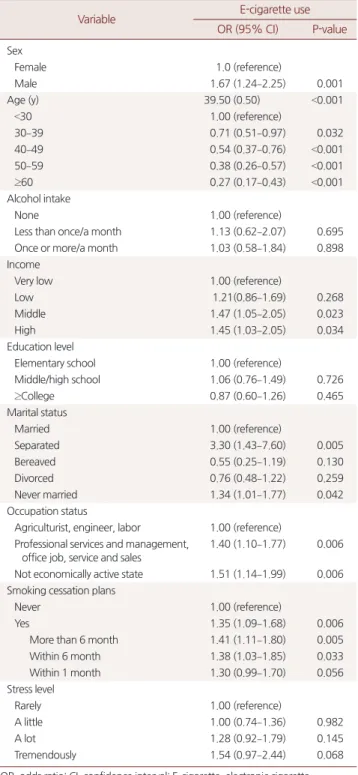
일반적인 특성에 대한 분석과 금연 관련 설문, 스트레스 인지 정 도, 우울감에 대한 분석 결과 중 통계적으로 의미 있는 결과를 보여 준 변수들에 대하여 다변량 로지스틱 회귀분석을 시행하였다(Table 4). 그 결과, 낮은 연령은 전자담배 경험 위험이 더 높았다(40–49세:
odds ratio [OR], 0.54; 95% confidence interval [CI], 0.37–0.76; 50–59세:
OR, 0.38; 95% CI, 0.26–0.57; P for trend<0.001).
소득 수준이 높은 군에서 전자담배 경험과 관련성이 높았다(mid- dle income group: OR, 1.47; 95% CI, 1.05–2.05; high income group: OR, 1.45; 95% CI, 1.03–2.05; P for trend=0.022). 미혼(OR, 1.34; 95% CI, 1.01–
1.77)과 별거(OR, 3.30; 95% CI, 1.43–7.60)도 전자담배 사용과 유의한 관련성을 보였다. 직업군 중에서는 전문가, 관리직, 사무직군이(OR,
1.40; 95% CI, 1.10–1.77) 전자담배 경험과 높은 관련성을 보였다. 스트 레스 인지 정도는 전자담배 사용과 유의한 상관관계를 보여주지 못 하였다. 하지만, 스트레스 정도가 높을수록 전자담배 사용 위험이 높아지는 경향성은 알 수 있었다(P for trend=0.009).
Table 3. The difference of health related factors between users and non-users of e-cigarettes
Questionnaire E-cigarette (N=2,333)
P-value Yes (n=741) No (n=1,592)
Stress level (n=2,333)
Tremendously 53 (7.2) 81 (5.1) <0.001
A lot 220 (29.7) 358 (22.5)
A little 391 (52.8) 913 (57.3)
Rarely 77 (10.4) 238 (14.9)
Depression (PHQ-9)a 3.44 (0.29) 2.94 (0.15) 0.120 Sleep duration
Less than 4 h 27 (3.6) 73 (4.6) 0.221
5–6 h 315 (42.5) 613 (38.5)
7–8 h 343 (46.3) 792 (49.7)
More than 9 h 55 (7.4) 113 (7.1)
Subjective health status
Very good/good 198 (26.7) 421 (26.4) 0.886
Moderate 381 (51.4) 848 (53.3)
Bad/too bad 126 (17.0) 284 (17.8)
Values are presented as number (%) or mean (standard deviation).
E-cigarette, electronic cigarette; PHQ, Patient Health Questionnaire.
aPHQ-9 was analyzed by t-test, described as mean (standard error).
All data was analyzed by chi-square test except PHQ-9.
Table 4. ORs and 95% CIs from multivariate logistic regression analysis between users and non-users of e-cigarettes
Variable E-cigarette use
OR (95% CI) P-value Sex
Female 1.0 (reference)
Male 1.67 (1.24–2.25) 0.001
Age (y) 39.50 (0.50) <0.001
<30 1.00 (reference)
30–39 0.71 (0.51–0.97) 0.032
40–49 0.54 (0.37–0.76) <0.001
50–59 0.38 (0.26–0.57) <0.001
≥60 0.27 (0.17–0.43) <0.001
Alcohol intake
None 1.00 (reference)
Less than once/a month 1.13 (0.62–2.07) 0.695
Once or more/a month 1.03 (0.58–1.84) 0.898
Income
Very low 1.00 (reference)
Low 1.21(0.86–1.69) 0.268
Middle 1.47 (1.05–2.05) 0.023
High 1.45 (1.03–2.05) 0.034
Education level
Elementary school 1.00 (reference)
Middle/high school 1.06 (0.76–1.49) 0.726
≥College 0.87 (0.60–1.26) 0.465
Marital status
Married 1.00 (reference)
Separated 3.30 (1.43–7.60) 0.005
Bereaved 0.55 (0.25–1.19) 0.130
Divorced 0.76 (0.48–1.22) 0.259
Never married 1.34 (1.01–1.77) 0.042
Occupation status
Agriculturist, engineer, labor 1.00 (reference) Professional services and management,
office job, service and sales
1.40 (1.10–1.77) 0.006
Not economically active state 1.51 (1.14–1.99) 0.006 Smoking cessation plans
Never 1.00 (reference)
Yes 1.35 (1.09–1.68) 0.006
More than 6 month 1.41 (1.11–1.80) 0.005
Within 6 month 1.38 (1.03–1.85) 0.033
Within 1 month 1.30 (0.99–1.70) 0.056
Stress level
Rarely 1.00 (reference)
A little 1.00 (0.74–1.36) 0.982
A lot 1.28 (0.92–1.79) 0.145
Tremendously 1.54 (0.97–2.44) 0.068
OR, odds ratio; CI, confidence interval; E-cigarette, electronic cigarette.
Reference of dependent variables is non-users of e-cigarette.
Youn A Kim, et al. The Characteristics of Electronic Cigarette User
Korean Journal of Family Practice
KJFP
5. 전자담배 사용자에서 전자담배 사용 이유
국민건강영양조사 제6기 3차년도인 2015년도 설문에서는 전자담 배 사용자에게 사용 이유를 묻는 설문이 포함되어 있었다. 이에 흡 연자 중 전자담배 사용자 318명의 설문을 분석하였다. 18.5%의 전자 담배 사용자가 ‘전자담배가 담배보다 덜 해로울 것 같아서’라고 응답 하였다. 41.5%의 응답자는 ‘금연하는데 도움이 될 것 같아서’라고 응 답하였다(Table 5).
고 찰
본 연구는 전자담배를 사용하는 흡연자에 관한 다양한 특성을 분석하고자 하였다. 본 연구에서 전자담배를 경험한 흡연자는 전자 담배를 경험하지 않은 흡연자에 비하여 연령이 더 낮았고, 상위 소 득 수준의 비율이 높았다. 미혼 혹은 별거인 경우 전자담배 사용과 관련성이 높았다. 직업군에서도 전문가, 관리직, 사무직의 비율이 더 높았다. 금연 의지도 전자담배를 경험한 군에서 더 높았으며, 스트레 스 인지 정도가 높아질수록 전자담배 사용 위험이 증가하였다. 본 연구 결과는 이전 다른 연구 결과와 다르지 않았다. 이전 전자담배 에 관한 연구에서 전자담배 경험률은 비흡연자 보다 흡연자에서 높 았으며, 고령의 흡연자보다는 45세 미만 젊은 연령군에서 비율이 높 았다.22) 전자담배를 사용하는 흡연자들이 사용하지 않은 흡연자군 에 비하여 고소득, 경제사회적 수준,23) 교육 수준이 더 높았다는 기
존 연구23,24)와도 일치하는 결과를 보였다.
본 연구에서 금연 의지가 있다고 응답한 군에서 전자담배 사용이 높게 나타났다(OR, 1.35; 95% CI, 1.09–1.68). 금연 이유는 본인과 가족 의 건강이 걱정 되어서 라는 응답이 두군 모두에서 높았다. 또한, 전 자담배를 경험해본 흡연자들의 약 50%는 전자담배가 궐련담배보다 덜 해롭거나, 전자담배 사용이 금연에 도움이 될 것이라고 생각하였 다. 하지만 실제 흡연량은 전자담배 사용자 군에서 더 적지 않았으
며, 제한적이지만 요 중 코티닌 수치는 전자담배 사용 군에서 약간 높은 경향도 보였다. 본 연구는 전자담배 경험자들은 전자담배가 금 연에 도움을 줄 것을 기대하고는 있었으나, 전자담배 사용이 실제 흡 연량 감소와 연관성을 보여주지 못하고 있음을 보여주었다. 본 연구 의 대상자인 한국인 흡연자의 인식은 기존 연구 결과와 다르지 않음 을 보여주었다. 3,538명의 흡연자를 대상으로 하여 전자담배 사용의 유병률과 특성을 살펴본 연구에서,8) 대상자의 67%가 전자담배가 궐 련담배보다 덜 해롭다고 믿고 있었으며, 전자담배를 사용하는 이유 로 건강과 금연에 도움이 될 것 같다고 생각한다는 응답이 80% 이상 이었다. 전자담배를 경험해보지 못한 흡연자에서도 향후 전자담배 에 관심이 있다고 대답한 비율이 50%에 달하였다. 하지만, 전자담배 의 안전성에 대해서는 아직 논란의 여지가 있다. 전자담배 마케팅 시 에는 안전하다는 문구가 자주 등장하고 있다. 그러나 전자담배는 기 존의 담배보다 덜 해롭거나, 독성이 적다고는 말할 수 있을지 모르지 만, 안전하다고 표현하기에는 무리가 있다.25) 호흡기 질환과의 관련성 이 보고 되었으며, 무연 제제임에도 불구하고 간접 흡연에 대한 영향 또한 존재한다.16-18) 전자담배가 금연에 효과적인지에 대해서도 아직 명확하지 않다. 약 2,254명의 흡연자를 대상으로 한 연구에서 전자담 배를 사용하는 사람이 그렇지 않은 흡연자보다 금연 의지와 금연 시 도 횟수가 더 높다고 보고하였다.6) 하지만, 실제 전자담배 사용 중인 흡연자에서 1년 추적관찰하였을 때 전자담배 사용군에서 금연 시 도가 유의하게 많았으나, 금연 유지율에서는 전자담배 사용군과, 사 용하지 않는 군에서 차이가 없었다.18) 또 다른 연구에서 전자담배 사 용 군과 다른 금연 보조제(니코틴 패치 등) 사용군을 비교하였을 때, 다른 보조제 사용에 비하여 유의하게 금연 시도율이 증가하지는 않
았다.26,27) 전자담배를 사용한 적 있는 흡연자는 금연 의지가 높은 군
일 수 있고, 금연의 방법으로써 전자담배에 관심을 가지는 경향을 보여 주었으나, 기존 연구결과에서 볼 때, 전자담배 사용 증가와 금 연 성공률 상승과는 상관관계를 입증하지 못하였다. 이와 같이 전자 담배의 안전성, 금연에 대한 효과에 대하여 논란이 있음에도 불구하 고 많은 흡연자들이 전자담배가 금연에 도움을 주거나 덜 해로울 것 이라고 생각하고 있었다. 전자담배에 대한 대중의 인식 개선이 필요 하다고 생각된다. 올바른 정보 전달을 위한 방법을 좀더 모색할 필요 가 있으며, 금연 관련 단체 및 의료계의 노력이 필요하다.
본 연구는 국가 통계인 국민건강영양조사 자료를 이용한 대규모 표본 집단 자료를 분석한 것으로 대한민국 국민의 대표성을 가진다 는 장점이 있다. 그러나, 설문조사를 이용한 단면연구로서, 인과 관계 를 파악하기 어려운 한계점을 가지고 있다. 또한, 설문을 통한 연구 로 보고 바이어스(reporting bias)에 영향을 받았을 수 있다. 전자담배 사용 경험은 질문하였지만, 전자담배 사용 기간, 전자담배에 포함된 Table 5. Reasons for e-cigarette use
Reasons for e-cigarette use Value (N=318 smokers) Less harmful than tobacco smoking 59 (18.6)
Helpful for smoking cessation 132 (41.5)
Possibility for indoor smoking 12 (3.8)
Easy access to obtain 1 (0.3)
Better taste 4 (1.3)
No smoke smell 50 (15.7)
Curiosity 55 (17.3)
Miscellaneous 5 (1.6)
Total 318 (100.0)
Values are presented as number (%).
E-cigarette, electronic cigarette.
김윤아 외. 전자 담배사용 경험있는 흡연자의 특성 Korean Journal of Family Practice
KJFP
니코틴 농도, 전자담배의 강도를 파악하지 못하였다는 한계점도 가 지고 있다. 향후 이러한 조사 항목들이 추가된 후속 자료 축적 및 후 속연구가 필요할 것으로 생각된다.
본 연구는 국민건강영양조사 설문 자료를 이용하여 한국인의 전 자담배 사용을 파악하였으며, 흡연자 중 전자담배 사용자에 대한 분석을 통해 이들의 특성과 전자담배 사용 이유 등을 파악하였다.
전자담배의 안전성 및 금연 보조제로서의 근거는 충분하지 않으나, 아직도 많은 흡연자들이 전자담배를 금연 보조제로 생각하고 있다.
전자담배에 대한 올바른 정보를 제공하는 것이 필요할 것으로 생각 된다.
요 약
연구배경:
국내에서 전자담배 시장이 빠른 속도로 커지고 있는 상 황에서, 아직 한국인을 대상으로 한 전자담배에 관한 연구가 많이 이루어져 있지 않다. 본 연구는 전자담배 사용하는 흡연자에 관한 일반적 특성(생활습관, 정신 건강 관련 특성, 흡연 행태, 금연 및 전자 담배 사용 이유 등)을 분석하고자 하였다.방법:
본 연구는 국민건강영양조사 제6기(2013–2015년)의 원시 자료 를 이용하였다. 전자담배 사용과 관련 요인을 분석하기 위해 인구 사 회학적 요인, 금연 관련 설문, 스트레스 인지 정도 등에 대하여 다변 량 로지스틱 분석을 하였다. 2015년도 국민건강영양조사 대상자 중 흡연자이면서 전자담배를 사용한 318명에 대하여, 전자담배 사용 이유에 관한 빈도 분석을 시행하였다.결과:
본 연구에서 전자담배를 경험한 흡연자는 전자담배를 경험하 지 않은 흡연자에 비하여 연령이 더 낮았고, 소득 수준이 높은 군에 서 전자담배 경험과 관련성이 높았다(odds ratio [OR], 1.45; 95% confi- dence interval [CI], 1.03–2.05). 미혼(OR, 1.34; 95% CI, 1.01–1.77)과 별거 (OR, 3.30; 95% CI, 1.43–7.60), 직업군 중에서는 전문가, 관리직, 사무직 군이(OR, 1.40; 95% CI, 1.10–1.77) 전자담배 경험과 높은 관련성을 보 였다. 금연 이유는 본인과 가족의 건강이 걱정되어서 라는 응답이 두 군 모두에서 높았다. 또한, 전자담배를 경험해본 흡연자들의 약 50%는 전자담배가 궐련담배보다 덜 해롭거나, 전자담배 사용이 금 연에 도움이 될 것이라고 생각하였다. 하지만, 실제 궐련 담배 흡연량 과 뇨 중 코티닌 농도는 두 군에서 통계적 차이를 보이지 않았다.결론:
전자담배의 안전성 및 금연 보조제로서의 근거는 충분하지 않으나, 아직도 많은 흡연자들이 전자담배를 금연 보조제로 생각하 고 있다. 전자담배에 대한 올바른 정보를 효과적으로 제공하는 것이 필요할 것으로 생각된다.중심단어:
전자담배; 담배; 금연; 흡연 CONFLICT OF INTERESTNo potential conflict of interest relevant to this article was reported.
ORCID
Youn A Kim, http://orcid.org/0000-0001-6084-5353 Jiwon Lee, http://orcid.org/0000-0002-5283-0298 Jeonghyo Kim, http://orcid.org/0000-0001-9118-6952 Jaeyeol Kim, http://orcid.org/0000-0002-4648-6267 Young-Jin Ko, http://orcid.org/0000-0001-8262-3794 Soyeun Kim, http://orcid.org/0000-0002-5214-1839 REFERENCES
1. WHO Framework Convention on Tobacco Control, Conference of the Parties to the WHO Framework Convention on Tobacco Control, sixth ses- sion. Electronic nicotine delivery systems: report by WHO [Internet]. Ge- neva: WHO; 2014. [cited 2017 Dec 6]. Available from: http://apps.who.int/
gb/fctc/PDF/cop6/FCTC_COP6_10Rev1-en.pdf.
2. Agaku IT, King BA, Husten CG, Bunnell R, Ambrose BK, Hu SS, et al.; Cen- ters for Disease Control and Prevention (CDC). Tobacco product use among adults--United States, 2012-2013. MMWR Morb Mortal Wkly Rep 2014; 63: 542-7.
3. Action on Smoking and Health. Use of electronic cigarettes (vapourisers) among adults in Great Britain [Internet]. London: Action on Smoking and Health; 2017. [cited 2017 Dec 6]. Available from: http://www.ash.org.uk/
files/documents/ASH_891.pdf.
4. Korea Centers for Disease Control and Prevention. Korea health statistics 2015: Korea National Health and Nutrition Examination Survey (KNHANES VI-3) [Internet]. Osong: KCDC; 2016. [cited 2017 Dec 6].
Available from: https://knhanes.cdc.go.kr/knhanes/sub04/sub04_03.do.
5. Pepper JK, Ribisl KM, Emery SL, Brewer NT. Reasons for starting and stop- ping electronic cigarette use. Int J Environ Res Public Health 2014; 11:
10345-61.
6. Rutten LJ, Blake KD, Agunwamba AA, Grana RA, Wilson PM, Ebbert JO, et al. Use of e-cigarettes among current smokers: associations among reasons for use, quit intentions, and current tobacco use. Nicotine Tob Res 2015; 17:
1228-34.
7. Richardson A, Pearson J, Xiao H, Stalgaitis C, Vallone D. Prevalence, harm perceptions, and reasons for using noncombustible tobacco products among current and former smokers. Am J Public Health 2014; 104: 1437- 44.
8. Brown J, West R, Beard E, Michie S, Shahab L, McNeill A. Prevalence and characteristics of e-cigarette users in Great Britain: findings from a general
Youn A Kim, et al. The Characteristics of Electronic Cigarette User
Korean Journal of Family Practice
KJFP
population survey of smokers. Addict Behav 2014; 39: 1120-5.
9. Soneji S, Barrington-Trimis JL, Wills TA, Leventhal AM, Unger JB, Gibson LA, et al. Association between initial use of e-cigarettes and subsequent ciga- rette smoking among adolescents and young adults: a systematic review and meta-analysis. JAMA Pediatr 2017; 171: 788-97.
10. Goniewicz ML, Knysak J, Gawron M, Kosmider L, Sobczak A, Kurek J, et al.
Levels of selected carcinogens and toxicants in vapour from electronic ciga- rettes. Tob Control 2014; 23: 133-9.
11. Clapp PW, Jaspers I. Electronic cigarettes: their constituents and potential links to asthma. Curr Allergy Asthma Rep 2017; 17: 79.
12. Thota D, Latham E. Case report of electronic cigarettes possibly associated with eosinophilic pneumonitis in a previously healthy active-duty sailor. J Emerg Med 2014; 47: 15-7.
13. Hureaux J, Drouet M, Urban T. A case report of subacute bronchial toxicity induced by an electronic cigarette. Thorax 2014; 69: 596-7.
14. Riker CA, Lee K, Darville A, Hahn EJ. E-cigarettes: promise or peril? Nurs Clin North Am 2012; 47: 159-71.
15. Kuschner WG, Reddy S, Mehrotra N, Paintal HS. Electronic cigarettes and thirdhand tobacco smoke: two emerging health care challenges for the pri- mary care provider. Int J Gen Med 2011; 4: 115-20.
16. Schober W, Szendrei K, Matzen W, Osiander-Fuchs H, Heitmann D, Schett- gen T, et al. Use of electronic cigarettes (e-cigarettes) impairs indoor air qual- ity and increases FeNO levels of e-cigarette consumers. Int J Hyg Environ Health 2014; 217: 628-37.
17. Schripp T, Markewitz D, Uhde E, Salthammer T. Does e-cigarette consump- tion cause passive vaping? Indoor Air 2013; 23: 25-31.
18. Brose LS, Hitchman SC, Brown J, West R, McNeill A. Is the use of electronic cigarettes while smoking associated with smoking cessation attempts, cessa- tion and reduced cigarette consumption? A survey with a 1-year follow-up.
Addiction 2015; 110: 1160-8.
19. McRobbie H, Bullen C, Hartmann-Boyce J, Hajek P. Electronic cigarettes for smoking cessation and reduction. Cochrane Database Syst Rev 2014; (12):
CD010216.
20. Rahman MA, Hann N, Wilson A, Mnatzaganian G, Worrall-Carter L. E- cigarettes and smoking cessation: evidence from a systematic review and meta-analysis. PLoS One 2015; 10: e0122544.
21. Malas M, van der Tempel J, Schwartz R, Minichiello A, Lightfoot C, Noor- mohamed A, et al. Electronic cigarettes for smoking cessation: a systematic review. Nicotine Tob Res 2016; 18: 1926-36.
22. Li J, Newcombe R, Walton D. The prevalence, correlates and reasons for us- ing electronic cigarettes among New Zealand adults. Addict Behav 2015; 45:
245-51.
23. Adkison SE, O'Connor RJ, Bansal-Travers M, Hyland A, Borland R, Yong HH, et al. Electronic nicotine delivery systems: international tobacco con- trol four-country survey. Am J Prev Med 2013; 44: 207-15.
24. Pearson JL, Richardson A, Niaura RS, Vallone DM, Abrams DB. e-Cigarette awareness, use, and harm perceptions in US adults. Am J Public Health 2012; 102: 1758-66.
25. Callahan-Lyon P. Electronic cigarettes: human health effects. Tob Control 2014; 23 Suppl 2: ii36-40.
26. Bullen C, Howe C, Laugesen M, McRobbie H, Parag V, Williman J, et al.
Electronic cigarettes for smoking cessation: a randomised controlled trial.
Lancet 2013; 382: 1629-37.
27. Beard E, West R, Michie S, Brown J. Association between electronic cigarette use and changes in quit attempts, success of quit attempts, use of smoking cessation pharmacotherapy, and use of stop smoking services in England:
time series analysis of population trends. BMJ 2016; 354: i4645.