Nicotine Dependence and Stress
Susceptibility in E-Cigarette Smokers:
The Korea National Health and Nutrition
Examination Survey 2013–2017
Jae Yeol Kim, Ph.D.
1,* , Hye Seon Kang, Ph.D.
2,* , Jae-Woo Jung, Ph.D.
1, Sun Young Jung, Ph.D.
3,
Hye Jung Park, Ph.D.
4, Jong Sook Park, Ph.D.
5, Joo Hun Park, Ph.D.
6, Sang Haak Lee, Ph.D.
7, Eun
Mi Chun, Ph.D.
8, Dong Il Park, Ph.D.
9, Jisook Park, Ph.D.
10, Hye Sook Choi, Ph.D.
11and on behalf
of the Korean Smoking Cessation Study Group
*Author affiliations appear at the end of this article.
Background: E-cigarettes are steadily gaining popularity in Korea. However, the characteristics of e-cigarette smokers, especially nicotine dependence and stress susceptibility, have not been evaluated in comparison to those of non-smokers or combustible cigarette non-smokers in Korea.
Methods: In this study, 28,059 participants from the Korea National Health and Nutrition Examination Survey (2013– 2017) were classified into the following three groups: non-smokers, smokers (current smokers and ex-smokers of combustible cigarettes only), and e-smokers (current smokers and ex-smokers of e-cigarettes regardless of combustible cigarette use).
Results: Among the participants, 16,980 (60.5%), 9,247 (33.0%), and 1,832 (6.4%) subjects were non-smokers, smokers, and e-smokers, respectively. E-smokers were younger, more educated, and had a higher household income than non-smokers or non-smokers. The number of e-non-smokers who smoked within 5 minutes of waking up (31.5% vs. 19.8%, p<0.001) and who planned to quit smoking within 6 months (39.1% vs. 35.7%, p<0.05) was greater than that of smokers. E-smokers perceived stress as “very much” (7.0% vs. 4.4%, p<0.001) and “a lot” (29.1% vs. 20.5%, p<0.001) compared to non-smokers. Suicidal ideation (6.5% vs. 4.7%, p<0.001), plans (2.4% vs. 1.3%, p<0.001), and attempts (1.1% vs. 0.5%, p<0.001) were higher in e-smokers than in non-smokers. Depressive episodes in 1 year (14.2% vs. 11.4%, p<0.05) and suicidal plans (2.4% vs. 1.8%, p<0.05) were more frequent among e-smokers than among smokers.
Conclusion: E-smokers were younger, more educated, and had a higher income, but they were more dependent on nicotine and susceptible to stress than non-smokers and smokers. Smoking cessation counseling should be tailored according to the characteristics of e-smokers.
Keywords: E-cigarette; Nicotine Dependence; Stress Susceptibility
Address for correspondence: Hye Sook Choi, Ph.D.
Department of Internal Medicine, Kyung Hee University Hospital, 23 Kyungheedae-ro, Dongdaemun-gu, Seoul 02447, Republic of Korea
Phone: 82-2-958-2824, Fax: 82-2-968-1848, E-mail: [email protected]
*Jae Yeol Kim and Hye Seon Kang contributed equally to this work.
Received: Dec. 24, 2020, Revised: Dec. 25, 2020, Accepted: Jan. 2, 2021, Published online: Jan. 6, 2021
cc It is identical to the Creative Commons Attribution Non-Commercial License (http://creativecommons.org/licenses/by-nc/4.0/).
Copyright © 2021
Introduction
Tobacco price increased from 2,500 KRW to 4,500 KRW in 2015 which was the sharpest hike in both relative and abso-lute terms contributed to a decreased smoking rate among adult men to below 40% for the first time in Korean history1.
After small rebound that went over 40% in 2016, it declined to less than 40% once again and stayed at that level thereafter2.
The total sales of tobacco also decreased from 4.36 billion packs in 2014 to 3.33 billion packs in 2015. However, it did not decrease further and remained at almost the same level in subsequent years. This could be attributed to the increased popularity of e-cigarettes3. It has been established that many
smokers seek ways to continue smoking even in the face of increased cigarette prices either reducing other expenses to spare money for originally preferred products or switching to cheaper products4. Hence, e-cigarette could be an attractive
alternative because they were exempted from the tax increase in 2015. However, economy might not be the dominant rea-son for the choice of e-cigarette in Korea. The gross domestic product per capita was 27,105 USD in 2015, and increased price of cigarettes, around 3.8 USD/pack would have been a negligible burden for Korean smokers. There might be more important reasons for the interest in e-cigarettes and the men-tal status of e-cigarette smokers might play vimen-tal role in this choice. A previous study reported that poorer mental health accounted for a higher prevalence of e-cigarette use among those with asthma5. Other studies reported that mental health
problems are associated with increased risk of initiating e-cig-arette among adolescents, university students, or veterans6-8.
However, few studies have evaluated the mental status of e-cigarette smokers among general population in Korea.
In the present study, we attempted to evaluate the preva-lence of cigarette use, the reasons for the choice of e-cigarettes, nicotine dependence, and the mental health status of e-smokers using the Korea National Health and Nutritional Examination Survey (KNHANES) data from 2013 to 2017.
Materials and Methods
1. The Korea National Health and Nutrition Examination Survey (KNHANES)
The KNHANES is a nationwide survey that has been con-ducted annually by the Korea Centers for Disease Control and Prevention (KCDC) to investigate the health and nutri-tional status of the Korean population since 1998. Since the sampling process of the KNHANES is stratified, multi-staged, and clustered based on the national census data, it assuredly represents the general Korean population9. All data were
fully anonymized prior to the assessment. All procedures and terms and conditions of the survey were performed in
accordance with the Declaration of Helsinki (7th version). Written informed consent was obtained from all participants prior to completing the survey. The questionnaire and dataset were provided with guidelines for calculating a health-related index indicated by the KCDC, which were available on the KCDC website (https://knhanes.cdc.go.kr/knhanes/eng/in-dex.do). The KNHANES has been administering e-cigarette-related questionnaires since 2013, hence, this study used the KNHANES data from January 2013 to December 2017. The present study was approved by the Institutional Review Board (IRB) of Kyung Hee University College of Medicine (IRB num-ber: KHUH 2019-10-033-004).
2. Measures
1) Smoking status
All participants were asked if they had smoked at least 100 cigarettes (5 packs) in their lifetime. If the answer was “no,” they were categorized as “non-smokers.” Those who respond-ed “yes” and who did not have experience with e-cigarettes were classified as “smokers” (current- and ex-smokers all com-bined). Those who had experience with e-cigarettes, regard-less of combustible cigarette use, were designated as “e-smok-ers.” We also analyzed the reasons for the use of e-cigarettes among the e-smokers.
2) Demographic data
Data on sociodemographic variables, such as age, sex, household income level, and educational level were collected. Household income and educational levels were divided into four quartiles. Comorbidities included self-reported physician diagnosis of asthma, chronic obstructive pulmonary disease, lung cancer, atopic dermatitis, and/or allergic rhinitis.
3) Nicotine dependence and the plan for smoking ces-sation
Based on the time between waking up and use of the first cigarette, participants were categorized into four groups: ≤5 minutes, 6–30 minutes, 31–60 minutes, or >60 minutes. Partic-ipants were asked if they had planned to quit smoking within a month or had stopped smoking for more than 1 day in the past year. Participants also completed a self-report question-naire regarding smoking cessation plans, and those who planned to quit smoking within 6 months were categorized as “having a smoking cessation plan.”
4) Mental health status examination
The mental health status of participants was evaluated for perceived stress, depressive episodes, suicidal ideation/ plans/attempts, and experience of consulting mental health professionals. Perceived stress was classified as “yes” if the par-ticipant experienced “very much” or “a lot” of stress in their ev-eryday life. Depressive episodes were assessed using verified
questionnaires. Participants were asked if they had suicidal ideation, suicide plans, or suicide attempt in the previous year.
3. Statistical analysis
Baseline characteristics were presented as percentages for categorical variables and as estimated means (±standard deviation) for continuous variables. Categorical variables and continuous variables were compared using the chi-square test and Student’s t test, respectively. An analysis of variance using a generalized linear model with composite samples was used to determine the differences in clinical variables according to the smoking status (three groups). Multivariate logistic re-gression analysis and linear rere-gression were performed after adjusting for age, sex, and smoking amount (pack-years). The analysis of mental health status according to smoking status was adjusted for income quartiles and educational levels. The results of multivariate logistic regression analyses were presented as odds ratios (ORs) and 95% confidence intervals (CIs), while those of the linear regression analysis were pre-sented as standardized beta coefficients. A two-sided p-value <0.05 was considered significant. All statistical analyses were performed using SPSS for Windows software version 20.0 (IBM Corp., Armonk, NY, USA).
Results
1. Study population
Of the 39,225 participants surveyed from 2013 to 2017, 28,059 were aged ≥19 years and responded to the health sur-vey, including a questionnaire on smoking habits. Among the selected 28,059 participants, 16,980 (60.5%), 9,247 (33.0%), and 1,832 (6.4%) were non-smokers, smokers, and e-smokers, respectively (Figure 1). Most e-smokers were currently
smok-ing combustible cigarettes (78.5%) or had previous experi-ence with them (18.7%). The proportion of current and ever e-smokers was 0.9% and 5.2%, respectively in 2013. It peaked to 2.6% (p<0.001, p for trend=0.005) and 7.8% (p<0.001, p for trend<0.001) in 2015, when the tobacco price increased, and then stayed at that level thereafter (Figure 2).
2. Clinical characteristics
Men were more predominant in the e-smokers and smok-ers groups than in the non-smoksmok-ers group (84.0%, 86.0%, and 16.0%, respectively; p<0.001). E-smokers were younger than smokers or non-smokers (mean ages, 39.73±14.11, 53.43±15.75, and 50.80±17.04 years, respectively; p<0.001). The proportion of e-smokers in the upper middle and highest quartiles of household income was more than that of smok-ers or non-smoksmok-ers (64.5%, 53.8%, and 55.8%, respectively;
2013 10 8 6 4 2 Percentage 0 2014 2015 2016 2017 Ever e-cigarette Current e-cigarette 5.2% 0.9% 5.1% 1.4% 2.6% 7.8% 1.6% 7.0% 7.4% 1.7%
Figure 2. Proportion of current and ever e-cigarette smokers from 2013 to 2017. The tobacco price increased from 2,500 KRW to 4,500 KRW in 2015. Data were obtained from the Korean National Health and Nutrition Examination Survey from 2013 to 2017.
39,225 Health survey of KNHANES 2013 2017 30,934 Age >19 n=28,059 2,875 Excluded 2,091 Missing values 781 Nonresponders to questionnaire 3 No information on smoking status
8,291 Age <19 16,980 Non-smokers (60.5%) 9,247 Smokers (33.0%) 1,832 E-smokers (6.4%)
Figure 1. Flow chart of selection of par-ticipants in the present study. A total of 28,059 participants of the Korean National Health and Nutrition Examination Survey (KNHANES) from 2013 to 2017 were classified into the following three groups; non-smokers, smokers (current smokers and ex-smokers of combustible cigarettes only), and e-smokers (current smokers and ex-smokers of e-cigarettes regardless of combustible cigarette use).
p<0.001). The proportion of college graduates was higher among e-smokers than among smokers or non-smokers (40.1%, 34.4%, and 33.4%, respectively; p<0.001) (Table 1).
3. Reason for choosing e-cigarettes
We analyzed the reasons for using e-cigarettes. Among 1,832 e-smokers, 840 responded to the questionnaire. The most common reason was “to try and quit smoking” (46.5%), fol-lowed by “less harmful than combustible smoking” (19.4%), “odorless than that of combustible smoking” (16.7%), “good flavor” (7.9%), “easy to smoke indoors” (3.9%), “tastes good” (0.6%), and “easier to obtain than combustible cigarette” (0.4%). Only one participant (0.1%) selected “the price” as the reason for using e-cigarettes.
4. Nicotine dependence and the plan for smoking cessation
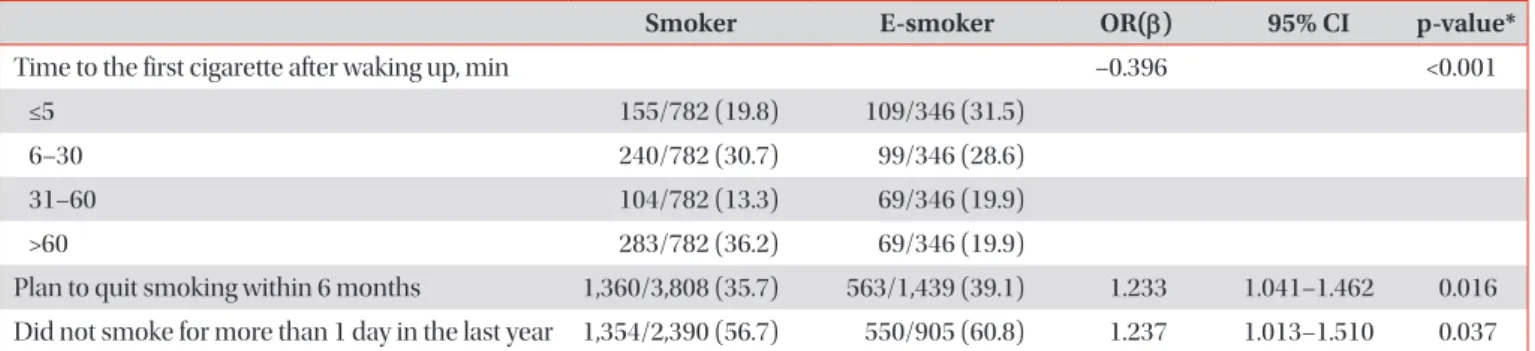
E-smokers were more dependent on nicotine than smok-ers. E-smokers were more likely to smoke within 5 minutes of waking up than smokers (31.5% vs. 19.8%, p<0.001), while the latter were more likely to smoke >60 minutes after wak-ing (36.2% vs. 19.9%, p<0.001). Regardwak-ing planned smokwak-ing cessation, the odds of having a plan to quit smoking within 6 months (OR, 1.233; 95% CI, 1.041–1.462; p=0.016) or not hav-ing smoked for more than one consecutive day in the last year (OR, 1.237; 95% CI, 1.013–1.510; p=0.037) were higher among e-smokers than among smokers (Table 2).
5. Mental health status
E-smokers were more susceptible to stress than non-smokers or smoker. Stress was perceived as “very much” (7.0%
Table 1. Clinical characteristics of Korean adults (≥19 years) according to smoking status (n=28,059)
Characteristic (n=16,980, 60.5%)Non-smoker (n=9,247, 33.0%)Smoker (n=1,832, 6.4%)E-smoker p-value*
Male sex 2,721 (16.0) 7,772 (84.0) 1,576 (86.0) <0.001 Age, yr 50.8±17.04 53.43±15.75 39.73±14.11 <0.001 Conventional cigarette <0.001 Non 16,980 (100) 0 51 (2.8) Former 0 5,437 (58.8) 342 (18.7) Current 0 3,810 (41.2) 1,439 (78.5) Smoking amount, PY 0 23.93±24.55 23.84±23.36 <0.001 Household income <0.001 Lowest quartile 3,313 (19.6) 1,901 (20.6) 209 (11.4)
Lower middle quartile 4,162 (24.6) 2,537 (25.6) 439 (24.0)
Upper middle quartile 5,433 (26.8) 2,494 (27.1) 601 (32.9)
Highest quartile 4,896 (29.0) 2,460 (26.7) 577 (31.6) Level of education <0.001 ≤Elementary school 4,204 (25.7) 1,741 (19.8) 115 (6.6) ≤Middle school 1,586 (9.7) 1,089 (12.4) 132 (7.6) ≤High school 5,084 (31.1) 2,939 (33.4) 795 (45.7) ≥College 5,457 (33.4) 3,020 (34.4) 697 (40.1) Comorbidity Asthma 536 (3.3) 247 (2.8) 45 (2.6) 0.095 Hypertension 3,866 (23.2) 2,424 (26.8) 230 (12.8) 0.677 Diabetes 1,420 (8.5) 1,032 (11.4) 115 (6.4) <0.001 Lung cancer 13 (0.1) 29 (0.3) 3 (0.2) 0.092
Values are presented as number (%) or mean±SD. PY: pack-years; SD: standard deviation.
vs. 4.4%, p<0.001) or “a lot” (29.1% vs. 20.5%, p<0.001) more among e-smokers than among non-smokers. Suicidal ideation (6.5% vs. 4.7%, p<0.001), suicide plans (2.4% vs. 1.3%, p<0.001), and suicide attempts (1.1% vs. 0.5%, p<0.001) were higher among e-smokers than among non-smokers. Depressive epi-sodes in 1 year (14.2% vs. 11.4%, p<0.05) and suicidal plans (2.4% vs. 1.8%, p<0.05) were more frequent in e-smokers than in smokers (Table 3).
Discussion
The present study investigated the prevalence of e-cigarette use, the reasons for the choice, nicotine dependence and mental health status of e-smokers using the nationally repre-sentative survey data of Korea, KNHANES (2013–2017). E-cigarettes are largely categorized into two types: closed system vaporizers (CSVs) and heated tobacco products (HTPs). The IQOS, the first type of HTP introduced in Korea was marketed on June 5, 2017, hence, almost all e-cigarettes data covered in the present study represent the CSV type of e-cigarettes.
The proportion of current and ever e-smokers in 2013 was 0.9% and 5.2%, respectively, which peaked to 2.6% and 7.8% in 2015, respectively, coinciding with the increase in tobacco prices. E-cigarettes were exempted from the tobacco tax in-crease in that year, making them attractive alternatives. It is natural to assume that the highest prevalence of e-cigarette smoking in 2015 was closely related to the price hike. How-ever, contrary to our expectation, only 1 out of 840 partici-pants (0.1%) selected price benefit as the reason for using e-cigarettes. E-smokers in the present study were more edu-cated, and had a higher household income than non-smokers or smokers (Table 1). In other Asian countries, e-cigarette users were highly educated and economically comfortable as well10,11. This might explain why the low price of e-cigarettes
was not a major reason for this choice.
The most common reason for e-cigarette use was “to try and quit smoking” (46.5%), followed by “less harmful than
com-bustible smoking” (19.4%). The two, most common reasons for the use of e-cigarettes among the participants in the pres-ent study were also the most debated issues. Previous studies have shown mixed results regarding the relationship between e-cigarette use and cessation of smoking. In the United States and United Kingdom, current e-cigarette use was associated with significantly higher quitting attempts and cessation of smoking12,13. However, e-cigarette use did not promote
smok-ing cessation or reduction of smoksmok-ing among in Mexican smokers14. A more precisely designed study would be
neces-sary to determine the relationship of e-cigarette use with quit-ting attempts and successful quitquit-ting in the future. The role of e-cigarette as less harmful tobacco product is also debated. The report of e-cigarette or vaping product-use associated lung injury in the United States in July 2019 raised serious concerns regarding the safety of the CSV type of e-cigarettes15.
The focus concerning the relative safety of e-cigarettes has moved to the HTP type of e-cigarettes since the authorization of IQOS as a modified risk tobacco product (MRTP) by the U.S. Food and Drug Administration as of July 7, 2020. Because the present analysis mainly focused on the CSV type of e-cigarettes, further discussion regarding this issue would not be continued.
Commonly, e-cigarette use (ever or current use) is more prevalent among younger age groups and men, which is consistent with our findings (Table 1)16. The demographic
features of e-smokers in the present study might partly explain unstable psychology and controversial attitudes regarding nicotine dependence and the plan to quit smoking. More e-smokers smoked within 5 minutes of waking up and planned to quit smoking within 6 months than smokers (Table 2). This conflicting attitude is once again reflected in their reasons for the use of e-cigarettes. Although they wanted to quit smoking with the aid of e-cigarettes, they wanted to continue smoking because they considered e-cigarettes to be less harmful than combustible cigarettes. It is important to note that over 97% of e-smokers had experienced combustible cigarettes, and over 78% of them were current smokers of conventional tobacco.
Table 2. Nicotine dependence and planned smoking cessation in current tobacco users
Smoker E-smoker OR(ββ) 95% CI p-value*
Time to the first cigarette after waking up, min –0.396 <0.001
≤5 155/782 (19.8) 109/346 (31.5)
6–30 240/782 (30.7) 99/346 (28.6)
31–60 104/782 (13.3) 69/346 (19.9)
>60 283/782 (36.2) 69/346 (19.9)
Plan to quit smoking within 6 months 1,360/3,808 (35.7) 563/1,439 (39.1) 1.233 1.041–1.462 0.016 Did not smoke for more than 1 day in the last year 1,354/2,390 (56.7) 550/905 (60.8) 1.237 1.013–1.510 0.037 Values are presented as number (%).
*Adjusted for sex, age, and smoking amounts (pack-years). OR: odd ratio; CI: confidence interval.
Thus, they wanted to stop smoking or at least to decrease the amount of combustible cigarette consumption, but they also wanted to continue smoking with less harmful product. This conflicting attitude of e-cigarette users explains why they are easily exploited by manufactures who claim e-cigarettes are MRTPs17. In addition, e-smokers were more susceptible to
stress than non-smokers or smoker. Stress was perceived as “very much” or “a lot” more among e-smokers than among non-smokers. Suicidal ideation, plans, and attempts were higher in e-smokers than in non-smokers. Depressive epi-sodes in 1 year and suicidal plans were more frequent among e-smokers than among smokers (Table 3). The association be-tween combustible cigarette use and subsequent depression and vice versa has been previously established18. Reportedly,
dual users (those using both e-cigarettes and combustible cigarettes) tend to have a higher prevalence of depression, sui-cidal behaviors, or other psychiatric comorbidities than single users of each type of cigarette among adolescents19,20. The
present study established that mentally unstable characteris-tics of e-smokers were not specifically restricted to young age group but were also applicable to the general population.
The present study had some limitations. First, the KNHANES included only adult aged ≥19 years. Therefore, the data of adolescents who are enthusiastic consumers of e-cigarettes were excluded in the present study. Second, we classified current and ex-smokers of e-cigarettes as e-smokers regardless the use of combustible cigarettes because pure e-cigarette users accounted for only 2.8% of e-smokers. There-fore, e-smokers in the present study represent dual smokers of e-cigarettes and combustible cigarettes rather than pure consumers of cigarettes alone. Third, the quantity of e-cigarettes consumed was not available in the KNHANES da-tabase, which made quantitative analysis impossible. Fourth, this study is an analysis of a cross-sectional study; therefore, the association in the analysis does not imply causality.
Despite these limitations, we revealed the conflicting at-titudes of e-smokers with respect to nicotine dependence and their plans to quit smoking. Although, they wanted to quit smoking, they were highly dependent on nicotine. They were more susceptible to stress and had suicidal ideas and plans. All of these characteristics of e-smokers might make them easy targets for the manufactures’ exploitation who claim the relative safety of e-cigarette products.
In conclusion, e-smokers were younger, more educated, and had a higher income, but were more nicotine-dependent and susceptible to stress. These characteristics might make it easy for e-cigarette manufacturers to emphasize the relative safety of their products. Smoking cessation counseling should be tailored to these characteristics of e-smokers.
Ta ble 3. M en tal h ealth s ta tus w ithin th e pr ev io us y ear a cc or d in g t o t ob ac co an d e-c ig ar et te sm ok in g s ta tus N on-sm ok ers (n=16,966) Sm ok ers (n=9,239) E-sm ok ers (n=1,832) p-valu e* N on-sm ok ers v s. E-sm ok ers Sm ok ers v s. E-sm ok ers OR( ββ) 95% CI p-valu e* OR( ββ) 95% CI p-valu e † Per ceive d s tr es s 0.001 –0.075 <0.001 –0.023 0.072 V er y muc h 741 (4.4) 420 (4.5) 128 (7.0) A lot 3,481 (20.5) 1,928 (20.9) 534 (29.1) A lit tle 9,792 (57.7) 5,250 (56.8) 980 (53.5) H ard ly 2,952 (17.4) 1,641 (17.8) 190 (10.4) D epr es sive episo de 1,338 (13.2) 634 (11.4) 163 (14.2) <0.001 1.957 1.560–2.456 <0.001 1.344 1.043–1.733 0.022 E xp erience of counseling in a ps yc hi atric c linic 386 (3.5) 187 (3.2) 42 (3.2) 0.007 1.169 0.784–1.743 0.443 0.878 0.585–1.318 0.531 Suicid al ide ation 481 (4.7) 324 (5.8) 74 (6.5) <0.001 1.569 1.839–3.588 <0.001 1.363 0.951–1.953 0.092 Suicid al pl an 183 (1.3) 138 (1.8) 38 (2.4) <0.001 3.220 2.001–5.181 <0.001 1.944 1.223–3.092 0.005 Suicide at tempts 67 (0.5) 6 (0.9) 18 (1.1) <0.001 4.271 2.041–8.939 <0.001 1.146 0.573–2.293 0.701 Per ceive d s tr es s ( over all) 4,222 (24.9) 2,348 (25.4) 662 (36.1) <0.001 1.905 1.679–2.162 <0.001 1.194 1.031–1.382 0.018 V alues ar e pr esent ed as num ber (%). *A djus te d for ag e, sex , income quartile , and le vel of e duc ation. † A djus te d for ag e, sex , income quartile , le vel of e duc
ation, and smoking amount (p
ac k-ye ar s). OR : o dds r atio; CI s: confidence int er vals .
*Author Affiliations
1Department of Internal Medicine, Chung-Ang University
College of Medicine, Seoul, 2Department of Internal Medicine,
Bucheon St. Mary’s Hospital, College of Medicine, The Catho-lic University of Korea, Seoul, 3College of Pharmacy,
Chung-Ang University, Seoul, 4Department of Internal Medicine,
Yonsei University College of Medicine, Seoul, 5Department
of Internal Medicine, Soonchunhyang University College of Medicine, Bucheon, 6Department of Pulmonary and Critical
Care Medicine, Ajou University School of Medicine, Suwon,
7Department of Internal Medicine, Eunpyeong St. Mary’s
Hos-pital, College of Medicine, The Catholic University of Korea, Seoul, 8Department of Internal Medicine, Ewha Womans
Uni-versity College of Medicine, Seoul, 9Department of Internal
Medicine, Chungnam National University College of Medi-cine, Daejeon, 10Department of Software Convergence, Seoul
Women’s University College of Interdisciplinary Studies for Emerging Industries, Seoul, 11Department of Internal
Medi-cine, Kyung Hee University Hospital, Seoul, Republic of Korea
Authors’ Contributions
Conceptualization: Kim JY, Choi HS. Methodology: Jung JW, Park HJ, Park JS. Formal analysis: Jung JW, Park JS, Jung SY. Data curation: Park JS, Park JH, Park DI, Chun EM. Software: Park J. Validation: Choi HS. Investigation: Kim JY, Choi HS, Jung JW, Park HJ, Park JS, Park J, Park JH, Park DI, Chun EM, Lee SH. Writing - original draft preparation: Kim JY. Writing - review and editing: Kim JY, Choi HS, Jung JW, Park HJ, Park JS, Park J, Park JH, Park DI, Chun EM, Lee SH. Approval of final manuscript: all authors.
Conflicts of Interest
No potential conflict of interest relevant to this article was reported.
Funding
This study was supported by the Ministry of Health & Wel-fare, Republic of Korea.
References
1. Kwon DS, Kim TH, Byun MK, Kim HJ, Lee HS, Park HJ, et al. Positive effects of the national cigarette price increase policy on smoking cessation in South Korea. Tuberc Respir Dis 2020;83:71-80.
2. Jung JW, Kim JY. Characteristics of a “rebound” in smoking after a tobacco price increase. Int J Tuberc Lung Dis 2020;24: 390-5.
3. Kim JY. Directions and challenges in smoking cessation treat-ment. Tuberc Respir Dis 2020;83(Suppl 1):S1-5.
4. Kuipers MA, Partos T, McNeill A, Beard E, Gilmore AB, West R, et al. Smokers’ strategies across social grades to minimise the cost of smoking in a period with annual tax increases: evi-dence from a national survey in England. BMJ Open 2019;9: e026320.
5. Alanazi AM, Alqahtani MM, Pavela G, Ford EW, Leventhal AM, Hendricks PS. Mental health and the association be-tween asthma and E-cigarette use among young adults in the United States: a mediation analysis. Int J Environ Res Public Health 2020;17:8799.
6. Riehm KE, Young AS, Feder KA, Krawczyk N, Tormohlen KN, Pacek LR, et al. Mental health problems and initiation of E-cigarette and combustible cigarette use. Pediatrics 2019; 144:e20182935.
7. Grant JE, Lust K, Fridberg DJ, King AC, Chamberlain SR. E-cigarette use (vaping) is associated with illicit drug use, men-tal health problems, and impulsivity in university students. Ann Clin Psychiatry 2019;31:27-35.
8. Hefner K, Rosenheck R, Merrel J, Coffman M, Valentine G, Sofuoglu M. E-cigarette use in veterans seeking mental health and/or substance use services. J Dual Diagn 2016;12:109-17. 9. Park YS, Park S, Lee CH. The attributable risk of smoking on
all-cause mortality in Korean: a study using KNHANES IV-VI (2007-2015) with mortality data. Tuberc Respir Dis 2020;83: 268-75.
10. Zhao D, Zuo Y, Urmi DS, Liu Y, Zheng P, Fan W, et al. Percep-tion of E-cigarette use among adult users in China: a mixed-method study. Int J Environ Res Public Health 2020;17:2754. 11. Abdulrahman SA, Ganasegeran K, Loon CW, Rashid A. An
online survey of Malaysian long-term e-cigarette user percep-tions. Tob Induc Dis 2020;18:26.
12. Johnson L, Ma Y, Fisher SL, Ramsey AT, Chen LS, Hartz SM, et al. E-cigarette usage is associated with increased past-12-month quit attempts and successful smoking cessation in two US population-based surveys. Nicotine Tob Res 2019;21: 1331-8.
13. Hajek P, Phillips-Waller A, Przulj D, Pesola F, Myers Smith K, Bisal N, et al. A randomized trial of E-cigarettes versus nico-tine-replacement therapy. N Engl J Med 2019;380:629-37. 14. Lozano P, Arillo-Santillan E, Barrientos-Gutierrez I,
Zavala-Ar-ciniega L, Reynales-Shigematsu LM, Thrasher JF. E-cigarette use and its association with smoking reduction and cessa-tion intencessa-tions among Mexican smokers. Salud Publica Mex 2019;61:276-85.
15. Layden JE, Ghinai I, Pray I, Kimball A, Layer M, Tenforde MW, et al. Pulmonary illness related to E-cigarette use in Illinois and Wisconsin: final report. N Engl J Med 2020;382:903-16. 16. Mayer M, Reyes-Guzman C, Grana R, Choi K, Freedman
ND. Demographic characteristics, cigarette smoking, and e-cigarette use among US adults. JAMA Netw Open 2020;3: e2020694.
17. Wackowski OA, Rashid M, Greene KL, Lewis MJ, O’Connor RJ. Smokers’ and young adult non-smokers’ perceptions and perceived impact of snus and e-cigarette modified risk mes-sages. Int J Environ Res Public Health 2020;17:6807.
18. Obisesan OH, Mirbolouk M, Osei AD, Orimoloye OA, Uddin SMI, Dzaye O, et al. Association between e-cigarette use and
depression in the behavioral risk factor surveillance system, 2016-2017. JAMA Netw Open 2019;2:e1916800.
19. Fluharty M, Taylor AE, Grabski M, Munafo MR. The associa-tion of cigarette smoking with depression and anxiety: a sys-tematic review. Nicotine Tob Res 2017;19:3-13.
20. Lee Y, Lee KS. Association of depression and suicidality with electronic and conventional cigarette use in South Korean adolescents. Subst Use Misuse 2019;54:934-43.