Article
pISSN 2233-9019 · eISSN 2233-9116 Korean J Fam Pract. 2015;5(3, suppl. 2):70-75
KJFP
Korean Journal of Family PracticeReceived February 27, 2015 Revised July 20, 2015 Accepted August 28, 2015 Corresponding Author Seon Mee Kim
Tel: +82-2-2626- 3276, Fax: +82-2-837- 0613 E-mail: [email protected]
Copyright © 2015 The Korean Academy of Family Medicine
This is an open-access article distributed under the terms of the Creative Commons Attribution Non-Commercial License (http://creativecommons.org/licenses/by-nc/3.0) which permits unrestricted noncommercial use, distribution, and reproduction in any medium, provided the original work is properly cited.
서 론
중· 고강도 신체활동(
moderate to vitorous physical acticity
;MVPA
)과 관계없이 지나친TV
시청, 직업적 컴퓨터 활동, 운전하 기 등의 좌식행동(sedentary behaviour
)은 비만,1, 2) 포도당대사손상3)을 증가시키는 중요한 역할을 하는 새로운 위험요인으로 작용한다.
이처럼 좌식행동에 의존하는 생활습관은 많은 시간을 차지하는데, 통계청에서
2009
년에 발표한 생활시간조사에 의하면 우리나라20
세 이상의 성인은 하루 중 요일평균 수면시간은 약7
시간48
분으로수면을 제외한
16
~17
시간을 활동하고, 이중50
~60
%에 해당하는8
~9
시간은 이동수단, 업무,TV
· 인터넷 등의 미디어 이용, 학습, 식사, 휴식 등 좌식 생활로 보내는 것으로 나타났다.4)한편, 비만의 개선을 위한 효과적인 방법으로 운동이 제시되 고 있는데, 미국 스포츠의학회(
ACSM
,Americal college of sports Medicin
,2010
)에서는 규칙적인 신체활동을 통해 체력의 향상과 더 불어 비만의 개선을 위해서는 중등도 강도의 운동은1
회30
분, 주5
회 이상 할 것을 권고하고 있다.5) 하지만 우리나라의 경우ACSM
가 이드 라인에서 제시한 주150
분, 주5
회 운동을 실천할 수 없는 가장한국인의 좌식 행동과 흔한 정신질환(스트레스, 우울감, 자살사고)와의 상관관계: 제 6기 국민건강영양조사
정상아, 진로사, 김선미
*, 안소양, 김정원, 오연희
고려대학교 구로병원 가정의학과
Association between sitting time and common mental illness(Perceived stress, Melancholy, Suicide ideation) In Korean.: The Sixth Korean National Health and Nutrition Examination Survey 2013
Sang Ah Jung, Ro Sa Jin, Seon Mee Kim*, So Yang An, Jeong Won Kim, Yeon Hee Oh Department of Family medicine, Korea university Guro Hospital, Seoul, Korea
Background: Sedentary behavior, such as sitting time, has a strong influence on physical health, independent from physical activity. However, the associations between mental health and sedentary behavior are not well understood. Therefore, this study investigates the relationship between sitting time and mental health by assessing the prevalence of perceived stress, suicide ideation, and melancholy in Korean adults.
Methods: We analyzed data from the 2013 Korean National Health and Nutrition Survey. In this cross-sectional study, data of 5964 participants were analyzed. Sitting time per week was verified by means of a paper survey. Chi-squared tests were used to examine the links between general attributes, healthrelated characteristics, and three indices of mental health(perceived stress, suicide ideation, and melancholy).
Results: Adults older than 19 years, reported an average sitting time per day of almost 9.36 h, 8.64h for males and 10.04h for females. Longer sitting time had a significant association with increased perceived stress and suicide ideation in males, and with only suicide ideation in females.
Conclusion: There is a positive correlation between stress, suicide ideation and increased sitting time in males. There is a positive correlation between suicide ideation and increased sitting time in females. Perceived stress, suicide ideation, and melancholy were most prevalent in the group with more than 5 to 9 hours of sitting time. This study confirms that prolonged sitting is independently associated with poor mental health.
Keywords: Sedentary Lifestyle, Depressive Disorder, Stress, Psychological, Suicide Ideation
큰 이유로 시간적 여유가 부족하며, 시간적 여유가 있더라도 대부 분의 시간을 좌식행동으로 보내는 것으로 나타났다.6)
몸을 움직이는 신체활동과는 달리, 앉아있는 것과 같은 좌식 행 동은 신체의 건강함과 역 상관관계를 가진다. 최근 좌식생활에 대 한 관심이 높아지면서 질병 사망률, 심장 혈관성 사망률,7) 그리고 당뇨병, 암, 비만, 고혈압증, 골-관절염과 같은 만성병들이 좌식생 활에 강하게 연관되어있다는 연구들이 있다.8, 9) 그러나 정신 건강 과의 연관성에 대해서는 아직 많은 연구가 시행되지 않았다. 그래 서 본문에서는 한국인의 앉아서 생활하는 시간과
3
가지 정신건강 지표(스트레스, 자살생각, 우울증) 사이의 연관성에 대해 살펴보고 자 한다.연구 대상 및 방법
1. 연구 대상
본 연구는
2013
년 국민건강영양조사(Korea National Health and Nutrition Examination Survey
[KNHANES
]) 제6
기1
차년도차 원 시자료를 이차 분석하였다.10) 국민건강영양조사는 보건복지부 질병 관리분부 주관으로 우리나라 국민의 건강과 영양조사를 실시하는 것으로 거주지역과 성별, 연령집단에 근거한 층화 다단계 집락 복 합 표본 추출법으로 전국에서 추출된 표본을 조사하므로 우리나라 국민을 대표할 수 있는 자료이다.10) 제6
기1
차년도(2013
)의 조사 대상자는10
,113
명이고, 건강설문· 검진조사, 영양조사 중1
개 이 상 조사에 참여한 사람은8
,018
명,79
.3
%의 참여율을 보였다.10) 본 연구는19
세 이상 성인을 분석대상으로 하였으며, 연령이19
세 미 만인 대상자와 연령을 알 수 없는 대상자를 제외한5
,964
명을 분석 대상으로 하였다. 자료는 해당기관에 자료사용에 대한 승인을 받아 사용하였다.2. 자료 수집 방법 및 절차
본 연구에서 사용한 자료는 국민건강영양조사자료 가운데에서 건강검진과 건강설문지를 통해 수집된 자료 가운데 본 연구와 관련 된 변수들을 분석에 이용하였다. 검진조사에서 신체 계측을 통해 자료를 수집한 체중과 신장 자료를 이용하였다. 설문조사를 통해 수집된 자료 가운데 본 연구에서 이용한 변수는 대상자의 인구사회 학적 특성, 건강행태 및 정신건강과 관련된 문항이었다. 인구사회 학적 특성은 연령, 성별, 교육수준, 독거 여부, 개인 소득수준, 가구 소득 수준 등이 포함되었고, 건강행태에는 현재 흡연 여부, 음주여 부, 격렬한 신체활동 참여여부, 중등도 신체활동 참여여부, 하루
30
분 이상 걷기 실천 여부, 비만 등이 포함되었으며, 정신건강과 관련 해서는 스트레스 인지 정도와 우울감 경험 여부, 자살 사고 여부가 포함되었다. 교육수준은 고등학교 졸업 미만과 고등학교 졸업 이상 으로 구분하였으며, 개인소득과 가구소득 모두 사분위수에 근거하 여 ‘상’,‘중상’, ‘중하’, ‘하’로 구분한 것을 이용하였다.
건강행태와 관련된 변수는 다음 변수들을 이용하였다. 현재 흡연 은 ‘현재 담배를 피우고 있는 경우’이며, 음주는 ‘하루에
30g
이상 복 용하는 경우’라고 응답한 경우로 정의하였다. 신체활동 중 격렬한 신체활동은 하루20
분 이상 격렬한 운동(달리기, 등산, 빠른 속도 로 자전거 타기 등)을 주3
회 이상 실천하는 사람, 중등도 신체활동 은 하루30
분 이상중등도 운동(천천히 하는 수영, 복식테니스, 배구 등)을 주5
일 이상 실천하는 사람, 걷기 활동은1
주일 동안 걷기를 하루30
분 이상, 주5
일 이상 실천하는 사람으로 분류하였다. 수면 시간은6
시간 미만과6
시간 이상으로 구분하였고, 스트레스 인지율 은 스트레스를 적게 느끼는 사람과 많이 느끼는 사람으로 구분하였 으며, 우울감 경험은 ‘최근1
년 동안 연속적으로2
주 이상 일상생활 에 지장이 있을 정도로 슬프거나 절망감 등을 느낀 적이 있는 경우’로 하였다. 우울감 경험은 주관적인 느낌으로 의사진단을 받은 우 울증과 달라 두 변수를 모두 분석에 포함하였다. 자살생각은 ‘지난
1
년 동안 진지하게 자살을 생각해 본 적이 있습니까?’라는 문항에‘예’라고 응답한 경우이다.
3. 자료분석 방법
본 연구에서 자료 분석은
SAS 9
.3
통계분석프로그램을 사용하 였으며, 통계학적 유의수준은 .05
로하였다. 자료 분석 시 복합표본 설계를 이용하여 표본을 선정한 경우에 사용하는 표본추출률 등을 반영한 가중치를 적용하였다. 설계가중치, 무응답률, 사후층화, 극 단 가중치 처리 단계를 거쳐 최종 산출된 개인가중치를 적용하였고,2013
년도 조사 년도의 가중치를 적용하였으며, 이를 통한 분석 결 과가 우리나라 성인을 대표할 수 있도록 하였다.10) 일반적 특성에 을 검정하기 위해Chi
-square test
를 이용하였으며, 성별에 따른 연속성 변수를 파악하기 위해t
-test
를 시행하였다. 정신건강질환 유무에 따른 평균 앉아 있는 시간을 파악하기 위해 보정변수를 고 려하여 공분산분석ANOVA
(analysis of variance
)를 이용하였으며, 앉아있는 시간과 정신 건강질환 이환율의 관계를 검정하기 위해 다 중 로지스틱 회귀분석을 이용하여 나이, 음주, 흡연, 운동 및 비만 (BMI
,body max index
)을 보정한p
-value
로 제시하였다.p
-value
는0
.05
미만을 통계적 유의한 차이가 있는 것으로 하였다.결 과
1. 연구대상자의 일반적 특성
본 연구의 대상자는 남성
2
,579
명, 여성3
,385
명으로 총5
,964
명이 참여하였다. 본 연구대상자의 성별에 따른 일반적 특성은Table 1
과 같다. 이 연구에 참여한 평균연령은 남성43
.7
세, 여성41
.4
세였으며, 남성에서 현재 흡연을 하는 경우라고 응답한 경우 는37
.5
%, 여성에서는4
.3
%였고, 하루에30g
이상의 음주를 한다라 고 응답한 고위험 음주는 남성에서13
%, 여성에서1
.9
% 였다. 평균BMI
(Body Mass Index
체중/신장2
)는 남성22
.9
, 여성23
.9
로 측정 되었으며 허리둘레는 남성76
.2cm
, 여성82
.5cm
로 측정되었다. 남 녀 간 일반적 특성의 분포를 살펴보면, 연령, 가구소득수준, 교육수 준의 비율에서 남녀 간 차이가 있었고, 현재 흡연, 고위험 음주, 신 체활동, 비만 등 건강행태에 있어서도 남녀 간 차이가 있었다.2. 앉아있는 시간과 흔한 정신질환의 유병률의 관계
우리나라
19
세 이상의 성인 대상자 중 일과 중 앉아있는 시간은 평균9
.36
시간이였으며, 남성은 평균8
.64
시간, 여성은 평균10
.04
시간 이었다. 남성에서 앉아있는 시간과 정신건강질환 유병률을 살 펴보면Table 2
와 같으며 앉아있는 시간에 따른 정신건강질환의 유 병률은 남성에서 앉아있는 시간이 길어질수록 스트레스가 증가하 며 통계학적으로 유의하였다(P
=0
.094
). 남성과 여성의 모두에서 하루에5
~9
시간 앉아있는 군에서 스트레스, 우울감, 자살생각의 유 병률이 가장 높았다. 그러나 남성에서의 우울감, 자살생각 및 여성 에서의 정신건강질환은 앉아있는 시간이 길어질수록 증가하는 양 상을 보였으나 통계학적으로 유의하지 않았다(Table 3
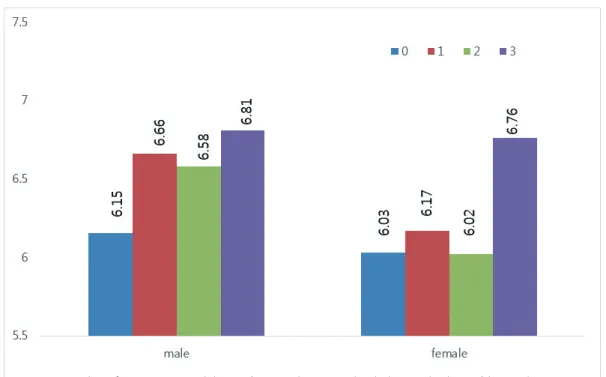
).스트레스, 우울감, 자살생각 중 가지고 있는 정신질환요소의 개 수와 앉아있는 시간을 비교해 보았을 때 남성에서 앉아있는 시간이 많을수록 스트레스, 우울감, 자살생각을 더 많이 가지고 있는 추세 를 보였으며 통계학적으로 유의하였다(
P
=0
.0184
). 여성에서는3
가 지 정신질환요소를 가지고 있는 군에서 앉아있는 시간이 가장 길었 으나 통계학적으로는 유의하지 않았다(p
=0
.2938
)(Figure 2
).앉아있는 시간과 정신 건강질환 이환율의 관계를 검정하기 위한 다중 로지스틱 회귀분석에서 남성에서 스트레스가 없다고 답변한 군의 평균 앉아있는 시간은
5
.73
±0
.11
시간이였으며 스트레스가 있다고 답변한 군의 평균 앉아있는 시간은6
.25
±0
.2
시간이였고 통계학적으로 유의하였다(p
=0
.0134
). 여성에서 스트레스가 없다 고 답변한 군의 평균 앉아있는 시간은5
.58
±0
.09
시간이였으며 스 트레스가 있다고 답변한 군의 평균 앉아있는 시간은5
.82
+0
.17
시 간이었고 통계학적으로는 유의하지 않았다(p
=0
.1808
).남성에서 우울감이 없다고 답변한 군의 평균 앉아있는 시간은
5
.82
±0
.11
시간이였으며 우울감이 있다고 답변한 군의 평균 앉아 있는 시간은6
.01
±0
.32
시간이였고 통계학적으로는 유의하지 않 았다(p
=0
.555
). 여성에서 우울감이 없다고 답변한 군의 평균 앉아 있는 시간은5
.62
±0
.09
시간이였으며 우울감이 있다고 답변한 군 의 평균 앉아있는 시간은5
.74
±0
.21
시간이었고 통계학적으로는 유의하지 않았다(p
=0
.5741
).Table 1. Socio-demographic characteristics and health behaviors by gender*
Characteristic MALE
(n= 2579)
FEMALE
(n= 3385) P†
AGE, mean, y 43.70.5 41.40.5 <0.001
BMI(kg/m2) 22.90.1 23.90.1 <0.001
WC, mean, cm 76.20.3 82.50.2 <0.001
Current smoking 37.5(1.4) 4.3(0.5) <0.001
High risk drinking 13(0.8) 1.9(0.3) <0.001
Education
(≥ High school) 72.3(1.2) 61.5(1.3) <0.001
Income(Low) 13.7(1) 17.7(1.3) <0.001
Physical activity; strenuous 23.2(1) 14(0.7) <0.001 Physical activity; moderate 8.9(0.8) 4.6(0.4) <0.001 Walking over 30min/day 42.6(1.2) 35.1(1.1) <0.001 Abbreviations: BMI, body mass index calculated as weight in kilograms divided by height in meters squared; WC, waist circumference.
* Data are represented as mean ± SEM or SE.
† P values are obtained by t-test or chi-square test.
Table 2. Association between sitting and mental health by grading sitting time in Male*
Group A
Group B
Group C
Group D Sitting time for
day(hr)
0,1,2 (n= 325)
3,4 (n= 555)
5,6,7,8,9 (n= 895)
>10 (n= 451) P† Perceived stress 13.4(1.9) 16.5(1.8) 42.4(2.5) 7.7(2.3) 0.0094 Melancholy 11.9(2.7) 22(3.5) 41.4(4.9) 24.7(4.6) 0.8237 Suicide ideation 9.4(3.7) 18.2(4.2) 42.1(6.2) 30.3(5.7) 0.3667
* Data are presented as number(%) unless otherwise indicated.
† Bold surfaces indicate statistically significant associations(p<0.05). P value from an ANOVA comparing a difference between 4 groups.
Table 3. Association between sitting and mental health by grading sitting time in Female*
Group E
Group F
Group G
Group H Sitting time for
day(hr)
0,1,2 (n= 458)
3,4 (n= 848)
5,6,7,8,9 (n= 1263)
>10 (n= 504) P† Perceived stress 14.2(1.5) 23.6(1.7) 38.4(2.1) 23.8(1.8) 0.1364 Melancholy 13.1(1.8) 23.4(2.2) 41.9(2.7) 21.6(2.3) 0.9047 Suicide ideation 10.6(2.1) 26.6(3.7) 37.5(4.1) 25.3(3.7) 0.4319
* Data are presented as number(%) unless otherwise indicated.
† P value from an ANOVA comparing a difference between 4 groups.
남성에서 자살사고가 없다고 답변한 군의 평균 앉아있는 시간은
5
.80
±0
.11
시간이였으며 자살사고가 있다고 답변한 군의 평균 앉 아있는 시간은6
.72
±0
.42
시간이였고 통계학적으로 유의하였다 (p
=0
.0292
). 여성에서 자살사고가 없다고 답변한 군의 평균 앉아 있는 시간은5
.59
±0
.09
시간이였으며 자살사고가 있다고 답변한 군의 평균 앉아있는 시간은6
.38
+0
.34
시간이었고 통계학적으로 유 의하였다(p
=0
.0268
)(Table 4
).고 찰
현대인의 에너지 소비 패턴은 과거 사냥, 음식물 획득, 육체적
노동등과 같은 활동적인 생활습관에서 좌식생활습관(
sedentary lifestyle
)으로 옮겨가고 이로 인해 하루 중 절반 이상을 좌식행동으 로 소비하고 있다.11) 그리고 이동수단과 일의 형태가 자동화 됨에 따라 장시간 앉아서 보낼 뿐만 아니라 업무가 없는 날에도 좌식을 위주로 하는 여가 시간 추구로 대부분의 생활을 좌식생활 형태로 소 비하게 만들었다. 고도의 산업화, 자동화로 인한 현대사회의 발달 은 이동수단 및 직장, 가사 등에서 생활습관의 편리함을 가져오는 반면 그 결과 인체에 많은 부정적인 영향을 초래하고 있다.12) 또한 좌식행동은 건강을 위협하는 요인이며, 신체활동의 독립적인 변인 이라 보고되고 있다.13)소수의 논문이 좌식행동과 정신건강의 연관관계에 대해 밝혔고14, Figure 1. Association between sitting time/day(hr) and common mental illness(Perceived stress, Melancholy, Suicide ideation)
Number of common mental disease (Perceived stress, Melancholy, Suicide ideation) by gender.
Table 4. Multiple logistic regression analysis for sitting time of common mental disease by gender
Male Female
No yes p† no yes p†
Perceived stress 5.73± 0.11 (n= 1794)
6.25± 0.2
(n= 459) 0.0134 5.58± 0.09
(n= 2326)
5.82± 0.17
(n= 747) 0.1808
Melancholy 5.82± 0.11
(n= 2084)
6.01± 0.32
(n= 169) 0.555 5.62± 0.09
(n= 2629)
5.74± 0.21
(n= 444) 0.5741
Suicide ideation 5.80± 0.11 (n= 2159)
6.72± 0.42
(n= 94) 0.0292 5.59± 0.09
(n= 2896)
6.38± 0.34
(n= 177) 0.0268
* Data are presented as number(hr) unless otherwise indicated.
† Bold surfaces indicate statistically significant associations(p<0.05). P-values are calculated by the analysis of logistic regression model for sitting time of common mental disease by gender, after adjustment for age, body mass index, regular physical activity, smoking and alcohol consumption.
P value from χ2 test for sitting time and common mental illness(Perceived stress, Melancholy, Suicide ideation). P-value was 0.018(significance was set at P<0.05) by chi- square test comparing with male.
15) 몇 가지 예외를 제외하고는16, 17) 앉아있는 것과 정신 건강 사이에 는 단면 연구로 이루어 졌다. 저자들의 결과들은 좌식 행동들과 흔 한 정신 질환 증상들 사이의 연관성과, 특히
TV
시청에14) 대한 연관 성에서 보여진 단면연구들15)과 다른 종속연구들의16,17) 연구결과와 는 부합하지 않았다. 비록 육체적 활동이 우울 증상을 감소시킬 수 있다 하더라도15), 앉아있는 시간의 감소만으로는 부족하다고 보인 다. 또한 우울증 증상은 여가시간에 더 오래 앉아있게 만들 수도 있 다.7) 본 연구는 한국인에서 앉아있는 시간과 정신건강질환 사이의 관계를 밝힌 최초의 연구이다. 또한 한국의 국민건강영양조사 자료 를 바탕으로 이루어진 연구로서 한국인을 대표할 수 있다는 장점이 있다.하지만 몇 가지 한계점을 들 수 있는데 첫째로 단면연구로 진행 되어 자료수집 과정에 관여할 수 없고 자료간의 인과관계에 대한 추 론이 힘들다는 점을 들 수 있으며 이를 보완하기 위해 후향적 디자 인의 연구가 시행되어야 할 것이다.18, 19) 둘째로 본 연구에서는 설문 지 형태로 자가 보고된 앉아있는 시간을 사용하였다는 점으로 앉아 있는 시간에 대해 지속적인 모니터링을 하지 못하였다. 셋째로 저 자들은 직업적 좌식생활의 종류를 구분할 수 없었고 결과가 직업군 에 따른 좌식 시간에 대해서는 파악하지 못하였다. 앉아있는 시간 그 자체 보다 작업환경(
e
.g
., 근무시간)의 특징이 단면적 연관성과 더 관련이 있을 수 있다는 연구가 있었다.20) 향후 이러한 점을 고려 한 연구가 시행되어야 할 것이다.본 연구는 한국인에서의
TV
시청, 독서하기 등의 좌식행동과 스 트레스, 우울감, 자살생각과의 상관관계를 알아보고자 하였다.연 구 결과 한국인들의 장시간 좌식 행동은 정신질환증상의 유병률과 정적인 상관관계가 있는 것으로 나타났다. 장시간 앉아있는 시간을 가지는 남성일수록 스트레스를 더 받으며, 남성과 여성 모두에서 장시간 앉아있는 군에서 자상생각이 증가하였다. 따라서 한국인들 의 장시간 좌식행동의 생활습관은 스트레스, 자살사고 등의 정신건 강과 밀접한 관계가 있는 것으로 판단되며 한국인들에게 규칙적인 신체활동의 개입은 스트레스 및 자살사고의 예방에 도움을 줄 것으 로 사료된다.요 약
연구배경: 앉아있는 시간을 포함한 신체적 활동이 적은 생활은 신 체 건강에 해가 될 수 있다. 이러한 생활과 정신 건강의 관련성에 대 한 연구는 아직까지는 적다. 그러므로 이 연구의 우리나라 성인 대 상자의 일과 중 앉아있는 시간을 알아보고 한국인의 앉아있는 시간 과 스트레스, 우울 및 자살사고의 상관관계를 알아보고자 한다.
방법: 본 연구는
2013
년에 시행된 제6
기1
차년도 국민 건강영양 조 사 결과를 이용한 횡단적 기술연구로19
세 이상의 성인5
,964
명을 대상으로 하였다. 앉아서 보낸 시간은 본인에게 주중 앉아서 보낸 시간(분)을 설문지 형태로 알아보았고 일반적 특성과 건강관련 특성 및 스트레스, 우울, 자살생각과 좌식 행동과의 관계는 카이제곱 분 석 방법을 이용하여 분석하였다.결과: 우리나라
19
세 이상의 성인 대상자 중 일과 중 앉아있는 시간 은 평균9
.36
시간이였으며, 남성8
.64
시간 여성10
.04
시간 이었다.남성에서 좌식생활이 길수록 스트레스와 자살사고가 많고 여성에 서는 좌식생활이 길수록 자살사고가 많음이 통계적으로 유의한 관 련이 있는 것으로 나타났다.
결론: 본 연구결과 남성에서 하루에 앉아있는 시간이 길수록 스트 레스가 많은 것으로 나타났고, 하루
5
~9
시간이상 앉아 있는 군에서 스트레스, 우울감, 자살사고가 가장 많은 것으로 나타났다. 이러한 연구 결과 장시간의 좌식생활은 정신건강저하와 독립적인 연관이 있음을 확인하였다.중심단어: 좌식 생활, 우울감, 스트레스, 자살사고, 정신건강, 앉아 있는 시간
REFERENCES
1. Stamatakis E, Hirani V, Rennie K. Moderate-to-vigorous physical activity and sedentary behaviours in relation to body mass index- defined and waist circumference-defined obesity. Br J Nutr 2009;
101: 765–73.
2. Hamilton MT, Hamilton DG, Zderic TW. Role of Low Energy Expenditure and Sitting in Obesity, Metabolic Syndrome, Type 2 Diabetes, and Cardiovascular Disease. Diabetes. 2007 ;56: 2655-67.
3. Healy GN, Dunstan DW, Salmon J, Cerin E, Shaw JE, Zimmet PZ, et al. Objectively Measured Light-Intensity Physical Activity Is Independently Associated With 2-h Plasma Glucose Diabetes Care.
2007; 30: 1384-9
4. Statistics Korea(2009). Lifestyle survey in Korea.
5. American College of sports medicine(2010). ACSM's Guidelines for Exercise Testing and Prescription(8th Ed.). Lipponcott Williams &
Wilkins.
6. Statistics Korea(2012). National Sport Participation Survey in Korea.
7. Wilmot EG, Edwardson CL, Achana FA, Davies MJ, Gorely T, Gray LJ, Khunti K, at al. Sedentary time in adults and the association with diabetes, cardiovascular disease and death: systematic review and meta-analysis. Diabetologia. 2012; 55: 2895-905.
8. Owen N, Bauman A, Brown W. Too much sitting: a novel and important predictor of chronic disease risk? Br J Sports Med. 2009;
43: 81-3
9. Patel AV, Bernstein L, Deka A, Feigelson HS, Campbell PT, Gapstur SM, at al. Leisure time spent sitting in relation to total mortality in a prospective cohort of US adults. Am J Epidemiol. 2010; 172:
419-29
10. Ministry of Health and Welfare, Korea Center for Disease Control and Prevention. Guidelines for using raw data of Korean National Health and Nutrition Examination Survey, the first survey of the sixth phase.(KNHANES VI-1). In. Seoul: Korea Center for Disease Control and Prevention; 2013(Korean)
11. Hagströmer M, Oja P, Sjöström M. Physical activity and inactivity in an adult population assessed by accelerometryMed Sci Sports Exerc. 2007; 39: 1502-8.
12. Kim TW, Kang HS. Effects of Sedentary Behavior Modification on Fasting Glucose and Insulin Resistance. Journal of Sport and Leisure Studies, 2009; 38: 1073 -1080
13. Thorp AA, Owen N, Neuhaus M, Dunstan DW. Sedentary behaviors and subsequent health outcomes in adults a systematic review of longitudinal studies, 1996-2011. Am J Prev Med. 2011;
41(2): 207-15.
14. Hamer M, Stamatakis E, Mishra GD. Television- and screen-based activity and mental well-being in adults. Am J Prev Med 2010; 38:
375-80.
15. Teychenne M, Ball K, Salmon J. Sedentary behavior and depression among adults: a review. Int J Behav Med 2010; 17: 246-54.
16. Lucas M, Mekary R, Pan A, Mirzaei F, O'Reilly EJ, Willett WC, et al. Relation between clinical depression risk and physical activity and time spent watching television in older women: a 10-year prospective follow-up study. Am J Epidemiol 2011; 174: 1017-27.
17. Sanchez-Villegas A, Ara I, Guillen-Grima F, Bes-Rastrollo M, Varo-Cenarruzabeitia JJ, Martinez-Gonzalez MA. Physical activity, sedentary index, and mental disorders in the SUN cohort study.
Med Sci Sports Exerc 2008; 40: 827-34.
18. Hamer M, Kivimaki M, Steptoe A. Longitudinal patterns in physical activity and sedentary behaviour from mid-life to early old age: a substudy of the Whitehall II cohort.J Epidemiol Community Health.
2012; 66: 1110-5.
19. Hamer M, Coombs N, Stamatakis E. Associations between objectively assessed and self-reported sedentary time with mental health in adults: an analysis of data from the Health Survey for England. BMJ Open. 2014; 4: e004580.
20. Virtanen M, Ferrie JE, Singh-Manoux A, Shipley MJ, Stansfeld SA, Marmot MG, at al. Long working hours and symptoms of anxiety and depression: a 5-year follow-up of the Whitehall II study.
Psychol Med. 2011; 41: 2485-94.