A cold-active and alkaline serine protease (Pro21717) was partially purified from the Antarctic marine bacterium Pseudoalteromonas arctica PAMC 21717. On a zymogram gel containing skim milk, Pro21717 produced two distinct clear-zones of approximately 37 kDa (low intensity) and 74 kDa (high intensity). These were found to have identical N-terminal sequences, suggesting they arose from an identical precursor and that the 37 kDa protease might homodimerize to the more active 74 kDa form of the protein. Pro21717 displayed proteolytic activity at 0–40°C (optimal temperature of 40°C) and maintained this activity at pH 5.0–10.0 (optimal pH of 9.0). Notably, relative activities of 30% and 45% were observed at 0°C and 10°C, respectively, in comparison to the 100% activity observed at 40°C, and this enzyme showed a broad substrate range against synthetic peptides with a preference for proline in the cleavage reaction.
Pro21717 activity was enhanced by Cu
2+and remained stable in the presence of detergent surfactants (linear alkylbenzene sulfonate and sodium dodecyl sulfate) and other chemical components (Na
2SO
4and metal ions, such as Ba
2+, Mg
2+, Ca
2+, Zn
2+, Fe
2+, K
+, and Na
2+), which are often included in commercial detergent formulations. These data indicate that the psychrophilic Pro21717 has properties comparable to the well-characterized mesophilic subtilisin Carlsberg, which is commercially produced by Novozymes as the trademark Alcalase. Thus it has the
potential to be used as a new additive enzyme in laundry detergents that must work well in cold tap water below 15°C.
Keywords: alkaline protease, Antarctic, cold-active, laundry detergent
Serine proteases are a widely used and extensively studied type of protease, among which the subtilisin or subtilase (subtilisin-like serine protease) family is the second largest family (Rawlings et al., 2006; Vojcic et al., 2015; Mageswari et al., 2017). The subtilases have a wide variety of applications, and have been applied in the detergent industry (Rao et al., 1998; Vojcic et al., 2015). Among subtilases, alkaline proteases attract particular interest from industrial enzyme companies because of their activity and stability at alkaline pH and in the presence of various surfactants and oxidizing agents used in detergents (Gupta et al., 2002; Joo and Chang, 2006; Saeki et al., 2007; Sellami-Kamoun et al., 2008; Haddar et al., 2009;
Niyonzima and More, 2015). For example, since its intro- duction as the first additive enzyme in the 1960s (Rao et al., 1998; Ottmann et al., 2009), subtilisin Carlsberg, originally isolated from Bacillus licheniformis has been widely used in laundry detergents.
Characterization of an Antarctic alkaline protease, a cold-active enzyme for laundry detergents
Ha Ju Park, Se Jong Han, Joung Han Yim, and Dockyu Kim*
Division of Polar Life Sciences, Korea Polar Research Institute, Incheon 21990, Republic of Korea
세탁세제 첨가용 효소 개발을 위한 남극 해양세균 유래 저온성 단백질분해효소의 특성 연구
박하주 ・ 한세종 ・ 임정한 ・ 김덕규*
극지연구소 극지생명과학연구부
(Received October 17, 2017; Revised December 18, 2017; Accepted December 20, 2017)
*For correspondence.
E-mail: [email protected];Tel.: +82-32-760-5525; Fax: +82-32-760-5509
Cold-adapted microorganisms are able to proliferate in cold environments and their cold-active (psychrophilic) enzymes are characterized by high catalytic efficiency at low and moderate temperatures at which homologous mesophilic enzymes are not active. Cold-active proteases have been isolated from cold- adapted bacteria in polar and glacier regions, and owing to their high catalytic activities at low temperatures, they have the potential for commercial use. Although, until now, many psy- chrophilic proteases have been characterized about their cold- activities (Huston et al., 2004; Wang et al., 2005; Larsen et al., 2006; Chen et al., 2007; Kuddus and Ramteke, 2012; Santiago et al., 2016), the studies for practical applications as additives in laundry and dish-washing detergents are scarce contrary to our expectations (Joshi and Satyanarayana, 2013; Mageswari et al., 2017). In addition to higher activity at low temperatures, properties required for new psychrophilic alkaline proteases to be candidates in detergent formulation include stability over a broad range of pH and in the presence of detergent components, and activity toward a variety of substrates (Kumara and Takagi, 1999).
We screened cold-adapted bacterial strains producing psychro- philic proteases from the Polar and Alpine Microbial Collection (PAMC) operated by the Korea Polar Research Institute (KOPRI) and selected one strain, Pseudoalteromonas arctica PAMC 21717, because of its excellent ability to produce a serine-type protease (Kim et al., 2010), which was initially isolated from sea water near King Sejong Station in Antarctica. In this work, we partially purified the extracellular protease from PAMC 21717 and characterized its cold activity, substrate range, mosaic structure, and stability under alkalinity and in the presence of surfactants, to estimate its potential as a new detergent additive.
Materials and Methods
Growth conditions and protease production
Pseudoalteromonas arctica PAMC 21717 was pre-cultured by inoculating a small amount of glycerol stock in ZoBell medium (5 g peptone, 1 g yeast extract, 0.01 g FePO
4, 750 ml sea water, and 250 ml distilled water per liter) containing 2%
glucose, and incubating for 1 day at 25°C. The cell culture (0.5
ml) was inoculated into 50 ml of modified ZoBell (SZB; 0.5 g peptone, 0.1 g yeast extract, 0.01 g FePO
4, 1% skim milk, 750 ml sea water, and 250 ml distilled water per liter) and incubated for 4 days at 5, 15, or 25°C. At appropriate time intervals, cell growth was examined by measuring the absorbance at 600 nm, and the proteolytic activity of the culture supernatant was determined as described below.
Enzyme assay
Enzyme assay method was modified from Sigma’s non- specific protease activity assay (Cupp-Enyard, 2008). After centrifuging PAMC 21717 cell culture (12,000 × g for 30 min at 4°C), 0.2 ml of supernatant (234 µg/ml) was added to 0.9 ml of 50 mM sodium phosphate buffer (pH 7.6; standard buffer) containing 0.65% substrate azocasein. After incubating the reaction mixture at 25°C for 1 h, 0.9 ml of 110 mM trichloroacetic acid was added before further incubation at 37°C for 30 min. To remove the precipitate, the mixture was centrifuged (12,000 × g for 3 min at 4°C) and filtered through a 0.45 µm filter. The filtrate (0.5 ml) was mixed with 0.25 ml Folin & Ciocalteu’s phenol reagent and 1.25 ml of 500 mM sodium carbonate. After incubating the mixture for 30 min at 37°C, the absorbance was determined at 660 nm and the enzyme activity was calculated using an L -tyrosine standard curve. One unit of protease activity was defined as the activity to produce 1 nmol of released amino acids per min, per mg of protein at 25°C.
Zymogram analysis
Enzyme solution was separated on 10% SDS-PAGE gels containing 0.3% skim milk or 1% gelatin. The gels were then rinsed in 100 ml renaturing buffer (27 g Triton X-100 in 1 L distilled water) and 100 ml developing buffer (50 mM Tris base, 50 mM Tris-HCl, 200 mM NaCl, 5 mM CaCl
2, 0.02% Brij 35) for 30 min, respectively. The rinsed gels in two buffers were incubated in 100 ml of developing buffer at 4°C or 25°C and stained with Coomassie Blue R-250 for detection of clear zones produced by proteolytic activity.
Partial purification of protease
PAMC 21717 was fermented in 20 L of SZB for 4 days at
15°C. The culture supernatant was recovered after centrifugation
(12,000 × g for 30 min at 4°C). The supernatant was buffer-
exchanged with 40 L of 20 mM Tris-HCl buffer (pH 7.6) and simultaneously concentrated through a Lab Scale TFF system (Millipore) equipped with an 8 kDa cut-off membrane. The resultant crude enzyme solution was designated Pro21717.
To determine the protease type of Pro21717, the enzyme solution was treated with various protease inhibitors as follows:
metalloprotease inhibitor (EDTA and iodoacetamide), cysteine protease inhibitor [aminophenylmercuric acetate (APMA), N- ethylmaleimide, leupeptin and HgCl
2], serine protease inhibitor (PMSF and N- α-p-tosyl- L -lysine chloromethyl ketone). One hundred microliters of Pro21717 (170 µg/ml) was pre-incubated in 1.0 ml of standard buffer containing 1 mM of each inhibitor on ice for 1 h. Subsequently, 90 µl of 6.5% azocasein was added to the treated mixture, and then the residual proteolytic activity of Pro21717 was measured under the conditions as described above.
For enzymatic characterization of Pro21717, except for inhibitor treatment for protease typing, the enzyme solution was treated with a protease inhibitor cocktail (0.03 mM pepstatin A, 0.1 mM E64, 0.2 mM bestatin, 5 mM EDTA, and 0.01 mM epoxomicin) to inhibit the proteolytic activities of proteases other than serine proteases (Overall and Blobel, 2007).
Effects of temperature and pH on protease activity and stability
The optimal temperature for proteolytic activity of Pro21717 was determined by incubating the enzyme reaction mixtures at a range of temperatures between 0 and 60°C and measuring its proteolytic activity. Thermal stability was analyzed by pre- incubating Pro21717 at various temperatures between 0 and 60°C for 1 h and then measuring its residual activity. The reaction mixture, consisting of 0.65% azocasein and 0.1 ml of Pro21717 (170 µg/ml) in 1.0 ml of standard buffer, was incu- bated at 25°C for 1 h. One hundred microliters of subtilisin Carlsberg (30 µg/ml) was used as the control enzyme.
The optimum pH for proteolytic activity was determined in 1.1 ml of reaction mixture containing 0.65% azocasein and 0.1 ml of Pro21717 (170 µg/ml) after incubating at 25°C for 1 h.
The pH was adjusted using 50 mM sodium acetate (pH 4.0–6.0) and 50 mM potassium phosphate (pH 6.0–9.5). For the determi- nation of pH stability, 10 µl of Pro21717 (17 mg/ml) was pre- incubated in 90 µl of the following buffers on ice for 1 h: 50
mM sodium acetate (pH 2.0 –6.0), 50 mM potassium phosphate (pH 7.0–10.0), and 50 mM sodium tetraborate (pH 10.0). Ten microliters of treated Pro21717 (1.7 mg/ml) was added to 1.09 ml of standard buffer containing 0.65% azocasein and incubated at 25°C for 1 h. Subtilisin Carlsberg (3 µg) was used as the control enzyme at 55°C.
Effects of metal ions and detergents on protease activity and stability
To assess the effects of metal ions and detergents on Pro21717 activity, 0.1 ml of Pro21717 (170 µg/ml) was mixed with 1 mM each of BaCl
2, CuSO
4, MgSO
4, CaCl
2, ZnSO
4, FePO
4, KCl, NaCl, Na
2SO
4, sodium linear alkylbenzen sulfonate (LAS), or SDS in 0.91 ml standard buffer, and incubated for 1 h on ice.
Subsequently, 90 µl of 6.5% azocasein was added to the reaction mixture, and the residual protease activity of Pro21717 was measured as described above.
Compatibility of Pro21717 with commercial detergent Pro21717 (0.1 ml, 400 µg/ml) or subtilisin Carlsberg (0.1 ml, 30 µg/ml) was incubated with 0.65% skim milk in 1.1 ml of a standard formulation for LAS detergents, provided from a laundry detergent manufacturer (LG Household & Health Care).
After incubating the enzymes at 10°C or 30°C for 1 h, the amount of amino acids released from skim milk hydrolysis by Pro21717 or subtilisin Carlsberg was measured. One unit of protease activity for skim milk was defined as the activity required to produce 1 nmol of amino acids released from hydrolyzed skim milk per min, per mg of protein.
Substrate specificity of protease
To assess the substrate specificity of Pro21717, its ability
to hydrolyze seven different synthetic peptides (5 mM) was
measured using Peek’s method (Peek et al., 1993): N-succinyl-
Ala-Ala-Val-p-nitroanilide (AAV), N-succinyl-Ala-Ala-Pro-
Leu-p-nitroanilide (AAPL), N-succinyl-Ala-Ala-Ala-p-nitroanilide
(AAA), N-succinyl-Gly-Gly-Phe-p-nitroanilide (GGF), N-succinyl-
Thr-Leu-Val-p-nitroanilide (TLV), N-succinyl-Ala-Ala-Pro-
Phe-p-nitroanilide (AAPF), and N-succinyl-Ala-Ala-Val-Ala-
p-nitroanilide (AAVA). Fifty microliters of Pro21717 (390 µg/ml)
was added to 700 µl standard buffer containing each substrate
(final concentration of 0.83 mM), followed by incubation at 25°C for 10 min. To terminate the assay, 250 µl of 2 M sodium acetate (pH 5.0) was added, and absorbance was then deter- mined at 410 nm. The enzyme activity was calculated using a p-nitroanilide standard curve. One unit of protease activity was defined as the activity required to produce 1 nmol of released p-nitroanilide per min, per mg of protein at 25°C. Subtilisin Carlsberg was assayed under the same conditions as Pro21717, apart from temperature (assayed instead at 55°C).
Results and Discussion
Effect of temperature on protease production
The patterns of cell growth and protease production of PAMC 21717 were examined at different temperatures (5, 15, and 25°C) in 50 ml SZB. Cell growth rapidly increased immediately after the temperature was shifted to 25°C, with a maximum specific growth rate of 0.58 h
-1, which occurred after 4 h of incubation. Cell growth at 15°C showed a similar pattern to that at 25°C, with a maximum growth rate of 0.37 h
-1. In contrast, PAMC 21717 at 5°C required 6 h of lag phase to reach an exponential phase and grew at a lower growth rate of 0.10 h
-1.
The protease production of PAMC 21717 was tested using the same temperatures and medium as for the growth examination.
At 15°C, the protease activity in cell culture against azocasein steadily increased, concomitantly with the cell growth, after approximately 6–24 h, and the maximal protease activity (2.7 U/ml) was maintained until 96 h. Protease production at 5°C was lower than that at 15°C, but the activity increased constantly until 96 h, when it reached 2.0 U/ml. At 25°C, protease pro- duction decreased after 24 h, with a maximal activity of 1.7 U/ml. These results indicate that PAMC 21717 is able to grow well in a temperature range of 15–25°C (optimal 25°C for growth), but produce a sufficient amount of protease at 5 –15°C (optimal 15°C for protease production), which is a distinct characteristic of cold-adapted microorganisms.
Preparation and structural characterization of Pro21717 Culturing for over-production of protease by PAMC 21717 was performed with a 20 L-scale fermenter for 96 h at 15°C. In time-interval examination, the growth of PAMC 21717 reached
its maximal level (2.5 × 10
10colonies/ml) within 24 h and maintained this level until the culture was ended (96 h). Skim milk in SZB media was rapidly hydrolyzed after 24 h and the specific activity of protease was found to be 7.5 ± 0.1, 19.4 ± 0.1, and 18.3 ± 1.1 U/mg after 24 h, 48 h, and 96 h, respectively.
When the culture supernatants were subjected to zymography on a 10% SDS-PAGE gel containing skim milk at 5°C, two significant clear zones resulting from cold activity of the protease were detected in the range of 37 to 74 kDa from all samples except for the 6 h culture (Fig. 1A). After centrifuging the 96 h culture, the supernatant was concentrated and desig- nated as crude enzyme solution Pro21717, which had a specific activity of 37.3 ± 0.8 U/mg. In zymogram analysis, Pro21717 produced the same proteolytic bands in the range of 37 –74 kDa as in the crude culture supernatants, with the 74 kDa protein showing higher intensity than the 37 kDa protein (Fig. 1B).
The two proteins of 37 kDa and 74 kDa in Pro21717, which were separated on 10% SDS-PAGE gel, were transferred to a PVDF membrane and subjected to N-terminal sequencing. The N-terminal sequences (GAQNSSWH) from the two proteins were identical to each other, demonstrating that they are originated from the same protease precursor. When searched against NCBI blastp, the protein sequences matched well with those of subtilisin-like serine proteases from many marine
(A) (B)
Fig. 1. Zymogram of culture supernatants from time-course incubations of P. arctica PAMC 21717 (A) and Pro21717 partially purified from 96 h culture supernatant and then treated with the protease inhibitor cocktail, described in materials and methods (B). The proteins separated on 10%
SDS-PAGE gel containing 0.3% skim milk (A) or 1% gelatin (B) were incubated at 5°C.
Pseudoalteromonas species, including the well-characterized psychrophilic subtilase MCP-03 from Pseudoalteromonas sp.
SM9913 (Yan et al., 2009). The majority of subtilase family proteins are known to be synthesized as protease precursors, which are secreted and finally maturated into an active form by cleavage of the non-catalytic region. The secreted mature forms are generally of low molecular weight, in the range of 15–30 kDa (Gupta et al., 2002). Considering the structural properties and maturation process of subtilases, the above results suggest that the 37 kDa protein is an active form which is produced through the maturation, and two 37 kDa molecules homodi- merize to produce a 74 kDa protease, which is a more activated form. This suggestion is supported by a previous report showing that homodimerization of tomato subtilase SBT3 is required in its protease activation (Ottmann et al., 2009).
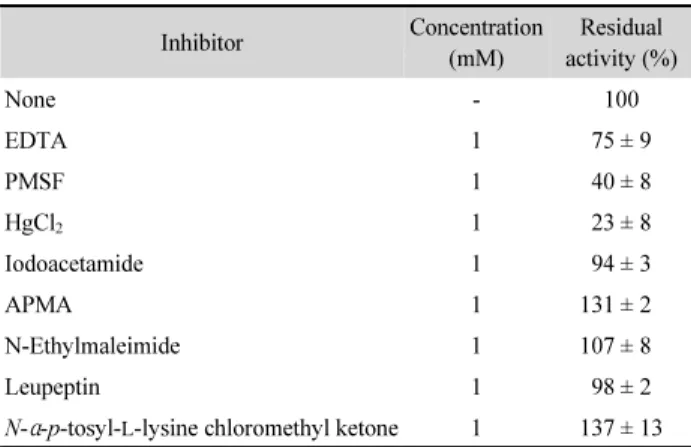
Inhibitor treatment of Pro21717 for protease typing Pro21717 was treated with various protease inhibitors for classification of its protease type (Table 1). Pro21717 was strongly inhibited by PMSF (serine protease inhibitor) and HgCl
2, which reduced the protease activity to approximately 40% and 23%, respectively, while cysteine protease inhibitors (APMA, N-ethylmaleimide, leupeptin, and N- α-p-tosyl- L -lysine chloromethyl ketone) had no effects on protease activity. HgCl
2is also known as a cysteine protease inhibitor, and cleaves disulfide bonds. These results suggest that Pro21717 is a serine protease and has the disulfide bonds essential for its proteolytic activity, but is not a cysteine protease. The metalloprotease inhibitor EDTA showed a minor inhibitory effect, remaining proteolytic
activity of 75%, while iodoacetamide had no effect. These inhibition tests suggest that Pro21717 is a serine-type protease associated with metalloproteases, although there is a possibility that it is a mixture of the two types of proteases. To inhibit the metalloprotease activity and other activities, if present, the protease inhibitor cocktail, described in the materials and methods, was added to Pro21717 solution for its enzymatic characterization as described below. Serine protease inhibitors, such as PMSF, AEBSF, and aprotinin, were not included in the inhibitor cocktail.
Effects of temperature and pH on Pro21717 activity and stability
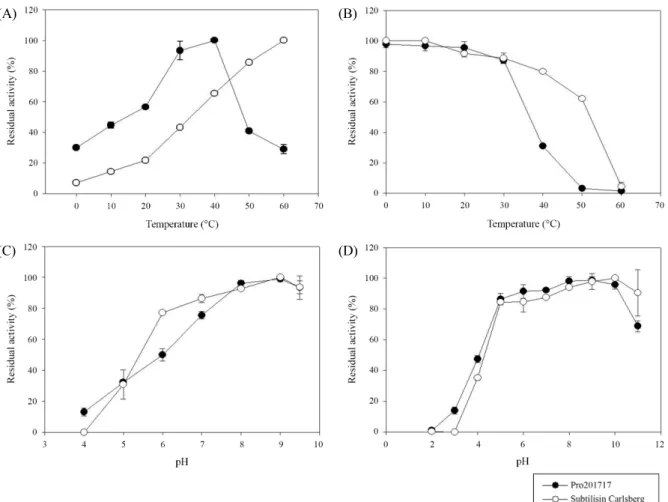
New additive enzymes for laundry detergents should have both high activity and high stability over a broad range of pHs and temperatures. To assess its suitability as an additive for laundry detergents, Pro21717 activity was analyzed at various temperatures. The proteolytic activity was highest in the range of 30–40°C, with an optimum at 40°C, but rapidly decreased at temperatures higher than 40°C (Fig. 2A). Pro21717 exhibited relative activities of 30% and 45% at 0°C and 10°C, respec- tively, relative to the optimal activity achieved at 40°C. In contrast to Pro21717, subtilisin Carlsberg produced by fer- mentation of Bacillus licheniformis (Sigma Aldrich), one of the first proteases used in detergents, showed even lower cold activity of 7% and 14% at 0°C and 10°C, respectively, relative to its optimal activity, achieved at 60°C. The relative activity (30%) of Pro21717 near 0°C was comparable to those of previously characterized psychrophilic proteases from several cold-adapted bacteria: Colwellia psychrerythraea 34H (12%) (Huston et al., 2004), Colwellia sp. NJ341 (30%) (Wang et al., 2005), and Pseudoalteromonas sp. SM9913 (45%) (Chen et al., 2007). Together with the results from protease typing tests, this shows that Pro21717 is a psychrophilic serine-type protease.
When incubated at the optimal temperature of 40°C for 1 h, Pro21717 activity rapidly decreased to less than 30% (Fig. 2B).
In contrast, mesophilic subtilisin Carlsberg retained 80% of its activity under the same conditions, and rapidly lost its activity at over 50°C. Together with above optimal temperature test, this stability test demonstrates that Pro21717 is a true psychro- philic protease showing higher cold activity at low temperatures and lower thermostability at mild temperatures.
Table 1. Residual activity of Pro21717 against various protease inhibitors
Inhibitor Concentration
(mM)
Residual activity (%)
None - 100
EDTA 1 75 ± 9
PMSF 1 40 ± 8
HgCl2 1 23 ± 8
Iodoacetamide 1 94 ± 3
APMA 1 131 ± 2
N-Ethylmaleimide 1 107 ± 8
Leupeptin 1 98 ± 2
N-α-p-tosyl-L-lysine chloromethyl ketone 1 137 ± 13
The effect of pH was determined by pre-incubating Pro21717 in buffer solutions of various pH values. Pro21717 exhibited higher activity at pH 8.0 –9.5, with maximum activity at pH 9.0 (Fig. 2C), suggesting alkaline nature. Pro21717 remained stable over a broad pH range (5.0–10.0), but lost its activity at pH lower than 5.0 and above 10.0 (Fig. 2D). Alkaline subtilisin Carlsberg showed a similar pattern, being active between pH 5.0 and 10.0, with maximum activity at pH 9.0, and rapidly losing its activity below pH 5.0 and above pH 10.0.
Effects of metal ions and chemical reagents on Pro21717 activity and stability
The effects of various metal ions and chemical reagents, which might be included as detergent components, on Pro21717 were analyzed (Fig. 3). In accordance with previous reports
(A)
(B)
(C)
(D)
Fig. 2. The effects of various temperatures and pHs on the activity and stability of Pro21717, treated with the protease inhibitor cocktail. The optimal temperature (A) and pH (C) for protease activity were measured and the stability in a broad range of temperatures (B) and pHs (D) were examined as described in ‘Materials and Methods’.
Fig. 3. The effects of various metal ions and detergents on the activity and stability of Pro21717, treated with the protease inhibitor cocktail. Pro21717 was pre-incubated in standard buffer containing 1 mM each compound on ice for 1 h, and the residual activity was measured as described in
‘Materials and Methods’.
(Giri et al., 2011), CuSO
4(cation Cu
2+) at 1 mM enhanced its protease activity by 64%, while the other cations, Ba
2+, Mg
2+, Ca
2+, Zn
2+, Fe
2+, K
+, and Na
2+, showed no effects. Remarkably, Pro21717 was resistant to denaturation by Na
2SO
4and LAS, which are included in standard commercial detergent formulas, and SDS, which is a strong protein denaturing surfactant. Haddar et al. (2009) noted that stability towards SDS is important because such enzymes are rare in the detergent market. For example, the cold-active serine protease from Colwellia sp.
NJ341 was sensitive to SDS (Wang et al., 2005). These data show that Pro21717 has sufficient resistance to common components of detergent formulas, which is a prerequisite for future use in the detergent market.
Substrate specificity of Pro21717
The proteolytic activity of Pro21717 for synthetic peptides, which are used to evaluate the substrate specificity of proteases, was tested. Pro21717 showed higher activity towards AAPF (100%) and AAPL (44.3%), with lower activity for AAA, GGF, TLV, and AAVA. In a comparative test, subtilisin Carlsberg had similar specificity for theses substrates to Pro21717, showing 100% and 66.5% activity towards AAPF and AAPL, respectively (Table 2). These results show that Pro21717 and subtilisin Carlsberg have similar substrate specificities and a preference for the neutral amino acid proline in the cleavage of (poly)peptides.
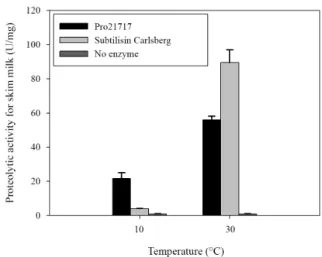
Compatibility of Pro21717 with commercial detergent After incubating with skim milk in a standard formulation for LAS detergents for 1 h, Pro21717 in the detergent solution
showed proteolytic activities of 55.9 ± 2.2 and 21.7 ± 3.4 U/mg at 30°C and 10°C, respectively. In comparison, subtilisin Carlsberg showed activities of 89.6 ± 7.3 and 4.0 ± 0.1 U/mg, respectively (Fig. 4). Interestingly, although the absolute activity was higher than the activity of Pro21717 at 30°C, subtilisin Carlsberg displayed much lower than Pro21717 at 10°C. These results clearly indicate that Pro21717 remains stable in a com- mercial detergent solution and is able to exhibit its proteolytic activity during the washing process in cold tap water below 15°C.
Proteases have a large variety of applications, and have been applied in the detergent industry. In recent years, temperatures used in household laundering and automated dishwashers have been reduced, both to save energy and as a result of the increased use of synthetic fibers which do not tolerate high temperatures (Kirk et al., 2002). Thus, cold-active alkaline proteases have been considered as new additive enzymes in laundry detergents, and they are also expected to open up new markets in the developing world. To be used in detergents, besides higher activity at low temperatures, these enzymes must also have properties such as higher activity at the pH (generally 9.0 –12.0) of detergent-containing wash water, stability in the presence of various detergent components (metal ions and surfactants), and a broad substrate range.
In recent years, industrial enzyme companies, such as Novozymes and Genencor, have been searching for new
Table 2. Substrate specificities of Pro21717 and subtilisin Carlsberg toward various substrates
Substrate Relative activity (%)
Pro21717 Subtilisin Carlsberg
AAV 3.1 ± 2.3 2.6 ± 1.3
AAPL 44.3 ± 1.1 66.5 ± 0.1
AAA 2.1 ± 1.1 1.5 ± 0.5
GGF 4.7 ± 1.7 0
TLV 6.7 ± 2.4 4.0 ± 3.7
AAPF 100 100
AAVA 8.7 ± 1.5 11.7 ± 2.3
Fig. 4. Compatibility of Pro21717 and subtilisin Carlsberg in commercial detergent solution. Pro21717, treated with the protease inhibitor cocktail, or subtilisin Carlsberg was incubated with skim milk in a standard formulation for LAS detergents at 10 or 30°C for 1 h, and the absolute proteolytic activity was measured as described in ‘Materials and Methods’.