512
JOURNALOF KOREAN FOREST SOCIETY ISSN 0445-4650(Print), ISSN 2289-0904(Online) http://e-journal.kfs21.or.kr
소나무재선충 생물학적 방제를 위한 Bacillus licheniformis MH48의 선발 및 특성 규명
정민해1·양서영1·이용성1·안영상2·박윤석3·한혜림4·김길용1*
1전남대학교 응용생물공학부, 2전남대학교 산림자원학부,
3(주)푸르네, 4국립산림과학원 산림병해충연구과
Selection and Characterization of Bacillus licheniformis MH48 for the Biocontrol of Pine Wood Nematode
(Bursaphelenchus xylophilus)
Min-Hae Jeong
1, Seo-Young Yang
1, Yong-Sung Lee
1, Young-Sang Ahn
2, Yun-Serk Park
3, Hye-rim Han
4and Kil-Yong Kim
1*1Division of Applied Bioscience and Biotechnology, Chonnam National University, Gwangju 61186, Korea
2Division of Forest Resources, Chonnam National University, Gwangju 61186, Korea
3Purne Co., Ltd., Institute of Environmentally-Friendly Agriculture, Chonnam National University, Gwangju 61186, Korea
4Division of Forest Insect Pests and Diseases, Korea Forest Research Institute, Seoul 02455, Korea
요 약: 소나무재선충(Bursaphelenchus xylophilus)에 의해서 발생하는 소나무재선충병은 우리나라 소나무림에 피해를 주고 있다. 본 연구는 친환경 소나무재선충 방제제 개발을 위하여 살선충 활성이 뛰어난 미생물을 선발하고자 실험 을 수행하였다. 소나무재선충에 대하여 살선충 효과를 나타내는 미생물을 선발하기 위해 5종 미생물의 배양액 처리 를 통해 살선충 활성이 뛰어난 Bacillus licheniformis MH48을 선발하였다. B. licheniformis MH48의 살선충 효과를 검 증하기 위해 세포 생육과 단백질 분해 효소 활성도를 분석하였는데, 세포 생육은 배양 3일째 가장 높았고 단백질 분 해 효소 활성은 7일째에 가장 높은 활성을 보였다. 또한, B. licheniformis MH48의 배양액 농도에 따른 소나무재선충 의 살선충 활성을 조사한 결과, 키틴-젤라틴(CG) 배지와 키틴-선충(CN) 배지 모두 20% 배양액 처리시 치사율이 80%
이상으로 나타났다. 특히, B. licheniformis MH48 배양액 처리 후 시간이 지남에 따라 소나무재선충의 표피가 분해되 는 것을 관찰하였다. 이러한 결과로 B. licheniformis MH48은 소나무재선충을 생물학적으로 방제할 수 있는 방제제 로서 가능성과 가치가 있다고 사료된다.
Abstract: Pine wilt disease (PWD) caused by pine wood nematode, Bursaphelenchus xylophilus, has become the most serious threat to pine trees in Korea. This study was subjected to investigate effective biological control agent against PWD. To select nematocidal bacteria against PWD, Bacillus licheniformis MH48 was selected among five bacteria due to its high nematocidal potential. B. licheniformis MH48 was tested for cell growth and protease activity to evaluate its nematicidal potential. In the B. licheniformis MH48, cell numbers were highest three days after incubation, while protease activity was highest after seven days. In the effect of different concentrations of B. licheniformis MH48 culture broth against B. xylophilus, 20% concentration of culture broth showed approximately 80% of pine wood nematode mortality compared to the control. Especially, pine wood nematode's cuticle layers were degraded two days after treatment of B. licheniformis MH48 culture broth. The present study suggests that B. licheniformis MH48 can be one of the potential biocontrol candidates against pine wood nematode due to its ability to produce protease.
Key words: pine forest, pine wood nematode, Bursaphelenchus xylophilus, pine wilt disease, biological control, Bacillus licheniformis
*Corresponding author E-mail: [email protected]
서 론
소나무재선충병은 소나무재선충(Bursaphelenchus xylophilus) 의해서 발병하는 식물병으로 소나무류에 심각 한 피해를 일으키고 있다. 소나무재선충은 북미 지역이 원 산지이지만, 이 지역의 대부분 소나무는 저항성을 지니고 있어 큰 피해가 발생하지 않는 것으로 보고되고 있다 (Dwinell and Nickle, 1989). 하지만 우리나라를 비롯한 극 동 아시아 지역의 소나무와 해송은 소나무재선충에 대한 저항성이 약해서 감염되면 고사하는 것으로 알려져 있다 (Takeuchi, 2008). 국내에서는 1988년 부산 지역에서 최초 로 발병된 것을 시작으로 2005년 피해면적이 7,811 ha로 급증하였고, 2013년에는 11,550 ha로 피해가 지속적으로 증가하는 실정이다(Yi et al., 1989; Korea Forest Service, 2014).
소나무재선충은 스스로 수목간의 이동이나 분산 능력 이 없고 매개충인 솔수염하늘소와 북방수염하늘소에 기 생하며, 이들이 건전한 소나무류 가지를 후식할 때 생기 는 상처 부위를 통해 기주 식물을 감염시킨다. 소나무재 선충이 기주 식물에 감염된 이후에는 수목내 영양분과 잿 빛곰팡이균을 섭취하면서 증식한다(Mamiya and Enda, 1972; Morimoto and Iwasaki, 1972; Oku et al., 1980;
Sasaki et al., 1984; Edward and Linit, 1992). 소나무재 선충의 소나무류 고사 기작에 대해서는 소나무재선충에 의한 유세포 파괴, 가도관 폐쇄에 의한 수분 이동 차단, 과 민감 반응에 의한 세포 자살, 소나무재선충이 보유한 세 균의 독소(cellulase)에 의한 스트레스 등으로 알려져 있다 (Yik and Birchfield, 1981; Kuroda, 1989).
현재 소나무재선충에 대한 방제는 매개충 방제 방법과 소나무재선충 방제 방법이 있는데 매개충을 대상으로 하 는 방제에서는 감염된 수목을 벌채하여 약제를 이용하여 훈증, 소각 및 하늘소류의 우화기간에 약제를 항공 살포 하는 방제법을 사용하고 있다. 또한 소나무재선충병을 방 제하기 위해 건전한 소나무를 대상으로 살선충제의 수간 주입이나 토양 관주를 통하여 예방하고 있다(Kishi, 1995;
Lee et al., 2003). 하지만 이러한 방제법은 대규모의 산림 에 적용할 경우 막대한 비용과 노동력 소요 등으로 경제 적인 측면에서 합리적이지 않으며 적용이 매우 비현실적 이다. 또한 화학제의 사용은 토양 및 수질 오염 등을 통해 산림생태계를 교란시키는 영향을 주는 것으로 알려져 있 다(Kamata, 2008; Lee et al., 2008).
최근에는 소나무재선충 등과 같은 식물기생성선충의 방 제를 위해 친환경적인 방법인 생물학적 방제법에 대한 관 심이 높아지면서 이에 대한 탐색과 개발에 대한 연구들이 활발히 진행되고 있다. 특히, 소나무재선충 방제를 위하여 식물 추출물에서 살선충 활성 물질을 확인·분리하였고
(Choi et al., 2006; Kong et al., 2007; Elbadri et al., 2008), 사상균류(Arthrobotrys conoides와 Pseudohalonectria adveraria)에서 추출한 물질은 소나무재선충을 억제하는 데 효과가 있다고 보고되었다(Dong et al., 2006; Yang et al., 2007). 또한, 미생물을 이용한 뿌리혹선충 방제에서는 Pseudomonas屬, Bacillus屬 및 Streptomyces屬 등의 미생 물에서 살선충 활성이 높다고 보고되고 있다(Siddiqui and Mahmood, 1999; Abo-Elyousr et al., 2010). 특히, Bacillus cereus가 생산한 단백질 분해 효소(protease)에 의해 뿌리 혹선충의 표피가 분해되어 치사하는 것을 확인하였으며 (Sela et al., 1998), Li et al.(2002)은 B. ambifaria의 배 양액 내의 단백질 분효 효소와 키틴 분해 효소(chitinase) 에 의해 선충의 알 부화가 감소하고 선충이 죽었음을 보 고하였다. 그러나 미생물을 이용한 소나무재선충 방제에 대한 연구는 국내에서 미흡한 실정으로 친환경적인 선충 미생물방제제의 개발이 요구되어지고 있다.
본 연구는 소나무재선충병 확산을 저감시킬 수 있는 미 생물 균주를 선발하고, 선발한 균주의 살선충 활성 및 생 리학적 특성 연구를 통하여 미생물을 이용한 소나무재선 충의 생물학적 방제의 가능성을 확인하고자 수행되었다.
재료 및 방법
1. 소나무재선충 배양
실험에 이용한 소나무재선충(B. xylophilus)은 국립산림 과학원에서 분양받았으며, 계대배양을 위하여 DifcoTM Potato Dextrose Agar, BD, USA(Potato Dextrose Agar) 배지에 Botrytis cinerea를 접종 후 26oC에 5일간 암실에서 배양하였다. 살선충 활성을 측정하기 위하여 B. cinerea가 배양된 PDA 배지에 소나무재선충을 접종한 다음 26oC에 서 5일간 배양하였고, 배양된 유충을 시험용 선충으로 사 용하였다.
2. 소나무재선충 살선충 활성 미생물 선발
소나무재선충에 대한 살선충 활성을 갖는 미생물 균주 를 선발하기 위하여 전남대학교 친환경농업연구소 토양 미생물학실험실에서 식물 기생성 선충류에 대해 살선충 효과가 검증된 미생물 Paenibacillus elgii HOA73 (Nguyen et al., 2013), Paenibacillus ehimensis KWN38 (Hong et al., 2013), Bacillus pumilus L1 (Lee and Kim, 2015), Bacillus amyloliquefaciens Y1 및 Bacillus licheniformis MH48의 5종을 이용하여 살선충 활성을 검정하였다.
살선충 활성도가 뛰어난 미생물 균주를 선발하기 위해 각각의 균주를 키틴-젤라틴(Chitin-gelatin, CG) 배지 (0.08% crab shell powder(GC+, 푸르네, 한국), 0.02%
Gelatin, 젤텍, 한국(젤텍, 한국), 0.3% 슈퍼21, 남해화학,
한국(N:P:K 21:17:17; 남해화학, 한국), 0.3% 하얀설탕, 백설, 한국(백설, 한국), 0.003% BactoTM Yeast Extract, BD, USA, 0.0003% Ferric Chloride, 대정화금, 한국·
6H2O)에서 5일간 배양한 다음 배양액을 5분간 원심분리 (12,000 rpm)한 후 상등액을 분리하였다. 5개 미생물 균주 중에서 소나무재선충 살충 효과가 높은 균주를 선발하기 24-well 24 well cell culture plate, SPL, 한국의 각각의 well에 소나무재선충 유충을 약 200마리 정도(300 µL) 분 주한 후 각각의 미생물 균주 배양액(50%)을 처리하고 상 온에서 24시간 경과 이후에 현미경(SZX16, Olympus, Japan)으로 살선충률을 조사하였다. 살선충 활성 미생물 선발 실험은 각각 3반복 수행하였다.
3. B. licheniformis MH48의 세포 생육
살선충 활성도가 높은 균주인 B. licheniformis MH48의 생육을 관찰하기 위하여 CG 배지와 키틴-선충(Chitin- nematode, CN) 배지를 이용하였다. CN 배지는 CG 배지 에서 젤라틴을 대신하여 소나무재선충을 약 10,000마리 첨가하여 구성하였다. 이는 선충 표피의 일부분이 젤라틴 으로 구성되어 있으므로 B. licheniformis MH48의 선충 기 질 이용(분해)을 관찰하기 위함이다. 그리고 CN 배지와 CG 배지를 121oC에서 15분간 멸균한 후 각각 B.
licheniformis MH48 균주를 접종하여 배양하였다. 세포 생 육은 24시간 간격으로 7일간 취하여 도말평판법을 이용 해 TSA(DifcoTM Tryptic Soy Agar, BD, USA) 배지에서 균총형성단위(Colony Forming Unit, CFU)를 측정하였다.
B. licheniformis MH48의 세포 생육 조사는 각각 3반복 수 행하였다.
4. B. licheniformis MH48의 단백질 분해 효소 활성 B. licheniformis MH48의 배양시간에 따른 단백질 분해 효소 활성을 측정하기 위하여 CN 배지와 CG 배지를 이 용하였다. B. licheniformis MH48을 30oC에서 7일간 배양 하면서 24시간 간격으로 각각의 시료를 채취하여 원심분 리(12,000 rpm, 5분)한 배양 상등액 0.1 mL를 사용하였다.
원심분리한 상등액에 적정 산도 유지를 위해 Tris HCl buffer(pH 8.0, 2 mM CaCl2, 1% casein) 1 mL를 넣고 60oC에서 10분간 반응시킨 후 20% 트리클로로아세트산 (Trichloroacetic acid) 0.4 mL를 첨가하여 15분간 정지한다.
이러한 시료를 원심분리(12,000 rpm, 10분)하여 얻은 상등 액을 취하여 UV-spectrophotometer (UV-1650PC, Shimadzu, Japan)를 이용해 280 nm에서 흡광도를 측정한 후 타이로 신(tyrosine)에 대한 표준 검량선으로 단백질 분해 효소 활 성을 분석하였다(Kembhavi et al., 1993). B. licheniformis MH48의 단백질 분해 효소 활성 분석은 3반복 수행하 였다.
5. B. licheniformis MH48의 배양액 농도별 소나무재 선충 살선충 활성 검정
B. licheniformis MH48의 소나무재선충에 대한 살선충 효과를 검정하기 위하여 CG 배지와 CN 배지에 균주를 접 종하여 30oC에서 5일간 배양 후 각각의 배양액을 0, 1, 2.5, 5, 10 및 20% 농도로 증류수에 희석하여 처리하였다.
소나무재선충은 24-well plates의 각 well에 약 200마리 정 도 분주한 후 위의 조건의 농도별 배양액을 처리한 다음 상온에서 24시간 및 48시간 간격으로 현미경 관찰하여 선 충의 살선충률을 조사하였다. B. licheniformis MH48의 농 도별 소나무재선충 살충 효과 분석은 각각 3반복 수행하 였다.
6. 통계분석
본 연구의 시험 결과들은 SAS 프로그램 9.1(2006)을 이 용하여 최소유의차(LSD) 검정 분석을 실시하였으며, P ≤ 0.05 수준에서 처리 간 유의성을 검정하였다.
결과 및 고찰
1. 소나무재선충에 대한 살선충 균주의 선발
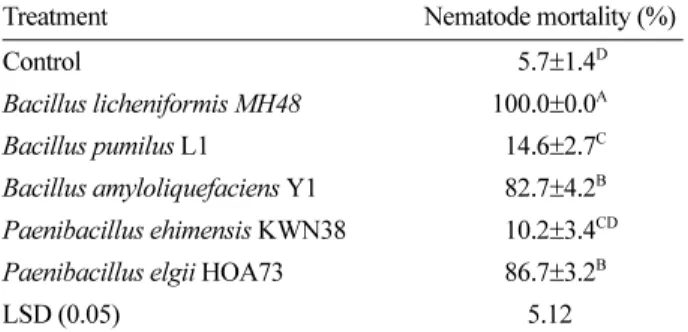
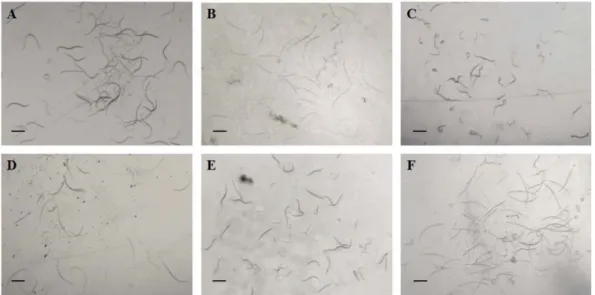
식물 기생성 선충류에 대해 살선충 효과가 검증된 미생 물인 P. elgii HOA73, P. ehimensis KWN38, B. pumilus L1, B. amyloliquefaciens Y1 및 B. licheniformis MH48 중에서 소나무재선충에 대해 살선충 활성을 검정하였다 (Table 1). 본 실험에서는 움직임이 없거나 곧게 뻗어 있는 소나무재선충을 죽은 것으로 판단(Park et al., 2007)하여 조사한 결과, B. licheniformis MH48(100%), P. elgii HOA73(86.6%) 및 B. amyloliquefaciens Y1(82.7%)의 세 균주에서 높은 살선충 활성이 확인되었다(Table 1). 특히, B. licheniformis MH48는 소나무재선충에 대한 살충 효과 가 매우 우수하였다(Table 1, Figure 1).
Table 1. Screening for nematicidal effect of microorganisms against pine wood nematode, B. xylophilus.
Treatment Nematode mortality (%)
Control 005.7±1.4D
Bacillus licheniformis MH48 100.0±0.0A
Bacillus pumilus L1 014.6±2.7C
Bacillus amyloliquefaciens Y1 082.7±4.2B Paenibacillus ehimensis KWN38 010.2±3.4CD Paenibacillus elgii HOA73 086.7±3.2B
LSD (0.05) 5.12
Calculated mean values are from three replicates±SD (standard deviation). Means with the same letter are not significantly different at P ≤ 0.05 when compared by LSD.
2. B. licheniformis MH48의 세포 생육
소나무재선충에 대한 살충 효과가 뛰어난 B. licheniformis MH48의 시간에 따른 미생물 활성 조사를 위해 세포 생육 을 조사한 결과, CG 배지와 CN 배지에서의 생육은 1일째 부터 2일째까지 서서히 증가하였고 3일째에 급격하게 증 가하다가 이후에 급격하게 감소하는 경향을 나타냈다 (Figure 2). 세포 생육이 가장 왕성한 배양 3일째에 CG 배 지와 CN 배지에서는 각각 8.16×10⁷ CFU mL−1과 9.97×10⁷ CFU mL−1로 CN 배지에의 생육이 더 높게 나타났다 (Figure 2). Woo and Kim(2007)도 B. licheniformis K11 의 세포 생장은 시간이 3일째 가장 높은 생육을 나타내고 이후 점차 감소하는 경향을 나타났다고 보고하였다.
또한, 실험에 사용된 CG 배지와 CN 배지의 생육이 유 사하게 나타난 것은 젤라틴 대체 성분으로 선충을 첨가한 CN 배지에서 B. licheniformis MH48 균주가 소나무재선
충을 분해하여 이를 기질로 이용한 것으로 판단된다. Hong et al.(2013)은 Paenibacillus ehimensis RS820가 뿌리혹선 충(Meloidogyne incognita)을 첨가한 배지에서 키틴 분해 효소와 젤라틴 분해 효소 등의 효소 활성이 유사하게 나 타나 선충을 기질로 이용하였음을 보고하였다.
3. B. licheniformis MH48의 단백질 분해 효소 활성 B. licheniformis MH48의 배양 시간에 따른 단백질 분해 효소 활성은 CG 배지와 CN 배지에서 모두 비슷한 경향 을 나타냈다(Figure 3). CG 배지와 CN 배지에서 단백질 분해 효소의 활성은 3일째까지 빠르게 증가하다가 4일과 5일째에는 증가폭이 감소하였다. 이후 CG 배지에서는 6 일째(54.1 unit mL−1) 약간 감소하다가 7일째에 69.3 unit mL−1까지 증가하는 경향을 보였고, CN 배지는 6일째(75.0 unit mL−1)에 급격하게 증가하여 7일째 81.5 unit mL−1로 Figure 1. Screening for nematicidal effect of microorganisms against pine wood nematode, B. xylophilus. Control (distilled water) (A), juvenile treated with B. licheniformis MH48 culture broth (B), B. pumilus L1 (C), B. amyloliquefaciens Y1 (D), P.
ehimensis KWN38 (E) and P. elgii HOA73 (F). Scale bars are 0.4 mm.
Figure 2. Cell growth curve for B. licheniformis MH48 on two medium at 30oC for 7 days in Chitin-gelatin (CG) and Chitin-nematode (CN) mediums. Error bars represent standard error of the mean.
Figure 3. Changes in protease activity of B. licheniformis MH48 culture broth at 30oC for 7 days in Chitin-gelatin (CG) and Chitin-nematode (CN) mediums. Error bars represent standard error of the mean.
계속 증가하였다. 따라서 B. licheniformis MH48 균주는 배양액내 균체수가 증가할 때 단백질 분해 활성도 증가하 지만 시간이 지날수록 균체의 수와 상관없이 효소 활성은 계속하여 증가하는 것으로 판단되었다.
일반적으로 친환경 미생물제제는 선충류의 세포막으로 이루어져 있는 큐티클 단백질(Sela et al., 1998)을 단백질 분해 효소가 가수분해함으로써 살선충 기작을 나타내는 것으로 사료된다. 특히, Bacillus 속이 생산한 단백질 분해 효소에 의해 뿌리혹선충(M. javanica)의 표피를 분해한다 고 보고되고 있으며(Sela et al., 1998, Li et al., 2002), 소나무재선충에 대해서는 Serratia屬과 Pseudomonas屬의 박테리아가 생산하는 세포외 단백질 분해 효소(extracellular protease)에 의해 소나무재선충의 큐티클 단백질이 분해되 어 살선충 효과가 있는 것으로 보고된 바 있다(Gabriel et al., 2013).
또한, B. licheniformis MH48 균주의 배양 배지를 CG 배지 및 CN 배지로 나누어 실험하였을 때 두 배지에서의 세포 생육와 단백질 분해 효소 활성이 거의 유사한 경향 인 것으로 보아 B. licheniformis MH48 균주가 선충을 분 해하여 기질로 이용하였다고 판단된다(Figure 3). 따라서 미생물 배양시 배지에 기질을 대신하여 선충을 첨가함으 로써 미생물의 선충 기질 이용은 살선충 효과 검정 등으 로 사용되고 있다(Hong et al., 2013, Lee et al., 2015).
선충의 표피 일부가 큐티클 단백질로 구성되어 있는 선충 의 경우에는 미생물이 생산하는 2차 대사산물인 단백질 분해 효소가 표피를 분해함으로써 살선충 활성을 나타내 는 것으로 사료됨에 따라 단백질 분해 효소 활성과 선충 치사율이 밀접한 상관관계가 있다고 사료된다.
4. B. licheniformis MH48의 배양액 농도별 살선충 활성 CG 배지 및 CN 배지에서 B. licheniformis MH48의 배 양액 농도별 살선충 활성을 조사한 결과는 다음과 같다 (Figure 4). CG 배지에서 0. 1, 2.5, 5, 10 및 20% 농도의
배양액 처리 48시간 이후 각각 4, 9.2, 9.3, 17.2, 68.3 및 80.7%의 치사율을 나타내었고, CN 배지에서는 2.8, 8.2, 5.8, 11.8, 71.7 및 80.7%의 치사율로 두 배지에서 비슷한 경향을 나타냈다(Figure 4). 또한 Khan et al.(2008)은 Paenibacillus polymyxa GBR-1의 배양액 농도가 높아질수 록 선충의 치사율이 높아지는 경향이 나타나고 있는 것으 로 보고하였다. 특히, B. licheniformis MH48 배양액을 처 Figure 4. Effect of different concentrations from culture broth of B. licheniformis MH48 on mortality of B. xylophilus's juveniles at 24h and 48h after inoculation in Chitin-gelatin (CG) medium (A) and Chitin-nematode (CN) medium (B). Error bars represent standard error of the mean. Calculated mean values are from three replicates. Means with the same letter are not significantly different at P=0.05 when compared by LSD.
Figure 5. Effect of B. licheniformis MH48 culture broth on mortality and degradation of the juvenile of B. xylophilus after 24h and 48h. Control (distilled water) (A), juvenile treated with bacterial culture at 24h (B) and 48h (C). Scale bars are 0.1 mm.
리하고 시간이 지남에 따라 소나무재선충이 분해되는 모 습을 관찰할 수 있었다(Figure 5). 이는 B. licheniformis MH48이 생산하는 단백질 분해 효소에 의해 소나무재선 충이 분해된 것으로 판단된다. Gabriel et al.(2013)도 박테 리아가 분비하는 효소에 의해 소나무재선충의 표피가 분 해되어 살선충 활성이 나타남을 보고하였으며, Hong et al.
(2013)은 P. ehimensis RS820이 분비하는 효소에 의하여 뿌리혹 선충의 알과 선충이 분해되었음을 확인하였다.
따라서 본 연구에서 선발된 B. licheniformis MH48의 배양액 속에 포함되어 있는 단백질 분해 효소 및 다양한 2차 대사산물에 의하여 소나무재선충의 치사율이 배양액 20% 농도에서 80% 이상 나타난 것으로 판단되며, B.
licheniformis MH48을 이용한 소나무재선충의 생물학적 방제는 충분한 가능성과 가치가 있다고 사료된다. 향후 이 러한 B. licheniformis MH48이 소나무 재선충을 억제하는 메커니즘을 규명하고 소나무 재선충에 감염된 소나무를 대상으로 미생물을 수간 주입 및 토양 관주 방법 등을 통 하여 실제적인 방제효과에 대한 연구와 사용시 약해 발생 에 대한 연구가 더 필요한 것으로 사료된다.
결 론
최근 우리나라의 남부지역을 중심으로 소나무재선충병 피해가 확산되고 있는 실정을 감안한다면 소나무재선충 저감을 위한 방제책 수립이 시급하다. 본 연구는 저비용 으로 대량 배양 가능한 친환경 미생물 제제를 이용한 소 나무재선충 밀도 조절을 위해 살선충 활성이 뛰어난 미생 물을 선발하고자 실험을 수행하였다. 또한 미생물이 환경 에 미치는 영향을 고려하여 미생물은 토양내 존재하는 B.
licheniformis MH48을 선발하였다. B. licheniformis MH48 의 살선충 효과가 있는 단백질 분해 효소의 활성은 7일째 가장 높았고, 저농도인 배양액의 20% 농도에서 소나무재 선충 치사율이 80% 이상으로 나타났다. 특히, 소나무재선 충은 48시간 동안 B. licheniformis MH48 배양액의 단백 질 분해 효소에 의해 표피가 분해되면서 죽고 있는 것으 로 관찰되었다. 이러한 결과로 기초로 B. licheniformis MH48의 배양액은 소나무재선충을 생물학적으로 방제할 수 있는 방제제로서 가능성이 높다고 생각된다.
감사의 글
본 연구는 산림청 ‘새만금 간척지 동백나무 자원림 조 성을 위한 친환경 비료 개발(S121414L050100)’ 연구에 의 해 수행되었습니다.
References
Abo-Elyousr, K.A., Khan, Z., El-Morsi Award, M., and Abe- del-Moneim, M.F. 2010. Evaluation of plant extracts and Pseudomonas spp. for control of root-knot nematode, Meloidogyne incognita on tomato. Nematropica 40(2):
289-299.
Choi, I.H., Park, J.D., Shin S.C., and Park, I.K. 2006. Nem- aticidal activity of medicinal plant extracts and two cinnama- tes isolated from Kaempferia galangal L. (proh Hom) against the pine wood nematode, Bursaphelenchus xylophilus.
Nematology 8: 359-365.
Dong, J., Zhou, Y., Li, Ru., Zhou, Wei., Li, L., Zhu, Yangui, Huang, Rong, and Zhang, Keqin. 2006. New nematicidal aza- philones from the aquatic fungus Pseudohalonectria adver- saria YMF1.01019. FEMS Microbiology Letters 264: 65- 69.
Dwinell, L.D. and Nickle, W.R. 1989. An overview of the pinewood nematode ban in North America. General tech- nical report SE-55, North America Forestry Commission Publication No. 2, Southeastern Forest Experimental Sta- tion, Forest service, United states Department of Agricul- ture. pp. 13.
Edward, O.R. and Linit, M.J. 1992. Transmission of Bursaph- elenchus xylophilus through oviposition wounds of Mono- chamm carolinensis (Coleoptera: Cerambycidae). Journal of Nematology 24: 133-139.
Elbadri, G.A.A., Lee, D.W., Park, J.C., Yu, H.B., Choo, H.Y., Lee, S.M., and Lim, T.H. 2008. Nematicidal screening of essentials oils and herbal extracts against Bursaphelen- chus xylophilus. Plant Pathology Journal 24: 178-182.
Gabriel P., Diogo N.P., Romeu F., Paula V., Susana S.S., Luis F., Isabel M.O.A., and Paula V.M. 2013. Nematicidal Bacte- ria Associated to Pindwood namatode produce extracellu- lar proteases. PLoS Onel 8(11): e79705.
Hong, S.H., Anees, M., and Kim, K.Y. 2013. Biocontrol of Meloidogyne incognita inciting disease in tomato by using a mixed compost inoculated with Paenibacillus ehimensis RS820. Biocontrol Science and Technology 23: 1024- 1039.
Kamata, N. 2008. Intergrated pest management of pine wilt disease in Japan: tactics and strategies. In: Zhao, B.G., K.
Futai, J.R. Sutherland and Y. takeuchi(eds.). Pine wilt dis- ease, Springer, Tokyo. pp. 304-322.
Kembhavi, A.A., Kulkarni, A., and Pant, A. 1993. Salt-toler- ant and thermostable alkalien protease from Bacillus sub- tilis NCIM No. 64. Applied Biochemistry and Biotechnology 38: 83-92.
Khan, Z., Kim, S.G., Jeon, Y.H., Khan, H.U., Son, S.H., and Kim, Y.H. 2008. A plant growth promoting rhizobacte- rium, Paenibacillus polymyxa strain GBR-1, suppresses root-knot nematode. Bioresource Technology 99: 3016-3023.
Kishi, Y. 1955. The pine wood nematode and the Japanese pine sawyer. Thomas Company, Tokyo, Japan. pp. 302.
Kong, J.O., Lee, S.M., Moon, Y.S., Lee, S.G. and Ahn, Y.J.
2007. Nematicidal activity of cassia and cinnamon oil compounds and related compounds toward Bursaphelen- chus Lignicolus (Nematoda: Aphelenchoididae). Journal of Nematology 39: 31-36.
Korea Forest Service. 2014. Statistical yearbook of forestry.
No.44 http://www.forest.go.kr (2015.01.11).
Kuroda, K. 1989. Terpenoids causing tracheid-cavitation in Pinus thunbergii infected by the pine wood nematode (Bursaphelenchus xylophilus). Annals of the Phytopatho- logical Society of Japan 55: 170-178.
Lee, S.M., Chung, Y.J., Moon, Y.S., Lee, D.W., Choo, H.Y., and Lee, C.K. 2003. Insecticidal activity and fumigation conditions of several insecticides against Japanese pine sawyer (Monochamus alternatus) larvae. Journal of Korean Forestry Society 92: 191-198. (in Korean abstract)
Lee, S.M., Kim, D.S., Kim, C.S., Choo, H.Y., and Lee, D.W.
2008. Possibility of simultaneous control of pine wilt dis- ease and Thecodiplosis japonensis and or Matsucoccus thunbergianae on black pine (Pinus thunbergii) by abam- ectin and emamectin benzoate. Korean Journal of Pesti- cide Science 12: 363-367. (in Korean abstract)
Lee, Y.S., Nguyen, X.H., Naing, K.W., Park, Y.S., and Kim.
K.Y. 2015. Role of lytic enzymes secreted by Lysobacter capsici YS12115 in the control of root-knot nematode of tomato plants. Indian Journal of Microbiology 55(1): 74- 80.
Lee, Y.S. and Kim, K.Y. 2015. Antagonistic potential of Bacillus pumilus L1 against root-knot nematode, Meloidogyne arenaria. Journal of phytopathology doi: 10.111/jph.12421.
Li, W., Roberts, D.P., Derby, P.D., Meyer, S.L.F., Lohrke, S., Lumsden, R.D., and Hebbar, K.P. 2002. Broad spectrum anti-biotic activity and disease suppression by the poten- tial biocontrol agent Burkholderia ambifaria BC-F. Crop Protection 21: 129-135.
Mamiya, Y. and Enda, N. 1972. Transmission of Bursaphelen- chus Lignicolus (Nematoda: Aphelenchoididae) By Mono- chamus Alternatus (Coleoptera: Cerambycidae). Nematologica 18: 159-162.
Morimoto, K. and Iwasaki, A. 1972. Role of Monachamus alternatus (Coleoptera: Cerambycidae) as a vector of Bur- saphelenchus Lignicolus (Nematoda: Aphelenchoididae).
Journal of Japanese Forestry 54: 177-183.
Nguyen, X.H., Naing, K.W., Lee, Y.S., Jung, W.J., Anees, M., and Kim, K.Y. 2013. Antagonistic potential of Paeni- bacillus elgii HOA73 agasint the root-knot nematode, Meloidogyne incognita. Nematology 15(8): 991-1000.
Oku, H., Shiraishi, T., Ouchi, S., Kurozumi, S., and Ohta, H.
1980. Pine wilt toxin, the metabolite of a bacterium asso- ciated with a nematode. Naturwissenschaften 67: 198-199.
Park, I.K., Kim, J.H., Lee, S.G., and Shin, S.C. 2007. Nem- aticidal activity of plant essential oils and components from Ajowan (Trachyspermum ammi), Allspice (Pimenta dioica) and Litsea (Litsea cubeba) essential oils against pine wood nematode (Bursaphelenchus Xylophilus). Jour- nal of Nematology 39(3): 275-279.
Sasaki, S., Odani, K., Nishiyama, Y., and Hayashi, Y. 1984.
Development and recovery of pine wilt disease studied by tracing ascending sap flow marked with water soluble strains. Journal of Japanese Forestry Society 66: 141-148.
Sela, S., Schickler, H., Chet, I., and Spigel, Y. 1998. Purifica- tion and characterization of Bacillus cereus collagenolytic/
proteolytic enzyme and its effect on Meloidogyne janan- ica cuticular proteins. European Journal of Plant Pathol- ogy 104: 59-67.
Siddiqui, Z.A. and Mahmood, I. 1999. Role of bacteria in the management of plant parasitic nematodes: a review.
Bioresource Technology 69: 167-179.
Takeuchi, Y. 2008. Host fate following infection by the pine wood nematode. In: Zhao, B.G., K. Futai, J.R. Suther- land and Y. takeuchi(eds.). Pine wilt disease, Springer, Japan. pp. 235-249.
Woo, S.M. and Kim, S.D. 2007. Confirmation of Non-Sidero- phore Antifungal Substance and Cellulase from Bacillus licheniformis K11 Containing Antagonistic Ability and Plant Growth Promoting Activity. Journal of Life Sci- ence 17(7): 983-989. (in Korean abstract)
Yang, J., Li, J., Liang, L., Tian, B., Zhang, Y., Cheng, C., and Zhang, K. 2007. Cloning and characterization of an extracellular serine protease from the nematode-trapping fungus Arthrobotrys conoides. Archives of Microbiology 188: 168-174.
Yi, C.K., Byun, B.H., Park, J.D., Yang, S.I., and Chang, K.H.
1989. First finding of the pinewood nematode, Bursaph- elenchus xylophilus (Steiner et Buhrer) Nickle and its insect vector in Korea. Research Reports of the Forestry Research Institute. 38: 141-149. (in Korean abstract) Yik, C.P. and Birchfield. W. 1981. Observations on the morphol-
ogy of the pine wood nematode, Bursaphelenchus xylo- philus. Journal of Nematology 13(3): 376-384.
(Received: March 9, 2015; Accepted: June 17, 2015)