Clindamycin resistant Bacillus licheniformis 14ADL4 was isolated from doenjang, a Korean high-salt-fermented soybean food. Strain 14ADL4 contains a single circular 4,332,232 bp chromosome with a G + C content of 45.86%. The complete genome of strain 14ADL4 includes lmrA and lmrB homologs may confer resistance to clindamycin.
Keywords: Bacillus licheniformis, clindamycin resistance, doenjang, starter
Bacillus licheniformis is one of the predominant bacterial species identified in fermented soybean foods of Korea (Kim et al., 2009; Lee et al., 2010). We considered the species as a potential starter candidate of doenjang, a Korean high-salt-fermented soybean food ripened at NaCl concentrations of > 12% (w/w), because of its salt tolerance on tryptic soy agar (TSA; Sigma- Aldrich) supplemented with 14% (w/v) NaCl and activities of amylase, protease, and lipase which can contribute to degrade macromolecules in soybeans (Jeong et al., 2014, 2017). In the process of selecting B. licheniformis starter candidates with biosafety from our stock cultures, we identified strain 14ADL4 resistant to clindamycin (Jeong et al., 2017). The minimum inhibitory concentration of clindamycin for strain 14ADL4
determined by the broth micro-dilution method according to the guidelines of the Clinical and Laboratory Standards Institute (2007) was 64 mg/L and the strain exhibited growth on TSA containing 30 mg/L clindamycin. The present study performed a complete genome analysis of strain 14ADL4 to shed light on the genetic background behind the phenotypic resistance to clindamycin.
Whole-genome sequencing was performed using the PacBio Single-Molecule Real-Time (SMRT) sequencing system by ChunLab, Inc. One contig was generated from a hybrid assembly of reads from the PacBio system (105,988 reads and 345.13 coverage) for B. licheniformis 14ADL4. The reads were assembled using CLC Genomics Workbench ver. 7.5.1 (CLC Bio) and CodonCode Aligner (CodonCode Co.). Gene prediction was performed using Glimmer 3 (Delcher et al., 2007), followed by annotation through a search against the Clusters of Orthologous Groups (COG) database (Tatusov et al., 1997).
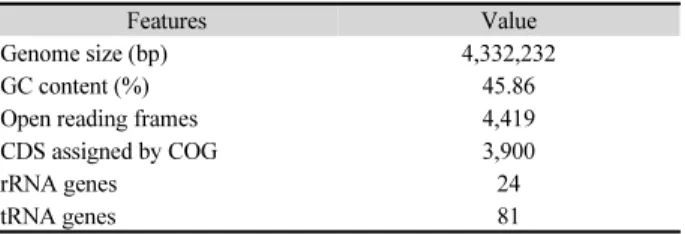
The complete genome of strain 14ADL4 consists of a single circular 4,332,232 bp chromosome with a G + C content of 45.86% (Table 1). The genome is predicted to contain 4,419 protein coding sequences, 81 tRNA genes, and 24 rRNA genes.
A total of 3,900 genes were functionally assigned to categories based on COG assignments. Gene category analysis shows that the majority of the genes are related to carbohydrate transport
Korean Journal of Microbiology (2018) Vol. 54, No. 2, pp. 169-170 pISSN 0440-2413
DOI https://doi.org/10.7845/kjm.2018.8027 eISSN 2383-9902
Copyright ⓒ 2018, The Microbiological Society of Korea
Complete genome sequence of Bacillus licheniformis 14ADL4 exhibiting resistance to clindamycin
Do-Won Jeong
1, Byunghoon Lee
2, and Jong-Hoon Lee
2*
1
Department of Food and Nutrition, Dongduk Women’s University, Seoul 02748, Republic of Korea
2
Department of Food Science and Biotechnology, Kyonggi University, Suwon 16227, Republic of Korea
Clindamycin 내성 Bacillus licheniformis 14ADL4의 유전체 염기서열
정도원
1・ 이병훈
2・ 이종훈
2*
1
동덕여자대학교 식품영양학과,
2경기대학교 식품생물공학과
(Received May 23, 2018; Revised May 28, 2018; Accepted May 28, 2018)
*For correspondence.
E-mail: [email protected];Tel.: +82-31-249-9656; Fax: +82-31-253-1165
170
∙ Jeong et al.미생물학회지 제54권 제2호
and metabolism (329 genes [8.4%]), followed by transcription (319 genes [8.2%]) and amino acid transport and metabolism (312 genes [8.0%]).
Strain 14ADL4 has two potential lincomycin resistance genes, lmrA (designated BL14DL4_03907, putative HTH-type transcriptional regulator gene) and lmrB (BL14DL4_03548, lincomycin resistance protein gene). The lmrAB genes, which encode a transcriptional repressor and a multidrug efflux protein, have been reported to be involved in the resistance of Bacillus subtilis to puromycin and lincomycin (Murata et al., 2003).
Erythromycin ribosome methylase gene (erm) has been reported to confer resistance to clindamycin as well as erythromycin (Leclercq, 2002), while any homolog of erm was not found in the genome of strain 14ADL4. In this context, the lmrAB operon found in strain 14ADL4 may confer resistance to lincosamide antibiotics including clindamycin. Comparative genomic analysis of B. licheniformis 14ADL4 with clindamycin sensitive B.
licheniformis strains will provide further genetic insight into the strain-specific clindamycin resistance of Bacillus species.
Illumination of the clindamycin resistance ortholog for B.
licheniformis will contribute to introduce a safety-approved Bacillus starter culture in food fermentations.
Nucleotide sequence accession number
B. licheniformis 14ADL4 has been deposited in the Korean Collection for Type Cultures under accession number KCTC 33983 and its complete genome sequence has been deposited in DDBJ/ENA/GenBank under accession number CP026673.
적 요
Clindamycin 내성 Bacillus licheniformis 14ADL4 균주는 된장으로부터 분리되었다. 14ADL4 균주의 유전체분석 결과, GC 함량 45.86%, 약 4.3 Mb 크기의 염색체가 확인되었고, 유 전체 상의 lmrA와 lmrB 추정 유전자가 clindamycin 내성에 관
여할 것으로 예상된다.
Acknowledgements
This research was supported by the Basic Science Research Program through the National Research Foundation of Korea (NRF) funded by the Ministry of Education (NRF-2016R1D1 A1B01011421 and NRF2016R1D1A1B03930239). This work was also supported by the Korea Institute of Planning and Evaluation for Technology in Food, Agriculture, Forestry and Fisheries (IPET) through the Technology Commercialization Support Program funded by the Ministry of Agriculture, Food and Rural Affairs (MAFRA, 815003-3). Byunghoon Lee was supported by Kyonggi University’s Graduate Research Assistantship 2018.
References
Clinical and Laboratory Standards Institute. 2007. Performance standards for antimicrobial susceptibility testing. Seventeenth informational supplement. CLSI, Wayne, PA, USA.
Delcher, A.L., Bratke, K.A., Powers, E.C., and Salzberg, S.L. 2007.
Identifying bacterial genes and endosymbiont DNA with glimmer.
Bioinformatics 23, 673–679.
Jeong, D.W., Jeong, M., and Lee, J.H. 2017. Antibiotic susceptibilities and characteristics of Bacillus licheniformis isolates from traditional Korean fermented soybean foods. LWT-Food Sci.
Technol. 75, 565–568.
Jeong, D.W., Kim, H.R., Jung, G., Han, S., Kim, C.T., and Lee, J.H.
2014. Bacterial community migration in the ripening of doenjang, a traditional Korean fermented soybean food. J. Microbiol.
Biotechnol. 24, 648–660.
Kim, T.W., Lee, J.H., Kim, S.E., Park, M.H., Chang, H.C., and Kim, H.Y. 2009. Analysis of microbial communities in doenjang, a Korean fermented soybean paste, using nested PCR-denaturing gradient gel electrophoresis. Int. J. Food Microbiol. 131, 265–271.
Leclercq, R. 2002. Mechanisms of resistance to macrolides and lincosamides: nature of the resistance elements and their clinical implications. Clin. Infect. Dis. 34, 482–492.
Lee, J.H., Kim, T.W., Lee, H., Chang, H.C., and Kim, H.Y. 2010.
Determination of microbial diversity in meju, fermented cooked soya beans, using nested PCR-denaturing gradient gel electro- phoresis. Lett. Appl. Microbiol. 51, 388–394.
Murata, M., Ohno, S., Kumano, M., Yamane, K., and Ohki, R. 2003.
Multidrug resistant phenotype of Bacillus subtilis spontaneous mutants isolated in the presence of puromycin and lincomycin.
Can. J. Microbiol. 49, 71–77.
Tatusov, R.L., Koonin, E.V., and Lipman, D.J. 1997. A genomic perspective on protein families. Science 278, 631–637.
Table 1. Genome features of Bacillus licheniformis 14ADL4
Features Value
Genome size (bp) 4,332,232
GC content (%) 45.86
Open reading frames 4,419
CDS assigned by COG 3,900
rRNA genes 24
tRNA genes 81