https://doi.org/10.14734/PN.2018.29.1.1 pISSN 2508-4887•eISSN 2508-4895
Keun Hyeok Ko, MD, Ji Young Chun, MD, Tae-Jung Sung, MD, PhD Department of Pediatrics, Hallym University Medical Center, Seoul, Korea
Objective: Ureaplasma spp. in the maternal genitourinary tract is increasingly known to cause preterm labor, spontaneous abortion, chorioamnionitis and adverse neonatal outcomes. However, con trover
sies still remain regarding whether or not to treat it aggressively. The aim of this study was to evaluate the effects of antenatal azithromycin (AZ) for Ureaplasma urealyticum (UU) infection on neonatal com
plications in preterm infants.
Methods: Retrospective singlecenter casecontrol study of preterm babies delivered at <32 weeks’
of gestation age (GA) between 2010 and 2014 were conducted. Cases were defined as infants with complete maternal AZ treatment when UU was confirmed and controls were without UU. Cases were matched with controls by birth year, GA, and birth weight. Subgroup analysis according to GA (23+0 28+6 weeks’ and 29+032+6 weeks’) were done as well.
Results: Of 169 cases identified 51 with untreated or incompletely treated mother, 26 died or trans
ferred, and four with incomplete chart were excluded; thus 88 preterm infants were matched to 88 controls. Incidence of bronchopulmonary dysplasia (BPD) and early sepsis were same in both group;
however, in very preterm infants between 23+0 to 28+6 weeks’ GA, incidence of moderatetosevere BPD was significantly higher in cases (42% vs. 16%, P=0.022) and incidence of sepsis was significantly lower (8% vs. 26%, P=0.033).
Conclusion: Maternal UU was associated with moderatetosevere BPD even though AZ treatment was done. Early sepsis was significantly less developed with prenatal antibiotics at ≤28 weeks’ GA.
Hence selective antenatal azithromycin therapy of UU is still needed for improving neonatal out
comes.
Key Words: Cervical Cerclage, Cervical length measurement, Uterine cervical incompetence, Prema
ture birth
Introduction
Ureaplasma urealyticum (UU) is one of the frequently isolated microorganisms from the amniotic fluid and infected placentas.1,2 Although UU is isolated from the vagina in 40% to 80% of sexually active asymptomatic women as a commensal organism, it can cause pre
term delivery, spontaneous abortion or miscarriages, chorioamnionitis, neonatal morbidity, and/or perinatal death.3,4 UU can be transmitted vertically from the mother to the fetus in utero, or to the newborn infant at delivery.5,6
Intrauterine UU infection is found to alter lung development, prolong inflammatory res
ponse and increase fibrotic reaction in animals.7 In one study, the risk of moderateto
severe bronchopulmonary dysplasia (BPD) development showed a 7.9fold increase in mecha nically ventilated infants being ventilated for any reason with positive UU tracheal aspirate,8 and a twofold increased risk for necrotizing enterocolitis (NEC) in preterm Received: 15 September 2017
Revised: 10 October 2017 Accepted: 21 October 2017 Correspondence to TaeJung Sung, MD, PhD Department of Pediatrics, Hallym University Medical Center, 1 Singilro, Yeongdeunpogu, Seoul 07441, Korea
Tel: +8228295142 Fax: +8228494469 E-mail: [email protected] Copyright© 2018 by The Korean Society of Perinatology
This is an Open Access article distributed under the terms of the Creative Com
mons Attribution NonCommercial License (http://creativecommons.org/
license/bync/4.0/), which permits unrestricted noncommercial use, distribution, and reproduction in any
Effects of Antenatal Azithromycin for
Ureaplasma spp. on Neonatal Outcomes
increased to 2.5fold higher in infants with positive serum UU colonization.10
Since genital mycoplasmas including UU are unable to pro
duce cell walls, betalactams, vancomycin, sulfonamides, or trimethoprim is ineffective.2 UU is generally susceptible to certain antibiotics that interfere with protein synthesis.2,11 There are some studies that have evaluated the use of eryth
ro mycin in preterm infants with UU colonization and erythro
mycin was once known as a standard antibiotic for preterm premature rupture of membrane (PPROM) treatment.1214 Azithromycin (AZ) is an expandedspectrum macrolide anti
biotic that is sup posed to have better tissue penetration than erythromycin; hence, it can be an alternative antibiotic.11,15 Recent studies in rhesus monkeys suggested that antenatal multipledose AZ therapy could mitigate pregnancyasso
ciated complications.16 However, not many studies about the effectiveness of antenatal AZ treatment have been done, and whether or not AZ is effec tive is still being debated. Thus, the aim of this study was to demonstrate the clinical effects of antenatal AZ treatment of UUcolonized mothers on neonatal morbidity.
Methods
1. Study subjects
All preterm infants who were admitted to Hallym University Medical Center between January 2010 and December 2014 were eligible for this study. Those without maternal UU results, those who were transferred to or from other institutes for any reason, those without complete medical charts, or those who died before 28 days of life were excluded. The final included infants were those born at ≤32 weeks’ of gestational age (GA), since most of the nearterm infants who were considered for inclusion did not need intensive care. Then infants with com
plete antenatal AZ treatment of UUcolonized mothers (cases) were matched with controls by birth year, GA, and birth weight (±100 g). This retrospective singlecenter casecontrol study was approved by the institutional review boards of our facility.
2. Urealyticum confirmation and azithromycin treatment UU samples from the maternal lower genitalia area were ob
tained from those who were admitted for any reason, via by vaginal swabs during a physical examination. MYCOFAST® Evolution 2 (International Microbio, Signes, France) was used for culture analysis, and polymerase chain reaction (PCR) was done as well. If the interval between admission and delivery was more than one week, the microbiological examinations were re peated. To obtain a sufficient amount of sample, all of the procedures were performed twice. UUpositive was de
fined as with at least one result was being positive, and then AZ was administrated for treatment. Complete antenatal azithro
mycin therapy was defined when oral AZ of 500 mg/day was admini strated for three consecutive days before delivery.
3. Definitions of parameters
The maternal and clinical variables compared between the cases and controls were GA, birth weight, preterm labor, PPROM, antenatal steroid administration, chorioamnionitis, sur
factant use, BPD, patent ductus arteriosus (PDA), retinopathy of prematurity (ROP), early sepsis, NEC, and cranial sonography abnormality.
PPROM was defined as the rupture of membranes ≥24 hours before delivery. Clinical chorioamnionitis was identified in the mother with fever (≥37.8°C) and two or more of the following:
leukocytosis (≥15,000 μL), elevated Creactive protein (≥3 mg/L), foul odor, maternal tachycardia (>100 beats/minute), and/
or fetal tachycardia (>160 beats/minute). Histological chorio amnionitis (HC) was defined as a placenta with polymorpho
nuclear leucocyte infiltration, as confirmed by a pathologist.
Surfactant was used prophylactically when the infants were at less than 30 weeks’ gestation or curatively when respira tory distress syndrome was diagnosed. Early sepsis was diag nosed on the basis of a positive blood culture, along with any one of the known clinical signs demonstrated less than three days after birth. PDA with treatment was defined as PDA with me
dical treatment and/or surgical operation following confirma
tion by echocardiography. NEC was diagnosed using mo dified Bell’s criteria and ≥stage IIA was analyzed. BPD was diagnosed as oxygen dependency at 36 weeks of postmenstrual age ac
cording to the National Institutes of Health consensus definition and severity was classified as mild, moderate, or severe.17 Ab
normal sonography was defined as intraventricular hemorrhage (≥grade 3)±periventricular leukomalacia.
surfactant use (56% vs. 60%, P=0.541) and BPD (35% vs. 43%, P=0.280). Other parameters including PDA with treatment, ROP with laser, NEC, early sepsis, abnormal cranial sonography showed no significant differences as well. Significant difference was found regarding higher incidence of moderatetosevere BPD in cases (18% vs. 7%, P=0.038) (Table 2).
Since gestational and/or birth weight is one of the major fac
tors for neonatal morbidities, we divided the study populations into subgroups regarding GA; specifically, infants with 29+0 32+6 weeks’ GA (cases n=50 vs. controls n=50, respectively) and infants with 23+028+6 weeks’ GA (cases n=38 vs. controls n=38, respectively). In a subgroup analysis, no significant dif
ferences were shown with respect to surfactant use, BPD, PDA with treatment, ROP with laser, NEC, and cranial sono
graphy abnormality between cases and controls. None of the infants with ≥29 weeks’ GA had moderatetosevere BPD and ROP with laser.
In infants of 23+028+6 weeks’ GA, the incidence of mode
ratetosevere BPD was higher in cases (42%) than in controls (16%) (P=0.022) and the incidence of early sepsis was signi
ficantly lower in cases (8%) than in controls (26%) (P=0.033).
4. Data analysis
Statistical analysis was performed using Student’s ttest for normally distributed data and the chisquared test or Fisher’s exact test for comparisons between frequencies. All statistical analysis was performed with SPSS (version 22, IBM, Armonk, NY, USA). Data were reported in the format of mean±standard deviation or number (%). Statistical significance was accepted at P<0.05.
Results
1. Overall characteristics of study population
During the study period, 169 preterm infants of ≤32 weeks’ GA were diagnosed as having maternal UU colonization. Of then, 51 cases were excluded due to incomplete or untreated mother at first. Of the remaining 118 cases 26 died or trans
ferred during their neonatal hospitalization and another four had to be excluded due to incomplete chart. From the cohort of 26 mo thers, four were transferred to a different department (two for PDA surgery and two for treatment of hydrocephalus).
From the final cohort of 22 mothers, 10 were in control group and 12 were in UU+ group. Causes of deaths were respiratory disease (nine patients, 41%), GIrelated disease (one patients, 5%), sepsis (four patients, 18%), multiple organ failure (six pa
tients, 27%), and cerebral hemorrhage (two patients, 9%). No deaths from UU infection have been confirmed. Thus the study popu lation comprised 88 cases and 88 matched controls.
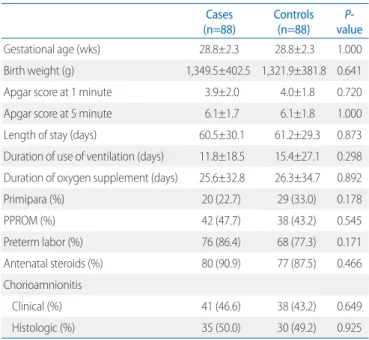
The demographics and clinical characteristics of cases and controls are depictured in Table 1. There were no significant differences regarding primipara, PPROM, preterm labor, ante
natal steroids, and chorioamnionitis between cases and con
trols of maternal variables. HC which was confirmed by patho
logist after delivery showed no difference between two groups.
For neonatal characteristics between cases and control, we found no significant differences between Apgar scores at 1 min ute and 5 minutes, length of stay, duration of use of ventila
tion, and duration of oxygen supplement (Table 1).
2. Neonatal morbidities according to the gestational age at birth
There were no significant differences in the incidence of
Table 1. The Demographics and Clinical Characteristics of Study Pop- ulation
Cases
(n=88) Controls
(n=88) P-
value
Gestational age (wks) 28.8±2.3 28.8±2.3 1.000
Birth weight (g) 1,349.5±402.5 1,321.9±381.8 0.641
Apgar score at 1 minute 3.9±2.0 4.0±1.8 0.720
Apgar score at 5 minute 6.1±1.7 6.1±1.8 1.000
Length of stay (days) 60.5±30.1 61.2±29.3 0.873
Duration of use of ventilation (days) 11.8±18.5 15.4±27.1 0.298 Duration of oxygen supplement (days) 25.6±32.8 26.3±34.7 0.892
Primipara (%) 20 (22.7) 29 (33.0) 0.178
PPROM (%) 42 (47.7) 38 (43.2) 0.545
Preterm labor (%) 76 (86.4) 68 (77.3) 0.171
Antenatal steroids (%) 80 (90.9) 77 (87.5) 0.466
Chorioamnionitis
Clinical (%) 41 (46.6) 38 (43.2) 0.649
Histologic (%) 35 (50.0) 30 (49.2) 0.925
Values presented as mean±standard deviation or n (%).
Abbreviation: PROM, preterm premature rupture of membrane.
Discussion
The subjects were initially divided into three groups: UUTx (UU+ mothers who received antenatal azithromycin therapy, n=88), UUNOTx (UU+ mothers who did not receive antenatal azithromycin therapy, n=51), and control group. However, since this study was a retrospective study and we wanted to evaluate the effect of AZ, we excluded those who did not receive or received incomplete antenatal azithromycin therapy (UUNOTx group) in the end. In this retrospective singlecenter case
control study, we demonstrated that maternal UU colonization
was significantly associated with moderatetosevere BPD despite antenatal AZ treatment.
Many studies demonstrated that the isolation of UU from the placenta or the lower genital tract during pregnancy plays a causal role in the process of intrauterine inflammation and infectiondriven preterm labor.10,18,19 Hence, as Acosta et al.16 said, preterm delivery caused by intrauterine infection can be potentially “preventable” and that maternal antibiotics could be administrated to prevent and treat intrauterine infection.
Their study on nonhuman primates showed that repeated IV doses of maternal AZ could be accumulated sufficient enough to clear Ureaplasma parvum (U. parvum) from the amniotic fluid. Another study in an ovine model by Miura et al.19 also showed that maternal antenatal azithromycin therapy of either IV only or IV+ intraamniotic AZ effectively eradicated marco
lidesen sitive U. parvum form the amniotic fluid. However, in our study, there was no significant differences in the incidence of preterm labor between two groups (86% vs. 77%, P=0.171).
This find ing might explain the ineffectiveness of antenatal treat ment of AZ and further investigations are needed.
Meanwhile, the frequency of perinatal transmission such as vertical transmission or intrauterine infection from UUcolo
nized mothers was reported to be 58% for preterm infants9 and 22% to 55% for fullterm infants.20 UU isolation in the pre term respiratory tract was associated with neonatal pneumo nia, severe respiratory failure, and BPD.16 Since three indepen dent groups first reported the association between lower respiratory tract UU colonization in very preterm infants and the develop
ment of chronic lung disease in 1988, numerous studies about UU colonization and BPD have been documented with different results.4,21,22 One study by Sung et al.8 demonstrated that the risk of the development of moderatetosevere BPD showed a 7.9fold increased risk in mechanically ventilated infants with a positive tracheal aspiration, as compared with mecha nically ventilated infants with a positive nasopharyngeal sam ple alone.
The associations between respiratory tract UU colonization and BPD have been confirmed by many studies, even though gestational age appeared to be a major confounder.2325
Recently, studies about the effects of macrolide antibiotics including erythromycin and/or AZ given either prophylactically or therapeutically to reduce BPD or other neonatal morbidities are reported with different results.7,12,26 A systematic review Table 2. Comparison of Neonatal Morbidities between Infants with
Antenatal Azithromycin Treated Group and Antenatal UU-Negative Groups
Cases
(n=88) Controls (n=88) P-
value
Surfactant use 49 (55.7) 53 (60.2) 0.541
29+032+6 week 14 (28.0) 16 (32.0) 0.828
23+028+6 week 35 (92.1) 37 (97.4) 0.304
BPD 31 (35.2) 38 (43.2) 0.280
29+032+6 week 2 (4.0) 7 (14.0) 0.160
23+028+6 week 29 (76.3) 31 (81.6) 0.779
Moderatetosevere BPD 16 (18.2) 6 (6.8) 0.038
29+032+6 week 0 0
23+028+6 week 16 (42.1) 6 (15.8) 0.022
PDA with medication±operation 11 (12.5) 17 (19.3) 0.303
29+032+6 week 1 (2.0) 2 (4.0) 1.000
23+028+6 week 10 (26.3) 15 (39.5) 0.329
ROP with laser treatment 12 (13.6) 14 (16.3) 0.675
29+032+6 week 0 0
23+028+6 week 12 (31.6) 14 (36.8) 0.809
NEC (≥stage IIA) 4 (4.5) 1 (1.1) 0.368
29+032+6 week 1 (2.0) 0 1.000
23+028+6 week 3 (7.9) 1 (2.6) 0.615
Early sepsis 8 (9.1) 13 (14.8) 0.353
29+032+6 week 5 (10.0) 3 (6.0) 0.715
23+028+6 week 3 (7.9) 10 (26.3) 0.033
IVH (≥grade 3)±PVL 6 (6.8) 10 (11.4) 0.432
29+032+6 week 1 (2.0) 3 (6.0) 0.617
23+028+6 week 5 (13.2) 7 (18.4) 0.754
Values are presented as number (%).
Abbreviations: UU, Ureaplasma urealyticum; BPD, bronchopulmonary dysplasia;
PDA, patent ductus arteriosus; ROP, retinopathy of prematurity; NEC, necrotizing enterocolitis; IVH, intraventricular hemorrhage; PVL, periventricular leukomalacia.
with metaanalysis showed promising results of prophylactic AZ therapy in terms of a significant reduction in BPD,7 while a very recent casecontrol study demonstrated no significant therapeutic effect of erythromycin on pulmonary short and longterm morbidity.27 Nevertheless, studies about antenatal macrolide treatment on neonatal morbidities are sparse. In our study about antenatal AZ treatment, it showed that overall BPD incidence seemed to be similar between cases and controls;
however, there was no effect on reducing the development of moderatetosevere BPD in certain gestational age ranges.
Hence, the administration of single antibiotics to eradicate intrauterine infection may not be sufficient as other studies have reported, and additional antiinflammatory therapy or selec tive treatments might be needed.19,28,29 Risk factors of BPD include not only sepsis, but also RDS, pulmonary interstitial emphysema, short gestational period, patent ductus arteriosus, increased pulmonary arterial pressure, and high peak inspiratory press
ure. Several studies reported that UU infection causes bron
chopulmonary dysplasia in premature babies. One of the hypo
theses state that phospholipase A2 produced by UU suppresses the production of pulmonary surfactant.30,31 More detailed mechanism discovered hitherto explains that the generation of bronchopulmonary dysplasia is due to an increased secretion of proinflammatory cytokines (such as IL6 and TNFα) by phagocytes when UU colony formation occurs.32 In this study, within mild BPD patients, the prevalence of bronchopulmonary dysplasia between the UU infection group (treated) and the control group was not significantly different. On the other hand, moderate and severe BPD group showed higher prevalence of bronchopulmonary dysplasia in mothers with less gestational age from the UU infection group. We have previously mention
ed as the limitation of our study that Az treatment may be an insufficient stand alone treatment as mentioned in other stud
ies. This allows us to speculate that additional antiinflamma
tory or selective treatments are needed. Furthermore, in the group of premature babies with very short gestational age, normal lung development is even more difficult. The babies are put into the environment with continuous damage against al
veolarization from lengthened ventilation and oxygen therap
ies. In addition, the babies are affected by UU infection from the mothers. To gether, the prevalence is significantly higher in severe BPD group compared to the control group.
In our findings, one unique result was that the incidence of early sepsis was significantly low with antenatal AZ treatment in infants of sepsis was’ GA (8% vs. 26%, P=0.033) although the total incidence of early sepsis in preterm babies ≤32 weeks’ GA between cases and controls were similar (9% vs. 15%, P=
0.353). In general, infected amniotic fluid and placenta from UU infected mother can infect the newborn.5,33 This ver tical infec
tion can cause sepsis in the newborn, and infected amniotic fluid also allows potential congenital pneumonia, sep sis from syste
mic infection, and CNS infection.34 If the newborn is likely to be premature due to UU infection, he or she is more prone to sep sis caused by other bacteria. This is because premature babies have suppressed immune system and mucosal barrier function, and therefore are more prone to infection. Sepsis has multiple risk factors including low birth weight, maternal infection, cho
rio amnionitis, premature rupture of membranes, and fetal hypo
xia.22 However, the fact that premature babies less than 28
weekold from mothers who received Az treat ment had signi
ficantly lower prevalence of early sepsis com pared to the other groups indicate potential effects of antenatal UU treat ment.
Waites et al.35 descried that even though infection in the blood
stream of neonates had not been documented, there were the potential ability of UU to produce invasive disease. Since studies about the effects of antenatal AZ on early sepsis are rare, our results could suggest a promising way to reduce early sepsis in preterm infants.
There are number of limitation in our study. First, variable antenatal antibiotics other than AZ were used, and we could not control for them since this was a retrospective study. However, this study was a single center study; hence, similar antibiotics were used for study populations apart from AZ. Second, a followup UU culture and/or PCR were not implemented to con firm UUnegative conversion. Hence, a large scaled ran
domized control study is urgently needed to prove these study results. Thirdly, although lateonset sepsis is known as one of the risk factors of BPD, it was not considered in our study.
Currently, our center is performing the examinations of prema
ture babies (under 35 weeks) with consent from their parents.
Sample collection is done through nasopharynx if the baby has no intubation or trachea and nasopharynx if the baby has intubation. However, in the process of obtaining the consent from the parents, several of them have refused to provide the
consent. This led to insufficient number of samples for the power of the study. In order to assess the effects of antenatal AZ treatment in the mothers on premature birthswhich is the main question of the studywe have performed indepth follow
up of UU condition in the premature babies. We had to collect more data in order to perform multivariate analysis considering the effects between groups when UU was negative and when UU was positive by detailing followup of UU condition in the premature babies. With the data we have collected thus far, we could not deduce any significant result. Additional data needs to be collected in future, and we plan on addressing this issue as a main question of our next study.
Furthermore, the limitation of this study is the lack of com
parative analysis of neonatal complications in the premature babies between the two subgroups of mothers: the group of UU negative mothers in the reexamination after antenatal Az treatment, and the group of UU positive mothers in the reex
amination.
In addition to all premature babies born between 23+028+6 week were given oxygen and ventilator treatment, and prema
ture babies born between 29+032+6 week were given ventilator treatment with varying ventilation therapies for different bab
ies. It is difficult to create subgroups as the therapies (such as high frequency ventilation, positive pressurelimited, time cy
cle me thod, nasal continuous positive airway pressure, high flow na sal cannula, and etc.) change frequently according to the con ditions and weaning stages of the babies. One possible asse
ssment is to use the first ventilation therapy after the birth as the sole variable, create subgroups, and perform multiple re
gres sion analysis in order to assess whether or not UU affects the severity of BPD. However, due to the limited number of cases, this issue should be addressed in the future.
In conclusion, maternal UU colonization was associated with the development of BPD, especially moderatetosevere BPD, even though antenatal AZ treatment was done. Early sepsis was significantly less developed with the administration of an
tenatal antibiotics in ially mod’ GA. Hence, selective antenatal azithromycin therapy of UU is still needed for improving neo
natal outcomes.
Conflict of interest
No potential conflict of interest relevant to this article was reported.
References
1) Sweeney EL, Dando SJ, Kallapur SG, Knox CL. The human Ureaplasma species as causative agents of chorioamnionitis. Clin Microbiol Rev 2016;30:349-79.
2) Waites KB, Katz B, Schelonka RL. Mycoplasmas and ureaplasmas as neonatal pathogens. Clin Microbiol Rev 2005;18:757-89.
3) Pararas MV, Skevaki CL, Kafetzis DA. Preterm birth due to maternal infection: causative pathogens and modes of prevention. Eur J Clin Microbiol Infect Dis 2006;25:562-9.
4) Sánchez PJ, Regan JA. Vertical transmission of Ureaplasma urealyticum from mothers to preterm infants. Pediatr Infect Dis J 1990;9:398-401.
5) Cassell GH, Davis RO, Waites KB, Brown MB, Marriott PA, Stagno S, et al.
Isolation of Mycoplasma hominis and Ureaplasma urealyticum from amniotic fluid at 16-20 weeks of gestation: potential effect on outcome of pregnancy. Sex Transm Dis 1983;10(4 Suppl):294-302.
6) Volgmann T, Ohlinger R, Panzig B. Ureaplasma urealyticum-harmless commensal or underestimated enemy of human reproductions? A review. Arch Gynecol Obstet 2005;273:133-9.
7) Nair V, Loganthan P, Soraisham AS. Azithromycin and other macrolides for prevention of bronchopulmonary dysplasia: a systematic review and meta-analysis. Neonatology 2014;106:337-47.
8) Sung TJ, Xiao L, Duffy L, Waites KB, Chesko KL, Viscardi RM. Frequency of ureaplasma serovars in respiratory secretions of preterm infants at risk for bronchopulmonary dysplasia. Pediatr Infect Dis J 2011;30:379-83.
9) Okogbule-Wonodi AC, Gross GW, Sun CC, Agthe AG, Xiao L, Waites KB, et al. Necrotizing enterocolitis is associated with ureaplasma coloniza- tion in preterm infants. Pediatr Res 2011;69(5 Pt 1):442-7.
10) Viscardi RM. Ureaplasma species: role in neonatal morbidities and outcomes. Arch Dis Child Fetal Neonatal Ed 2014;99:F87-92.
11) Drew RH, Gallis HA. Azithromycin--spectrum of activity, pharmacokine- tics, and clinical applications. Pharmacotherapy 1992;12:161-73.
12) Jónsson B, Rylander M, Faxelius G. Ureaplasma urealyticum, erythro- mycin and respiratory morbidity in high-risk preterm neonates. Acta Paediatr 1998;87:1079-84.
13) Heggie AD, Jacobs MR, Butler VT, Baley JE, Boxerbaum B. Frequency and significance of isolation of Ureaplasma urealyticum and Mycoplas- ma hominis from cerebrospinal fluid and tracheal aspirate specimens from low birth weight infants. J Pediatr 1994;124:956-61.
14) Lyon AJ, McColm J, Middlemist L, Fergusson S, McIntosh N, Ross PW.
Randomised trial of erythromycin on the development of chronic lung disease in preterm infants. Arch Dis Child Fetal Neonatal Ed 1998;78:
F10-4.
15) Reed MD, Blumer JL. Azithromycin: a critical review of the first azilide antibiotics and its role in pediatric practice. Pediatr Infect Dis J 1997;
16:1069-83.
16) Acosta EP, Grigsby PL, Larson KB, James AM, Long MC, Duffy LB, et al.
Transplacental transfer of Azithromycin and its use for eradicating intra- amniotic ureaplasma infection in a primate model. J Infect Dis 2014;
209:898-904.
17) Jobe AH, Bancalari E. Bronchopulmonary dysplasia. Am J Respir Crit Care Med 2001;163:1723-9.
18) Yoon BH, Romero R, Park JS, Chang JW, Kim YA, Kim JC, et al. Microbial invasion of the amniotic cavity with Ureaplasma urealyticum is associated with a robust host response in fetal, amniotic, and maternal compartments. Am J Obstet Gynecol 1998;179:1254-60.
19) Miura Y, Payne MS, Keelan JA, Noe A, Carter S, Watts R, et al. Maternal intravenous treatment with either azithromycin or solithromycin clears Ureaplasma parvum from the amniotic fluid in an ovine model of intrauterine infection. Antimicrob Agents Chemother 2014;58:5413-20.
20) Kundsin RB, Driscoll SG, Monson RR, Yeh C, Biano SA, Cochran WD.
Association of Ureaplasma urealyticum in the placenta with perinatal morbidity and mortality. N Engl J Med 1984;310:941-5.
21) Heggie AD, Bar-Shain D, Boxerbaum B, Fanaroff AA, O'Riordan MA, Robertson JA. Identification and quantification of ureaplasmas coloniz- ing the respiratory tract and assessment of their role in the develop- ment of chronic lung disease in preterm infants. Pediatr Infect Dis J 2001;20:854-9.
22) Cassell GH, Waites KB, Crouse DT, Rudd PT, Canupp KC, Stagno S, et al.
Association of Ureaplasma urealyticum infection of the lower respira- tory tract with chronic lung disease and death in very-low-birth-weight infants. Lancet 1988;2:240-5.
23) Wang EE, Ohlsson A, Kellner JD. Association of Ureaplasma urealyticum colonization with chronic lung disease of prematurity: results of a metaanalysis. J Pediatr 1995;127:640-4.
24) Abele-Horn M, Scholz M, Wolff C, Kolben M. High-density vaginal Urea- plasma urealyticum colonization as a risk factor for chorioam nionitis
and preterm delivery. Acta Obstet Gynecol Scand 2000;79:973-8.
25) van Waarde WM, Brus F, Okken A, Kimpen JL. Ureaplasma urealyticum colonization, prematurity and bronchopulmonary dysplasia. Eur Respir J 1997;10:886-90.
26) Jonsson B, Karell AC, Ringertz S, Rylander M, Faxelius G. Neonatal Ureaplasma urealyticum colonization and chronic lung disease. Acta Paediatr 1994;83:927-30.
27) Resch B, Gutmann C, Reiterer F, Luxner J, Urlesberger B. Neonatal Urea- plasma urealyticum colonization increases pulmonary and cere bral morbidity despite treatment with macrolide antibiotics. Infection 2016;
44:323-7.
28) Gomez R, Romero R, Nien JK, Medina L, Carstens M, Kim YM, et al.
Antibiotic administration to patients with preterm premature rupture of membranes does not eradicate intra-amniotic infection. J Matern Fetal Neonatal Med 2007;20:167-73.
29) Kenyon S, Boulvain M, Neilson JP. Antibiotics for preterm rupture of membranes. Cochrane Database Syst Rev 2013;(12):CD001058.
30) DeSilva NS, Quinn PA. Characterization of phospholipase A1, A2, C activity in Ureaplasma urealyticum membranes. Mol Cell Biochem 1999;201:159-67.
31) Schrama AJ, de Beaufort AJ, Sukul YR, Jansen SM, Poorthuis BJ, Berger HM. Phospholipase A2 is present in meconium and inhibits the activity of pulmonary surfactant: an in vitro study. Acta Paediatr 2001;90:412-6.
32) Groneck P, Goetze-Speer B, Speer CP. Inflammatory bronchopulmonary response of preterm infants with microbial colonisation of the airways at birth. Arch Dis Child Fetal Neonatal Ed 1996;74:F51-5.
33) Foulon W, Naessens A, Dewaele M, Lauwers S, Amy JJ. Chronic Urea- plasma urealyticum amnionitis associated with abruptio placentae.
Obstet Gynecol 1986;68:280-2.
34) Waites KB, Rudd PT, Crouse DT, Canupp KC, Nelson KG, Ramsey C, et al.
Chronic Ureaplasma urealyticum and Mycoplasma hominis infections of central nervous system in preterm infants. Lancet 1998;1:17-21.
35) Waites KB, Crouse DT, Cassell GH. Systemic neonatal infection due to Ureaplasma urealyticum. Clin Infect Dis 1993;17 Suppl 1:S131-5.