https://doi.org/10.14734/PN.2018.29.3.107 pISSN 2508-4887•eISSN 2508-4895
Soohyun Kim, MD*, Chae Young Kim, MD*, Euiseok Jung, MD,
Heeyoung Kim, CHAPN, PhD, Woo Sun Song, MD,
Byong Sop Lee, MD, PhD, Ellen Ai-Rhan Kim, MD, PhD, Ki-Soo Kim, MD, PhD Department of Pediatrics, Asan Medical Center Children’s Hospital, University of Ulsan College of Medicine, Seoul, Korea
*These authors contributed equally to this work.
Objective: Ureaplasma has been demonstrated the cause of short and long-term morbidities of preterm infants, especially such as bronchopulmonary dysplasia (BPD). This study aims to evaluate the influence of Ureaplasma on neonatal morbidities and the effect of macrolide treatment in very low birth weight (VLBW) infants.
Methods: We performed a retrospective review of clinical records of VLBW infants born between 2015 and 2016. Their endotracheal aspirate and gastric juice were obtained immediately after birth and tested for Ureaplasma. Therapeutic macrolides were administered according to the clinical judgment, not routinely, in Ureaplasma-positive infants. Neonatal morbidities were compared using individual matching analysis between Ureaplasma-positive and negative groups, and with macrolides administration.
Results: A total of 144 infants with the mean (±standard deviation) gestational age of 28+3 (±3+3) weeks and birth weight of 1,051.9 (±290.0) g were included, and 30 (20.8%) were Ureaplasma-posi- tive. Ureaplasma-positive group was associated with higher incidence of respiratory distress syn drome (RDS, P=0.039) and severe neurologic injury (SNI; intraventricular hemorrhage ≥grade 3 or periventri- cular leukomalacia, P=0.013). However, Ureaplasma-positive group was not associated with the risk of BPD (P=0.706). In the subgroup analysis for Ureaplasma-positive infants, there was no difference in the incidence of morbidities according to the macrolides administration.
Conclusion: Although Ureaplasma has no independent role in the development of BPD, Ureaplasma- positive VLBW infants were more likely to have RDS and SNI. The macrolides administered in Ureaplas- ma-positive was not effective to reduce neonatal morbidities.
Key Words: Ureaplasma, Macrolides, Very low birth weight infant, Respiratory distress syndrome, Intraventricular hemorrhage
서론
최근 신생아 의료 기술의 발전으로 생존 가능한 미숙아의 재태 연령은 낮아지고, 출생 체 중 1,500 g 미만의 극소저출생체중아의 생존율은 급속히 증가하였다.1,2 따라서 이들의 신경 학적 발달과 장기적 예후의 중요성이 커지고 있다. 하지만 산전 스테로이드 사용과 폐 표면 활성제 투여 및 새로운 기계환기 치료 등의 다각적 노력에도 불구하고, 미숙아의 주요 이환 율인 기관지폐 이형성증(bronchopulmonary dysplasia, BPD)의 빈도는 크게 감소하지 못하 였다.3,4 BPD는 기관마다 차이는 있지만, 재태 나이 28주 이하의 미숙아에서 약 30%의 발생 률을 보이며, BPD에 이환된 미숙아들은 동반된 합병증으로 중증의 폐동맥 고혈압과 성장 부전과 같은 장기적인 후유증을 경험하고, 중증 BPD에 의하여 사망까지 이르게 된다.4,5 BPD는 자궁내 염증 등에 의한 출생 전 태아 폐 손상과, 출생 후 감염과 장기간의 기계환기요 Received: 13 March 2018
Revised: 3 May 2018 Accepted: 19 May 2018 Correspondence to Euiseok Jung, MD
Division of Neonatology, Department of Pediatrics, Asan Medical Center Children’s Hospital, 88 Olympic-ro 43- gil, Songpa-gu, Seoul 05505, Korea Tel: +82-2-3010-3372
Fax: +82-2-3010-7302 E-mail: [email protected] Copyright© 2018 by The Korean Society of Perinatology
This is an Open Access article distributed under the terms of the Creative Com- mons Attribution Non-Commercial License (http://creativecommons.org/
license/by-nc/4.0/), which permits unrestricted non-commercial use, distribution, and reproduction in any
The Effect of Macrolide Therapy on Bron
chopulmonary Dysplasia in Ureaplasma
Positive Very Low Birth Weight Infants
(Urea plasma)는 약 80%의 산모에서 생식기에 상재하는, 조산 과 관련하여 양수와 태반으로부터 가장 흔히 획득되는 균이 다.6,7 유레아플라즈마와 연관된 미숙아 폐 손상에 대해서는 그 동안 상반되는 연구가 보고되어 왔다. 유레아플라즈마가 미성 숙한 폐의 조기 섬유화를 유발함으로써 폐포화를 방해하여 BPD를 야기하기 때문에,8-10 이에 대한 출생 후 마크로라이드 (macrolide) 항생제를 이용한 제균 치료가 BPD의 유병률을 감 소시킨다는 연구와10 유레아플라즈마가 BPD의 병인과는 관련 이 없으며, BPD 발생에 대한 유레아플라즈마 제균 치료의 효과 가 없다는 연구들도 존재한다.11,12 그리고 BPD라는 미숙아 폐질 환과 별개로 유레아플라즈마가 미숙아의 다른 주요 이환율에도 영향을 줄 수 있다는 연구들이 보고되고 있다. 유레아플라즈마 양성의 미숙아들에서 괴사성 장염(necrotizing enterocolitis, NEC)의 발병률이 2배 증가되며,13 뇌실내 출혈(intraventricular hemorrhage, IVH)의 위험도는 2.3배 증가되었다.14 따라서 저 자들은 극소저출생체중아에서 유레아플라즈마 양성이 BPD를 포함하여 주요 이환율에 미치는 영향 및 유레아플라즈마 양성 에 대한 마크로라이드 항생제 투약의 효과에 대해 알아보고자 하였다.
대상 및 방법
1. 대상
본 연구는 2015년 1월부터 2016년 12월까지 서울아산병원 에서 출생하여 신생아 중환자실에 입원한 출생 체중 1,500 g 미 만의 출생아 중에서, 예방적으로 마크로라이드를 투여한 산모 에게서 출생한 극소저출생체중아를 대상으로 하였다. 출생 후 유레아플라즈마에 대한 배양검사나 중합 효소 연쇄반응(poly
merase chain reaction, PCR)을 시행하지 않은 경우, 선천성 기 형 및 염색체 이상이 있는 경우와 BPD의 중증도를 진단할 수 없 었던 월경 후 나이 36주 이전에 사망한 경우는 연구 대상에서 제 외하였다. 연구는 서울아산병원의 임상연구윤리위원회의 승인 하에 의무기록을 후향적으로 분석하여 진행하였으며 동의서는 면제되었다(S2018-0346-001).
2. 방법
연구 대상의 임상적 특성으로는 재태 나이, 출생 체중, 성별, 분만형태, 산모의 조기 양막 파수, 전자간증, 융모양막염, 자궁 내 성장 지연, 출생 전 스테로이드 사용, 출생 후 유레아플라즈 마 검출 유무를 비롯하여, 신생아호흡곤란증후군(respiratory distress syndrome, RDS), 동맥관 개존증(patent ductus arte
riosus, PDA), NEC, BPD, IVH, 뇌실주위 백질연화증(periven
tricular leukomalacia, PVL), 미숙아 망막증(retinopathy of pre
maturity, ROP)과 지연성 패혈증(late-onset sepsis, LOS)을 조 사하였다. BPD는 미국 국립보건원에서 제시한 기준(National Institute of Child Health and Human Development criteria)15 을 사용하여, 출생 후 최소 28일 이상 산소 치료를 시행한 경우 로 월경 후 나이 36주 이후에도 흡입 산소 분압(fraction of in
spired oxygen, FiO2) 0.3 미만의 산소가 필요한 경우는 중등도 로, FiO2 0.3 이상의 산소나 양압환기요법이 필요한 경우를 중증 으로 정의하였다. BPD의 치료를 목적으로 하는 출생 후 스테로 이드 투여 시에는 덱사메타손(dexamethasone)이 사용되었다.
출생 전 스테로이드 사용은 분만 전 한 번이라도 투여된 경우로 산정하였다. 한편, 치료가 필요한 PDA는 심초음파로 동맥관을 통한 좌우 단락을 보이며, 이로 인한 임상 증상으로 이부프로펜 (ibuprofen) 투약과 같은 내과적 치료 혹은 동맥관 결찰술과 같 은 수술적 치료를 받은 경우로 구분하였다. NEC는 Bell의 분류16 에 따라 2도 이상의 경우로 하였다. 심각한 신경학적 손상(se
vere neurologic injury, SNI)은 Papile의 분류17에서 3도 이상의 IVH이거나 PVL이 발생한 경우로 정의하였다. ROP는 안과 전 문의의 판단에 따라 레이저 치료가 필요한 경우를, LOS는 한국 신생아네트워크(Korean Neonatal Network) 기준에 따라 출생 7일 이후 혈액배양검사에서 균이 동정되는 경우18 산정하였다.
극소저출생체중아의 유레아플라즈마 양성 여부를 확인하기 위하여, 출생 직후 멸균 위관을 삽입하여 채취한 위액과 기관내 흡인을 통하여 채취한 검체로 배양 및 PCR를 시행하였다. 이때, 유레아플라즈마 양성은 검체의 배양검사 혹은 PCR에서 양성 결 과가 확인된 경우로 정의하였다. 마크로라이드 항생제는 유레아 플라즈마 양성으로 확인된 환아들에서 일괄적으로 사용되지는 않았으며, 신생아 분과 전문의의 임상적 판단에 따라 출생 후 2-3일 이후 산소 요구량이 증가되면서 흉부 엑스선 소견상 조 기 BPD 소견19이 관찰되는 경우를 고려하여 마크로라이드 투 약 여부 및 종류를 결정하였다. 마크로라이드 항생제는 클라리 스로마이신(clarithromycin)과 아지스로마이신(azithromycin) 의 두 가지 종류가 사용되었다. 투여 용량은 클라리스로마이신 의 경우는 20 mg/kg/day로 14일,20 아지스로마이신의 경우는 10 mg/kg/day 로 7일, 이어서 5 mg/kg/day로 7일간21 사용하 였다.
유레아플라즈마의 양성이 이환율에 미치는 영향을 확인하기 위하여, 유레아플라즈마 양성 여부에 따라, 유레아플라즈마 양 성군을 재태 나이(±6일)와 출생 체중(±50 g)에 따라 음성군과 일치시키는 개별 매칭(individual matching)을 통하여 두 군의 RDS, PDA 치료, NEC, BPD 및 치료적 스테로이드 투여, 산소
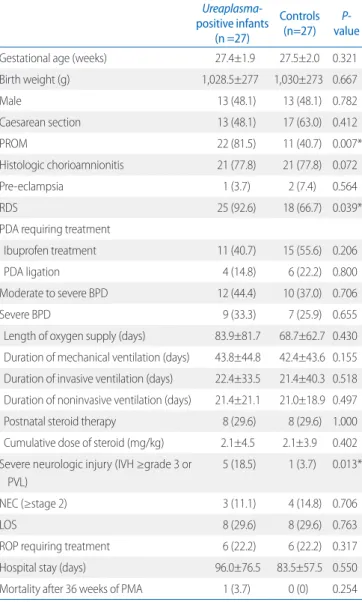
중증의 BPD, 산소 공급 기간 및 기계환기요법(침습적, 비침습 적)의 적용 기간은 두 군 간의 유의한 차이가 없었다. BPD에 대 한 치료로 사용된 스테로이드의 투약 빈도 및 투약된 축적 용량 도 군 간 차이를 나타내지 않았다. NEC, ROP, LOS 등의 기타 질 환의 이환율에서도 유의한 차이가 없었다.
3. 유레아플라즈마에 대하여 마크로라이드 투약에 따른 임상 적 특성 비교
유레아플라즈마 양성으로 확인된 30명 중, 치료적 목적으로 마크로라이드(클라리스로마이신 12명, 아지스로마이신 2명)를 공급 기간, 인공호흡기 사용 기간, SNI, ROP 및 LOS 등을 비교
분석하였다. 또한 유레아플라즈마 양성군에서 마크로라이드 항 생제의 투약 효과를 확인하기 위하여 투여군과 투여하지 않은 대조군으로 나누어 변수들을 비교 분석하였다.
3. 통계처리
본 연구에서 통계분석은 SPSS version 21.0 (SPSS, Inc., Chicago, IL, USA)을 사용하였다. 연속형 변수는 평균(±표준편 차)으로, 범주형 변수는 빈도(백분율)로 표현하였으며, 변수의 특성과 검정군의 분포도에 따라 카이제곱검정, Fisher의 정확 검정, 독립 t검정, Mann-Whitney U검정과 McNemar 검정을 이용하여 두 군을 비교하였다. 모든 분석에서 P<0.05 경우를 통 계적으로 유의한 것으로 간주하였다.
결과
1. 연구 대상의 임상적 특징
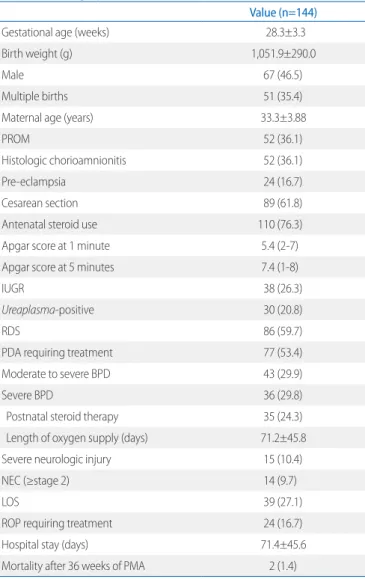
연구 기간 동안 본원 신생아 중환자실에 입원한 극소저출생 체중아는 158명이었다. 이들 중에서 선천성 기형 및 염색체 이 상과 월경 후 주수 36주 이전에 사망한 환자를 제외한 최종 연 구 대상자는 총 144명이었다. 이들의 평균 재태 연령은 28+3주 (±3+3), 출생 체중은 1,051.9 g (±290.0)이었다(Table 1). 산모 의 전자간증은 24명(16.7%), 조기양막파수는 52명(36.1%)에서 확인되었으며, 산전 스테로이드 치료는 110명(76.3%)에게 시행 되었다. 출생 직후 시행한 유레아플라즈마 검출에서는 30명 (20.8%)에서 양성 결과를 보였다. 극소저출생체중아의 주요 이 환율에 있어서는, 치료가 필요한 PDA, 중등도 이상의 BPD, SNI, NEC와 ROP의 발생률은 각각 53.4%, 29.9%, 10.4%, 9.7%
와 16.7%를 보였다. 월경 후 주수 36주 이후의 사망률은 1.4%
로 보고되었다.
2. 유레아플라즈마 양성군과 음성군 간의 임상적 특성 비교 총 144명의 극소저출생체중아 중에서 유레아플라즈마 양성 은 30명(20.8%), 음성은 114명(79.2%)에 해당하였다. 개별 매 칭을 통하여 적합하지 않은 3명을 제외 후 유레아플라즈마 양성 군(27명)과 음성군(27명)의 임상적 특성을 비교하였다(Table 2). 분석 결과에서, 양성군은 음성군의 2배의 조기양막파수의 빈도를 나타내었다(81.5% vs. 40.7%, P=0.007). 또한 음성군에 비하여 양성군은 출생 직후 RDS에 대한 치료를 더 빈번히 받았 으며(92.6% vs. 66.7%, P=0.039), SNI의 발생이 유의하게 증가 하였다(18.5% vs. 3.7%, P=0.013). 반면에, 중등도 이상 혹은
Table 1. Demographic Characteristics
Value (n=144)
Gestational age (weeks) 28.3±3.3
Birth weight (g) 1,051.9±290.0
Male 67 (46.5)
Multiple births 51 (35.4)
Maternal age (years) 33.3±3.88
PROM 52 (36.1)
Histologic chorioamnionitis 52 (36.1)
Pre-eclampsia 24 (16.7)
Cesarean section 89 (61.8)
Antenatal steroid use 110 (76.3)
Apgar score at 1 minute 5.4 (2-7)
Apgar score at 5 minutes 7.4 (1-8)
IUGR 38 (26.3)
Ureaplasma-positive 30 (20.8)
RDS 86 (59.7)
PDA requiring treatment 77 (53.4)
Moderate to severe BPD 43 (29.9)
Severe BPD 36 (29.8)
Postnatal steroid therapy 35 (24.3)
Length of oxygen supply (days) 71.2±45.8
Severe neurologic injury 15 (10.4)
NEC (≥stage 2) 14 (9.7)
LOS 39 (27.1)
ROP requiring treatment 24 (16.7)
Hospital stay (days) 71.4±45.6
Mortality after 36 weeks of PMA 2 (1.4)
Values are presented as mean±standard deviation, mean (interquartile range), or number (%).
Abbreviations: PROM, premature rupture of membranes; IUGR, intrauterine growth retardation; RDS, respiratory distress syndrome; PDA, patent ductus arteriosus;
BPD, bronchopulmonary dysplasia; NEC, necrotizing enterocolitis; LOS, late-onset sepsis; ROP, retinopathy of prematurity; PMA, postmenstrual age.
투약받은 군(14/30, 46.7%)과 투약받지 않은 군(16/30, 53.3%) 을 대상으로 하위그룹 분석(subgroup analysis)을 시행하였다 (Table 3). 이때 유레아플라즈마 양성을 확인 후, 마크로라이드 투약은 출생 후 평균 5일째(3-7일) 이루어졌다.
중등도 이상의 BPD 발생의 경우, 마크로라이드를 투약군에 서 8명(57.1%), 비투약군에서 5명(31.3%)에서 각각 중등도 이 상의 BPD가 발생하였지만, 두 군 간의 유의한 차이는 없었다.
중증 BPD의 경우에도 각각 7명(50.0%)과 5명(31.3%)에서 관
찰되었으며 두 군 간의 유의한 차이는 없었다. 산소 공급 기간 및 기계환기요법의 기간, 출생 후 BPD에 대한 스테로이드 투약 빈도 및 축적 용량에 있어서도 유의한 차이는 보이지 않았다. 반 면에, 마크로라이드 투약군에서 이부프로펜으로 치료한 동맥관 개존증의 비율이 비투약군에 비하여 유의하게 높았다(57.1%
vs. 18.8%, P=0.029). 마크로라이드와 이부프로펜의 투약 시기 에 있어서는, 동맥관 개존증에 대한 첫 번째 이부프로펜 투약이 마크로라이드 투약보다 77.8% (7/9)에서 먼저 이루어졌다. 이 중에서 2번 이상의 동맥관 개존증의 약물 치료가 이루어진 경우 는 55.6% (5/9)에 해당하며, 이것도 마크로라이드 비투약군에 비하여 투약군에서 유의하게 높았다(P=0.012). 반면에, SNI는 Table 2. Clinical Outcomes between Ureaplasma-Positive Infants and
Matched Controls
Ureaplasma- positive infants
(n =27)
Controls (n=27) P-
value
Gestational age (weeks) 27.4±1.9 27.5±2.0 0.321
Birth weight (g) 1,028.5±277 1,030±273 0.667
Male 13 (48.1) 13 (48.1) 0.782
Caesarean section 13 (48.1) 17 (63.0) 0.412
PROM 22 (81.5) 11 (40.7) 0.007*
Histologic chorioamnionitis 21 (77.8) 21 (77.8) 0.072
Pre-eclampsia 1 (3.7) 2 (7.4) 0.564
RDS 25 (92.6) 18 (66.7) 0.039*
PDA requiring treatment
Ibuprofen treatment 11 (40.7) 15 (55.6) 0.206
PDA ligation 4 (14.8) 6 (22.2) 0.800
Moderate to severe BPD 12 (44.4) 10 (37.0) 0.706
Severe BPD 9 (33.3) 7 (25.9) 0.655
Length of oxygen supply (days) 83.9±81.7 68.7±62.7 0.430 Duration of mechanical ventilation (days) 43.8±44.8 42.4±43.6 0.155 Duration of invasive ventilation (days) 22.4±33.5 21.4±40.3 0.518 Duration of noninvasive ventilation (days) 21.4±21.1 21.0±18.9 0.497 Postnatal steroid therapy 8 (29.6) 8 (29.6) 1.000 Cumulative dose of steroid (mg/kg) 2.1±4.5 2.1±3.9 0.402 Severe neurologic injury (IVH ≥grade 3 or
PVL)
5 (18.5) 1 (3.7) 0.013*
NEC (≥stage 2) 3 (11.1) 4 (14.8) 0.706
LOS 8 (29.6) 8 (29.6) 0.763
ROP requiring treatment 6 (22.2) 6 (22.2) 0.317
Hospital stay (days) 96.0±76.5 83.5±57.5 0.550
Mortality after 36 weeks of PMA 1 (3.7) 0 (0) 0.254 Values are presented as mean±standard deviation or number (%).
Abbreviations: PROM, premature rupture of membranes; RDS, respiratory distress syndrome; PDA, patent ductus arteriosus; BPD, bronchopulmonary dysplasia; IVH, intraventricular hemorrhage; PVL, periventricular leukomalacia; NEC, necrotizing enterocolitis; LOS, late-onset sepsis; ROP, retinopathy of prematurity; PMA, post- menstrual age.
*P<0.05.
Table 3. Subgroup Analysis for Ureaplasma-Positive Infants According to Macrolide Treatment (n=30)
Macrolide
(n=14) No macrolide (n=16) P-value
Gestational age (weeks) 27.3±1.6 27.4±1.9 0.227
Birth weight (g) 1,030±261 1,022±267 0.078
Male 6 (42.9) 9 (56.3) 0.464
Caesarean section 8 (57.1) 6 (37.5) 0.706
PROM 10 (71.4) 14 (87.5) 0.383
Histologic chorioamnionitis 7 (50.0) 14 (87.5) 0.032
RDS 13 (92.9) 15 (93.8) 0.724
PDA requiring treatment
Ibuprofen treatment 8 (57.1) 3 (18.8) 0.029*
Ibuprofen treatment (≥2 times) 5 (35.7) 0 (0) 0.012*
PDA ligation 3 (21.4) 3 (18.8) 0.605
Moderate to severe BPD 8 (57.1) 5 (31.3) 0.153
Severe BPD 7 (50.0) 5 (31.3) 0.296
Ventilator (days) 53.5±53.0 33.0±31.1 0.169
Length of oxygen supply (days) 89.2±108 59.6±45.5 0.356 Postnatal steroid therapy 7 (50.0) 4 (25.0) 0.236 Cumulative dose of steroid 3.2±5.7 1.1±3.2 0.255 Severe neurologic injury (IVH ≥grade
3 or PVL)
3 (21.4) 2 (12.5) 0.642
NEC (≥stage 2) 3 (21.4) 0 (0) 0.090
LOS 6 (42.9) 4 (25.0) 0.442
ROP requiring treatment 5 (35.7) 2 (12.5) 0.204
Mortality after 36 weeks of PMA 0 (0) 1 (6.3) 0.533 Values are presented as mean±standard deviation or number (%).
Abbreviations: PROM, premature rupture of membranes; RDS, respiratory distress syndrome; PDA, patent ductus arteriosus; BPD, bronchopulmonary dysplasia; IVH, intraventricular hemorrhage; PVL, periventricular leukomalacia; NEC, necrotizing enterocolitis; LOS, late-onset sepsis; ROP, retinopathy of prematurity; PMA, post- menstrual age.
*P<0.05.
마크로라이드 투약 여부와는 차이가 없었으며, NEC, ROP, LOS 등에서도 군 간 유의한 차이를 보이지 않았다.
고찰
유레아플라즈마는 두 개의 다른 종(Ureaplasma urealyticum 과 Ureaplasma parvum)으로 분류되는 하위 박테리아로서, Ureaplasma parvum보다는 Ureaplasma urealyticum에 노출 된 영아에서 BPD의 발생 위험도가 높으며,9,21,22 조기부터 장기 간 노출될수록 폐의 손상은 악화될 수 있다.22 메타분석을 통하 여서도 유레아플라즈마 감염이 미숙아의 BPD의 발병률 증가와 연관된 것으로 보고된 바 있다.22-24 하지만 유레아플라즈마 감 염과 BPD의 발병이 서로 관련성이 없다는 상반된 연구들도 보 고되었는데, 이들 연구에서는 감염을 뒷받침할 수 있는 자궁내 유레아플라즈마의 존재를 쉽게 확인할 수 없고, 유레아플라즈 마가 자발적 조기 진통이 있는 산모의 가장 흔한 자궁내 감염 병 원체이지만, 조기 진통의 경우 유레아플라즈마 이외의 하나 이 상의 박테리아종에 의한 자궁내 감염과도 관련이 있기 때문에 유레아플라즈마 감염과 BPD 발생의 관련성을 명확히 뒷받침하 기 어려웠기 때문이다.11,25-27 본 연구의 결과에서는 유레아플라 즈마 양성군에서 중등도/중증 BPD 발생의 유의한 관련성을 확 인하지 못하였다.
한편, BPD 이외에도 유레아플라즈마는 IVH, NEC, ROP 및 장기적인 신경학적 발달에 영향을 준다는 보고가 있다.13,14,28-32
본 연구에서의 유레아플라즈마 양성군과 음성군의 임상적 특징 을 비교하였을 때, RDS와 SNI의 유의한 차이가 있었다. 유레아 플라즈마의 감염과 RDS와의 연관성과 관련하여, 유레아플라즈 마에 의하여 생성된 phospholipase A2에 의한 폐 계면 활성제 의 저해와 수용성 세포간 부착 분자뿐만 아니라 interleukin의 생성을 포함한 많은 메커니즘을 통하여 폐 손상을 일으킬 수 있 다고 알려져 있다.31 Viscardi 등14의 연구에서 중추 신경계(cen
tral nervous system, CNS) 외부에서 시작된 염증이 IVH 발병 기전에 기여할 수 있다는 점에서 유레아플라즈마 양성인 극소 저출생체중아에서 3도 이상의 IVH가 증가함을 보였다. 유레아 플라즈마 PCR에서 양성 혈청이 양막염 및 IL-1β의 증가와 관 련이 있으며, 특히 IL-1β의 증가가 태아 염증 반응을 유발하여 전신성 및 CNS에 영향을 미칠 수 있다.14 동물 실험이지만, 어린 원숭이에서 IL-1β의 정맥내 투여가 CSF에서의 IL-6를 유도함 을 보여주었다.32,33
유레아플라즈마에 대한 출생 후 항생제 사용에 의한 효과에 대하여 많은 연구들이 진행되고 있다. 유레아플라즈마는 신생
아에 사용 가능한 에리스로마이신(erythromycin), 아지스로마 이신 및 클라리스로마이신과 같은 마크로라이드계 약물에 감수 성이 있다.20,21,34 이전 연구에서 아지스로마이신과 클라리스로 마이신은 에리스로마이신보다 유레아플라즈마에 대한 시험관 내(in vitro) 항균 활성이 우수하다고 보고하였다.34 유레아플라 즈마에 감염된 미숙아의 BPD를 치료하기 위하여 아지스로마이 신 20 mg/kg/day의 고용량으로 3일 동안 사용하였을 때, 안전 성뿐만 아니라 항염증작용으로 BPD 발병 감소에 효과가 있음 을 보였다.21,35 유레아플라즈마의 치료로 클라리스로마이신을 사용한 연구에서도 유레아플라즈마 양성인 미숙아를 대상으로 클라리스로마이신을 10 mg/kg를 10일간 사용하여 BPD의 위 험도를 낮출 수 있음을 보여주었다.20 하지만 아지스로마이신 혹은 클라리스로마이신을 이용한 본 연구에서는 유레아플라즈 마 양성 미숙아에게 투약하였을 때 중등도/중증의 BPD의 발병 률을 감소시키지 못하였으며, BPD 치료를 위한 스테로이드 치 료의 빈도도 줄이지 못하였다. Resch 등31의 연구에서도, 유레 아플라즈마 양성 미숙아들에게 마크로라이드 항생제를 사용하 는 것이 BPD의 예방에 효과가 없는 것을 보고하였으며, 이는 본 연구와 같은 결과를 보여주었다. 이러한 결과는 마크로라이드 에 대한 유레아플라즈마의 내성을 고려할 수 있다.36,37 임상적으 로 분리된 유레아플라즈마의 균주 수가 증가하면서 마크로라이 드에 내성을 보일 수 있는데, 특히 CT28 균주는 에리스로마이 신, 록시스로마이신(roxithromycin) 등에 동등하게 내성을 보이 나, 테트라사이클린(Teracycline) 내성에는 관련이 없는 것으 로 알려져 있다.36 이것은 유레아플라즈마 임상 균주의 특정 저 항성 유전자(ermB, msrA, msrB, msrC 및 msrD)에 의한 23s RNA의 돌연변이로 유레아플라즈마의 마크로라이드의 내성을 설명할 수 있다.37 본 연구에서도 마크로라이드의 이러한 내성 기전이 작용하였을 수도 있다.
한편, 본 연구에서 마크로라이드로 치료한 유레아플라즈마 양성군에서 치료하지 않은 군에 비하여 내과적 치료(ibuprofen) 를 필요로 하는 PDA의 위험도가 의미 있게 높았다. 산모의 융모 양막염이 있는 경우 양수나 기관지 흡입 세정액(bronchial aspi
rate fluid)에서 IL-6, TNF-α와 같은 염증성 사이토카인(proin
flammatory cytokine)이 증가하는데 이러한 융모양막염의 흔 한 원인균으로 특히 유레아플라즈마(Ureaplasma urealyticum) 로 알려져 있다.7,9,20-22,38 마크로라이드는 이와 같은 염증성 사이 토카인의 분비를 억제함으로써 항염증 작용을 지닌다.20,21,38 하 지만 마크로라이드의 항염증 작용으로 동맥관 개존증의 치료의 효과를 기대할 수 있는 것과는 달리, 본 연구에서는 마크로라이 드 투여군에서 PDA의 치료를 위한 이부프로펜의 재투여가 유 의하게 높았음을 관찰하였다. 하지만 수술적 치료에서는 군 간
의 차이를 확인하지 못하였다. 이것은 유레아플라즈마와 BPD 의 연관성을 임상적으로 염두하여 PDA에 대하여 보다 적극적 인 약물 치료가 시행되었을 가능성을 추정하게끔 한다. 반면에, 본 연구에서는 유레아플라즈마 양성인 극소저출생체중아에 대 한 마크로라이드 치료가 RDS나 신경학적 손상을 포함한, 다른 주요 이환율에 미치는 영향은 관찰되지 않았다. 한편, 본 연구 동안 마크로라이드의 잘 알려진 부작용39,40인 비후성 유문 협착 증, 부정맥 등과 같은 심각한 부작용은 나타나지 않았다.
본 연구는 몇 가지 제한점을 가진다. 첫 번째, 단일기관 연구 이기 때문에 연구 대상군이 적고, 선택 편의(selection bias)가 있을 수 있다. 두 번째, 유레아플라즈마 양성으로 확인된 극소저 출생체중아 중에서 임상의의 판단에 따라 마크로라이드 투약의 여부가 결정되었기 때문에 상대적으로 전신 상태가 더 좋지 않 은 극소저출생체중아에게 치료가 집중된 경향이 있을 수 있다 는 점이다. 이러한 점에서 항생제를 비롯한 다양하게 투약된 약 물들이 마크로라이드 약동학에 영향을 주었을 가능성이 있다.
마지막으로, 본 연구에 두 가지 종류의 마크로라이드 항생제가 사용되었기 때문에 종류의 차이가 미치는 영향이 있을 수 있으 며, 23s RNA의 돌연변이로 인한 마크로라이드 항생제의 감수 성이 다를 수 있고 마이코플라즈마 호미니스(Mycoplasma ho
minis)와의 동시 감염의 존재 등으로 제균 치료에 영향을 줄 수 있다는 점이다.
본 연구를 통하여 유레아플라즈마 양성인 극소저출생체중아 에서 BPD 발생을 포함한 주요 이환율과 이에 대한 마크로라이 드 투약의 효과를 확인할 수 있었다. 유레아플라즈마 양성은 증 등도/중증 BPD와 연관성이 없었고, RDS, SNI의 발생률 증가와 연관성을 나타내었다. 마크로라이드 항생제에 의한 유레아플라 즈마 치료 시도는 극소저출생체중아의 주요 이환율을 감소시키 지 못하였다. 향후 유레아플라즈마가 BPD를 포함하여 미숙아 의 여러 질환에 미치는 영향을 확인할 수 있는 대규모 연구가 필 요할 것으로 생각된다.
References
1) El-Metwally D, Vohr B, Tucker R. Survival and neonatal morbidity at the limits of viability in the mid 1990s: 22 to 25 weeks. J Pediatr 2000;137:
616-22.
2) Callaghan WM, MacDorman MF, Shapiro-Mendoza CK, Barfield WD. Ex- plaining the recent decrease in US infant mortality rate, 2007-2013. Am J Obstet Gynecol 2017;216:73.e1-73.e8.
3) Voynow JA. "New" bronchopulmonary dysplasia and chronic lung dis- ease. Paediatr Respir Rev 2017;24:17-8.
4) Viscardi RM, Muhumuza CK, Rodriguez A, Fairchild KD, Sun CC, Gross GW, et al. Inflammatory markers in intrauterine and fetal blood and ce- rebrospinal fluid compartments are associated with adverse pulmonary and neurologic outcomes in preterm infants. Pediatr Res 2004;55:1009- 17.
5) Choi CW, Kim BI. Epidemiology, clinical characteristics, and pathophy- siology of bronchopulmonary dysplasia. Neonatal Med 2013;20:283-91.
6) Jung E, Kim S, Jung YH, Lee J, Shin SH, Choi CW, et al. Effect of prenatal and postnatal prophylaxis with macrolide of Ureaplasma on the deve- lopment of bronchopulmonary dysplasia in preterm infants. Neonatal Med 2015;22:78-83.
7) Sweeney EL, Dando SJ, Kallapur SG, Knox CL. The human Ureaplasma species as causative agents of chorioamnionitis. Clin Microbiol Rev 2016;30:349-79.
8) Schelonka RL, Waites KB. Ureaplasma infection and neonatal lung dis- ease. Semin Perinatol 2007;31:2-9.
9) Viscardi RM. Ureaplasma species: role in neonatal morbidities and out- comes. Arch Dis Child Fetal Neonatal Ed 2014;99:F87-92.
10) Ballard HO, Anstead MI, Shook LA. Azithromycin in the extremely low birth weight infant for the prevention of bronchopulmonary dysplasia:
a pilot study. Respir Res 2007;8:41.
11) Aaltonen R, Vahlberg T, Lehtonen L, Alanen A. Ureaplasma urealyticum:
no independent role in the pathogenesis of bronchopulmonary dys- plasia. Acta Obstet Gynecol Scand 2006;85:1354-9.
12) Mhanna MJ, Delong LJ, Aziz HF. The value of Ureaplasma urealyticum tracheal culture and treatment in premature infants following an acute respiratory deterioration. J Perinatol 2003;23:541-4.
13) Okogbule-Wonodi AC, Gross GW, Sun CC, Agthe AG, Xiao L, Waites KB, et al. Necrotizing enterocolitis is associated with Ureaplasma colonization in preterm infants. Pediatr Res 2011;69(5 Pt 1):442-7.
14) Viscardi RM, Hashmi N, Gross GW, Sun CC, Rodriguez A, Fairchild KD. In- cidence of invasive Ureaplasma in VLBW infants: relationship to severe intraventricular hemorrhage. J Perinatol 2008;28:759-65.
15) Jobe AH, Bancalari E. Bronchopulmonary dysplasia. Am J Respir Crit Care Med 2001;163:1723-9.
16) Bell MJ, Ternberg JL, Feigin RD, Keating JP, Marshall R, Barton L, et al.
Neonatal necrotizing enterocolitis. Therapeutic decisions based upon clinical staging. Ann Surg 1978;187:1-7.
17) Papile LA, Burstein J, Burstein R, Koffler H. Incidence and evolution of subependymal and intraventricular hemorrhage: a study of infants with birth weights less than 1,500 gm. J Pediatr 1978;92:529-34.
18) Lee SM, Chang M, Kim KS. Blood culture proven early onset sepsis and late onset sepsis in very-low-birth-weight infants in Korea. J Korean Med Sci 2015;30 Suppl 1:S67-74.
19) Crouse DT, Odrezin GT, Cutter GR, Reese JM, Hamrick WB, Waites KB, et al. Radiographic changes associated with tracheal isolation of Ureap- lasma urealyticum from neonates. Clin Infect Dis 1993;17 Suppl 1:S122- 30.
20) Ozdemir R, Erdeve O, Dizdar EA, Oguz SS, Uras N, Saygan S, et al. Clari- thromycin in preventing bronchopulmonary dysplasia in Ureaplasma urealyticum-positive preterm infants. Pediatrics 2011;128:e1496-501.
21) Ballard HO, Shook LA, Bernard P, Anstead MI, Kuhn R, Whitehead V, et al.
Use of azithromycin for the prevention of bronchopulmonary dysplasia in preterm infants: a randomized, double-blind, placebo controlled trial.
Pediatr Pulmonol 2011;46:111-8.
22) Sánchez PJ, Regan JA. Ureaplasma urealyticum colonization and chronic lung disease in low birth weight infants. Pediatr Infect Dis J 1988;7:542- 6.
23) Wang EE, Ohlsson A, Kellner JD. Association of Ureaplasma urealyticum colonization with chronic lung disease of prematurity: results of a meta- analysis. J Pediatr 1995;127:640-4.
24) Cassell GH, Waites KB, Watson HL, Crouse DT, Harasawa R. Ureaplasma urealyticum intrauterine infection: role in prematurity and disease in newborns. Clin Microbiol Rev 1993;6:69-87.
25) Cassell GH, Waites KB, Crouse DT, Rudd PT, Canupp KC, Stagno S, et al.
Association of Ureaplasma urealyticum infection of the lower respiratory tract with chronic lung disease and death in very-low-birth-weight in- fants. Lancet 1988;2:240-5.
26) Ollikainen J, Korppi M, Heiskanen-Kosma T, Heinonen K. Chronic lung disease of the newborn is not associated with Ureaplasma urealyticum.
Pediatr Pulmonol 2001;32:303-7.
27) Romero R, Ghidini A, Mazor M, Behnke E. Microbial invasion of the am- niotic cavity in premature rupture of membranes. Clin Obstet Gynecol 1991;34:769-78.
28) Ozdemır R, Sarı FN, Tunay ZO, Erdeve O, Canpolat FE, Oguz SS, et al. The association between respiratory tract Ureaplasma urealyticum coloni- zation and severe retinopathy of prematurity in preterm infants ≤1250 g. Eye (Lond) 2012;26:992-6.
29) Kasper DC, Mechtler TP, Böhm J, Petricevic L, Gleiss A, Spergser J, et al. In utero exposure to Ureaplasma spp. is associated with increased rate of bronchopulmonary dysplasia and intraventricular hemorrhage in pre- term infants. J Perinat Med 2011;39:331-6.
30) Cultrera R, Seraceni S, Germani R, Contini C. Molecular evidence of Ure- aplasma urealyticum and Ureaplasma parvum colonization in preterm
infants during respiratory distress syndrome. BMC Infect Dis 2006;6:166.
31) Resch B, Gutmann C, Reiterer F, Luxner J, Urlesberger B. Neonatal Urea- plasma urealyticum colonization increases pulmonary and cerebral morbidity despite treatment with macrolide antibiotics. Infection 2016;
44:323-7.
32) Reyes TM, Coe CL. The proinflammatory cytokine network: interactions in the CNS and blood of rhesus monkeys. Am J Physiol 1998;274(1 Pt 2):R139-44.
33) Goldenberg RL, Andrews WW, Goepfert AR, Faye-Petersen O, Cliver SP, Carlo WA, et al. The alabama preterm birth study: umbilical cord blood Ureaplasma urealyticum and mycoplasma hominis cultures in very preterm newborn infants. Am J Obstet Gynecol 2008;198:43.e1-5.
34) Togami K, Chono S, Morimoto K. Distribution characteristics of clarithro- mycin and azithromycin, macrolide antimicrobial agents used for treat- ment of respiratory infections, in lung epithelial lining fluid and alveolar macrophages. Biopharm Drug Dispos 2011;32:389-97.
35) Smith C, Egunsola O, Choonara I, Kotecha S, Jacqz-Aigrain E, Sammons H. Use and safety of azithromycin in neonates: a systematic review. BMJ Open 2015;5:e008194.
36) Lu C, Ye Tl, Zhu Gx, Feng Py, Ma H, Lu Rb, et al. Phenotypic and genetic characteristics of macrolide and lincosamide resistant Ureaplasma ure- alyticum isolated in Guangzhou, China. Curr Microbiol 2010;61:44-9.
37) Palù G, Valisena S, Barile MF, Meloni GA. Mechanisms of macrolide resis- tance in Ureaplasma urealyticum: a study on collection and clinical strains. Eur J Epidemiol 1989;5:146-53.
38) Watterberg KL, Demers LM, Scott SM, Murphy S. Chorioamnionitis and early lung inflammation in infants in whom bronchopulmonary dys- plasia develops. Pediatrics 1996;97:210-5.
39) Mahon BE, Rosenman MB, Kleiman MB. Maternal and infant use of ery- thromycin and other macrolide antibiotics as risk factors for infantile hypertrophic pyloric stenosis. J Pediatr 2001;139:380-4.
40) Albert RK, Schuller JL; COPD Clinical Research Network. Macrolide anti- biotics and the risk of cardiac arrhythmias. Am J Respir Crit Care Med 2014;189:1173-80.