https://doi.org/10.14734/PN.2018.29.4.159 pISSN 2508-4887•eISSN 2508-4895
Hyunsoo Kim, MD, Jiyeon Kim, MD, Sun Young Ko, MD, Son Moon Shin, MD, Yeon Kyung Lee, MD Department of Pediatrics, Cheil General Hospital and Women’s Health Care Center, Dankook University College of Medicine, Seoul, Korea
Objective: To compare neonatal respiratory morbidity of twins according to birth order related to gestational age and mode of delivery.
Methods: We performed the retrospective research of the medical records of 3,224 neonates (1,612 twin pairs) born in a single center from January 2011 to December 2015. Subjects were classified into four gestational age groups: very (<32 weeks), moderate (32-33 weeks), late (34-36 weeks) preterm, and term (≥37 weeks) groups. We investigated clinical characteristics and respiratory morbidity according to birth order related to gestational age group and mode of delivery.
Results: We found increased risk of respiratory morbidity in second-born twin than first-born twin (P=0.039). Second-born twin was associated with increased risk of respiratory distress syndrome (RDS) in late preterm group (odds ratio [OR] 2.8, 95% confidence interval [CI] 1.30-5.95), and transient tachypnea of newborn in term group (OR 1.4, 95% CI 1.03-1.81). In vaginal delivery mode, there was no difference of respiratory morbidity between first and second-born twin in each group, but in cases of Cesarean delivery, second-born twin was related with a greater risk of RDS in late preterm group (OR 2.3, 95% CI 1.07-5.09). Birth order and Cesarean section independently increased the risk of RDS (adjusted OR [aOR] 1.69, 95% CI 1.12-2.54; aOR 2.14, 95% CI 1.25-3.66, respectively).
Conclusion: Second-born twin and Cesarean delivery are associated with increased risk of RDS, especially in late preterm twins.
Key Words: Respiratory distress syndrome, newborn, Cesarean section, Birth order, Twins
서론
신생아의 호흡기질환은 주산기 이환율과 사망률의 주요 원인으로서, 신생아 집중치료실 입원을 요하는 중요한 적응증이다.1 이 중에서 신생아 호흡곤란 증후군은 주로 미숙아에서 폐의 발달 미숙으로 인한 폐표면 활성제의 부족에 의하여 발생하는 중요한 신생아 호흡기질 환으로 남아, 미숙아, 제왕절개술, 쌍생아 중 두 번째 아기 등이 발병 위험인자로 고려되고 있 으며, 이에 대한 예방과 관리가 신생아 사망률 감소와 예후 향상을 위한 신생아 집중 치료의 가장 중요한 분야 중 하나이다. 그와 달리 신생아 일과성 빈호흡은 만삭아와 만삭에 거의 가 까운 후기 미숙아에서 주로 보이는 흔한 호흡기질환으로 출생시 폐포 및 폐간질 등의 폐조직 내에서 폐액의 흡수 지연으로 일어나는 양성 질환이며 빠른 분만, 진통의 지연, 제왕절개술 로 태어난 아기에서 높은 빈도를 나타낸다. 일반적으로, 호흡기질환을 포함한 주산기 이환 율과 사망률은 단생아보다 쌍생아에서, 쌍생아 중에서는 첫 번째보다 두 번째 쌍생아에서 높은 것으로 알려져 있다.2-4
지금까지 쌍생아 간 호흡기계 질환 특히, 신생아 호흡곤란 증후군은 두 번째 아기에서 많 은 것으로 알려져 있으나, 최근 연구에서는 기존에 알려진 바와 달리 차이가 없는 것으로 보 고되기도 한다.5,6 이런 상반된 연구 결과들은 대상자 수가 비교적 적거나, 대상자 수가 많더 Received: 15 June 2018
Revised: 13 August 2018 Accepted: 26 August 2018 Correspondence to Yeon Kyung Lee, MD
Department of Pediatrics, Cheil General Hospital and Women’s Healthcare Center, Dankook University College of Medicine, 17 Seoae-ro 1-gil, Jung-gu, Seoul 04619, Korea
Tel: +82-2-2000-7771 Fax: +82-2-2000-7789 E-mail: [email protected] Copyright© 2018 by The Korean Society of Perinatology
This is an Open Access article distributed under the terms of the Creative Com- mons Attribution Non-Commercial License (http://creativecommons.org/
license/by-nc/4.0/), which permits unrestricted non-commercial use, distribution, and reproduction in any
Neonatal Respiratory Morbidity in Twins
according to Birth Order and Mode of
Delivery
에서는 이런 연구가 거의 없는 실정이다. 이에 저자들은 출생 순 서에 따른 쌍생아의 신생아 호흡곤란 증후군과 함께 호흡기계 이환율의 차이를 재태 연령별로 포괄하여, 분만방식에 따라 비 교하고자 하였다.
대상 및 방법
2011년 1월 1일부터 2015년 12월 31일까지 본원에서 출생 한 쌍생아의 의무기록 및 데이터베이스를 통하여 총 3,224명 (1,612쌍)을 대상으로 후향적 연구를 시행하였다. 쌍태아 중에 서 태아사망 또는 사산으로 인하여 한 명만 출생한 경우, 첫 번 째 쌍생아는 질식분만되었으나 두 번째 쌍생아는 제왕절개술로 출생한 경우는 연구에서 제외하였다.
대상자의 재태 연령에 따라 조기 미숙아(very preterm, 32주 미만), 중기 미숙아(moderate preterm, 32-33주), 후기 미숙아 (late preterm, 34-36주), 만삭아군(37주 이상)으로 분류하였 고, 체중, 신장, 두위, 1분과 5분 아프가 점수, 성별, 분만방식(질 식분만, 제왕절개술), 태위(정상-두정위, 비정상-둔위, 횡위) 등 의 임상적 특징을 조사하였다. 신생아 호흡기계 질환은, 신생아 일과성 빈호흡(transient tachypnea of newborn, TTN), 신생아 호흡곤란 증후군(respiratory distress syndrome with surfac- tant, RDS), 기계환기를 필요로 하는 신생아 호흡곤란(respira- tory distress of newborn with ventilator care, RD)으로 구분하 여 재태 연령 및 분만방식별로 출생 순서에 따른 쌍생아 간 이환 율의 차이를 비교하였다. TTN의 진단은 빈호흡, 그렁거림, 비 익확장, 흉부견축 등 비효율적인 호흡 양상이 보이는 임상적인 호흡곤란의 징후가 기계환기요법 없이 출생 72시간 이내에 회 복되고, 흉부 영상검사에서 과팽창 및 양측 폐문부 주위로 방사 되는 선상 울혈 소견을 보이는 경우로 정의하였다. RDS는 생후 첫 24시간 동안 산소 요구량이 증가하는 호흡곤란을 특징으로 하는 임상증상을 나타내고 흉부 영상검사에서 폐음영의 감소, 망상 과립상 음영, 공기 기관지 음영 등의 소견을 보이며 폐표면 활성제의 투여가 필요하였던 경우로 정의하였다. RD는 RDS를 제외한 대상자에서 비강 지속적 양압 환기를 포함한 기계환기 요법을 필요로 한 경우로 정의하였다.
통계분석은 출생 순서에 따른 쌍생아의 임상적 특성과 재태 연령 및 분만방식에 따른 호흡기계 이환율의 차이를 비교하기 위하여 Statistical package for the social sciences (SPSS soft- ware, version 18; SPSS Inc., Chicago, IL, USA)를 사용하였다.
연속변수에서 대응표본 t-검정을, 범주형 변수에서 카이제곱검 정을 시행하였다. 쌍생아 중에서 두 번째 쌍생아만 이환된 경우
를 첫 번째 쌍생아만 이환된 경우의 수로 나눈 값을 위험도 (odds ratio, OR)로 정한 이분형 변수는 Matched case-control 분석을 통하였고 Epi Info™ 7.2 (Centers for disease control and prevention, Atlanta, GA, USA)를 사용하여 멕네마검정을 시행하였다. 로지스틱 회귀분석을 통하여 보정된 위험도 (adjusted odds ratio, aOR)를 산출하였으며, 유의수준 0.05 미 만에서 통계적으로 유의한 것으로 정하였다.
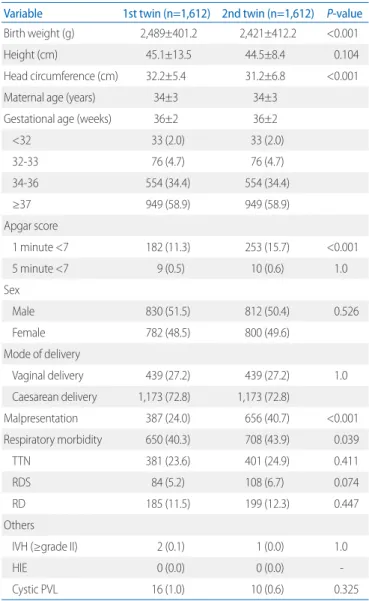
Table 1. Characteristics and Respiratory Outcomes of the Study Pop- ulation (n=3,224)
Variable 1st twin (n=1,612) 2nd twin (n=1,612) P-value Birth weight (g) 2,489±401.2 2,421±412.2 <0.001
Height (cm) 45.1±13.5 44.5±8.4 0.104
Head circumference (cm) 32.2±5.4 31.2±6.8 <0.001
Maternal age (years) 34±3 34±3
Gestational age (weeks) 36±2 36±2
<32 33 (2.0) 33 (2.0)
32-33 76 (4.7) 76 (4.7)
34-36 554 (34.4) 554 (34.4)
≥37 949 (58.9) 949 (58.9)
Apgar score
1 minute <7 182 (11.3) 253 (15.7) <0.001
5 minute <7 9 (0.5) 10 (0.6) 1.0
Sex
Male 830 (51.5) 812 (50.4) 0.526
Female 782 (48.5) 800 (49.6)
Mode of delivery
Vaginal delivery 439 (27.2) 439 (27.2) 1.0
Caesarean delivery 1,173 (72.8) 1,173 (72.8)
Malpresentation 387 (24.0) 656 (40.7) <0.001
Respiratory morbidity 650 (40.3) 708 (43.9) 0.039
TTN 381 (23.6) 401 (24.9) 0.411
RDS 84 (5.2) 108 (6.7) 0.074
RD 185 (11.5) 199 (12.3) 0.447
Others
IVH (≥grade II) 2 (0.1) 1 (0.0) 1.0
HIE 0 (0.0) 0 (0.0) -
Cystic PVL 16 (1.0) 10 (0.6) 0.325
Values are presented as mean±standard deviation or number (%).
Abbreviations: TTN, transient tachypnea of newborn; RDS, respiratory distress syndrome with surfactant; RD, respiratory distress of newborn with ventilator care; IVH, intraventricular hemorrhage; HIE, hypoxic ischemic encephalopathy;
PVL, periventricular leukomalacia.
interval [CI] 1.30-5.95, P=0.010). 분만방식별로 볼 때, 질식분 만에서는 쌍생아 간 호흡기계 이환율의 차이가 모든 재태 연령 에서 없었지만, 제왕절개술에서는 후기 미숙아에서 두 번째 쌍 생아의 RDS 발생률이 첫 번째 쌍생아보다 높았다(OR 2.3, 95%
CI 1.07-5.09, P=0.03). 만삭아에서는 쌍생아 간의 TTN 발생 률의 차이가 있었지만(OR 1.4, 95% CI 1.03-1.81, P=0.03), 분 만방식별로 볼 때는 차이가 없었다(Table 2).
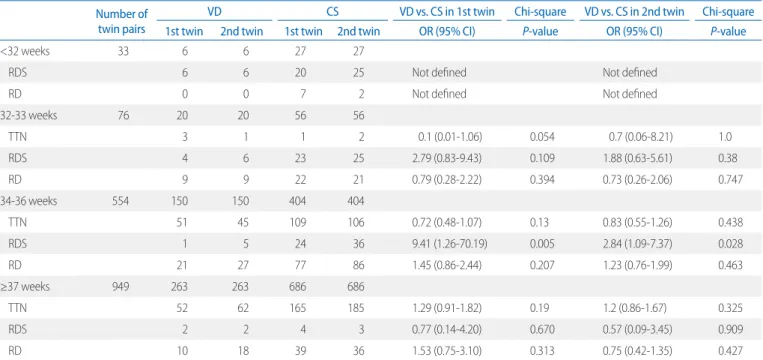
출생 순서에 따른 각각의 쌍생아에서 분만방식에 대한 재태 연령별 호흡기 이환율 비교에서는, 조기, 중기 미숙아 및 만삭아 군에서는 호흡기계 이환율이 분만방식에 따라 차이가 없었지 만, 후기 미숙아군에서는 첫 번째 쌍생아 및 두 번째 쌍생아 모 두에서 질식분만보다 제왕절개술에서의 RDS 발생률이 높았다 (각각 OR 9.41, 95% CI 1.26-70.19, P=0.005 및 OR 2.84, 95%
CI 1.09-7.37, P=0.028) (Table 3).
로지스틱 회귀분석에서 출생 순서는 다른 요인과 상관 없이 RDS 발생률과 관련이 있었다(aOR 1.69, 95% CI 1.12-2.54, P=0.012). 질식분만에서는 출생 순서에 따른 RDS 발생률이 통 계적으로 유의하지 않았으나, 제왕절개술에서는 두 번째 쌍생 아의 RDS 발생률이 유의하게 높았다(aOR 1.65, 95% CI 1.06- 2.58, P=0.026). 대상아 전체에서 제왕절개술에 의한 RDS 발생 률도 질식분만에 비하여 높았다(aOR 2.14, 95% CI 1.25-3.66, P=0.006) (Table 4).
결과
대상자 수는 총 3,224명(1,612쌍)이었고, 남아가 1,642명, 여 아가 1,582명이었다. 산모의 평균연령은 34±3세였다. 재태 연령 24주에서 39주 사이에 출생하였고, 평균 재태 연령은 36±3주였 다. 재태 연령별로 32주 미만의 조기 미숙아가 66명, 32-33주의 중기 미숙아가 152명, 34-36주의 후기 미숙아가 1,108명, 만삭 아 1,898명이 출생하였다. 질식분만으로 878명이 출생하였고, 제왕절개술을 통하여 2,346명이 출생하였다. 출생 순서에 따른 첫 번째와 두 번째 쌍생아의 평균 체중은 각각 2,489± 401.1 g, 2,421±412.2 g으로 첫 번째 쌍생아의 출생 체중이 유의하게 컸 다(P<0.001). 신장은 차이가 없었으며, 두위는 첫 번째 쌍생아가 두 번째 쌍생아에 비하여 유의하게 컸다(각각 32.2±5.4 cm, 31.2±6.8 cm, P<0.001). 1분 아프가 점수가 7점 미만인 경우는 두 번째 쌍생아가 첫 번째 쌍생아에 비하여 유의하게 많았지만 (P<0.001), 5분 아프가 점수는 차이가 없었다. 두 번째 쌍생아의 전체 호흡기계 이환율이 첫 번째에 비하여 높았지만(P=0.039), TTN, RDS, RD 각각에서는 차이가 없었다(Table 1).
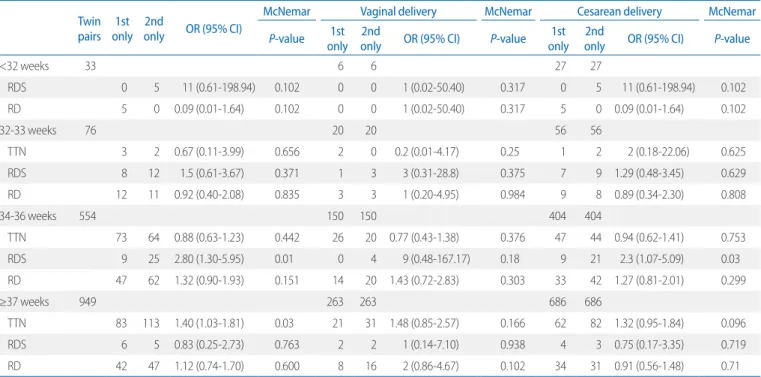
출생 순서에 따른 쌍생아 간의 재태 연령 및 분만방식에 따른 호흡기계 이환율 비교에서, 조기 및 중기 미숙아군에서는 호흡 기계 이환율의 차이가 없었으나, 후기 미숙아군에서의 RDS 발 생률에는 유의한 차이가 있었다(OR 2.8, 95% confidence
Table 2. Difference of Respiratory Morbidity Incidence between 1st and 2nd Twin by Gestational Age and Mode of Delivery Twin
pairs 1st only 2nd
only OR (95% CI)
McNemar Vaginal delivery McNemar Cesarean delivery McNemar
P-value 1st only 2nd
only OR (95% CI) P-value 1st only 2nd
only OR (95% CI) P-value
<32 weeks 33 6 6 27 27
RDS 0 5 11 (0.61-198.94) 0.102 0 0 1 (0.02-50.40) 0.317 0 5 11 (0.61-198.94) 0.102
RD 5 0 0.09 (0.01-1.64) 0.102 0 0 1 (0.02-50.40) 0.317 5 0 0.09 (0.01-1.64) 0.102
32-33 weeks 76 20 20 56 56
TTN 3 2 0.67 (0.11-3.99) 0.656 2 0 0.2 (0.01-4.17) 0.25 1 2 2 (0.18-22.06) 0.625
RDS 8 12 1.5 (0.61-3.67) 0.371 1 3 3 (0.31-28.8) 0.375 7 9 1.29 (0.48-3.45) 0.629
RD 12 11 0.92 (0.40-2.08) 0.835 3 3 1 (0.20-4.95) 0.984 9 8 0.89 (0.34-2.30) 0.808
34-36 weeks 554 150 150 404 404
TTN 73 64 0.88 (0.63-1.23) 0.442 26 20 0.77 (0.43-1.38) 0.376 47 44 0.94 (0.62-1.41) 0.753
RDS 9 25 2.80 (1.30-5.95) 0.01 0 4 9 (0.48-167.17) 0.18 9 21 2.3 (1.07-5.09) 0.03
RD 47 62 1.32 (0.90-1.93) 0.151 14 20 1.43 (0.72-2.83) 0.303 33 42 1.27 (0.81-2.01) 0.299
≥37 weeks 949 263 263 686 686
TTN 83 113 1.40 (1.03-1.81) 0.03 21 31 1.48 (0.85-2.57) 0.166 62 82 1.32 (0.95-1.84) 0.096
RDS 6 5 0.83 (0.25-2.73) 0.763 2 2 1 (0.14-7.10) 0.938 4 3 0.75 (0.17-3.35) 0.719
RD 42 47 1.12 (0.74-1.70) 0.600 8 16 2 (0.86-4.67) 0.102 34 31 0.91 (0.56-1.48) 0.71
Abbreviations: OR, odds ratio; CI, confidence interval; RDS, respiratory distress syndrome with surfactant; RD, respiratory distress of newborn with ventilator care; TTN, transient tachypnea of newborn.
고찰
쌍생아 간의 호흡기계 이환율에 관한 기존의 연구들에서는 대부분 두 번째 쌍생아가 첫 번째 쌍생아에 비하여 신생아 호흡 곤란 증후군을 비롯한 호흡기계 이환율이 더 높은 것으로 알려 져 있다.7-9 최근 들어서는 기존의 연구와 다른 결과들이 보고되 었는데, Chen 등6은 쌍생아에서 호흡기계 이환율의 차이는 없 다고 하였으며, Swanson 등10은 10분 이상의 간격을 두고 태어 난 쌍생아 사이에서도 호흡기계 이환율의 차이가 없다고 하였 으나, 본 연구에서는 쌍생아 사이에서 전체 호흡기계 이환율의 유의한 차이가 있었다.
호흡기계 이환율에서 가장 중요한 질환인 RDS는 두 번째 쌍생 아가 첫 번째 쌍생아보다 이환율이 높은 것으로 알려져 있지만, 기존의 연구들은 주로 1,500 g 미만의 극소저체중출생아나 재태 연령 32주 미만의 조기 미숙아 등에 한정하여 이루어진 경우가
대부분이다.7,8,11-15 본 연구에서는 두 번째 쌍생아가 첫 번째 쌍 생아에 비하여 호흡기계 이환율이 높았으며, 특히 34-36주의 후 기 미숙아에서 RDS 발생률이 유의하게 높음을 알 수 있었다. 본 연구를 포함한 이제까지의 연구 결과들을 볼 때, 두 번째 쌍생아 가 첫 번째 쌍생아에 비하여 폐 발달 및 성숙도 측면에서 불리한 상황에 있는 것으로 생각되나, 이에 대한 기전에 대해서는 아직 까지 알려진 바가 없다.
분만방식에 따른 RDS를 포함하는 호흡기계 이환율의 차이는 일반적으로 제왕절개술이 질식분만보다 높은 것으로 알려져 있 다.16 이는 질식분만의 진통과정이 폐액의 흡수를 촉진하는 것에 반하여, 진통과정을 겪지 않은 제왕절개술에서는 폐액의 흡수지 연으로 인한 폐부종에 의하여 호흡기 이환율이 높은 것으로 생 각되어 왔다.9 하지만 최근의 Barrett 등17의 연구에서는 쌍생아 에서 제왕절개술이 질식분만에 비하여 호흡기계 질환을 포함하 여 신생아 이환율을 높이지 않는다고 발표하였고, Seelbach- Table 3. Comparison of Respiratory Morbidity in 1st and 2nd Twin by Mode of Delivery
Number of twin pairs
VD CS VD vs. CS in 1st twin Chi-square VD vs. CS in 2nd twin Chi-square 1st twin 2nd twin 1st twin 2nd twin OR (95% CI) P-value OR (95% CI) P-value
<32 weeks 33 6 6 27 27
RDS 6 6 20 25 Not defined Not defined
RD 0 0 7 2 Not defined Not defined
32-33 weeks 76 20 20 56 56
TTN 3 1 1 2 0.1 (0.01-1.06) 0.054 0.7 (0.06-8.21) 1.0
RDS 4 6 23 25 2.79 (0.83-9.43) 0.109 1.88 (0.63-5.61) 0.38
RD 9 9 22 21 0.79 (0.28-2.22) 0.394 0.73 (0.26-2.06) 0.747
34-36 weeks 554 150 150 404 404
TTN 51 45 109 106 0.72 (0.48-1.07) 0.13 0.83 (0.55-1.26) 0.438
RDS 1 5 24 36 9.41 (1.26-70.19) 0.005 2.84 (1.09-7.37) 0.028
RD 21 27 77 86 1.45 (0.86-2.44) 0.207 1.23 (0.76-1.99) 0.463
≥37 weeks 949 263 263 686 686
TTN 52 62 165 185 1.29 (0.91-1.82) 0.19 1.2 (0.86-1.67) 0.325
RDS 2 2 4 3 0.77 (0.14-4.20) 0.670 0.57 (0.09-3.45) 0.909
RD 10 18 39 36 1.53 (0.75-3.10) 0.313 0.75 (0.42-1.35) 0.427
Abbreviations: VD, vaginal delivery; CS, cesarean section; OR, odds ratio; CI, confidence interval; RDS, respiratory distress syndrome with surfactant; RD, respiratory distress of newborn with ventilator care; TTN, transient tachypnea of newborn.
Table 4. Logistic Regression Analysis of the Relative Effects of Birth Order on Respiratory Distress Syndrome by Mode of Delivery
Number of twin sibling infants Variable aOR (95% CI) P-value
Vaginal delivery only 878 Birth order 2.33 (0.79-6.87) 0.127
Caesarean delivery only 2,346 Birth order 1.65 (1.06-2.58) 0.026
Vaginal and caesarean delivery 3,224 Birth order 1.69 (1.12-2.54) 0.012
Caesarean delivery 2.14 (1.25-3.66) 0.006
Adjusted for birth weight, head circumference, gestational age, malpresentation.
Abbreviations: aOR, adjusted odds ratio; CI, confidence interval.
Goebel18의 연구 결과도 이와 같았다. 또한, 2014년 Cochrane review는 만삭의 쌍생아에서 선택적 제왕절개술이 RDS를 포함 한 호흡기계 이환율을 증가시키지 않는다고 발표하였다.19 이번 연구에서는 제왕절개술이 질식분만에 비하여 RDS가 발생할 위 험이 각각의 쌍생아에서 높게 나왔고, 특히 후기 미숙아에서 그 정도가 증가하였다. 또한 분만방식별 쌍생아 간의 RDS 발생률 은, 질식분만에서는 첫 번째 쌍생아보다 두 번째 쌍생아에서 RDS 발생이 높은 것으로 알려져 있지만, 제왕절개술 내에서의 쌍생아 간 이환율 차이에 대해서는 주로 조기 미숙아에서만 알 려져 있었다.7,11,13 본 연구에서는 기존의 연구와 달리 질식분만 에서는 모든 재태 연령군에서 쌍생아 간의 RDS 발생률의 차이 가 없었고, 제왕절개술에서는 조기 및 중기 미숙아 그리고 만삭 아군에서 쌍생아 간의 차이가 없었으나, 후기 미숙아군에서는 두 번째 쌍생아에서 첫 번째 쌍생아에 비하여 RDS 발생률이 높 았다. 따라서, 후기 미숙아에서도 제왕절개술에서 출생 순서에 따른 RDS 발생률의 차이가 있음을 알 수 있었다.
로지스틱 회귀분석에서 출생 순서와 제왕절개술은 RDS의 발 생률을 높이는 독립적인 요인이었으며, 후기 미숙아에서 특히 그 위험도가 증가하였다. 이를 통하여 후기 미숙아에서의 제왕 절개술 감소는 두 번째 쌍생아뿐만 아니라, 첫 번째 쌍생아의 RDS 발생률까지 줄일 수 있는 것으로 생각되어, 선택적 제왕절 개술 시행에 있어 고려되어야 할 요인으로 생각된다.
쌍생아 간 TTN의 발생률 차이에 대한 연구는 거의 없었으며, Suzuki 등20의 연구에서는 만삭아에서 선택적 제왕절개술이 쌍 생아의 TTN 발생률을 증가시킨다고 하였지만 출생 순서에 따 른 쌍생아 간 차이에 대한 연구는 없었다. 본 연구에서는 만삭아 군에서 두 번째 쌍생아가 첫 번째 쌍생아보다 TTN에 걸릴 위험 이 유의하게 높았으나, 분만방식별로 분류하였을 때는 차이가 없었다.
그동안 여러 연구에서 쌍생아 간 호흡기계 이환율의 차이를 비교하였지만, 대상자 수가 적었으며, 대상자 수가 많은 인구기 반 데이터의 경우라도 상대적으로 재태연령이 작은 조기 미숙 아 등에 한정된 경우가 대부분이었다. 본 연구는 단일기관임에 도 불구하고 비교적 많은 쌍생아를 대상으로 하였고, 특히 후기 미숙아와 만삭아 수가 많아서 이 재태 연령의 쌍생아 간 호흡기 계 이환율 비교가 용이하였다. 그러나 조기 미숙아의 대상자 수 가 많지 않아, 극소저체중출생아나 조기 미숙아에 한정하여 진 행된 연구들과 직접적으로 비교하기는 어려운 부분이 있었다.
또한 산모의 병력이나, 태아곤란, 반복적 제왕절개술 등 제왕절 개술의 적응증, 출생시간 간격의 차이 등은 본 연구에 포함되지 않아, 이와 관련된 정보들에 대한 조사가 이루어진다면 향후 연 구에 도움이 될 것으로 생각된다. 신생아 호흡기계 이환에 중요
한 영향을 미치는 산전 스테로이드 투여 여부는 본 연구에서 고 려되지 않았지만, 쌍생아 사이에서의 조건은 동일한 것으로 간 주하였고 그 영향은 비교적 적을 것으로 판단된다.
결론적으로, 후기 미숙아에서 두 번째 쌍생아의 RDS에 대한 발생률이 첫 번째 쌍생아 비하여 유의하게 높았으며, 제왕절개 술 또한 질식분만에 비하여 RDS의 발생률을 높이는 요인이었 다. 따라서, 후기 미숙아에서 선택적 제왕절개술의 적응증 및 적 정 시기의 결정에 참고자료가 될 수 있을 것으로 생각된다.
References
1) Lee YK. Causes of respiratory distress in immediate postnatal period.
Korean J Perinatol 2002;13:366-71.
2) Ferguson WF. Perinatal mortality in multiple gestations. A review of peri natal deaths from 1609 multiple gestations. Obstet Gynecol 1964;
23:861-70.
3) Wyshak G. Birth hazard of the second twin. JAMA 1963;186:869-70.
4) Prins RP. The second-born twin: can we improve outcomes? Am J Obstet Gynecol 1994;170:1649-56; discussion 1656-7.
5) Usta IM, Nassar AH, Awwad JT, Nakad TI, Khalil AM, Karam KS. Com- parison of the perinatal morbidity and mortality of the presenting twin and its co-twin. J Perinatol 2002;22:391-6.
6) Chen SJ, Vohr BR, Oh W. Effects of birth order, gender, and intrauterine growth retardation on the outcome of very low birth weight in twins. J Pediatr 1993;123:132-6.
7) Arnold C, McLean FH, Kramer MS, Usher RH. Respiratory distress syn- drome in second-born versus first-born twins. A matched case-control analysis. N Engl J Med 1987;317:1121-5.
8) Shinwell ES, Blickstein I, Lusky A, Reichman B. Effect of birth order on neonatal morbidity and mortality among very low birthweight twins: a population based study. Arch Dis Child Fetal Neonatal Ed 2004;89:F145- 8.
9) Marttila R. Epidemiological and genetic study of respiratory distress syndrome in preterm infants: specific aspects of twin and multiple births. Oulu: University of Oulu, 2003:31-50.
10) Swanson K, Grobman WA, Miller ES. The association between the intertwin interval and adverse neonatal outcomes. Am J Perinatol 2017;
34:70-3.
11) Armson BA, O'Connell C, Persad V, Joseph KS, Young DC, Baskett TF.
Determinants of perinatal mortality and serious neonatal morbidity in the second twin. Obstet Gynecol 2006;108(3 Pt 1):556-64.
12) Ei-Jallad MF, Abu-Heija AT, Ziadeh S, Obeidat A. Is the second-born twin at high risk? J Obstet Gynaecol 1998;18:133-5.
13) Hacking D, Watkins A, Fraser S, Wolfe R, Nolan T. Respiratory distress syndrome and birth order in premature twins. Arch Dis Child Fetal Neonatal Ed 2001;84:F117-21.
14) Mei-Dan E, Shah J, Lee S, Shah PS, Murphy KE; Canadian Neonatal Net- work Investigators. The effect of birth order on neonatal morbidity and
mortality in very preterm twins. Am J Perinatol 2017;34:845-50.
15) Bricelj K, Tul N, Lasic M, Bregar AT, Verdenik I, Lucovnik M, et al. Respi- ratory morbidity in twins by birth order, gestational age and mode of delivery. J Perinat Med 2016;44:899-902.
16) Zanardo V, Simbi AK, Franzoi M, Soldà G, Salvadori A, Trevisanuto D.
Neonatal respiratory morbidity risk and mode of delivery at term: influ- ence of timing of elective caesarean delivery. Acta Paediatr 2004;93:
643-7.
17) Barrett JF, Hannah ME, Hutton EK, Willan AR, Allen AC, Armson BA, et al.
A randomized trial of planned cesarean or vaginal delivery for twin
pregnancy. N Engl J Med 2013;369:1295-305.
18) Seelbach-Goebel B. Twin birth considering the current results of the
"twin birth study". Geburtshilfe Frauenheilkd 2014;74:838-44.
19) Dodd JM, Deussen AR, Grivell RM, Crowther CA. Elective birth at 37 weeks' gestation for women with an uncomplicated twin pregnancy.
Cochrane Database Syst Rev 2014;2:CD003582.
20) Suzuki S, Yamashita E, Inde Y, Hiraizumi Y, Satomi M. Increased rate of elective cesarean delivery and neonatal respiratory disorders in twin pregnancies. J Nippon Med Sch 2010;77:93-6.