1/2 https://jkms.org
In the scholarly publishing industry, editorial articles are written by or under the concerted supervision of the key editors of journals. The first principle is that a worthy editorial article is an opinion maker.1 Editorials should stretch views on topmost topics of the day and try to invite scholars' attention and exertion headed for the topic. Generally, it should ground more research and publication on its highlighted themes. By this, the journal editors are leading sciences to solve our world's problems.
Coronavirus disease 2019 (COVID-19) is a crisis that has produced huge losses for the world thus far. Therefore, it is expected that world-class journals use their leading means, editorial articles, to relieve the crisis. Scopus, as one of the chief databases of journals, attest that until June 30, 2020 near 1,800 editorials in relation to the COVID-19 are published from different fields. Majority of these editorials were in the field of medicine, though journals from other fields were not beyond the trend.
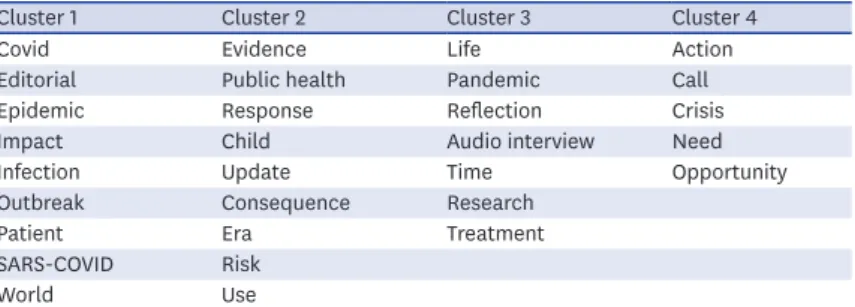
Many editorials do not have abstract, keywords, or sub-sections, but their title and the core body are the concern. Considering the fact that the chosen title is the most important part to attract readers' attentiveness and affect the readerships and the editorial's encouragement power2, title exploration of the recorded editorials, per VOSviewer software (Leiden
University, Rapenburg, Netherland), performed. The result reveals four clusters of the titles' coders, as shown in Table 1.
Because of the role of the editorials in solving the current world problem, from a holistic view, it is expected, at least by the author of this paper, that the common crisis management coders, such as those related to the crisis grounds and effects, cure and management, and J Korean Med Sci. 2020 Sep 21;35(37):e320
https://doi.org/10.3346/jkms.2020.35.e320 eISSN 1598-6357·pISSN 1011-8934
Correspondence
Received: Aug 21, 2020 Accepted: Aug 23, 2020 Address for Correspondence:
Shahryar Sorooshian, MSc, MSc, PhD Department of Business Administration, University of Gothenburg, Box 610, SE-405 30 Gothenburg, Sweden.
E-mail: [email protected]
© 2020 The Korean Academy of Medical Sciences.
This is an Open Access article distributed under the terms of the Creative Commons Attribution Non-Commercial License (https://
creativecommons.org/licenses/by-nc/4.0/) which permits unrestricted non-commercial use, distribution, and reproduction in any medium, provided the original work is properly cited.
ORCID iD Shahryar Sorooshian
https://orcid.org/0000-0001-5336-827X Disclosure
The author have no potential conflicts of interest to disclose.
Shahryar Sorooshian
Department of Business Administration, University of Gothenburg, Gothenburg, Sweden
Crisis Management by Journal Editors:
Case of COVID-19
Table 1. VOSviewer output
Cluster 1 Cluster 2 Cluster 3 Cluster 4
Covid Evidence Life Action
Editorial Public health Pandemic Call
Epidemic Response Reflection Crisis
Impact Child Audio interview Need
Infection Update Time Opportunity
Outbreak Consequence Research
Patient Era Treatment
SARS-COVID Risk
World Use
SARS-COVID = severe acute respiratory syndrome coronavirus.
future alterations due to the crisis, were more highlighted. Hence, future editorials are invited to pay more attention to the formulation of the document title.
REFERENCES
1. Singh A, Singh S. What is a good editorial? Mens Sana Monogr 2006;4(1):14-7.
PUBMED | CROSSREF
2. Panjehpour, Sorooshian S. Content analysis of manuscript titles. Int J Eng Adv Technol 2019;8(6):4531-6.
2/2 https://jkms.org https://doi.org/10.3346/jkms.2020.35.e320
COVID-19 Crisis Management by Editors