Printed in the Republic of Korea DOI 10.5012/jkcs.2010.54.01.049
요약. 무수탄산칼륨 존재 하에서 2-chloro-N-(4,6-diarylpyrimidin-2-yl)acetamides 25-33를 모르포린과 축합 반응시켜서 2-mor- pholino-N-(4,6-diarylpyrimidin-2yl)acetamides 34-42 화합물들을 합성하였다. 합성된 화합물들의 녹는점, 원소분석, MS, FT-IR,
1H- & 13C-NMR로 화학적인 구조를 규명되었다.
주제어: 2-Morpholino-N-(4,6-diarylpyrimidin-2-yl)acetamides, 2-Chloro-N-(4,6-diarylpyrimidin-2-yl)acetamides, 모르포린, 클로 로아세틸화반응
ABSTRACT. A new series of novel 2-morpholino-N-(4,6-diarylpyrimidin-2-yl)acetamides 34-42 is synthesized by the condensation of 2-chloro-N-(4,6-diarylpyrimidin-2-yl)acetamides 25-33 with morpholine in the presence of anhydrous potassium carbonate. The synthesized compounds have been characterized by melting point, elemental analysis, MS, FT-IR, one-dimensional NMR (1H & 13C) spectroscopic data.
Keywords: 2-Morpholino-N-(4,6-diarylpyrimidin-2-yl)acetamides, 4,6-Diarylpyrimidin-2-amines, Chloroacetylation, Morpholine, Synthesis
새로운 2-morpholino-N-(4,6-diarylpyrimidin-2-yl)acetamides의 합성과 분광학적 특성의 연구
Vijayakumar Kanagarajan, Jayaraman Thanusu, and Mannathusamy Gopalakrishnan*
Synthetic Organic Chemistry Laboratory, Department of Chemistry, Annamalai University, Annamalainagar-608 002, Tamil Nadu, India
(접수 2009. 9. 16; 수정 2009. 12. 24; 게재확정 2010. 1. 19)
Design, Synthesis and Spectral Characterization
of Novel 2-morpholino-N-(4,6-diarylpyrimidin-2-yl)acetamides
Vijayakumar Kanagarajan, Jayaraman Thanusu, and Mannathusamy Gopalakrishnan*
Synthetic Organic Chemistry Laboratory, Department of Chemistry, Annamalai University, Annamalainagar-608 002, Tamil Nadu, India
*E-mail: [email protected]
(Received September 16, 2009; Revised December 24, 2009; Accepted January 19, 2010)
INTRODUCTION
Pyrimidines being an integral part of nucleic acids and many chemotherapeutic agents display a wide range of pharmacolo- gical activities as bactericide,1fungicide,2phosphodiesterase inhibitor,3viricide,4and leishmancide.5 Pyrimidines are the basic nucleus in nucleic acids and have been associated with a number of biological activities.6 Substituted aminopyrimidine nuclei are common in marketed drugs such as anti-atheros- clerotic aronixil, anti-histaminic thonzylamine, anti-anxielytic buspirone, anti-psoriatic enazadrem, and other medicinally re- levant compounds.7 Many pyrimidine derivatives have been found to be active against different forms of cancer.8 Various method of synthesis and reactions of aminopyrimidines are reported.9-11
Amides are well known for their therapeutic values.12 The chemistry of chloro acetyl group has received significant atten-
tion through the years resulting in substantial advances both in the synthetic and medicinal aspects. N-Benzyl-β-chloropropion- amide is a well-proven anticonvulsant agent13 and is marketed under the trade name Hibicon and Hydrane. Chloroacetyl deri- vatives of some amines were found to exert diverse biological properties such as antiepileptic,14antiplasmodic,15 antitumour, anti-MDR,16antimicrobial,17herbicidal,18 mild stimulant and depressant activities.19Antibiotics like penicillins and cephalo- sporins have amide group. Novel bioactive natural compounds20 are synthesized by the conversion of ketones into amides, since amide group is an important pharmacophores.
Many N-fuctionalized morpholines have found to posses diverse pharmacological activites. They are reported to exert a number of important physiological activities such as anti- diabetic,21,22antiemetic,23,24 platelet aggregation inhibitors and antihyperlipo-proteinemics,21 bronchodilators and growth sti- mulants25 and antidepressants.26These were also used in the
O
Y
H O X
O H3C
X Y
+
NaOH 200C stirring
1 h
CH3 HO
NaOH reflux 10 h
N N
NH2
Y X
O
Cl Cl
O HN
N N
Cl
Y X
O HN N
N
O N Y
X
Et3N reflux 6 h
Anhyd.K2CO3 reflux 8-10 h X Y
34 H H 35 CH3 H 36 F H 37 H OCH3 38 H F 39 CH3 OCH3 40 F F 41 CH3 F 42 F OCH3
NH2 H2N
NH .HNO3
2-morpholino-N-(4,6-diarylpyrimidin-2-yl)acetamides 2-chloro-N-(4,6-diarylpyrimidin-2-yl)acetamides 2-amino-4,6-diarylpyrimidines (E)-1,3-diarylprop-2-en-1-ones
1-3 4-6 7-15
16-24
25-33 34-42
1 32 45 6
HN O
Scheme 1. Synthetic route for the formation of 2-morpholino-N-(4,6- diarylpyrimidin-2-yl)acetamides treatment of inflammatory diseases, pain, migraine and asthma.24
Recently, we exploited the synthesis of some novel struc- turally diverse heterocyclic compounds comprising pyrimidine nucleus such as 3,4-dihydropyrimidin-2(1H)-ones27 and - thi- ones and 2-phenyl-3-(4,6-diarylpyrimidin-2-yl)thiazolidin-4- ones,28 morpholine nucleus namely (E)-1-4-morpholinophenyl)- 3-aryl-prop-2-en-1-ones29 and amide moiety such as 2,7-diaryl- [1,4]-diazepan-5-ones.30 In the interest of above, we planned to synthesize a target molecule, 2-morpholino-N-(4,6-diaryl- pyrimidin-2-yl)acetamides which unite biolabile 4,6-diaryl- pyrimidin-2-amines, chloroacetyl chloride and morpholine moieties together to furnish a new series of compounds.
RESULTS AND DUSCUSSION
A four-step synthetic route furnished the target compounds 2-morpholino-N-(4,6-diarylpyrimidin-2-yl)acetamides 34-42 in good yields. A general schematic representation is given in Scheme 1. The Claisen-Schmidt31 condensation of equimolar quantities of appropriate acetophenone and appropriate benz- aldehyde in the presence of sodium hydroxide gives E-1,3- diarylprop-2-en-1-ones 7-15. When E-1,3-diarylprop-2-en-1- ones 7-15 are refluxed with guanidine nitrate in the presence of sodium hydroxide, 2-amino-4,6-diarylpyrimidines32 16-24 are formed. Various substituted 2-chloro-N-(4,6-diarylpyri-
midin-2-yl)acetamides33 25-33 are synthesized by electrophilic substitution reaction of chloroacetyl chloride with the corres- ponding parent 2-amino-4,6-diarylpyrimidines 16-24 in the presence of triethyl amine as base and toluene as solvent. Then, condensation of 2-chloro-N-(4,6-diarylpyrimidin-2-yl)acet- amides 25-33 with morpholine in the presence of anhydrous potassium carbonate furnished 2-morpholino-N-(4,6-diaryl- pyrimidin-2-yl)acetamides 34-42. The physical and analytical data for compounds 34-42 is given in Table 1.
The following nine compounds 34-42 are synthesized from the corresponding 2-chloro-N-(4,6-diarylpyrimidin-2-yl)acet- amides 25-33:
❖ 2-morpholino-N-(4,6-diphenylpyrimidin-2-yl)acet- amide 34
❖ 2-morpholino-N-(4-(4-methylphenyl)-6-phenylpyri- midin-2-yl)acetamide 35
❖ N-(4(4-fluorophenyl)-6-phenylpyrimidin-2-yl)2-morpho- linoacetamide 36
❖ N-(4-phenyl-6-(4-methoxyphenyl)-pyrimidin-2-yl)2- morpholinoacetamide 37
❖ N-(4-phenyl-6-(4-fluorophenyl)-pyrimidin-2-yl)2-mor- pholinoacetamide 38
❖ N-(4-(4-methoxyphenyl)-6-(4-methylphenyl)pyrimi- din-2-yl)2-morpholinoacetamide 39
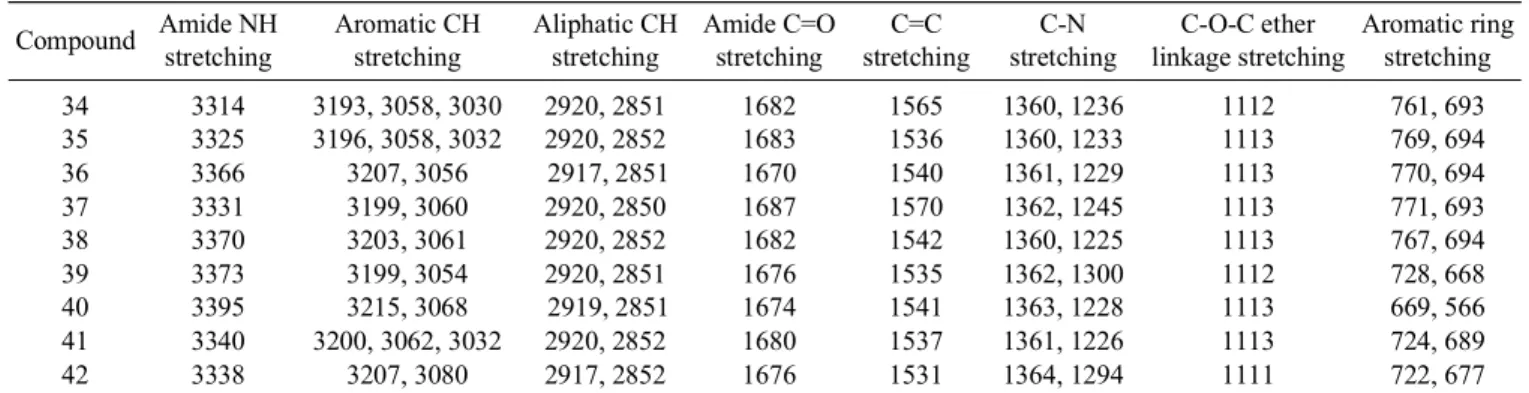
Table 2. FT-IR absorption frequencies (cm-1) for selected functional groups of compounds 34-42 Compound Amide NH
stretching
Aromatic CH stretching
Aliphatic CH stretching
Amide C=O stretching
C=C stretching
C-N stretching
C-O-C ether linkage stretching
Aromatic ring stretching
34 3314 3193, 3058, 3030 2920, 2851 1682 1565 1360, 1236 1112 761, 693
35 3325 3196, 3058, 3032 2920, 2852 1683 1536 1360, 1233 1113 769, 694
36 3366 3207, 3056 2917, 2851 1670 1540 1361, 1229 1113 770, 694
37 3331 3199, 3060 2920, 2850 1687 1570 1362, 1245 1113 771, 693
38 3370 3203, 3061 2920, 2852 1682 1542 1360, 1225 1113 767, 694
39 3373 3199, 3054 2920, 2851 1676 1535 1362, 1300 1112 728, 668
40 3395 3215, 3068 2919, 2851 1674 1541 1363, 1228 1113 669, 566
41 3340 3200, 3062, 3032 2920, 2852 1680 1537 1361, 1226 1113 724, 689
42 3338 3207, 3080 2917, 2852 1676 1531 1364, 1294 1111 722, 677
Table 1. Physical and analytical data of compounds 34-42
Compounds X Y Yield(%) m.p. (oC)
Elemental analysis (%)
m/z (M+H)+.
Molecular formula C Found
(calculated)
H Found (calculated)
N Found (calculated)
34 H H 58 45 70.55 (70.57) 5.88 (5.92) 14.90 (14.96) 375
C22H22N4O2
35 CH3 H 44 40 71.06 (71.11) 6.20 (6.23) 14.38 (14.42) 389
C23H24N4O2
36 F H 45 50 67.30 (67.33) 5.35 (5.39) 14.25 (14.28) 393
C22H21FN4O2
37 H OCH3 88 40 68.28 (68.30) 5.95 (5.98) 13.82 (13.85) 405
C23H24N4O3
38 H F 76 45 67.30 (67.33) 5.36 (5.39) 14.25 (14.28) 393
C22H21FN4O2
39 CH3 OCH3 54 50 68.87 (68.88) 6.22 (6.26) 13.36 (13.39) 419
C24H26N4O3
40 F F 41 45 64.31 (64.38) 4.87 (4.91) 13.62 (13.65) 411
C22H20F2N4O2
41 CH3 F 48 55 67.95 (67.97) 5.66 (5.70) 13.76 (13.78) 407
C23H23FN4O2
42 F OCH3 50 50 65.36 (65.39) 5.46 (5.49) 13.21 (13.26) 423
C23H23FN4O3
❖ N-(4,6-bis(4-fluorophenyl)pyrimidin-2-yl)2-morpholi- noacetamide 40
❖ N-(4-(4-fluorophenyl)-6-(4-methylphenyl)pyrimidin- 2-yl)2-morpholinoacetamide 41
❖ N-(4-(4-methylphenyl)-6-(4-fluorophenyl)pyrimidin- 2-yl)2-morpholinoacetamide 42
The structures of all the newly synthesized compounds are characterized by m.p.’s, elemental analysis, FT-IR, MS, one- dimensional NMR (1H and 13C) spectra.
FT-IR spectrum of 2-morpholino-N-(4,6-diphenylpyrimidin- 2-yl)acetamide 34 shows characteristic absorption frequency (Table 2) observed at 3314cm-1 is due to N-H stretching vibra- tions of the amide group. The absorption frequency at 3193 ~ 3030 cm-1 is assigned to aromatic stretching vibration. The ab- sorption frequency at 2920 ~ 2851 cm-1 is assigned to aliphatic
stretching vibration. The band at 1682 cm-1 is due to the presence of amide C=O stretching frequency. The absorption band at 1360 ~ 1236 cm-1 is consistent with C-N stretching vibration.
The absorption band at 1565 cm-1 is due to C=C stretching vibration. In addition, compound 34 displayed characteristic absorption bands (cm-1) in the regions 761 ~ 693 (aromatic ring stretching) and 1112 (C-O-C ether linkage in the morpholine ring); this gives positive evidence for the formation of com- pound 34.
In the 1H NMR spectrum of 34, a singlet observed at 3.91 ppm for two protons is assigned to methylene protons. The singlet for H-5 proton is observed at 6.69 ppm. The amide proton resonates at 10.25 ppm. Two triplets are observed and they are due to the methylene protons O(CH2)2 and N(CH2)2 of morpho- line ring. Among the triplets, one triplet observed in the region of 2.65 ~ 2.63 ppm corresponding to two protons and this signal
Table 3. Proton NMR chemical shifts (δ, ppm) of compounds 34-42 Compounds
Morpholine ring Acetamide moiety Pyrimidine ring
N(CH2) (triplet)
O(CH2) (triplet)
CH2
(singlet)
NH (broad singlet)
H-5 (singlet)
Ar-protons (multiplet)
Others (singlet)
34 2.65-2.63
J = 4.5 Hz
3.49-3.47
J = 4.8 Hz 3.91 10.25 6.69 8.20-7.30 -
35 2.68-2.66
J = 4.3 Hz
3.51-3.49
J = 4.6 Hz 3.88 10.24 6.65 8.37-7.06 3.85
OCH3
36 2.66-2.64
J = 4.4 Hz
3.49-3.47
J = 4.6 Hz 3.93 10.30 6.72 7.97-7.04 -
37 2.65-2.63
J = 4.5 Hz
3.49-3.46
J = 4.7 Hz 3.98 10.30 6.72 8.45-7.02 -
38 2.68-2.66
J = 4.8 Hz
3.51-3.49
J = 4.6 Hz 3.87 10.25 6.66 8.46-7.05 3.84
OCH3
39 2.656-2.64
J = 4.9 Hz
3.49-3.47
J = 4.6 Hz 3.97 10.30 6.62 8.45-6.74 -
40 2.68-2.66
J = 4.8 Hz
3.48-3.46
J = 4.4 Hz 3.89 10.26 6.67 8.35-7.25 2.37
CH3
41 2.65-2.63
J = 4.5 Hz
3.49-3.46
J = 4.7 Hz 3.85 10.18 6.58 8.19-7.02 3.82, OCH3
2.35, CH3
42 2.66-2.64
J = 4.3 Hz
3.49-3.47
J = 4.6 Hz 3.95 10.26 6.68 8.28-7.27 2.36
OCH3
is due to methylene protons N(CH2)2 of morpholine ring. Ano- ther triplet appeared in the region of 3.49 ~ 3.47 ppm, corres- ponding to two protons, which can be conveniently assigned to methylene protons O(CH2)2 of morpholine ring. The aromatic protons resonate in the region 8.20 ~ 7.30 ppm.
The 13C resonance at 163.91 ppm is assigned to the amide group bearing carbon C-2 of pyrimidine moiety. The amide car- bonyl carbon resonances at 169.40 ppm. The 13C resonances observed at 164.72 and 101.27 ppm are due to the C-4 and C-5 carbons respectively. The 13C resonances observed at 164.72 ppm is conveniently assigned to C-6 carbon. There are two 13C resonances observed at 45.89 and 67.25 ppm. Among the two resonances, one 13C resonance at 45.89 ppm is due to methylene carbon N(CH2)2 of morpholine ring and 13C resonances at 67.25 ppm is unambiguously assigned to methylene carbon O(CH2)2
of morpholine ring. The methylene carbon attached to amide carbonyl carbon resonances at 66.23 ppm. The remaining 13C signal at 137.38 ppm and 134.55 ppm are due to ipso carbons.
The aromatic carbons are observed in the region of 130.30 ~ 126.87 ppm.
The 1H and 13C NMR chemical shifts of all the newly synthe- sized compounds are furnished in Table 3 and 4 respectively.
CONCLUSION
In conclusion, we have synthesized a series of 2-morpholino- N-(4,6-diarylpyrimidin-2-yl)acetamides 34-42 by a four step synthetic route in good yields and characterized by their phy- sical and analytical data. The target molecules 34-42 have
pharmacophoric group such as amide besides the presence of biologically active morpholine and pyrimidine nuclei. The biological screening studies are under progress to evaluate the antibacterial, antifungal, antioxidant and anticancer potencies of the newly synthesized of 2-morpholino-N-(4,6-diarylpyri- midin-2-yl)acetamides 34-42.
EXPERIMENTAL
Thin layer chromatography (TLC) was carried out to monitor the course of the reaction and purity of the product. All the reported melting points were taken in open capillaries and were uncorrected. IR spectra were recorded in KBr (pellet forms) on a Thermo Nicolet-Avatar-330 FT-IR spectrophotometer and important absorption values (cm-1) alone are listed. 1H and 13C NMR spectra were recorded at 400 MHz and 100 MHz res- pectively on Bruker Avance II 400 NMR spectrometer using DMSO-d as solvent. The ESI +ve MS spectra were recorded on a Bruker Daltonics LC-MS spectrometer. Satisfactory micro- analysis was obtained on Carlo Erba 1106 CHN analyzer.
By adopting the literature precedent1,3-diaryl-prop-2-en-1- ones31 7-15, 2-amino-4,6-diarylpyrimidines32 16-24 and 2- chloro-N-(4,6-diarylpyrimidin-2-yl)acetamides33 25-33 were synthesized.
General method for the synthesis of 2-morpholino-N-(4,6- diarylpyrimidin-2-yl)acetamides 34-42
A mixture of 2-chloro-N-(4,6-diarylpyrimidin-2-yl)acetami- des 25-33 (0.005 mol), anhydrous potassium carbonate (0.01
Table 4. Carbon NMR chemical shifts (δ, ppm) of compounds 34-42 Compound
Morpholine ring Acetamide moiety Pyrimidine ring
N(CH2) O(CH2) CH2 C=O C-2 C-4 C-5 C-6 Aromatic
Carbons Ipso carbons Others 34 45.89 67.25 66.23 169.40 163.91 164.72 101.27 164.72 130.30-126.87 137.38, 134.55 - 35 46.02 67.29 66.24 171.01 163.85 164.48 101.01 164.75 128.49-113.89 137.76, 136.87,
129.05
55.27 OCH3
36 45.87 67.13 66.07 171.22 161.84 163.73 101.59 163.97 131.22-114.71 137.28,
136.55, 133.07 - 37 45.99 67.28 66.24 168.30 162.37 163.94 101.59 163.72 131.21-115.33 137.27,
136.14, 133.79 - 38 46.01 67.31 66.25 168.55 161.25 163.65 100.82 162.31 129.07-113.89 133.93, 129.79,
129.56, 129.27
55.27 OCH3
39 45.93 67.20 66.07 170.37 162.42 163.80 101.37 163.80 130.20-114.29 133.73, 131.43 - 40 45.99 67.27 66.23 169.45 163.95 164.70 101.45 164.70 130.30-126.88 140.17, 137.39,
134.52, 131.11
20.89 CH3
41 46.02 67.30 66.32 171.27 161.15 163.84 100.66 164.24 129.11-113.87 140.02, 134.66, 129.67
55.26, OCH3
20.82, CH3
42 45.93 67.21 66.08 170.21 161.38 163.89 101.24 164.83 127.98-115.31 140.23, 134.47, 129.15
20.90 CH3
mol) and morpholine (0.005 mol) in dry toluene was refluxed for about 8 ~ 10 h. After completion of the reaction, potassium carbonate was removed by filtration and excess of solvent was removed under reduced pressure. The obtained residues were purified by column chromatography using benzene and ethyl- acetate (1:1) mixture as eluent which afforded 2-morpholino- N-(4,6-diarylpyrimidin-2-yl)acetamides 34-42 in good yields.
Acknowledgments. Authors are thankful to NMR Research Centre, Indian Institute of Science, Bangalore for recording spectra. One of the authors namely V. Kanagarajan is grateful to Council of Scientific and Industrial Research (CSIR), New Delhi, Republic of India for providing financial support in the form of CSIR-Senior Research Fellowship (SRF) in Organic Chemistry.
REFERENCES
1. Mercer, F. L.; Lindhorst, T. E.; Commoner, B. Science 1953, 117, 558.
2. Matolesy, G. World Rev. Pest. Contr. 1971, 10, 50.
3. Weishaar, R. E.; Cain, M. C.; Bristor, J. A. J. Med. Chem. 1999, 42, 805.
4. Commoner, B.; Mercer, F. L. Nature 1951, 168, 113.
5. Ram, V. J.; Singha, V. K.; Guru, P. Eur. J. Med. Chem. 1990, 25, 549-555.
6. Ahluwalia, V. K.; Chauhan, A.; Khurana, A. Indian J. Chem.
1989, 28B, 964.
7. Tam, S. W.; Wong, Y. N.; Huang, S.; Shen, H. Eur. J. Med. Chem.
1999, 42, 809.
8. Goyal, R. N.; Bhusan, R.; Agarwal, A. J. Indian Chem. Soc. 1985, 62, 229.
9. Hamilton, D. J.; Sutherland, A. Tetrahedron Lett. 2004, 45, 5739.
10. Akyuz, S.; Akyuz, T. J. Mol. Struct. 2005, 744, 881.
11. Akyuz, S. J. Mol. Struct. 2003, 651, 205.
12. Chauhan, D.; Chauhan, J.S.; Singh, J. Indian J. Chem. 2001, 40B, 524.
13. Kushner, S.; Cassell, R.T.; Morton, J.; William, J. H. J. Org. Chem.
1951, 16, 1283.
14. Kochetkov, N. K.; Dudykina, N.V. J. Gen. Chem. USSR, 1951, 26, 2915.
15. Kochetkov, N. K.; Dudykina, N.V. J. Gen. Chem. USSR, 1957, 32, 1481.
16. Eregowda, G. B.; Kalpana, H. N.; Hedge, R.; Thimmaiah, K. N.
Indian J. Chem. 2000, 39B, 243.
17. Al-Haiza, M. A.; Mostafa, M. S.; El-Kady, M. Y. Molecules 2003, 8, 275.
18. Gan, J.; Wang, Q.; Yates, S. R.; Koskinen, C.; Jury, W. A. Proc.
Natl. Acad. Sci. U.S.A. 2002, 99, 5189.
19. Hasan, S. J.; Bhakar Rao. V. S.; Husain. S.; Sattur, P. B. Indian J.
Chem. 1971, 9, 1022.
20. Marouka K, Yamamoto H. Comprehensive Organic Synthesis, Trost B M. Pergamonn Press, 1991, Vol. 6, p 6221.
21. Manfred, R.; Michael, M.; Robert, S.; Wolfgang, G. Eur. Pat.
Appl. EP 1989, 334146, 28. Chem. Abstr. 1989, 112, 178999.
22. Manfred, R.; Michael.; Robert, S.; Wolfgang, G.; Eckhard, R.
Ger. Offen. DE 1989, 3729285, 17. Chem. Abstr. 1989, 111, 134172.
23. Hale, J. J.; Mills. S. G.; MacCross, M.; Dorn, C. P.; Finke, P. E.;
Budhu, R. J.; Reamer, R. A.; Huskey, W. P.; Luffer-Atlas, D.; Dean, B. J.; McGowan, E. M.; Feeney, W. P.; Chiu, S. H. L.; Cascieri, M.
A.; Chicchi, G. G.; Kurtz, M. M.; Sadowski, S.; Ber, E.; Tattersall, F. D.; Rupniak, N. M. J.; Williams, A. R.; Raycroft, W.; Hargreaves, R.; Metzger, J. M.; Maclntyre, D. E. J. Med. Chem. 2000, 43, 1234.
24. Dorn, C. P.; Hale, J. J.; MacCoss, M.; Mills, S. G. US Patent 1997, 5691336, 82. Chem. Abstr. 1979, 128, 48231.
25. Fisher, M. H.; Wyvratt, M. J. U. S. Patent 1991, 5077290, 10.
Chem. Abstr. 1991, 116, 214513.
26. Avramova, P.; Danchev, N.; Buyukliev, R.; Bogoslovova, T. Arch.
Pharm. 1998, 331, 342.
27. Gopalakrishnan, M.; Sureshkumar, P.; Thanusu, J.; Kanagarajan, V.; Ezhilarasi, M. R. Lett. Org. Chem. 2008, 5, 142.
28. Gopalakrishnan, M.; Thanusu, J.; Kanagarajan, V. J. Enz. Inhib.
Med. Chem. 2008, 23, 347.
29. Gopalakrishnan, M.; Thanusu, J.; Kanagarajan, V. Med. Chem.
Res. 2007, 16, 392.
30. Gopalakrishnan, M.; Sureshkumar, P.; Thanusu, J.; Kanagarajan, V.; Govindaraju, R.; Jayasri, G. J. Enz. Inhib. Med. Chem. 2007, 22, 709.
31. Guthrie, W.; Wang, X. P. Can. J. Chem. 1991, 69, 339.
32. Kothari, S.; Singhal, M.; Vijayvergia, D.; Vyas, R.; Verma, B. L.
J. Indian Chem. Soc. 2000, 77, 329.
33. Speziale, A. J.; Ha, P. C. J. Am. Chem. Soc. 1956, 78, 2556.