www.earticle.net
한우 거세우의 TMR사양에서 비육후기 농후사료 첨가가 사양성적, 도체특성 및 등심의 이화학적 특성과 관능평가에 미치는 영향
조웅기1#· 정찬성3#· 김현정4· 김지은4· 김보람4· 이성실2· 문여황5
경상대학교 응용생명과학부(BK21 program) 대학원생1, 교수2; 경기도축산위생연구소 연구원3; 경남과학기술대학교 동물생명과학과 대학원생4, 교수5
Effects of Supplemental Concentrate During the Late Fattening Phase on Performance, Carcass Characteristics, Biochemical Composition and Sensory
Test of Loin in TMR Feeding of Korean Steers
Woong Ki Cho1#, Chan Sung Jeong3#, Hyun Jung Kim4, Ji Eun Kim4, Bo Ram Kim4, Sung Sill Lee2 and Yea Hwang Moon5*
1Graduate Student,2Professor, Division of Applied Life Science (Institute of Agriculture & Life Science), BK21 plus, Gyeongsang National University, Jinju 52828, Korea, 3Researcher, Gyeonggido Livestock and Veterinary Service, Suwon 16381, Korea
4Graduate Student, 5Professor, Department of Animal Science & Biotechnology, Gyeongnam National University of Science and Technology, Jinju 52725, Korea
ABSTRACT1)
This study was conducted to investigate the effects by supplementing concentrates during the late fattening phase in TMR (total mixed ration) feeding of Korean steer on the performance, carcass traits, physico-chemical characteristics and sensory test of the longissimus dorsi muscle. Eight Korean steers (24 months of age) averaging 604 kg in body weight were fed the TMR (Control) or the TMR supplemented with concentrates (TMR+conc.) until 30 months of age, then they were slaughtered. Steers fed the TMR supplemented with concentrates had a higher (p<0.05) intakes of dry matter and TDN (total digestible nutrient), carcass weight and marbling score compared to those fed TMR only, but carcass grade did not differ (p>0.05) between treatments. Amino acid concentration of the longissimus dorsi muscle did not differ between treatments, However, the highest concentrations were for glutamic acid and lowest for cystine; further, and the content of essential amino acids was highest for lysine, leucine, threonine, arginine, and isoleucine in that order.Cis-oleic acid and arachidonic acid of fatty acids in the longissimus dorsi muscle were higher (p<0.05) in the control condition compared to TMR+conc. The contents of oleic acids, palmitic acid, stearic acid constituted about 88% of the total fatty acids. Although the physico-chemical characteristics of the longissimus dorsi muscle did not significantly differ between treatments (p>0.05), but the sensory test results were lower for the TMR+conc. condition. These results suggest that supplementing concentrates during the late fattening phase of Korean steers resulted in increasing the carcass weight and marbling score.
However, the cis-oleic acid content of the longissimus dorsi muscle was decreased as a result of supplementing concentrates, which could affect negatively in meat sensory evaluation.
(Key words: Korean steers, Feeding system, Longissimus dorsi muscle, Biochemical composition, Sensory test)
*Corresponding author: Yea-Hwang Moon, Department of Animal Science & Biotechnology, Gyeongnam National University of Science and Technology, Jinju 52725, Korea. Tel: +82-55-751-3265, E-mail: [email protected]
#These authors contributed equally to this work.
This is an Open Access article distributed under the terms of the Creative Commons Attribution Non-Commercial License (http://creativecommons.org/licenses/by-nc-nd/3.0/deed.ko), which permits unrestricted non-commercial use, distribution, and reproduction in any medium, provided the original work is properly cited. The moral rights of the named author(s) have been asserted.
[Provider:earticle] Download by IP 118.70.52.165 at Monday, December 20, 2021 7:47 PM
www.earticle.net
Ⅰ. 서론
한우거세우의 비육단계별 사양관리에서 비육후기는 일 반적으로 22개월령 이후부터 출하 시(29-30개월령)까지로 규정짓는다. 이 시기는 비육우의 육질에 결정적인 영향을 끼치는 근육 내 지방이 많이 침착되는 시기(Yamazaki, 1977)이므로 사료의 조성과 영양소 섭취량에 특별히 신경 을 써야한다. 즉, 이 시기에 영양소 섭취량을 충분히 유지 시킬 수 있도록 하는 것이 도체중량을 높이게 되고, 도체 중량이 증가되면 근내지방도도 직선적으로 증가(Bruns et al., 2004)하기 때문이다. 특히, 비육후기에서도 후반부인 24개월령 이후는 유지요구량이 증가하는 시기로 사료효율 이 떨어지고(NIAS, 2017), 근내지방 침착이 완성되는 시기 이므로 비육 마무리기라고도 한다. 사료섭취량이 줄어드는 이 시기에는 영양수준이 높은 사료를 급여하여야 하기 때 문에 섬유질 배합사료인 TMR보다는 농후사료를 최대한 섭취할 수 있도록 조사료와 분리 급여하는 사양방식에 대 해 주로 연구가 진행되어 왔다. 이러한 관점에서 TMR사양 에서 비육 마무리기에 사료섭취량 감소를 최소화하기 위 해서는 기호성이 좋은 농후사료를 추가로 급여하는 것도 하나의 방편이 될 수 있을 것이다. 한편, 국내소비자들의 육류소비경향이 양보다는 질적 개념으로 전환되면서 질 좋은 쇠고기가 수입되고, 지역별 한우 브랜드육이 시장에 정착하면서 소비자들의 선택폭도 확대되고 있다. 한우 사 양프로그램이 근내지방도를 높이는 고급육생산에 집중하 다 보니, 등지방이 지나치게 많이 축적되어 육량평가에서 는 나쁜 결과를 초래하는 경우가 많다. 이러한 상황에서 농림수산식품부에서는 근내지방도 위주의 도체등급의 결 과만으로 소비여건 변화를 충족시키기는 어려울 것으로 판단하여 질적 평가방식이 보완된 축산물 등급판정 세부 기준을 2019년 12월 1일부터 시행할 예정이다. 그러나 이 러한 기준만으로 등급이 우수한 쇠고기가 반드시 소비자 들의 입맛에 맞는 결과를 나타내지는 못하기 때문에 한우 산업의 경쟁력 강화를 위해서는 지역별 브랜드육의 육질 평가에 관능평가도 병행되어야 할 것으로 사료된다.
따라서 본 연구는 한우 거세우의 TMR사양에서 비육 마 무리기에 농후사료를 추가 급여함으로써 영양소 섭취수준 을 달리하였을 때, 사양성적과 도체품질 및 관능평가에 영 향을 끼치는 요인들에 대해 조사해 보고자 수행되었다.
Ⅱ. 재료 및 방법
1. 공시동물 및 시험기간
24개월령 한우거세우(평균체중 604kg) 8두를 이용하여 출하 시(30개월령)까지 사양시험을 실시하였다.
2. 공시사료 및 시험설계
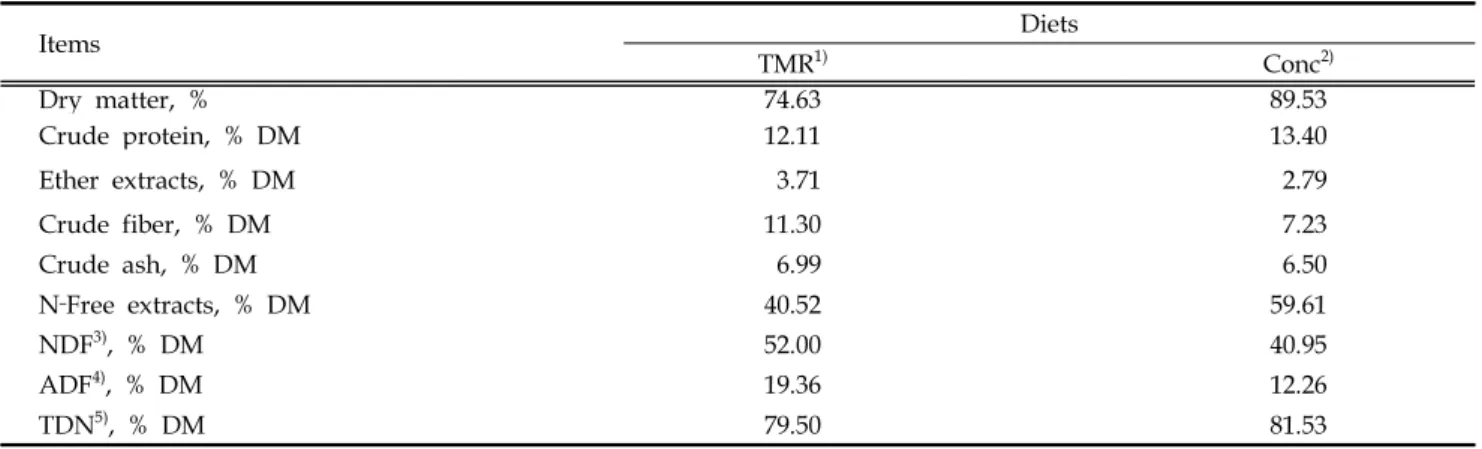
시험사료의 화학적 조성과 TMR의 배합비는 Table 1에 나타내었으며, 처리구는 대조구로서 TMR구와 TMR에 농 후사료로서 시판 비육후기용 배합사료를 추가로 급여한 구(TMR+Conc.)로 나누어 체중에 따라 각각 4두씩 난괴법 으로 배치하여다. 공시축은 주기적으로 개체별 사료섭취량 측정이 가능한 스탄쵼이 설치된 우사에서 군별 사육되었 으며, 농후사료 추가급여에 의한 효과를 충분히 나타내기 위한 사양관리를 하였다. 즉, TMR은 자유채식을 통한 총 섭취량을 측정한 후, 2주일 간격으로 공시축을 스탄쵼에 계류하여 자유채식 시 총섭취량의 1/4씩을 각각 2회 분할 급여함으로써 잔량이 최소화 될 수 있도록 하였고, 농후사 료는 비육후기(24-26개월령)에는 일일 1.25kg, 비육 마무리 기(27-30개월령)에는 일일 2.5kg을 top dressing하여 완전 히 섭취토록 하였다.
3. 조사항목 및 조사방법
(1) 공시재료
사양시험이 종료된 공시축은 24시간동안 절식시킨 후, 인근 축산물 공판장으로 이송하여 12시간 동안 계류시킨 다음, 도축하였다. 도체는 24시간 냉장실에서 냉각시킨 후 농림부 고시 제 2014-14호 축산물등급판정세부기준(2014.
2.3.)에 따라 육량 및 육질등급을 판정하였고, 등심의 이화 학적 특성과 관능검사를 위하여 도축장에서 모든 공시축 의 배최장근을 약 3kg씩 구입하여 진공포장한 후, 분석 시 까지 저온냉장실(2℃)에서 보관 하였다.
(2) 아미노산, 지방산 조성
배최장근의 아미노산 조성은 질소가스가 충진된 cap-tube에서 산(6N-HCl) 가수분해를 시킨 후, 자동 아미 노산 분석기(Pharmacia Biotech, Biochrom 20, Sweden)로 분석하였고, 등심 근내지방의 지방산 조성은 Folch 등 (1957)의 방법으로 지방을 추출하여 Lepage와 Roy(1986)의 방법에 따라 지방산을 methylation 시킨 후, GC(Shimadzu GC-14A, Japan)를 이용하여 분석하였다.
[Provider:earticle] Download by IP 118.70.52.165 at Monday, December 20, 2021 7:47 PM
www.earticle.net
Table 1. Chemical composition of experimental diets
Items Diets
TMR1) Conc2)
Dry matter, % 74.63 89.53
Crude protein, % DM 12.11 13.40
Ether extracts, % DM 3.71 2.79
Crude fiber, % DM 11.30 7.23
Crude ash, % DM 6.99 6.50
N‐Free extracts, % DM 40.52 59.61
NDF3), % DM 52.00 40.95
ADF4), % DM 19.36 12.26
TDN5), % DM 79.50 81.53
1)Corn, 25.5%; Barley, 10.0%; Hulls (wheat bran, soybean hull, cottonseed hull), 20.8%; Meals (Brewer's grain, Soybean meal, Palm kernel meal, Coconut meal), 32.5%; Vitamin-mineral premix, 1.3%; Hay (rice straw, rye grass, klein hay, alfalfa, tall fescue) 10.0%.
2)Concentrate: Commercial formula feed.
3)NDF: Neutral detergent fiber.
4)ADF: Acid detergent fiber.
5)TDN: Total digestible energy.
(3) 이화학적 분석
우육의 이화학적 특성은 저온냉장실(2℃)에서 14일 동안 숙성시킨 등심시료를 이용하였다. pH는 세절한 우육을 균 질화 시킨 후, pH meter(Thermo, Benchtop meter, USA) 로 측정하였고, 보수력(WHC, %)은 마쇄한 육류의 유리수 분과 전수분 함량을 구하여 계산하였다. 육즙감량(drip loss)은 육류시료를 일정한 모양으로 절단한 후, 보관하면 서 발생되는 감량을 측정하여 구하였고, 가열감량(cooking loss)은 시료를 일정한 모양으로 절단하여 무게를 측정하 고, 항온수조에서 가열 후 방냉시켜서 다음의 공식으로 구 하였다.
가열 감량
가열 전 시료의 양
가열 전 시료의 양 가열 후 남은 시료의 양
×
지방산패도(TBARS)는 Buege와 Aust(1978)의 방법에 따 라 구하였고, 휘발성 염기태질소화합물(VBN)은 Conway dish를 이용하여 산, 알카리 적정법으로 구하였다.
(4) 관능평가
관능평가는 숙성시킨 등심을 가로 4㎝×세로 3㎝×두께 1
㎝로 잘라서 조리용 철판에서 앞, 뒷면 각각 1분 동안 조리 하여 7명의 검사요원들에 의해 풍미(1-3, 약함; 4-6, 중간;
7-9, 강함), 연도(1-3, 질김; 4-6, 중간; 7-9, 연함) 및 다즙성 (1-3, 건조; 4-6, 중간; 7-9, 다즙)의 정도를 측정하였다.
4. 통계분석
통계분석은 SAS(Statistical Analysis System) release 9.01 for windows 통계 package(copyright 2002 by SAS Institute Inc. Cary, NC, USA)를 이용하여 T-test로 95%
수준에서 유의성검정을 하였다.
Ⅲ. 결과 및 고찰
1. 영양소 섭취량 및 체중 변화
비육후기의 한우 거세우에게 TMR을 자유채식 시키면서 농후사료를 추가로 급여하였을 때, 영양소 섭취량, 증체량 및 도체등급은 Table 2에 나타내었다. 농후사료 추가급여 구가 대조구인 TMR 자유채식구에 비해 건물 및 TDN섭취 량이 유의적(p<0.05)으로 많았다. 본 시험에서 한우 거세우 가 섭취한 건물, TDN 및 조단백질 수준을 한국가축사양표 준(NIAS, 2017)에서 한우거세우(체중 600-700kg)의 요구량 과 비교해 볼 때, 대조구인 TMR구에서는 일일 0.4kg 증체 에 필요한 요구량(건물 7.6-8.0kg, TDN 5.67-6.14kg, CP 0.93-10.15kg) 수준이었으며, 농후사료 추가구에서는 일일 0.8kg 증체에 필요한 요구량(건물 8.6-9.2kg, TDN 7.0- 7.43kg, CP 1.08-1.21kg) 수준에 해당되었다.
증체량은 농후사료 추가구가 대조구에 비해 유의적
[Provider:earticle] Download by IP 118.70.52.165 at Monday, December 20, 2021 7:47 PM
www.earticle.net
Items Treatments
TMR TMR+Conc.
Dry matter intake, kg/d 7.46±0.04b 9.33±0.12a
TDN intake, kg/d 5.83±0.03b 7.35±0.12a
Crude protein intake, kg/d 0.96±0.04b 1.06±0.07a
Initial body weight, kg 608±10.30 600±5.52
Final body weight, kg 699±10.66b 722±9.20a
Daily body gain, kg/d 0.50±0.06b 0.68±0.02a
Carcass weight, kg 402±7.59b 430±8.88a
Backfat thickness, mm 13.75±1.43 13.75±1.09
Longissimus dorsi muscle area, ㎠ 84.00±0.68 87.75±2.83
Yield index1) 64.10±1.08 63.91±0.69
Marbling score2) 5.25±0.31b 6.50±0.32a
Carcass grade3) 3.25±0.63 3.75±0.48
Mean±SE (n=4).
a,bMeans in the same row with different superscript differ significantly (p<0.05).
1)Yield index=68.184-(0.625×Back fat thickness)+(0.130×Longissimus dorsi muscle area)-(0.024×Carcass wt.)+3.23.
2)Marbling score (1 – 9): 1=devoid, 9=abundant.
3)Carcass grade: Yield grade (A=3, B=2, C=1)+Quality grade (1++=3, 1+=2, 1=1).
Table 2. The feeding performance and carcass characteristics by supplemental concentrate during the late fattening phase in TMR feeding of Hanwoo steers
(p<0.05)로 많았고, 도체특성에서 등지방 두께는 차이가 없 었으나, 도체중과 근내지방도는 농후사료 추가구가 대조구 에 비해 유의적(p<0.05)로 증가하였다. 육량 및 육질 등급 을 수치화한 결과인 도체등급에서는 처리 간 통계적인 유 의차는 없었으나 농후사료 추가구에서 향상되는 경향을 나타내었다. 한우 비육우에 있어서 출하월령이 증가할수록 도체중과 근내지방도와 같은 형질은 개선되지만 등지방은 두꺼워져서 육량등급에 오히려 불리해진다(NIAS, 2017).
또한 22개월령 이후, 비육마무리기에 건물이나 고 에너지 원(전분, 당, 유기산) 성분의 섭취량이 증가할수록 근내지 방도가 높아지므로(Williams et al., 1999) 이 시기동안 소 가 농후사료 섭취량을 최고치로 유지할 수 있도록 하는 것 이 중요하다고 하였다. Moon 등(2018)은 비육후기 한우거 세우의 육량 및 육질과 가장 상관관계가 높은 혈중 biomarker는 각각 AST와 retinol이었으며, 이들 성분을 이 용하여 도체등급을 미리 예측할 수 있는 회귀식을 도출하 기도 하였다.
2. 아미노산 조성
비육후기의 한우 거세우에게 TMR을 자유채식 시키면서 농후사료를 추가로 급여하였을 때, 도체의 배최장근 아미
노산 조성은 Table 3에 나타내었다.
아미노산 조성에서 glutamic acid 함량이 한우 배최장근 100g당 약 38mg으로 가장 높았으며, cystine이 약 1.9mg 수준으로 가장 낮았다. 분석된 각 필수아미노산의 함량은 처리 간에 유의적인 차이가 없었으며, lysine, leucine, threonine, valine, arginine, isoleucine, phenylalanine 순으 로 높았다. Moon 등(2011)은 한우 거세우 등심부위의 아미 노산 조성 중 glycine은 100g 당 1.91-2.75mg, alanine은 17.11-17.45mg, glutamic acid는 9.21-10.11mg 수준이라고 하여 본 연구결과보다 낮았으며, Cho 등(2008)은 시판되고 있는 한우육의 glutamic acid와 alanine 함량은 100g당 각 각 276.0-536.0mg, 130.6-175.2mg으로 본 시험의 결과에 비 해 매우 높은 수준이었으나, arginine(7.00-10.49mg/100g), phenylalanine(4.70-13.88mg/100g), leucine(5.98-10.26mg/
100g)은 본 시험의 결과보다 낮거나 비슷한 수준이었다.
우육의 아미노산 조성이 연구자에 따라 차이가 나는 것은 시료채취 부위가 동일하지 않았기 때문으로 사료된다. 또 한, Cho 등(2008)은 1++등급 거세한우의 부위별 이화학적 육질특성을 조사한 결과, 등심의 아미노산조성에서 glutamic acid 함량이 가장 높았고, aspartic acid, leucine, lysine 순이었다고 하여 본 시험의 결과와 같았다. 한우육 등심 중 아미노산 종류에 따라 단맛(sweet), 신맛(sour), 쓴
[Provider:earticle] Download by IP 118.70.52.165 at Monday, December 20, 2021 7:47 PM
www.earticle.net
Table 3. Amino acid profile of the longissimus dorsi muscle by supplementation of energy during the late fattening phase of Hanwoo steers (mg/100g)
Items Treatment
TMR TMR+Conc.
Threonine 13.59±2.78 15.80±0.84
Valine 14.46±2.92 16.64±0.76
Methionine 6.38±1.26 7.22±0.34
Isoleucine 12.57±2.51 14.45±0.66
Leucine 23.37±4.64 20.91±6.17
Phenylalanine 9.42±1.87 10.82±0.54
Arginine 13.24±2.70 15.38±0.82
Histidine 9.16±2.01 9.88±0.37
Lysine 22.06±4.44 25.53±1.26
Aspartic acid 24.49±4.95 28.65±1.47
Serine 13.22±2.72 15.37±0.92
Glutamic acid 34.93±7.07b 41.55±2.23a
Proline 13.91±3.13 15.17±0.91
Glycine 20.57±4.22 24.48±1.32
Alanine 23.39±4.81 27.17±1.30
Cystine 1.83±0.38 1.97±0.13
Tyrosine 7.31±1.34 7.63±0.28
Essential amino acids 124.3±0.63 136.6±0.63
Semi- or non-essential amino acids 139.7±1.17 162.0±1.41
a,bMeans in the same row with different superscripts differ significantly (p<0.05).
Mean±SE (n=4).
맛(bitter) 및 감칠맛(umami) 등 여러 가지 맛에 관련이 있 으며(Brand and Bryant, 1994), glycine, alanine, threonine, proline 및 serine은 단맛, leucine, isoleucine, methionine, phenylalanine, lysine, valine, histidine, arginine은 쓴맛, aspartic acid는 신맛, glutamic acid는 Umami로 분류하고 있다(Yoshikazu et al., 2009). 본 연구에서 단맛 계통의 아 미노산 함량은 농후사료 추가구가 대조구에 비해 약 12.5%
높은 수준이었으나, 쓴맛 계통의 아미노산 함량은 대조구 가 농후사료 추가구에 비해 약 12.9% 낮은 수준으로 나타 났다.
한국식품연구원(KFRI, Korea Food Research Institute)에 의하면 고기 맛에 긍정적인 영향을 미치는 아미노산은 glutamic acid, methionine, cystine이며, 이들 아미노산의 총 함량은 정육 100g당 한우육은 2.43g, 수입육은 1.88g, 젖 소육은 1.79g으로 한우육이 월등히 높았으며, 한우와 외국 품종의 교잡우는 2.33g 정도라고 하여 고기맛과 관련하는 아미노산합성에 대한 한우의 유전성을 확인할 수 있다. 배 최장근의 아미노산 중에서 함량이 가장 높은 glutamic acid는 우마미를 향상시키는 아미노산으로 알려져 있는데, 본 시험에서는 농후사료 추가구가 대조구에 비해 glutamic
acid가 유의적(p<0.05)으로 높았으나 관능평가(Table 5)에 서는 모든 항목에서 유의적인 차이는 없었지만 대조구가 오히려 높은 경향이었다.
3. 지방산 조성
비육후기의 한우 거세우에게 TMR을 자유채식시키면서 농후사료를 추가로 급여하였을 때, 도체의 배최장근내 지 방산 조성은 Table 4에 나타내었다.
지방산함량은 oleic acid, palmitic acid, stearic acid 순으 로 높았으며, 이들 지방산이 전체 지방산의 약 88%를 차지 하고 있었다. 지방산 중에서 cis-oleic acid와 arachidonic acid는 TMR구가 농후사료 추가구보다 유의적(p<0.05)으로 높았으나, 다른 지방산들은 처리 간에 차이가 없었다.
배최장근내 불포화지방산 함량이 포화지방산보다 높았 으며, 총 지방산 중에서 oleic acid 함량이 현저히 높아, 불 포화지방산 중에서도 단일 불포화지방산이 많았다. 포화지 방산에 대한 불포화지방산의 비율은 TMR구가 농후사료 첨가구보다 유의적인 차이는 없었으나 높은 경향을 보였 다. 육류에 불포화지방산 비율이 지나치게 높으면 식감을
[Provider:earticle] Download by IP 118.70.52.165 at Monday, December 20, 2021 7:47 PM
www.earticle.net
Table 4. The fatty acid composition (%) of intramuscular fat in the longissimus dorsi muscle by supplemental concentrate during the late fattening phase in TMR feeding of Hanwoo steers
Items Treatments
TMR TMR+Conc.
Myristic acid (C14:0) 1.81±0.25 2.26±0.39
Pentadecanoic acid (C15:0) 0.46±0.14 0.64±0.31
Palmitic acid (C16:0) 26.29±1.29 29.37±1.51
Palmitoleic acid (C16:1) 1.55±0.68 1.00±0.36
Magaric acid (C17:0) 0.44±0.12 0.46±0.19
Magaroleic acid (C17:1) 0.44±0.06 0.46±0.02
Stearic acid (C18:0) 12.30±0.98 12.30±1.78
trans-Oleic acid (C18:1n-9) 1.32±0.10 3.60±2.02
cis-Oleic acid (C18:1n-9) 49.94±0.98a 45.78±0.90b
trans-Linoleic acid (C18:2n-6) 0.16±0.01 0.14±0.05
cis-Linoleic acid (C18:2n-6) 3.87±0.32 2.90±0.68
r-Linolenic acid (C18:3n-3) 0.29±0.07 0.34±0.05
Arachidonic acid (C20:4n-6) 0.75±0.10a 0.28±0.02b
Saturated fatty acid 41.45±1.09 45.15±2.35
Monounsaturated fatty acid 53.42±0.62 51.02±1.79
Polyunsaturated fatty acid 5.11±0.47 3.73±0.74
Unsaturated fatty acid 58.52±1.09 54.75±2.39
USFA/SFA 1.42±0.06 1.23±0.11
a,bMeans in the same row with different superscripts differ significantly (p<0.05).
Mean±SE (n=4).
떨어뜨리는 연지방의 함량이 높아진다는 것을 의미하는데, 본 시험의 관능평가결과(Table 5)로 볼 때, 그러한 영향을 미칠 만한 수준은 아닌 것으로 판단된다. Park과 Yoo (1994)에 의하면 한우고기의 oleic acid 함량은 48.73%로 수입쇠고기 38.29%, 젖소 36.53%, 교잡우 38.22%보다 10%
이상이 높은 것으로 나타났으며, 본 시험에서는 한우육에 있어서 일반적인 수준의 범위에 있었다.
4. 이화학적 특성 및 관능평가
비육후기의 한우 거세우에게 TMR구와 TMR을 자유채 식시키면서 농후사료를 추가로 급여하여 도축하였을 때, 배최장근의 물리화학적 특성 및 관능평가 결과는 Table 5 에 나타내었다.
배최장근의 pH는 약 5.2수준으로 처리 간 차이가 없었 으며, 총 수분함량, 육즙감량, 조리감량, TBARS 및 휘발성 염기태 질소화합물(VBN)은 처리에 따른 유의적인 차이가 없었다(p>0.05). 쇠고기 신선육의 pH는 저장기간이 증가함 에 따라 증가하는데(Holley et al., 1994), 이것은 효소에 의 한 유리아미노산 생성, 숙성 중 단백질 완충물질의 변화,
전해질 해리의 감소, 아미노산의 분해 및 암모니아 생성 때문이다(Demeyer et al., 1979). Shin 등(2006)은 신선한 우육 등심의 pH는 5.6이었으며, 저장 6일째에 6.2수준으로 증가하면서 부패가 진행되었다고 하여 본 시험의 pH 수준 은 적절한 범위에 있었다.
지방산패도(TBARS)는 보관기간에 따른 지질 과산화물 의 최종산물 malondialdehyde(MA) 수치로 육의 산패도를 판단하는 지표로 사용된다. 쇠고기의 경우는 TBARS가 0.2mg MA/kg 이하 수준이 신선한 상태이며, 4.0mg MA/kg 이상은 완전히 산패된 것으로 평가(Brewer et al., 1992; Jeon et al., 2013)하고 있어 본 시험에서는 0.45- 0.54mg MA/kg 으로 대체로 양호한 수준이었다. 식품공전 에서는 단백질함량이 높은 식육의 신선도를 측정하는 기 준으로 휘발성 염기태 질소화합물(VBN) 함량은 20mg%
이하 수준이 신선하다고 규정하고 있으며, 쇠고기에서 VBN 함량이 15mg% 이상이 되면 부패취를 느낄 수 있다 (Kim et al., 1972; Park et al., 1988)고 하였는데, 본 시험에 서는 8.4-11.2mg% 수준으로 산패나 부패에 관련하는 항목 들에 대해서 적절한 수준의 범위에 있었다.
관능평가에서 측정된 풍미, 다즙성 및 연도는 처리 간에
[Provider:earticle] Download by IP 118.70.52.165 at Monday, December 20, 2021 7:47 PM
www.earticle.net
Table 5. The physico-chemical characteristics and sensory test of the longissimus dorsi muscle by supplemental concentrate during the late fattening phase in TMR feeding of Hanwoo steers
Items Treatments
TMR TMR+Conc.
Physico-chemical characteristics
pH 5.26±0.09 5.24±0.06
Total moisture, % 3.46±0.29 2.80±0.21
Drip loss, % 0.03±0.00 0.03±0.00
Cooking loss, % 25.11±1.15 27.18±3.85
TBARS1), mg MA/kg 0.45±0.02 0.54±0.10
VBN2), mg% 11.20±2.29 8.40±2.80
Sensory test
Flavor3) 6.66±0.50 5.76±0.47
Tenderness4) 7.00±0.48 6.07±0.62
Juiciness5) 6.47±0.68 5.57±0.56
1)TBARS: Thiobarbituric acid reactive substances.
2)VBN: Volatile basic nitrogen.
3)Flavor: weak (1~3), middle (4~6), strong (7~9).
4)Tenderness: chunkiness (1~3), middle (4~6), tender (7~9).
5)Juiciness: dry (1~3), middle (4~6), juicy (7~9).
Mean±SE (n=4).
유의적인 차이는 없었으나 지방산 분석결과에서 cis-oleic acid와 arachidonic acid 함량이 높았던 TMR구가 농후사 료 첨가구에 비해 대체로 성적이 좋은 것으로 나타났다. 본 시험에서 trans-oleic acid을 포함한 총 oleic acid 함량 으로 비교하였을 때, 처리 간 차이(51.3% : 49.4%)가 더욱 좁혀져, 지방산 분석결과와 관능평가 결과를 연관 지을 경 우에는 총 oleic acid 함량보다는 cis-oleic acid 함량을 적용 하는 것이 바람직한 것으로 사료된다. 일반적으로 고기의 관능특성은 섭취 시 느끼는 형태변화 과정, 침샘의 자극정 도 등을 종합적인 느낌으로 판단된다(Jowitt, 1974). 쇠고기 에 있어서 육질의 기호도를 가장 크게 좌우하는 것은 연도 (Wood et al., 1996)이고, 쇠고기의 연도는 근내지방도가 가장 중요한 요인이므로(Thompson, 2001) 육질등급이 높 을수록 연도는 높아진다(Shackelford et al., 1995). Lee 등 (2004)은 관능평가를 각 요인별로 6점 만점으로 분석한 결 과, 육질등급이 높아짐에 따라 연도는(3.19:4.48), 풍미 (4.18:4.74) 그리고 다즙성(3.88:4.68)이 각각 유의적(p<0.05) 으로 증가되었다고 하였다. Park 등(2019)은 돈육의 지방산 과 맛 요인들의 다중회귀 분석에서 oleic acid, stearic acid 및 포화지방산은 일반적으로 선호하는 맛으로 간주되는 풍 미(savoriness)와 단맛(sweetness)은 증가시키고, linolenic acid는 선호하지 않는 신맛(sourness)과 쓴맛(bitterness)을 증가시킨다고 하였다. 본 시험에서 조사된 관능평가의 결 과는 근내지방도나 육질등급 혹은 glutamic acid보다는
cis-oleic acid 함량에 의해서 영향을 더 많이 받은 것으로 나타났다.
이상의 결과들을 종합해 보면, 비육후기에 있는 한우거 세우에게 농후사료를 추가로 급여하여 영양소섭취량을 증가시키면 도체중과 배최장근의 근내지방도와 glutamic acid 함량은 증가되었으나 관능평가에서는 cis-oleic acid 와 arachidonic acid와 같은 지방산이 많은 대조구에 비 해 낮은 편이었다. 따라서 쇠고기의 맛은 cis-oleic acid 지방산에 의해 가장 영향을 많이 받는 것으로 판단된다.
Ⅳ. 요약
본 연구는 한우 TMR사양에서 비육후기 동안 농후사료 를 첨가하였을 때, 사양성적과 도체특성, 배최장근의 물리·
화학적 특성 및 관능평가에 미치는 영향을 조사하기 위하 여 수행되었다. 한우거세우 8두(24개월령, 평균체중 604kg) 를 TMR구(Control)와 TMR에 배합사료 추가구(TMR+
conc.)에 각각 배치하여 출하 시(30개월령)까지 사양한 후, 도축하였다. 배합사료 추가구가 대조구에 비해 건물과 TDN섭취량 및 도체중과 근내지방도는 유의적(p<0.05)으 로 높았으나, 도체등급에서는 차이가 없었다(p>0.05). 배최 장근 아미노산 조성은 처리간 차이는 없었으며, glutamic acid 함량이 가장 높았고, cystine함량이 가장 낮았다. 필수
[Provider:earticle] Download by IP 118.70.52.165 at Monday, December 20, 2021 7:47 PM
www.earticle.net
아미노산 중에는 lysine, leucine, threonine, arginine, isoleucine 순으로 높았다. 배최장근 지방산 중에서 cis- oleic acid와 arachidonic acid 함량은 대조구가 배합사료 추가구보다 유의적(p<0.05)으로 높았으며, oleic acid, palmitic acid, stearic acid 순으로 높았고, 이들 지방산이 전체 지방산의 약 88%를 차지하고 있었다. 배최장근의 물 리, 화학적 특성과 관능평가에서는 처리에 따른 유의적 차 이는 없었으나(p>0.05), 대조구의 결과가 대체로 우수한 편 이었다. 이상의 결과들로 볼 때, 한우거세우에게 비육후기 동안 농후사료를 추가 급여하면 도체중과 근내지방도는 증가되나, 배최장근내 cis-oleic acid함량이 줄어들어 육류 관능평가에서는 부정적인 효과를 나타낼 수 있을 것으로 사료된다.
사사
본 논문은 2018년도 경남과학기술대학교 대학회계연구 비 지원에 의해 수행되었음.
Ⅴ. 참고문헌
1. Brewer, M. S. and Habers, C. A. Z. 1993. Effect of packaging on physical and sensory characteristic of ground pork in long-term frozen storage. J. Food Sci.
56:627-631.
2. Brand, J. G. and Bryant, B. P. 1994. Receptor mechanisms for flavour stimuli. Food Qual. Prefer.
5:31-40.
3. Bruns, K. W., Pritchard, R. H. and Boggs, D. L. 2004.
The relationships among body weight, body composition, and intramuscular fat content in steers. J.
Anim. Sci. 82(5):1315–1322.
4. Buege, A. J. and Aust, S. D. 1978. Microsomal Lipid peroxidation, In Methods in enzymology, Gleischer S.
and Parke L. (ed), Academic Press Inc., New York. pp.
302-310.
5. Cho, S. H., Seong, P. N., Kim, J. H., Park, B. Y., Baek, B. H., Lee, Y. J., In, T. S., Lee, J. M., Kim, D. H. and Ahn, C. N. 2008. Calorie, cholesterol, collagen, free amino acids, nucleotide-related compounds and fatty
acid composition of Hanwoo steer beef with 1++
quality grade. Korean J. Food Sci. Ani. Resour.
28(3):333-343.
6. Demeyer, D. I., Vandekerckhove, P. and Moermans, R.
1979. Compounds determining pH in dry sausage.
Meat sci. 3:161-164.
7. Folch, J., Lee, M. and Stanley, G. H. S. 1957. Simple method for the isolation and purification of total lipids from animal tissues. J. Biol. Chem. 226:497-509.
8. Holley, R. A., Gariepy, D., Delaquis, P., Doyon, G.
and Gagnon, J. 1994. Static controlled atmosphere packaging retail ready pork. J. Food sci. 59:1296-1301.
9. Jeon, K. H., Kwon, K. H., Kim, E. M., Kim, Y. B., Sohn, D. I. and Choi, J. Y. 2013. Effect of cooking methods with various heating apparatus on the quality characteristics of beef. Korean J. Culinary Research. 19(5):196-205.
10. Jowitt, R. 1974. Psychobiology-Its foundations and current outlook. J. Texture Stud. 8:229-240.
11. Kim, Y. J., Park, Y. K. and Kong, U. Y. 1972. Studies on the preservation of raw beef by gamma radiation.
Korean J. Food Sci. Technol. 4:95-99.
12. Lee, J. M., Park, B. Y., Cho, S. H., Kim, J. H., Yoo, Y.
M., Chae, H. S. and Choi, Y. I. 2004. Analysis of carcass quality grade components and chemico- physical and sensory traits of M. longissimus dorsi in Hanwoo. J. Anim. Sci. Technol. (Kor.) 46(5):833-840.
13. Lepage, G. and Roy, C. C. 1986. Direct transesterification of all classes of lipid in one-step reaction. J. Lipid Research. 27:114-120.
14. Livestock Assessment. 2007. Grading of carcasses of methods, standards and enforcement.
15. Moon, Y. H., Cho, W. K. and Lee, S. S. 2018.
Investigation of blood biomarkers related to meat quality and quantity in Hanwoo steers. Asian- Australas J. Anim. Sci. 31(12):1923.
16. Moon, Y. H., Yang, S. J. and Jung, I. C. 2011. Effect of feeding mugwort (Artemisia capillaris) TMR fodder on nutritional composition of Hanwoo beef.
Korean J. Life. Sci. 21:568-575.
17. NIAS (National institute of animal science). 2017.
Korean feeding standard for Hanwoo. RDA. pp.
[Provider:earticle] Download by IP 118.70.52.165 at Monday, December 20, 2021 7:47 PM
www.earticle.net
57-62.
18. Park, B. S. and Yoo, I. J. 1994. Comparison of fatty acid composition among imported beef, Holstein steer beef and Hanwoo beef. Korean J. Anim Sci.
36(1):69-75.
19. Park, G. B., Kim, Y. J., Lee, H. G., Kim, J. S. and Kim, Y. H. 1988. Changes in freshness of meats during postmortem storage. Korean J. Anim. Sci.
30:672-677.
20. Park, J. R., Choe, H. S. and Shim, K. S. 2019. Effect of fatty acid compositions on eating quality on Pork loin. Ann. Anim. Resour. Sci. 30(2):49-58.
21. SAS. 2002. SAS User's Guide: Statistics. SAS Institute Inc. Cary. NC.
22. Shackelford, S. D., Wheeler, T. L. and Koohmarmie, M. 1995. Relationship between shear force and trained sensory panel tenderness rations of 10 major muscles form bos indicus and bos taurus cattle. J.
Anim. Sci. 73:3333-3340.
23. Shin, H. Y., Ku, K. J., Park, S. K. and Song, K. B.
2006. Use of freshness indicator for determination of freshness and quality change of beef and pork during storage. Korean J. Food Sci. Technol.
38(3):325-330.
24. Thompson, J. M. 2001. The relationship between marbling and sensory traits. Marbling symposium.
Coffs Harbour, Australia. pp. 77-87.
25. Williams, G. L., McVey, W. R. Jr. and Hunter, J. F.
1993. Mammary somatosensory pathways are not required for suckling-mediated inhibition of luteinizing hormone secretion and delay of ovulation in cows. Biol. Reprod. 49:1328.
26. Wood, J. D., Brown, S. N., Nute, G. R., Whittington, F. M., Perry, A. M., Johnson, S. P. and Enser, M.
1996. Effects of breed, feed level and conditioning time on the tenderness of pork. Meat Sci. 44:105-112.
27. Yamazaki, T. 1977. The effects of age and fatness on the meat quality and quantity of beef cattle I. The growth of various organs and tissues of Japanese Black Breed steers. Bull. Chugoku Natl. Agric. Exp.
Sta. Series B. 23:53.
28. Yoshikazu, A., Tani, H., Shimizu, N., Yamaguchi, S., Iwamoto, E. and Fuzita, F. 2009. Influence of the formula feed which contained mainly full-fat rice bran, barley bran, rough ground barley and broken rice on the productivity and meat quality in fattening Japanese Black cows. Bulletin of Beef Cattle Science.(Japan) 87:19-28.
(Received 14 Auguest 2019, Revised 09 December 2019, Accepted 11 December 2019)
[Provider:earticle] Download by IP 118.70.52.165 at Monday, December 20, 2021 7:47 PM