www.earticle.net
에너지 수준이 다른 사료에 복합효소제의 첨가가 육계의 사양성적, 영양소 소화율, 혈액성상, 장내미생물 균총 및 소장 융모에 미치는 영향
심영호1# · 김진수2# · Hosseindoust Abdolreza2 · Santosh Laxman Ingale3 · 최요한2 · 김민주2 오승민2 · 함형빈2 · 채병조2*
㈜사조바이오피드1, 강원대학교 동물생명과학대학2, Advanced Enzyme Technologies Ltd.3
Effects of Supplementation of Multienzymes in Diets Containing Different Energy Levels on Growth Performance, Nutrient Digestibility,
Blood Metabolites, Microbiota and Intestinal Morphology of Broilers
Young Ho Shim
1#, Jin Soo Kim
2#, Abdolreza Hosseindoust
2, Santosh Laxman Ingale
3, Yo Han Choi
2, Min Ju Kim
2, Seung Min Ohh
2, Hyung Bin Ham
2and Byung Jo Chae
2*1Sajo Bio Feed Co., Ltd., Hampyeong 57136, Korea
2Department of Animal Life Science, College of Animal Life Sciences, Kangwon National University, Chuncheon 24341, Korea
3Advanced Enzyme Technologies Ltd., Thane 400-604, India
ABSTRACT1)
The present study was conducted to investigate the effects on growth performance, nutrient digestibility, and gut health of broiler chickens when a dietary supplementation of multienzymes was added to diets, containing different energy levels. A total of 480 broiler chickens of similar body weight (Ross 308, 1-day-old) were randomly subjected to four treatments. The dietary treatments included a corn-soybean meal-based diet supplemented with: multienzyme (amylase+protease+
mannanase+xylanase+phytase), 0.05% enzyme, and different energy levels (3010 and 3060 kcal/kg). The experimental diets were fed to the chicks in a mash form for 35 days in two phases (1–21 d, phase I;
and 22–35 d, phase II). During the overall period, chicks fed with diets supplemented with multienzymes had a better weight gain (p<0.05) and feed conversion ratio (FCR) than those fed with diets without enzymes. There was no difference in the growth rate and FCR among the chicks fed with diets supplemented with enzymes, even though the dietary energy levels were different. The apparent fecal and ileal digestibility of dry matter, gross, crude protein, calcium, and phosphorus were significantly enhanced (p<0.05). The population of cecal and ileal Lactobacillus spp. was significantly increased (p<0.05), and Clostridium spp. and coliforms were significantly decreased (p<0.05) in diets supplemented with enzymes. Villus height and villus height to crypt depth ratio in the small intestine was also significantly enhanced (p<0.05) in diets supplemented with enzymes. In conclusion, multienzyme supplementation had positive effects on the weight gain of broilers, FCR, digestibility of nutrients, and on the growth of intestinal microbiota.
(Key words: Enzyme supplementation, Energy level, Digestibility, Microflora, Broiler)
* Correspondence authors: Byung Jo Chae, Department of Animal Life Science, Kangwon National University, Chuncheon 24341, Korea. Tel: +82-33-250-8616, E-mail: [email protected]
#These authors contributed equally to this work.
This is an Open Access article distributed under the terms of the Creative Commons Attribution Non-Commercial License (http://creativecommons.org/licenses/by-nc-nd/3.0/deed.ko), which permits unrestricted non-commercial use, distribution, and reproduction in any medium, provided the original work is properly cited. The moral rights of the named author(s) have been asserted.
[Provider:earticle] Download by IP 118.70.52.165 at Monday, December 20, 2021 7:52 PM
www.earticle.net
Ⅰ. 서론
사료의 소화율에는 사료 내 함유된 non starch polysaccharide (NSP)의 영향이 크다. 사료 내 NSP는 수분과 결합하여 소화물의 점도를 높이게 되고(Campbell and Bedford, 1992), 이로 인해 소화관내 소화효소의 작용을 방해함 으로서 영양소의 흡수를 저하시킬 수 있다고 보고되었 다(Leeson and Summers, 2001).
특히, 가금과 같은 단위동물의 경우 사료 내의 모든 영양소를 분해할 만큼의 충분한 효소를 분비하지 못하 므로 NSP를 분해하여 영양소 이용률을 개선시킬 수 있 는 효소제들이 근래에 들어서 주목을 받고 있다. 이러 한 효소제는 사료의 원가절감과 대체원료의 이용증진 을 위하여 사용량이 점차 증가하는 추세이며, 현재 많 이 이용되고 있는 효소제로는 xylanase, β-glucanase, β-mannanase, amylase, protease, phytase 등이 있다.
사료 내 효소제의 첨가는 일반적으로 소화율 개선으 로 인해 성장률과 사료효율을 향상시킨다. 단위가축 사 료 내 xylanase, phytase, amylase, protease, cellulase, β- glucanase와 같은 효소제를 첨가할 경우 비전분성 탄수화물의 소화율을 증진시켜 사료효율을 개선하고 성장률에 효과가 있다고 보고하였다(Jo et al., 2012).
Juanpere 등(2005)은 육계사료 내 효소제를 첨가하여 급여했을 때 에너지는 2.60%, 건물은 2.99%, 전분은 1.72%, β-glucan은 17.24% 그리고 지방은 7.23%의 소 화율을 개선한다고 보고하였다. 또한 Owens 등(2008) 은 육계사료에 xylanase를 첨가하여 급여했을 때 장 내 점도가 유의하게 감소한다고 하였고, Kocher 등(2000) 은 높은 수준(35%)의 캐놀라박이 함유된 육계사료에 β-glucanase와 xylanase를 첨가하여 급여한 결과 공장 내 NSP 함량이 유의하게 감소된다고 보고하였다.
한편, Kim 등(2013)은 사료 내 효소제의 첨가는 사료 의 영양소 이용성을 개선하여 에너지 절약 효과가 있다 고 하였다. 실제로 NSP를 분해할 수 있는 복합효소제 의 급여는 사료 내 에너지 절약효과를 기대할 수 있다. 그러나 복합효소제의 급여가 어느 정도의 에너지 절약 효과가 있는지에 대한 연구는 미흡한 실정이다.
따라서 본 연구는 에너지 수준을 달리한 육계사료에 서 복합효소제의 첨가가 사양성적, 영양소 소화율, 혈 액성상, 장 내 미생물 및 소장 융모에 미치는 영향에 대해 알아보고자 수행하였다.
Ⅱ. 재료 및 방법
1. 복합효소제
본 시험에 이용된 복합효소제(DigeGrain DeltaⓇ, Advance Enzyme Technologies, Thane, India)는 Bacillus amyloliquefaciens, Bacillus licheniformis, Trichoderma citrinoviride, Trichoderma citrinoviride와 Pichia pastoris로 부터 각각 추출한 amylase, protease, β-mannanase, xylanase와 phytase를 이용하였으며, 함량은 amylase 800,000BAU/kg, protease 1,000,000PCU/kg, β-mannanase 2,500,000MNU/kg, xylanase 600,000XU/kg 및 phytase 1,000,000FTU/kg이다.
2. 공시동물, 시험사료 및 사양관리
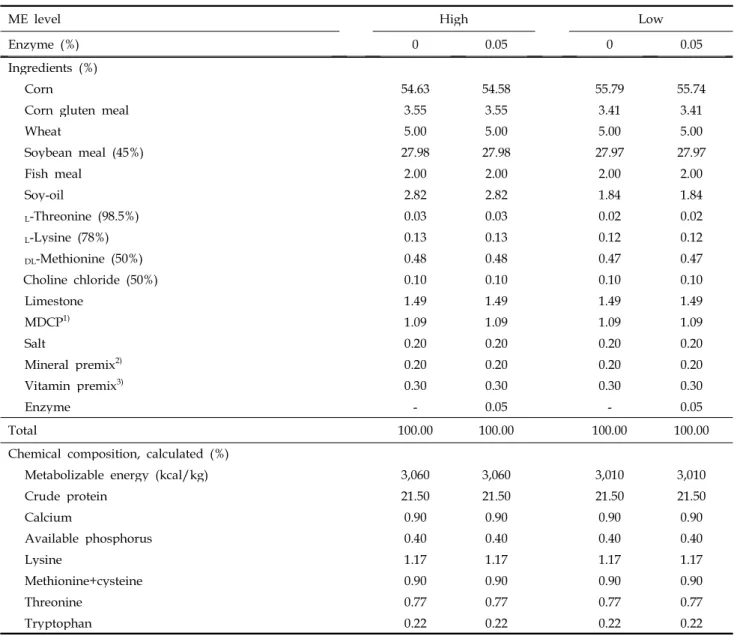
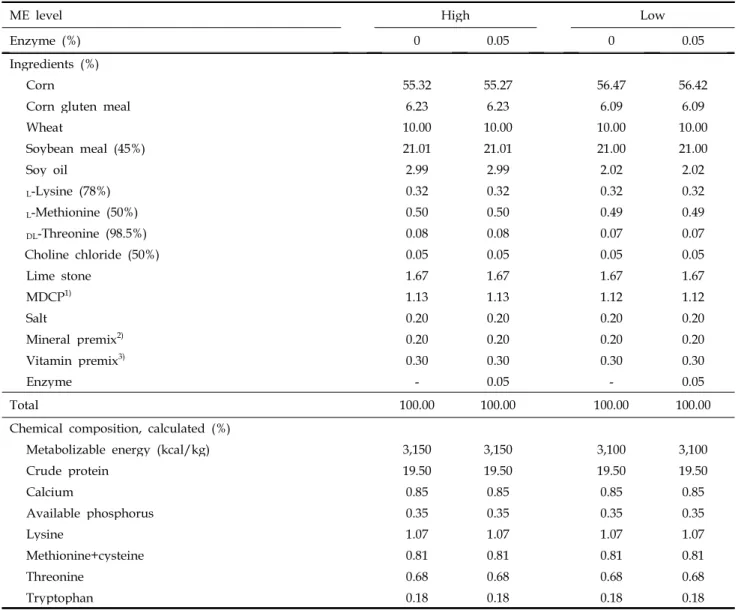
사양시험을 위하여 육계(Ross 308, 1일령) 480수를 공시하여 4처리 8반복, 반복당 15수를 완전임의 배치하 였다. 시험기간은 전기 3주(0∼21일)와 후기 2주(21∼35 일)로 나누어 총 5주간 실시하였다. 처리내용은 사료 내 대사에너지 2수준과 복합효소제 첨가유무에 따른 2×2 요인 분석법에 따랐으며, 고에너지(전기 3,060kcal/kg; 후 기 3,150kcal/kg) 사료에 복합효소제 무첨가와 첨가 (0.05%), 저에너지(전기 3,010kcal/kg; 후기 3,100kcal/
kg) 사료에 복합효소제 무첨가와 첨가(0.05%)로 구성하 였다. 시험사료의 영양소 수준은 NRC(1994)에서 제시 된 영양소 요구량을 충족하거나 초과하도록 배합하였 으며(Table 1, 2), 사료는 가루형태로 급여하였다. 시험 사료와 물은 자유채식 시켰으며 본 시험에 이용된 복합 효소제를 제외하고는 다른 첨가제나 약품은 일체 사용 하지 않았다. 시험기간의 육계의 사양관리는 본 연구실 의 관행에 준하여 실시하였다.
3. 조사항목 및 방법
(1) 사양성적
육계의 체중측정은 시험개시, 전기 종료(3주)와 후기 종료(5주)시에 실시하였으며, 사료섭취량은 체중측정 시 사료 급여량에서 잔량을 제하였으며, 사료요구율은 사료섭취량을 증체량으로 나누어 산출하였다.
[Provider:earticle] Download by IP 118.70.52.165 at Monday, December 20, 2021 7:52 PM
www.earticle.net
Table 1. Ingredient and chemical composition of basal diet, as-fed basis (Phase Ⅰ)
ME level High Low
Enzyme (%) 0 0.05 0 0.05
Ingredients (%)
Corn 54.63 54.58 55.79 55.74
Corn gluten meal 3.55 3.55 3.41 3.41
Wheat 5.00 5.00 5.00 5.00
Soybean meal (45%) 27.98 27.98 27.97 27.97
Fish meal 2.00 2.00 2.00 2.00
Soy-oil 2.82 2.82 1.84 1.84
L-Threonine (98.5%) 0.03 0.03 0.02 0.02
L-Lysine (78%) 0.13 0.13 0.12 0.12
DL-Methionine (50%) 0.48 0.48 0.47 0.47
Choline chloride (50%) 0.10 0.10 0.10 0.10
Limestone 1.49 1.49 1.49 1.49
MDCP1) 1.09 1.09 1.09 1.09
Salt 0.20 0.20 0.20 0.20
Mineral premix2) 0.20 0.20 0.20 0.20
Vitamin premix3) 0.30 0.30 0.30 0.30
Enzyme - 0.05 - 0.05
Total 100.00 100.00 100.00 100.00
Chemical composition, calculated (%)
Metabolizable energy (kcal/kg) 3,060 3,060 3,010 3,010
Crude protein 21.50 21.50 21.50 21.50
Calcium 0.90 0.90 0.90 0.90
Available phosphorus 0.40 0.40 0.40 0.40
Lysine 1.17 1.17 1.17 1.17
Methionine+cysteine 0.90 0.90 0.90 0.90
Threonine 0.77 0.77 0.77 0.77
Tryptophan 0.22 0.22 0.22 0.22
1)Monodicalcium phosphate.
2)Supplied per kg diet: 20 mg Fe, 16 mg Cu, 110 mg Zn, 120 mg Mn, 1.25 mg I, 0.9 mg Co, 0.3 mg Se.
3)Supplied per kg diet: 10,000 IU vitamin A, 4,500 IU vitamin D3, 65 mg vitamin E, 1.5 mg vitamin B1, 12 mg vitamin B2, 3.2 mg vitamin B6, 0.011 mg vitamin B12, 3.0 mg vitamin K3, 18 m pantothenic acid, 60 mg niacin, 0.18 mg biotin, 1.9 mg folic acid, 18 mg ethoxyquin.
(2) 영양소 소화율
영양소의 분 소화율 측정을 위해 전분채취법을 이용 하였으며, 시험종료 일주일 전부터 불소화지시제인 Chromic oxide(Cr2O3)을 사료에 0.25%로 첨가하였다.
분 채취는 Cr2O3을 첨가한 사료를 급여한 후 4일 이후 부터 반복별 분을 채취하였다(4처리 8반복). 외관상 회 장소화율 측정을 위해 후기 종료(5주)시 반복당 2수씩 도계하여 회장내용물을 채취하였다. 채취한 회장내용 물은 건조하기 전까지 –20℃에서 냉동 보관하였다.
소화율 측정용 시료는 혼합하여 열풍 건조기로 60℃
에서 72시간 건조한 후 1mm wiley mill로 분쇄 후 분 석을 실시하였다. 사료, 분 및 회장내용물의 일반성분 분석은 AOAC(2007) 방법에 의해 실시하였고, 에너지 는 단열폭발열량측정기(Model 1241 Parr Instrument, Moline, IL, USA)로 측정하였으며, Cr2O3은 acid digestion method에 의하여 Spectrophotometer(Model V-550, Jasco, Japan)를 이용하여 측정하였다.
[Provider:earticle] Download by IP 118.70.52.165 at Monday, December 20, 2021 7:52 PM
www.earticle.net
Table 2. Ingredient and chemical composition of basal diet, as-fed basis (Phase Ⅱ)
ME level High Low
Enzyme (%) 0 0.05 0 0.05
Ingredients (%)
Corn 55.32 55.27 56.47 56.42
Corn gluten meal 6.23 6.23 6.09 6.09
Wheat 10.00 10.00 10.00 10.00
Soybean meal (45%) 21.01 21.01 21.00 21.00
Soy oil 2.99 2.99 2.02 2.02
L-Lysine (78%) 0.32 0.32 0.32 0.32
L-Methionine (50%) 0.50 0.50 0.49 0.49
DL-Threonine (98.5%) 0.08 0.08 0.07 0.07
Choline chloride (50%) 0.05 0.05 0.05 0.05
Lime stone 1.67 1.67 1.67 1.67
MDCP1) 1.13 1.13 1.12 1.12
Salt 0.20 0.20 0.20 0.20
Mineral premix2) 0.20 0.20 0.20 0.20
Vitamin premix3) 0.30 0.30 0.30 0.30
Enzyme - 0.05 - 0.05
Total 100.00 100.00 100.00 100.00
Chemical composition, calculated (%)
Metabolizable energy (kcal/kg) 3,150 3,150 3,100 3,100
Crude protein 19.50 19.50 19.50 19.50
Calcium 0.85 0.85 0.85 0.85
Available phosphorus 0.35 0.35 0.35 0.35
Lysine 1.07 1.07 1.07 1.07
Methionine+cysteine 0.81 0.81 0.81 0.81
Threonine 0.68 0.68 0.68 0.68
Tryptophan 0.18 0.18 0.18 0.18
1)Monodicalcium phosphate.
2)Supplied per kg diet: 20 mg Fe, 16 mg Cu, 110 mg Zn, 120 mg Mn, 1.25 mg I, 0.9 mg Co, 0.3 mg Se.
3)Supplied per kg diet: 10,000 IU vitamin A, 4,500 IU vitamin D3, 65 mg vitamin E, 1.5 mg vitamin B1, 12 mg vitamin B2, 3.2 mg vitamin B6, 0.011 mg vitamin B12, 3.0 mg vitamin K3, 18 m pantothenic acid, 60 mg niacin, 0.18 mg biotin, 1.9 mg folic acid, 18 mg ethoxyquin.
(3) 혈액성상
혈청은 자동생화학 분석기(Dri-chem 3500i, Fuji, Japan)를 이용하여 혈청 내 total cholesterol(TCHO), triglyceride (TG), glucose(GLU), Ca 및 P의 함량을 분석하였다. 사 양시험 종료 시 반복당 2수를 선발하여 익정맥에서 혈 액을 채취하여 heparin으로 항응고 처리한 vacutainer tube에 넣은 후 실험실로 옮겨 3,000rpm에서 20분간 원심분리하여 혈청을 분리한 후 분석하기 전까지 –20℃
에서 냉동 보관하였다.
(4) 장 내 미생물
장내 미생물을 조사하기 위해 전기와 후기 종료 시에 도살된 육계 회장 및 맹장에서 내용물을 공기와의 접촉 을 최대한 피하면서 채취한 후 밀봉하였다. 맹장내용물 은 채취 후 비닐팩에 밀봉하여 아이스박스에 저장하여 즉시 실험실로 옮겨 분석하였다. 장내 미생물 검사는 회장과 맹장 내용물 5g씩을 수거하여 45ml 희석액에 넣고 균질하게 1차 현탁액을 만들어 현탁액 1ml를 9ml 희석액에 연속 희석하였다. 희석 중 혐기 상태를 유지
[Provider:earticle] Download by IP 118.70.52.165 at Monday, December 20, 2021 7:52 PM
www.earticle.net
Table 3. Selection of media and culturing condition for the enumeration of microorganisms
Item Medium Incubation
Temp, ℃ Hour
Total anaerobic bacteria Tryptic soy agar 37 48
Lactobacillus spp. MRS agar1) 37 48
Clostridiumspp. TSC agar (anaerobic)2) 37 48
Coliform bacteria Violet red bile agar 37 48
1)MRS agar+NaN3 0.02%+L-cysteine hydrecloride monohydrate 0.05%.
2)TSC agar+egg yolk emulsion (distilled water: egg yolk=4:1) 25 ml/500 ml+cysloserine (1 mg/500 ml).
하기 위해 희석액 표면을 파라핀 오일로 코팅하였고 질 소 가스로 충진하며 실험하였다. 제조된 희석액 중 원 하는 희석액에서 1ml를 취하여 페트리 디쉬에 분주 후 배양하였다. 이때 사용한 희석액은 peptone과
L-cysteine․HCl을 각각 0.5%, 0.05%씩 첨가한 용액을 사 용하였다. 균수 측정을 위해 사용된 배지와 발효조건은 Table 3과 같으며, 미생물 중 총균수(total anaerobic bacterial counts)와 Clostridium spp. counts는 Gas Pak System(BBL)을 사용하여 혐기상태로 발효하였고, Lactobacillus spp. counts와 Coliform bacteria는 호기상 태로 발효한 후 세균의 수는 각 plate의 colony- forming unit(CFU)로 계산 후 log10으로 환산하였다.
(5) 소장 morphology
도체직후 소장의 십이지장, 공장 그리고 회장을 구분 하여 융모의 형태학적 변화를 관찰하기 위하여 각 부분 (십이지장, 공장 및 회장)은 1㎝ 크기로 적출하여 식염 수로 세척 후 10% 포르말린 용액에 고정시켜 주사현미 경으로 관찰 할 때까지 상온에서 보관하였다. 소장의 융모 높이(villus height), 융와 깊이(crypt depth)를 측 정하기 위하여 10% 포르말린 용액에 보존되어 있던 시 료를 paraffin으로 고정시킨 후 6㎛ 크기로 절단하여 azure A와 eosin으로 염색하였다. 염색된 시료는 40배 비율의 microscope에서 측정하였다(Cera et al., 1988).
융모 높이와 융와 깊이의 비율(villus height: crypt depth, VH/CD)은 융모 높이를 융와 깊이로 나누어 산 출하였다.
4. 통계처리
본 2×2요인 실험설계에 의하여 얻어진 모든 데이터 는 SAS(2012) 프로그램의 GLM procedure를 이용하여 사료 내 대사에너지 수준(ML)과 복합효소제(E)의 영향
및 이들 간의 상호작용 효과를 분석하였으며, 평균간 비교는 tukey’s honestly significant difference test를 실시하였다. 이때 사양성적은 반복(펜)의 수를 측정단 위로 하였고, 영양소 이용률은 한 케이지에 공시한 2수 를 측정단위로, 혈액성상, 장 내 미생물, 소장 morphology는 선발한 개체단위로 하였다.
Ⅲ. 결과 및 고찰
1. 사양성적과 영양소 소화율
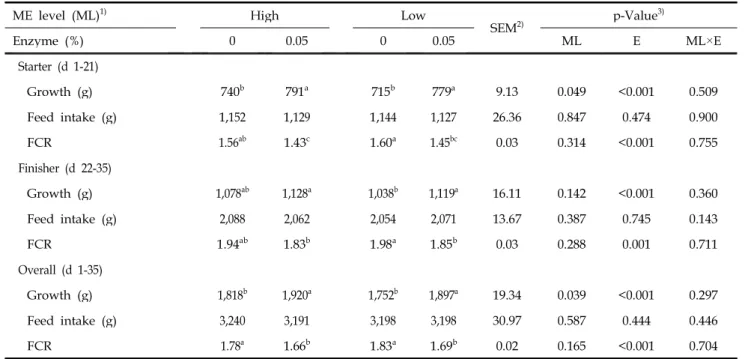
사료 내 대사에너지 수준과 복합효소제의 첨가가 육 계의 사양성적과 영양소 소화율에 미치는 영향은 Table 4 및 5와 같다. 전기(d 1-21), 후기(d 22-35) 및 전 기간(d 1-35)에서 효소제 첨가 시 무첨가구에 비해 증 체량과 사료요구율이 유의적으로 개선되었다. 사료섭 취량에서는 에너지 수준간 그리고 효소제 첨가유무에 따른 영향이 없었다.
본 실험에서 복합효소제의 첨가로 사양성적이 개선 된 것은 기존의 연구결과(Willamil et al., 2012;
Mohammadi et al., 2016)와 일치하는 결과이며, 특히 육계사료 내 복합효소제(xylanase, amylase and protease)를 첨가한 결과 증체량과 사료요구율이 개선 되었다는 Cowieson과 Ravindran(2008)의 보고와 일치 한다. 복합효소제의 첨가는 사료 내 에너지 수준에 관 계없이 사양성적이 개선되지만 사료 내 에너지 수준이 50kcal/kg 정도 낮아도 효소제의 첨가로 인해 에너지 수준이 높은 사료와 비교해 볼 때 사양성적에 차이가 없음은 복합효소제의 에너지 절약효과를 나타낸다고 볼 수 있다.
효소제의 첨가로 인해 성장률과 사료요구율이 개선 되는 원인을 소화율 개선에서 찾아볼 수 있다. Table 5
[Provider:earticle] Download by IP 118.70.52.165 at Monday, December 20, 2021 7:52 PM
www.earticle.net
Table 4. Effects of dietary energy level and supplementation of exogenous enzymes on growth performance in broilers
ME level (ML)1) High Low
SEM2) p-Value3)
Enzyme (%) 0 0.05 0 0.05 ML E ML×E
Starter (d 1-21)
Growth (g) 740b 791a 715b 779a 9.13 0.049 <0.001 0.509
Feed intake (g) 1,152 1,129 1,144 1,127 26.36 0.847 0.474 0.900
FCR 1.56ab 1.43c 1.60a 1.45bc 0.03 0.314 <0.001 0.755
Finisher (d 22-35)
Growth (g) 1,078ab 1,128a 1,038b 1,119a 16.11 0.142 <0.001 0.360
Feed intake (g) 2,088 2,062 2,054 2,071 13.67 0.387 0.745 0.143
FCR 1.94ab 1.83b 1.98a 1.85b 0.03 0.288 0.001 0.711
Overall (d 1-35)
Growth (g) 1,818b 1,920a 1,752b 1,897a 19.34 0.039 <0.001 0.297
Feed intake (g) 3,240 3,191 3,198 3,198 30.97 0.587 0.444 0.446
FCR 1.78a 1.66b 1.83a 1.69b 0.02 0.165 <0.001 0.704
1)ML: starter-high (3,060 kcal/kg), -low (3,010 kcal/kg); finisher-high (3,150 kcal/kg), -low (3,100 kcal/kg).
2)SEM: Standard error of means.
3)ML: ME level effect; E: enzyme effect; ML×E: ME level×enzyme interaction.
abcValues with different superscripts of the row significantly differ (p<0.05).
Table 5. Effects of dietary energy level and supplementation of exogenous enzymes on fecal and ileal digestibility (%) in broilers
ME level (ML)1) High Low
SEM2) p-Value3)
Enzyme (%) 0 0.05 0 0.05 ML E ML×E
Feces (d 33-35)
DM 76.10 77.13 75.88 76.79 0.27 0.329 0.002 0.844
GE 77.15ab 78.25a 76.73b 77.76ab 0.32 0.174 0.003 0.925
CP 67.54ab 68.82a 67.17b 68.25ab 0.38 0.253 0.006 0.796
Ca 41.96 43.31 41.27 42.41 0.45 0.096 0.011 0.818
P 39.68ab 41.41a 38.98b 40.40ab 0.46 0.096 0.004 0.757
Ileum (at d 35)
DM 74.61ab 75.54a 74.08b 75.16ab 0.32 0.185 0.006 0.821
GE 75.66ab 76.47a 75.17b 75.88ab 0.28 0.063 0.011 0.869
CP 66.22ab 67.29a 65.65b 66.64ab 0.35 0.111 0.009 0.911
Ca 39.76 41.25 39.26 40.67 0.49 0.353 0.017 0.944
P 38.24ab 39.92a 37.40b 38.80ab 0.56 0.109 0.014 0.818
1)ML: starter-high (3,060 kcal/kg), -low (3,010 kcal/kg); finisher-high (3,150 kcal/kg), -low (3,100 kcal/kg).
2)SEM: Standard error of means.
3)ML: ME level effect; E: enzyme effect; ML×E: ME level×enzyme interaction.
abValues with different superscripts of the row significantly differ (p<0.05).
[Provider:earticle] Download by IP 118.70.52.165 at Monday, December 20, 2021 7:52 PM
www.earticle.net
에서 보는 바와 같이 사료 내 효소제의 첨가로 인해 분 및 회장 소화율을 유의적으로 개선되었다. 즉, 분 및 회 장내용물에 대한 건물, 에너지, 조단백질, 칼슘 및 인의 소화율이 전체적으로 개선되었다. 본 연구결과 육계 사 료에 복합효소제의 첨가는 영양소 소화율이 뚜렷이 개 선되는 것을 알 수 있었으며, 이는 복합효소제 첨가 시 영양소 소화율을 개선시킨다는 많은 연구결과와 일치 하였다(Meng et al., 2005; Leslie et al., 2007;
Rutherfurd et al., 2007; Yang et al., 2010).
2. 혈액성상
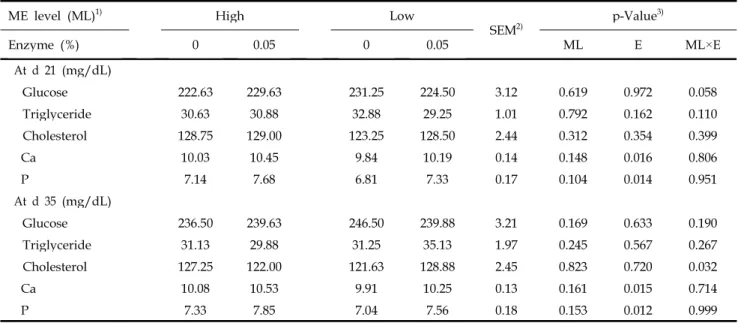
사료 내 복합효소제의 첨가가 육계의 혈액성상에 미 치는 영향은 Table 6과 같다. 사양시험 개시 후 21일차 와 35일차에 채취한 혈액에서 glucose, triglyceride 및 cholesterol 함량은 사료 내 효소제 첨가에 따른 차이는 없었으나 Ca과 P의 함량에서는 유의적인 차이가 있었 다. 사료 내 대사에너지 수준과 복합효소제의 상호작용 효과는 모든 항목에서 나타나지 않았다. 이는 육계사료 내 합성효소제를 첨가한 결과 혈 중 glucose, triglyceride 가 감소했다는 Onilude와 Oso(1999)의 보고와 상반되 는 것이지만 이러한 사항은 사료의 구성과 사육조건에 따라 다르게 나타나기 때문에 이에 대한 연구가 더 필
요할 것으로 생각된다. 혈 중 Ca과 P의 증가는 효소제 내 phytase에 의해 phytate 형태와 결합하고 있는 Ca과 P가 체내 이용되기 용이한 형태로 분리되어 이용률이 개선됨으로써 높아진 것으로 사료된다. 또한 사료의 영 양소 소화율과 혈액 성상 간에는 관계가 없는 것으로 판단되나 기존의 연구에서 이에 대한 검토가 부족함으 로 앞으로 더 많은 연구가 이루어져야 할 것으로 여겨 진다.
3. 장 내 미생물
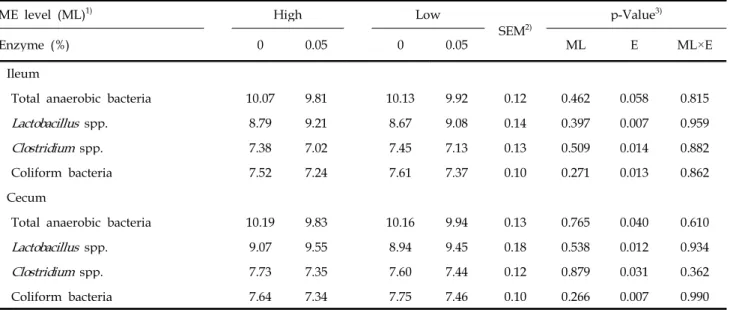
사료 내 대사에너지 수준과 복합효소제의 첨가가 육 계의 장 내 미생물에 미치는 영향은 Table 7과 같다. 효 소제의 첨가로 인해 회장과 맹장에서 유익균인 Lactobacillus spp.는 증가하였고, 유해균인 Clostridium spp.과 Coliform bacteria는 감소하였다. 이러한 결과는 육계 사료에 xylanase를 첨가할 경우 장 내 Lactobacillus spp.의 수가 유의적으로 증가하고 Coliforms과 Salmonella 가 유의적으로 감소하였다고 보고한 Nian 등(2011)의 연구 결과와 유사하다. Bedford(2000)와 Cowieson 등(2000)의 연구에서 외인성 효소제 사용은 사료 내 탄수화물의 이 용률이 달라짐으로서 장 내 미생물 조성이 변화될 수 있음을 보고하였다. 본 시험에서도 복합효소제 첨가에
Table 6. Effects of dietary energy level and supplementation of exogenous enzymes on blood metabolites in broilers
ME level (ML)1) High Low
SEM2) p-Value3)
Enzyme (%) 0 0.05 0 0.05 ML E ML×E
At d 21 (mg/dL)
Glucose 222.63 229.63 231.25 224.50 3.12 0.619 0.972 0.058
Triglyceride 30.63 30.88 32.88 29.25 1.01 0.792 0.162 0.110
Cholesterol 128.75 129.00 123.25 128.50 2.44 0.312 0.354 0.399
Ca 10.03 10.45 9.84 10.19 0.14 0.148 0.016 0.806
P 7.14 7.68 6.81 7.33 0.17 0.104 0.014 0.951
At d 35 (mg/dL)
Glucose 236.50 239.63 246.50 239.88 3.21 0.169 0.633 0.190
Triglyceride 31.13 29.88 31.25 35.13 1.97 0.245 0.567 0.267
Cholesterol 127.25 122.00 121.63 128.88 2.45 0.823 0.720 0.032
Ca 10.08 10.53 9.91 10.25 0.13 0.161 0.015 0.714
P 7.33 7.85 7.04 7.56 0.18 0.153 0.012 0.999
1)ML: starter-high (3,060 kcal/kg), -low (3,010 kcal/kg); finisher-high (3,150 kcal/kg), -low (3,100 kcal/kg).
2)SEM: Standard error of means.
3)ML: ME level effect; E: enzyme effect; ML×E: ME level×enzyme interaction.
[Provider:earticle] Download by IP 118.70.52.165 at Monday, December 20, 2021 7:52 PM
www.earticle.net
Table 7. Effects of dietary energy level and supplementation of exogenous enzymes on intestinal (ileum and cecum) microflora (CFU log10/g) in broilers (at d 35)
ME level (ML)1) High Low
SEM2) p-Value3)
Enzyme (%) 0 0.05 0 0.05 ML E ML×E
Ileum
Total anaerobic bacteria 10.07 9.81 10.13 9.92 0.12 0.462 0.058 0.815
Lactobacillus spp. 8.79 9.21 8.67 9.08 0.14 0.397 0.007 0.959
Clostridiumspp. 7.38 7.02 7.45 7.13 0.13 0.509 0.014 0.882
Coliform bacteria 7.52 7.24 7.61 7.37 0.10 0.271 0.013 0.862
Cecum
Total anaerobic bacteria 10.19 9.83 10.16 9.94 0.13 0.765 0.040 0.610
Lactobacillus spp. 9.07 9.55 8.94 9.45 0.18 0.538 0.012 0.934
Clostridiumspp. 7.73 7.35 7.60 7.44 0.12 0.879 0.031 0.362
Coliform bacteria 7.64 7.34 7.75 7.46 0.10 0.266 0.007 0.990
1)ML: starter-high (3,060 kcal/kg), -low (3,010 kcal/kg); finisher-high (3,150 kcal/kg), -low (3,100 kcal/kg).
2)SEM: Standard error of means.
3)ML: ME level effect; E: enzyme effect; ML×E: ME level×enzyme interaction.
따른 장 내 미생물 조성이 유익하게 변화되었으며 이는 육계의 장내 환경이 개선되었다는 것을 암시하기도 한 다. 그러나 사료 내 대사에너지 수준에 따른 장 내 미 생물 조성에서는 차이가 나타나지 않았다.
3. 장 내 미생물
사료 내 대사에너지 수준과 복합효소제의 첨가가 육 계의 장 내 미생물에 미치는 영향은 Table 7과 같다. 효 소제의 첨가로 인해 회장과 맹장에서 유익균인 Lactobacillus spp.는 증가하였고, 유해균인 Clostridium spp.과 Coliform bacteria는 감소하였다. 이러한 결과는 육계 사료에 xylanase를 첨가할 경우 장 내 Lactobacillus spp.의 수가 유의적으로 증가하고 Coliforms과 Salmonella가 유의적으로 감소하였다고 보고한 Nian 등 (2011)의 연구결과와 유사하다. Bedford(2000)와 Cowieson 등(2000)의 연구에서 외인성 효소제 사용은 사료 내 탄수화물의 이용률이 달라짐으로서 장 내 미생 물 조성이 변화될 수 있음을 보고하였다. 본 시험에서 도 복합효소제 첨가에 따른 장 내 미생물 조성이 유익 하게 변화되었으며 이는 육계의 장내 환경이 개선되었 다는 것을 암시하기도 한다. 그러나 사료 내 대사에너 지 수준에 따른 장 내 미생물 조성에서는 차이가 나타
나지 않았다. 4. 소장 morphology
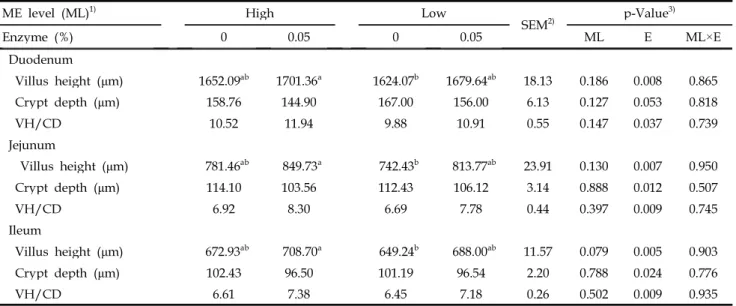
사료 내 대사에너지 수준과 복합효소제의 첨가가 육 계의 소장 융모에 미치는 영향은 Table 8과 같다. 사료 내 대사에너지 수준에 따른 육계의 소장 융모 변화는 없었지만 십이지장(duodenum), 공장(jejunum) 및 회장 (ileum)의 융모높이, 융와 깊이 및 융와 높이와 깊이의 비율에서 복합효소제 첨가효과가 나타났다. 이것은 복 합효소제의 첨가가 장 발달에 도움이 되는 것으로 여겨 진다. 또한 이러한 결과는 소맥-대두박 위주의 육계사 료에 복합효소제를 첨가하여 급여한 결과 소장의 융모 길이가 증가했다는 Wu 등(2004)의 보고와 유사하다.
이와 반대로 수수와 보리를 기초로 한 사료에 복합효소 제를 첨가한 경우 처리구간에 장발달에서 차이가 나타 나지 않았다는 결과(Rebole et al., 2010)와는 상반되는 것이지만, 사료의 원료구성에 따라 차이가 있을 수 있 다는 점에 대해서는 더 많은 연구가 필요하다고 할 수 있다.
Ⅳ. 요약
[Provider:earticle] Download by IP 118.70.52.165 at Monday, December 20, 2021 7:52 PM
www.earticle.net
Table 8. Effects of dietary energy level and supplementation of exogenous enzymes on intestinal morphology in broilers (at d 35)
ME level (ML)1) High Low
SEM2) p-Value3)
Enzyme (%) 0 0.05 0 0.05 ML E ML×E
Duodenum
Villus height (μm) 1652.09ab 1701.36a 1624.07b 1679.64ab 18.13 0.186 0.008 0.865
Crypt depth (μm) 158.76 144.90 167.00 156.00 6.13 0.127 0.053 0.818
VH/CD 10.52 11.94 9.88 10.91 0.55 0.147 0.037 0.739
Jejunum
Villus height (μm) 781.46ab 849.73a 742.43b 813.77ab 23.91 0.130 0.007 0.950
Crypt depth (μm) 114.10 103.56 112.43 106.12 3.14 0.888 0.012 0.507
VH/CD 6.92 8.30 6.69 7.78 0.44 0.397 0.009 0.745
Ileum
Villus height (μm) 672.93ab 708.70a 649.24b 688.00ab 11.57 0.079 0.005 0.903
Crypt depth (μm) 102.43 96.50 101.19 96.54 2.20 0.788 0.024 0.776
VH/CD 6.61 7.38 6.45 7.18 0.26 0.502 0.009 0.935
1)ML: starter- high (3,060 kcal/kg), -low (3,010 kcal/kg); finisher-high (3,150 kcal/kg), -low (3,100 kcal/kg).
2)SEM: Standard error of means.
3)ML: ME level effect; E: enzyme effect; ML×E: ME level×enzyme interaction.
abValues with different superscripts of the row significantly differ (p<0.05).
본 연구는 대사에너지 수준을 달리한 사료에서 복합 효소제의 첨가가 육계의 사양성적, 영양소 소화율, 혈 액성상, 장 내 미생물 및 소장 융모에 미치는 영향을 알아보기 위하여 실시하였다. 사양시험을 위하여 육계 (Ross 308, 1일령) 480수를 공시하여 4처리 8반복, 반복 당 15수를 완전임의 배치하였다. 시험기간은 전기 3주 (0∼21일)와 후기 2주(21∼35일)로 나누어 5주간 실시하 였다. 처리내용은 사료 내 대사에너지 2수준과 복합효 소제(amylase + protease + mannanase + xylanase + phytase) 첨가유무에 따른 2×2요인법에 따랐으며, 고에 너지(전기 3,060kcal/kg; 후기 3,150kcal/kg) 사료에 복 합효소제 무첨가와 첨가(0.05%), 저에너지(전기 3,010kcal/kg; 후기 3,100kcal/kg) 사료에 복합효소제 무첨가와 첨가(0.05%)로 구성하였다. 사양시험 전기간, 증체량과 사료요구율이 복합효소제 첨가구가 무첨가구 에 비해 유의적으로 개선되었으나 사료 내 대사에너지 수준간에는 차이가 없었다. 건물, 에너지, 조단백질, 칼 슘 및 인에 대한 분 및 회장소화율은 복합효소제 첨가 시 유의적으로 개선되었다. 맹장 및 회장 내 미생물에 서는 복합효소제 첨가 시 Lactobacillus spp.는 증가하고 Clostridium spp.이나 Coliform bacteria는 감소하였다.
융모길이와 융모길이와 융와깊이의 비율이 효소제 첨 가로 인해 개선되었다. 본 연구의 결과로 미루어 볼 때,
육계사료 내 복합효소제의 첨가는 에너지 수준에 관계 없이 육계의 생산성에 도움이 되는 것으로 판단되며 효 소제 첨가로 인해 에너지 절약효과를 얻을 수 있을 것 으로 판단된다.
사사
본 연구는 2017년도 강원대학교 대학회계 학술연구 조성비(과제번호 D1001086-01-01)와 ㈜사조바이오피드, Advanced Enzyme Technologies Ltd.(과제번호 C1011538 -01-01)의 지원에 의하여 수행되었습니다.
Ⅴ. REFERENCES
1. AOAC. Official Methods of Analysis. 18th ed.
Association of Official Analytical Chemists International, Gaithersburg, MD, USA. 2007.
2. Bedford, M. R., Patience, J. F., Classen, H. L. and Inborr, J. 1992. The effect of dietary enzyme supplementation of rye- and barley-based diet on
[Provider:earticle] Download by IP 118.70.52.165 at Monday, December 20, 2021 7:52 PM
www.earticle.net
digestion and subsequent performance in weanling pigs. Can. J. Anim. Sci. 72:97.
3. Bedford, M. R. 2000. Exogenous enzymes in monogastric nutrition-their current value and future benefits. Anim. Feed Sci. Technol. 86:1-13.
4. Campbell, G. L. and Bedford, M. R. 1992. Enzyme applications for monogastric feeds: A review. Can.
J. Anim. Sci. 72:449-466.
5. Cera, K. R., Mahan, D. C. and Reinhart, G. A.
1989. Apparent fat digestibilities and performance responses of postweaning swine fed diets supplemented with coconut oil, corn oil or tallow.
J. Anim. Sci. 67:2040-2047.
6. Cowieson, A. J. and Ravindran, V. 2008. Effect of exogenous enzymes in maize-based diets varying in nutrient density for young broilers: Growth performance and digestibility of energy, minerals and amino acids. Br. Poult. Sci. 49:37–44.
7. Jo, J. K., Ingale, S. L., Kim, J. S., Kim, Y. W., Kim, K. H. and Lohakare, J. D. 2012. Effects of exogenous enzyme supplementation to corn- and soybean meal-based or complex diets on growth performance, nutrient digestibility, and blood metabolites in growing pigs. J. Anim. Sci, 90:3041-3048.
8. Juanpere, J., Perez-Vendrell, A. M., Angulo, E. and Brufau, J. 2005. Assessment of potential interactions between phytase and glycosidase enzyme supplementation on nutrient digestibility in broilers. Poult. Sci. 84:571-580.
9. Kim, J. S., Ingale, S. L., Lee, S. H., Kim, K. H., Kim, J. S., Lee, J. H. and Chae, B. J. 2013. Effects of energy levels of diet and β-mannanase supplementation on growth performance, apparent total tract digestibility and blood metabolites in growing pigs. Anim. Feed Sci. Technol. 186:64–70.
10. Kocher, A., Choct, M., Porter, M. D. and Broz, J.
2000. The effects of enzyme addition to broiler diets containing high concentrations of canola or sunflower meal. Poult. Sci. 79:1767-1774.
11. Leeson, S. and Summers, J. D. 2001. Scott’s Nutrition of the Chicken. 4th Ed. University
Books P. O. Box 1326 Guelph, Ontario, Canada.
12. Leslie, M. A., Moran, E. T. and Bedford, M. R.
2007. The effect of phytase and glucanase on the ileal digestible energy of corn and soybean meal fed to broilers. Poult. Sci. 86:2350–2357.
13. Meng, X. and Slominski, B. A. 2005. Nutritive values of corn, soybean meal, canola meal, and peas for broiler chickens as affected by a multicarbohydrase preparation of cell wall degrading enzymes. Poult. Sci. 84:1242–1251.
14. Mohammadi, J., Mohammadi, M., Mehrasbi, M.
R. and Peyda, M. 2016. Investigation of enzyme immobilization effects on its characteristics. J.
Hum. Environ. Health. Promot. 1:183-188.
15. Nian, Y. M., Guo, Y. J., Ru, A. and Péron, F. D.
2011. Effect of xylanase supplementation on the net energy for production, performance and gut microflora of broilers fed corn/soy-based diet Asian-Aust. J. Anim. Sci. 24:1282-1287.
16. NRC. Nutrient Requirement of Poultry. 9th Edn.
National Academy Press, Washington, DC, USA.
1994.
17. Onilude, A. A. and Oso, B. A. 1999. Effect of fungal enzyme mixture supplementation of various fibre-containing diets fed to broiler chicks 2: On blood, liver, and kidney total lipids, tri-acylglycerols, and cholesterol. World. J.
Microbiol. Biotechnol. 15:315–320.
18. Owens, B., Tucker, L., Collins, M. A. and McCracken, K. J. 2008. Effects of different feed additives alone or in combination on broiler performance, gut microflora and ileal histology.
Br. Poult. Sci. 49:202-212.
19. Rebolé, A., Ortiz, L. T., Rodríguez, M., Alzueta, C., Treviño, J. and Velasco, S. 2010. Effects of inulin and enzyme complex, individually or in combination, on growth performance, intestinal microflora, cecal fermentation characteristics, and jejunal histomorphology in broiler chickens fed a wheat-and barley-based diet. Poult. Sci.
89:276-286.
20. Rutherfurd, S. M., Chung, T. K. and Moughan, P.
[Provider:earticle] Download by IP 118.70.52.165 at Monday, December 20, 2021 7:52 PM
www.earticle.net
J. 2007. The effect of a commercial enzyme preparation on apparent metabolizable energy, the true ileal amino acid digestibility, and endogenous ileal lysine losses in broiler chickens.
Poult. Sci. 86:665–672.
21. SAS, 2012. Statistical Analysis System. Users Guide: Statistics, Version 8.2, SAS Institute, Cary, NC, USA.
22. Willamil, J., Badiola, I., Devillard, E., Geraert, P.
and Torrallardona, D. 2012. Wheat- barley- rye- or corn-fed growing pigs respond differently to dietary supplementation with a carbohydrase complex. J. Anim. Sci. 90:824–832.
23. Wu, Y. B., Ravindran, V., Thomas, D. G., Birtles, M. J. and Hendriks, W. H. 2004. Influence of phytase
and xylanase, individually or in combination, on performance, apparent metabolisable energy, digestive tract measurements and gut morphology in broilers fed wheat-based diets containing adequate level of phosphorus. Br. Poult. Sci. 45:76-84.
24. Yang, Z. B., Yang, W. R., Jiang, S. Z., Zhang, G.
G., Zhang, Q. Q. and Siow, K. C. 2010. Effects of a thermotolerant multi-enzyme product on nutrient and energy utilization of broilers fed mash or crumbled corn-soybean meal diets. J.
Appl. Poult. Res. 19:38–45.
(Received 04 August 2017, Revised 21 September 2017, Accepted 21 September 2017)
[Provider:earticle] Download by IP 118.70.52.165 at Monday, December 20, 2021 7:52 PM