www.earticle.net
Bifidobacterium ruminantium 첨가가 청보리와 티모시 조사료의 in vitro 반추위 내 발효성상과 메탄 발생에 미치는 영향
김세진 · 최정호 · 김창현* 국립한경대학교 동물생명환경과학과
Effects of Supplementation of Bifidobacterium ruminantium on in vitro Ruminal Fermentation and Methane Production
Se Jin Kim, Jung Ho Choi and Chang-Hyun Kim*
Department of Animal Life and Environment Science, Hankyong National University, Anseong 17579, Korea
ABSTRACT
This study was conducted to evaluate effects of supplementation ofBifidobacterium ruminantium on in vitro ruminal fermentation and methane production. Ruminal fermentation characteristics of Timothy hay (C1), whole barley (C2), Timothy hay +B. ruminantium (T1) and whole barley + B. ruminantium (T2) were evaluated at 0, 3, 6, 9, 12, 24 and 48 h incubation at 39℃. The amount ofB. ruminantium culture added into T1 and T2 was 0.3 ml. The pH values ranged from 5.99 to 6.83 in all the treatments. Concentration of NH3-N of C2 and T2 was higher than C1 and T1 at 48 h (p<0.05). The total gas production of C2 and T2 was higher than C1 and T1 at 9 h (p<0.05). The total methane production of treatments withB. ruminantium was not significantly different at 24 and 48 h (p<0.05). Concentration of lactic acid was significantly different between both substrates (p<0.05). Therefore, B. ruminantium supplementation was determined to be insignificant in the in vitro ruminal fermentation and methane production, while a further study was required to investigate relation to lactic acid production with different forage sources.
(Key words: Bifidobacgerium ruminantium, Lactic acid, Methane, Rumen) 1)
Ⅰ. 서론
Probiotics는 살아있는 유익미생물로 반추동물을 포함한 숙주동물에 급여하면 이들의 장내세균총을 변화시켜 건강 에 유익한 작용을 한다고 알려져 있다(Havenaar와 Huis in't Veld, 1992). Probiotics 중에서 유산균인 Bifidobacteria 는 사람의 소화관내에서 잘 자라는 특성을 가지고 있고, 유 아의 분변에서도 자주 검출된다. Scardovi 등(1969)의 연구
에 따르면 Bifidobacterium ruminantium은 반추위 내에서 다 량 존재하고 있으며, 헤테로발효성의 기능을 가진다고 알 려져 있다. 또한 가축의 증체율과 사료섭취율을 높이며, 사 료섭취율을 늘리며, 다른 혐기성 세균과는 달리 발효 과정 중에 가스를 발생시키지 않고 초산 및 유산과 같은 유기산 을 생성하여 반추위내 적정 pH를 유지시키는 역할을 한다 고 알려져 있다(Biavati와 Mattarelli, 1991).
따라서 본 연구는 TDN가가 높고 영양가치가 높아 조사
* Corresponding author: Chang-Hyun Kim, Department of Animal Life and Environment Science, Hankyong National University, Anseong 17579, Korea. Tel: +82-31-670-5095, E-mail: [email protected]
This is an Open Access journal distributed under the teams of the Creative Commons Attribution Non-Commercial License (http://creativecommons.org/licenses(by-nc/3.0) which permits unrestricted non-commercial use, and reproduction in any medium, provided the original work is properly cited.
[Provider:earticle] Download by IP 118.70.52.165 at Monday, December 20, 2021 7:55 PM
www.earticle.net
료로 주로 쓰이는 청보리와 티모시 건초를 이용한 in vitro 반추위 배양시험에 B.ruminantium을 첨가하여 반추위 발효 성상 및 메탄 발생량에 미치는 영향을 알아보고자 실시하 였다.
Ⅱ. 재료 및 방법
1. 실험 재료
본 실험에서 사용한 사료는 시중에 판매하는 티모시 건 초와 청보리를 건조(60℃에서 최소 24시간 이상)시킨 후 hammer mill(MFC CZ13, Gemini, Netherlands)에 1mm screen을 이용하여 분쇄 후 사용하였다. 균주는 한국생명 공학연구원 미생물자원센터(KCTC)의 Bifidobacterium ruminantium KCTC3425를 분양 받았다. 티모시 건초와 청 보리의 건물(DM, dry matter)은 98.0%와 97.8%, 조단백질 (CP, crude protein)은 10.4%와 10.6%, 조지방(EE, ether extract)은 0.5%와 1.0%, 조섬유(CF, crude fiber)은 33.1%
와 21.1%, 조회분(CA, crude ash)은 8.4%와 7.1%, NDF (neutral detergent fiber)는 55.3%와 43.7% 그리고 ADF(acid detergent fiber)는 36.7%와 23.1% 였다.
2. 실험 동물 및 사양관리
충남 청주에 위치한 청원 목장의 반추위 cannula가 시술 된 홀스타인 거세우(800kg, 100개월령)로부터 반추위액을 채취하였다. 1일 2회(08:00, 17:00) 시판 중인 배합사료 3kg(fresh weight) 급여하였고, 에뉴얼라이그라스는 자유 채식 하도록 하였다.
3. 배지 및 배양방법
B. ruminantium을 배양한 배지는 trypticase phytone yeast extract broth(TPY, Scardovi, 1986)로 제조하였으며, 120ml serum bottle에 TPY 60ml을 분주하고 B.
ruminantium 배양액 0.3ml(기질의 5%)을 주입 한 후 CO2
를 충진한 상태에서 고무마개와 알루미늄 캡을 이용하여 밀패하여 혐기성 조건을 유지하여 38℃ 항온배양기 (VS-1203P1, Dasol, Korea)에서 12시간 배양한 후 본 배양 액을 in vitro 시험을 위해 사용 하였다.
4.
In vitro
반추위 발효실험In vitro 반추위 발효실험을 위해 serum bottle에 각 0.6g 티모시 건초(C1), 0.6g 청보리(C2)와 C1에 B. ruminantium 배양액 0.3ml 첨가(T1)와 C2에 B. ruminantium 배양액 0.3ml 첨가(T2)하여 총 4처리구로 하였다. 각 serum bottle 마다 pH 7.0으로 맞춘 McDougall’s buffer solution (McDougall, 1948)과 cheese cloth 8겹으로 걸려낸 반추위 액을 4:1로 혼합한 용액 60ml을 분주한 후 CO2를 충진한 상태에서 고무마개와 알루미늄 캡을 이용하여 밀패하여 혐기성 조건으로 만든 후 39℃ 항온배양기(VS-1203P1, Dasol, Korea)에서 각 0, 3, 6, 9, 12, 24 및 48시간 동안 배 양하였고 처리구 및 시간대별로 4처리구 3반복으로 시험 을 수행하였다.
5. 조사 항목 및 방법
A.O.A.C (1990) 방법에 준하여 사료의 건물 및 기타 조 성분을 분석하였으며, NDF와 ADF는 Van Soest 등(1991) 의 방법에 준하여 분석하였다. 배양시간 동안 발생한 가스 발생량은 water displacement apparatus를 이용하여 가스 발생량을 측정하였다(Ferorak와 Hrwdey, 1983). pH는 배 양 시간대별로 배양이 완료된 serum bottle을 개봉하여 15 ml conical tube에 상층액을 회수하였으며, 회수한 상층액을 5,000 rpm에서 10분간 원심분리한 후에 pH 측정기(S20 SevenEasyTM pH, Mettler Toledo, Switzerland)를 이용하 여 측정하였다. 배양 완료된 배양액내 NH3-N 농도 측정은 Cheny와 Mabach (1962)의 방법으로 수행 하였다. 배양액 내 휘발성 지방산(VFA)의 농도는 각 시간대별 시료 1ml 기준으로 5:5 황산(H2SO4) 0.4ml 첨가하고 1ml의 ethyl ether를 첨가하여 30초간 혼합 하였다. 이후 micro centrifuge(5415R, Eppendorf, Germany)를 이용하여 5,000rpm 에서 5분간 원심분리 한 후 상층액을 채취하여 Gas chromatography(GC-2010, Shimadzu, Japan)에서 농도를 분석하였다. GC의 조건은 injector 250℃, column 150℃, detector 200℃였으며, column은 capillary column을 사용 하였다. Lactic acid 함량은 배양액 시료를 HPLC(200 series, Perkin Elmer, USA)를 이동상은 0.008N H2SO4를 사용하여 용출속도 0.60ml/min에서 UV detector로 210nm 에서 측정 하였다.
[Provider:earticle] Download by IP 118.70.52.165 at Monday, December 20, 2021 7:55 PM
www.earticle.net
6. 통계처리
본 실험에서 얻은 결과들은 SAS package(Statistical Analysis System, 1996)의 GLM procedure를 이용하여 분 산분석을 실시하였으며, 평균간 차이는 Duncan(1955)의 다중검정법에 의해 95% 유의수준으로 분석하였다.
Ⅲ. 결과 및 고찰
1.
In vitro
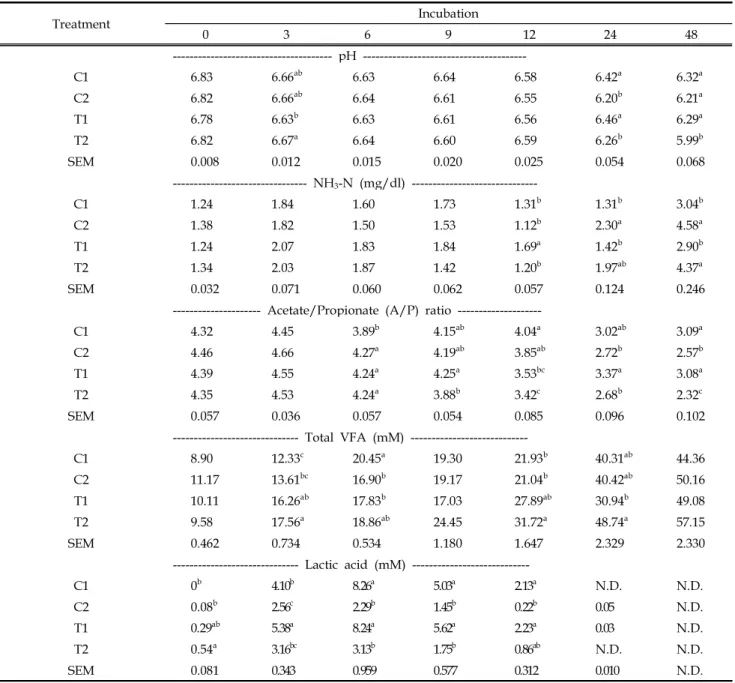
반추위 배양액 내 발효성상배양시간에 따른 in vitro 반추위 발효특성은 Table 1에 나타내었다. 모든 처리구간 배양액의 pH는 큰 차이가 없 었으며, 배양 시간 경과함에 따라 pH가 감소하였다. 배양 3시간대에 T2의 pH가 T1보다 높았으며(p<0.05), 배양 24 시간에는 C1과 T1 및 C2와 T2간 같은 기질간의 B.
ruminantium의 첨가에 의한 pH에는 유의적 차이가 없었으 나, 티모시와 청보리 기질간에는 청보리를 기질로 이용하 였을 때 pH가 유의적으로 낮았다(p<0.05). 배양 48시간대 에는 C1, C2 및 T1이 T2보다 pH가 유의적으로 높았다 (p<0.05). 반추위 미생물 활동에 적합한 pH 범위는 5.8~7.0 로(Hiltner와 Dehority, 1983) 본 연구결과 pH로 인한 미생 물 활동에 영향은 없을 것이라고 판단된다.
배양시간대별 NH3-N 농도는 모든 처리구에서 배양 3시 간대에 증가한 후 6시간대에 감소하였으며, 배양 48시간대 의 C2와 T2의 NH3-N 농도는 C1과 T1보다 유의적으로 높 았다(p<0.05). 배양 48시간대에서 NH3-N 농도가 급격히 증가하는데는 반추위 미생물이 사멸하면서 일어나는 lysis 의 영향인 것으로 생각되고 있으며, 본 실험에서 NH3-N 농도는 in vitro 반추위 배양시 반추위 박테리아에 적합한 NH3-N 농도인 5~8mg/100ml보다 낮은 수준이었으며 (Annison, 1975; Satter와 Slyter, 1974; Satter와 Roffler, 1975), 이로 인해 12~24시간대에서 protein sparing 효과가 일어난 것으로 보고 있다(Russell과 Strobel, 1989). 반추위 내 NH3-N 농도에 영향을 미치는 요인으로는 미생물 단백 질 합성 비율과 단백질 분해율(Mehrez 등, 1977)등이 있는 데 티모시와 청보리의 조단백질 함량이 낮아 공급되는 질 소의 양이 부족하여 반추위내 NH3-N 생성이 극히 낮은 것 으로 보여 진다.
배양시간대별 acetate/propionate(A/P) ratio는 배양 시 간이 경과함에 따라 모든 처리구에서 감소하는 경향이 나
타났으며, 배양 6시간대에서 C1이 C2, T1 및 T2보다 A/P ratio가 유의적으로 낮았다(p<0.05). 배양 48시간대에서 T2 가 C2보다 A/P ratio가 유의적으로 낮았으며(p<0.05), 이 를 통해 청보리에 B. ruminantium의 첨가는 propionate의 증가에 기여 했을 것이라고 보고 있다. Propionate의 증가 로 hydrogen sink가 발생하여 메탄의 생성이 감소되며 (Irmgard, 1996), A/P ratio를 낮게 하여 단백질 이용효율, 증체 그리고 사료 이용효율이 증가할 것으로 보고 있다 (Shaw 등, 1960). 또한 Table 2에서 메탄 발생량에서 메탄 발생량이 티모시를 기질로 이용하였을 때 더 낮은 이유 중 의 하나인 것으로 판단된다.
Total VFA 발생량은 모든 처리구에서 배양시간이 경과 함에 따라 증가를 하였다. 배양 12시간대에 total VFA 발 생량은 T2가 C1 그리고 C2보다 유의적으로 높았다 (p<0.05). 모든 처리구에서 배양시간이 경과함에 따라 total VFA 발생량이 증가하는 반면, A/P ratio는 감소하는 경향 이었는데, 이는 total VFA 발생량이 증가하면 acetate와 propionate의 비율이 감소한다는 Gray와 Pilgrim(1951)의 연구결과와 일치하였다. Total VFA의 발생량이 본 시험결 과 최대 57.15mM로 낮은 경향을 나타내었으나 반추위 내 total VFA은 정상적으로 70∼130mM을 유지하였고, 높을 경우는 200mM, 낮게는 30mM을 유지한다는 Maeng (1998)의 결과와 같이 조사료를 이용한 본 실험에서 배양 시간이 더 증가되었다면 정상적 발생량을 나타내었을 것 으로 사료된다. 또한 NH3-N 발생량이 초기 배양시간에 낮 아 반추위 내 미생물의 합성량이 낮아졌으며, VFA 발생량 도 증가되지 않는 결과를 나타내었다.
Latic acid의 발생량은 배양 3시간대에 T1이 C1에 비해 유의적으로 높은 lactic acid를 생성하였으며(p<0.05), 3, 6, 9, 12 그리고 24시간에서 C1과 T1 및 C2와 T2간의 유의적 차이가 있는 것으로 보아(p<0.05), 조사료의 종류에 따라 반추위 내 미생물발효에 의한 lactic acid 발생량이 다름을 알 수 있었다. 배양 6시간대와 9시간대의 lactic acid의 발 생량은 C1과 T1이 C2와 T2보다 유의적으로 높은 결과를 나타내었으나(p<0.05) pH는 변화가 없었던 결과를 나타내 었는데 이와 같은 결과는 완충력이 높은 MacDougall’s buffer의 영향으로 사료된다. 또한 섬유질 함량이 낮고 알 곡이 포함되어 전분의 함량이 높은 청보리처리구인 C2에 서 lactic acid의 생성량이 티모시처리구인 T1보다 낮은 것 은 전분이나 섬유질의 함량만으로 lactic acid 발생량을 평 가 할 수 없음을 나타내고 있으며, 이에 대한 추가 연구가 필요할 것으로 사료된다.
[Provider:earticle] Download by IP 118.70.52.165 at Monday, December 20, 2021 7:55 PM
www.earticle.net
Table 1. Effects of Bifidobacterium ruminantium supplementation on in vitro ruminal fermentation characteristics using Timothy hay and whole barley
Treatment Incubation
0 3 6 9 12 24 48
--- pH ---
C1 6.83 6.66
ab6.63 6.64 6.58 6.42
a6.32
aC2 6.82 6.66
ab6.64 6.61 6.55 6.20
b6.21
aT1 6.78 6.63
b6.63 6.61 6.56 6.46
a6.29
aT2 6.82 6.67
a6.64 6.60 6.59 6.26
b5.99
bSEM 0.008 0.012 0.015 0.020 0.025 0.054 0.068
--- NH
3-N (mg/dl) ---
C1 1.24 1.84 1.60 1.73 1.31
b1.31
b3.04
bC2 1.38 1.82 1.50 1.53 1.12
b2.30
a4.58
aT1 1.24 2.07 1.83 1.84 1.69
a1.42
b2.90
bT2 1.34 2.03 1.87 1.42 1.20
b1.97
ab4.37
aSEM 0.032 0.071 0.060 0.062 0.057 0.124 0.246
--- Acetate/Propionate (A/P) ratio ---
C1 4.32 4.45 3.89
b4.15
ab4.04
a3.02
ab3.09
aC2 4.46 4.66 4.27
a4.19
ab3.85
ab2.72
b2.57
bT1 4.39 4.55 4.24
a4.25
a3.53
bc3.37
a3.08
aT2 4.35 4.53 4.24
a3.88
b3.42
c2.68
b2.32
cSEM 0.057 0.036 0.057 0.054 0.085 0.096 0.102
--- Total VFA (mM) ---
C1 8.90 12.33
c20.45
a19.30 21.93
b40.31
ab44.36
C2 11.17 13.61
bc16.90
b19.17 21.04
b40.42
ab50.16
T1 10.11 16.26
ab17.83
b17.03 27.89
ab30.94
b49.08
T2 9.58 17.56
a18.86
ab24.45 31.72
a48.74
a57.15
SEM 0.462 0.734 0.534 1.180 1.647 2.329 2.330
--- Lactic acid (mM) ---
C1 0
b4.10
b8.26
a5.03
a2.13
aN.D. N.D.
C2 0.08
b2.56
c2.29
b1.45
b0.22
b0.05 N.D.
T1 0.29
ab5.38
a8.24
a5.62
a2.23
a0.03 N.D.
T2 0.54
a3.16
bc3.13
b1.75
b0.86
abN.D. N.D.
SEM 0.081 0.343 0.959 0.577 0.312 0.010 N.D.
C1; timothy hay, C2; whole barley, T1; timothy hay+ B. ruminantium , T2; whole barley+ B. ruminantium .
a,b
Values within the same column with different superscripts differ (p<0.05).
SEM: Standard error of means.
N.D.: Not detected
2. 총 가스 발생량 및 총 메탄 발생량
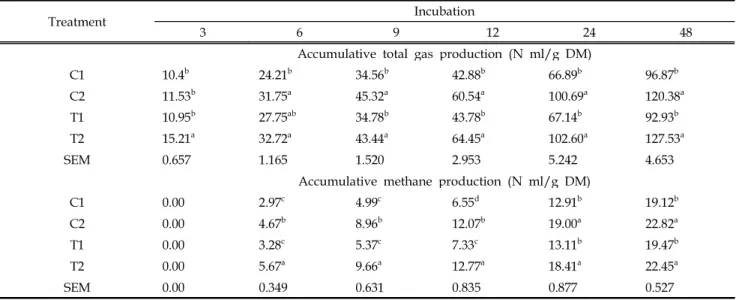
배양시간에 따른 총 가스 발생량과 총 메탄 발생량은 Table 2에 나타내었다. 배양 3시간대의 T2는 C1, C2, T1과 비교시 총 가스 발생량이 유의적으로 높았으며(p<0.05), 배 양 9시간대부터는 C2와 T2가 C1과 T1보다 총 가스 발생량
이 유의적으로 높았다(p<0.05).B. ruminantium을 첨가하지 않은 C1과 C2보다 B. ruminantium을 첨가한 T1과 T2의 총 가스 발생량이 높은 경향을 나타낸 것은 첨가한 미생물에 의해 건물 소화율이 증가하였기 때문으로 판단된다. Theodorou 등(1994)의 보고에 의하면 in vitro 실험에서 가 스발생량은 건물소화율을 간접적으로 나타내는 지표라고
[Provider:earticle] Download by IP 118.70.52.165 at Monday, December 20, 2021 7:55 PM
www.earticle.net
Table 2. Effects of Bifidobacterium ruminantium supplementation on total gas and methane production in in vitro ruminal fermentation using Timothy hay and whole barley
Treatment Incubation
3 6 9 12 24 48
Accumulative total gas production (N ml/g DM)
C1 10.4
b24.21
b34.56
b42.88
b66.89
b96.87
bC2 11.53
b31.75
a45.32
a60.54
a100.69
a120.38
aT1 10.95
b27.75
ab34.78
b43.78
b67.14
b92.93
bT2 15.21
a32.72
a43.44
a64.45
a102.60
a127.53
aSEM 0.657 1.165 1.520 2.953 5.242 4.653
Accumulative methane production (N ml/g DM)
C1 0.00 2.97
c4.99
c6.55
d12.91
b19.12
bC2 0.00 4.67
b8.96
b12.07
b19.00
a22.82
aT1 0.00 3.28
c5.37
c7.33
c13.11
b19.47
bT2 0.00 5.67
a9.66
a12.77
a18.41
a22.45
aSEM 0.00 0.349 0.631 0.835 0.877 0.527
C1; timothy hay, C2; whole barley, T1; timothy hay+ B. ruminantium , T2; whole barley+ B. ruminantium .
a,b
Values within the same column with different superscripts differ (p<0.05).
SEM: Standard error of means.
하였고, Beuvink 등(1992)은 발효정도에 따라 가스 발생량 이 변화하며 건물소화율과 가스발생량의 상관관계가 높다 는 보고와 일치하였다.
메탄가스 발생량도 총가스 발생량과 유사하게 배양시간 이 증가함에 따라 모든 대조구와 처리구에서 증가하는 양 상을 보였다. 두 조사료 기질 간에 뚜렷한 메탄발생의 차 이가 있었고 청보리가 더 높은 메탄발생의 잠재성을 나타 내었다. 청보리의 경우 배양 6, 9 및 12시간에 B.
ruminantium 첨가구가 더 많은 메탄을 발생시켰으며 (p<0.05), 티모시는 배양 12시간에만 첨가구가 더 높은 메 탄을 발생시켰다(p<0.05). 이러한 결과는 결국 lactic acid 를 생산하는 B. ruminantium의 첨가는 총가스 발생량과 함 께 메탄가스도 동시에 증가시켜 메탄저감에는 효과적이지 못한 것으로 판단되었다.
이상의 결과를 종합해 보면 B. ruminantium 첨가한 청보 리와 티모시에 대한 반추위 내 발효 성상과 메탄저감 효과 는 미약한 것으로 보고 있으나, 전분함량이 높고 섬유질 함량이 낮은 청보리에서 lactic acid 생산량이 적게 발생되 어 조사료의 종류에 따라 lactic acid 발생량이 차이가 나 며, 앞으로 이와 관련된 추가연구가 필요한 것으로 판단된 다.
Ⅳ. 요약
본 연구는 반추위내에서 lactic acid를 생산하는 Bifidobacterium ruminantium 첨가가 반추위내 발효와 메탄발생에 미치는 시험을 실시하였으며, 티모시와 청보리를 기질로 하여 반 추위미생물을 이용한 in vitro 배양실험을 실시하였다. 대 조구로는 티모시(C1)와 청보리(C2)를 기질로 한 2개의 무 처리구와, 티모시와 청보리 기질에 각각 B. ruminantium 배양액 0.3ml을 첨가한 2개의 처리구(T1, T2)로 하여 39℃
에서 0, 3, 6, 9, 12, 24 및 48시간 배양하였다. 배양 48시간 대의 pH는 C1, C2 및 T1이 T2보다 pH가 유의적으로 높았 다(p<0.05). NH3-N 농도는 모든 처리구에서 배양 48시간 대에 급격히 증가하는 양상을 보였으며, C1에 비해 C2와 T2에서 높은 NH3-N 농도를 나타내었다(p<0.05). 총 가스 발생량은 배양 9시간대부터 C1와 T1에 비해 C2와 T2이 높 았으며(p<0.05), 총 메탄 가스 발생량은 전 시간대에서 C2 와 T2가 C1과 T1 보다 유의적으로 높았으며(p<0.05), 배양 24시간대부터 B. ruminantium 첨가 유무에 따른 총 메탄 발생량은 유의적으로 차이가 없는 것으로 나타났다 (p<0.05). Lactic acid의 발생량은 배양 3시간대에 T1이 C1 에 비해 유의적으로 높았으며(p<0.05), 3, 6, 9, 12 및 24시 간에서 C1, T1과 C2, T2간의 유의적 차이가 있는 것으로 보아(p<0.05), 조사료의 종류에 따라 반추위 내 lactic acid 발생량이 차이를 나타내었다. 따라서 B. ruminantium 첨가
[Provider:earticle] Download by IP 118.70.52.165 at Monday, December 20, 2021 7:55 PM
www.earticle.net
에 따른 반추위 in vitro 발효에는 청보리와 티모시를 사료 로 사용하였을 때 효과가 미약하였으며, 조사료 종류에 따 른 lactic acid 발생량에 관한 추가 연구가 필요할 것으로 사료된다.
사사
본 연구는 농림축산식품부 고부가가치 식품기술개발사 업(과제번호: 314075-3)에 의해 이루어진 것임.
Ⅴ. REFERENCES
1. Annison, E. F. 1975. Microbial protein synthesis in relation to amino acid requirements. In Tracer Studies on Non-protein Nitrogen for Ruminants-Ⅱ. FAO/
LAED, p. 141.
2. A.O.A.C. 1990. Official Methods of Analysis. 14th ed.
Association of Official Analytical Chemists.
Washington, DC, USA.
3. Beuvink, J. M., Spoelstra, S. F. and Hogendorp, R. J.
1992. An automated method of measuring the time course of gas production of feedstuffs incubated with buffered rumen fluid. Neth. J. Agri. Sci. 40:401-407.
4. Biavati, B. and Mattarelli, P. 1991. Bifidobacterium ruminantium sp. Nov. and Bifidobacterium merycicum sp.
Nov. from the rumen of cattle. Int. J. Syst. 41:163-168.
5. Chaney, A. L. and Marbach, E. P. 1962. Modification reagents for determination of urea and ammonia.
Clinical Chem. 8:130-132
6. Duncan, D. B. 1955. Multiple range and multiple F tests. Biometrics. 11:1-42.
7. Ferorak, P. M. and Hrwdey, S. E. 1983. A simple apparatus for measuring gas production by methanogenic culture in serum bottle. Environ. Technol. Lett. 4:268.
8. Gray, F. V. and Pilgrim, A. F. 1951. Fermentation in the rumen of the sheep. J. Exp. Biol. 28:83-90.
9. Havenaar, R. and Huis in’t Veld, J. H. J. 1992.
Probiotics; a general view. In The Lactic Acid Bacteria, Vol. I. The Lactic Acid Bacteria in Health and Disease.
B. J. B. Wood (Ed). Elsevier Applied Science
Publishers, London, England. pp.1-125.
10. Hiltner, P and Dehority, B. A. 1983. Effect of soluble carbohydrates on digestion of cellulose by pure cultures of rumen bacteria. Appl. Environ. Microbiol.
46:642-648.
11. Irmgard Immig. 1996. The rumen and hindgut as source of ruminant methanogenesis. Environ. Monit.
Assess. 42:57-72.
12. Maeng, W. J. 1998. Ruminant Nutrition.
Hyangmunsa. Seoul. Korea. pp. 91-112.
13. McDougall, E. I. 1948. Studies on ruminant saliva. I.
The composition and output of sheep's saliva.
Biochem. J, 43(1):99-109
14. Mehrez, A. Z., Ørskov, E. R. and McDonald, I. 1977.
Rates of rumen fermentation in relation to ammonia concentration. Br. J. Nutri. 38:437-443.
15. Russeil, J. B. and Strobel, H. J. 1989. Effect of ionophores on ruminal fermentation. App. Environ.
Microbil. 55:1-6.
16. SAS. 1996. SAS procedures guide, Version 8, SAS Institute Inc. Cary, NC, USA.
17. Satter, L. D. and Slyter, L. L. 1974. Effect of ammonia concentration on rumen microbial protein production in-vitro. Br. J. Nutr. 32:199-208.
18. Satter, L. D. and Roffler, R. E. 1975. Nitrogen requirement and utilization in dairy cattle. J. Dairy Sci. 58:1219-1237.
19. Scardovi, V. 1986. Genus Bifidobacterum Orla-Jensen 1924, 472AL. In Bergey’s Manual of Systematic Bacteriology, Vol. 2, P. H. A. Sneath, N. S. Mair, M.
E. Sharpe, and J. G. Holt (Ed), Williams and Wilkins, Blatimore, MD, USA. pp. 1418–1435.
20. Scardovi, V., Trovatelli, L. D., Crociani, F. and Sgorbati, B. 1969. Bifidobacteria in bovine rumen.
Archiv. Mikrobiol. 68:278-294.
21. Shaw, J. C., Ensor, W. L., Tellechea, H. F. and Lee, S.
D. 1960. Relation of diet to rumen volatile fatty acids, digestibility, efficiency of gain and degree of unsaturation of body fat in steers. J. Nutr. Sci.
71:203-208.
22. Theodorou, M. K., Williams, B. A., Dhanoa, M. S., McAllan, A. B. and France, J. 1994. A simple gas production method using a pressure transducer to
[Provider:earticle] Download by IP 118.70.52.165 at Monday, December 20, 2021 7:55 PM
www.earticle.net
determine the fermentation kinetics of ruminant feeds. Anim. Feed Sci. Technol. 48:185-197.
23. Van Soest, P. J., Robertson, J. B. and Lewis, B. A.
1991. Methods for fiber, neutral detergent fiber, and non starch polysaccharides in relation to animal
nutrition. J. Dairy Sci. 74:3583-3597.
(Received 10 May 2016, Revised 20 June 2016, Accepted 21 June 2016)
[Provider:earticle] Download by IP 118.70.52.165 at Monday, December 20, 2021 7:55 PM