www.earticle.net
사료 주머니의 공극 크기가 in vitro 반추위 내 발효성상에 미치는 영향
문준범1⋅김한빈1⋅이정수1⋅박중국4⋅신동은4⋅박병기4,6⋅송재용5⋅이세영3⋅서자겸2*
부산대학교 생명자원과학대학 동물생명자원과학과 대학원생1, 교수2, 천안연암대학교 축산계열 교수3, 농협사료 연구원4, 농협중앙회 축산연구원5, 강원대학교 동물생명과학대학 교수6
Different Pore Size of Filter Bags Containing Feed Samples Changed Rumen Fermentation Characteristics in an in Vitro System
Joon-Beom Moon1, Han-Been Kim1, Jeong-Soo Lee1, Joong-Kook Park4, Dong-Eun Shin4, Byung-Ki Park4,6, Jae-Yong Song5, Se-Young Lee3 and Ja-kyeom Seo2*
1Graduate Students, 2Professor, Department of Animal Science, Pusan National University, Miryang 50463, Korea
3Professor, Department of Animal Science, Yonam College, Cheonan 31005, Korea
4Researcher, Nonghyupfeed Co., Ltd, Seoul 05398, Korea
5Researcher, Institute of Livestock, Nonghyup Co. Ltd., Ansung 17558, Korea
6Professor, Department of Animal Science, Kangwon National University, Chuncheon 24341, Korea
ABSTRACT1)
In in vitro fermentation studies, feed samples can either be included in the in vitro rumen medium using filter bags or can be directly dispersed. The objective of this study was to investigate the effects of different pore sizes of filter bags on the rumen fermentation characteristics in an in vitro system. Corn, soybean meal, and timothy were ground to pass through a 1.0-mm screen and were formulated in the ratio of 70:7:23 based on DM, respectively. The formulated experimental diet (2g/DM) was put in F57 filter bags and R510 nylon bags (Ankom®) which pore sizes were 25 and 50 µm, respectively. An in vitro study was conducted to determine the rumen fermentation characteristics for 3, 6, 12, 24, and 48 h and rumen microbial community at 48 h of incubation. A significantly higher production of gas was observed in the R510 bags than in F57 at all the incubation times (p<0.01). IVDMD (p<0.01) and IVNDFD (p<0.01) were significantly higher, whereas pH (p<0.01) and NH3-N (p<0.01) were lower when R510 bags were used. In the VFA composition, acetate and butyrate were significantly higher (p<0.01) in R510 bags, and propionate and total VFA concentration did not differ (p=0.55 and 0.25, respectively) between F57 and R510 bags. The log copy numbers of bacteria and protozoa did not differ (p=0.69 and 0.94, respectively) between F57 and R510 bags, whereas those of fungi were significantly higher in R510 than in F57 bags (p<0.01). Therefore, the use of R510 may reflect actual rumen fermentation characteristics more precisely than those of F57 because increased gas production, nutrient digestibility and acetate, butyrate proportion were founded in R510.
(Key words: Nylon bag, Filter bag, Pore size, Fermentation characteristics, In vitro digestibility)
* Corresponding Author: Jakyeom Seo, Life and Industry Convergence Research Institute, Department of Animal Science, Pusan National University, Miryang 50463, Korea. Tel: +82-55-350-5513, Email: [email protected]
This is an Open Access article distributed under the terms of the Creative Commons Attribution Non-Commercial License (http://creativecommons.org/licenses/by-nc-nd/3.0/deed.ko), which permits unrestricted non-commercial use, distribution, and reproduction in any medium, provided the original work is properly cited. The moral rights of the named author(s) have been asserted.
[Provider:earticle] Download by IP 118.70.52.165 at Monday, December 20, 2021 7:46 PM
www.earticle.net
Ⅰ. 서론
반추동물의 사료로 이용되는 원료의 종류는 다양하고 그 이용성도 천차만별이므로 배합 전 각 원료들의 영양적 가치를 평가하는 연구는 필수적이다. 또한 화학적 방법으 로 평가된 사료의 영양적 가치는 실제 동물의 이용성에 따 라 달라질 수 있으므로 원료의 소화율을 측정하는 생물학 적 평가 방법 또한 필요하다(Ha et al., 2005). 생물학적 평 가방법 중in vivo 법은 동물을 직접 사용하여 소화율을 평 가함에 따라 가장 정확한 방법으로 인정되고 있으나 실험 수행에 있어 높은 비용과 노동력을 요한다는 단점이 있다. 그에 반해 주요 소화기관에 누관이 장착된 동물을 이용하 는 in situ와 동물에게서 직접 채취된 소화액 또는 인공적 으로 제조된 유사 소화액을 사용하는 in vitro 법은 실험에 필요한 비용과 시간이 적게 들고, 한 번의 실험에 여러 처 리를 통한 차이를 평가할 수 있으며, 동물 복지 측면의 제 약이 적다는 장점을 가지고 있어 축우 사료의 영양적 가치 를 평가하기 위한 방법으로 널리 이용되고 있다(Tagliapietra et al., 2012; Valente et al., 2015).
In vitro 소화 실험에서 평가되는 시험사료는 serum bottle 내에 담겨 소화액과 직접 접촉하여 배양되며 일정 배양 시간이 지난 후 filter paper에 걸러진 시험 사료의 잔 량과의 차를 통해 소화율이 측정된다. 상기 방법은 사료와 반추위액에 존재하는 미생물과의 직접적인 접촉을 유도하 여 실제 반추위 발효 상황에 가장 근접한 조건을 조성할 수 있다는 장점이 있으나, 사료를 거르는 과정에서 수행자 의 숙련도에 따라 사료의 소실 정도가 달라지는 문제가 발 생할 수 있으며 또한 거르는 과정에서의 시간적 소요가 크 다. 상기 방법의 단점을 보완할 수 있는 방법으로 제시되 고 있는 것은 filter bag의 사용인데 이는 in situ 법에서 시 험 사료를 다공성의 주머니에 담은 뒤 반추위 누관을 통하 여 배양시키는 방법처럼, 시험사료를 filter bag에 담은 뒤 serum bottle에 넣어 배양시키는 방법이다. filter bag의 사 용은 사료를 일정 주머니에 담아서 배양시키기 때문에 실 험자의 숙련 차이에 따른 사료 소실의 차이를 줄일 수 있 을 뿐만 아니라 실험에 소요되는 추가적인 노동과 시간을 절약할 수 있다는 장점이 있으며 그에 따라 최근 보고되고 있는 in vitro 실험 연구에서 많이 제시되고 있다(Wilman and Adesogan, 2000; Puchala et al., 2012; Spanghero et al., 2015).
반추위액을 사용한 in vitro 법에서 사용될 filter bag의 중요한 조건은 filter bag이 미생물의 사료로의 접근을 방
해하지 않음과 동시에 배양 중 사료 입자의 소실을 막아주 며 분해 이후 발효 산물이 filter bag 내부에서 빠른 속도로 빠져나올 수 있어야 한다는 점이다. 하지만, 선행 연구에서 는 filter bag을 사용한 처리구의 섬유소 소화율이 기존의 직접 접촉 방법에 비해 유의적으로 낮았음을 보고하였다 (Krizsan et al., 2013; Tagliapietra et al., 2012).
한편,in vitro 실험에서 주로 이용된 filter bag의 공극 크 기는 25㎛이고 in situ 실험에서 이용하는 nylon bag (R510, Ankom Technology Corp., NY, USA)의 공극 크기 는 50㎛로 nylon bag이 filter bag보다 더 큰 공극 크기를 가지고 있으나, 현재까지 in vitro 실험에서 filter bag과 다 른 공극 크기를 가진 bag과의 발효성상 비교는 진행된 바 가 없다.
따라서 본 연구의 목적은 in vitro 발효성상 평가에 있어 서 filter bag과 nylon bag의 공극 차이가 in vitro 반추위 발효 성상 및 미생물의 조성 변화에 미치는 영향을 파악하 는데 있다.
Ⅱ. 재료 및 방법
1. 공시재료 및 공시동물
본 연구에서 사용된 원료인 쌀, 대두박, 티모시는 국내 배합사료회사 중 한 곳(AT Immune Inc., Ochang, Korea) 으로부터 제공받았다. 각각의 원료들은 1mm체가 부착된 cyclone mill(Foss, HillerØd, Demark)로 분쇄되었고, 체를 통해 입자크기가 0.3~1mm인 원료만 공시재료로 이용되었 다. 본 연구에서 사용될 시험 사료를 제조하기 위하여 각 원료는 건물(dry matter, DM) 기준, 쌀 70%, 대두박 7%, 티모시 23%의 비율로 혼합되었다.
반추위액을 채취하기 위해 사용된 공시동물은 반추위 캐뉼라가 장착된 건유기 홀스타인 젖소로(528±30kg, body weight), 6:4의 조농비율로 사료를 급여 받았으며, 조사료 원으로는 티모시를 농후사료원으로 상용 배합사료(12% 조 단백(crude protein, CP), 3.5% 조지방(ether extract, EE), 26% 중성세제불용섬유소(neutral detergent insoluble fiber, NDF), 10% 조회분(ash))를 1일 2회 급여받았다.
2. 영양소 성분분석
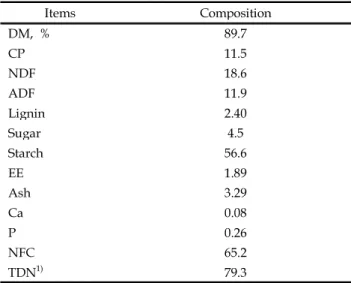
공시사료의 영양소 성분분석의 결과는 Table 1에 나타내
[Provider:earticle] Download by IP 118.70.52.165 at Monday, December 20, 2021 7:46 PM
www.earticle.net
었다. 사료의 원료사료 3종의 건물(#934.01), 조단백(#976.05), 조지방(#920.39), 산성세제불용섬유소(acid detergent insoluble fiber, ADF, #973.18), 조회분(#942.05), 칼슘(Ca, #927.02), 인(P, 3964.06)은 AOAC(2005)에 제시된 방법에 따라 분석 되었다. CP는 총 질소 함량의 6.25배로 계산된 값을 측정 하였고, 사료의 총 질소 함량은 Nitrogen Combustion Analyzer(Leco FP-528 Leco, MI, USA)를 이용하여 측정되 었다. 섬유소 함량 평가를 위한 NDF와 리그닌(acid detergent lignin, ADL)은 Van Soest 등(1991)에 의해 분석 되었으며, NDF 분석을 위해 열에 안정한 아밀라아제(α -amylase)를 사용하였고, 잔여 재를 포함하여 표현하였다.
탄수화물 분획 중 Starch는 Hall (2009)이 제시한 방법에 의해 분석되었다. 가용성 단백질(soluble protein, SolP)을 분석하기 위해서는 Krishnamoorthy 등(1982)이 제시한 방 법을 사용하였고, 중성세제불용단백질(neutral detergent insoluble crude protein, NDICP)과 산성세제불용단백질 (acid detergent insoluble crude protein, ADICP)의 분석은 Licitra 등(1996)이 제시한 방법을 사용하였다.
Table 1. Estimated chemical composition (%, dry matter basis or as stated) of experimental feeds used for in vitro
Items Composition
DM, % 89.7
CP 11.5
NDF 18.6
ADF 11.9
Lignin 2.40
Sugar 4.5
Starch 56.6
EE 1.89
Ash 3.29
Ca 0.08
P 0.26
NFC 65.2
TDN1) 79.3
DM, dry matter; CP, crude protein; NDF, neutral detergent insoluble fiber, NDF; ADF, acid detergent fiber; EE, ether extract; NFC, non fiber carbohydrate; TDN, total digestible nutrients.
1)The value of TDN was calculated by the methods suggested from NRC (2001)
상기의 분석항목을 이용하여 사료의 에너지가를 가소화 영양소 총량(total digestible nutrients, TDN)으로 평가하 기 위해 NRC 젖소사양표준(2001)을 사용하였고, 비섬유소
탄수화물(non fiber carbohydrate, NFC)을 구하기 위해서 는 아래의 수식을 이용하였다.
NFC = [100 – ash – EE – CP - (NDF – NDICP)]
3.
In vitro
발효 평가상용으로 판매되고 있는 제품 중 25µm의 공극 크기를 가 진 F57 filter bag(Ankom Technology Corp., NY, USA)과 50µm의 공극 크기를 가진 R510 nylon bag (Ankom Technology Corp., NY, USA)이 실험에 사용될 사료 주머 니로 선정되었고, 각 처리구의 명칭을 F57, R510으로 명명 하였다. In vitro 발효 시험에 앞서 배합된 동일 배합사료 2g/DM은 각 처리구에 해당하는 사료 주머니에 담긴 후 배양 시험 전까지 500mL의 duran bottle에 보관되었는데 각 배양 용기 당, 2개의 사료 주머니를 보관하였다. 반추위 액은 당일 오전 사료급여 전 캐뉼라를 통해 채취되었으며, 2L 보온병에 보관되어 즉시 연구실로 옮겨졌다. 이후 8겹 의 cheeze cloth에 걸러진 뒤 1:3의 비율로 in vitro buffer(Goering and Van Soest, 1970)에 희석되었고, O2free-CO2에 bubbling시켜 완전 혐기 상태를 유지한 상태 로 유지되었다. 이를 각각 filter bag과 nylon bag이 담긴 500mL duran bottle에 250mL 씩 분주하고 bottle cap을 이용하여 완전 sealing 처리하였다. Sealing된 duran bottle 은 39℃ incubator에서 48h 배양 처리를 거친 다음 개봉되 어 건물 소화율(in vitro dry matter degradability, IVDMD), 섬유소 소화율(in vitro neutral detergent fiber degradability, IVNDMD), pH, 암모니아태 질소(ammonia nitrogen, NH3-N), 휘발성지방산(volatile fatty acids, VFA) 발생량을 측정하였다. 각 배양시간에 가스 발생량은 pressure transducer(Sun Bee Instrument Inc.)를 이용하여 3, 6, 12, 24 그리고 48h에 대해 측정하였고(Theodorou et al., 1994), 배양액 내의 미생물 조성을 평가하기 위해 위액 1.7mL을 채취하여 20,000g×15min 조건에서 원심분리 후 pellet화하여 상층액을 제거하고 –80℃ 초저온냉동고 (Innova®U725 Upright Freezer, Eppendorf AG, Hamburg, Germany)에 분석 전까지 보관하였다.
최종 배양 시간(48h) 이후 소화물이 포함된 반추위액을 수거하여 3000rpm×15min의 원심분리 과정을 거친 다음, 상등액을 각 1mL씩 NH3-N와 VFA 측정을 위해 배양하였 다. NH3-N 측정용 배양액에는 0.2M H2SO4200µL를, VFA 측정용 배양액에는 25% metaphosphoric acid 200µL를 각
[Provider:earticle] Download by IP 118.70.52.165 at Monday, December 20, 2021 7:46 PM
www.earticle.net
각 첨가하여 vortexing 후 –80℃에 냉동 보관하였다. 사료 가 담긴 filter bag은 증류수를 이용하여 6~7회 washing 후 55℃ dry oven에서 48h 건조, 방랭 후 무게를 측정하여 건 물 소화율을 측정하였다(Goering and Van Soest, 1970). 이 후 소화물 잔량 내 섬유소 소화율은 fiber analyzer(A200, Ankom Technology Corp., NY, USA)를 이용하여 분석하 였다.
pH는 3000rpm×15min의 원심분리 과정을 거친 반추위 액을 pH meter(FP20, Mettler toledo, OH, USA)를 이용하 여 측정하였다. NH3-N 측정은 Chaney and Marbach (1962)가 제시한 방법을 이용하여 측정하였다. 냉동 보관해 둔 배양액 Sample을 4℃에서 녹이고, 20,000g× 15분의 원 심분리과정을 후 상등액 200µL을 1.5mL tube에 분주하였 다. NH3-N standard와 각각의 시료 2µL씩을, phenol color reagent(phenol 50g, sodium nitroferricyanide 0.25g, distilled water 1L)와 alkali-hypochlorite(sodium hydroxide 25g, sodium hypochlorite 16.8mL, distilled water 1L) 각 100µL 씩을 96 well cell plate에 분주하고, 항온 수조(37℃) 에서 15분간 반응시켜 microplate reader(iMARK, Bio-Rad Inc., CA, USA)를 이용하여 630nm의 파장에서 흡광도를 측정하였다.
VFA의 측정은 Erwin 등(1961)이 제시한 방법에 따라 측 정하였다. 보관해둔 sample을 4℃에서 녹이고, 20,000g× 15 분의 원심분리과정 후 상층액 200µL를 99% ethanol 800µL 로 희석하여 VFA 분석을 위한 flame ionization detector와 capillary column(NukolTM Fused silica capillary column 30m×250µm×0.25µm, Supelco Inc., PA, USA)이 장착된 gas chromatography(Agilent 7890A, Agilent Technology, CA, USA)를 이용하여 측정하였다. 측정을 위한 oven, injector, detector의 온도는 각각, 90, 90-200, 230℃로 유지 되었고, 질소는 이동상 gas로 30mL/min의 flow rate를 유 지하며 사용되었다.
4. Genomic DNA 추출
In vitro 반추위 미생물 평가를 위한 gDNA(genomic DNA) 추출은 1.7mL의 rumen fluid pellet을 이용하여 Yu 와 Morrison (2004)에 의해 제시된 RBB+C(repeated bead beating plus column) method 방법에 따라 추출하였다. 이 를 간략하게 제시하면, 위액으로부터 얻은 pellet에 lysis buffer 1mL을 첨가한 후 재부유시키고, zirconia beads가 들어있는 2mL screw-cap tube(Simport®, Quebec, Canada)
에 용액을 옮겨 Bullet Blender(Next Advance, NY, USA) 를 이용하여 최대 속도로 3분간 균질시켰다. 균질이 끝나 면 70℃에 15분 동안 incubation을 실시하며, incubation 이후 4℃에서 16000g×5min 의 원심분리 과정을 거쳐 새 2mL tube에 보관하였고 pellet이 들어있는 tube에는 lysis buffer 300µL를 첨가하여 위의 과정을 한 번 더 반복하였다.
Lysis buffer를 통해 추출된 용액에 260µL의 10M ammonium acetate를 첨가하여 잘 섞은 후 ice에 5분 동안 incubation을 실시하고, 그 후 4℃에서 16000g× 10min의 원심분리를 실시하였다. 상층액을 2개의 새 2mL tube에 옮긴 후 isopropanol을 첨가하여 30분간 incubation을 실 시하고, incubation 이후 4℃에서 16000g× 15min 의 원심 분리를 실시하였다. 상층액을 제거하고 70% ethanol 500µL로 핵산 pellet을 세척한 후 pellet을 3차 증류수 50µL 에 용해시켰다.
RNA와 단백질을 제거하고 DNA를 정제하기 위해 Dokdo-Prep™ Bacterial Genomic DNA purification kit (Elpisbiotech inc., Daejeon, Korea)을 이용하였다. 핵산 pellet을 용해시킨 3차 증류수에 DNase-free RNase (10mg/mL)를 2µL 넣은 후 상온에 5분간 incubation을 실 시하였다. incubation이 끝나고 gDNA lysis buffer (G2-1) 360µL, gDNA lysis buffer(G2-2) 40µL 그리고 proteinase K 용액 20µL를 넣어 잘 섞은 후 65℃에서 15분 동안 incubation을 실시하였다. incubation 과정이 끝나고 spin column에 용액을 옮긴 후 4℃에서 16000g× 1min 의 원심 분리 과정을 저치며, 750µL의 wash buffer를 이용하여 세 척하였다. 16000g×5min 의 원심분리 과정을 통해 잔존하 는 wash buffer를 완전히 제거하고 pellet을 100µL의 3차 증류수에 용해시켜 gDNA를 얻었다.
5. 재조합 plasmid의 제작
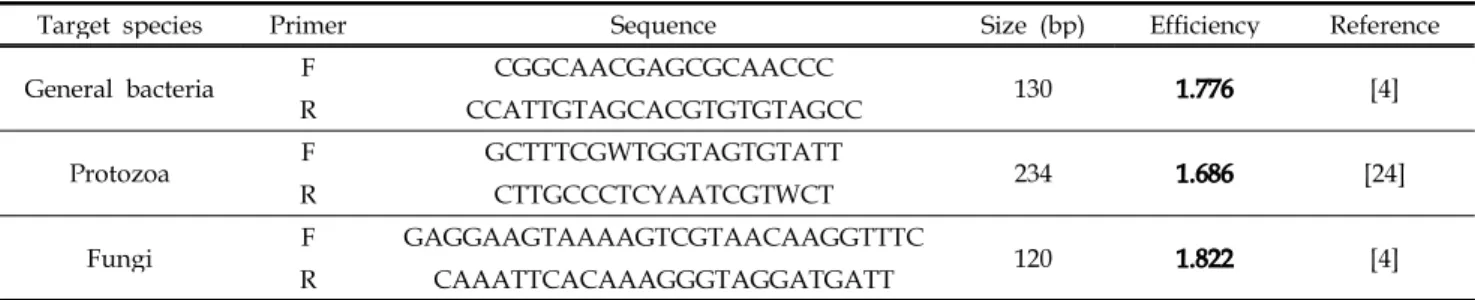
본 연구에 사용된 primer 정보는 Table 2에 제시하였다.
real-time PCR의 정량 기준으로 사용하기 위하여 각 primer의 재조합 DNA를 제작하였다. 반추위액에서 앞서 제시된 방법으로 gDNA 추출하고, 이를 template로 하여 C1000™ Thermal cycler(Bio-Rad Inc., CA, USA)를 이용하 여 PCR을 진행하였다. PCR 조건은 최종 반응액 20µL에 0.5µL의 10mM dNTPs Mix(BioFACT™, Daejeon, Korea), 2µL의 10x Buffer(BioFACT™, Daejeon, Korea), 2µL gDNA, 1µL forward primer(10pmol concentration), 1µL reverse primer(10pmol concentration), 0.2µL Taq polymerase
[Provider:earticle] Download by IP 118.70.52.165 at Monday, December 20, 2021 7:46 PM
www.earticle.net
Table 2. PCR primers used in this study
Target species Primer Sequence Size (bp) Efficiency Reference
General bacteria F CGGCAACGAGCGCAACCC
130 1.776 [4]
R CCATTGTAGCACGTGTGTAGCC
Protozoa F GCTTTCGWTGGTAGTGTATT
234 1.686 [24]
R CTTGCCCTCYAATCGTWCT
Fungi F GAGGAAGTAAAAGTCGTAACAAGGTTTC
120 1.822 [4]
R CAAATTCACAAAGGGTAGGATGATT
(BioFACT™, Daejeon, Korea), 그리고 13.3µL 3차 증류수로 하였고, 반응조건은 95℃에서 10분간 pre-denaturation을 수행한 후, denaturation 95℃ 30초, annealing 60℃ 30초, extension 72℃ 30초 과정을 35회 반복하였다. PCR 산물은 gel extraction kit(LaboPassTM Gel and PCR Clean-up Kit, Cosmogenetech, Seoul, Korea)를 이용하여 해당 밴드만을 획득한 후, pGEM-T Easy vector(Promega, Wisconsin, USA) 에 ligation 하고,Escherichia coli DH5α에 transformation 하 였다. Transformation된 E. coli는 엠피실린(50mg/L)이 첨 가된 LB broth에서 한밤 배양 후, plasmid mini prep kit(DokDo-Prep Plasmid Mini-Prep Kit, Elpisbiotech inc., Daejeon, Korea)을 이용하여 완성된 plasmid를 획득하였 고, 앞서 제시된 동일한 조건으로 PCR 검증하여 재조합 plasmid를 완성하였다.
6. Real-time PCR
Real-time PCR(polymerase chain reaction)은 CFX96 Touch™ System(Bio-Rad Inc., CA, USA)을 이용하였다.
Real time PCR의 조성은 최종 반응액 20µL에 0.5µL의 10mM dNTPs Mix(BioFACT™, Daejeon, Korea), 2µL의 10x Buffer(BioFACT™, Daejeon, Korea), 1µL의 gDNA (~20ng), 1µL forward primer(10pmol concentration), 1µL reverse primer(10pmol concentration), 0.2µL Taq polymerase (BioFACT™, Daejeon, Korea), 1µL Evagreen(SolGent Co., Ltd., Daejeon, Korea), 그리고 13.3µL 3차 증류수이었다.
본 실험에 사용된 반응조건은 95℃에서 10분동안 pre- denaturation을 수행한 후, denaturation 95℃ 30초, annealing 60℃ 30초, extension 72℃ 30초 과정을 40회 반 복하였다. 각 cycling 단계에서 evagreen의 형광값을 측정 하였고, 40회의 cycling이 완결된 후 60~95℃까지 30초당 1℃씩 온도를 증가시켜 melting point analysis를 수행하였 고, Ct(threshold cycle)와 Tm(annealing temperature)값은 CFX manager software(Bio-Rad Laboratories, Inc. CA,
USA)를 이용하여 분석하였다. Standard curve는 앞서 제 작된 각 재조합 primer를 1×10⁵부터 1×10⁹copies/µL까지 10-fold serial dilution하여 사용되었다. Corresponding copy number는 아래의 계산식에 의해 도출되었다(Lee et al., 2006).
≤ ×
× ×
아래의 계산식을 이용하여 standard curve의 slope로부 터 PCR 증폭의 efficiency(E)를 계산하였다(Lee et al., 2006). 절대 정량은 standard curve에 대한 Ct value를 이 용하여 결정되었다.
7. 통계 분석
In vitro 실험에서 측정된 모든 data는 SAS package 9.3(SAS Institute Inc., Carey, NC, USA)의 proc t-test를 이용하여 분석되었고, Bag에 따른 처리구 간 유의적 차이 는 5% 유의수준에서 통계적 유의성을 검증하였다.
Ⅲ. 결과
1.
In vitro
발효 평가사료 주머니의 공극 차이에 따른 in vitro 가스 생성 및 가스 parameter에 대한 결과는 Table 3에 나타내었다. 배 양시간이 증가함에 따라 F57과 R510 모두 가스 발생량이 증가하였고, 모든 배양시간에서 F57에 비해 R510에서 유의 적으로 높은 가스 발생량을 보였다(p<0.01).
Table 4는 사료 주머니의 공극 차이에 따른 in vitro 건
[Provider:earticle] Download by IP 118.70.52.165 at Monday, December 20, 2021 7:46 PM
www.earticle.net
물 소화율, 섬유소 소화율, pH, NH3-N, 그리고 VFA 발생 량에 대한 결과이다. 건물과 섬유소 소화율에서는 F57에 비해 R510에서 모두 유의적으로 높은 결과를 보였다 (p<0.01). 한편, pH와 NH3-N에서는 F57에서 R510에 비해 유의적으로 높은 값을 나타냈다(p<0.01).In vitro 최종 48h 배양에서 발생한 VFA 조성에서, 총 VFA 발생량과 propionate 비율, A:P ratio(acetate to propionate ratio)에 서는 유의적인 차이가 나타나지 않았고(Total VFA, p=0.25; propionate, p=0.55; A:P ratio, p=0.25), acetate와 butyrate 비율에서는 F57에 비해 R510에서 유의적으로 높 았다(p<0.01).
Table 5는 사료 주머니의 공극 차이에 따른 in vitro 배 양 후의 미생물 조성에 대한 결과이다. 48h 배양이 끝난 위액으로부터 추출한 gDNA 내의 general bacteria와 protozoa의 총량에서는 F57과 R510 모두 유의적인 차이를 보이지 않았고(general bacteria, p=0.69; protozoa, p=0.94), fungi 총량을 비교하였을 때 F57에 비해 R510에서 유의적
으로 높은 결과를 나타냈다(p<0.01).
Ⅳ. 고찰
본 연구는 in vitro 발효성상의 평가에 사용될 수 있는 상용 사료 주머니의 공극의 차이가 실제 발효 성상에 미치 는 영향을 평가하기 위해 수행되었다.
In vitro 발효 실험에서 가스 발생량의 측정은 사료의 영 양적 평가와 소화율을 대변할 수 있는 지표로 이용되며 (Sommart et al., 2000; Ki et al., 2017), 사료 주머니의공극 이 큰 R510에서 증가된 가스발생량을 나타내었다. 또한 최 종 가스발생량 건물 소화율, 섬유소 소화율 역시 R510에서 높았으며 이는 실제 미생물에 의한 발효가 주머니의 공극 이 큰 R510에서 더욱 활발히 일어난다는 가설을 증명한다.
다시 말해, R510 처리구의 가스 발생량과 영양소 소실율의 공통된 유의적 증가는 공극 면적의 확대와 in vitro
Table 3. In vitrogas production by different pore size of filter bags
F57 R510 n SEM p-value
Gas (mL/g DM)
3 h 42.61 71.57 4 4.396 <0.01
6 h 67.58 121.47 4 6.740 <0.01
12 h 112.58 214.98 4 13.677 <0.01
24 h 228.28 397.88 4 22.670 <0.01
48 h 392.74 541.86 4 20.353 <0.01
F57, The treatment in which F57 filter bags (25 µm) were used; R510, The treatment in which R510 nylon bags (50 µm) were used;
SEM, standard error of the mean. DM, dry matter.
Table 4. Fermentation characteristics after in vitroincubation using different pore size of filter bags
Item F57 R510 n SEM p-value
DM digestibility (%) 66.06 86.60 4 2.44 <0.01
NDF digestibility (% NDF) 33.91 50.09 4 0.90 <0.01
pH 6.29 5.79 4 0.07 <0.01
NH3-N (mg/dL) 47.56 42.29 4 1.40 <0.01
Total VFA (mM) 97.7 102.2 4 8.03 0.25
Acetate (mM) 452.7 478.3 4 5.87 <0.01
Propionate (mM) 217.6 213.0 4 7.35 0.55
Butyrate (mM) 204.9 229.3 4 5.07 <0.01
A:P ratio 2.1 2.3 4 0.09 0.25
F57, The treatment in which F57 filter bags (25 µm) were used; R510, The treatment in which R510 nylon bags (50 µm) were used;
SEM, standard error of the mean; DM, dry matter; NDF, neutral detergent insoluble fiber; NH3-N, ammonia-nitrogen; VFA, volatile fatty acids; A:P ratio, acetate to propionate ratio.
[Provider:earticle] Download by IP 118.70.52.165 at Monday, December 20, 2021 7:46 PM
www.earticle.net
Table 5. Rumen microbial population after in vitroincubation using different pore size of filter bags
Variable F57 R510 n SEM p-value
Organism
General bacteria1) 1.66 1.71 4 0.16 0.69
Protozoa2) 5.04 4.88 4 3.12 0.94
Fungi3) 1.18 2.54 4 0.35 <0.01
F57, The treatment in which F57 filter bags (25 µm) were used; R510, The treatment in which R510 nylon bags (50 µm) were used;
SEM, standard error of the mean.
1)× 1010 copy number of the 16S rDNA gene per gram of rumen content.
2)× 108 copy number of the 18S rDNA gene per gram of rumen content.
3)× 105 copy number of the 18S rDNA gene per gram of rumen content.
반추위 발효 증가와의 유의적 관련성을 증명함과 동시에 영양소 소실율의 차이가 공극 면적 차이에 의한 washing 과정상의 과도한 미소화영양소 제거에 의한 차이가 아니 라는 것이다. 오히려 공극이 F57에 비해 큰 R510을 사용할 경우 실제 반추 미생물과 사료와의 1차적 접촉 기회를 증 가시킬 수 있다는 사실을 반영한다고도 볼 수 있다 (Lindberg et al. 1984).
NH3-N은 사료 중 단백질 원료가 미생물에 의해 분해됨 에 따라 발생되는 최종 발효산물로, 미생물의 단백질 이용 성과 암모니아의 미생물 전환 효율과 밀접한 관계가 있다 (Firkins et al., 2007). F57에서 유의적으로 낮았던 건물 소 화율과 가스 발생량을 고려할 때, F57의 NH3-N 발생량이 낮을 것으로 예상하였으나 실제 수치는 R510에서 낮았다.
반추미생물의 영양소 발효과정이 활발할수록 미생물 내 높은 ATP 축적이 가능하며 축적된 에너지를 바탕으로 흡 수된 NH3-N는 미생물체단백질로 재합성될 가능성이 높다 (Bach et al., 2005). 본 연구에서 측정된 R510에서 낮은 NH3-N 발생량은 상기 과정에 의한 미생물체단백질로의 NH3-N 재이용성 증가와 유관할 것으로 추정된다. 따라서 본 연구의 가스발생량, 영양소 소화율, NH3-N 발생량의 결과는 in vitro 실험에서 사료 주머니를 사용할 경우, R510 의 적용이 F57에 비해 반추위 내 사료 이용성의 평가에 효 과적일 것으로 보인다. 그러나 본 연구에서는 CP 소화율 및 미생물체 단백질 생성량을 직접 측정하지 않았으므로, 추가적인 연구를 통한 사료 주머니 공극 차이에 따른 미생 물체 단백질 생성량과 조단백질 소화율의 관계의 규명이 필요할 것으로 사료된다.
Acetate는 주로 섬유소 분해 박테리아에 의해 구조 탄수 화물이 분해되었을 때 생성되며, propionate는 전분 분해 박테리아에 의해 비구조 탄수화물이 분해되었을 때 생성 된다(Enjalbert et al., 1999). 반추위액의 pH는 반추 미생물 의 사료 분해에 의한 여러 발효 산물에 의해 변화되는데,
총 VFA 생성량의 증가는 pH의 저하에 영향을 줄 수 있다 (Ha et al., 2005). 본 연구에서 F57에 비해 R510에서 높은 acetate 비율은 구조 탄수화물의 발효 차이에 의한 것으로 사료되며, 이는 R510에서 유의적으로 높았던 섬유소 소화 율 결과와 일치한다. 영양소 소화율, 가스 발생량을 고려할 때, R510에서 낮은 pH와 높은 VFA 발생량이 예상 되었고 실제 pH 결과는 예상과 같이 R510에서 유의적으로 낮았 으나 총 VFA 발생량은 처리구 간 유의적인 차이 없이 수 치적 증가만을 나타내었다. 반추위 pH가 6.0 이하로 감소 할 경우, 섬유소 분해 미생물의 활성은 낮아지고 주요 전 분 분해 미생물의 활성 증가 및 탄수화물 분해 대사경로의 전환 등이 나타난다(Dijkstra et al., 2012). 본 연구에서는 R510의 영양소 소화가 유의적으로 높았고 이는 pH의 유 의적 감소로 나타났는데 상기 과정에서 주요 전분 분해 미 생물의 탄수화물 분해대사 경로의 전환이 발생하여 VFA 이외의 유기산의 발생이 더욱 증가하였을 것으로 추정된 다.
한편, 높은 반추위 사료 분해율과 미생물 수는 정의 상 관관계를 보이는 것으로 알려져 있으며 R510에서 높은 영 양소 소화율과 가스 발생량을 나타낸 본 연구결과를 바탕 으로 R510에 존재하는 general bacteria와 protozoa, fungi 의 절대량이 F57에 비해 높을 것으로 예상하였다. 하지만, real-time PCR을 이용하여 미생물 우점도를 분석한 결과, R510에서 유의적으로 높았던 fungi를 제외한 general bacteria와 protozoa에서는 유의적인 차이가 나타나지 않 았다.
반추위 내 fungi는 세포 외 분비 효소를 통해 사료 입자 를 작게 하여 bacteria 및 fungi의 접촉면적을 증가시킬 수 있어 사료 분해를 증진시키며(Lowe et al., 1987), 탄수화물 분해과정에서 생성된 육탄당(hexose)을 이용하여 formate, acetate, lactate, CO2, H2등을 생성한다(Trinci et al., 1994).
반추위 내 발효 산물 중 formate는 미생물에 의해 CO2와
[Provider:earticle] Download by IP 118.70.52.165 at Monday, December 20, 2021 7:46 PM
www.earticle.net
H2로 전환되어 반추위액에서 측정되지 않으며, 생성된 H2
는 메탄 및 propionate 합성을 통해 제거된다(Ha et al., 2005). 이번 실험 결과에서는 R510에서 F57에 비해 소화가 더 진행되었지만 VFA 총량에서는 유의적인 차이가 나타 나지 않았고 fungi를 제외한 general bacteria와 protozoa 의 총량에서도 유의적인 차이가 나타나지 않았다. 이는 R510에서 높은 우점도를 보인 fungi로 인해 formate의 생 성량이 증가하였고 이는 CO2와 H2로 전환되어 메탄 발생 에 이용된 것으로 판단된다. Ramin 등(2013)의 연구에서는 사료 주머니의 유무에 따른 가스 발생량을 비교하는 in vitro 실험을 수행하였고, 사료 주머니를 이용한 in vitro 실 험을 수행할 경우, 전체 가스 발생량 대비 메탄 발생량이 증가한다고 보고하였다(p<0.01). 따라서, 본 연구에서는 메 탄 발생량을 측정하진 않았지만 두 처리구 간 propionate 발생 비율에서는 유의적인 차이가 나타나지 않았으며 (p=0.55), 선행연구 결과를 토대로 보았을 때 R510에서 높 았던 소화율에 비해 유의적으로 낮았던 총 VFA 발생량은 formate 생성 및 메탄 발생에 의한 것으로 사료된다. 정확 한 연구 결과를 위해 사료 주머니의 공극 차이에 따른 in vitro 배양 시간별 메탄 발생량을 측정하는 연구가 필요할 것으로 사료된다.
Ⅴ. 요약
사료의 생물학적 평가 방법 중 in vitro 발효 평가는 사 료 주머니를 사용하는 방법과 사료 주머니 없이 배양병에 직접 사료를 담아 수행하는 방법이 있으며, 본 연구에서는 사료 주머니의 공극 차이가 in vitro 반추위 발효성상과 미 생물 조성에 미치는 영향을 평가하였다. 본 연구의 공시 사료는 1mm로 분쇄된 쌀과 대두박, 티모시를 70:7:23의 비 율로 이용하였으며, 공극 크기가 각각 25µm, 50µm인 F57 과 R510에 공시 사료를 2g씩 담아 in vitro 실험을 수행하 였다. In vitro 배양 이후 3, 6, 12, 24, 48h 동안 발생한 발 효 성상과 48h 배양 이후 반추 미생물의 조성을 분석하였 다. 모든 배양 시간에서 가스 발생량은 R510에서 F57보다 유의적으로 높았고(p<0.01), 건물 소화율(p<0.01)과 섬유소 소화율(p<0.01) 또한 R510에서 F57보다 유의적으로 높았 다. 반면, pH(p<0.01)와 NH3-N(p<0.01)은 F57에 비해 R510 에서 유의적으로 낮았다. Acetate와 butyrate 비율은 R510 에서 유의적으로 높았고(p<0.01), propionate 비율과 총 VFA 발생량은 두 처리구 간 유의적인 차이가 나타나지 않
았다(propionate, p=0.55; Total VFA, p=0.25). General bacteria와 protozoa의 총량에서는 유의적인 차이가 나타 나지 않았고(general bacteria, p=0.69; protozoa, p=0.94), fungi의 총량은 F57보다 R510에서 유의적으로 높았다 (p<0.01). 따라서, R510에서 높았던 가스 발생량과 영양소 소화율, acetate, butyrate 비율을 토대로, in vitro 발효 평 가에서 R510을 사용하는 것이 F57 사용에 비해 실제 반추 위 발효 성상을 더 정확히 반영할 수 있다고 판단된다.
사사
이 논문은 부산대학교 기본연구지원사업(2년)에 의하여 연구되었음.
Ⅵ. 참고문헌
1. AOAC. 2005. Official Methods of Analysis of AOAC International. 18th ed. Association of Official Analytical Chemists, Gaithersburg, MD, U.S.A.
2. Bach, A., Calsamiglia, S., and Marshall, D. Stern. 2005.
Nitrogen metabolism in the rumen. J. Dairy Sci.
88:E9-E21.
3. Chaney, A. L. and Marbach, E. P. 1962. Modified reagents for determination of urea and ammonia. Clin.
Chem. 8:130-132.
4. Denman, S. E. and McSweeney, C. S. 2006.
Development of a real-time PCR assay for monitoring anaerobic fungal and cellulolytic bacterial populations within the rumen. FEMS Microbiol. Ecol. 58:572-582.
5. Dijkstra, J., Ellis, J. L., Kebreab, E., Strathe, A. B., López S., France, J. and Bannink, A. 2012. Ruminal pH regulation and nutritional consequences of low pH, Anim. Feed Sci. Technol. 172:22-33.
6. Enjalbert, F., Garrett, J., Moncoulon, R., Bayourthe, C.
and Chicoteau, P. 1999. Effects of yeast culture (Saccharomyces cerevisiae) on ruminal digestion in non-lactating dairy cows. Anim. Feed Sci. Technol.
76:195-206.
7. Erwin, E., Marco, G. and Emery, E. 1961. Volatile fatty acid analyses of blood and rumen fluid by gas
[Provider:earticle] Download by IP 118.70.52.165 at Monday, December 20, 2021 7:46 PM
www.earticle.net
chromatography. J. Dairy Sci. 44:1768-1771.
8. Firkins, J., Yu, Z. and Morrison, M. 2007. Ruminal nitrogen metabolism: perspectives for integration of microbiology and nutrition for dairy. J. Dairy Sci.
90:E1-E16.
9. Goering, H. K. and Van Soest, P. 1970. Forage fiber analyses(apparatus, reagents, procedures, and some applications). Agricultural Research Service, US Department of Agriculture.
10. Ha, J., Lee, S., Moon, Y. and Kim, C. 2005. Ruminant nutrition and physiology. Seoul National University press. Seoul, Korea.
11. Hall, M. B. 2008. Determination of starch, including maltooligosaccharides, in animal feeds: Comparison of methods and a method recommended for AOAC collaborative study. J. AOAC Int. 92:42-49.
12. Ki, K., Park, S., Lim, D. and Seo, S. 2017. Evaluation of the nutritional value of locally produced forage in Korea using chemical analysis and in vitro ruminal fermentation. Asian-australas. J. Anim. Sci. 30:355.
13. Krishnamoorthy, U., Muscato, T., Sniffen, C. and Van Soest, P. 1982. Nitrogen fractions in selected feedstuffs. J. Dairy Sci. 65:217-225.
14. Krizsan, S., Jančík, F., Ramin, M. and Huhtanen, P.
2013. Comparison of some aspects of the in situ and in vitro methods in evaluation of neutral detergent fiber digestion. J. Anim. Sci. 91:838-847.
15. Lee, C., Kim, J., Shin, S. and Hwang, S. 2006.
Absolute and relative QPCR quantification of plasmid copy number inEscherichia coli. J. Biotechnol.
123:273-280.
16. Licitra, G., Hernandez, T. and Van Soest, P. 1996.
Standardization of procedures for nitrogen fractionation of ruminant feeds. Anim. Feed Sci.
Technol. 57:347-358.
17. Lindberg, J. E., Kaspersson, A. and Ciszuk, P. 1984.
Studies on pH, number of protozoa and microbial ATP concentrations in rumen-incubated nylon bags with different pore sizes. J. Agric. Sci. 102:501-04.
18. Lowe, S. E., Theodorou, M. and Trinci, A. 1987.
Growth and fermentation of an anaerobic rumen fungus on various carbon sources and effect of
temperature on development. Appl. Environ.
Microbiol. 53:1210-1215.
19. NRC. Nutrient requirements of dairy cattle. 2001.
National Academic Press. Washington, D.C., U.S.A.
20. Puchala, R., Animut, G., Patra, A., Detweiler, G., Wells, J., Varel, V., Sahlu, T. and Goetsch, A. 2012.
Effects of different fresh-cut forages and their hays on feed intake, digestibility, heat production, and ruminal methane emission by Boer× Spanish goats. J.
Anim. Sci. 90:2754-2762.
21. Ramin, M., Krizsan, S., Jančík, F. and Huhtanen, P.
2013. Measurements of methane emissions from feed samples in filter bags or dispersed in the medium in an in vitro gas production system. J. Dairy Sci.
96:4643-4646.
22. Sommart, K., Parker, D., Rowlinson, P. and Wanapat, M. 2000. Fermentation characteristics and microbial protein synthesis in an in vitro system using cassava, rice straw and dried ruzi grass as substrates.
Asian-australas. J. Anim. Sci. 13:1084-1093.
23. Spanghero, M., Zanfi, C., Signor, M., Davanzo, D., Volpe, V. and Venerus, S. 2015. Effects of plant vegetative stage and field drying time on chemical composition and in vitro ruminal degradation of forage soybean silage. Anim. Feed Sci. Technol.
200:102-106.
24. Sylvester, J. T., Karnati, S. K., Yu, Z., Morrison, M.
and Firkins, J. L. 2004. Development of an assay to quantify rumen ciliate protozoal biomass in cows using real-time PCR. J. Nutr. 134:3378-3384.
25. Tagliapietra, F., Cattani, M., Hindrichsen, I. K., Hansen, H. H., Colombini, S., Bailoni, L. and Schiavon, S. 2012. True dry matter digestibility of feeds evaluated in situ with different bags and in vitro using rumen fluid collected from intact donor cows. Anim. Prod. Sci. 52:338-346.
26. Theodorou, M. K., Williams, B. A., Dhanoa, M. S., McAllan, A. B. and France, J. 1994. A simple gas production method using a pressure transducer to determine the fermentation kinetics of ruminant feeds. Anim. Feed Sci. Technol. 48:185-197.
27. Trinci, A. P., Davies, D. R., Gull, K., Lawrence, M. I.,
[Provider:earticle] Download by IP 118.70.52.165 at Monday, December 20, 2021 7:46 PM
www.earticle.net
Nielsen, B. B., Rickers, A. and Theodorou, M. K.
1994. Anaerobic fungi in herbivorous animals. Mycol.
Res. 98:129-152.
28. Valente, T. N. P., Detmann, E. and Sampaio, C. B.
2015. Recent advances in evaluation of bags made from different textiles used in situ ruminal degradation. Can. J. Anim. Sci. 95:493-498.
29. Van Soest, P., Robertson, J. and Lewis, B. 1991.
Methods for dietary fiber, neutral detergent fiber, and nonstarch polysaccharides in relation to animal nutrition. J. Dairy Sci. 74:3583-3597.
30. Wilman, D. and Adesogan, A. 2000. A comparison of filter bag methods with conventional tube methods of determining the in vitro digestibility of forages.
Anim. Feed Sci. Technol. 84:33-47.
31. Yu, Z. and Morrison, M. 2004. Improved extraction of PCR-quality community DNA from digesta and fecal samples. Biotechniques 36:808-812.
(Received 18 February 2020, Revised 29 June 2020, Accepted 30 June 2020)
[Provider:earticle] Download by IP 118.70.52.165 at Monday, December 20, 2021 7:46 PM