Effect of Herbal Extracts Supplementation on Ruminal Methane Production and Fermentation Characteristics In vitro
Shin Ja Lee
1, Sung Sill Lee
1and Yea Hwang Moon
2*
1
Division of Applied Life Science (BK 21 Program), Gyeongsang National University, Jinju 660-701, Korea
2
Department of Animal Science and Biotechnology, Gyeongnam National University of Science and Technology, Jinju 660-758, Korea
Received July 25, 2011 /Revised September 2, 2011 /Accepted September 6, 2011This study was conducted to investigate the effects of several herbal extracts (obtusifolia, cinnamon, chinese pepper, licorice root) on the characteristics of rumen fermentation in vitro. Soybean meal was used as a substrate for fermentation in vitro. Herbal extracts were supplemented to media by 10% of the substrate. The substrates supplemented to Dehority artificial media with herbal extracts were fer- mented in 30ml serum bottles for 0, 3, 6, 9, 12 and 24 hr at 39℃. Cumulative gas production was significantly (p<0.05) greater in the herbal extract supplements than in the control, in the order of lico- rice root, chinese pepper, cinnamon and obtusifolia. Methane proportions of the herbal extracts were significantly (p<0.05) higher than that of the control. Licorice root extract supplementation resulted in the lowest methane proportion at 3 hr fermentation. Proportion of hydrogen was significantly (p<0.05) higher in the herbal extract supplements than in the control at 12 hr fermentation. Compared to the control, ammonia concentration in the licorice root was significantly higher at 3 hr fermentation, but lower at 12 hr fermentation (p<0.05). Based on these results, supplementation of the herbal extracts used in this experiment resulted in increased cumulative gas production and stimulating methane pro- duction in vitro rumen fermentation.
Key words : In vitro rumen fermentation, herbal extracts, methane
*Corresponding author
*Tel:+82-55-751-3265, Fax:+82-55-751-3267
*E-mail : [email protected]
Journal of Life Science 2011 Vol. 21. No. 9. 1315~1322 DOI : http://dx.doi.org/10.5352/JLS.2011.21.9.1315
서 론
사료 중 영양성분은 반추위 미생물에 의해 분해되어 휘발성 지방산, 수소, 이산화탄소, 암모니아 등으로 전환된다. 휘발성 지방산과 암모니아는 동물과 반추위 미생물에 의해 이용되지 만, 이산화탄소와 수소는 반추위내 박테리아에 의해 메탄으로 전환되는데 메탄은 체내에서 흡수되지 못하고 대기로 방출되 어 대기 오염의 원인이 되고 있다[20]. 메탄은 이산화탄소에 비해 그 양은 적지만 에너지를 흡수하는 능력은 이산화탄소의 21배이고, 지구온난화에 15% 정도 관여하는 것으로 알려져 있다[47]. 반추위에서 생산되는 메탄은 총 가스의 25~30%를 차지하며, 사양조건에 따라 섭취된 에너지의 2~15% 정도가 메탄가스로 손실되고 있다[17,21]. 반추동물에 있어서 사료에 너지의 약 8% 이상이 반추위 발효과정에서 생성된 메탄으로 손실되기 때문에 메탄 생성을 억제 시키는 것은 사료의 이용 효율 향상에도 중요하다[14].
반추위내 메탄생성 억제를 위한 방법으로 사료섭취량 조절 [22], 조사료와 농후사료의 비율 조절[40], 탄수화물 종류의 조 절[30], 조사료의 가공[3], monensin과 같은 프로토조아 제어 제[32], 불포화 지방산이나[50] 할로겐 화합물들의 첨가[13], 대
사제어를 위한 fumaric 산의 첨가[27] 그리고 yucca extracts와 같은 천연물질을 이용한 반추위 발효성상을 조절하려는 방법 [15,37]들이 연구되어 왔다. 메탄생성 박테리아는 프로토조아 의 표면에 주로 서식하는 것[32]으로 알려져 있는데, Shin 등 [41]은 in vitro 반추위 미생물 발효시험에서 생강이 프로토조 아를 크게 억제하여 메탄생성 억제제로서 개발이 가능하다고 하였다. 본 연구에서 사용된 천연물질로서 한약재인 결명자에 는 약리성분으로 항균작용을 하는 aloe emodin 등이 함유되어 있고, 계피에는 식이섬유가 54.3%, 지질 3.5%, 단백질 3.6%, 칼슘 1.2%가 함유되어 있는 다이어트식품이며 방부효과도 있 다[19]. 산초는 종자를 제외한 주정추출물에 함유되어 있는 es- tragole이 항균활성을 나타내는 주성분으로서 Vibrio para- haemolyticus에 대한 천연항균제로서 가능성이 있고[24], 감초 는 추출물을 탁주[23]나 불고기 소스로 이용[42]하면, 항균활 성과 저장안정성이 있는 것으로 보고되고 있다.
본 연구는 한약재로 많이 사용되고 있는 천연물질로서 항균
혹은 방부기능이 있는 것으로 알려져 있는 결명자
(obtusifolia), 계피(cinnamon), 산초(chinese pepper) 및 감초
(licorice root) 추출물을 in vitro 반추위 발효에 첨가하였을 때,
총 가스 생성량, 메탄과 수소생성 및 발효 성상을 조사해 보고
자 실시되었다.
Table 1. Chemical compositions of soybean meal and herbs used in this experiment Chemical composition Soybean
meal Treatments
Obtusifolia Cinnamon Chinese pepper Licorice root
Moisture, % 11.16 11.88 16.56 16.21 10.83
Crude protein, DM% 17.71 19.14 3.43 9.42 7.66
Crude fat, DM% 1.50 4.94 3.22 8.28 4.69
Crude fiber, DM% 30.25 13.31 29.37 19.19 27.85
Crude ash, DM% 4.09 4.83 2.74 5.73 5.92
NDF1, DM% 57.22 33.94 54.89 39.77 52.65
ADF2, DM% 38.81 17.91 48.55 10.42 39.55
1Neutral detergent fiber.
2Acid detergent fiber.
재료 및 방법
공시재료
In vitro 발효를 위한 기질은 대두박(미국산)을 사용하였고, 한약재 추출물은 한약재로 널리 사용되는 결명자, 계피, 산초 및 감초 10 g을 ethanol (95%) 300 ml에 침지시켜 50℃의 항온 수조에서 1시간 동안 정치시켰다. Filter paper (Whatman No.1)로 2회에 걸쳐 거른 다음, rotary evaporator에서 45℃를 유지하면서 농축시켰다[16].
발효기질인 대두박과 공시 한약재의 화학적 조성은 Table 1에서 보는 바와 같다.
공시축 및 사양관리
반추위 누관이 장착된 체중 약 600 kg의 홀스타인 착유우로 부터 in vitro 시험에 사용될 반추위액을 채취하였다. 위액 채 취를 위한 공시축의 사양관리는 농후사료와 조사료(볏짚+티 모시)의 비율을 풍건물 기준으로 4:6으로 하여 체중의 3%되는 양을 1일 2회(06:00와 16:00)로 분할하여 급여하였고, 물과 미 네랄 블록은 자유 섭취토록 하였다.
시험설계 및 in vitro 발효방법
시험구는 무처리 대조구와 4종의 한약재 추출물 처리구를 두었으며, 발효시간은 0, 3, 6, 9, 12, 및 24시간으로 설정하여 각 처리당 3반복으로 총 90개의 serum bottle이 사용되었다.
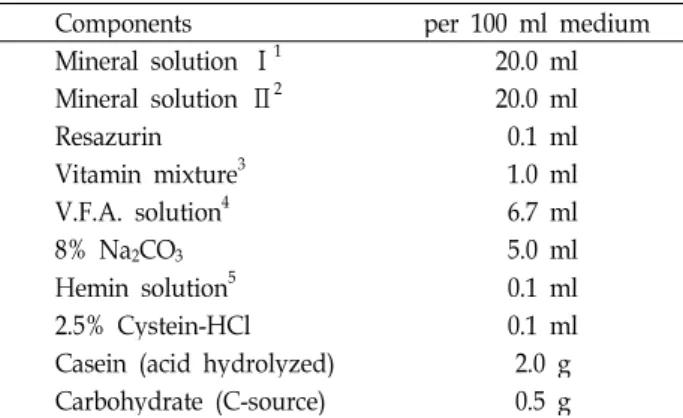
In vitro 발효를 위한 배양액은 Dehority artificial medium [9]을 사용하였고, 첨가하는 영양물질의 배합비율은 Table 2에 서 보는 바와 같다.
반추위 혼합 미생물로 사용될 위액은 in vitro 발효를 위한 미생물 접종 개시 2시간 전에 반추위 cannula를 통하여 채취 하였다. 채취한 위액은 oxygen free-CO
2gas가 충전된 보온용 기에 담아 온도를 유지시킨 채로 실험실로 운반한 다음, 사료 입자에 부착되어 있는 미생물을 분리하기 위하여 homoge- nizer에 넣고, oxygen free-CO
2gas를 충전하여 강하게 교반한 다음, 2겹의 cheese cloth로 여과하였다. 여과된 위액은 30분~1 시간 정도 정치시켜 비중이 낮은 사료입자를 부유시킨 다음,
Table 2. The composition of Dehority's artificial medium
Components per 100 ml medium
Mineral solution Ⅰ1 20.0 ml
Mineral solution Ⅱ2 20.0 ml
Resazurin 0.1 ml
Vitamin mixture3 1.0 ml
V.F.A. solution4 6.7 ml
8% Na2CO3 5.0 ml
Hemin solution5 0.1 ml
2.5% Cystein-HCl 0.1 ml
Casein (acid hydrolyzed) 2.0 g
Carbohydrate (C-source) 0.5 g
1Mineral solution I: K2HPO46.0 g in 1,000 ml distilled water.
2Mineral solution II: CaCl2 (anhydrous), 0.25 g; MgSO4
(anhydrous), 0.25 g; NaCl, 4.5 g; (NH4)2SO4, 4.5 g; MnSO4 · H2O, 0.10 g; FeSO4· 7H2, 0.01 g in 1,000 ml distilled water.
3Vitamin mixture: pyridoxine HCl, 0.20 g; nicotinic acid amide, 0.20 g; Ca-d-pantothenate, 0.20 g; para-aminobenzoic acid, 0.01 g; stock solution 1.0 ml in 1,000ml distilled water.
4V.F.A. solution: acetic acid 17 ml (2.9×10⁻²M); propionic acid, 6 ml (8.0x10⁻³M), DL-α-methylbutyric acid, n-valeric acid, and iso-valeric acid 1 ml each (9×10⁻⁴M).
5Hemin solution: dissolve 50 mg hemin in 1 ml of 1 N NaOH;
make to 100 ml with distilled water.
진공펌프로 완전히 제거하고, 중간층의 투명한 위액을 채취하 였다. 채취한 위액과 혐기 희석액[5]을 동일한 양으로 혼합하 여 in vitro 발효실험을 위한 반추위 혼합 미생물 용액으로 사 용하였다.
발효기질은 입자도 1 mm의 대두박 0.1 g을 30 ml의 serum bottle에 넣고, 10 ml의 Dehority artificial medium을 분주하 고, 위액 5 ml을 혐기 가스주입장치를 이용하여 접종한 다음, Gel상의 한약 추출물을 기질의 10% 수준(10 mg)으로 첨가하 여 39℃로 유지되는 shaking incubator (120 rpm)에서 설정된 시간 동안 발효시켰다.
조사항목 및 조사방법
공시재료의 일반성분 중, 건물(AOAC 930.15), 조회분
Table 3. The effect of herbal extracts on the pH of media during rumen fermentation
in vitro
IncubationTime (hr) Treatments
Control Obtusifolia Cinnamon Chinese pepper Licorice root
0 6.64±0.02 6.89±0.15 6.49±0.24 6.58±0.01 6.59±0.02
3 6.58±0.03b 6.57±0.01bc 6.71±0.01a 6.53±0.00cd 6.52±0.00d
6 6.72±0.14 6.56±0.01 6.69±0.05 6.58±0.01 6.57±0.03
9 6.56±0.03 6.53±0.03 6.64±0.06 6.54±0.02 6.54±0.02
12 6.51±0.01ab 6.48±0.01ab 6.54±0.04a 6.46±0.01b 6.46±0.00b
24 6.54±0.03 6.52±0.01 6.55±0.07 6.51±0.01 6.50±0.01
Mean 6.59±0.03 6.59±0.06 6.60±0.03 6.53±0.02 6.53±0.02
Mean±SE.
Mean with different superscripts in the same row differ significantly(
p
<0.05).(AOAC 942.05), 조단백질(AOAC 984.13, Model Tecator Kjeltec 1030 Analyzer), 조섬유(Model Tecator Fibertec System M6)의 분석은 AOAC [1] 방법에 준하였으며, neutral detergent fiber (NDF)와 acid detergent fiber (ADF) 함량은 Van Soest 등[48]의 방법에 따라 분석하였다.
발효 용액의 pH는 각 발효시간대별 gas 시료를 채취한 다음, pH meter (Mettler Toledo, MP230)를 이용하여 측정 하였다.
총 Gas 발생량은 각 발효시간대별로 시험관을 shaking in- cubator에서 꺼낸 후, 온도에 따른 변화를 감안하여 상온에서 20분간 방치시킨 다음, water displacement apparatus를 이용 하여 gas 발생량을 측정하였다[12].
메탄과 수소가스의 농도는 각 시간대별 가스발생량 측정 후, 30 ml serum bottle의 알루미늄 캡을 제거하고 주사기를 이용하여 10 ml vaccutainer에 가스를 포집하여 Molecular sieve 13×45-60 MESH (2.0M×1/8"×2.0 mm SS, VARIAN) col- umn이 장착된 gas-chromatography (VARIAN CP-3800, USA)를 이용하여 분석하였다. Gas-tight syringe를 이용하여 gas 시료를 1.0 ml씩 주입하였으며 0%, 5%, 10%, 15%, 20%
methane (balance nitrogen)을 standard gas 농도로 사용하였 다. GC의 분석조건은 oven temperature는 60℃, injector tem- perature 120℃, TCD (Thermal conductivity) temperature 120℃, FID (Flameionization) temperature 200℃로 하였으며, total run time 2:30분이었고 carrier gas는 nitrogen을 이용하 였다.
암모니아 농도는 10 ml 원심분리관에 발효액 6.2 ml을 넣 고, 미생물의 활성을 중지시키기 위하여 포화 HgCl
20.06 ml을 첨가하여 3,000 rpm에서 15분 동안 원심 분리하였다. 원심분 리한 상층액을 Chaney와 Marbach [6]의 방법에 따라 처리하 여 spectrophotometer (UVIKON 923 Double beam UV/VIS) 로 파장 630 nm에서 측정하였다.
통계처리
시험 결과는 SAS program [39]의 General Linear Model (GLM) procedure에 따라 처리되었으며, 각 처리구간에 유의
성 검증을 위해 분산분석을 실시한 후, Duncan's multiple range test [10]를 실시하였다.
결과 및 고찰
pH 변화
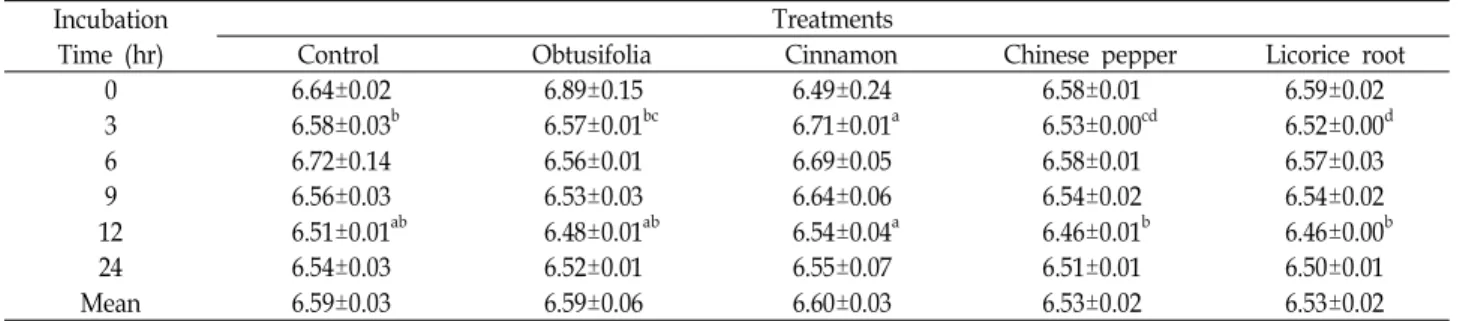
한약재 추출물 첨가에 따른 in vitro 반추위 미생물 발효시간 별 pH 변화는 Table 3에서 보는 바와 같다.
반추위 혼합 미생물 배양액의 pH는 6.46~6.89 수준으로서 발효 전인 0시간대 대조구의 pH수준과 비교할 때, 계피, 산초, 감초 추출물을 첨가하면 pH가 떨어진 반면, 결명자 추출물 첨가 시에는 증가하였다. 또한, 발효 전(0시간대)과 발효 3시간 대를 비교하였을 때, 계피 추출물 첨가구에서는 증가하였으나 타 처리구에서는 감소하는 경향이었다. 발효 3시간과 12시간 대에 계피 추출물 첨가구에서 가장 높았고, 산초 추출물 첨가 구와 감초 추출물 첨가구에서 가장 낮았다(p<0.05). 발효시간 에 따라서는 12시간대까지 떨어지다가 24시간대에 증가하는 경향이었다.
일반적으로 반추위는 사료의 미생물 발효로 생성되는 휘발 성지방산과 완충력이 높은 타액 및 암모니아에 의해 pH가 6.0~7.0 수준으로 유지되지만, 농후사료를 지나치게 많이 급여 하면 다량의 유산생성과 타액분비 저하로 pH가 5 이하까지 떨어질 수도 있다[26]. 반추위 pH는 쉽게 발효되는 탄수화물 급여 시에 낮아지고[45], pH 6.0 이하일 때 in vitro시험에서 섬유소 분해가 저해를 받으며[44], in vivo시험에서도 같은 결 과[35]를 나타내는데, pH 6.8부근에서 섬유소 분해균의 활성 이 가장 높은[46] 것으로 보고되고 있다. 본 시험에서 pH의 수준은 일반적인 범위 내에 있었고, 처리와 발효시간과 경과 에 따른 변화폭은 크지 않았다.
Gas 생성량
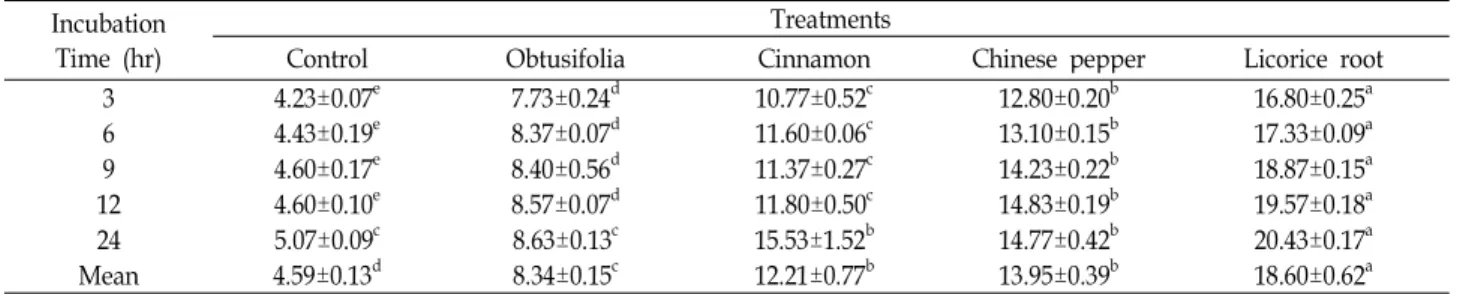
한약재 추출물 첨가에 따른 in vitro 반추위 미생물 발효시간 별 총 가스 생성량은 Table 4에서 보는 바와 같다.
총 가스발생량은 감초, 산초, 계피, 결명자 추출물 첨가구와
대조구 순으로 감초 추출물 첨가구에서 가장 많았고, 대조구
Table 4. The effect of herbal extracts on the cumulative gas production during rumen fermentation
in vitro
1 IncubationTime (hr)
Treatments
Control Obtusifolia Cinnamon Chinese pepper Licorice root
3 4.23±0.07e 7.73±0.24d 10.77±0.52c 12.80±0.20b 16.80±0.25a
6 4.43±0.19e 8.37±0.07d 11.60±0.06c 13.10±0.15b 17.33±0.09a
9 4.60±0.17e 8.40±0.56d 11.37±0.27c 14.23±0.22b 18.87±0.15a
12 4.60±0.10e 8.57±0.07d 11.80±0.50c 14.83±0.19b 19.57±0.18a
24 5.07±0.09c 8.63±0.13c 15.53±1.52b 14.77±0.42b 20.43±0.17a
Mean 4.59±0.13d 8.34±0.15c 12.21±0.77b 13.95±0.39b 18.60±0.62a
Mean±SE.
Mean with different superscripts in the same row differ significantly (
p
<0.05).1Gas production per fermentation substrate (soybean meal), ml/g.
Table 5. The effects of herbal extracts on the proportions of methane, hydrogen and calculated carbon dioxide during rumen fermenta- tion
in vitro
Incubation
time (hr) Treatments
Control Obtusifolia Cinnamon Chinese pepper Licorice root
---CH4, %---
3 2.77±0.11a 2.91±0.17a 3.06±0.08a 2.44±0.25a 1.04±0.24b
6 3.76±0.16bc 3.49±0.02c 3.10±0.23c 4.59±0.56ab 5.17±0.31a
12 6.46±0.32b 8.98±0.08a 9.57±0.20a 10.44±0.37a 10.00±0.11a
Mean 4.33±1.10 5.13±1.93 5.24±2.16 5.82±2.39 5.40±2.59
--- H2, %---
3 0.21±0.005 0.22±0.018 0.21±0.012 0.19±0.005 0.21±0.005
6 0.18±0.006 0.19±0.002 0.18±0.006 0.19±0.002 0.18±0.002
12 0.13±0.012b 0.17±0.009a 0.16±0.010ab 0.15±0.011ab 0.17±0.010a
Mean 0.17±0.023 0.19±0.014 0.18±0.014 0.18±0.013 0.19±0.012
---CO21
, %---
3 90.02±3.08 89.87±6.79 89.73±4.03 90.37±6.27 91.75±12.56
6 89.06±3.64 89.32±0.78 89.72±5.20 87.22±6.31 87.65± 3.36
12 86.41±6.62a 83.85±2.81b 83.27±3.20b 82.41±3.67b 82.83± 2.34b
Mean 88.50±0.62 87.68±1.11 87.57±1.24 87.00±1.37 87.41± 1.49
Mean±SE.
Mean with different superscripts in the same row differ significantly (
p
<0.05).1Calculated values; CO2=93-CH4-H2 (Dehority, 2003).
에서 가장 적었다(p<0.05). 한약재 추출물의 첨가는 반추위 혼 합미생물의 발효에 의한 가스 생성량을 촉진시켜 모든 시간대 에서 무처리 대조구에 비해 1.8~4.1배 높게(p<0.05) 나타나, 결 명자, 계피, 산초 및 감초 추출물은 반추위내 가스 생성량을 줄이는 목적에는 부적합하였다. 제 1위의 미생물 발효과정에 서 1일 560~1,000 l의 가스가 생성되며, 이산화탄소와 메탄의 생성비율은 서식하는 미생물의 상태와 섭취사료의 발효균형 에 따라 다르다[26]. 본 시험에서 대조구에 비해 한약재 추출물 첨가구에서 가스 생성량이 크게 높다는 것은 항균활성이 있는 한약재라고 하더라도 혐기 미생물에 대해서는 활성 억제기능 보다는 혐기 발효를 촉진시켜 가스 생성을 증가시키는 물질로 작용하였기 때문으로 사료된다. 본 시험에서는 감초 추출물 첨가구에서 총 가스발생량이 타 처리구에 비해 유의적 (p<0.05)으로 많았는데, 동일한 조건의 Moon [31]의 결과에
의하면 감초 추출물 첨가구에서 in vitro 건물소화율이 낮아졌 다고 보고하여, 가스 발생량과 in vitro 건물소화율과는 부(-)의 관계에 있는 것으로 사료된다.
메탄, 수소 및 이산화탄소 생성비율
한약재 추출물 첨가에 따른 in vitro 반추위 미생물 발효시간 별 메탄, 수소 및 이산화탄소 생성비율은 Table 5에서 보는 바와 같다.
메탄 생성비율은 3시간 발효 시, 감초 추출물 첨가구가 타 처리구에 비해 유의적으로 낮았으나, 6시간 발효 시에는 가장 높았고, 12시간 발효 시에는 대조구에서 가장 낮았다(p<0.05).
발효시간이 경과함에 따라 메탄생성 비율이 높아졌는데, 이러
한 결과는 면양에 있어서 반추위 메탄가스 발생량은 사료급여
후, 시간이 경과함에 따라 직선적으로 증가하였다고 한,
Table 6. The effect of herbal extracts on NH3-N production during rumen fermentation
in vitro
1 Incubationtime (hr) Treatments
Control Obtusifolia Cinnamon Chinese pepper Licorice root
0 3.64±0.15 3.69±0.16 3.89±0.12 3.98±0.08 3.84±0.10
3 4.28±0.11b 4.45±0.11ab 4.43±0.03ab 4.67±0.06a 4.65±0.06a
6 5.92±0.37a 5.20±0.18b 6.03±0.20a 5.99±0.24a 6.33±0.18a
12 7.41±0.31a 7.64±0.21a 7.19±0.23ab 7.30±0.30ab 6.57±0.24b
Mean 5.31±0.85 5.25±0.86 5.39±0.75 5.49±0.73 5.35±0.66
Mean±SE.
Mean with different superscripts in the same row differ significantly (
p
<0.05).1mg/100 ml of media.
Ortigues 등[36]의 결과와 일치하였다. 메탄생성 비율은 처리 별 평균값에서 유의적인 차이는 없었으나 가스발생량이 많았 던 한약재 추출물 첨가구(Table 4)가 대조구에 비해 높은 편이 었다. Shin 등[41]은 in vitro 반추위 미생물 발효시험에서 생강 첨가구에서 메탄생성 박테리아가 주로 서식하고 있는 프로토 조아를 크게 억제하여 메탄생성 억제제로서 개발이 가능하다 고 하였다.
수소가스의 생성비율은 6시간 발효 시까지는 처리구간에 차이가 없었으나, 12시간 발효 시에는 결명자나 감초 추출물 첨가구가 대조구에 비해 유의적(p<0.05)으로 높았고, 발효시 간이 경과함에 따라 메탄생성 비율과는 반대로 수소생성 비율 이 낮아졌다.
일반적으로 반추위 미생물 발효의 최종 발효산물로서 이산 화탄소(65%)와 메탄(27%)이 주요 가스이며[7], 이외에도 수소 (0.2%) 그리고 황화수소, 일산화탄소 및 미량의 산소 혼합가스 가 약 7%를 구성하고 있으므로[8], 혼합가스의 비율을 제외한 나머지에서 메탄과 수소비율을 제외하면 이산화탄소의 비율 을 구할 수 있다. 본 시험에서 CO
2=93-CH
4-H
2의 공식으로 계 산된 이산화탄소의 비율은 12시간 발효 시에는 대조구가 한약 재 첨가구에 비해 유의적(p<0.05)으로 높았으나, 처리별 평균 값에는 유의차가 없었으며, 이산화탄소가 총 가스발생량의 약 87%를 차지하고 있었다. 이렇게 이산화탄소의 비율이 in vivo 시험에서 일반적인 수준인 65% [8]보다 현저히 높게 나타난 것은 본 시험에서 메탄 생성비율이 낮았기 때문인데(27%:
5.2%), 반추위에서 메탄을 생성하는 메탄생성 박테리아 (methanogenic bacteria)는 극도의 혐기성으로서 in vitro 실험 환경이 이들 미생물의 활성을 충분히 발휘하기에는 힘든 조건 이었기 때문인 것으로 사료된다.
이산화탄소와 수소는 반추위 내 박테리아에 의한 메탄 생성 의 원료가 되므로[8] 총 가스 중, 이산화탄소 비율이 감소한다 는 것은 수소와 함께 메탄생성의 원료로 사용되었기 때문이 며, 이로 인해 메탄의 비율은 증가하게 된다. 본 시험에서도 메탄생성 비율이 높았던 한약재 추출물 첨가구에서 원료인 이산화탄소 생성비율이 낮았다(Table 5). 또한, 반추위 메탄생 성 박테리아는 이산화탄소와 수소를 이용하여 메탄가스를 발
생시키며, 메탄생성 박테리아의 성장률은 수소의 공급수준에 따라 다른데[14], 본 시험의 발효 12시간대 결과에서 메탄생성 비율이 높았던 한약재 추출물 첨가구가 대조구에 비해 수소의 비율이 높아 그 결과를 뒷받침하고 있다. Ok 등[33]은 본 시험 과 유사한 결과로 saponin 함유 식물 추출물 중 비누풀 추출물 에서 가스발생량, 메탄생성량 등이 높았다고 하였다.
암모니아 생성량
한약재 추출물 첨가에 따른 in vitro 반추위 미생물 발효시간 별 암모니아 생성은 Table 6에서 보는 바와 같다.
발효 3시간대의 암모니아 농도는 산초구와 감초추출물 첨 가구가 대조구에 비해 유의적으로 높았으며, 발효 6시간대에 는 결명자 추출물 첨가구가 대조구에 비해 유의적으로 낮았 고, 12시간대에서는 감초 추출물 첨가구에서 암모니아 생성량 이 가장 낮았다(p<0.05). 일반적으로 in vivo 시험에서 반추위 암모니아 농도는 사료 급여 후 1~3시간 경과 시에 peak를 이 룬 이후로 감소되는데[25], 본 시험에서는 발효시간이 경과될 수록 암모니아 농도가 증가하였다. 이러한 결과는 암모니아의 흡수 및 이동 등에 의한 희석이 in vitro 시험에서는 일어나지 않았고, 시험관내 환경에서 미생물의 정착에 필요한 시간과 활성에 있어서 한계가 있었기 때문으로 사료된다.
암모니아는 반추위미생물 성장에 있어서 필수적인 질소원
[4]으로서 미생물 질소의 50~80%가 암모니아로부터 합성되며
[29], 과잉의 암모니아는 간에서 요소로 전환되어 타액 등으로
재순환 되거나, 뇨로써 배설된다. 최대의 반추위 미생물단백
질 합성효율을 위한 적정 암모니아 수준[43]은 in vitro 시험에
서 위액 100 ml 당 5~8 mg 수준[2,38]이며, Okorie 등[34]은
in vivo 시험에서 위액 100 ml 당 5 mg이라고 요약하여, 본
시험의 결과와 비슷한 수준이었다. 반추위액의 적정 암모니아
농도는 반추위에서 발효를 최대로 하고, 발효된 기질 단위당
미생물단백질 합성을 최대로 할 수 있으나, 발효와 미생물 단
백질 합성간의 관계가 항상 일정하지는 않다[28]. Windschitl
과 Stern [49]은 반추위 in vitro 연속배양법으로 수행한 시험에
서 최대의 미생물 단백질합성과 cellulose 소화는 암모니아 수
준이 동일한 농도에서 일어났으나, 유기물은 암모니아 농도가
약간 낮을 때 소화율이 가장 높았다고 하였다. Erdman 등[11]
은 반추위 내에서 최대의 미생물합성을 위한 암모니아 수준과 발효나 소화율을 최대로 하는 수준은 다르다고 하였으며, Hoover [18]는 섬유소나 건물소화에 필요한 암모니아농도는 적절한 미생물성장에 요구되는 것보다 높다고 하였다. 일반적 으로 반추위내 발효정도는 휘발성지방산과 암모니아 농도와 밀접한 관계[8]를 가지는데, 본 시험의 결과에서 발효시간별 암모니아 농도변화를 메탄 생성비율과 비교해보면, 감초 추출 물 첨가구가 대조구에 비해 메탄 생성비율이 낮았던(Table 5) 3시간 발효 시에 암모니아 농도는 오히려 높았으며(Table 6), 메탄생성 비율이 가장 높았던 12시간 발효 시에는 암모니아 농도가 낮아 서로 상반되는 관계를 나타내고 있다.
이상의 결과에서 본 시험에 사용된 한약재를 반추가축에게 급여하면, 가스 및 메탄 생성을 촉진시킬 수 있으므로 반추위 메탄가스 저감제제로서는 부적합하나 감초 추출물의 경우는 발효초기(3시간대)에 저감효과가 나타나 추가 연구가 필요할 것을 사료된다.
감사의 글
이 논문은 2010년 농촌진흥청 연구비 및 2009학년도 경남과 학기술대학교 기성회지원에 의해 수행되었음.
References
1. A.O.A.C. 1995. Official methods of analysis 16th edition.
Association of official analytical chemists, Washington. D.C.
2. Allison, M. J. 1969. Biosynthesis of amino acids by ruminal microorganisms.
J. Anim Sci.
29, 797-807.3. Blaxter, K. 1989. Energy metabolism in animals and man.
pp. 123, Cambridge University Press, Cambridge, UK.
4. Bryant, M. P. and I. M. Robinson. 1961. Studies on the nitro- gen requirements of some ruminal cellulolytic bacteria.
Appl. Environ. Microbiol.
9, 96-103.5. Bryant, M. P. and L. A. Burkey. 1953. Cultural methods and some characteristics of some of the more numerous groups of bacteria in the bovine rumen.
J. Dairy Sci.
36, 205-217.6. Chaney, A. L. and E. P. Marbach. 1962. Modification reagents for determination of urea and ammonia.
Clinical Chem
. 8, 130-132.7. Clarke, R. T. J. 1977. The gut and its micro-organisms. pp.
36-71, In Clarke, R. T. J. and T. Bauchop (eds.),
Microbial ecology of the gut.
Academic Press. New York, NY. USA.8. Dehority, B. A. 2003. Rumen microbiology. Nottingham University Press. Nottingham, U.K.
9. Dehority, B. A. and H. W. Scott. 1967. Extent of cellulose and hemicellulose digestion in various forage by pure cul- tures of rumen bacteria.
J. Dairy Sci.
50, 1136-1141.10. Duncan, D. B. 1955. Multiple range and multiple F tests.
Biometrics
11, 1-42.11. Erdman, J. W., Jr, G. C. Jr. Fahey, and C. B. White. 1986.
Effects of purified dietary fiber sources on beta-carotene uti- lization by the chick.
J. Nutr.
116, 2415-2423.12. Ferorak, P. M. and S. E. Hrwdey. 1983. A simple apparatus for measuring gas production by methanogenic cultures in serum bottles.
Environ. Technol. Lett.
4, 425-432.13. Goel, G., H. P. S. Makkar, and K. Becker. 2009. Inhibition of methanogens by bromochloromethane: effects on micro- bial communities and rumen fermentation using batch and continuous fermentations.
Br. J. Nutr.
101, 1484-1492.14. Ha, J. K., S. S. Lee, Y. S. Moon, and C. H. Kim. 2005.
Ruminant nutrition and physiology. Seoul National University press. Seoul, Korea.
15. Hart, K. J., D. R. Yanez-ruiz, S. M. Duval, N. R. McEwan, and C. J. Newbold. 2008. Plant extracts to manipulate rumen fermentation.
Anim. Feed Sci. Tech.
147, 8-35.16. Hsieh, P. C., J. L. Mau, and S. H. Huang. 2001. Antimicrobial effect of various combinations of plant extracts.
Food Microbiol.
18, 35-43.17. Holter, J. B and A. B. Yong. 1992. Method production is dry and lactating Holstein (CVS).
J. Dairy Sci.
75, 2165-2175.18. Hoover, W. H. 1986. Chemical factors involved in ruminal fiber digestion.
J. Dairy Sci.
69, 2755-2766.19. Hwang, A. K. 2009. Korean herbal medicine for health func- tional food. Bookstec, Korea.
20. IPCC (Intergovernmental Panel on Climate Change). 1992.
Climate Change 1992. The supplementary report to the IPCC Scientific Assessment. pp. 200, In Houghton, J. T., B.
A. Callander, and S. K. Varney (eds.), Cambridge University Press, Cambridge, UK.
21. Johnson, D. E., T. M. Hill, and B. R. Carmean. 1991. New perspectives on ruminant methane emission. In Wenk, C.
and M. Boessinger (eds.), pp. 376-379, Energy metabolism of farm animals. ETH. Zurich. Switzerland.
22. Johnson, K. A. and D. E. Johnson. 1995. Methane emissions from cattle.
J. Anim. Sci.
73, 2483-2492.23. Kim, A., S. Y. Lee, K. Kim, E. J. Song, J. H. Kim, M. J. Kim, K. W. Ji, I. S. Ahn, and D. H. Ahn. 2008. Effects of glycyr- rhiza uralensis on shelf-life and quality of takju.
J. Korean Soc. Food Sci. Nutr.
40, 194-200.24. Kim, J. S., K. M. Koo, Y. H. Jung, J. G. Yang, and G. G.
Lee. 2004. Antimicrobial activities of zanthoxylum schinifo- lium extract against
Vibrio parahaemolyticus
.J. Korean Soc.
Food Sci. Nutr.
33, 500-504.25. Lynch, G. L., L. L. Berger, N. R. Merchen, G. C. Jr. Fahey, and E. C. Baker. 1987. Effects of ethanol and heat treatments of soybean meal and infusion of sodium chloride into the rumen on ruminal degradation and escape of soluble and total soybean meal protein in steers.
J. Anim. Sci.
65, 1617-1625.26. Maeng, W. J. 1998. Ruminant nutrition. p.21. Hyangmunsa.
Seoul. Korea.
27. Martin, S. A. 1998. Manipulation of ruminal fermentation with organic acids: a review.
J. Anim. Sci.
76, 3123-3132.28. Mehrez, A. Z., E. IL Ørskov, and I. McDonald. 1977. Rates of rumen fermentation in relation to ammonia con-
centration.
Brit. J. Nutr.
38, 437-443.29. Mercer, J. R. and E. F. Annison. 1976. Utilization of nitrogen in ruminants. In Cole, D. J. A., K. N. Boorman, P. J. Buttery, D. Lewis, R. J. Neale, and H. Swan (eds.), Protein metabo- lism and nutrition. Butterworths, London, UK.
30. Moe, P. W. and H. F. Tyrrell. 1979. Methane production in dairy cows.
J. Dairy Sci.
62, 1583-1586.31. Moon, Y. H. 2009. Effect of herbal extracts on the huminal dry matter digestibility, volatile fatty acid production and growth rate of microbes
in vitro
.J. Agriculture Life Sci.
43, 67-75.32. Newbold, C. J., B. Lassalas, and J. P. Jouany. 1995. The im- portance of methanogenesis associated with ciliate protozoa in ruminal methane production
in vitro
.Lett. Appl. Microbiol.
21, 230-234.
33. Ok, J. U., Y. C. Baek, K. H. Kim, S. C. Lee, Y. J. Seol, K.
Y. Lee, C.W. Choi, C. O. Jeon, S. S. Lee, S. Sill. Lee, and Y. K. Oh. 2011. Effects of Saponin contained plant extracts on ruminal fermentation characteristics and methane production.
J. Anim Sci. Tech.
53, 147-154.34. Okorie, A. U., P. J. Buttery, and D. Lewis. 1977. Ammonia concentration and protein synthesis in the tureen.
Proc. Nutr.
Soc.
36:38 (Abstr.).35. Ørskov, E. R. and C. Frasr. 1975. The effects of processing of barley-based supplements on rumen pH, rate of digestion and voluntary intake of dried grass in sheep.
Br. J. Nutr.
34, 493-500.
36. Ortigues, I., J. P. Fontenot, and J. G. Ferry. 1988. Digesta flows in sheep fed poor quality hay supplemented with urea and carbohydrates
. J. Anim. Sci.
66, 975-985.37. Pen, B., C. Sar, B. Mwenya, M. Kuwaki, R. Morikawa, and J. Takahashi. 2006. Effects of yucca schidigera and quillaja saponaria extracts on
in vitro
ruminal fermentation and methane emission.Anim. Feed Sci. Tech.
129, 175-186.38. Sarter, L. D. and L. L. Slyter. 1974. Effect of ammonia concen- tration on rumen microbial protein production
in vitro. Brit.
J. Nutr.
32, 199-208.39. SAS, 1999. SAS/STAT software for PC. Release 8.01. SAS institute Inc., Cary, N.C., U.S.A.
40. Shibata, M., F. Terada, K. Iwasaki, M. Kurihara, and T.
Nishida. 1992. Methane production in heifers, sheep and goats consuming diets of various hay-concentrate ratios.
Anim. Sci. Technol. Japan
3, 1221-1227.41. Shin, S. W., S. J. Lee, J. U. Ok, S. M. Lee, J. H. Lim, K.
H. Kim, Y. H. Moon, and S. S. Lee. 2007. Effects of bio- logically active materials prepared for several minerals and plants on the growth of rumen microbes.
J. Life Sci.
17, 1555-1561.42. Shin, U. T. 2010. Quality characteristics of Bulgogi sauce with licorice extract. Ms.D. Thesis, Kyung Hee University, Seoul, Korea.
43. Stern, M. D. and W. H. Hoover. 1979. Methods for determin- ing and factors affecting rumen microbial protein synthesis:
a Review.
J. Anim. Sci.
49, 1590-1603.44. Stewart, C. S. 1977. Factors affecting the cellulolytic activity of rumen contents.
Appl. Environ. Microbiol.
33, 497-502.45. Strobel, H. J. and J. B. Russell. 1986. Effect of pH and energy spilling on bacterial protein synthesis by carbohy- drate-limited cultures of mixed rumen bacteria.
J. Dairy Sci.
69, 2941-2947.
46. Terry, R. A., J. M. A. Tilley, and G. E. Outen. 1969. Effect of pH on cellulose digestion under
in vitro
conditions.J.
Sci. Food Agric.
20, 317-320.47. Van Nevel and D. Demeyer. 1995. Feed additives and other interventions for decreasing methane emissions. Wallace, R.
J. and A. Chesson (eds.), pp. 329-349, Biotechnology in ani- mal feeds and animal feeding. VCH Publishers. New York.
USA.
48. Van Soest, P. J., J. B. Robertson, and B. A. Lewis. 1991.
Methods for fiber, neutral detergent fiber, and non starch polysaccharides in relation to animal nutrition.
J. Dairy Sci.
74, 3583-3597.
49. Windschitl, P. M. and M. D. Stern. 1988. Effects of supple- mentation of diets containing lignosulfonate-treated soy- bean meal on bacterial fermentation in continuous culture of ruminal contents.
J. Anim. Sci.
66, 2948-2958.50. Zhang, C. M., Y. Q. Guoa, Z. P. Yuan, Y. M. Wu, J. K. Wang, J. X. Liu, and W. Y. Zhub. 2008. Effect of octadeca carbon fatty acids on microbial fermentation, methanogenesis and microbial flora