www.earticle.net
사료 내 단백질 수준 및 Protease 첨가가 이유자돈의 사양성적, 영양소 소화율, 장 내 미생물, 소장 형태학적 변화 및 분 중 유해가스 발생에 미치는 영향
하상훈1# · 최요한4# · Abdolreza Hossseindoust1 · 하동진5 · Joseph Moturi1 · 문준영1 Tajudeen Habeeb1 · 이창번3 · 박종완1 · 김진수2* · 사수진4*
.강원대학교 바이오헬스융합학과 대학원생1, 교수2, 강원대학교 동물산업융합학과 대학원생3; 농촌진흥청 국립축산과학원 양돈과 연구원4; ㈜CTC바이오 애니멀헬스 팀장5
Effects of Dietary Protein Level and Supplementation of Protease on Growth Performance, Nutrient Digestibility, Gut Microflora, Intestinal Morphology,
and Fecal Noxious Gas Emission in Weanling Pigs
Sang Hun Ha1#, Yo Han Choi4#, Abdolreza Hosseindoust1, Dong Jin Ha5, Joseph Moturi1, Jun Young Mun1, Tajudeen Habeeb1, Chang Beon Lee3, Jong Wan Park1, Jin Soo Kim2* and Soo Jin Sa4*
1Graduate Student, 2Professor, Department of Bio-Health Convergence, Kangwon National University, 3Graduate Student, College of Animal life sciences, Kangwon National University, Chuncheon 24341, Korea, 4Researcher, Swine Science Division, National
Institute of Animal Science, R.D.A., Seonghwan 31000, Korea, 5Director, CTCBIO Animal Health, Seongnam 13647, Korea
ABSTRACT1)
This study was conducted to determine the effects of dietary protein level and supplementation of protease on growth performance, nutrient digestibility, gut microflora, intestinal morphology and fecal noxious gas emission in weanling pigs. A total of 240 weaned pigs (Landrace×Yorkshire×Duroc, 5.82±0.3 kg) were used during 4 weeks in 2 phases (days 0-14, phase 1; and days 15-28, phase 2) feeding program based on age and initial body weight.
Pigs were allocated to 2×2 factorial arrangement, including 2 protein levels (HP, high protein; LP, low protein) and 2 protease levels (with or without protease). The average daily gain in the LP treatment (357 g/d) was increased rather than the HP treatment (339 g/d). A greater avarage daily gain was observed in dietary suppiemented protease treatment (358 vs 339 g/d). Average feed intake was greater in the LP treatment (544 g/d) rather than the HP treatment (530 g/d). A greater average daily feed intake was observed in dietary supplemented protease treatment (552 vs 523 g/d). Dry matter and crude protein digestibility were increased in dietary supplemented protease treatment (82.62% and 76.08%, respectively) rather than non-supplemented treatment (81.74%
and 75.13%, respectively). Ileal Lactobacillus spp. count increased in dietary supplemented protease treatment (7.42 vs 7.32 log10CFU/g). Emission of H2S was decreased in the LP treatment (4.41 ppm) rather than HP treatment (4.78 ppm). Emission of NH3was decreased in dietary supplemented protease treatment (10.43 ppm vs 11.76 ppm).
In conclusion, the decrease of dietary protein level and supplementation of protease had beneficial effects on growth performance, nutrient digestibility, gut microflora, and noxious gas emission in weanling pigs.
(Key words: Protein, Protease, Nutrient digestibility, Noxious gas, weanling pigs)
*Corresponding author: Jin Soo Kim, College of Biomedical life sciences, Kangwon National University, Chuncheon 24341, Korea. Tel:
+82-33-250-8614, E-mail: [email protected], Soo Jin Sa, Swine Science Division, National Institute of Animal Science, R.D.A., Seonghwan 31000, Korea. Tel: +82-41-580-3450, E-mail: [email protected]
#These authors contributed equally to this work.
This is an Open Access article distributed under the terms of the Creative Commons Attribution Non-Commercial License (http://creativecommons.org/licenses/by-nc-nd/3.0/deed.ko), which permits unrestricted non-commercial use, distribution, and reproduction in any medium, provided the original work is properly cited. The moral rights of the named author(s) have been asserted.
[Provider:earticle] Download by IP 118.70.52.165 at Monday, December 20, 2021 7:44 PM
www.earticle.net
Ⅰ. 서론
단백질은 가축의 생명을 유지하기 위한 필수아미노산의 공급과 합성을 위한 질소공급원으로(Yoo et al., 2006), 사 료를 통한 적정 수준의 공급은 돼지의 성장 및 유지에 필 수적이다(NRC, 2012). 일반적으로 이유자돈에게 고단백의 사료를 급여하지만, 소화되지 못한 장 내 단백질은 장관 내에서 병원균의 증식을 유발하고, 발생된 장 내 독소로 면역력 저하, 설사, 심할 경우 폐사에 이른다. 또한 배출된 질소 및 유해가스로 인한 생산성 감소, 질병발생 및 환경 적인 문제가 발생하고 있다(Webb et al., 2014, Lan et al., 2016; Wang et al., 2018). 이러한 문제점을 해결하기 위한 법안 개정 및 연구가 이루어지고 있는데, 사료 관리법 (2016) 개정안 중 사료 내 조단백질 함량 성분등록이 최소 요구량에서 최대량 제한으로 변경되었고, NRC(2012)는 조 단백질 함량 감소, 합성 아미노산의 첨가가 자돈의 성장을 저해시키지 않으면서 장 건강을 개선하며 사료비 절감 및 질소 배출을 감소시킨다고 보고하였다. 또한 저단백 사료 는 장내 독성물질의 생성을 억제하여 자돈에게 무항생제 사료 급여 시 장 건강을 개선할 수 있는 좋은 방법으로 알 려져 있다(Yuan et al., 2020; Zhou et al., 2020).
양돈산업에서 단백질원으로 사용되는 대두박에는 phytin, lectin, allergen, trypsin inhibitor과 같이 원료의 이용성을 낮추는 항영양성 인자들을 포함하고 있어 사료 효율에 부 정적인 영향을 미치고 결과적으로 사료비 증가의 중요한 요인으로 알려져 있다(Hong et al., 2011). 또한 이유자돈 시기는 소화효소 분비능력이 충분하지 않으며, 특히 단백 질 소화율의 경우 위장 내 염산 분비능력이 떨어지기 때문 에 펩신의 활성이 낮게 나타난다(Lee, 2014). 따라서 이러 한 문제를 해결하기 위하여 효소제 사용이 하나의 방안으 로서 제시되고 있다. Protease와 같은 단백질 분해 효소제 관련 연구를 통해 가축의 성장률 개선과 더불어 사료비용 이 감소된다는 결과들이 보고되고 있다(Duarte et al., 2019; Park et al., 2020; Yu et al., 2020). Hong 등(2011)의 연구결과에서 자돈 사료 내 protease의 첨가는 사료효율을 개선하였고, Jo 등(2012)은 단위동물 사료 내 xylanase, phytase, protease 등의 효소제 첨가 시 성장 및 사료효율 을 개선한다고 보고하였다. 그러나 이와 관련된 기존의 연 구들은 대체원료 관련 연구들로써, 저단백질 사료 내 protease의 첨가 연구는 미흡한 상황이다.
따라서, 본 연구는 사료 내 단백질 함량 및 protease 첨 가가 이유자돈의 사양성적, 영양소 소화율, 장 내 미생물, 소장 형태학적 변화 및 분 중 유해가스 발생에 미치는 영
향을 알아보기 위해 수행하였다.
Ⅱ. 재료 및 방법
1. 시험설계, 공시동물 및 사양관리
사료 내 단백질 수준 및 protease(Danisco Animal nutrition, Marlborough, United Kingdom)의 첨가에 따른 영향을 알아보기 위하여 이유자돈 (Landrace×Yorkshire×
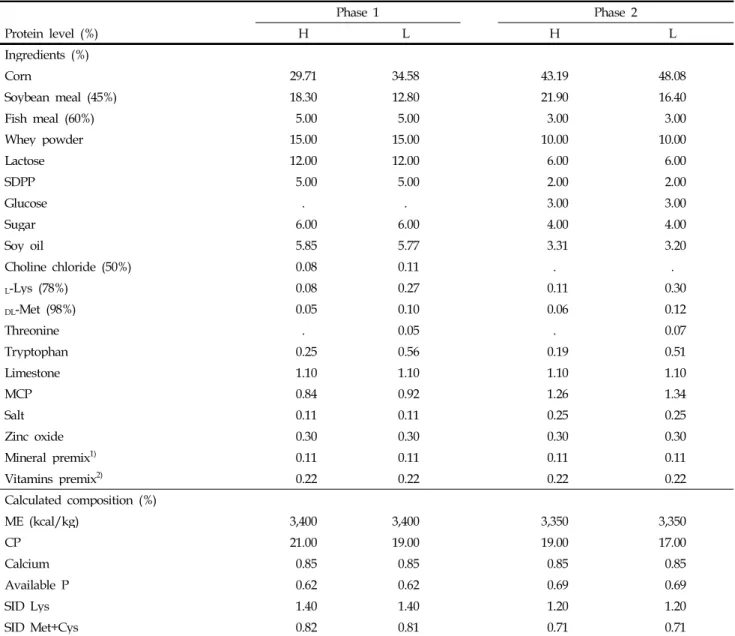
Duroc, 21±3일령 5.82±0.3kg) 240두를 공시하였고, 시험기 간은 이유 후 phase 1(0-14d), phase 2(15-28d)의 단계로 나누어 총 4주간(0-28d) 실시하였다. 처리내용은 사료 내 단백질 두 수준과(phase 1, H: CP 21% / L: CP 19%;
phase 2, H: CP 19% / L: CP 17%) protease 첨가 유무에 따른 2×2 요인설계법에 준하였다. 시험사료는 단계별 영양 소 요구량(NRC, 2012)에 충족하거나 초과하여 배합하였고 (Table 1) 사료와 물은 자유채식토록 하였다. 그 외 자돈의 사양관리는 본 연구실의 관행에 준하여 실시하였다.
2. 사양성적
사양성적을 조사하기 위해 자돈의 체중을 실험 개시 및 각 phase 종료 시 측정하여 증체량을 산출하였고, 체중 측 정 시 사료 급이기의 잔량을 측정하여 사료 섭취량을 계산 하였다. 도출된 증체량 및 사료섭취량을 사육일수로 나누 어 일당증체량(average daily gain, ADG)과 일당사료섭취 량(average daily feed intake, ADFI)을 계산하였다. 사료효 율(weight gain to feed intake ratio, G:F)은 일당증체량에 서 일당사료섭취량을 나누어 계산하였다.
3. 영양소 소화율
영양소 소화율을 측정하기 위해 각 phase 종료 7일 전부 터 사료 내 Cr2O3을 0.25%첨가하였다. 분 채취는 Cr2O3를 첨가한 사료를 급여 후 4일 이후부터 채취하였으며, 채취 된 분을 혼합하여 열풍 건조기로 60℃, 72시간 건조 한 뒤 1㎜ Wiley mill로 분쇄하였다. 사료와 분의 일반성분분석 은 AOAC(2019)의 방법으로 분석하였고, 에너지는 단열폭 발열량측정기(Model 1241 Parr Instrument Co., Molin, IL) 로 측정하였으며, Cr2O3은 acid digestion method의 방법 으로 spectrophotometer(Model V-550, Jasco Co., Japan)를
[Provider:earticle] Download by IP 118.70.52.165 at Monday, December 20, 2021 7:44 PM
www.earticle.net
Table 1. Formula and chemical composition of experimental diets
Phase 1 Phase 2
Protein level (%) H L H L
Ingredients (%)
Corn 29.71 34.58 43.19 48.08
Soybean meal (45%) 18.30 12.80 21.90 16.40
Fish meal (60%) 5.00 5.00 3.00 3.00
Whey powder 15.00 15.00 10.00 10.00
Lactose 12.00 12.00 6.00 6.00
SDPP 5.00 5.00 2.00 2.00
Glucose . . 3.00 3.00
Sugar 6.00 6.00 4.00 4.00
Soy oil 5.85 5.77 3.31 3.20
Choline chloride (50%) 0.08 0.11 . .
L-Lys (78%) 0.08 0.27 0.11 0.30
DL-Met (98%) 0.05 0.10 0.06 0.12
Threonine . 0.05 . 0.07
Tryptophan 0.25 0.56 0.19 0.51
Limestone 1.10 1.10 1.10 1.10
MCP 0.84 0.92 1.26 1.34
Salt 0.11 0.11 0.25 0.25
Zinc oxide 0.30 0.30 0.30 0.30
Mineral premix1) 0.11 0.11 0.11 0.11
Vitamins premix2) 0.22 0.22 0.22 0.22
Calculated composition (%)
ME (kcal/kg) 3,400 3,400 3,350 3,350
CP 21.00 19.00 19.00 17.00
Calcium 0.85 0.85 0.85 0.85
Available P 0.62 0.62 0.69 0.69
SID Lys 1.40 1.40 1.20 1.20
SID Met+Cys 0.82 0.81 0.71 0.71
1)Supplied per kilogram of diet: 16,000 IU vitamin A, 3,000 IU vitamin D3, 40 IU vitamin E, 5.0 mg vitamin K3, 5.0 mg vitamin B1, 20 mg vitamin B2, 4 mg vitamin B6, 0.08 mg vitamin B12, 40 mg pantothenic acid, 75 mg niacin, 0.15 mg biotin, 0.65 mg folic acid.
2)Supplied per kilogram of diet: 45 mg Fe as ferrous sulfate, 0.25 mg Co as cobalt sulfate, 50 mg Cu as copper sulfate, 15 mg Mn as manganese oxide, 25 mg Zn as zinc oxide, 0.35 mg I as potassium iodide, 0.13 mg Se as sodium selenite.
영양소 소화율 (%) = 1 − 사료 중의 Cr2O3 함량 × 분 중의 영양소 함량 (%)
× 100 분 중의 Cr2O3 함량 × 사료 중의 영양소 함량 (%)
이용하여 측정하였다.
4. 장 내 미생물
장 내 미생물은 Kim 등(2017)의 분석방법을 기반으로 phase 2 종료시점에서 처리구 별 6두씩, 총 24두를 도축한
뒤 십이지장, 공장 및 회장을 구분하여 적출하였고, 장 내 용물을 채취한 후 밀봉하여 아이스박스에 저장한 뒤 즉시 실험실로 옮겨 분석하였다. 맹장 내용물 5g씩 취하여 45ml 희석액에 넣고 균질하게 1차 현탁액을 만든 뒤 현탁액 1ml를 9ml 희석액에 연속 희석하였다. 희석 중 혐기 상태 유지를 위해 희석액 표면을 paraffin 오일로 코팅하였고 질
[Provider:earticle] Download by IP 118.70.52.165 at Monday, December 20, 2021 7:44 PM
www.earticle.net
소가스를 충진하며 진행하였다. 제조된 희석액 1ml를 페트 리디쉬에 분주하여 배양하였으며, 이때 사용한 희석액은 peptone과 L-cysteine·HCl을 각각 0.5%, 0.05%씩 첨가한 용액을 사용하였다.
5. 소장 내 융모의 형태학적 변화
소장 내 융모의 형태학적 변화를 조사하기 위해 앞서 적 출된 이유자돈의 십이지장, 공장 및 회장을 각각 2cm 크기 로 적출하여 식염수로 세척 후 10% formalin 용액에 고정 시켜 microscope로 관찰 전까지 냉장 보관하였다. 소장의 융모길이(villus height, VH), 융와깊이(crypt depth, CD)를 측정하기 위해 formalin 용액에 보존된 샘플을 paraffin으 로 고정시킨 후 6㎛ 크기로 절편하여 azure A와 eosine으 로 염색하였다. 염색된 시료는 40배 비율 microscope에서 측정하였다(Cera et al., 1988). 융모길이와 융와깊이의 비 율(VH/CD)은 융모길이를 융와깊이로 나누어 산출하였다.
6. 분내 유해가스
분내 발생하는 유해가스 물질 측정은 시험 종료 시 각 처리구에서 동일한 시간 동안 배설된 분을 6두씩 신선한 분을 300g 채취하였다. 채취된 분은 1,000ml 밀봉된 플라 스틱 용기에 넣고 실온에서 24시간 발효시킨 뒤, 7일간 실 온에서 보관하며 Gastec(Model GV-100, GASTEC, Japan) 을 사용하여 발생되는 총 암모니아(NH3), 황화수소(H2S) 및 메르캅탄(Total mercaptans)의 농도를 측정하였다.
7. 통계적 분석
본 실험에서 측정된 데이터는 사료 내 단백질 수준과 protease 및 그 상호작용효과의 유의성을 SAS(SAS Inst., Inc., Cary, NC, US)프로그램의 2×2원 배치 분산분석(Two- way ANOVA)을 이용하여 조사하였고, 이때 p<0.05이면 통계적으로 유의성이 있는 것으로 인정하였다.
Ⅲ. 결과 및 고찰
1. 사양성적
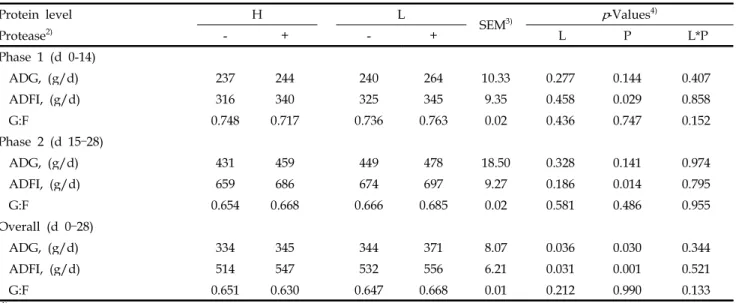
단백질 수준과 protease 첨가에 따른 사양성적 결과는
Table 2와 같다. phase 1과 2에서는 단백질 수준에 따른 유 의적인 차이는 나타나지 않았지만, 사료섭취량이 protease 첨가구가 비첨가구에 비하여 유의적으로 증가하였다 (p<0.05). Overall에서(0~4주) 저단백 사료가 고단백 사료 에 비하여 일당증체량과 일당사료섭취량이 증가하였으며 (p<0.05), protease 첨가구가 비첨가구에 비하여 일당증체량 과 일당사료섭취량이 유의적으로 증가하였다(p<0.05). 일반 적으로 저단백질 사료급여가 고단백질 사료급여에 비해 사양성적이 낮은 것으로 알려져 있다. 하지만 Rattigan 등 (2020)은 저단백질 사료 내 합성아미노산 첨가 시 아미노 산 요구량을 충족하여 사양성적에 부정적인 영향을 미치 지 않는다고 보고하였다. Glenmer 등(2016)은 이유자돈 사 료 내 protease 첨가 시 영양소 소화율이 개선된다고 보고 하였으며, Yu 등(2020)은 저단백질 사료 내 protease 첨가 를 통해 낮은 성장이 개선되었다고 보고하였다.
이러한 결과들은 본 시험의 결과와 일치하며, 아미노산 요구량이 충족된 저단백질 사료 내 protease 첨가 시에도 자돈의 증체량과 장내 유해균 개선에 효과가 있을 것으로 사료된다.
2. 영양소 소화율
영양소 소화율 결과는 Table 3과 같다. phase 1 에서는 단백질 수준에 따른 유의적인 차이는 나타나지 않았으나, protease 첨가에 따라 에너지 소화율이 유의적으로 증가되 었고(p<0.05), 단백질 소화율이 증가하는 경향이 나타났다 (p=0.056). phase 2 에서는 단백질 수준에 따른 유의적인 차이는 나타나지 않았지만, 저단백 사료가 고단백 사료에 비해 에너지 소화율이 증가하는 경향이 나타났다(p=0.079).
Protease 첨가구는 비첨가구에 비해 건물과 단백질 소화율 이 유의적으로 증가되었고(p<0.05), 단백질 소화율이 증가 되었다(p<0.05). 이유 후 자돈은 소화효소와 위산의 분비량 이 낮기 때문에(Hong et al., 2011), 탄수화물, 단백질을 효 과적으로 소화하지 못하며, 이로 인한 소화 장애와 성장지 연 등의 문제들이 발생된다(Vondruskova et al., 2010). 또 한 위 내 낮은 산도는 불안정한 장내 환경을 조성하며, 이 는 장 내 유해균의 증식에 유리한 조건이라고 보고하였다 (Lee, 2014). Park 등(2020)은 저단백질 사료는 고단백질 사 료에 비해 건물 및 단백질 소화율이 낮으나, protease의 첨 가를 통해 개선시킬 수 있다고 보고하였다. 이는 본 실험 결과와는 상이하지만, protease 첨가 시 긍정적인 영향을 미치는 점은 일치하였다.
[Provider:earticle] Download by IP 118.70.52.165 at Monday, December 20, 2021 7:44 PM
www.earticle.net
Table 2. Effect of dietary protein levels and protease supplementation on growth performance of weanling pigs1)
Protein level H L
SEM3) p-Values4)
Protease2) - + - + L P L*P
Phase 1 (d 0-14)
ADG, (g/d) 237 244 240 264 10.33 0.277 0.144 0.407
ADFI, (g/d) 316 340 325 345 9.35 0.458 0.029 0.858
G:F 0.748 0.717 0.736 0.763 0.02 0.436 0.747 0.152
Phase 2 (d 15–28)
ADG, (g/d) 431 459 449 478 18.50 0.328 0.141 0.974
ADFI, (g/d) 659 686 674 697 9.27 0.186 0.014 0.795
G:F 0.654 0.668 0.666 0.685 0.02 0.581 0.486 0.955
Overall (d 0–28)
ADG, (g/d) 334 345 344 371 8.07 0.036 0.030 0.344
ADFI, (g/d) 514 547 532 556 6.21 0.031 0.001 0.521
G:F 0.651 0.630 0.647 0.668 0.01 0.212 0.990 0.133
1)Data represent means based on six replicates per treatment.
2)Protease contained 4,000 units/g.
3)SEM: Standard error mean.
4)L: Protein level (%), P: Protease (%), L*P: Protein level*Protease
Table 3. Effect of dietary protein levels and protease supplementation on the apparent total tract digestibility (%) of nutrients1)
Protein level H L
SEM3) p-Values4)
Protease2) - + - + L P L*P
d 14
Dry matter 84.37 85.08 85.21 85.99 0.53 0.116 0.175 0.951
Gross energy 81.53 82.91 82.11 83.02 0.48 0.481 0.027 0.631
Crude protein 78.10 78.88 78.52 79.56 0.45 0.238 0.056 0.776
d 28
Dry matter 81.59 82.48 80.86 82.76 0.44 0.678 0.006 0.316
Gross energy 78.15 79.35 79.44 79.71 0.38 0.079 0.055 0.179
Crude protein 75.07 75.97 75.19 76.18 0.48 0.769 0.009 0.859
1)Data represent means based on six replicates per treatment.
2)Protease contained 4,000 units/g.
3)SEM: Standard error mean.
4)L: Protein level (%), P: Protease (%), L*P: Protein level*Protease 3. 장 내 미생물
단백질 수준과 protease 첨가에 따른 장 내 미생물 변화 결과는 Table 4와 같다. 장 내 미생물에서는 단백질 수준 에 따른 유의적인 차이는 나타나지 않았다. 사료 내 protease 첨가에 따라 Lactobacillus spp.가 회장과 맹장에서 유의적으로 증가하였으며(p<0.05), 회장에서 Coliform bacteria가 감소하는 경향이 나타났다(p=0.056). 이유자돈의 경우 사료와 환경의 변화로 인한 스트레스가 가장 큰 시기 로, 성장부진 및 설사가 발생하고 심할 경우 폐사에 이른
다. 이에 대한 방안으로 장관 면역력 개선을 목적으로 유 익균 증식 및 유해균 억제 관련 연구결과들이 보고되고 있 으며, 효소제 사용 시에도 유사한 효과를 나타내는 것으로 알려져 있다(Xiong et al., 2019; Kim et al., 2020; Lee et al., 2021). Kim 등(2017)의 연구결과에서 자돈 사료 내 protease 첨가 시 Firmicutes와 Lactobacillus spp.의 수준이 증가한다고 보고하였고, Olfati 등(2021)의 연구결과에서 protease 첨가 시 Coliform bacteria가 감소하고 Lactobacillus spp.가 증가하는 것으로 보고되었는데, 이는 본 실험의 결 과와 일치하였다.
[Provider:earticle] Download by IP 118.70.52.165 at Monday, December 20, 2021 7:44 PM
www.earticle.net
Table 4. Effect of dietary protein levels and protease supplementation on bacterial populations (log10CFU/g) in ileum and cecum of weanling pigs (d 28)1)
Protein level H L
SEM3) p-Values4)
Protease2) - + - + L P L*P
Ileum
Total anaerobic bacteria 8.64 8.35 8.47 8.39 0.06 0.116 0.175 0.951
Lactobacillus spp. 7.35 7.39 7.29 7.44 0.05 0.481 0.027 0.631
Coliform bacteria 4.95 4.75 4.86 4.63 0.06 0.238 0.056 0.776
Cecum
Total anaerobic bacteria 8.70 8.66 8.65 8.62 0.05 0.363 0.539 0.881
Lactobacillus spp. 7.38 7.48 7.35 7.57 0.04 0.462 0.002 0.192
Coliform bacteria 4.46 4.33 4.37 4.32 0.05 0.352 0.116 0.435
1)Data represent means based on six replicates per treatment.
2)Protease contained 4,000 units/g.
3)SEM: Standard error mean.
4)L: Protein level (%), P: Protease (%), L*P: Protein level*Protease
Table 5. Effect of dietary protein levels and protease supplementation on small intestinal morphology in weanling pigs (d 28)1)
Protein level H L SEM3) p-Values4)
Protease2) - + - + L P L*P
Villus height (㎛)
Duodenum 479 494 478 518 18.85 0.560 0.160 0.526
Jejunum 446 456 459 459 21.54 0.697 0.813 0.831
Ileum 236 242 232 225 11.76 0.398 0.983 0.592
Crypt depth (㎛)
Duodenum 284 294 301 303 12.94 0.324 0.652 0.756
Jejunum 255 266 274 280 15.29 0.279 0.599 0.855
Ileum 169 156 159 152 10.17 0.494 0.349 0.790
VH/CD
Duodenum 1.70 1.70 1.61 1.73 0.11 0.751 0.570 0.601
Jejunum 1.76 1.73 1.69 1.65 0.08 0.347 0.655 0.914
Ileum 1.43 1.57 1.50 1.52 0.13 0.927 0.577 0.660
1)Data represent means based on six replicates per treatment.
2)Protease contained 4,000 units/g.
3)SEM: Standard error mean.
4)L: Protein level (%), P: Protease (%), L*P: Protein level*Protease
4. 소장 내 융모의 형태학적 변화
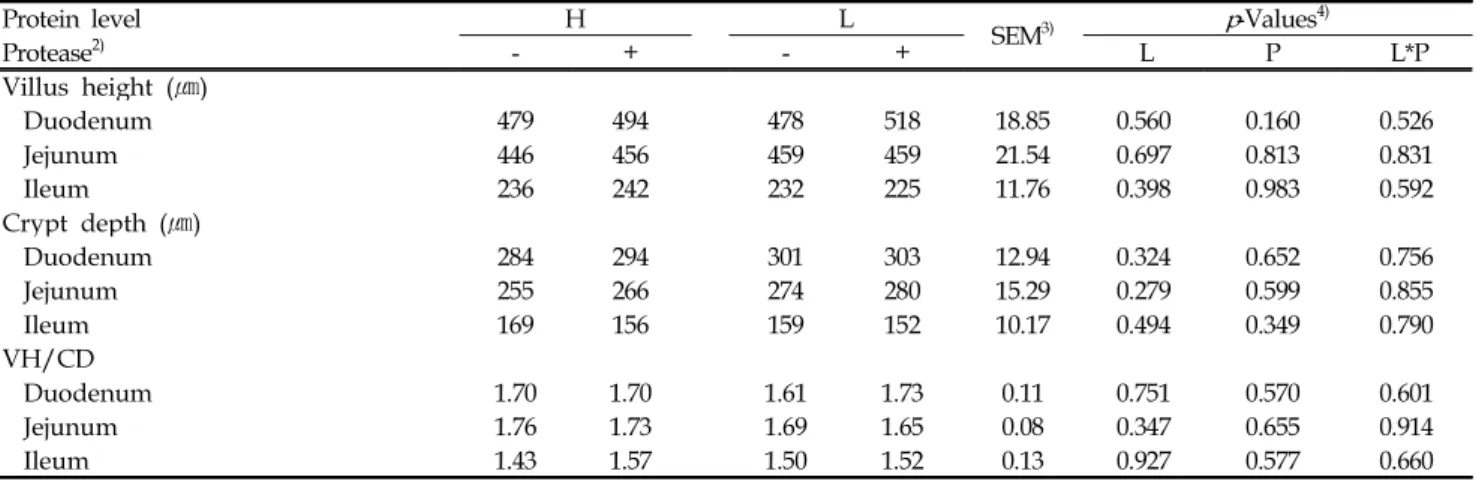
소장 내 융모의 형태학적 변화는 Table 5와 같다. 단백 질 수준과 protease 첨가에 따른 처리구간 유의적인 차이 는 나타나지 않았다. Kim 등(2017)의 연구결과에서 자돈사 료 내 protease 첨가 시 유의적인 차이가 나타나지 않았으 며 이는 본 실험의 결과와 일치하였다. 그러나 Zuo 등 (2015)의 연구결과에 의하면 소화율이 낮은 단백질원을 사 용한 자돈 사료에 protease 첨가 시 융모길이, 융와깊이 및 그 비율을 개선하였다고 보고하였고, 그 원인으로 protease 가 항영양성 인자의 알러지성 반응을 저해시킴으로서 장 내 융모의 발달을 개선하였다고 고찰하였다.
5. 분내 유해가스
분내 유해가스 시험결과는 Table 6과 같다. 저단백 사료 가 고단백 사료에 비해 황화수소 발생량이 유의적으로 감 소하였으며(p<0.05), 암모니아 발생량도 감소하는 경향이 나타났다(p=0.053). 또한 protease 첨가구에서 암모니아 발 생량이 유의적으로 감소하였고(p<0.05), 황화수소 발생량이 감소하는 경향이 나타났다(p=0.056). 이전의 연구결과들에 서 소화되지 못한 단백질들이 장 내 유해균에 의해 황화수 소, 암모니아 및 악취물질이 발생한다고 보고되었다(Neis et al., 2015; Portune et al., 2016). Wang 등(2018)은 사료 내 단백질 10g/kg이 감소할 때 마다 분 중 암모니아 발생
[Provider:earticle] Download by IP 118.70.52.165 at Monday, December 20, 2021 7:44 PM
www.earticle.net
Table 6. Effect of dietary protein levels and protease supplementation on gas emission of weanling pigs (d 28)1)
Protein level H L
SEM3) p-Values4)
protease2) - + - + L P L*P
NH3, ppm 12.72 10.53 10.80 10.34 0.51 0.053 0.018 0.109
H2S, ppm 5.27 4.29 4.20 4.04 0.28 0.028 0.056 0.160
Total mercaptans 4.22 3.55 3.46 3.33 0.27 0.095 0.172 0.346
1)Data represent means based on six replicates per treatment.
2)Protease contained 4,000 units/g.
3)SEM: Standard error mean.
4)L: Protein level (%), P: Protease (%), L*P: Protein level*Protease
량이 8%씩 줄어든다고 보고하였고, Tactacan 등(2016)은 이유자돈 사료 내 protease 첨가 시 분 중 암모니아 발생 량이 감소된다는 연구결과를 보고하였다. 따라서 이유자돈 사료 내 protease 첨가는 단백질의 소화율을 높여 소장관 내 유입되는 질소원을 감소시킬 수 있다. 또한, 질소를 이 용하는 유해균의 증식을 억제하여 분 중 배출되는 유해물 질을 감소시킬 수 있을 것으로 사료된다.
Ⅳ. 요약
본 연구는 사료 내 단백질 수준 및 protease 첨가가 이 유자돈의 사양성적, 영양소 소화율, 장 내 미생물, 소장 형 태학적 변화 및 분 중 유해가스 발생에 미치는 영향을 알 아보기 위해 실시되었다. 총 240두의 이유자돈 (Landrace×Yorkshire×Duroc, 5.82±0.3kg)을 공시였으며, 4 주 간 2단계(days 0-14, phase 1; and days 15-28, phase 2) 로 나누어 사양실험을 진행하였다. 처리구는 사료 내 단백 질 두 수준과(phase 1, HP: CP 21% / LP: CP 19%; phase 2, HP: CP 19% / LP: CP 17%) protease 첨가 유무에 따 른 2×2 요인설계법에 준하였다. 연구 결과, 일당증체량은 LP 처리구(357g/d)가 HP처리구(339g/d)에 비하여 증가하 였고(p<0.05), 사료 내 protease 첨가한 처리구(358g/d)가 비첨가구(339g/d)에 비하여 증가하였다(p<0.05). 일당사료 섭취량은 LP 처리구(554g/d)가 HP(530g/d) 처리구에 비 하여 증가하였고(p<0.05), 사료 내 protease 첨가한 처리구 (552g/d)가 비첨가구(523g/d)에 비하여 증가하였다 (p<0.05). 사료 내 protease 첨가구의 건물소화율과 조단백 질 소화율(각각 82.62%, 76.08%)이 비첨가구(각각 81.74%, 75.13%)에 비해 증가되었고(p<0.05), 사료 내 protease 첨 가구의 IleumLactobacillus spp. 수치(7.42log10CFU/g)가 비 첨가구(7.32log10CFU/g)에 비하여 증가되었다(p<0.05). 또 한 LP 처리구의 암모니아 발생량(4.41ppm)이 HP처리구
(4.78ppm)에 비하여 감소하였고(p<0.05), 사료 내 protease 첨가한 처리구의 황화수소 발생량(10.43ppm)이 비첨가구 (11.76ppm)에 비하여 감소하였다(p<0.05).
본 연구결과로 미루어 볼 때, 이유자돈 사료 내 단백질 함량 감소 및 protease 첨가 시 자돈의 성장, 영양소 소화 율 및 분 중 유해가스 발생량 저감에 도움이 되는 것으로 판단되며 이로 인해 사료비 절감 및 환경 개선의 효과를 얻을 수 있을 것으로 사료된다.
사사
본 논문은 농촌진흥청 연구사업(세부과제번호:PJ01504401) 의 지원 및 2021년도 농촌진흥청 국립축산과학원 전문연 구원 과정 지원사업에 의해 이루어진 것임
Ⅴ. 참고문헌
1. AOAC. Official Methods of Analysis. 18th ed.
Association of Official Analytical Chemists International, Gaithersburg, MD, U.S.A. 2007.
2. Bhandari, S. K., Opapeju, F. O., Krause, D. O. and Nyachoti, C. M. 2010. Dietary protein level and probiotic supplementation effects on piglet response to Escherichia coli K88 challenge: performance and gut microbial population. Livest. Sci. 133(1-3):185-188.
3. Chen, F., Hao, Y., Piao, X. S., Ma, X., Wu, G. Y., Qiao, S. Y., Li, D. F. and Wang, J. J. (2011).
Soybean-derived β-conglycinin affects proteome expression in pig intestinal cells in vivo and in vitro.
J. Anim. Sci, 89(3):743-753.
[Provider:earticle] Download by IP 118.70.52.165 at Monday, December 20, 2021 7:44 PM
www.earticle.net
4. Duarte, M. E., Zhou, F. X., Dutra Jr, W. M. and Kim, S. W. 2019. Dietary supplementation of xylanase and protease on growth performance, digesta viscosity, nutrient digestibility, immune and oxidative stress status, and gut health of newly weaned pigs. Anim.
Nutr. 5(4):351-358.
5. Hong, S. M., Jang, H. D., Kim, H. J., Yoo, J. S., Lee, J.
H. and Kim, I. H. 2011. Nonruminant Nutrition : Effects of enzyme complex supplementation on growth performance, nutrient digestibility, blood profiles and economic feed cost in growing pigs. J.
Anim. Sci. Technol. 53(2):113-118.
6. Jang, Y. D., Oh, H. K., Piao, L. G., Choi, H. B., Yun, J. H. and Kim, Y. Y. 2009. Evaluation of probiotics as an alternative to antibiotic on growth performance, nutrient digestibility, occurrence of diarrhea and immune response in weanling pigs. J. Anim. Sci.
Technol. 51(1):25-32.
7. Jo, J. K., Ingale, S. L., Kim, J. S., Kim, Y. W., Kim, K.
H., Lohakare, J. D., Lee, J. H. and Chae, B. J. 2012.
Effects of exogenous enzyme supplementation to corn-and soybean meal-based or complex diets on growth performance, nutrient digestibility, and blood metabolites in growing pigs. J. Anim. Sci.
90(9):3041-3048.
8. Kim, B., Park, I. H., Kim, J., Kim, S., Lee, J. J., Kim, K., Jang, K., Oh, S., Oh. S., Kim, Y., Cho, J. Y., Cho, S. H. and Song, M. 2017. Effects of dietary protease on gut microbiota of weaned pigs. J. Anim. Sci. 95:38.
9. Kim, J. S., Hosseindoust, A., Lee, S. H., Choi, Y. H., Kim, M. J., Lee, J. H., Kwon, I. K. and Chae, B. J.
2017. Bacteriophage cocktail and multi-strain probiotics in the feed for weanling pigs: effects on intestine morphology and targeted intestinal coliforms and Clostridium. Anim. 11(1):45-53.
10. Kim, D. W., Choi, Y. H., Kim, J. E., Cho, E. S., Jung, H. J., Oh, S. M., Kim, J. D. and Kim, J. S. 2020.
Effects of complex probiotic supplementation on growth performance, nutrient digestibility, blood metabolites, noxious gas and fecal microflora in weanling pigs. J. K. Soc. Acad-Ind. coop. Society, 21(5):266-273.
11. Lan, R. X., Koo, J. M. and Kim, I. H. 2016. Effects of Lactobacillus acidophilus supplementation in different energy and nutrient density diets on growth performance, nutrient digestibility, blood characteristics, fecal microbiota shedding, and fecal noxious gas emission in weanling pigs. Anim. Feed Sci. Technol. 219:181-188.
12. Lee, S. W. 2014. Effect of dietary crude protein reduction in weanling pigs (Doctoral dissertation, Graduate School, Seoul National University).
13. Lee, H. J., Noh, H. T., Paradhipta, D. H. V., Joo, Y.
H., Lee, S. S., Choi, J. S., Kim, D. H., Kim, S. K. and Kim, S. C. 2021. Impact of supplementary microbial additives producing antimicrobial substances and digestive enzymes on growth performance, Blood metabolites and fecal microflora of weanling pigs.
Anim. 11(5):1217.
14. Neis, E. P., Dejong, C. H. and Rensen, S. S. 2015.
The role of microbial amino acid metabolism in host metabolism. Nutr. 7(4):2930-2946.
15. NRC. 2012. Nutrient Requirements of Swine. 11th ed.
National. Academic. Press, Washington, DC. U.S.A.
16. Olfati, Z., Shariatmadari, F., Torshizi, M. K., Ahmadi, H., Sharafi, M. and Bedford, M. R. 2021. Effects of gelatin as an alternative protein source and mono-component protease supplementation on growth performance, viscosity, digestibility and microbial population of ileal digesta, digestive tract traits and gut morphology of broiler chickens. Livest.
Sci. 244:104326.
17. Park, S., Lee, J. J., Yang, B. M., Cho, J. H., Kim, S.
Y., Kang, J. W., Oh, S. J., Park, D. J., Perez-Maldonad, R., Cho, J. Y., Park, I. H., Kim, H.
B. and Song, M. H. 2020. Dietary protease improves growth performance, nutrient digestibility, and intestinal morphology of weaned pigs. J. Anim. Sci.
Technol. 62(1):21.
18. Portune, K. J., Beaumont, M., Davila, A. M., Tomé, D., Blachier, F. and Sanz, Y. 2016. Gut microbiota role in dietary protein metabolism and health-related outcomes: the two sides of the coin. Trends Food Sci. Technol. 57:213-232.
[Provider:earticle] Download by IP 118.70.52.165 at Monday, December 20, 2021 7:44 PM
www.earticle.net
19. Rattigan, R., Sweeney, T., Maher, S., Ryan, M. T., Thornton, K. and O’Doherty, J. V. 2020. Effects of reducing dietary crude protein concentration and supplementation with either laminarin or zinc oxide on the growth performance and intestinal health of newly weaned pigs. Anim. Feed Sci. Technol.
270:114693.
20. Tactacan, G. B., Cho, S. Y., Cho, J. H. and Kim, I. H.
2016. Performance responses, nutrient digestibility, blood characteristics, and measures of gastrointestinal health in weanling pigs fed protease enzyme.
Asian-Australas. J.Anim. Sci. 29(7):998.
21. Vondruskova, H., Slamova, R., Trckova, M., Zraly, Z.
and Pavlik, I. 2010. Alternatives to antibiotic growth promoters in prevention of diarrhoea in weaned piglets: a review. Vet. Med. 55(5):199.
22. Wang, Y., Zhou, J., Wang, G., Cai, S., Zeng, X. and Qiao, S. 2018. Advances in low-protein diets for swine. J. Anim. Sci Biotechnol. 9(1):1-14.
23. Xiong, X., Zhou, J., Liu, H., Tang, Y., Tan, B. and Yin, Y. 2019. Dietary lysozyme supplementation contributes to enhanced intestinal functions and gut microflora of piglets. Food Funct. 10(3):1696-1706.
24. Yu, J., Yu, G., Yu, B., Zhang, Y., He, J., Zheng, P., Mao, X., Luo, J., Huang, Z., Luo, Y., Yan, H., Wang,
Q., Wang, H. and Chen, D. 2020. Dietary protease improves growth performance and nutrient digestibility in weaned piglets fed diets with different levels of soybean meal. Livest, Sci. 241:104179.
25. Yuan, D., Wang, J., Xiao, D., Li, J., Liu, Y., Tan, B.
and Yin, Y. 2020. Eucommia ulmoides Flavones as potential alternatives to antibiotic growth promoters in a low-protein diet improve growth performance and intestinal health in weanling piglets. Anim.
10(11):1998.
26. Zuo, J., Ling, B., Long, L., Li, T., Lahaye, L., Yang, C.
and Feng, D. 2015. Effect of dietary supplementation with protease on growth performance, nutrient digestibility, intestinal morphology, digestive enzymes and gene expression of weaned piglets.
Anim. Nutr. 1(4):276-282.
27. Zhou, J., Wang, Y., Zeng, X., Zhang, T., Li, P., Yao, B., Wang, L., Qiao, S. and Zeng, X. 2020. Effect of antibiotic-free, low-protein diets with specific amino acid compositions on growth and intestinal flora in weaned pigs. Food Funct. 11(1):493-507.
(Received 13 September 2021, Revised 29 September 2021, Accepted 30 September 2021)
[Provider:earticle] Download by IP 118.70.52.165 at Monday, December 20, 2021 7:44 PM