http://dx.doi.org/10.5625/lar.2013.29.1.48
4-Week repeated oral dose toxicity study of 1,4-dichlorobutane in rats
Wook-Joon Yu
1#, In-Chul Lee
2#, Jinsoo Lee
1, Sang-Min Lee
2, Sung-Hwan Kim
2, Hyung-Seon Baek
2, Changjong Moon
2, Sung-Ho Kim
2, Yong-Hyun Chung
3, Jong-Choon Kim
2*
1
Korea Institute of Toxicology, KRICT, Daejeon, Korea
2
College of Veterinary Medicine, Chonnam National University, Gwangju, Korea
3
Chemical Safety and Health Research Center, Occupational Safety and Health Research Institute, Daejeon, Korea
The present study investigated the potential subacute toxicity of 1,4-dichlorobutane by a 4-week repeated oral dose in Sprague-Dawley rats. The test article was administered once daily by gavage to male rats at dose levels of 0, 100, 300, and 1,000 mg/kg/day for 4 weeks. All rats were sacrificed at the end of the treatment period. During the test period, clinical signs, mortality, body weight, hematology, serum biochemistry, gross findings, and organ weight were examined. At 1,000 mg/kg/day, an increase in the clinical signs and weights of the liver and kidneys was observed in the male rats. Serum biochemical investigations revealed an increase in alanine aminotransferase, alkaline phosphatase, total cholesterol, total bilirubin, phospholipids, blood urea nitrogen, and gamma glutamyl transferase levels. There were no treatment-related adverse effects in the low and middle-dose groups. In the present experimental conditions, the target organs were determined to be liver and kidney. The no-observed-adverse-effect level was considered to be 300 mg/kg/day in rats.
Key words: 1,4-Dichlorobutane, subacute toxicity, target organ, no-observed-adverse-effect level
Received 3 February 2013; Revised version received 4 March 2013; Accepted 8 March 2013
Chloro-alkanes (C10-13), also called short chain chlorinated paraffins, are a complex mixture of closely related hydrocarbons with 10-13 carbon atoms arranged in chains and containing 50-70% chlorine by weight.
Dichlorobutane is a chloroalkane with the molecular formula C
4H
8Cl
2, which is obtained by common chloroalkane synthetic methods. Dichlorobutane isomers are further utilized in various industrial and laboratory organic syntheses. Notably, 1,4-dichlorobutane (1,4- DCB) can be used as a precursor for nylon 6,6 or to produce tetrahydrofuran. 1,4-DCB is a colorless stable liquid with a mild pleasant odor. In addition, it is flammable and incompatible with strong bases and strong oxidizing agents. This chemical reacts vigorously
with oxidizing materials [1].
1,4-DCB is one of the high production volume chemicals with an annual production volumes >1 thousand metric tonnes (2.2 million pounds) in more than one economically developed country. The circulating amount of 1,4-DCB in Korea was 181,487 tonnes in 2007. As industrial workers may be exposed to 1,4-DCB at a high concentration during manufacture, it is important that the potential human health risks are assessed and that occupational exposures are managed accordingly. According to a single dose toxicity study, the oral LD
50value for rats is 3,420 mg/kg. It was reported that 1,4-DCP does not induce micronuclei in bone marrow cells of ICR mice [1]. However, no
#
These authors contributed equally to this work.
*Corresponding author: Jong-Choon Kim, College of Veterinary Medicine, Chonnam National University, 77 Yongbongro, Buk-gu, Gwangju 500-757, Korea
Tel: +82-62-530-2827; Fax: +82-62-530-2809; E-mail: [email protected]
This is an Open Access article distributed under the terms of the Creative Commons Attribution Non-Commercial License (http://creativecommons.org/licenses/
by-nc/3.0) which permits unrestricted non-commercial use, distribution, and reproduction in any medium, provided the original work is properly cited.
information is available on the potential subacute toxicity of 1,4-DCB after repeated oral exposure despite its widespread uses and exposure. Moreover, 1,4-DCB is not listed by AGGIH (American Conference of Industrial Hygienists), IARC (International Agency for Research on Cancer), and NTP (National Toxicology Program).
In the present study, we report the results of a 4-week repeated oral dose toxicity study in rats performed as part of a safety evaluation program for 1,4-DCB.
Although the most likely route of exposure is inhalation, the oral route of exposure was selected for this study because there was a possibility of oral exposure, and oral dosing is more accurate to estimate the amount of test chemical ingested by an organism.
Materials and Methods
Animal husbandry and maintenance
Twenty-four male Sprague-Dawley rats aged 4 weeks were purchased from Orient Bio (Seoul, Korea) and were used after a 1 week quarantine and acclimatization period. Two animals per cage were housed in a room maintained at a temperature of 23±3
oC and a relative humidity of 50±10% with artificial lighting from 08:00 to 20:00 and with 13 to 18 air changes per hour. The animals were provided tap water sterilized by ultraviolet irradiation and commercial rodent chow (PMI Nutritional International Inc., Richmond, IN, USA) ad libitum. This experiment was conducted in facilities approved by the Association for Assessment and Accreditation of Laboratory Animal Care International, and all procedures were approved by the Institutional Animal Care and Use Committee, Korea Institute of Toxicology.
Test chemical and exposure
1,4-DCB was purchased from Sigma-Aldrich (St.
Louis, MO, USA). The test chemical was dissolved in corn oil (Sigma-Aldrich) and dosing solutions were prepared daily before treatment. The daily application volume (4 mL/kg body weight) of 1,4-DCB was calculated in advance based on the most recently recorded body weight of each individual animal. The test mixture was administered by gavage to male rats for 4 weeks. Vehicle control rats received an equivalent volume of corn oil alone.
Experimental groups and dose selection
Healthy male rats were assigned randomly to four
experimental groups (n=6 per group): three treatment groups receiving 100, 300, and 1,000 mg/kg/day 1,4- DCB and a vehicle control group. Because the toxic potency of 1,4-DCB was expected to be low, a dose of 1,000 mg/kg/day was selected as the standard toxicological limit dose that is recommended by OECD test guidelines.
Doses of 300 and 100 mg/kg/day were selected as medium and low doses, respectively. In addition, a vehicle control group was added to determine the effects of the vehicle.
Clinical observation and mortality
All animals were observed twice daily (before and after exposure) throughout the study period for any clinical signs of toxicity and mortality.
Body weights
The body weight of each rat was measured at the beginning of exposure and once per week during exposure.
Hematology
The animals were fasted overnight before necropsy and blood collection. Blood samples were drawn from the posterior vena cava using a syringe with a 24-gauge needle under sodium isoflurane anesthesia. Blood samples were collected into CBC bottles containing EDTA-2K (Green Cross Medical Industry, Seoul, Korea), and analyzed within 20 minutes using an automatic hematology analyzer (Bayer ADVIA 120 Hematology Analyzer System, Leverkusen, Germany). The following parameters were determined: red blood cell count (RBC), hemoglobin concentration (HB), hematocrit (HCT), mean corpuscular volume (MCV), mean corpuscular hemoglobin (MCH), mean corpuscular hemoglobin concentration (MCHC), reticulocytes (RET), platelet count (PLT), mean platelet volume (MPV), white blood cell count (WBC), and differential WBC count.
Serum biochemistry
Blood samples were centrifuged at 3,000 rpm for 10
minutes within 1 hour after collection. The sera were
stored at −80
oC prior to analysis. The following serum
biochemistry parameters were evaluated using an
autoanalyzer (Toshiba 200FR NEO, Toshiba Co., Tokyo,
Japan): aspartate aminotransferase (AST), alanine
aminotransferase (ALT), alkaline phosphatase (ALP),
blood urea nitrogen (BUN), creatinine (CRTN), glucose,
total cholesterol (T-CHO), total bilirubin (T-BIL), total protein (TP), albumin (ALB), creatine phosphokinase (CPK), triglycerides (TG), calcium, inorganic phosphorus (IP), phospholipid (PL), and gamma glutamyl transferase (GGT).
Gross findings
All surviving animals were anesthetized with isoflurane to collect blood samples at the end of the experiment.
The rats were sacrificed by exsanguination from the abdominal aorta. Complete gross postmortem examinations were performed on all terminated animals.
Organ weights
Absolute and relative (organ-to-body weight ratios) weights of the following organs were measured: brain, liver, spleen, heart, seminal vesicles, prostate, kidneys, adrenal gland, testes, and epididymides.
Statistical analysis
Data are expressed as mean±standard deviation.
Variance in the numerical data was checked by Bartlett’s test [2]. If the variance was homogeneous, the data were subjected to one-way analysis of variance (ANOVA) and, if not, they were analyzed by the Kruskal-Wallis non-parametric ANOVA [3]. If either of the tests showed a significant difference among the groups, the data were analyzed by Dunnett’s post-hoc test [4]. Clinical signs and necropsy were represented as frequencies and were subjected to the Fisher's exact probability test [5] when necessary. The statistical analysis was performed by comparing the treatment groups with the control group using the Path/Tox System (version 4.2.2; Xybion Medical Systems Co., Cedar Knolls, NJ, USA) and SAS software version 9.1 (SAS Institute, Cary, NC, USA).
Significant probability values are represented as P<0.05 (*) and P<0.01 (**).
Results
Clinical signs and mortality
There were no treatment-related mortalities in any of the animals treated with 1,4-DCB during the study period (Table 1). However, treatment-related clinical signs, including salivation, decreased locomotor activity, loss of fur, abnormal fur, and closed eyes were observed at a high incidence in the 1,000 mg/kg/day group. Post- dosing salivation was also observed in the 100 and 300 mg/kg/day groups at a high incidence.
Body weight changes
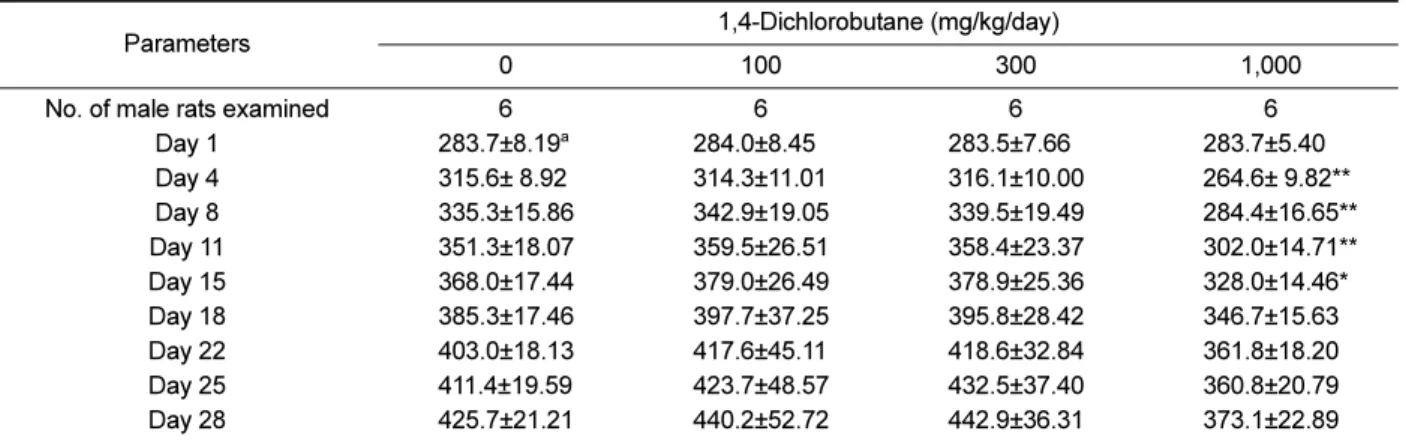
As shown in Table 2, the body weight of male rats was significantly suppressed in the 1,000 mg/kg/day group on days 4, 8, 11, and 15 when compared with that in the control group.
Hematology
No significant differences between the treatment groups and controls were observed for any of the hematological parameter examined (Table 3).
Serum biochemistry
As presented in Table 4, a significant increase in AST level was observed in the 100 mg/kg/day group in comparison with that in the control group (Table 4). The 1,000 mg/kg/day group exhibited a significant increase in ALT, ALP, T-CHO, T-BIL, ALB, PL, BUN, and GGT levels when compared with those in the control group.
Gross findings
At the scheduled necropsy, no treatment-related gross findings were observed in any of the treated animals at necropsy (data not shown).
Table 1. Clinical signs of male rats treated with 1,4-dichlorobutane for 4 weeks
Parameters 1,4-Dichlorobutane (mg/kg/day)
0 100 300 1,000
No. of male rats examined 6 6 6 6
Normal appearance
a6
a1 0 0
Decreased locomotor activity 0 0 0 6
Loss of fur 0 0 0 4
Abnormal fur 0 0 0 6
Closed eyes 0 0 0 6
Salivation 0 5 6 6
a
A single rat may be represented more than once in the listing of individual signs.
Organ weights
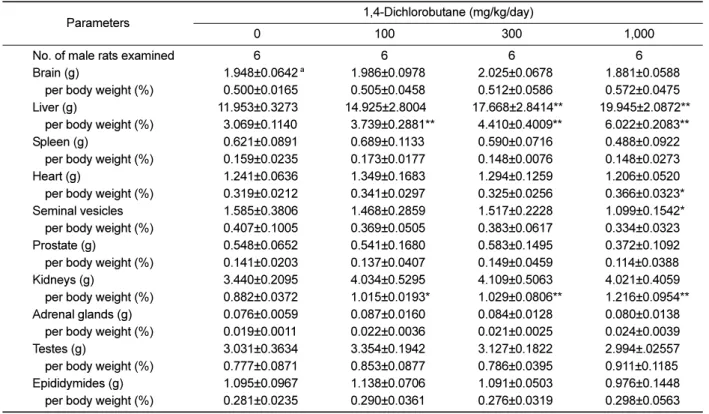
The absolute and relative organ weights of the rats are shown in Table 5. A significant increase in the relative weights of liver and kidneys were observed in the 100 mg/kg/day group compared with those in the control group. A significant increase in the absolute and relative weights of the liver and relative weight of the kidneys was observed in the 300 mg/kg/day group compared with those in the control group. In the 1,000 mg/kg/day group, the absolute and relative weights of the liver and the relative weights of the heart and kidneys were significantly increased, whereas the absolute weight of
seminal vesicles was significantly increased when compared with those in the control group.
Discussion
The present study investigated the potential subacute toxicity of 1,4-DCB by a 4-week repeated oral administration to Sprague-Dawley rats at dose levels of 0, 100, 300, and 1,000 mg/kg/day. The results of this study showed that daily oral administration of 1,4-DCB for 4 weeks at 1,000 mg/kg/day caused some changes in clinical signs, body weight, serum biochemical parameters, and organ
Table 2. Body weight changes in male rats treated with 1,4-dichlorobutane for 4 weeks
Parameters 1,4-Dichlorobutane (mg/kg/day)
0 100 300 1,000
No. of male rats examined 6 6 6 6
Day 1 283.7±8.19
a284.0±8.45 283.5±7.66 283.7±5.40
Day 4 315.6± 8.92 314.3±11.01 316.1±10.00 264.6± 9.82**
Day 8 335.3±15.86 342.9±19.05 339.5±19.49 284.4±16.65**
Day 11 351.3±18.07 359.5±26.51 358.4±23.37 302.0±14.71**
Day 15 368.0±17.44 379.0±26.49 378.9±25.36 328.0±14.46*
Day 18 385.3±17.46 397.7±37.25 395.8±28.42 346.7±15.63
Day 22 403.0±18.13 417.6±45.11 418.6±32.84 361.8±18.20
Day 25 411.4±19.59 423.7±48.57 432.5±37.40 360.8±20.79
Day 28 425.7±21.21 440.2±52.72 442.9±36.31 373.1±22.89
a
Values are presented as mean±SD.
*Indicates significant difference at P<0.05 level when compared with the control group.
**Indicates significant difference at P<0.01 level when compared with the control group.
Table 3. Hematological values in male rats treated with 1,4-dichlorobutane for 4 weeks
Parameters 1,4-Dichlorobutane (mg/kg/day)
0 100 300 1,000
No. of male rats examined 6 6 6 6
RBC (×10
12/L) 8.66±0.462
a8.58±0.536 8.74±0.419 8.56±0.272
HB (g/dL) 16.1±0.76 16.2±0.53 16.2±0.72 15.8±0.49
HCT (%) 50.2±2.50 50.8±2.40 50.2±2.91 50.0±1.96
MCV (fl) 58.0±1.49 59.3±1.57 57.5±1.75 58.5±1.64
MCH (pg) 18.6±0.66 18.9±0.66 18.6±0.33 18.4±0.41
MCHC (g/dL) 32.0±0.39 31.9±0.55 32.4±0.89 31.5±0.62
RET (%) 02.5±0.36 02.5±0.46 02.6±0.90 02.8±0.54
PLT (×10
9/L) 1028±87.4 .990±209.7 1062±106.8 1097±210.6
WBC (×10
9/L) 8.72±0.719 12.73±3.026 12.28±2.773 10.34±2.264
NEU (%) 18.2±5.36 12.9±4.73 18.2±20.96 18.0±7.18
LYM (%) 77.2±5.56 77.8±4.31 72.8±23.87 74.7±8.86
MON (%) 02.1±0.33 06.4±4.23 06.8±5.92 04.4±1.72
EOS (%) 01.1±0.40 00.6±0.29 00.5±0.48 00.9±0.33
BAS (%) 00.4±0.15 00.7±0.20 00.4±0.14 00.4±0.15
LUC (%) 01.1±0.38 01.7±1.02 01.4±0.84 01.5±0.53
a
Values are presented as mean±SD.
RBC, red blood cells; HB, hemoglobin, HCT, hematocrit; MCV, mean corpuscular volume; MCH, mean corpuscular hemoglobin; MCHC,
mean corpuscular hemoglobin concentration; RET, reticulocyte; PLT, platelets; WBC, white blood cells, NEU, neutrophils; LYM,
lymphocytes; MON, monocytes; EOS, eosinophils; BAS, basophils; and LUC, large unstained cells.
Table 4. Serum biochemical values in male rats treated with 1,4-dichlorobutane for 4 weeks
Parameters 1,4-Dichlorobutane (mg/kg/day)
0 100 300 1,000
No. of male rats examined 6 6 6 6
AST (IU/dL) 108.5±11.96
a169.2±50.75* 147.6±26.45 108.5±15.56
ALT (IU/dL) 033.4±3.93 044.4±14.64 051.2±15.08 075.7±30.15**
ALP (mg/dL) 0.430±67.6 0.450±113.7 0.558±101.3 0.627±101.6*
BUN (mg/dL) 012.3±1.35 016.1±4.56 017.9±4.52 022.5±4.97**
CRTN (mg/dL) 00.51±0.034 00.50±0.055 00.49±0.089 00.43±0.047
GLU (mg/dL) 122.2±17.51 124.5±17.29 102.9±29.72 116.2±24.00
T-CHO (mg/dL) 050.5±7.50 049.2±14.08 060.7±23.75 082.3±19.17*
T-BIL (mg/dL) 0.130±0.008 0.129±0.008 0.235±0.116 0.249±0.077**
TP (g/dL) 06.53±0.286 06.47±0.379 06.57±0.432 06.69±0.322
ALB (g/dL) 04.28±0.130 04.25±0.096 04.39±0.160 04.53±0.171*
CPK (IU/L) 0.470±132.5 0.658±253.7 0.697±186.7 0453±205.8
TG (mg/dL) 029.9±3.77 034.2±15.04 075.5±86.99 046.2±22.18
Ca (mg/dL) 10.67±0.371 10.89±0.290 10.58±0.477 10.94±0.399
IP (mg/dL) 09.21±0.977 10.25±0.870 09.48±0.846 10.66±0.887
PL (mg/dL) 00.83±8.9 00.86±15.5 0.108±38.0 0.146±28.8**
GGT (IU/L) 00.00±0.000 00.04±0.084 00.15±0.317 04.09±2.467**
a
Values are presented as mean±SD.
*Indicates significant difference at P<0.05 level when compared with the control group.
**Indicates significant difference at P<0.01 level when compared with the control group.
AST, aspartate aminotransferase; ALT, alanine aminotransferase; ALP, alkaline phosphatase; BUN, blood urea nitrogen; CRTN, creatinine; GLU, glucose; T-CHO, total cholesterol; T-BIL, total bilirubin; TP, total protein; ALB, albumin; CPK, creatine phosphokinase;
TG, triglycerides; Ca, calcium; IP, inorganic phosphate; PL, phospholipid; and GGT, gamma glutamyl transferase.
Table 5. Absolute and relative organ weights in male rats treated with 1,4-dichlorobutane for 4 weeks
Parameters 1,4-Dichlorobutane (mg/kg/day)
0 100 300 1,000
No. of male rats examined 6 6 6 6
Brain (g) 1.948±0.0642
a1.986±0.0978 2.025±0.0678 1.881±0.0588
per body weight (%) 0.500±0.0165 0.505±0.0458 0.512±0.0586 0.572±0.0475
Liver (g) 11.953±0.3273 14.925±2.8004 17.668±2.8414** 19.945±2.0872**
per body weight (%) 3.069±0.1140 3.739±0.2881** 4.410±0.4009** 6.022±0.2083**
Spleen (g) 0.621±0.0891 0.689±0.1133 0.590±0.0716 0.488±0.0922
per body weight (%) 0.159±0.0235 0.173±0.0177 0.148±0.0076 0.148±0.0273
Heart (g) 1.241±0.0636 1.349±0.1683 1.294±0.1259 1.206±0.0520
per body weight (%) 0.319±0.0212 0.341±0.0297 0.325±0.0256 0.366±0.0323*
Seminal vesicles 1.585±0.3806 1.468±0.2859 1.517±0.2228 1.099±0.1542*
per body weight (%) 0.407±0.1005 0.369±0.0505 0.383±0.0617 0.334±0.0323
Prostate (g) 0.548±0.0652 0.541±0.1680 0.583±0.1495 0.372±0.1092
per body weight (%) 0.141±0.0203 0.137±0.0407 0.149±0.0459 0.114±0.0388
Kidneys (g) 3.440±0.2095 4.034±0.5295 4.109±0.5063 4.021±0.4059
per body weight (%) 0.882±0.0372 1.015±0.0193* 1.029±0.0806** 1.216±0.0954**
Adrenal glands (g) 0.076±0.0059 0.087±0.0160 0.084±0.0128 0.080±0.0138
per body weight (%) 0.019±0.0011 0.022±0.0036 0.021±0.0025 0.024±0.0039
Testes (g) 3.031±0.3634 3.354±0.1942 3.127±0.1822 2.994±.02557
per body weight (%) 0.777±0.0871 0.853±0.0877 0.786±0.0395 0.911±0.1185
Epididymides (g) 1.095±0.0967 1.138±0.0706 1.091±0.0503 0.976±0.1448
per body weight (%) 0.281±0.0235 0.290±0.0361 0.276±0.0319 0.298±0.0563
a