Classic Floating Elbow in Adults: A Case Series
Chul-Hyun Cho , Kyung-Keun Min
Department of Orthopedic Surgery, Dongsan Medical Center, Keimyung University School of Medicine, Daegu, Korea
Background: The aim of this study was to assess demographics, clinical outcomes, and complications of classic floating elbow in adults.
Methods: Six patients with ipsilateral diaphyseal fractures of the humerus, radius, and ulna were reviewed retrospectively. All patients were treated operatively and available for follow-up at a minimum of 1 year after surgery. The average age of the patients was 45.2 years (22−64 years) and the average follow-up period was 37.0 months (14−103 months). They were evaluated with postoperative outcome measures, including a visual analog scale (VAS) for pain, Mayo elbow performance score (MEPS), and American Shoulder and Elbow Sur- geons (ASES) shoulder score. Residual complications were also evaluated.
Results: Five patients (83.3%) had open fracture, and 4 patients (66.7%) presented with associated nerve injury. All fractures were united within postoperative 4 months, except 1 delayed union. The average VAS pain score, MEPS, and ASES shoulder score at the final follow- up examination was 2.5, 79.8, and 67.5 respectively. Three patients including 2 cases of joint stiffness with incomplete recovery from nerve injury and 1 case of complex regional pain syndrome had poor clinical outcome.
Conclusions: Although the classic floating elbow is rare, these injuries potentially have associated problems such as open fracture or nerve injury. The presence of residual neurological symptoms predispose to poorer clinical outcomes.
(Clin Shoulder Elbow 2015;18(1):8-12)
Key Words: Humerus; Radius; Ulna; Fracture; Floating elbow
Introduction
Floating elbow is an extremely rare injury typically described as ipsilateral fractures of the humerus and forearm.1,2) Because of the result of high-energy trauma, it can be combined with severe soft tissue damage, leading to open fracture and neurovascular injury.3-5) For this reason, injuries usually have unpredictable clinical outcome after treatment.3)
Although literature describing functional outcomes in patients with floating elbow is limited, surgical treatment has been widely accepted. Evidence that these injuries are treated most effec- tively with surgical stabilization of the humerus and the forearm using a plate or intramedullary nail has been well reported in the literature.6-11) However, most studies have emphasized the com- plexity of these injuries and the potentially unpredictable long- term functional results.3,4,12,13)
The classic floating elbow in adults has been defined as ip- silateral diaphyseal fractures of the humerus, radius, and ulna.2) Several studies have described floating elbow variant injuries including humerus shaft and intra-articular olecranon and/or radius fractures, humerus intercondylar and forearm shaft frac- tures, humerus shaft and radius or ulna shaft fractures.3,4,14) Most published articles on floating elbow have dealt with both classic floating elbow and floating elbow variant injuries. We thought that classic floating elbow injuries have different entity from floating elbow variant injury. Furthermore, only 2 clinical studies on classic floating elbow have been reported.2,15) In this study, only patients with ipsilateral diaphyseal fractures of the humerus, radius, and ulna were included. The aim of this study was to as- sess demographics, clinical outcomes, and complications of clas- sic floating elbow in adults.
Copyright © 2015 Korean Shoulder and Elbow Society. All Rights Reserved. pISSN 2383-8337
Clinics in Shoulder and Elbow Vol. 18, No. 1, March, 2015 http://dx.doi.org/10.5397/cise.2015.18.1.8
Received September 1, 2014. Revised October 20, 2014. Accepted October 31, 2014.
Correspondence to: Chul-Hyun Cho
Department of Orthopedic Surgery, Keimyung University Dongsan Medical Center, 56 Dalseong-ro, Jung-gu, Daegu 700-712, Korea Tel: +82-53-250-7729, Fax: +82-53-250-7205, E-mail: [email protected]
Financial support: None. Conflict of interests: None.
Methods
Ten patients who had sustained classic floating elbow injury were treated in Keimyung University Dongsan Medical Center between December 2002 and March 2013. The classic float- ing elbow was defined as ipsilateral diaphyseal fractures of the humerus, radius, and ulna. Of these patients, 4 patients were excluded because 1 had trans-humeral amputation, 1 had died, and 2 were lost to follow-up. Patients aged younger than 18 years or patients with floating elbow variant injuries according to Ditsios et al.’s classification3) were also excluded. Six patients who were available for follow-up at a minimum of 1 year after surgery were reviewed retrospectively.
The average age of the patients at the time of injury was 45.2 years (range, 22−64 years), and there were 5 men and 1
woman. Two dominant arms and 4 non-dominant arms were af- fected. Five patients (83.3%) had roller injury and 1 (16.7%) had a motor vehicle accident. The average follow-up period after surgery was 37.0 months (range, 14−103 months) (Table 1).
According to location of fractures, there were 4 middle 1/3 and 2 distal 1/3 fractures in the humerus. There were 3 middle 1/3 and 3 distal 1/3 fractures in the radius and ulna.
Surgical Treatment
All fractures were managed operatively by two surgeons. The method of treatment of any individual patients was at the discre- tion of the attending surgeon. Irrigation and debridement were performed in all patients with open fracture. Four patients (case 1, 3, 4, and 5) had external fixation for management of soft tis- sue damage. For definite treatment, all humerus fractures were
Table 1. Patients’ Clinical Data Case
no. Age
(yr) Sex Injury
mechanism Open
fracture Nerve
injury Humerus
treatment Radius and
ulna treatment Final VAS score Final
MEPS Final ASES
score FU period
(mo) Complications
1 45 M Roller H (IIIA) BP IM nail Plate 3 75 62 34 IRN, stiffness (S, E)
2 55 M Roller F (II) - IM nail IM nail 0 95 98 24 -
3 22 M MVA - RN IM nail Plate 1 85 90 103 -
4 44 M Roller F (II) - IM nail Plate 0 100 100 22 -
5 64 F Roller F (II) MN IM nail Plate 5 69 39 25 CRPS
6 41 M Roller H, F (I) RN IM nail Plate 6 55 16 14 IRN, DU, Stiffness (E)
VAS: visual analogue scale, MEPS: Mayo elbow performance score, ASES: American Shoulder and Elbow Surgeons, FU: follow-up, M: male, F: female, MVA: mo- tor vehicle accident, H: humerus, F: forearm, BP: brachial plexus, RN: radial nerve, MN: median nerve, IM: intramedullary, IRN: incomplete recovery of nerve injury, S: shoulder, E: elbow, CRPS: complex regional pain syndrome, DU: delayed union.
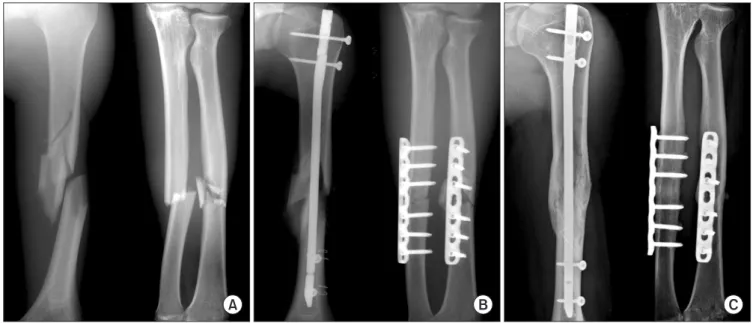
Fig. 1. A 22-year-old man with floating elbow associated with radial nerve injury, multiple fractures, and internal organ injuries. (A) Preoperative radiographs show ipsilateral midshaft fractures of the humerus, radius, and ulna. (B) Postoperative radiographs after delayed surgery show internal fixation with intramedul- lary nailing for the humerus and plating for the radius and ulna. (C) Radiograph at 8.6 years after the surgery shows complete bony union with satisfactory clini- cal outcome.
A B C
treated by closed reduction and interlocking intramedullary nail- ing. In management of forearm fractures, five patients had open reduction and plate fixation and 1 patient had closed reduction and intramedullary nailing using a Rush pin.
In case 1, forearm fractures were fixed immediately using a plate. Type IIIA open humeral fracture had external fixation for management of severe soft tissue injury with third degree burn.
After skin grafts 2 times, closed reduction and intramedullary fixation using an interlocking nail was performed 14.5 weeks after initial trauma. In case 2 with Type II open fracture of the forearm, the humerus and forearm fractures were treated simul- taneously with immediate closed reduction and intramedullary fixation using an interlocking nail and Rush pin. In case 3, the humerus and forearm fractures had delayed fixation 30 days after initial trauma because of internal organ injuries and mul- tiple fractures (Fig. 1). In cases 4, 5, and 6, open fractures (time interval from injury to internal fixation: 25 days, 32 days, and 18 days) had final internal fixation after management of soft tissue injury using external fixation and closed fractures had immediate internal fixation.
Postoperatively, patients began active and passive range of motion for shoulder, elbow, and wrist within 1 week after defi- nite internal fixation. Rehabilitation protocols during temporary external fixation or soft tissue management were individualized.
Radiological and Clinical Assessment
Radiological outcomes were evaluated using serial plain ra- diographs. Pain intensity was assessed using visual analog scale (VAS) pain scores (0=no pain; 10=unbearable pain). Functional outcomes for shoulder and elbow were assessed using American Shoulder and Elbow Surgeons (ASES) shoulder score and Mayo elbow performance score (MEPS). The ASES shoulder scoring system is a self-rated scale composed of the VAS pain score (50%) and the cumulative activities of daily living score (50%). The MEPS scoring system was used to assess pain (maximum score, 45 points), motion (maximum score, 20 points), stability (maxi- mum score, 10 points), and daily functional activities (maximum score, 25 points). Residual complications were also evaluated.
Results
Five patients (83.3%) presented with open fracture. Three patients had open fracture of the forearm only, 1 open fracture of the humerus only, and 1 open fracture of the humerus and forearm. According to Gustillo-Anderson classification, there was 1 Type I and 1 Type IIIA injury in humeral fractures. There were 3 Type II and 1 Type I injuries in forearm fractures.
Four patients (66.7%) presented with associated nerve in- jury. Two patients had radial nerve injury, 1 with brachial plexus injury, and 1 with median nerve injury. At the final follow-up examination, only 1 patient (case 3) had complete recovery of
nerve injury.
All fractures were united within postoperative 4 months, ex- cept 1 delayed union was healed at postoperative 10 months.
The average VAS pain score, MEPS, and ASES score at the final follow-up examination was 2.5, 79.8, and 67.5 respectively.
Three patients had residual complications and poor clinical outcomes. Case 1 had shoulder (100o of forward flexion, 30o of external rotation, and L4 level of internal rotation) and elbow (-20o of extension, 100o of flexion, 60o of pronation, and 60o of supination) stiffness with incomplete recovery of brachial plexus injury. Case 5 had complex regional pain syndrome. Case 6 had elbow stiffness (-30o of extension, 110o of flexion, 70o of prona- tion, and 60o of supination) with delayed union of the humerus and incomplete recovery of radial nerve injury. At 14 months after surgery, the patient did not want to undergo any further operation for radial nerve palsy for personal reasons.
Discussion
The combination of ipsilateral fractures of the humerus and forearm creates an unstable intermediate articulation.13) In 1980, Stanitski and Micheli16) introduced the term ‘floating elbow’ to describe the injury pattern of ipsilateral supracondylar humerus and forearm axis fractures that disconnect the elbow from the remaining limb in children. This description was recently extend- ed to adults who sustain concomitant fractures of the humerus and forearm in the same limb.2,13,15)
Classic floating elbow injuries may be a different entity than floating elbow variant injury. Floating elbow variant injuries, in- cluding elbow fractures, may have different injury mechanisms and poorer clinical outcomes because of direct elbow injury.
In our study, patients with ipsilateral diaphyseal fractures of the humerus, radius, and ulna were only included for assessment of demographics, clinical outcomes, and complications of classic floating elbow in adults.
Although their injuries show a very rare fracture pattern, com- bined problems can usually occur.3-5) Associated neurovascular injury or soft tissue damage not only adds to the complexity of the surgical management but also, more often than not, ad- versely influences the functional outcome of the upper extrem- ity.13) Jockel et al.4) reported that floating elbow represents high- energy trauma and there are significant associated injuries. They concluded that nerve injury is correlated with lower subjective clinical outcomes. Simpson and Jupiter13) reported that the float- ing elbow was an exceptionally complex injury and that compli- cations such as nonunion, infection, or neurological sequelae, which led to the potential for long-term functional disability of the involved limb, could be considerable. In our study, we ob- served open fracture in 5 patients (83.3%), nerve injury in 4 pa- tients (66.7%), and combined injuries including other fractures or internal organ damage in 3 patients (50.0%).
Floating elbow injuries may require temporary fixation, staged fixation, or late reconstruction if accompanied by associ- ated problem or complication.4) Since 1984, when Rogers et al.10) reported a 100% nonunion rate in the humerus on floating elbow injuries treated without rigid fixation in the humerus, rigid internal fixation of the humerus and forearm fractures has been accepted as the treatment of choice for this injury. When the injuries have serious soft tissue damage, temporary external fixa- tion can be used in management of soft tissue injury for mainte- nance of length and rotational alignment.13) A few investigators reported a relatively large series of floating elbow injuries in adults.
Yokoyama et al.15) reported that good or excellent clinical results were achieved in 67% of patients with floating elbow injuries. Rogers et al.10) documented 19 floating elbow injuries in adults and concluded that the open reduction and internal fixa- tion of both humeral and forearm fractures was preferable for management of these injuries.
Previous studies have attempted to identify factors that pre- dict functional outcomes after floating elbow injury.2-4,15) Accord- ing to Yokoyama et al.15), who reported on 15 floating elbows in 14 patients, there was no difference in outcomes based on multiple factors, including open fracture, vascular injury, time to fixation, injury severity score, and nerve injury. However, they concluded that these injuries potentially have many complica- tions, such as infection, nonunion, and neurovascular damage, which led to the potential for long-term functional disability of the involved limb.
As we saw in this study, joint stiffness and neurological se- quelae are common complications in patients with floating el- bow injury. Loss of elbow motion is commonplace, particularly involving elbow flexion and extension, although loss of forearm rotation has also been noted, particularly in the setting of associ- ated high energy trauma to the forearm.13) Pierce and Hodurski9) reported that the most common injury associated with floating elbow was residual nerve damage, which occurred in more than 50% of patients and was a factor contributing to poor function.
Vascular injuries associated with severe soft tissue injuries and neurologic deficits were speculated to be factors contributing to the poor outcome from the findings.15) Solomon et al.2) showed that patients with associated nerve injury have lower functional outcomes. They reported that patients with floating elbow inju- ries tend to have a bimodal distribution of long-term outcome.
These findings are consistent with those of our study. In our study, case 1 with shoulder and elbow stiffness with incomplete sensory recovery of brachial plexus injury, case 5 with complex regional pain syndrome, and case 6 with elbow stiffness and incomplete motor recovery of radial nerve injury had poor clini- cal outcomes. Although we did not perform statistical analysis because of a small number of patients, three patients (50%) with incomplete recovery of nerve injury had poor clinical outcomes.
This study will be helpful to surgeons in the effort to provide more accurate counseling to patients with floating elbow regard- ing the long-term clinical outcomes and the implication of con- comitant problems such as neurological sequelae.
This study had limitations, including a small number of pa- tients, retrospective design. Unfortunately, this limitation is a product of the available data because floating elbow injuries are rare. Prospective multi-center studies are required for objective evaluation of clinical outcomes and complications and to assess prognostic factors affecting clinical outcomes.
Conclusion
Although the classic floating elbow is rare, these injuries potentially have associated problems such as open fracture or nerve injury. The presence of residual neurological symptoms predispose to poorer clinical outcomes.
References
1. Han MS, Yoon HD, Kim YC, Son JH, Choi JS, Lee YG. A clini- cal analysis of concomitant ipsilateral fracture of the humerus and forearm. J Korean Orthop Assoc. 1992;27(1):212-9.
2. Solomon HB, Zadnik M, Eglseder WA. A review of out- comes in 18 patients with floating elbow. J Orthop Trauma.
2003;17(8):563-70.
3. Ditsios K, Boutsiadis A, Papadopoulos P, et al. Floating elbow injuries in adults: prognostic factors affecting clinical outcomes.
J Shoulder Elb Surg. 2013;22(1):74-80.
4. Jockel CR, Gardenal RM, Chen NC, Golden RD, Jupiter JB, Capomassi M. Intermediate-term outcomes for floating el- bow and floating elbow variant injuries. J Shoulder Elb Surg.
2013;22(2):280-5.
5. Sohn SK, Kim BH, Yang SW. Management of ipsilateral frac- tures of humerus and forearm in adults. J Korean Shoulder Elb Soc. 1998;1(2):212-20.
6. Kim JR, Song KJ, Kim SJ, Lee JM, Hwang BY. Analysis of the operative treatment of ipsilateral diaphyseal fractures of the humerus and forearm. J Korean Soc Fract. 1998;11(1):34-40.
7. Cho CH, Song KS, Kim SK. Antegrade interlocking intramedul- lary nailing in humeral shaft fractures. J Korean Shoulder Elb Soc. 2010;13(1):1-6.
8. Lange RH, Foster RJ. Skeletal management of humeral shaft fractures associated with forearm fractures. Clin Orthop Relat Res. 1985;(195):173-7.
9. Pierce RO Jr, Hodurski DF. Fractures of the humerus, radius, and ulna in the same extremity. J Trauma. 1979;19(3):182-5.
10. Rogers JF, Bennett JB, Tullos HS. Management of concomitant ipsilateral fractures of the humerus and forearm. J Bone Joint Surg Am. 1984;66(4):552-6.
11. Suh JT, Kim SH, Yoo CI. Surgical treatment of concomitant ipsi-
lateral humerus and forearm fractures. J Korean Orthop Assoc.
1994;7(2):316-21.
12. Levin LS, Goldner RD, Urbaniak JR, Nunley JA, Hardaker WT Jr. Management of severe musculoskeletal injuries of the upper extremity. J Orthop Trauma. 1990;4(4):432-40.
13. Simpson NS, Jupiter JB. Complex fracture patterns of the up- per extremity. Clin Orthop Relat Res. 1995;(318):43-53.
14. De Carli P, Boretto JG, Bourgeois WO, Gallucci GL. Floating
dislocated elbow: a variant with articular fracture of the hu- merus. J Trauma. 2006;60(2):421-2.
15. Yokoyama K, Itoman M, Kobayashi A, Shindo M, Futami T.
Functional outcomes of “floating elbow” injuries in adult pa- tients. J Orthop Trauma. 1998;12(4):284-90.
16. Stanitski CL, Micheli LJ. Simultaneous ipsilateral fractures of the arm and forearm in children. Clin Orthop Relat Res.
1980;(153):218-22.