An Anterosuperior Deltoid Splitting Approach for Plate Fixation of Proximal Humeral Fractures
Dong-Ju Shin, Young-Soo Byun , Young-Ho Cho, Ki-Hong Park, Hyun-Seong Yoo
Department of Orthopedic Surgery, Daegu Fatima Hospital, Daegu, Korea
Background: The purpose of this study was to evaluate the usefulness and safety of the anterosuperior deltoid splitting approach for fixation of displaced proximal humeral fractures by analyzing the surgical outcomes.
Methods: Twenty-three patients who could be followed-up for at least 8 months after the treatment of displaced proximal humeral fractures through the anterosuperior deltoid splitting approach were enrolled. We evaluated the reduction of the fractures and surgery- related complications at the last follow-up using X-ray results and clinical outcomes comprising the University of California at Los Angeles (UCLA) scoring system and the Korean Shoulder Society (KSS) score.
Results: At the last follow-up of patients treated using the anterosuperior deltoid splitting approach for internal fixation of proximal humeral fractures, we found 22 cases (95.6%) of bone union, a mean UCLA score of 28.3 (range, 15 to 34) and a mean KSS score of 82.1 (range, 67 to 95). Various surgery-related complications were noted; a case of varus malunion after fracture displacement, a case of nonunion, a case of delayed union, two cases of impingement, and a case of partial axillary nerve injury, which recovered completely through the follow-up.
Conclusions: Plate fixation using the anterosuperior deltoid splitting approach could be another reliable option for treating displaced proximal humeral fractures.
(Clin Shoulder Elbow 2015;18(1):2-7)
Key Words: Humerus; Anterosuperior deltoid splitting approach; Minimally invasive plate osteosynthesis
Introduction
Fractures of the proximal humerus, a relatively common type of fracture, compose 5% of all fractures of the bone. Their num- bers are increasing with the growing aged population.1) As stable fractures in most individuals, they are successfully treated in 80%
of nonsurgical interventions. However, unstable fractures with severe displacements or comminution require surgical interven- tions of anatomical reduction and internal fixation that allow shoulder function-restoring joint exercises to be implemented early on.2) Various surgical interventions exist for proximal hu- meral fractures and the recently developed locking compression plates for fixation are considered as effective tools for osteosyn- thesis of fractures of the proximal humerus.3)
Different approaches for fixation of locking compression plates are used by orthopedic surgeons. For example, the delto- pectoral approach commonly disrupts vascular supply to the fracture site and aggravates displacement of fractures. Abundant vascular supply is compromised by the invasive skin incision and unnecessarily large dissection of the soft tissue during the surgical intervention. Knock on effects of a compromised vascular sup- ply are complications such as deep infection, bone nonunion, delayed bone union, and avascular necrosis of the humeral head. Further, fractures are displaced even more by the need to laterally pull the deltoid and internally rotate the shoulders to insert plates. As an alternative to this approach, the authors have employed a minimally invasive plate fixation technique us- ing the anterosuperior deltoid splitting approach. We used this
Copyright © 2015 Korean Shoulder and Elbow Society. All Rights Reserved. pISSN 2383-8337
Clinics in Shoulder and Elbow Vol. 18, No. 1, March, 2015 http://dx.doi.org/10.5397/cise.2015.18.1.2
Received July 29, 2014. Revised October 27, 2014. Accepted October 28, 2014.
The abstract of this article was announced at 2013 The Korean Fracture Society Annual Spring Congress.
Correspondence to: Young-Soo Byun
Department of Orthopedic Surgery, Daegu Fatima Hospital, 99 Ayang-ro, Dong-gu, Daegu 701-724, Korea Tel: +82-53-940-7320, Fax: +82-53-940-7417, E-mail: [email protected]
Financial support: None. Conflict of interests: None.
approach to treat proximal humeral fractures and evaluated its usefulness and safety by analyzing the surgical outcomes.
Methods
Subjects of Study
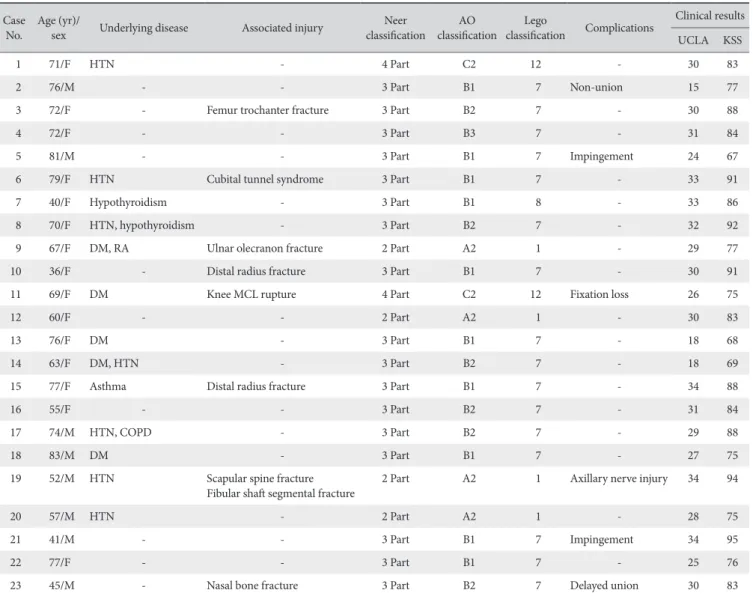
From November 2010 to February 2012, we enrolled 23 patients, who were able to participate in a prospective follow- up study of at least 8 months, with displaced fractures of the proximal humerus for an anterosuperior deltoid splitting ap- proach of internal plate fixation. The mean follow-up period was 15.9 months (range, 8 to 23 months). The mean age of the study subjects was 64 years (range, 36 to 83 years), and of these 69.5% (16 patients) were over the age of 60. The study subjects comprised of 8 males and 15 females, and the fractures were on the right shoulder in 11 patients and on the left in 12. The mode
of injury was a fall in 18 cases (78.2%), accidents on either the road or a fall in 4 (17.3%) and 1 (4.3%), respectively. A total of 8 patients (34.7%) had a combined-injury; a fracture in a differ- ent region in 6 patients, an injury in the ulnar nerve in 1, and a ligament injury of the knee in 1. A total of 13 patients (56.5%) had an underlying disease; hypertension in 7 patients, diabetes in 5, hypothyroidism in 2, rheumatoid arthritis in 1, asthma in 1, and chronic obstructive pulmonary disease in 1. According to Neer’s classification of fractures,4) 4 patients had a 2-part fracture (17.3%), which also connected to the neck, 17 patients had a 3-part fracture (73.9%); of which 15 patients had fractures con- nected to the neck from the greater tuberosity and 2 from the lesser tuberosity, and lastly 2 patients had a 4-part fracture. Ac- cording to the Müller AO fracture classification, 4 patients had a type A2 fracture, 10 had type B1, 6 had a type B2, 1 had type B3, and 2 had type C2. According to the Lego fracture classifica-
Table 1. Patient Demographics Case
No. Age (yr)/
sex Underlying disease Associated injury Neer
classification AO
classification Lego
classification Complications Clinical results UCLA KSS
1 71/F HTN - 4 Part C2 12 - 30 83
2 76/M - - 3 Part B1 7 Non-union 15 77
3 72/F - Femur trochanter fracture 3 Part B2 7 - 30 88
4 72/F - - 3 Part B3 7 - 31 84
5 81/M - - 3 Part B1 7 Impingement 24 67
6 79/F HTN Cubital tunnel syndrome 3 Part B1 7 - 33 91
7 40/F Hypothyroidism - 3 Part B1 8 - 33 86
8 70/F HTN, hypothyroidism - 3 Part B2 7 - 32 92
9 67/F DM, RA Ulnar olecranon fracture 2 Part A2 1 - 29 77
10 36/F - Distal radius fracture 3 Part B1 7 - 30 91
11 69/F DM Knee MCL rupture 4 Part C2 12 Fixation loss 26 75
12 60/F - - 2 Part A2 1 - 30 83
13 76/F DM - 3 Part B1 7 - 18 68
14 63/F DM, HTN - 3 Part B2 7 - 18 69
15 77/F Asthma Distal radius fracture 3 Part B1 7 - 34 88
16 55/F - - 3 Part B2 7 - 31 84
17 74/M HTN, COPD - 3 Part B2 7 - 29 88
18 83/M DM - 3 Part B1 7 - 27 75
19 52/M HTN Scapular spine fracture
Fibular shaft segmental fracture 2 Part A2 1 Axillary nerve injury 34 94
20 57/M HTN - 2 Part A2 1 - 28 75
21 41/M - - 3 Part B1 7 Impingement 34 95
22 77/F - - 3 Part B1 7 - 25 76
23 45/M - Nasal bone fracture 3 Part B2 7 Delayed union 30 83
UCLA: University of California at Los Angeles scoring system, KSS: Korean Shoulder Society score, M: male, F: female, HTN: hypertension, DM: diabetes mel- litus, RA: rheumatoid arthritis, COPD: chronic obstructive lung disease, MCL: medial collateral ligament.
tion, 4 patients had a type 1 fracture, 16 had type 7, 1 had type 8, and 2 had type 12. Finally, 8 and 15 patients enrolled into our study had a preoperative varus or valgus deformity, respectively (Table 1).
Treatment Methods
Under general anesthesia, the patients were treated in a beach-chair position. An image intensifier was used to assist sur- gery. First, two incisions were made; a proximal incision and a distal incision. The proximal incision, which axially opens a skin section, 5 cm in length, posterior to the anterolateral acromion, exposes the deltoid. The distal incision axially opens a skin sec- tion above the humeral shaft that is sufficiently away from the fracture. When making both incisions, we cared not to injure the axillary nerve and the brachial circumflex artery, and cared to minimize soft tissue dissection so that we could maximally preserve vascular supply to the fracture site. Through these inci- sions, we used the anterosuperior deltoid splitting approach, the process by which the proximal humerus is exposed, to reduce the fracture. The anterosuperior deltoid splitting approach sepa-
rates the thin lining of fat between the anterior and the middle deltoid region. The axial separation or split exposes the bone, after a tunnel that runs to the proximal humerus is made with- out injuring the axillary nerve. Then, through the distal incision, the displaced humeral head, displaced greater tuberosity or the lesser tuberosity were reduced.
K-wires were used for temporary fixation of the reduced frac- tures. Then, an image intensifier was used as a quick method to confirm the reduction. The proximal incision was used to approach distally and insert the Philos plating system (Synthes, Oberdorf, Switzerland), and during this, traction to the deltoid and axillary nerves was minimized by maneuvering the shoulder with slight abduction to prevent injury to the axillary nerve. The axillary nerve was covered up manually using the surgeon’s fin- gers, and the plate was inserted in between the nerve and the outer surface of the proximal humerus.
The proximal end of the plate was positioned posterior to and level to the peak of the greater tuberosity. K-wires were used for temporary fixation of the plate while keeping in mind to prevent plate-induced acromial impingement. Through the
Fig. 1. A 52-year-old male sustained a proxi- mal humeral fracture by a fall to the ground.
(A) A radiograph shows a 2-part displaced fracture of the proximal humerus. (B) Re- constructed three-dimensional computed to- mography scan show a marked displacement of a fracture fragment with varus angulation of the neck-shaft angle. (C) A radiograph taken during the operation shows the chang- ing of the neck-shaft angle from a varus to a valgus angulation by valgus forcing of the distal humeral fragment. (D) An intraopera- tive photo shows the anterorsuperior deltoid splitting approach.
A B
C D
distal incision, we gradually moved the plate against the wall of the humeral shaft using cortical screws. In case of varus an- gulated humeral heads in certain patients, the plate was never- theless placed as adjacent to the humeral shaft as we could so that the proximal end of the plate could provide the support for the displaced humeral head. In case of varus deformity, the proximal fragment was forced laterally to the distal fragment to make a valgus angulation, and cortical screws were used to fix the plate to the shaft. If the proximal and distal medial cortical bones touched and varus deformity impended, locking screws were used for additional fixation to prevent varus deformity (Fig.
1). The locking screws were fixed through the proximal incision.
This anterosuperior deltoid splitting approach typically does not allow internal support screws plate for fixation to be used due to high risk of axillary nerve injury. Thus, permanent fixation of the plate was achieved through the rotator cuffs using non- absorbable sutures to reduce a displaced fracture of the greater tuberosity. Even where a greater tuberosity fracture was not found, non-absorbable sutures were used for additional fixation.
To prevent postoperative stiffness, pendulum exercise was begun a week after acute pain dissipated, and active assisted exercises were begun after 3 weeks. After bone union was ra- diologically confirmed, muscle strengthening exercises were implemented.
Clinical Assessment
Postoperative surgical outcomes were assessed by pain, func- tion, range of motion, and muscle strength of the affected arm.
Postoperative level of patient satisfaction was assessed using the University of California at Los Angeles (UCLA) scoring system5) and the Korean Shoulder Society (KSS) score.6) Postoperative and follow-up radiographs were used to confirm reduction of fractures and bone union. Radiographs were used to detect any complications such as infection, shoulder joint stiffness, and loosening of internal fixatives.
Results
Using the anterosuperior deltoid splitting approach for inter- nal fixation of proximal humeral fractures, we achieved 22 out of 23 bone unions (95.6%). For postoperative shoulder range of motion (ROM), we found a mean forward elevation of 133o ± 9.2o (range, 90o to 160o), a mean external rotation of 52o ± 8.4o (range, 30o to 80o), and a mean internal rotation at the 12th tho- racic vertebra (range, 6th thoracic vertebra-sacrum). For clinical outcome, we found a mean UCLA score of 28.3 (range, 15 to 34); 3 cases of ‘excellent’ scores; 12 ‘good’; and 8 ‘poor’, and fi- nally, we found a mean KSS score of 82.1 (range, 67 to 95). The mean waiting period for treatment was 7.3 days (range, 1 to 46 days), and the mean duration of time the patient was under an- esthesia was 144 minutes (range, 85 to 205 minutes). The range
of blood loss during surgery was 30 to 300 ml. The Philos plating system was used without internal support screws in all patients.
In terms of surgery-related complications, we found a total of 6 complications; a case of varus deformity induced by re-dis- placement of the fracture, a case of nonunion, a case of delayed union, 2 cases of subacromial impingement syndrome, and a case of partial injury of the axillary nerve. In the case of re-dis- placement of the greater tuberosity fracture, the re-displacement resulted from loosening of the locking screws around 5 weeks after the operation without any obvious external signs. Despite recommendations for revision, the patient refused revision sur- gery and the bone fused as displaced. For the case of nonunion of the fracture, despite 6 weeks of watchful waiting, pain per- sisted, the fracture was mildly displaced, and bone union did not form. Thus, the patient was referred to us for a secondary surgery. During the surgery, bone substitutes to fill the severe bone deficits at the medial humeral head were needed. After 4 weeks of surgery, radiological tests showed a successful reduc- tion and a forward elevation of 90o of the arms. After 6 weeks of surgery, even though the patient complained of pain without any particular injury, radiological tests showed a maintained re- duction and normal callus formation. After 4 months of surgery, we found that bone absorption began, and at 5 months, we found loosening of the locking screws. Despite this, since callus formation and progressive signs of bone union began to show in parts, we decided to maintain our vigil. However, bone union did not occur even after one year of surgery, so although a bone transplantation was advised, the patient refused to continue with further treatment. In the 2 cases of subacromial impingement syndrome, both patients showed amelioration of symptoms after the locking plates were removed. After 10 days of the plate re- moving surgery, although an electromyography showed a loss in nerve conduction of the deltoid muscle in one patient, marking an injured axillary nerve, the injury naturally resolved later on.
Discussion
Numerous surgical treatments for displaced proximal humeral fractures exist. Yet, a standardized, systematic approach that can be routinely applied has not been devised. Many studies have used the delto-pectoral approach to make an open reduction and internal plate fixation to treat displaced proximal humeral fractures. However, over-dissection of the soft tissue, unnec- essary traction or compression of the deltoid root, avascular necrosis induced by damaged brachial circumflex artery, bone nonunion, bone malunion, and infections are commonly associ- ated complications of this approach.6-13) Bäthis et al.12) have also shown that during open reduction and internal plate fixation of 3-part or 4-part fractures of the proximal humeral head are asso- ciated with a 16% prevalence rate of avascular necrosis, whereas during minimally invasive fixation, this association is reduced to
9%. Similarly, Egol et al.14) showed that, even during open reduc- tion, when dissection of the soft tissue and injury to the vascular tissue is minimized, avascular necrosis occurs less.
In order to minimize the associated complications to the delto-pectoral approach, the authors used an alternative antero- superior deltoid splitting approach to treat displaced fractures of the humeral head. The anterosuperior deltoid splitting approach separates the line forming between the anterior and the middle section of the deltoid and minimizes dissection of the soft tissue whilst preserving bone vascularization as much as possible. Fur- ther, as only a sufficient amount of internal rotation is required for bone reduction, reduction is likely to be maintained more successfully. This approach has been used previously for plate fixation during reduction of proximal humeral fractures, humeral shaft fractures, and rotator cuff injuries.15,16) Gardner et al.13) have also used this approach in 16 patients with fractures of the proxi- mal humerus. However, a disadvantage of this approach is that it is associated with high incidence of axillary nerve injury.17-19) Axil- lary nerves are in fact one of the most commonly injured nerves during shoulder-related surgeries.20) Gardner et al.13) reported that the axillary nerve is positioned on average 63.3 mm lateral to the acromion and 35.5 mm posterior to the greater tuberosity of the humerus. Thus, due to the close proximity of the proximal humerus and the axillary nerve, the anterosuperior deltoid split- ting approach does not allow insertion of internal support screws at the posteromedial sides of the proximal humerus. Since the authors could not insert internal support screws, we aimed to anatomically reduce the posteromedial calcar, which is an important structure that maintains reduced humeral heads, by as much as possible. Nevertheless, other surgeons have shown that if the lateral 5 cm21-23) or 4.2 cm24) of the acromion is not disturbed during the deltoid splitting,21-23) the axillary nerve will be preserved. However, this also shows that variations exist as to the exact region which the surgeons regard as a ‘safe zone’.
Thus, on a patient-by-patient basis, surgeons should be aware of the axillary nerve by keeping an eye on it by touch when skin incisions are made.
In our study, we found a case of axillary nerve injury diag- nosed using an electromyography after 10 days of surgery. We suspect that the injury was not incurred during surgery, but indirectly from traction to the deltoid muscle. We found that the complication resolved by itself at the outpatient’s follow-up, and an electromyography after 2 years showed a healthy axillary nerve.
We used the UCLA scoring system and KSS score as indica- tors of clinical outcome after surgery. We found poor UCLA scores in 8 patients, but the average age of these patients was 72.7 years, being above that of the total patients. Further, the av- erage ROM of these 8 patients in terms of internal rotation was at the sacrum, which is also below average of the whole study group. The UCLA scoring system comprises of 5 parts; pain,
function, ROM, muscle strength, and patient satisfaction. Each part is scored with marks out of 10, 10, 5, 5, and 5, respectively, giving a total possible mark of 35. Despite scoring highly in the rest of the sections, these 8 patients received an overall poor UCLA score because they had difficulty performing the Brassiere body motion in the ROM section, therefore receiving only 4 out of 10 marks.
Lin et al.25) carried out a plate fixation of displaced proxi- mal humeral fractures in a total of 86 patients. In 43 patients, they carried out a standard delto-pectoral approach and in the other 43 patients, a deltoid-splitting approach. At the 12-month follow-up, they did not find a statistically significant difference in the Constant-Murley score between patients of different treat- ment groups. However, at the 3- and 6-month follow-up, better clinical outcomes were seen for the deltoid-splitting approach group in terms of pain, satisfaction levels in daily activities, and ROM. Despite disadvantages of the deltoid-splitting approach in that it can potentially damage the axillary nerve, sometimes needs rotational revision, and cannot use internal support screws, it has the advantage that the fracture can be approached with minimal invasion. This means soft-tissue damage-induced complications can be reduced, and excessive traction of the del- toid and internal rotation of the shoulder, which are required for the delto-pectoral approach, can be avoided.
The limitations in our study were that no controls were taken and that the sample size was small. A subsequent study with controls and a larger sample size is needed.
Conclusion
In conclusion, we found that the anterosuperior deltoid split- ting approach, a minimally invasive approach for plate fixation of displaced proximal humeral fractures showed satisfactory postoperative clinical and radiological outcomes. By using this approach, we minimized the amount of soft tissue dissection, and by doing so reduced the associated complications that can lead to recurrent displacement of fractures. We believe the an- terosuperior deltoid splitting approach is a useful and safe treat- ment method for displaced fractures of the proximal humerus.
References
1. Baron JA, Barrett JA, Karagas MR. The epidemiology of periph- eral fractures. Bone. 1996;18(3 Suppl):209S-13S.
2. Depalma AF, Cautilli RA. Fractures of the upper end of the hu- merus. Clin Orthop. 1961;20:73-93.
3. Ring D. Current concepts in plate and screw fixation of os- teoporotic proximal humerus fractures. Injury. 2007;38 Suppl 3:S59-68.
4. Neer CS 2nd. Displaced proximal humeral fractures. II. Treat- ment of three-part and four-part displacement. J Bone Joint
Surg Am. 1970;52(6):1090-103.
5. Constant CR, Murley AH. A clinical method of functional as- sessment of the shoulder. Clin Orthop Relat Res. 1987;(214):
160-4.
6. Tae SK, Rhee YG, Park TS, et al. The development and vali- dation of an appraisal method for rotator cuff disorders: the Korean Shoulder Scoring System. J Shoulder Elb Surg. 2009;
18(5):689-96.
7. Kristiansen B, Christensen SW. Plate fixation of proximal hu- meral fractures. Acta Orthop Scand. 1986;57(4):320-3.
8. Traxler H, Surd R, Laminger KA, Windisch A, Sora MC, Firbas W. The treatment of subcapital humerus fracture with dynamic helix wire and the risk of concommitant lesion of the axillary nerve. Clin Anat. 2001;14(6):418-23.
9. Chapman JR, Henley MB, Agel J, Benca PJ. Randomized pro- spective study of humeral shaft fracture fixation: intramedul- lary nails versus plates. J Orthop Trauma. 2000;14(3):162-6.
10. Livani B, Belangero WD. Bridging plate osteosynthesis of hu- meral shaft fractures. Injury. 2004;35(6):587-95.
11. Zhiquan A, Bingfang Z, Yeming W, Chi Z, Peiyan H. Minimally invasive plating osteosynthesis (MIPO) of middle and distal third humeral shaft fractures. J Orthop Trauma. 2007;21(9):
628-33.
12. Bäthis H, Tingart M, Bouillon B, Tiling T. Surgical treatment of proximal humeral fractures. Is the T-plate still adequate osteo- synthesis procedure? Zentralbl Chir. 2001;126(3):211-6.
13. Gardner MJ, Griffith MH, Dines JS, Briggs SM, Weiland AJ, Lorich DG. The extended anterolateral acromial approach al- lows minimally invasive access to the proximal humerus. Clin Orthop Relat Res. 2005;(434):123-9.
14. Egol KA, Ong CC, Walsh M, Jazrawi LM, Tejwani NC, Zucker- man JD. Early complications in proximal humerus fractures (OTA Types 11) treated with locked plates. J Orthop Trauma.
2008;22(3):159-64.
15. Blum J, Rommens PM. Proximal interlocking of humeral intra-
medullary nails and risk of axillary nerve injury. Unfallchirurg.
2002;105(1):9-13.
16. Rommens PM, Blum J, Runkel M. Retrograde nailing of hu- meral shaft fractures. Clin Orthop Relat Res. 1998;(350):26- 39.
17. Hepp P, Theopold J, Voigt C, Engel T, Josten C, Lill H. The surgical approach for locking plate osteosynthesis of displaced proximal humeral fractures influences the functional outcome.
J Shoulder Elb Surg. 2008;17(1):21-8.
18. Lill H, Hepp P, Rose T, König K, Josten C. The angle stable lock- ing-proximal-humerus-plate (LPHP) for proximal humeral frac- tures using a small anterior-lateral-deltoid-splitting-approach - technique and first results. Zentralbl Chir. 2004;129(1):43-8.
19. Apaydin N, Uz A, Bozkurt M, Elhan A. The anatomic rela- tionships of the axillary nerve and surgical landmarks for its localization from the anterior aspect of the shoulder. Clin Anat.
2007;20(3):273-7.
20. Bono CM, Grossman MG, Hochwald N, Tornetta P 3rd. Radial and axillary nerves. Anatomic considerations for humeral fixa- tion. Clin Orthop Relat Res. 2000;(373):259-64.
21. Abbott LC, Dec J, Saunders JB, et al. Surgical approaches to the shoulder joint. J Bone Joint Surg Am. 1949;31(2):235-55.
22. Burkhead WZ Jr, Scheinberg RR, Box G. Surgical anatomy of the axillary nerve. J Shoulder Elb Surg. 1992;1(1):31-6.
23. Kontakis GM, Steriopoulos K, Damilakis J, Michalodimitrakis E. The position of the axillary nerve in the deltoid muscle. A cadaveric study. Acta Orthop Scand. 1999;70(1):9-11.
24. Abhinav G, Sivaraman B, Matthew N, Grahame JST. A contri- bution to the calculation of a safe deltoid split. Int J Shoulder Surg. 2008;2(3):52-5.
25. Lin T, Xiao B, Ma X, Fu D, Yang S. Minimally invasive plate osteosynthesis with a locking compression plate is superior to open reduction and internal fixation in the management of the proximal humerus fractures. BMC Musculoskelet Disord.
2014;15:206.