565 Copyright © 2012 The Korean Society of Cardiology
Korean Circulation Journal
Introduction
Congenital coronary artery anomalies are usually detected as in- cidental findings during conventional coronary angiography (CAG).
These anomalies are found in 0.6-1.3% of the population who un- dergo CAG.
1) An isolated single coronary artery (SCA) with the right coronary artery (RCA) originating from the left circumflex coronary artery (LCX) is a rare variant among coronary artery anomalies.
2) Also, it is extremely rare that this anomaly is associated with right ven- tricular myocardial infarction.
Case
A 39-year-old male smoker with hyperlipidemia suffered from sudden chest pain and dyspnea -1 hour earlier. He had no specific medical or family history of coronary artery disease. On physical ex- amination, the blood pressure was 85/60 mm Hg, and his pulse rate
Case Report
http://dx.doi.org/10.4070/kcj.2012.42.8.565
Print ISSN 1738-5520 • On-line ISSN 1738-5555
Right Ventricular Myocardial Infarction due to Right Coronary Artery Total Occlusion Originating From the Distal Left Circumflex Artery
Sung Ho Ma, MD, Dong Hyun Kim, MD, Jae Young Hur, MD, Kwang Seok Kim, MD, Se Jin Byun, MD, Ki Hyun Park, MD, and Seong-Bo Yoon, MD
Department of Internal Medicine, Hongik Hospital, Seoul, Korea
An isolated single coronary artery is rare but often associated with other congenital cardiac malformations and myocardial ischemia. We report a rare case of right ventricular myocardial infarction due to total occlusion of the right coronary artery originating from the distal left circumflex artery. (Korean Circ J 2012;42:565-567)
KEY WORDS: Myocardial infarction; Coronary vessel anomalies.
Received: November 7, 2011
Revision Received: December 22, 2011 Accepted: January 3, 2012
Correspondence: Seong-Bo Yoon, MD, Department of Internal Medicine, Hongik Hospital, 899-1 Sinjeong 4-dong, Yangcheon-gu, Seoul 158-738, Korea
Tel: 82-2-2600-0436, Fax: 82-2-2600-4605 E-mail: [email protected]
• The authors have no financial conflicts of interest.
This is an Open Access article distributed under the terms of the Creative Commons Attribution Non-Commercial License (http://creativecommons.
org/licenses/by-nc/3.0) which permits unrestricted non-commercial use, distribution, and reproduction in any medium, provided the original work is properly cited.
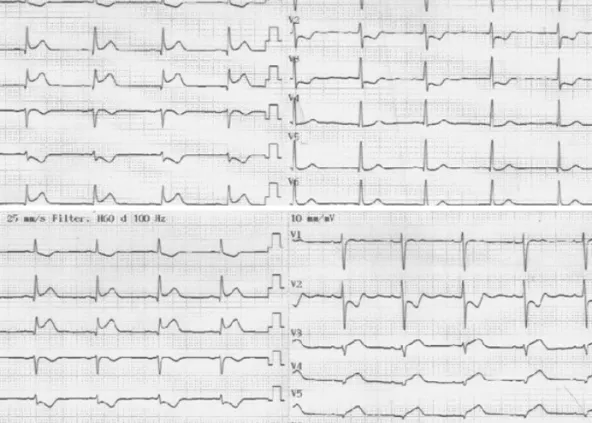
was 46/min with Kussmaul’s sign. An initial electrocardiogram showed definite ST-segment elevation in the inferior leads (II, III, aVF) with reciprocal changes (Fig. 1A), as well as ST-segment elevation in the reverse precordial leads (V3R, V4R, V5R, V6R) (Fig. 1B). Trans- thoracic echocardiography demonstrated akinesia of the right ventricular free wall, inferior wall, and posterior-lateral wall from the left ventricle base to the apex. Also, echocardiography showed 43.6%
of the left ventricular ejection fraction. The initial cardiac enzyme test was elevated (creatine kinase-MB 6.7 ng/mL). Emergency CAG was performed with the assumption of right ventricular myocardial in- farction related to the proximal RCA. The CAG showed total occlu- sion of the distal LCX (Fig. 2) and absence of the RCA ostium, despite repeated attempts at RCA catheterization and ascending aortogra- phy. Therefore, we concluded that the coronary artery related with the right ventricular infarction was the RCA originating from the distal LCX. Immediately after thrombus aspiration with a thrombus aspiration catheter (Thrombuster II®, Kaneka, Osaka, Japan) at the distal LCX, percutaneous coronary intervention (PCI) was followed by balloon angioplasty (Ikazuchi® 3.0×15 mm, Kaneka, Osaka, Japan) and stent insertion (Biomatrix® 4.0×18 mm, Biosensors, Morges, Switzerland) at the distal LCX. After stent insertion, CAG showed no residual stenosis and good distal flow at the distal LCX. Also, CAG showed that the distal LCX extended to the course of the RCA (Fig. 3).
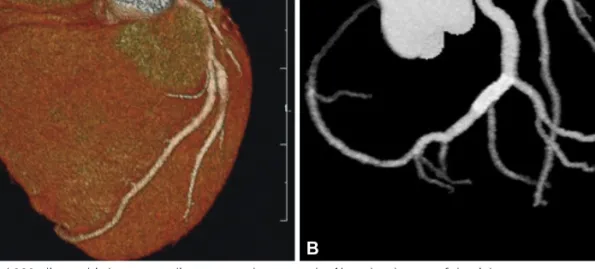
Before discharge, contrast enhanced 320-slice multi-detector car- diac computed tomography showed that the RCA ostium was ab- sent (Fig. 4A), and the distal LCX was extended to the RCA territory while supplying the right ventricle and patent distal LCX stent (Fig. 4B).
After PCI, the patient had no chest pain and was discharged without
any significant complications.