Here, we report the draft genome sequence of Aurantimonas coralicida DM33-3 isolated from Amundsen Sea Polynya. The genome size is 4,620,302 bp, 4,415 coding sequences, one rRNA operon (additionally two 5S ribosomal RNA genes), and 45 tRNA genes. Genes related to manganese oxidation and thiosulfate oxidation are also included in the genome. The genome harbors genes coding for enzymes having varying affinities to oxygen and nitrate reduction. This showed that strain DM33-3 might play the potential role in biogeochemical cycling (manganese, sulfur and nitrogen cycle) in the Amundsen Sea Polynya.
Keywords: Aurantimonas coralicida, Antarctica, Polynya
Manganese is an abundant element in the Earth’s crust and plays a key role in biogeochemical cycles. Some microorganisms are known to be associated with the manganese cycle.
Recently, the first chemolithotrophic manganese oxidizer was isolated, and its genomic properties were reported (Yu and Leadbetter, 2020). Previously, only heterotrophic manganese- oxidizing bacteria were known (Nealson, 2006). One strain,
Aurantimonas manganoxydans SI85-9A1, is a known hetero- trophic Mn(II) oxidizer that produces Mn(III/IV) oxides (Dick et al., 2008). The genus Aurantimonas has been isolated from various environments such as deep-sea sediment (Li et al., 2017), marine (Anderson et al., 2009), cave (Jurado et al., 2006), coral (Denner et al., 2003), root (Liu et al., 2016), and air (Weon et al., 2007). DM33-3 was isolated from a water column of the Amundsen Sea Polynya, Antarctica. For preparation of inoculum, microbial cells from the seawater were collected under vacuum through a sterile membrane filter (pore diameter of 0.2 µm, Adcantec Tokyo) and was incubated in marine broth (Difco) at 15°C. To obtain isolate, the enrichment culture was spread on marine agar 2216 (MA;
Difco). Among the colonies, a bacterial strain was isolated and purified. Its cells were routinely cultured at 25°C on MA and deposited at the Korea Culture Type Collection (KCTC) as KCTC 72499.
DNA was extracted using a DNeasy Blood & Tissue Kit (Qiagen) for genome sequencing. The DNA library was prepared using the TruSeq DNA Nano kit and the genome sequencing was performed using Illumina Hiseq 6000 at Microgen. Automated annotation was performed using the
Korean Journal of Microbiology (2021) Vol. 57, No. 2, pp. 116-118 pISSN 0440-2413
DOI https://doi.org/10.7845/kjm.2021.1024 eISSN 2383-9902
Copyright ⓒ 2021, The Microbiological Society of Korea
Draft genome sequence of Aurantimonas coralicida DM33-3 isolated from Amundsen Sea Polynya
So-Jeong Kim
1* , Jong-Geol Kim
2, Gi-Yong Jung
1, Jisoo Park
3, and Eun-Jin Yang
31
Geologic Environment Research Division, Korea Institute of Geoscience and Mineral Resources, Daejeon 34132, Republic of Korea
2
Division of Biological Sciences and Research Institute for Basic Science, Wonkwang University, Iksan 54538, Republic of Korea
3
Division of Polar Science, Korea Polar Research Institute, Incheon 21990, Republic of Korea
아문젠해 폴리냐로부터 분리된 Aurantimonas coralicida DM33-3의 유전체 분석
김소정
1* ・ 김종걸
2・ 정기용
1・ 박지수
3・ 양은진
31
한국지질자원연구원 지질환경연구본부,
2원광대학교 생명과학부,
3극지연구소 해양연구본부
(Received April 6, 2021; Revised May 12, 2021; Accepted June 1, 2021)
*For correspondence. E-mail: [email protected];
Tel.: +82-42-868-3311; Fax: +82-42-868-3414
Draft genome sequence of Aurantimonas coralicida DM33-3∙
117
Korean Journal of Microbiology, Vol. 57, No. 2 NCBI Prokaryotic Genome Annotation Pipeline. Bacterial
universal primers 27F and 1492R were used to amplify 16S rRNA gene sequence (Lane, 1991). The similarity of 16S rRNA gene was conducted using EzBioCloud (Yoon et al., 2017). 16S rRNA gene analysis revealed that the isolate had 100% similarity with Aurantimonas coralicida DSM14790.
Digital comparisons of genomic sequence of strain DM33-3 and DSM14790, ANI and AAI were analyzed by JSpiecesWS and compareM, respectively. The ANI and AAI values were 97.8% and 96.1%, respectively. Based on the value of species boundaries (Konstantinidis and Tiedje, 2005; Konstantinidis et al., 2006), strain DM33-3 is considered a new strain of Aurantimonas coralicida.
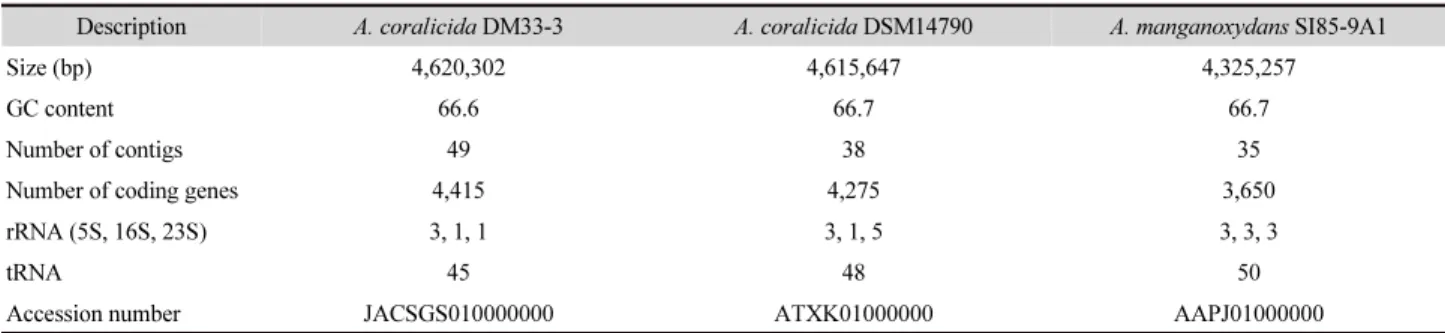
The genomic size of Aurantimonas coralicida DM33-3 is 4,620,302 bp with 49 scaffolds and 66.6% of the G + C content.
The coverage of the genome is 286.0×. Total genes are predicted to be 4,423, with one ribosomal operon (Table 1).
The genome has complete glycolysis and TCA cycle. Similar to Aurantimonas manganoxydans SI85-9A1, the manganese oxidizer, duplicate manganese-oxidizing related gene cluster (H9Q09_15580 - 15610 and H9Q09_20460 - 20480) and RubisCO (H9Q09_17670 - 17675) are found in this genome. However, the function of RubisCO in A. manganoxydans SI85-9A1 is unclear (Caspi et al., 1996). Strain DM33-3 contains the sox gene cluster (SoxGTRSVWXYZABCD; H9Q09_00175 - 00235).
These genes are also found in the genome of DSM14790. This might support the growth of strain DM33-3 with thiosulfate oxidation in the environment.
The genome includes one cytochrome bd-type quinol oxidase (H9Q09_17750 - 17755; high affinity for oxygen), two cbb
3-type cytochrome c oxidases (H9Q09_01970 - 02005 and H9Q09_21295 - 21310; high affinity for oxygen), and three
cytochrome c oxidases (H9Q09_04305 - 04310, H9Q09_12435 - 12455, and H9Q09_21985 - 22005; low affinity for oxygen).
Compared with DSM 14790, the genome of strain DM33-3 had an additional cbb
3-type cytochrome c oxidase. Furthermore, genes related to respiratory nitrate reductase (H9Q09_21845 - 21860) are observed in this genome, which are absent in the genomes of A. manganoxydans SI85-9A1 and A. coralcida DSM14790. This shows that strain DM33-3 might live at various oxygen levels and under anaerobic conditions. The genome also contains heavy metal detoxification systems such as arsenic reductase (H9Q09_03245 - 03260) and mercury reductase (H9Q09_09930 - 09945).
Taken together, strain DM33-3 may adapt various environ- ments by thiosulfate oxidation, a wide range of oxygen respiration, and heavy metal detoxification compared to previous isolates. Thus, this report provides new insights into the ecology of manganese-oxidizing groups from the Amundsen Sea Polynya.
Nucleotide sequence accession number(s)
The genome of Aurantimonas coralicida DM33-3 has been deposited in NCBI under accession number JACSGS0100 00000. Strain DM33-3 is deposited at KCTC as KCTC 72499.
적 요
아문젠해 폴리냐로부터 분리한 Auramtimonas coralicida DM33-3 균주의 유전체 정보를 제공한다. 이 유전체는 4,620,302 bp, 4,415개의 단백질 코딩 유전자, 1개의 rRNA 오페론, 45개의 rRNA를 가진다. 망간과 티오황산염 산화 유전자가 발견되었 다. 또한 다양한 산소 친화도를 가지는 말단산화 효소와 질산염
Table 1. Genomic features of Aurantimonas coralicida DM33-3 and related strains
Description A. coralicida DM33-3 A. coralicida DSM14790 A. manganoxydans SI85-9A1
Size (bp) 4,620,302 4,615,647 4,325,257
GC content 66.6 66.7 66.7
Number of contigs 49 38 35
Number of coding genes 4,415 4,275 3,650
rRNA (5S, 16S, 23S) 3, 1, 1 3, 1, 5 3, 3, 3
tRNA 45 48 50
Accession number JACSGS010000000 ATXK01000000 AAPJ01000000
118
∙ Kim et al.미생물학회지 제57권 제2호
환원 효소를 암호화하는 유전자를 포함하고 있다. 이는 아문젠 해 폴리냐에서 DM33-3 균주가 생지화학적 순환(망간, 황, 질소 순환)에 다양한 잠재적 역할을 할 수 있음을 보여 준다.
Acknowledgments
This work was supported by the Basic Research Project of the Korea Institute of Geoscience and Mineral Resources (21-3412-1) and a grant (PE21110) from the Korea Polar Research Institute.
Conflict of Interest
The authors have no conflicts of interest to report.
References
Anderson CR, Dick GJ, Chu ML, Cho JC, Davis RE, Bräuer SL, and Tebo BM. 2009. Aurantimonas manganoxydans, sp. nov. and Aurantimonas litoralis, sp. nov.: Mn(II) oxidizing representatives of a globally distributed clade of alpha-Proteobacteria from the order Rhizobiales. Geomicrobiol. J. 26, 189–198.
Caspi R, Haygood MG, and Tebo BM. 1996. Unusual ribulose- 1,5-bisphosphate carboxylase/oxygenase genes from a marine manganese-oxidizing bacterium. Microbiology 142, 2549–2559.
Denner EBM, Smith GW, Busse HJ, Schumann P, Narzt T, Polson SW, Lubitz W, and Richardson LL. 2003. Aurantimonas coralicida gen. nov., sp. nov., the causative agent of white plague type II on Caribbean scleractinian corals. Int. J. Syst. Evol. Microbiol. 53, 1115–1122.
Dick GJ, Podell S, Johnson HA, Rivera-Espinoza Y, Bernier-Latmani
R, McCarthy JK, Torpey JW, Clement BG, Gaasterland T, and Tebo BM. 2008. Genomic insights into Mn(II) oxidation by the marine alphaproteobacterium Aurantimonas sp. strain SI85-9A1.
Appl. Environ. Microbiol. 74, 2646–2658.
Jurado V, Gonzalez JM, Laiz L, and Saiz-Jimenez C. 2006. Auranti- monas altamirensis sp. nov., a member of the order Rhizobiales isolated from Altamira Cave. Int. J. Syst. Evol. Microbiol. 56, 2583–2585.
Konstantinidis KT, Ramette A, and Tiedje JM. 2006. The bacterial species definition in the genomic era. Phil. Trans. R. Soc. B 361, 1929–1940.
Konstantinidis KT and Tiedje JM. 2005. Towards a genome-based taxonomy for prokaryotes. J. Bacteriol. 187, 6258–6264.
Lane D. 1991. 16S/23S rRNA sequencing. In Stackebrandt E and Goodfellow M. (eds.), Nucleic Acid Techniques in Bacterial Systematics. pp. 115–175. John Wiley and Sons, New York, USA.
Li AZ, Lin LZ, Zhang MX, and Zhu HH. 2017. Aurantimonas aggregata sp. nov., isolated from deep-sea sediment. Int. J. Syst.
Evol. Microbiol. 67, 5056–5061.
Liu BB, Wang HF, Li QL, Zhou XK, Zhang YG, Xiao M, Li QQ, Zhang W, and Li WJ. 2016. Aurantimonas endophytica sp. nov., a novel endophytic bacterium isolated from roots of Anabasis elatior (C.
A. Mey.) Schischk. Int. J. Syst. Evol. Microbiol. 66, 4112–4117.
Nealson KH. 2006. The manganese-oxidizing bacteria. In Dworkin M, Falkow S, Rosenberg E, Schleifer KH, and Stackebrandt E.
(eds.), The Prokaryotes. vol. 5, pp. 222–231. Springer, New York, USA.
Weon HY, Kim BY, Yoo SH, Joa JH, Lee KH, Zhang YS, Kwon SW, and Koo BS. 2007. Aurantimonas ureilytica sp. nov., isolated from an air sample. Int. J. Syst. Evol. Microbiol. 57, 1717–1720.
Yoon SH, Ha SM, Kwon S, Lim J, Kim Y, Seo H, and Chun J. 2017.
Introducing EzBioCloud: a taxonomically united database of 16S rRNA gene sequences and whole-genome assemblies. Int. J.
Syst. Evol. Microbiol. 67, 1613–1617.
Yu H and Leadbetter JR. 2020. Bacterial chemolithoautotrophy via manganese oxidation. Nature 583, 453–458.