We report the draft genome sequence of a phosphate-solubilizing bacterium, Caballeronia jiangsuensis EK, isolated from the rhizosphere of Phragmites australis (reed). The genome of strain EK comprised 8.87 Mbp with a G + C content of 62.6%, 7,922 protein-coding genes, and 55 tRNAs. Several genes related to phosphate solubilization were found including alkaline phosphatase, C-P lyase, and exopolyphosphatase. Further, genes involved in auxin biosynthesis were identified. These indicates that strain EK possesses potential plant growth-promoting activity.
Keywords: Caballeronia, phosphate-solubilizing bacteria, plant growth stimulation
The genus Caballeronia was first proposed in 2011 (Gyaneshwar et al., 2011) but its name was validated and reclassified from Burkholderia only recently (Dobritsa and Samadpour, 2016).
Over the past few decades, Burkholderia has been considered a pathogenic species. However, most of the potentially bene- ficial plant-associated Burkholderia were moved to the genera Paraburkholderia and Caballeronia during reclassification (Dobritsa and Samadpour, 2016; Dobritsa et al., 2017). Pho- sphorous is an essential factor for plant growth. However, the
most phosphorous in soil exists ion-complex from (calcium, aluminum, or iron), which is unavailable form for plant use (Rodriguez and Fraga, 1999). Phosphate-solubilizing bacteria play a role for releasing phosphorous from inorganic or organic phosphorous (Rodriguez and Fraga, 1999). To obtain plant growth-stimulating bacteria, we tried to isolate a phosphate- solubilizing bacterium from the rhizosphere of a plant.
Strain EK was isolated from the rhizosphere of Phragmites australis (reed) using Pikovskayas agar (Pikovskaya, 1948).
The root of the reed was washed with saline solution, and the washed solution was used as the inoculum. After two weeks of incubation, a clear halo was observed on Pikovskayas agar. A cream white colony with a halo was picked and transferred several times to a new medium for isolation. The cells were routinely cultured at 25°C on an R2A plate.
DNA was extracted using the CTAB method (Hurt et al., 2001). Genomic DNA sequencing was performed at Macrogen on an Illumina Hiseq4000 system. A DNA library was prepared using the TruSeq Nano DNA kit. Raw reads were filtered by FastQC and were assembled using SOAPdenovo. Annotation was performed using the NCBI Prokaryotic Genomes Automatic Annotation Pipeline (PGAP). To predict more protein functions, KEGG, COG, and Pfam domain searches were analyzed as
Korean Journal of Microbiology (2021) Vol. 57, No. 2, pp. 106-108 pISSN 0440-2413
DOI https://doi.org/10.7845/kjm.2021.1011 eISSN 2383-9902
Copyright ⓒ 2021, The Microbiological Society of Korea
Draft genome sequence of Caballeronia jiangsuensis EK, a phosphate- solubilizing bacterium isolated from the rhizosphere of reed
So-Jeong Kim
1, Gi-Yong Jung
1,2, and In-Hyun Nam
1*
1
Geologic Environment Research Division, Korea Institute of Geoscience and Mineral Resources, Daejeon 34132, Republic of Korea
2
Department of Biological Sciences and Biotechnology, Microbiology & Biotechnology, Chungbuk National University, Cheongju 28644, Republic of Korea
갈대 뿌리로부터 분리한 인산가용화 Caballeronia jiangsuensis EK 균주의 유전체 분석
김소정
1・ 정기용
1,2・ 남인현
1*
1
한국지질자원연구원 지질환경연구본부,
2충북대학교 생명시스템학과 미생물학 및 생명공학 전공
(Received February 22, 2021; Revised March 30, 2021; Accepted April 6, 2021)
*For correspondence. E-mail: [email protected];
Tel.: +82-42-868-3164; Fax: +82-42-868-3414
Draft genome sequence of Caballeronia jiangsuensis EK∙
107
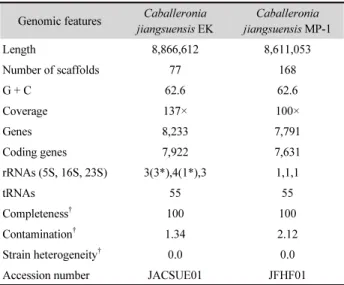
Korean Journal of Microbiology, Vol. 57, No. 2 reported previously (Kim et al., 2019). Average nucleotide identity (ANI) and average amino acid identity (AAI) were analyzed using JSpeciesWS and CompareM, respectively. The genome completeness was analyzed by CheckM (Parks et al., 2015). The genome of strain EK contained 77 scaffolds with 137× coverage. The genome length was 8.87 Mbp with a G + C content of 62.6 (Table 1). The genome comprised 7,922 protein- coding genes, 55 tRNAs, and 10 rRNAs. Among the total protein-coding genes, 6,179 genes (78.0%) were assigned to COG. Genes categorized into COG classification were associated with general function prediction only (R, 10.6%), function unknown (S, 9.7%), transcription (K, 9.7%), and amino acid metabolism and transport (E, 9.1%).
Based on the 16S rRNA gene sequence, the closest related strain of strain EK was Caballeronia jiangsuensis MP-1, a methyl parathion (MP)-degrading bacterium (99.6% similarity)
Table 1. Genomic features of strain EK and Caballeronia jiangsuensis MP-1
Genomic features Caballeronia
jiangsuensis EK Caballeronia jiangsuensis MP-1
Length 8,866,612 8,611,053
Number of scaffolds 77 168
G + C 62.6 62.6
Coverage 137× 100×
Genes 8,233 7,791
Coding genes 7,922 7,631
rRNAs (5S, 16S, 23S) 3(3*),4(1*),3 1,1,1
tRNAs 55 55
Completeness† 100 100
Contamination† 1.34 2.12
Strain heterogeneity† 0.0 0.0
Accession number JACSUE01 JFHF01
* Complete rRNAs.
† Data from CheckM analysis.
Table 2. Genes related to plant growth promotion in the genome of strain EK
Function Locus tag Annotation Gene
Reduction of ACC IAG25_23140 1-aminocyclopropane-1-carboxylate deaminase
Production of IAA IAG25_38455 indole-3-glycerol phosphate synthase TrpC trpC
IAG25_38460 anthranilate phosphoribosyltransferase trpD
IAG25_14870 tryptophan synthase subunit beta trpB
IAG25_14880 tryptophan synthase subunit alpha trpA
IAG25_38465 aminodeoxychorismate/anthranilate synthase component II trpG
IAG25_38470 anthranilate synthase component I trpE
Phosphate solubilization IAG25_13340 alpha-D-ribose 1-methylphosphonate 5-triphosphate diphosphatase phnM
IAG25_13345 phosphonate C-P lyase system protein PhnL phnL
IAG25_13350 phosphonate C-P lyase system protein PhnK phnK
IAG25_13355 alpha-D-ribose 1-methylphosphonate 5-phosphate C-P-lyase PhnJ phnJ
IAG25_13360 carbon-phosphorus lyase complex subunit PhnI phnI
IAG25_13365 phosphonate C-P lyase system protein PhnH phnH
IAG25_13370 phosphonate C-P lyase system protein PhnG phnG
IAG25_13375 phosphonate metabolism transcriptional regulator PhnF phnF
IAG25_16020 exopolyphosphatase ppx
IAG25_16025 polyphosphate kinase 1 ppk1
IAG25_16030 phosphate regulon sensor histidine kinase PhoR phoR
IAG25_16035 phosphate regulon transcriptional regulator PhoB phoB
IAG25_16040 phosphate signaling complex protein PhoU phoU
IAG25_16045 phosphate ABC transporter ATP-binding protein PstB pstB
IAG25_16050 phosphate ABC transporter permease PstA pstA
IAG25_16055 phosphate ABC transporter permease PstC pstC
IAG25_16060 phosphate ABC transporter substrate-binding protein PstS pstS
IAG25_32010 quinoprotein glucose dehydrogenase gcd
IAG25_13290 alkaline phosphatase D phoD
IAG25_14335 alkaline phosphatase D phoD
108
∙ Kim et al.미생물학회지 제57권 제2호
(Liu et al., 2014). The ANI and AAI of the genome of strain EK was 95.3% and 97.5%, respectively, compared with that of C.
jiangsuensis MP-1. This indicated that strain EK was Caballeronia jiangsuensis EK based on the criteria for species definition (Konstantinidis and Tiedje, 2005; Konstantinidis et al., 2006).
The genome of strain EK contained several genes related to phosphate solubilization (Table 2). It encoded alkaline phosphatase D (PhoD; IAG25_13290 and IAG25_14335) and C-P lyase (IAG25_13340~IAG25_13375) for releasing free orthophosphate from organic phosphorus. It also encoded exopolyphosphatase (Ppx; IAG25_16020) and polyphosphate kinase (Ppk; IAG25_16025), which hydrolyze inorganic poly- phosphate. Gluconic acid produced by quinoprotein glucose dehydrogenase (gcd, IAG25_32010) of strain EK might indirectly hydrolyze orthophosphate from inorganic phosphorus. Furthermore, genes related to the production of indole-acetic acid (IAA) and reduction of 1-aminocyclopropane-1-carboxylate (ACC) could also contribute to the plant growth-promoting activity of strain EK. These genomic features indicate that strain EK could be a plant growth-promotiong rhizobacteria (PGPR) candidate.
Nucleotide sequence accession numbers
The strain EK was deposited to the Korean Collection for Type Cultures (KCTC) as 18763P. The genomic DNA infor- mation for strain EK is available at NCBI GenBank under accession JACSUE010000000.
적 요
인산 가용화 능력을 가지는 Caballeronia jiangsuensis EK 균주의 유전체 분석을 실시하였다. 그 결과 EK 균주의 유전체 는 8.87 Mbp, 62.6 G + C값을 가지며, 총 7,922개의 단백질 코 딩 유전자를 포함하고 있었다. Alkaline phosphatase, C-P lyase, exopolyphosphatase 같은 인산 가용화 관련 유전자들을 EK 유 전체 내에서 확인할 수 있었다. 또한, 옥신 생합성과 관련된 유전 자를 포함하고 있었다. 이러한 결과는 Caballeronia jiangsuensis EK가 식물 생장 촉진 잠재능을 가진 미생물임을 보여준다.
Acknowledgments
This study was supported by the Basic Research Project of
the Korea Institute of Geoscience and Mineral Resources (21-3412-1).
Conflict of Interest
We have no conflicts of interest to report.
References
Dobritsa AP, Linardopoulou EV, and Samadpour M. 2017. Transfer of 13 species of the genus Burkholderia to the genus Caballeronia and reclassification of Burkholderia jirisanensis as Paraburkholderia jirisanensis comb. nov. Int. J. Syst. Evol. Microbiol. 67, 3846–
3853.
Dobritsa AP and Samadpour M. 2016. Transfer of eleven species of the genus Burkholderia to the genus Paraburkholderia and proposal of Caballeronia gen. nov. to accommodate twelve species of the genera Burkholderia and Paraburkholderia. Int. J. Syst. Evol.
Microbiol. 66, 2836–2846.
Gyaneshw ar P, Hirsch AM, Moulin L, Chen WM, Elliott GN, Bontemps C, Estrada-de Los Santos P, Gross E, Dos Reis FB, Sprent JI, et al. 2011. Legume-nodulating betaproteobacteria:
diversity, host range, and future prospects. Mol. Plant Microbe Interact. 24, 1276–1288.
Hurt RA, Qiu X, Wu L, Roh Y, Palumbo AV, Tiedje JM, and Zhou J.
2001. Simultaneous recovery of RNA and DNA from soils and sediments. Appl. Environ. Microbiol. 67, 4495–4503.
Kim SJ, Kim JG, Lee SH, Park SJ, Gwak JH, Jung MY, Chung WH, Yang EJ, Park J, Jung J, et al. 2019. Genomic and meta- transcriptomic analyses of carbon remineralization in an Antarctic polynya. Microbiome 7, 29.
Konstantinidis KT, Ramette A, and Tiedje JM. 2006. The bacterial species definition in the genomic era. Philos. Trans. R. Soc.
Lond. B Biol. Sci. 361, 1929–1940.
Konstantinidis KT and Tiedje JM. 2005. Towards a genome-based taxonomy for prokaryotes. J. Bacteriol. 187, 6258–6264.
Liu XY, Li CX, Luo XJ, Lai QL, and Xu JH. 2014. Burkholderia jiangsuensis sp. nov., a methyl parathion degrading bacterium, isolated from methyl parathion contaminated soil. Int. J. Syst.
Evol. Microbiol. 64, 3247–3253.
Parks DH, Imelfort M, Skennerton CT, Hugenholtz P, and Tyson GW.
2015. CheckM: assessing the quality of microbial genomes recovered from isolates, single cells, and metagenomes. Genome Res. 25, 1043–1055.
Pikovskaya RI. 1948. Mobilization of phosphorus in soil in connection with vital activity of some microbial species. Mikrobiologiya 17, 362–370.
Rodríguez H and Fraga R. 1999. Phosphate solubilizing bacteria and their role in plant growth promotion. Biotechnol. Adv. 17, 319–339.