Here, we report the first draft genome sequence of the member of the genus Tianweitania, which was isolated from sediment core in north-east China. The whole-genome sequence was analyzed in this study using Illumina Hiseq platform. The genome comprises 22 contigs with genome size of 4,704,309 bp long. The G + C content was 61.8%. The draft genome contains 4,476 protein-coding genes, 57 pseudogenes and 60 RNA genes including 6 ribosomal RNA genes, 50 transfer RNA (tRNA) genes and 4 non-coding RNA (ncRNA) genes.
Siderophore biosynthesis genes and tryptophan biosynthesis genes were identified. These indicates that Tianweitania sediminis Z8
Tpossesses potential plant growth-promoting activity.
Keywords: Phyllobacterium, Tianweitania sediminis Z8
T, draft genome sequence, indole-acetic acid, siderophore
The family Phyllobacteriaceae belongs to the order Rhizobiales, class Alphaproteobacteria and phylum Proteobacteria and was originally described by Mergaert et al. (2002). Most members of the Phyllobacteriaceae family are recognized for their plant growth promoting effects (Willems et al., 2014) and a few members have reportedly been employed in the degradation of hazardous pollutants and in maintaining the health of cultivated plant species (Mahieu et al., 2011; Maynaud et al.,
2013). Here we report the draft genome of Tianweitania sediminis Z8
Twhich was isolated from a subsurface sediment core by Han et al. (2016). The results of the EzBioCloud server (Kim et al., 2012) comparison 16S rRNA gene sequence revealed that strain Z8
Twas most closely related to Corticibacterium populi 16B10-2-7
T(97.6%) followed by Mesorhizobium carbonis B2.3
T(96.9%), Phyllobacterium bourgognense STM 2 01
T(96.9%) and P. myrsinacearum DSM 5892
T(96.7%). The strain Z8
Twas incubated at 30°C in R2A for 24 h. To facilitate the future research into this bacterium we determined the draft genome sequence of strain Z8
T. Genomic DNA was extracted using the TaKaRa MiniBES
TBacteria Genomic DNA extraction Kit version 3.0 (TaKaRa) as described previously (Chhetri et al., 2020). For genome sequencing, a standard DNA library was prepared using the TruSeq DNA PCR-Free Library Prep Kit (Illumina). Subsequentialy, whole genome sequencing was performed by de novo sequencing analysis using an Illumina Hiseq 4000 sequencer with a paired-end read length of 151 bp and the sequences were assembled using SPAdes Analysis v.3.10.1 by Macrogen. The obtained sequence was annotated using NCBI Prokaryotic Genome Annotation Pipeline (PGAP) (Tatusova et al., 2016) and antiSMASH database version 5.0 (Blin et al., 2019). The whole genome sequences of closely related members were retrieved from NCBI database and a phylogenomic tree was reconstructed based on the concatenation of 92 core genes from close relatives of T. sediminis Z8
Tin the
Korean Journal of Microbiology (2021) Vol. 57, No. 3, pp. 232-234 pISSN 0440-2413
DOI https://doi.org/10.7845/kjm.2021.1036 eISSN 2383-9902
Copyright ⓒ 2021, The Microbiological Society of Korea
Draft genome sequence of Tianweitania sediminis isolated from the subsurface sediment core
Geeta Chhetri, Inhyup Kim, Jiyoun Kim, Minchung Kang, Yoonseop So, and Taegun Seo*
Department of Life Science, Dongguk University-Seoul, Goyang 10326, Republic of Korea
지하 침전물에서 분리한 Tianweitania sediminis에 대한 유전체 서열
채트리 기타 ・ 김인협 ・ 김지연 ・ 강민정 ・ 소윤섭 ・ 서태근*
동국대학교-서울 바이오시스템대학 생명과학과
(Received May 11, 2021; Revised September 14, 2021; Accepted September 17, 2021)
*For correspondence. E-mail: [email protected];
Tel.: +82-31-961-5135; Fax: +82-31-961-5348
Tianweitania sp. Z8
T∙ 233
Korean Journal of Microbiology, Vol. 57, No. 3 family Phyllobacteriaceae (Fig. 1) (Na et al., 2018). The whole
genome sequence of strain Z8
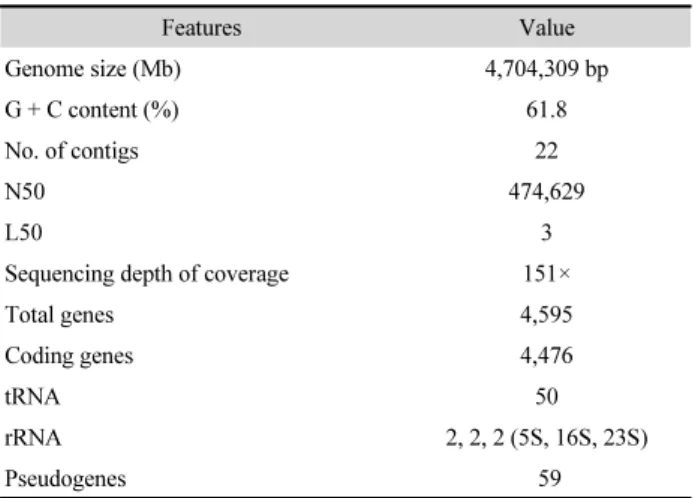
Twas 4.7 Mb long containing 22 contigs with an N50 value of 474,629 bp and the L50 value of 3. Genome coverage of strain Z8
Twas 151.0× and the G + C content of the genome was 61.8%. A total of 4,595 genes, 4,476 coding genes, 6 rRNAs, 50 tRNAs, and 59 pseudogenes were predicted. The genome statistics are described in Table 1. The genome of T. sediminis Z8
Tcontained four gene clusters for siderophore biosynthesis: siderophore ABC transporter substrate- binding protein (J5Y06_RS04340), siderophore-interacting pro- tein (J5Y06_RS19880), TonB-dependent siderophore receptor (J5Y06_RS08475) and iron-siderophore ABC transporter substrate-binding protein (J5Y06_RS08485). Furthermore, genes related to the production of indole-acetic acid (IAA) were also revealed: indole-3-glycerol phosphate synthase (TrpC;
J5Y06_RS20195), tryptophan synthase subunit alpha (TrpA;
J5Y06_RS02255), tryptophan synthase subunit beta (TrpB;
J5Y06_RS02260), tryptophan-tRNA ligase (TrpS; J5Y06_
RS20845), tryptophan-rich sensory protein (J5Y06_RS08720), anthranilate phosphoribosyltransferase (TrpD; J5Y06_RS20200), and anthranilate synthase (J5Y06_RS12080). These genomic features of T. sediminis Z8
Tindicate that, like other members of family Phyllobacteriaceae, it could also be a plant growth- promoting rhizobacteria (PGPR) candidate. Moreover, various sets of genes for flagellar biosynthesis, flagellar motor switch protein, flagellar basal-body and hook-associated proteins were also found. The results of antiSMASH revealed that strain Z8
Tcontains five biosynthetic gene clusters in its genome including redox-cofactor, terpene, NAGGN and T3PKS. NAGGN is a molecule involved in osmotic stress adaptation and may help the T. sediminis Z8
Tin various habitats. To the best of our knowledge, this is the first report on the genome sequence of a Tianweitania species. Therefore, this genomic study will provide considerable insight for functional and comparative genomic study of the species, as well as the genus.
Fig. 1. Phylogenomic tree of strain T. sediminis Z8
Tand closely related strains was constructed based on core genomes using UBCG, genomes of all 17 related strains are available on NCBI GenBank. GenBank accession numbers are shown in parentheses. Bootstrap analysis was carried out using 100 replications.
Percentage bootstrap values (> 50%) are given at branching points. Bar, 0.050 substitutions per position.
234 ∙ Chhetri et al.
미생물학회지 제57권 제3호
Nucleotide sequence accession number
The strain is available at the Japan Collection of Micro- organisms (JCM 30358
T). The draft genome sequence of T.
sediminis Z8
Thas been deposited in DDBJ/ENA/GenBank JAGIYY000000000.
적 요
이 연구에서 중국 북동부 지하 침전물에서 분리된 Tianweitania sediminis Z8
T균주를 Illumina Hiseq 플랫폼을 사용하여 전장
유전체를 분석하여 다음과 같은 결과를 얻었다. Z8
T균주의 염
기서열은 4,704,309 bp로 이루어져 있으며 22개의 contig로 구 성되어 있다. 유전체의 G + C 함량은 61.8%이다. 유전체에는 4,476개의 단백질 암호화 유전자, 57개의 위유전자, 60개의 RNA 유전자가 있다. 60개의 RNA 유전자 중 6개는 rRNA 유 전자, 50개는 tRNA 유전자, 4개는 ncRNA 유전자로 예상할 수 있었다. 그리고 siderophore 생합성 유전자와 트립토판 생합성 유전자가 있음을 확인하였는데, 이 결과로부터 Tianweitania sediminis Z8
T균주가 식물 성장 촉진하는 잠재적 활성을 가질 수 있을 것으로 예상할 수 있다.
Acknowledgments
This work was supported by a grant from the National Institute of Biological Resources (NIBR), funded by the Ministry of Environment (MOE) of the Republic of Korea (NIBR202002203), and by the National Research Foundation
of Korea (NRF) grant funded by the Korea government (MSIT) (2020R1F1A1072647).
Conflict of Interest
The authors have no conflict of interest to report.
References