The strain Weizmannia coagulans BA375, which was isolated from soil of a saltern, produced 1,4-β-xylanase and acetylxylan esterase. The draft genome sequence of the strain W. coagulans BA375 was determined using Illumina MiSeq platform. The genome comprises 82 contigs with genome size of 3,060,890 bp long and GC content of 46.9%. The draft genome contains 2,785 protein-coding genes, 130 pseudogenes and 117 RNA genes including 33 ribosomal RNA genes, 80 transfer RNA (tRNA) genes and 4 non-coding RNA (ncRNA) genes. The strain W. coagulans BA375 has polyprenyl glycosylphospho- transferase gene which is involved in biosynthesis of exopoly- saccharides.
Keywords: Weizmannia coagulans, draft genome sequence, exopolysaccharide, Illumina MiSeq, xylanase
Weizmannia coagulans is the type species of the genus Weizmannia which was recently transferred from the Coagulans clade consisting of three Bacillus species, B. coagulans, B.
acidiproducens, and B. ginsengihumi in the genus Bacillus (Gupta et al., 2020). Weizmannia coagulans is facultatively aerobic, Gram-stain-positive, rod shaped, endospore-forming bacteria, and has been used as probiotics being more stable than Lactobacillus strains in heat treatment. Besides, it was known to produce lactic acid and food enzymes such as α-amylase, α-
galactosidase, β-galactosidase and lipase (Konuray and Erginkaya, 2018). Several strains of W. coagulans have been isolated from canned food, tomato juice, gelatin, milk, pharmaceuticals and silage as well as soil (Gupta et al., 2020). Xylanase is widely used in food and pulp bleaching and several studies have been performed to produce xylanase by W. coagulans (Heck et al., 2005; Chauhan et al., 2006) and exopolysaccharide have found diverse applications in various food and pharmaceutical industries. In this study, we present the draft genome sequence and annotation of the strain W. coagulans BA375.
The strain was isolated by diluting a soil sample in sterile 0.85% (w/v) NaCl solution and plating on tryptic soy agar (TSA; BD) supplemented with 3% (w/v) NaCl and the adjustment of pH to 7.0 using 1 M NaOH. The strain was subsequently purified three times by plating on TSA supplemented with 3%
(w/v) NaCl at 37°C for 2 days and maintained on the same medium.
Genomic DNA of strain BA375 was extracted using Genomic DNA Prep Kit (Biofact) and used to sequence the 16S rRNA gene, according to the previous study (Lee and Yoon, 2008).
The comparison of the 16S rRNA gene sequence showed the highest similarity to Bacillus coagulans ATCC 7050
T(98.9%).
The whole-genome sequencing and analysis of the strain BA375 was performed using the paired-end sequencing method on the MiSeq platform (Illumina) at ChunLab. The estimation of genome completeness and quality was performed
Korean Journal of Microbiology (2021) Vol. 57, No. 2, pp. 119-121 pISSN 0440-2413
DOI https://doi.org/10.7845/kjm.2021.1028 eISSN 2383-9902
Copyright ⓒ 2021, The Microbiological Society of Korea
Draft genome sequence of Weizmannia coagulans BA375 isolated from saltern soil in Korea
Ki-Hong Yoon*
Food Science & Biotechnology Major, Woosong University, Daejeon 34606, Republic of Korea
염전에서 분리한 Weizmannia coagulans BA375 균주의 유전체 분석
윤기홍*
우송대학교 외식조리영양학부 바이오식품과학전공
(Received April 21, 2021; Revised June 1, 2021; Accepted June 1, 2021)
*For correspondence. E-mail: [email protected];
Tel.: +82-42-630-9742; Fax: +82-42-630-9389
120 ∙ Ki-Hong Yoon
미생물학회지 제57권 제2호
by CheckM v1.0.12 (Parks et al., 2015). The resulting short sequencing reads were assembled in contigs using the SPAdes 3.13.0 program (Bankevich et al., 2012). The genome sequence was annotated with the Rapid Annotation of microbial genomes using Subsystems Technology (RAST) (Aziz et al., 2008; Overbeek et al., 2014), and the protein-coding sequences were determined using the NCBI Prokaryotic Genome Annotation Pipeline (PGAP) (Tatusova et al., 2016). The genome sequences of the members of the species W. coagulans which are available in the NCBI database were taken for comparative analysis. The average nucleotide identity (ANI) values between genomes of the strain BA375 and other W. coagulans strains were calculated using the ANI Calculator (www.ezbiocloud.net/
tools/ani) (Yoon et al., 2017a, 2017b). To determine genomic relatedness, digital DDH (dDDH) values were computed using Genome-to-Genome Distance Calculator (GGDC) version 2.1 (Meier-Kolthoff et al., 2013).
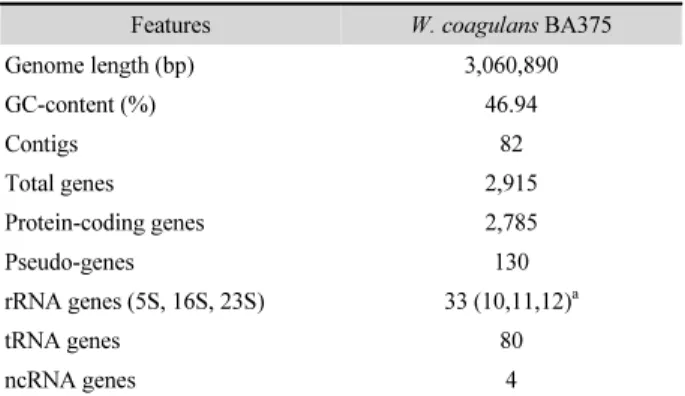
The draft genome of W. coagulans BA375 composed of 82 contigs with a chromosome length of 3,060,890 bp (N
50value 90,601 bp) with 572× sequencing coverage, and 46.9% GC content. The result of CheckM estimation indicated that genome completeness at 100.0% with 0.0% contamination and strain heterogeneity. The NCBI PGAP annotation revealed that the genome contains 2,785 protein-coding genes, 130 pseudogenes and 117 RNA genes including 33 rRNA genes (10 5S ribosomal RNA, 11 16S ribosomal RNA, 12 23S ribosomal RNA), 80 transfer RNA (tRNA) genes and 4 non-coding RNA (ncRNA) genes (Table 1). Two conserved signature indels (CSIs), acetate kinase and O-methyltransferase, that are shared exclusively by the members of the genus Weizmannia (Gupta et al., 2020) were
found in the genome of strain BA375. The average nucleotide identity (ANI) and dDDH value between genomes of strain BA375 and the closest type strain, W. coagulans ATCC 7050
Twas 97.9% and 80.6%, respectively. The PGAP analysis showed that the genome of the strain BA375 contains genes encoding 1,4-β-xylanase (J1C53_RS14485) and acetylxylan esterase (J1C53_RS14455). Moreover, we also found genes involved in the production of exopolysaccharides, polyprenyl glycosylphosphotransferase (J1C53_RS10835). Among genomes of 43 W. coagulans strains, only strain 36D1 had endo-1,4-β- xylanase (BCOA_RS21565), while the genes of acetylxylan esterase and polyprenyl glycosylphosphotransferase were not found in any other genomes except the strain BA375. These findings signify that W. coagulans BA375 has potential for applications in food and feed industries.
Nucleotide sequence and strain accession numbers The 16S rRNA gene sequence and draft genome sequence of Weizmannia coagulans BA375 has been deposited at GenBank under the accession LC140744 and JAFMQA010000000. The strain BA375 has been deposited at Korean Agricultural Culture Collection (KACC 18681) and at NITE Biological Resource Center in Japan (NBRC 112273).
적 요
염전 토양에서 분리한 Weizmannia coagulans BA375는 1,4-β-xylanase 및 acetylxylan esterase를 생산한다. BA375 균 주의 전장유전체는 3,060,890 bp 크기로 82개의 contig로 구성 되어 있으며 GC 함량은 46.9% 이다. 유전체는 2,785개의 단백 질 코딩 유전자로 되어 있으며, 130개의 유사 유전자 및 33개 의 리보솜 RNA 유전자, 80개의 운반 RNA (tRNA) 유전자 및 4개의 비 코딩 RNA 유전자 (ncRNA) 등 117개의 RNA 유전자 를 포함하고 있다. BA375 균주는 균체외 다당체의 생합성에 관여하는 polyprenyl glycosylphosphotransferase를 가지고 있 는 것으로 확인되었다.
Acknowledgments
This research is based on the support of 2020 Woosong University Academic Research Funding.
Table 1. General genomic features of W. coagulans BA375
Features W. coagulans BA375
Genome length (bp) 3,060,890
GC-content (%) 46.94
Contigs 82
Total genes 2,915
Protein-coding genes 2,785
Pseudo-genes 130
rRNA genes (5S, 16S, 23S) 33 (10,11,12)
atRNA genes 80
ncRNA genes 4
a
rRNA genes including 10 (5S) complete rRNAs, and 11, 12 (16S, 23S) partial
rRNAs.
Genome sequence of Weizmannia coagulans BA375 ∙ 121
Korean Journal of Microbiology, Vol. 57, No. 2
Conflict of Interest
The author declares that I have no conflicts of interests.
References