KJTCVS
The Korean Journal of Thoracic and Cardiovascular SurgeryClinical Research Mid-Term Results of Totally Thoracoscopic Ablation in Patients with Recurrent Atrial Fibrillation after Catheter Ablation
Suk Kyung Lim, M.D.
1,*, Joo Yeon Kim, M.D.
1,*, Young Keun On, M.D., Ph.D.
2, Dong Seop Jeong, M.D., Ph.D.
11
Department of Thoracic and Cardiovascular Surgery and
2Division of Cardiology, Department of Medicine, Samsung Medical Center, Sungkyunkwan University School of Medicine, Seoul, Korea
ARTICLE INFO
Received August 8, 2019 Revised December 25, 2019 Accepted April 12, 2020 Corresponding author Dong Seop Jeong Tel 82-2-3410-1278 Fax 82-2-3410-0089 E-mail [email protected] ORCID
https://orcid.org/0000-0002-6947-8403
*
These authors contributed equally to this work.
Background: We investigated the impact of previous catheter ablation (CA) on the mid- term outcomes of totally thoracoscopic ablation in patients with lone atrial fibrillation (AF).
Methods: Between February 2012 and July 2018, 332 patients underwent totally thora- coscopic ablation for the treatment of AF (persistent AF; n=264, 80%). The patients were stratified into CA (n=47, 14%) and non-CA (nCA; n=285, 86%) groups according to their CA history.
Results: All the baseline clinical characteristics and risk factors were similar between the groups except for age, percentage of male patients, prevalence of paroxysmal AF, prior percutaneous coronary intervention, and left atrial volume index (LAVI). No significant in- tergroup differences were observed in the incidence of early and late complications. At late follow-up, normal sinus rhythm was observed in 92% (43 of 47) of the patients in the CA group and 85% (242 of 285) of the patients in the nCA group (p=0.268). The rate of free- dom from AF recurrence at 5 years was 55.3%±11.0% in the CA group, which was similar to that in the nCA group (55.7%±5.1%, p=0.690). In Cox regression analysis, preoperative brain natriuretic peptide levels and LAVI were associated with AF recurrence, but CA his- tory was not significant.
Conclusion: Totally thoracoscopic ablation was safe and effective in treating AF irrespec- tive of CA history. A history of CA did not appear to affect the procedural complexity.
Keywords: Atrial fibrillation, Radiofrequency catheter ablation, Totally thoracoscopic ab- lation
Copyright
© The Korean Society for Thoracic and Cardiovascular Surgery. 2020. All right reserved.
Introduction
Atrial fibrillation (AF), which is the most common car- diac arrhythmia, is associated with significant complica- tions such as heart failure and stroke. The overall incidence rate of AF is 9.9 per 1000 person-years [1]. For patients with AF that is refractory to antiarrhythmic drugs, the Cox maze III operation has been proven to be the most effective procedure, with a high success rate [2]. Radiofrequency catheter ablation (CA) has been a primary choice of treat- ment for AF owing to its safety and low invasiveness. How- ever, a major concern is the high AF recurrence rate, which has been reported to be up to 43% within 12 months after CA [3-5]. Recurrent symptomatic AF or atrial tachycardia after a CA procedure necessitates repeated ablation in 20%–40% of patients [6]. With repeated procedures, com-
plications may occur in up to 6% of cases [7]. The most common finding in cases of repeated CA is high pulmo- nary vein reconnection through the previously targeted pulmonary veins, reflecting the undesirable capability of CA to achieve transmurality [8]. In addition, repeated ab- lation could result in a scar burden in the atrial tissue, which can be problematic and even promote the formation of a proarrhythmic substrate in the atria, which subse- quently leads to new non‐pulmonary vein triggers or atyp- ical atrial flutter in the future [9]. Totally thoracoscopic ab- lation (TTA) may be a good choice of treatment owing to its high capability of achieving transmurality in patients with refractory AF. According to recent reports, this tech- nique eliminates AF in 80% to 91% of patients [10]. The number of patients referred for TTA is increasing because of its advantages after failed CA; however, the efficacy of
https://doi.org/10.5090/kjtcs.19.059 pISSN: 2233-601X eISSN: 2093-6516
Korean J Thorac Cardiovasc Surg. 2020;53(5):270-276
Suk Kyung Lim, et al. Mid-Term Results of Totally Thoracoscopic Ablation in Patients with Recurrent Atrial Fibrillation KJTCVS
TTA in these patients remains unknown. Herein, we inves- tigated the impact of previous CA on the outcomes of TTA.
Methods
Study population
We applied the definitions of terms used in the 2012 Heart Rhythm Society/European Heart Rhythm Associa- tion/European Cardiac Arrhythmia Society consensus document for catheter and surgical ablation of AF. Patients with paroxysmal, persistent, or long-standing persistent AF refractory to at least 1 antiarrhythmic drug or direct current cardioversion were eligible candidates for TTA.
The indications for TTA also included patient preference for surgery, a history of stroke, or a relative contraindica- tion to warfarin therapy. TTA was contraindicated in pa- tients with left atrial thrombi or intolerance to one-lung ventilation. Transthoracic echocardiography, pulmonary function testing, and chest computed tomography were performed in all patients preoperatively.
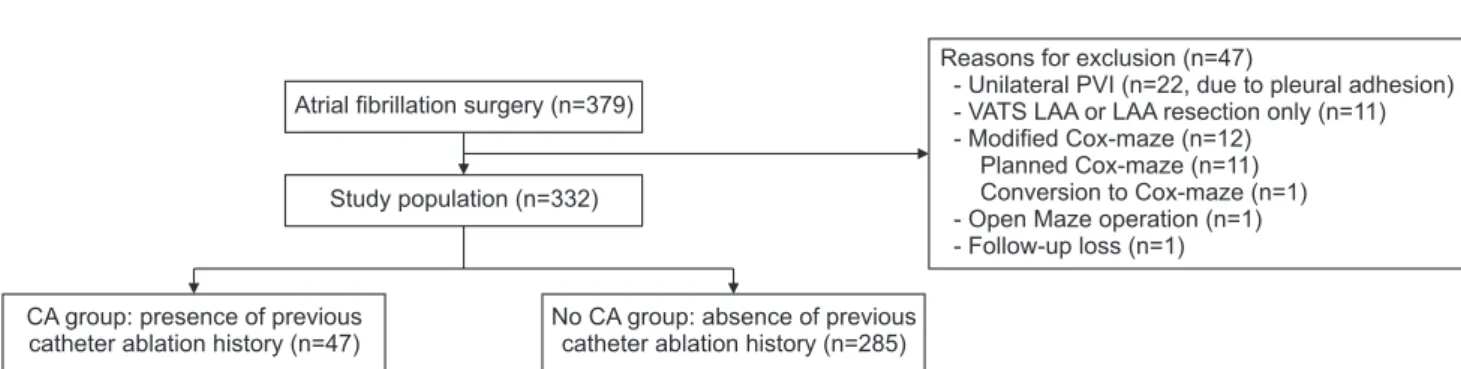
Between February 2012 and July 2018, 379 patients un- derwent surgery solely for arrhythmia at Samsung Medical Center. Forty-seven patients who had a Cox maze opera- tion or incomplete pulmonary vein isolations were exclud- ed from the study (Fig. 1). Consequently, 332 patients who underwent TTA for the treatment of AF were retrospec- tively evaluated. The patients were grouped according to the presence (CA group; n=47, 14%) or absence (nCA group; n=285, 86%) of a CA history. We compared the rhythm outcomes and complications between the 2 groups.
The study was approved by the Institutional Review Board of Samsung Medical Center (IRB approval no., SMC 2019- 12-011-001). Informed consent was obtained from all indi- vidual participants included in the study.
Operative technique
After general anesthesia induction and double-lumen endotracheal intubation, selective ventilation of the contra- lateral lung was performed. TTA is a video-assisted thora- coscopic surgical technique without the aid of the Da Vinci system and cardiopulmonary bypass. A bilateral approach is required, and the right-side procedure is performed first with a 12-mm port inserted in the fourth intercostal space at the anterior axillary line. Two additional ports are placed, a 5-mm port in the third intercostal space at the anterior axillary line and a 5-mm port in the sixth inter- costal space at the midaxillary line, after carbon dioxide insufflation to expand the operative field and depress the diaphragm. The pericardium is opened, and pericardial tenting is performed. A rubber band is then fixed to an AtriCure Isolator Transpolar Clamp (AtriCure Inc., Ma- son, OH, USA), and the bipolar clamp is opened and se- cured around the antrum of the right pulmonary veins to perform bipolar radiofrequency ablation for at least 6 over- lapping lesions. On the left side, a 12-mm port is inserted in the fourth intercostal space at the midaxillary line. Like on the right side, a 5-mm port is inserted in the third in- tercostal space at the anterior axillary line and a 5-mm port is inserted in the sixth intercostal space at the midax- illary line. The left atrial roof and floor lesions connecting both pulmonary veins are created with a linear pen device (AtriCure Inc.). Next, the ganglionated plexuses are ablated because they are composed of autonomic fibers and can initiate AF when excess activity at these sites occurs [11].
An AtriCure Cooltip pen (AtriCure Inc.) is used to con- firm the placement of the ablation lines, and a pacing test is subsequently conducted. The ligament of Marshall (LOM), which might be a source of adrenergic atrial tachy- cardia, is also divided. The left atrial appendage (LAA) is either removed by stapling with an endoscopic stapling de-
Atrial fibrillation surgery (n=379)
Reasons for exclusion (n=47)
- Unilateral PVI (n=22, due to pleural adhesion) - VATS LAA or LAA resection only (n=11) - Modified Cox-maze (n=12)
Planned Cox-maze (n=11) Conversion to Cox-maze (n=1) - Open Maze operation (n=1) - Follow-up loss (n=1)
No CA group: absence of previous catheter ablation history (n=285) CA group: presence of previous
catheter ablation history (n=47)
Study population (n=332)
Fig. 1. Flow diagram of patient selection. PVI, pulmonary vein isolation; VATS, video-assisted thoracoscopic surgery; LAA, left atrial
appendage; CA, catheter ablation.
KJTCVS https://doi.org/10.5090/kjtcs.19.059
vice (Endo GIA; Tyco Healthcare Group, North Haven, CT, USA) or clipped (AtriClip; AtriCure Inc.). The sequence of the procedures has been discussed in more detail in a pre- viously published article [10].
Electrophysiological study
In our early practice, we performed an endocardial pro- cedure 3 months after surgery on the basis of the finding that during this window period, even with bidirectional block confirmation, several patients showed late cavo-tri- cuspid-isthmus (CTI)-dependent atrial flutter [10]. Howev- er, we currently perform a staged hybrid procedure only in patients with recurrent atrial tachyarrhythmia refractory to thoracoscopic epicardial ablation.
Pulmonary vein potentials were assessed using Lasso catheters (Biosense Webster) with a diameter of 15–25 mm.
The intra-atrial, atrio-His, and His-ventricular conduction intervals were measured. CTI ablation was performed in patients with long-standing AF or in those who had epi- sodes of atrial flutter after TTA.
Postoperative care and follow-up
The patients were monitored in the intensive care unit for the first 24 hours. Postoperatively, heparin was admin- istered, and conversion to either warfarin or edoxaban was performed on postoperative day 1. Oral amiodarone was prescribed if the heart rate was >80 beats/min at rest. All the patients were followed up at 3, 6, and 12 months, and annually thereafter with 24-hour Holter monitoring and echocardiography to evaluate rhythm and atrial activity.
Electric or chemical cardioversion was performed in pa- tients with AF, atrial flutter, or atrial tachycardia within the 3-month blanking period during follow-up. All antiar- rhythmic drugs were discontinued once patients recovered sinus rhythm at 3 months or up to 6 months.
Statistical analysis
The independent t-test was used to compare continuous variables, which are presented as medians and interquartile ranges, between the 2 groups. The chi-square test was used to compare categorical data, which are presented as pro- portions. Freedom from AF recurrence at 5 years was ana- lyzed using curves derived from a Kaplan-Meier analysis.
A p-value of <0.05 was considered to indicate statistical significance. Cox regression analysis was performed to identify predictors of AF recurrence after TTA. The vari-
ables that were included in the univariate analysis were age, body mass index, hypertension, congestive heart fail- ure, AF duration, preoperative brain natriuretic peptide, left atrial volume index, left ventricular ejection fraction, and history of CA. Variables with p-values of <0.20 in the univariate analysis were entered into the multivariate anal- ysis.
Results
Baseline characteristics of the patients
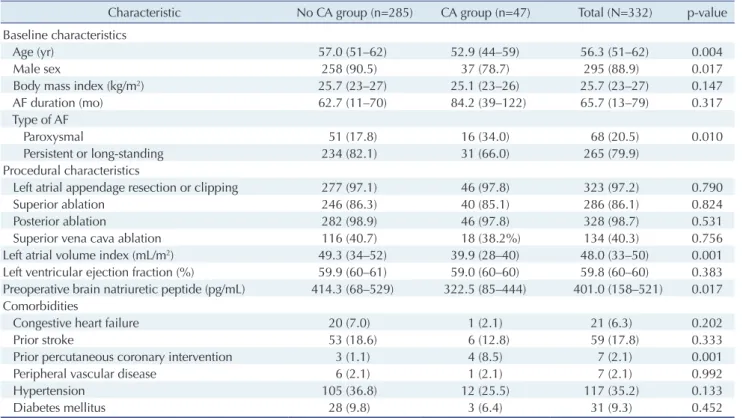
The baseline characteristics of the patients are shown in Table 1. The median age of all the patients was 56 years, and the patients in the nCA group were older than those in the CA group. The proportion of male patients was higher in the nCA group than in the CA group. The patients in the CA group had significantly smaller left atrial volume index (49 versus 39 mL/m
2, p=0.001) and were more likely to have paroxysmal AF than those in the nCA group (34.0% versus 18.2%, p=0.01). In addition, the patients in the nCA group had higher preoperative BNP levels (414.3 versus 322.5 pg/mL, p=0.017). Concerning comorbidities, more patients had a history of prior percutaneous coronary intervention in the CA group (8% versus 1%, p=0.001). The other baseline characteristics and risk factors were similar between the groups. In the CA group, 29 (62%), 14 (29%), and 4 (9%) patients had a history of 1, 2, and 3 previous CAs, respectively. All the patients underwent isolation of both pulmonary veins. LAA resection or clipping was per- formed in 323 patients (97%). Additionally, 134 patients (40%) underwent ablation of a circular lesion made in the superior vena cava with a bipolar clamp, when the right atrium was significantly enlarged in the thoracoscopic view. The proportions of the surgical techniques used were similar between the groups (Table 1). Thirty-two patients, of whom only 1 was from the CA group, underwent post- procedural electrophysiological confirmation after TTA.
Postoperative complications
Postoperative adverse outcomes are listed in Table 2. No mortality was reported during hospitalization or follow-up.
Regarding thromboembolism, only 3 cases of stroke oc- curred in the nCA group. Pulmonary complications, in- cluding prolonged pleural effusion and mild pneumonia, occurred in 12 patients in the nCA group and in 1 patient in the CA group (p=0.495).
One patient experienced subconjunctival hemorrhage.
Suk Kyung Lim, et al. Mid-Term Results of Totally Thoracoscopic Ablation in Patients with Recurrent Atrial Fibrillation KJTCVS
However, the symptom resolved spontaneously without any treatment. Minor chest tube bleeding that required no intervention occurred in 4 cases. Chest tube drainage was needed for pleural hematoma that developed 2 days after removal of the original chest tube in 1 case. Two cases needed bleeding control operation for the left hemothorax on postoperative day 1 for a sustained large amount of chest tube bleeding. In one of the cases, we could not find the specific bleeding focus solely on the basis of the diffuse oozing. The bleeding focus in the other case was from the arterial bleeding of the apex side of the left pleural space, where we initially performed adhesiolysis for pleural adhe-
sion. Neither patient showed any postoperative complica- tions.
Rhythm outcomes
The median follow-up duration was 24.3 months, and all the patients were followed up with 24-hour Holter moni- toring. The median follow-up duration was 22.8 months in the CA group and 24.8 months in the nCA group. At the latest follow-up, normal sinus rhythm was observed in 92%
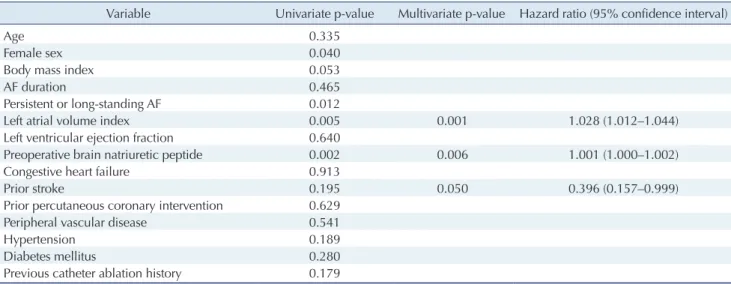
(43 of 47) of the patients in the CA group and in 85% (242 of 285) of the patients in the nCA group (p=0.268). Of the 285 patients, 75 (27%) and 210 (73%) attained sinus rhythm with and without taking antiarrhythmic drugs, respective- ly. The rate of freedom from AF recurrence at 5 years was 55.3%±11.0% in the CA group, which was similar to that in the nCA group (55.7%±5.1%, p=0.690) (Fig. 2). In the Cox regression analysis, preoperative brain natriuretic peptide levels (hazard ratio, 1.001; p=0.006) and the left atrial vol- ume index (hazard ratio, 1.028; p=0.001) were associated with AF recurrence after TTA (Table 3).
Table 1. Baseline and procedural characteristics
Characteristic No CA group (n=285) CA group (n=47) Total (N=332) p-value
Baseline characteristics
Age (yr) 57.0 (51–62) 52.9 (44–59) 56.3 (51–62) 0.004
Male sex 258 (90.5) 37 (78.7) 295 (88.9) 0.017
Body mass index (kg/m
2) 25.7 (23–27) 25.1 (23–26) 25.7 (23–27) 0.147
AF duration (mo) 62.7 (11–70) 84.2 (39–122) 65.7 (13–79) 0.317
Type of AF
Paroxysmal 51 (17.8) 16 (34.0) 68 (20.5) 0.010
Persistent or long-standing 234 (82.1) 31 (66.0) 265 (79.9)
Procedural characteristics
Left atrial appendage resection or clipping 277 (97.1) 46 (97.8) 323 (97.2) 0.790
Superior ablation 246 (86.3) 40 (85.1) 286 (86.1) 0.824
Posterior ablation 282 (98.9) 46 (97.8) 328 (98.7) 0.531
Superior vena cava ablation 116 (40.7) 18 (38.2%) 134 (40.3) 0.756
Left atrial volume index (mL/m
2) 49.3 (34–52) 39.9 (28–40) 48.0 (33–50) 0.001
Left ventricular ejection fraction (%) 59.9 (60–61) 59.0 (60–60) 59.8 (60–60) 0.383
Preoperative brain natriuretic peptide (pg/mL) 414.3 (68–529) 322.5 (85–444) 401.0 (158–521) 0.017 Comorbidities
Congestive heart failure 20 (7.0) 1 (2.1) 21 (6.3) 0.202
Prior stroke 53 (18.6) 6 (12.8) 59 (17.8) 0.333
Prior percutaneous coronary intervention 3 (1.1) 4 (8.5) 7 (2.1) 0.001
Peripheral vascular disease 6 (2.1) 1 (2.1) 7 (2.1) 0.992
Hypertension 105 (36.8) 12 (25.5) 117 (35.2) 0.133
Diabetes mellitus 28 (9.8) 3 (6.4) 31 (9.3) 0.452
Values are presented as median (interquartile range) or number (%).
CA, catheter ablation; AF, atrial fibrillation.
Table 2. Major complications
Variable No CA group
(n=285)
CA group
(n=47) p-value
Stroke 3 (1.0) 0 0.480
Postoperative bleeding 6 (2.1) 2 (4.2) 0.373
Pacemaker insertion 4 (1.4) 0 0.414
Prolonged pleural effusion 12 (4.2) 1 (2.1) 0.495 Sinus node dysfunction 8 (2.8) 2 (4.2) 0.590 Values are presented as number (%).
CA, catheter ablation.
KJTCVS https://doi.org/10.5090/kjtcs.19.059
Discussion
In this study, we compared the outcomes of patients who underwent TTA with and without a history of CA. No pre- vious study in the current literature has investigated the effect of CA on TTA. The mechanisms of AF are known to be complex and are not fully understood despite extensive research. The pulmonary veins are considered the most important treatment target, as they function as triggers for the development of AF. However, the sources of recurrent AF, especially permanent AF, are often difficult to identify.
In patients with refractory AF, re-entrant activities induced
by atrial remodeling are another possible causative factor [12]. In a previously published study, AF recurrence after PVI was predicted on the basis of the extent of fibrosis, and atrial fibrosis was present in all the cases [13]. Fibrosis identified on cardiac magnetic resonance imaging was proven to be an independent factor associated with AF re- currence after CA [13]. Furthermore, a left atrial scar bur- den after multiple extensive CA was reported [14]. There- fore, we anticipated that the patients in the CA group would be in a more advanced atrial remodeling state with repeated CA, which might lead to a lower chance of nor- mal sinus rhythm recovery than those in the nCA group.
Surgical complexity was sometimes observed in patients with a CA history, including pericardium adhesion due to hemopericardium, left atrial contractions, and dimpling.
Infrequently, some patients had left atrial stenosis or occlu- sion after repeated radiofrequency CA, which increased the operative time, but did not affect the surgical out- comes. Our data also showed that the 2 groups had no sig- nificant differences in AF recurrence.
The 2016 European Society of Cardiology/European As- sociation for Cardiothoracic Surgery guidelines for AF in- dicate TTA as a class 2A recommendation for the treat- ment of symptomatic and drug-refractory AF. This recommendation is based on the FAST trial, which showed that surgical ablation is better than CA for patients with an enlarged left atrium and hypertension, or in whom prior CA has failed [15]. Recent studies have reported additional long-term outcomes of CA and surgical ablation. Castella et al. [16] reported that surgical ablation was associated with higher rates of sinus rhythm maintenance and lower
Table 3. Predictors of recurrent AF
Variable Univariate p-value Multivariate p-value Hazard ratio (95% confidence interval)
Age 0.335
Female sex 0.040
Body mass index 0.053
AF duration 0.465
Persistent or long-standing AF 0.012
Left atrial volume index 0.005 0.001 1.028 (1.012–1.044)
Left ventricular ejection fraction 0.640
Preoperative brain natriuretic peptide 0.002 0.006 1.001 (1.000–1.002)
Congestive heart failure 0.913
Prior stroke 0.195 0.050 0.396 (0.157–0.999)
Prior percutaneous coronary intervention 0.629
Peripheral vascular disease 0.541
Hypertension 0.189
Diabetes mellitus 0.280
Previous catheter ablation history 0.179
100.0
80.0
60.0
40.0
20.0
0
Freedom from AF a t 5 year (%)
Follow-up (mo) No. at risk
285 47
209 33
149 27
105 15
81 7
45 5
28 4
p=0.690Previous catheter ablation( )
Previous catheter ablation(+)
10.00 20.00 30.00 40.00 50.00 60.00
55.7%+5.1%55.3%+11.0%