ABSTRACT
The cryoballoon was invented to achieve circumferential pulmonary vein isolation more efficiently to compliment the shortcomings of point-by-point ablation by radiofrequency ablation (RFA). Its efficacy and safety were shown to be comparable to those of RFA, and the clinical outcomes have improved with the second-generation cryoballoon. The basic biophysics, implemental techniques, procedural recommendations, clinical outcomes, and complications of the cryoballoon are presented in this practical and systematic review.
Keywords: Atrial fibrillation; Catheter ablation; Cryosurgery
INTRODUCTION
For the treatment of symptomatic paroxysmal atrial fibrillation (PAF), catheter ablation is considered the first treatment strategy,
1)and pulmonary vein isolation (PVI) is an essential and standard approach for both paroxysmal and persistent atrial fibrillation (AF).
2)3)Radiofrequency catheter ablation (RFCA) has been a mainstay in arrhythmia treatment including PVI for AF. Cryoablation for arrhythmias has been used for cardiac surgery for decades,
4)and transvenous catheter cryoablation for arrhythmias has been used since the 2000s.
Cryoablation gained distinguished attention when it was used for AF therapy. The
introduction of cryoballoon ablation (CBA) to isolate pulmonary veins (PVs) was considered breakthrough technology because of its single energy application for encircling lesions at the antral level of PVs, whereas conventional RFCA was characterized by point-by-point multiple energy applications for isolating PVs. The FIRE AND ICE trial has shown that the cryoballoon is not inferior to irrigated-tip radiofrequency ablation (RFA) in terms of efficacy and safety,
5)and that CBA is becoming one of the most widely used ablation technologies in the field of AF treatment.
In this article, the basic biophysics of the cryoballoon, tissue changes due to cryothermal energy and practical applications are described. To determine the current efficacy and safety of CBA, a systematic review was performed by reviewing 12 studies comparing the second- generation cryoballoon (CB-2) and RFA.
Review Article
Received: Oct 10, 2017 Accepted: Nov 30, 2017 Correspondence to Paul J. Wang, MD
Stanford University, 300 Pasteur Drive, Stanford, CA 94305, USA.
E-mail: [email protected] Copyright © 2018. The Korean Society of Cardiology
This is an Open Access article distributed under the terms of the Creative Commons Attribution Non-Commercial License (https://
creativecommons.org/licenses/by-nc/4.0) which permits unrestricted noncommercial use, distribution, and reproduction in any medium, provided the original work is properly cited.
ORCID iDs Eun-Sun Jin
https://orcid.org/0000-0003-1182-8244 Paul J. Wang
https://orcid.org/0000-0002-5467-5877 Conflict of Interest
The authors have no financial conflicts of interest.
Author Contributions
Conceptualization: Jin ES, Wang PJ; Data curation: Jin ES; Formal analysis: Jin ES;
Investigation: Jin ES; Methodology: Jin ES;
Project administration: Jin ES; Software: Jin ES; Supervision: Wang PJ; Validation: Wang PJ;
Visualization: Jin ES; Writing - original draft: Jin ES; Writing - review & editing: Wagn PJ.
Eun-Sun Jin , MD, PhD
1, and Paul J. Wang MD, FHRS
21
Cardiovascular Center, Kyung Hee University Hospital at Gangdong, Kyung Hee University, Seoul, Korea
2
Division of Cardiovascular Medicine, Stanford University School of Medicine, Stanford, CA, USA
Cryoballoon Ablation for Atrial
Fibrillation: a Comprehensive Review
and Practice Guide
BASIC BIOPHYSICS OF THE CRYOBALLOON
Tissue changes due to cryothermal energy were characterized by intracellular and
extracellular ice crystal formation, osmotic cellular damage, microvascular injury resulting in hemorrhage, and inflammation, ischemia, fibrosis, and apoptosis of the surrounding tissue.
In contrast to RFA lesions, cryoablation lesions are characterized by the preservation of the tissue architecture, including fibrocytes and collagen with significantly fewer large vascular structures or endocardium.
6)Based on this biophysical characteristic of preserving the tissue architecture, cryoablation was preferred to reduce the risk of causing destruction to the normal structure during specific arrhythmias such as atrioventricular nodal reentrant tachycardia or tachycardia originating near the His bundle region. These characteristics explain the lower risk of cardiac perforation or thrombogenicity compared to RFA.
7)Cryothermal energy is produced during refrigerant injected through a fine tube. The refrigerant vaporizes at the tip of a cryoablation catheter and can freeze the adjacent tissue.
While freezing, the catheter tip adheres to the affected tissue, which enables the application of stable energy. The cryoballoon has the same overall structural mechanism of cryoenergy production, except the tip is composed of balloons.
The first-generation Arctic Front™ cryoballoon system (Medtronic, Minneapolis, MN, USA) has been commercially available since 2010. The cryoballoon contains inner and outer balloons, a central lumen for a guide wire and contrast, a thermocouple for inner balloon temperature monitoring, and lumens for the cryorefrigerant (an intake lumen and an exhaust lumen). Pressurized cryorefrigerant (nitrous oxide [N
2O]) is delivered to the distal aspect of the inner balloon to allow the temperature to decrease to a maximum of −80°C. Heat is absorbed from the surrounding tissue. Then, the cryorefrigerant is returned to the console through a lumen under a vacuum.
8)The first-generation cryoballoon (CB-1) has an equatorial cooling region that could cause ineffective encircling of PVs (Figure 1). To compensate for this disadvantage, the CB-2, the Arctic Front Advance™ (Medtronic), was developed. It has similar basic structures but features a modified refrigerant injection system that renders more homogeneous cooling of the complete distal hemisphere, including the distal tip.
9)With this development, the 1-year success rate was improved and complication rates decreased from those of CB-1.
10)11)A B
Figure 1. Compared to the first-generation cryoballoon (A), the second-generation cryoballoon has homogeneous
cooling system in distal hemisphere (B) (Courtesy; Medtronic, Minneapolis, MN, USA).
There are 2 size options for the cryoballoon, 23 and 28 mm. The 28-mm cryoballoon is preferable because it avoids common complications that can occur when the balloon is deeply seated in PVs. The size can be chosen according to the anatomical characteristics of PVs.
ABLATION PROCEDURES
A single interatrial septal puncture is enough for CBA because the spiral Achieve™
(Medtronic) catheter for the PV electrogram recording is inserted through the central guide wire lumen of the cryoballoon. An Achieve™ mapping catheter is installed before the cryoballoon is inserted in the patient's body.
The septal puncture technique is the same as that for RFA using a standard transseptal sheath, but a low anterior septal puncture is recommended to allow more space for the cryoballoon to move and provide better support to the PVs, especially the right inferior PV.
Intracardiac echocardiography (ICE) is strongly recommended during septal puncture to ensure safety.
The inserted standard transseptal sheath is replaced by a steerable transseptal sheath (FlexCathAdvance™; Medtronic) with a 12-Fr inner diameter and 15-Fr outer diameter over a long stiff guidewire. This steerable sheath is stiffer than usual transseptal sheaths and is designed to steer and support the cryoballoon throughout the procedure. A cryoballoon and an Achieve™ mapping catheter can be inserted through the sheath. While the cryoballoon is being moved inside the left atrium, the Achieve™ catheter should lead the cryoballoon outside the sheath because the distal tips of both the cryoballoon and sheath are stiff to avoid cardiac damage.
When the cryoballoon is located near a PV, the next most important task is complete PV occlusion with the distal hemisphere of the cryoballoon. A cryoballoon should be inflated outside the PV and advanced to the PV antrum to be fitted. Because of low pressure, the inflated cryoballoon rarely causes cardiac damage, but it is better to avoid inflating the balloon inside the PV. With 1–2 mL of contrast injection, PV angiography should be performed to assess the complete sealing of the PV by the balloon. If the contrast leakage is seen, then the balloon can be repositioned. When the balloon fits the PV without any contrast leakage, instead of ablation, the balloon can be withdrawn slightly to see some leakage. This technique will show whether the balloon is at the appropriate antral position. Sometimes, the balloon could be inside the PV, which causes more complications to surrounding structures such as phrenic nerves (phrenic nerve injury [PNI]).
After the balloon is positioned appropriately, the Achieve™ mapping catheter could be adjusted to obtain the best possible PV recordings. Electrical isolation of the PVs is detectable, and the time required to achieve electrical PV isolation could be used as an indicator of long-term success of PV isolation.
When cryoenergy is applied, compliance of the balloon can be changed and the cooled
cryoballoon adheres to the surrounding tissue. Therefore, to avoid cardiac damage, the
cryoballoon should not be moved while cryoenergy is being applied. The 180-second initial
ablation with a CB-2 is recommended by experts, but the optimal duration of cryoenergy
application has not been determined.
To prevent complications, esophageal temperature and diaphragmatic motion during phrenic nerve stimulation should be monitored.
EFFICACY AND SAFETY: A SYSTEMATIC REVIEW
Since CB-1 and the more developed CB-2 were released in 2010 and 2012, respectively, many studies showed comparable efficacy of CBA to that of RFA, until now. The FIRE AND ICE trial results were released in 2016. It was a large, randomized, controlled study including both CB-1 and CB-2 that provided important information indicating that CBA is not inferior to RFA with respect to efficacy and overall safety.
5)Because the cryoballoon has been improved from the CB-1 to the CB-2,
12)13)and because RFA has been improved from a simple irrigated-tip catheter to a force-sensing catheter,
14)it is reasonable to compare the efficacy and safety of CB-2 and the contact-force RFA catheter, even though there are only a few studies regarding this.
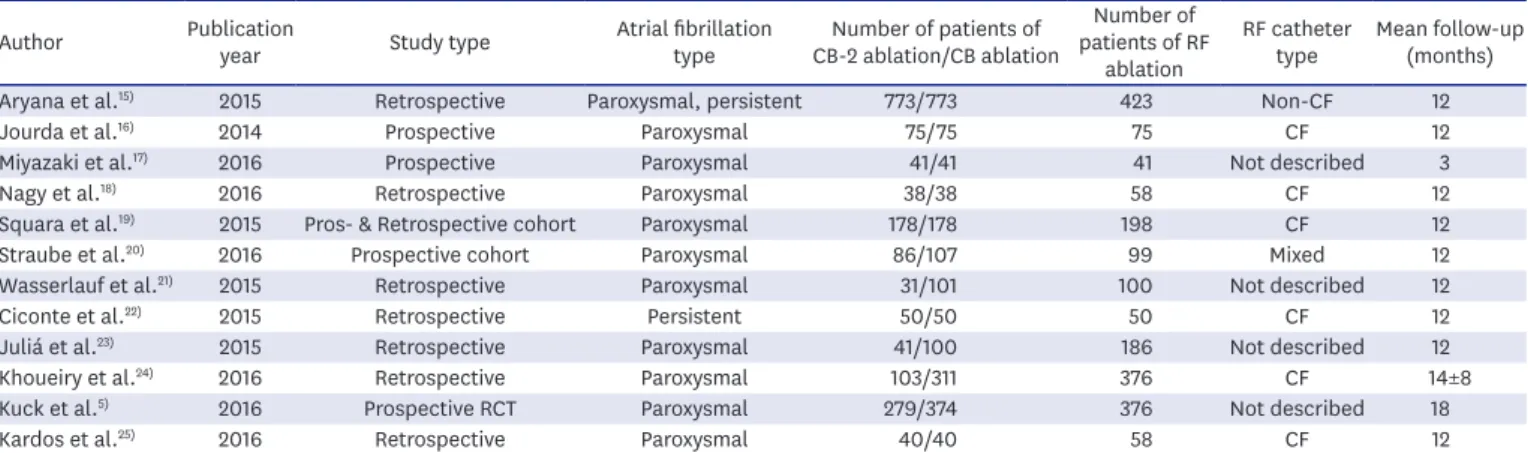
We systematically reviewed studies comparing the CB-2 and/or the CB-1 with RFA for AF ablation. We searched the studies comparing CBA with RFA in PubMed, EBSCO, Web of Science, and the Cochrane Library, and we excluded studies using the CB-1 alone or mostly CB-1 for the CBA group. We included studies in the analysis only when recurrence of atrial tachyarrhythmia (ATA) was evaluated during follow-up. A total of 12 studies involving 4,228 non-overlapped patients were included.
5)15-25)Of the 12 studies, 7 included only CB-2 for the cryoablation group and 5 included CB-2 for a median of 41% of patients (range, 30.7–80.4%). Six studies used only the force-sensing RFA catheter, and the other studies had no particular description of which type of RFA catheter was used (Table 1). Three hundred eighty-three of 4,228 patients (9%) had persistent AF.
Acute procedural success
Electrical PVI was investigated using the index procedure in 8 studies. The acute procedural success rate ranged from 98.4% to 100% in the CB-2 group and from 97.4% to 100% in the RFA group; the median success rate was 99% in both groups. There was no significant difference between the 2 groups.
Table 1. Baseline characteristics of included studies Author Publication
year Study type Atrial fibrillation
type Number of patients of CB-2 ablation/CB ablation
Number of patients of RF
ablation
RF catheter
type Mean follow-up (months)
Aryana et al.
15)2015 Retrospective Paroxysmal, persistent 773/773 423 Non-CF 12
Jourda et al.
16)2014 Prospective Paroxysmal 75/75 75 CF 12
Miyazaki et al.
17)2016 Prospective Paroxysmal 41/41 41 Not described 3
Nagy et al.
18)2016 Retrospective Paroxysmal 38/38 58 CF 12
Squara et al.
19)2015 Pros- & Retrospective cohort Paroxysmal 178/178 198 CF 12
Straube et al.
20)2016 Prospective cohort Paroxysmal 86/107 99 Mixed 12
Wasserlauf et al.
21)2015 Retrospective Paroxysmal 31/101 100 Not described 12
Ciconte et al.
22)2015 Retrospective Persistent 50/50 50 CF 12
Juliá et al.
23)2015 Retrospective Paroxysmal 41/100 186 Not described 12
Khoueiry et al.
24)2016 Retrospective Paroxysmal 103/311 376 CF 14±8
Kuck et al.
5)2016 Prospective RCT Paroxysmal 279/374 376 Not described 18
Kardos et al.
25)2016 Retrospective Paroxysmal 40/40 58 CF 12
CB = cryoballoon; CB-2 = second-generation cryoballoon; CF = contact-force, force sensing radiofrequency catheter; RCT = randomized controlled trial; RF =
radiofrequency.
Recurrence of ATA during follow-up
Studies were included only when the patients were followed-up for at least 3 months. The follow-up period was 12 months in 9 studies; other studies included a follow-up period of 3–18 months.
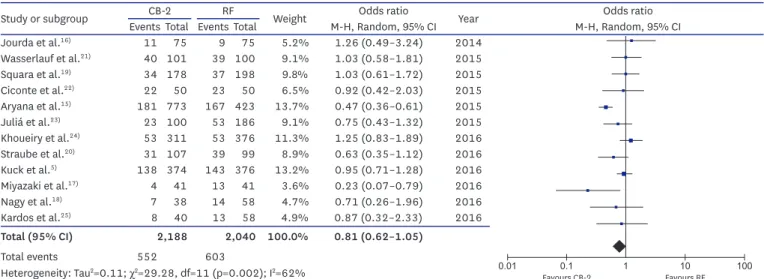
Recurrence of ATA after a single procedure was similar between the 2 groups (12 studies;
4,228 patients; 25.2% CB-2 vs. 29.5% RF; odds ratio [OR], 0.81; 95% confidence interval [CI], 0.62–1.05; p=0.11) (Figure 2A).
When the radiofrequency (RF) group was confined to force-sensing RFA, there was no difference between the CB-2 and force-sensing RF groups (6 studies; 1,507 patients; 19.5%
CB-2 vs. 18.3%; OR, 1.08; 95% CI, 0.83–1.40; p=0.58) (Figure 2B).
Procedural and fluoroscopy time
For the CB-2 group, an electroanatomical mapping system was used for some patients.
In contrast, in the RFA group, most RFA was performed with the assistance of an
Study or subgroup CB-2 RF Weight Odds ratio Year Odds ratio
Events Total Events Total M-H, Random, 95% CI M-H, Random, 95% CI
Jourda et al.
16)11 75 9 75 5.2% 1.26 (0.49–3.24) 2014
Wasserlauf et al.
21)40 101 39 100 9.1% 1.03 (0.58–1.81) 2015
Squara et al.
19)34 178 37 198 9.8% 1.03 (0.61–1.72) 2015
Ciconte et al.
22)22 50 23 50 6.5% 0.92 (0.42–2.03) 2015
Aryana et al.
15)181 773 167 423 13.7% 0.47 (0.36–0.61) 2015
Juliá et al.
23)23 100 53 186 9.1% 0.75 (0.43–1.32) 2015
Khoueiry et al.
24)53 311 53 376 11.3% 1.25 (0.83–1.89) 2016
Straube et al.
20)31 107 39 99 8.9% 0.63 (0.35–1.12) 2016
Kuck et al.
5)138 374 143 376 13.2% 0.95 (0.71–1.28) 2016
Miyazaki et al.
17)4 41 13 41 3.6% 0.23 (0.07–0.79) 2016
Nagy et al.
18)7 38 14 58 4.7% 0.71 (0.26–1.96) 2016
Kardos et al.
25)8 40 13 58 4.9% 0.87 (0.32–2.33) 2016
Total (95% CI) 2,188 2,040 100.0% 0.81 (0.62–1.05)
Total events 552 603
Heterogeneity: Tau
2=0.11; χ
2=29.28, df=11 (p=0.002); I
2=62%
Test for overall effect: Z=1.62 (p=0.11)
A
0.01 0.1 1 10 100
Favours CB-2 Favours RF
Study or subgroup CB-2 CF-RF Weight Odds ratio Year Odds ratio
Events Total Events Total M-H, Random, 95% CI M-H, Random, 95% CI
Jourda et al.
16)11 75 9 75 7.8% 1.26 (0.49–3.24) 2014
Ciconte et al.
22)22 50 23 50 11.3% 0.92 (0.42–2.03) 2015
Squara et al.
19)34 178 37 198 26.2% 1.03 (0.61–1.72) 2015
Nagy et al.
18)7 38 14 58 6.8% 0.71 (0.26–1.96) 2016
Khoueiry et al.
24)53 311 53 376 40.8% 1.25 (0.83–1.89) 2016
Kardos et al.
25)8 40 13 58 7.1% 0.87 (0.32–2.33) 2016
Total (95% CI) 692 815 100.0% 1.08 (0.83–1.40)
Total events 135 149
Heterogeneity: Tau
2=0.00; χ
2=1.63, df=5 (p=0.90); I
2=0%
Test for overall effect: Z=0.55 (p=0.58)
B
0.01 0.1 1 10 100
Favours CB-2 Favours RF
Figure 2. Recurrence of atrial tachyarrhythmias. (A) The second-generation cryoballoon (CB-2) vs. radiofrequency (RF) ablation. (B) CB-2 vs. force-sensing RF catheter ablation (CF-RF).
CI = confidence interval.
electroanatomical mapping system. However, the exact numbers of those using an electroanatomical mapping system were not provided.
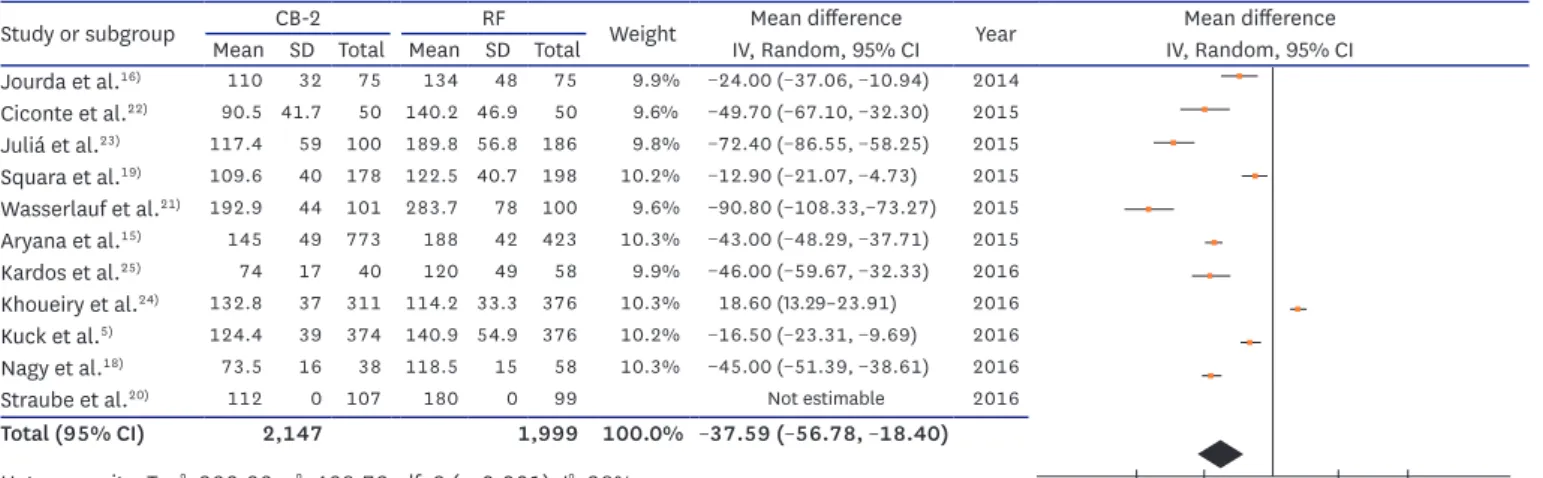
Procedural time ranged from 73.5±16 minutes to 192.9±44 minutes in the CB-2 group and from 118.5±15 minutes to 283.7±78.0 minutes in the RF group. The procedure time was much shorter in the CB-2 group (mean difference [MD], −37.59 minutes; 95% CI, −56.78, −18.4;
p<0.001) (Figure 3A).
The fluoroscopy time was from 13.8±4 minutes to 39.8±14.9 minutes in the CB-2 group and from 15.8±6 minutes to 73.0±30.1 minutes in the RF group. The procedure time was shorter in the CB-2 group, but the difference was small (MD, −3.1 minutes; 95% CI, −6.93, −0.73;
p=0.11) (Figure 3B).
Study or subgroup CB-2 RF Weight Mean difference Year Mean difference
Mean SD Total Mean SD Total IV, Random, 95% CI IV, Random, 95% CI
Jourda et al.
16)110 32 75 134 48 75 9.9% −24.00 (−37.06, −10.94) 2014 Ciconte et al.
22)90.5 41.7 50 140.2 46.9 50 9.6% −49.70 (−67.10, −32.30) 2015 Juliá et al.
23)117.4 59 100 189.8 56.8 186 9.8% −72.40 (−86.55, −58.25) 2015 Squara et al.
19)109.6 40 178 122.5 40.7 198 10.2% −12.90 (−21.07, −4.73) 2015 Wasserlauf et al.
21)192.9 44 101 283.7 78 100 9.6% −90.80 (−108.33,−73.27) 2015 Aryana et al.
15)145 49 773 188 42 423 10.3% −43.00 (−48.29, −37.71) 2015 Kardos et al.
25)74 17 40 120 49 58 9.9% −46.00 (−59.67, −32.33) 2016 Khoueiry et al.
24)132.8 37 311 114.2 33.3 376 10.3% 18.60 (13.29–23.91) 2016 Kuck et al.
5)124.4 39 374 140.9 54.9 376 10.2% −16.50 (−23.31, −9.69) 2016 Nagy et al.
18)73.5 16 38 118.5 15 58 10.3% −45.00 (−51.39, −38.61) 2016
Straube et al.
20)112 0 107 180 0 99 Not estimable 2016
Total (95% CI) 2,147 1,999 100.0% − 37.59 ( − 56.78, − 18.40) Heterogeneity: Tau
2=923.22; χ
2=468.79, df=9 (p<0.001); I
2=98%
Test for overall effect: Z=3.84 (p<0.001)
A
−100 −50 1 50 100
Favours CB-2 Favours RF
B
Study or subgroup CB-2 RF Weight Mean difference Year Mean difference
Mean SD Total Mean SD Total IV, Random, 95% CI IV, Random, 95% CI
Jourda et al.
16)21.5 8.5 75 25.3 9.9 75 11.5% −3.80 (−6.75, −0.85) 2014 Juliá et al.
23)26.8 16.4 100 35.4 19.4 186 10.7% −8.60 (−12.85, −4.35) 2015
Aryana et al.
15)29 13 773 23 14 423 12.0% 6.00 (4.38–7.62) 2015
Ciconte et al.
22)14.5 5.6 50 19.8 6.8 50 11.7% −5.30 (−7.74, −2.86) 2015 Wasserlauf et al.
21)46 22.4 101 73 30.1 100 8.5% −27.00 (−34.34, −19.66) 2015
Straube et al.
20)16 0 107 16 0 99 Not estimable 2016
Khoueiry et al.
24)26.1 8.7 311 23.8 10.7 376 12.1% 2.30 (0.85–3.75) 2016
Kardos et al.
25)14 17 40 16 5 58 9.9% −2.00 (−7.42, −3.42) 2016
Nagy et al.
18)13.8 4 38 15.8 6 58 11.9% −2.00 (−4.00, 0.00) 2016 Kuck et al.
5)21.7 13.9 374 16.6 17.8 376 11.8% 5.10 (2.81–7.39) 2016
Total (95% CI) 1,969 1,801 100.0% − 3.10 ( − 6.93, 0.73)
Heterogeneity: Tau
2= 31.07; χ
2=173.00, df=8 (p<0.001); I
2=95%
Test for overall effect: Z=1.58 (p=0.11)
−50 Favours CB-2−25 1 Favours RF25 50Figure 3. Comparison of procedure time and fluoroscopy time between the second-generation cryoballoon (CB-2) vs. radiofrequency (RF) ablation group. (A) Procedure time. (B) Fluoroscopy time.
SD = standard deviation.
COMPLICATIONS
PNI
Transient PNI was evaluated in 11 studies, and permanent PNI was evaluated in 9 studies.
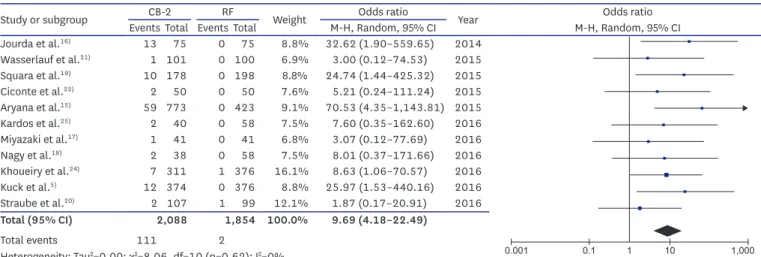
Transient PNI is relatively common in CBA. Of 11 studies that included 2,088 patients, transient phrenic injury occurred in a median of 5% (range, 0.99–17.3%). Permanent PNI occurred in only 4 studies, with a median incidence rate of 1% (range, 0.26–2.5%). On the contrary, in the RFA group, only 2 cases of transient PNI occurred in 1,854 patients (0.1%) and permanent PNI never occurred (transient PNI was higher in the CB-2 group; OR, 9.69;
95% CI, 4.18–22.49; p<0.001) (Figure 4A).
To prevent PNI, monitoring of the phrenic nerve function is important, especially while the right superior PV (RSPV) is being ablated, because the risk of PNI is highest in the RSPV. Right phrenic nerve stimulation with palpation of the strength of diaphragmatic contractions or monitoring of the diaphragmatic compound motor action potential
Study or subgroup CB-2 RF Weight Odds ratio Year Odds ratio
Events Total Events Total M-H, Random, 95% CI M-H, Random, 95% CI
Jourda et al.
16)13 75 0 75 8.8% 32.62 (1.90–559.65) 2014
Wasserlauf et al.
21)1 101 0 100 6.9% 3.00 (0.12–74.53) 2015
Squara et al.
19)10 178 0 198 8.8% 24.74 (1.44–425.32) 2015
Ciconte et al.
22)2 50 0 50 7.6% 5.21 (0.24–111.24) 2015
Aryana et al.
15)59 773 0 423 9.1% 70.53 (4.35–1,143.81) 2015
Kardos et al.
25)2 40 0 58 7.5% 7.60 (0.35–162.60) 2016
Miyazaki et al.
17)1 41 0 41 6.8% 3.07 (0.12–77.69) 2016
Nagy et al.
18)2 38 0 58 7.5% 8.01 (0.37–171.66) 2016
Khoueiry et al.
24)7 311 1 376 16.1% 8.63 (1.06–70.57) 2016
Kuck et al.
5)12 374 0 376 8.8% 25.97 (1.53–440.16) 2016
Straube et al.
20)2 107 1 99 12.1% 1.87 (0.17–20.91) 2016
Total (95% CI) 2,088 1,854 100.0% 9.69 (4.18–22.49)
Total events 111 2
Heterogeneity: Tau
2=0.00; χ
2=8.06, df=10 (p=0.62); I
2=0%
Test for overall effect: Z=5.29 (p<0.001)
A
0.001 0.1 1 10 1,000
Favours CB-2 Favours RF
Study or subgroup CB-2 RF Weight Odds ratio Year Odds ratio
Events Total Events Total M-H, Random, 95% CI M-H, Random, 95% CI
Jourda et al.
16)0 75 1 75 2.9% 0.33 (0.01–8.20) 2014
Aryana et al.
15)5 773 7 423 22.8% 0.39 (0.12–1.23) 2015
Ciconte et al.
22)0 50 1 50 2.9% 0.33 (0.01–8.21) 2015
Squara et al.
19)0 178 5 198 3.6% 0.10 (0.01–1.79) 2015
Wasserlauf et al.
21)0 101 5 100 3.6% 0.09 (0.00–1.57) 2015
Khoueiry et al.
24)5 311 9 376 24.9% 0.67 (0.22–2.01) 2016
Kuck et al.
5)4 374 9 376 21.5% 0.44 (0.13–1.44) 2016
Kardos et al.
25)0 40 1 58 2.9% 0.47 (0.02–11.91) 2016
Straube et al.
20)2 107 7 99 11.9% 0.25 (0.05–1.24) 2016
Nagy et al.
18)0 38 1 58 2.9% 0.50 (0.02–12.54) 2016
Total (95% CI) 2,047 1,813 100.0% 0.39 (0.23–0.68)
Total events 16 46
Heterogeneity: Tau
2=0.00; χ
2=3.30, df=9 (P=0.95); I
2=0%
Test for overall effect: Z=3.34 (p<0.001)
B
0.001 0.1 1 10 1,000
Favours CB-2 Favours RF