doi: 10.1253/circj.CJ-18-0928
are important for improving the efficacy of AF ablation.1 To achieve better clinical and rhythm outcomes, the catheter technology has continuously been evolving, but it is also necessary to perform a long-term evaluation. The Yonsei AF cohort has enrolled and followed more than 2,200 patients after a de novo AF catheter ablation during the past 9 years, and has performed relatively strict rhythm monitoring based on the 2012 Heart Rhythm Society (HRS)/European Heart Rhythm Association (EHRA)/ European Cardiac Arrhythmia Society (ECAS) Expert Consensus Statement guidelines. The purposes of this study were to review the characteristics of this patient population, procedure methods and instruments, and efficacy and safety of AF ablation over the 9 years, and to examine the differ-ences between that before and after the STAR-AF2 report.
Methods
Subjects
This study protocol adhered to the principles of the Decla-ration of Helsinki and was approved by the Institutional
O
ver the past decade, catheter ablation of atrialfibrillation (AF) has been shown to maintain sinus rhythm more effectively than anti-arrhythmic drugs (AAD).1 It was also shown that triggers in the pulmonary veins (PV) were important in the initiation of AF,2 and circumferential PV isolation subsequently became the basic ablation strategy in all AF ablation procedures. There has been a high recurrence rate, however, in patients with persistent and long-standing persistent AF who underwent circumferential PV isolation (CPVI) alone. To improve the clinical outcome, a substrate modification was introduced, such as additional linear and complex frac-tionated atrial electrogram (CFAE) ablation. A recently published randomized control trial, the Substrate and Trigger Ablation for Reduction of Atrial Fibrillation Trial Part II (STAR-AF2), found that an extra-PV ablation does not have an added benefit compared with CPVI alone.3 With the change in the ablation strategy, various ablation catheters have been developed to improve the efficacy and safety of AF ablation. It is well known that radiofrequency (RF) power delivery and optimal electrode-tissue contact
Received August 20, 2018; revised manuscript received October 30, 2018; accepted November 26, 2018; J-STAGE Advance Publication released online January 9, 2019 Time for primary review: 24 days
Yonsei University Health System, Seoul, Korea
Mailing address: Hui-Nam Pak, MD, PhD, FHRS, Yonsei University Health System, 50-1 Yonsei-ro, Seodaemun-gu, Seoul 120-752, Republic of Korea. E-mail: [email protected].
ISSN-1346-9843 All rights are reserved to the Japanese Circulation Society. For permissions, please e-mail: [email protected]
Trends and Outcome of Catheter Ablation of
Atrial Fibrillation Over 9 Years
― Focus on Empirical Extra-Pulmonary Vein Ablation ―
Je-Wook Park, MD; Hee Tae Yu, MD, PhD; Tae-Hoon Kim, MD;
Jae-Sun Uhm, MD, PhD; Jong-Youn Kim, MD, PhD; Boyoung Joung, MD, PhD; Moon-Hyoung Lee, MD, PhD; Hui-Nam Pak, MD, PhD
Background: The Substrate and Trigger Ablation for Reduction of Atrial Fibrillation Trial Part II (STAR-AF2) emphasized the
importance of circumferential pulmonary vein isolation (CPVI) during AF ablation.
Methods and Results: This study involved 2,297 consecutive patients (mean age, 58±11 years; 73.1% male, 70.1% paroxysmal AF) undergoing AF ablation from 2009 to 2017. We investigated the ablation lesion set, ablation time, catheter type, and clinical outcomes. Over the 9 years, the extra-pulmonary vein (PV) left atrial (LA) ablation rate (76.8% to 19.4%, P<0.001 for trend) and ablation time (P<0.001 for trend) decreased dramatically, whereas the 1-year recurrence rates decreased (21.8% to 14.1%, P=0.04 for trend). In persistent AF patients, the extra-PV LA ablation rate (91.4% to 55.3%, P<0.001) and ablation time (P<0.001) decreased after the STAR-AF2 report, but the 1-year recurrence rates remained similar (22.1% to 17.9%, P=0.281). A mesh-type flexible tip (MFT) catheter with a moderately increased radiofrequency power was used since 2012, and the MFT catheter was independently associated with a lower clinical recurrence compared to other irrigated-tip catheters (HR, 0.670; 95% CI: 0.559–0.803, P<0.001; log rank P=0.002) without increasing the procedure-related complications (OR, 1.434; 95% CI: 0.937–2.194, P=0.097).
Conclusions: Over the 9 years the extra-PV LA ablation and 1-year recurrence rates in the AF ablation cohort decreased, in part
due to improved catheter technology.
Key Words: Atrial fibrillation; Catheter ablation; STAR-AF2; Trend
Prucka CardioLabTM Electrophysiology system (General
Electric Medical Systems, Milwaukee, WI, USA), and RF catheter ablation (RFCA) was performed in all patients using 3-D electroanatomical mapping (NavX; St. Jude Medical, Minnetonka, MN, USA) merged with 3-D spiral computed tomography (CT). Double trans-septal punctures were performed and multi-view pulmonary venograms were obtained. After securing a trans-septal access, a circumfer-ential PV-mapping catheter (Lasso; Biosense-Webster, Diamond Bar, CA, USA) was advanced to the PV using a long sheath (Schwartz SL1, St. Jude Medical). Systemic anticoagulation with i.v. heparin was achieved to maintain an activated clotting time of 350–400 s during the procedure. For electroanatomical mapping, the 3-D geometry of both the LA and PV was generated using the NavX system and then merged with 3-D spiral CT.
RFCA
We used an open irrigated-tip catheter (Celcius; Johnson & Johnson, Diamond Bar, CA, USA; NaviStar ThermoCool, Biosense-Webster; ThermoCool SF, Biosense-Webster; Review Board of the Yonsei University Health System. All
patients provided written informed consent for inclusion in the Yonsei AF ablation Cohort Database (ClinicalTrials. gov identifier: NCT02138695). This study included 2,297 consecutive patients (mean age, 58±11 years; 73.1% male, 70.1% paroxysmal AF) who underwent de novo ablation between March 2009 and December 2017. We performed a serial rhythm follow-up based on the 2012 HRS/EHRA/ ECAS Expert Consensus Statement guidelines. The exclu-sion criteria were as follows: (1) permanent AF refractory to electrical cardioversion; (2) AF with valvular disease ≥grade 2; and (3) a previous repeated ablation procedure. Echocardiography was performed in all patents to obtain the left atrial (LA) diameter, left ventricular ejection fraction (LVEF), peak transmitral flow velocity (E), and tissue Doppler imaging of the peak septal mitral annular velocity (Em) according to the American Society of Echocardiog-raphy guidelines.
Electrophysiological Mapping
The intracardiac electrograms were recorded using the
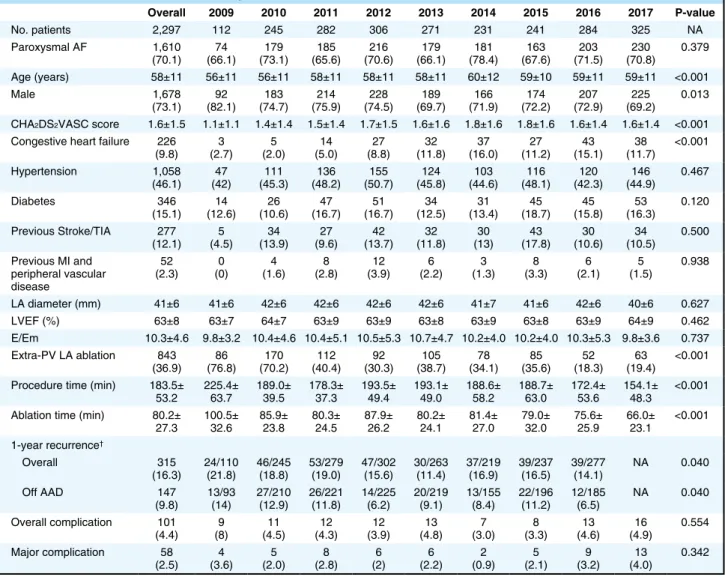
Table 1. Baseline Characteristics According to Year
Overall 2009 2010 2011 2012 2013 2014 2015 2016 2017 P-value No. patients 2,297 112 245 282 306 271 231 241 284 325 NA Paroxysmal AF 1,610 (70.1) (66.1)74 (73.1)179 (65.6)185 (70.6)216 (66.1)179 (78.4)181 (67.6)163 (71.5)203 (70.8)230 0.379 Age (years) 58±11 56±11 56±11 58±11 58±11 58±11 60±12 59±10 59±11 59±11 <0.001 Male 1,678 (73.1) (82.1)92 (74.7)183 (75.9)214 (74.5)228 (69.7)189 (71.9)166 (72.2)174 (72.9)207 (69.2)225 0.013 CHA2DS2VASC score 1.6±1.5 1.1±1.1 1.4±1.4 1.5±1.4 1.7±1.5 1.6±1.6 1.8±1.6 1.8±1.6 1.6±1.4 1.6±1.4 <0.001
Congestive heart failure 226
(9.8) (2.7)3 (2.0)5 (5.0)14 (8.8)27 (11.8)32 (16.0)37 (11.2)27 (15.1)43 (11.7)38 <0.001 Hypertension 1,058 (46.1) (42)47 (45.3)111 (48.2)136 (50.7)155 (45.8)124 (44.6)103 (48.1)116 (42.3)120 (44.9)146 0.467 Diabetes 346 (15.1) (12.6)14 (10.6)26 (16.7)47 (16.7)51 (12.5)34 (13.4)31 (18.7)45 (15.8)45 (16.3)53 0.120 Previous Stroke/TIA 277 (12.1) (4.5)5 (13.9)34 (9.6)27 (13.7)42 (11.8)32 (13)30 (17.8)43 (10.6)30 (10.5)34 0.500 Previous MI and peripheral vascular disease 52 (2.3) (0)0 (1.6)4 (2.8)8 (3.9)12 (2.2)6 (1.3)3 (3.3)8 (2.1)6 (1.5)5 0.938 LA diameter (mm) 41±6 41±6 42±6 42±6 42±6 42±6 41±7 41±6 42±6 40±6 0.627 LVEF (%) 63±8 63±7 64±7 63±9 63±9 63±8 63±9 63±8 63±9 64±9 0.462 E/Em 10.3±4.6 9.8±3.2 10.4±4.6 10.4±5.1 10.5±5.3 10.7±4.7 10.2±4.0 10.2±4.0 10.3±5.3 9.8±3.6 0.737 Extra-PV LA ablation 843 (36.9) (76.8)86 (70.2)170 (40.4)112 (30.3)92 (38.7)105 (34.1)78 (35.6)85 (18.3)52 (19.4)63 <0.001 Procedure time (min) 183.5±
53.2 225.4± 63.7 189.0± 39.5 178.3± 37.3 193.5± 49.4 193.1± 49.0 188.6± 58.2 188.7± 63.0 172.4± 53.6 154.1± 48.3 <0.001 Ablation time (min) 80.2±
27.3 100.5± 32.6 85.9± 23.8 80.3± 24.5 87.9± 26.2 80.2± 24.1 81.4± 27.0 79.0± 32.0 75.6± 25.9 66.0± 23.1 <0.001 1-year recurrence† Overall 315 (16.3) 24/110 (21.8) 46/245 (18.8) 53/279 (19.0) 47/302 (15.6) 30/263 (11.4) 37/219 (16.9) 39/237 (16.5) 39/277 (14.1) NA 0.040 Off AAD 147 (9.8) 13/93 (14) 27/210 (12.9) 26/221 (11.8) 14/225 (6.2) 20/219 (9.1) 13/155 (8.4) 22/196 (11.2) 12/185 (6.5) NA 0.040 Overall complication 101 (4.4) (8)9 (4.5)11 (4.3)12 (3.9)12 (4.8)13 (3.0)7 (3.3)8 (4.6)13 (4.9)16 0.554 Major complication 58 (2.5) (3.6)4 (2.0)5 (2.8)8 (2)6 (2.2)6 (0.9)2 (2.1)5 (3.2)9 (4.0)13 0.342 Data given as n (%) or mean ± SD. †1-year recurrence after AF ablations performed from 2009 to 2016. AAD, anti-arrhythmic drug; AF, atrial
fibrillation; E/Em, early diastolic mitral inflow velocity/early diastolic mitral annular velocity; LA, left atrium; LVEF, left ventricular ejection fraction; MI, myocardial infarction; NA, not applicable; PV, pulmonary vein; TIA, transient ischemic attack.
cedure time, and ablation time were analyzed using the ANOVA contrast test. Freedom from AF/atrial tachyar-rhythmia (AF/AT) recurrence after AF ablation was compared across groups on Kaplan-Meier analysis, using the log-rank test for statistical significance. Univariate and multivariate cox regression analyses were performed to determine the predictors of AF/AT recurrence after AF ablation. Propensity score matching was carried out to reduce the selection bias in before-after comparisons with regard to STAR-AF2, and MFT catheter vs. other irrigated tip catheters. Logistic regression analysis was also used to investigate the risk factors for procedure-related complica-tions. Statistical significance was considered for two-sided P<0.05. All statistical analysis was performed using SPSS for Windows (version 23.0; SPSS, Chicago, IL, USA), XLSTAT 2014 (Paris, France) and R (3.1.0, R Foundation for Statistical Computing, Boston, MA, USA).
Results
Subjects
The baseline characteristics of 2,297 enrolled patients who underwent ablations between 2009 and 2017 are listed in Table 1. Patient age (56±11 to 59±11 years, P<0.001 for trend), the proportion of female patients (17.9% to 30.8%, P=0.013 for trend), and CHA2DS2VASc score (1.1±1.1 to
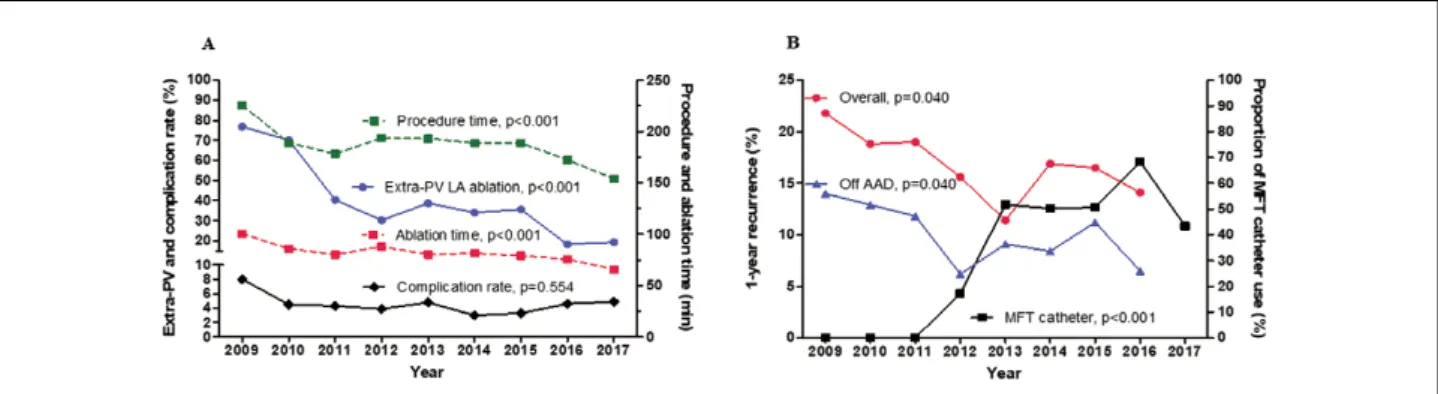
1.6±1.4, P<0.001 for trend) gradually increased over the 9 years. The proportion of patients with congestive heart failure (2.7% to 11.7%, P<0.001 for trend) also increased. AF Ablation Lesion Set: Nine-Year Trend and Outcomes We successfully conducted CPVI in all patients (100%) and achieved bidirectional block of the cavotricuspid isthmus unless the patient had an atrioventricular nodal conduction problem. The extra-PV LA ablation rate had decreased remarkably (76.8% to 19.4%, P<0.001 for trend, Figure 1A). Accordingly, the procedure time (P<0.001 for trend) and ablation time (P<0.001 for trend) have also been decreasing (Figure 1A). The extra-PV LA lesion set and its bidirectional block rate are summarized in Supplementary Table 1. Despite the decreasing trend in the extra-PV LA ablation rate, the 1-year recurrence rate has significantly decreased (overall, 21.8% to 14.1%, P=0.040 for trend; off AAD 14.0% to 6.5%, P=0.040 for trend; Figure 1B).
ThermoCool SmartTouch, Biosense-Webster; and TactiCath, St. Jude Medical) for RFCA. From 2012, we also started to use a mesh-type flexible tip (MFT) catheter (Coolflex; St. Jude Medical 30–35 W, 47°C; and FlexAbility, St. Jude Medical). All patients underwent de novo procedures with CPVI and the majority of patients (91.6%) underwent cavotricuspid isthmus block. For the extra-PV LA ablation, we conducted additional linear ablation including that of a roof line, posterior inferior line (posterior box lesion), and anterior line, especially in patients with persistent AF. A left lateral isthmus ablation, right atrial ablation, and CFAE ablation were performed in a minority of patients at the operator’s discretion (Supplementary Table 1). We defined extra-PV LA ablation as an additional linear ablation with or without CFAE ablation following the CPVI. The procedure ended when there was no immediate recurrence of AF in 10 min after cardioversion under an isoproterenol infusion (5–10 μg/min).
Post-Ablation Management and Follow-up
After RFCA the patients visited the outpatient clinic at 1, 3, 6, and 12 months and every 6 months thereafter or whenever they had symptoms. Electrocardiography (ECG) was performed at every visit. Twenty-four-hour Holter monitoring was performed at 3, 6, and 12 months and then every 6 months according to the 2012 HRS/EHRA/ECAS Expert consensus statement guidelines. One-year recurrence of AF was defined as recurrent episodes of atrial tachy-cardia or AF lasting ≥30 s in the 3–12 months after the AF ablation.
Statistical Analysis
Continuous variables are reported as mean ± SD and were analyzed using Student’s t-test for comparison between two groups. Categorical variables are reported as n (%) and were analyzed using chi-squared test and Fisher’s exact test. The trends in the categorical variables including the type of AF, sex, congestive heart failure, hypertension, diabetes, previous history of a stroke or transient ischemic attack, previous history of myocardial infarction (MI) or peripheral vascular disease, extra-PV LA ablation, post-ablation AAD use, 1-year recurrence rate, and complication rate were assessed on Cochran-Armitage trend analysis. The trends in the continuous variables including age, CHA2DS2VASC score, LA diameter, LVEF, E/Em,
pro-Figure 1. Trends in (A) ablation time, procedure time, extra-pulmonary vein (extra-PV) ablation, and complication rate over the past 9 years, and (B) 1-year recurrence rate after atrial fibrillation (AF) ablation and the use of a mesh-type flexible tip (MFT) catheter over the past 8 years. AAD, anti-arrhythmic drugs; LA, left atrial.
Figure 2. Kaplan-Meier estimates of (A–C) freedom from atrial fibrillation/atrial tachyarrhythmia (AF/AT) recurrence and (D–F) freedom from AF/AT recurrence off anti-arrhythmic drugs (AAD) according to (A,D) AF type; (B,E) before vs. after the Substrate and Trigger Ablation for Reduction of Atrial Fibrillation Trial Part II (STAR-AF2) report; and (C,F) before vs. after the STAR-AF2 report after propensity score matching for age, sex, AF type, left atrial diameter, and CHA2DS2VASc score and its components.
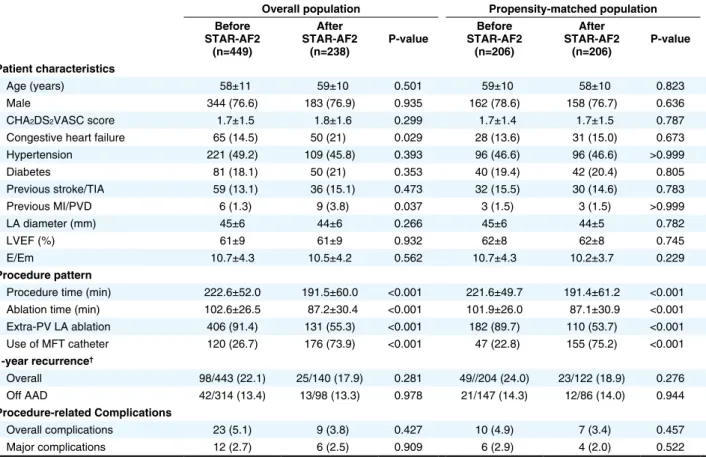
Table 2. Change in Persistent AF Patient Characteristics After STAR-AF2 and According to Propensity Matching
Overall population Propensity-matched population
Before STAR-AF2 (n=449) After STAR-AF2 (n=238) P-value Before STAR-AF2 (n=206) After STAR-AF2 (n=206) P-value Patient characteristics Age (years) 58±11 59±10 0.501 59±10 58±10 0.823 Male 344 (76.6) 183 (76.9) 0.935 162 (78.6) 158 (76.7) 0.636 CHA2DS2VASC score 1.7±1.5 1.8±1.6 0.299 1.7±1.4 1.7±1.5 0.787
Congestive heart failure 65 (14.5) 50 (21) 0.029 28 (13.6) 31 (15.0) 0.673 Hypertension 221 (49.2) 109 (45.8) 0.393 96 (46.6) 96 (46.6) >0.999 Diabetes 81 (18.1) 50 (21) 0.353 40 (19.4) 42 (20.4) 0.805 Previous stroke/TIA 59 (13.1) 36 (15.1) 0.473 32 (15.5) 30 (14.6) 0.783 Previous MI/PVD 6 (1.3) 9 (3.8) 0.037 3 (1.5) 3 (1.5) >0.999 LA diameter (mm) 45±6 44±6 0.266 45±6 44±5 0.782 LVEF (%) 61±9 61±9 0.932 62±8 62±8 0.745 E/Em 10.7±4.3 10.5±4.2 0.562 10.7±4.3 10.2±3.7 0.229 Procedure pattern
Procedure time (min) 222.6±52.0 191.5±60.0 <0.001 221.6±49.7 191.4±61.2 <0.001
Ablation time (min) 102.6±26.5 87.2±30.4 <0.001 101.9±26.0 87.1±30.9 <0.001
Extra-PV LA ablation 406 (91.4) 131 (55.3) <0.001 182 (89.7) 110 (53.7) <0.001 Use of MFT catheter 120 (26.7) 176 (73.9) <0.001 47 (22.8) 155 (75.2) <0.001 1-year recurrence† Overall 98/443 (22.1) 25/140 (17.9) 0.281 49//204 (24.0) 23/122 (18.9) 0.276 Off AAD 42/314 (13.4) 13/98 (13.3) 0.978 21/147 (14.3) 12/86 (14.0) 0.944 Procedure-related Complications Overall complications 23 (5.1) 9 (3.8) 0.427 10 (4.9) 7 (3.4) 0.457 Major complications 12 (2.7) 6 (2.5) 0.909 6 (2.9) 4 (2.0) 0.522 Data given as n (%) or mean ± SD. †1-year recurrence after AF ablation performed between 2009 and 2016. MFT, mesh-type flexible tip; PVD,
peripheral vascular disease; STAR-AF2, Substrate and Trigger Ablation for Reduction of Atrial Fibrillation Trial Part II. Other abbreviations as in Table 1.
alone (Supplementary Table 2). Role of the MFT Catheter
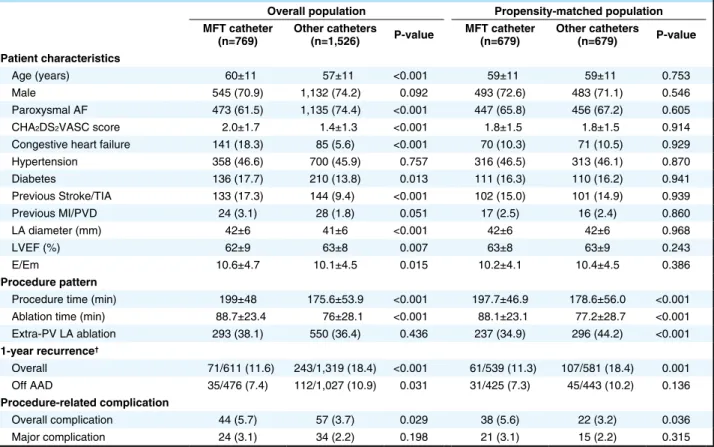
We have been using an MFT catheter with a moderately high RF power (30–35 W) since 2012, and the prevalence of its use has increased from 17.3% in 2012 to 43.4% in 2017 (P<0.001 for trend). The 1-year recurrence rates show a decreasing trend over this period (P=0.040 for trend, Figure 1B). Contact force-sensing catheters were used in a small proportion of patients since 2015 (n=131, 5.7%) and were included in the other catheter group. Despite some differences in the baseline characteristics between the MFT catheter group and other catheter group (Table 3), the long-term AF/AT recurrence rate was significantly lower in the MFT catheter group than in the other catheter group (log rank P=0.002; Figure 3A,B). The procedure-related complication rate was higher with the MFT catheter (5.7% vs. 3.7%, P=0.029), but the major complication rate did not significantly differ compared with the other catheters (3.1% vs. 2.2%, P=0.198, Table 3).
After propensity score matching for age, sex, AF type, LA diameter, and CHA2DS2-VASc score and its
compo-nents, the 1-year recurrence rate (P=0.001, Table 3) and long-term AF/AT recurrence (log rank P=0.002; Figure 3C,D) remained lower in the MFT catheter group than in the other catheter group. Although the major complication rate did not differ (P=0.315), the overall complication rate was higher in the MFT catheter group than in the other catheter group (P=0.036, Table 3).
In patients who underwent CPVI alone, patients with MFT catheter had better rhythm outcome than those with STAR-AF2: Change in Practice Patterns
As shown in Figure 2A,D, the rhythm outcome was worse in patients with persistent AF than in those with paroxysmal AF (log rank P<0.001). For the 687 patients with persistent AF, we compared the periods before and after the STAR-AF2 publication (May 2015; Table 2). The extra-PV LA ablation rate (91.4% to 55.3%, P<0.001), procedure time (P<0.001), and ablation time (P<0.001) decreased signifi-cantly after the STAR-AF2 report, but the procedure-related complication rate did not significantly differ (P=0.427). The clinical recurrence rate of AF/AT before did not significantly differ from that after the STAR-AF2 report (log rank P=0.336; Figure 2B,E). Because the proportion of patients with congestive heart failure (P=0.029) and previous MI/peripheral artery disease (P=0.037) was higher in the post-STAR-AF2 period, we conducted propensity score matching for age, sex, LA diameter, and CHA2DS2VASC score and its components.
Even after the propensity score matching, the overall AF/ AT recurrence (log rank P=0.275; Figure 2C,F) and proce-dure-related complication rate (P=0.457) before did not significantly differ from that after the STAR-AF2 report in the patients with persistent AF.
Of the total study population, the patients with extra-PV LA ablation had significantly higher proportions of male sex, persistent AF and congestive heart failure, larger LA, lower LVEF, and higher E/Em than those with CPVI alone (Supplementary Table 2). In the persistent AF group, LA size was larger (P=0.012) and MFT catheter was less frequently utilized (P=0.002) in patients who underwent extra-PV LA ablation than those with CPVI
Table 3. Patient Characteristics According to MFT Catheter Status and Propensity Matching
Overall population Propensity-matched population
MFT catheter
(n=769) Other catheters (n=1,526) P-value MFT catheter (n=679) Other catheters (n=679) P-value Patient characteristics
Age (years) 60±11 57±11 <0.001 59±11 59±11 0.753 Male 545 (70.9) 1,132 (74.2) 0.092 493 (72.6) 483 (71.1) 0.546 Paroxysmal AF 473 (61.5) 1,135 (74.4) <0.001 447 (65.8) 456 (67.2) 0.605 CHA2DS2VASC score 2.0±1.7 1.4±1.3 <0.001 1.8±1.5 1.8±1.5 0.914
Congestive heart failure 141 (18.3) 85 (5.6) <0.001 70 (10.3) 71 (10.5) 0.929 Hypertension 358 (46.6) 700 (45.9) 0.757 316 (46.5) 313 (46.1) 0.870 Diabetes 136 (17.7) 210 (13.8) 0.013 111 (16.3) 110 (16.2) 0.941 Previous Stroke/TIA 133 (17.3) 144 (9.4) <0.001 102 (15.0) 101 (14.9) 0.939 Previous MI/PVD 24 (3.1) 28 (1.8) 0.051 17 (2.5) 16 (2.4) 0.860 LA diameter (mm) 42±6 41±6 <0.001 42±6 42±6 0.968 LVEF (%) 62±9 63±8 0.007 63±8 63±9 0.243 E/Em 10.6±4.7 10.1±4.5 0.015 10.2±4.1 10.4±4.5 0.386 Procedure pattern
Procedure time (min) 199±48 175.6±53.9 <0.001 197.7±46.9 178.6±56.0 <0.001
Ablation time (min) 88.7±23.4 76±28.1 <0.001 88.1±23.1 77.2±28.7 <0.001
Extra-PV LA ablation 293 (38.1) 550 (36.4) 0.436 237 (34.9) 296 (44.2) <0.001 1-year recurrence† Overall 71/611 (11.6) 243/1,319 (18.4) <0.001 61/539 (11.3) 107/581 (18.4) 0.001 Off AAD 35/476 (7.4) 112/1,027 (10.9) 0.031 31/425 (7.3) 45/443 (10.2) 0.136 Procedure-related complication Overall complication 44 (5.7) 57 (3.7) 0.029 38 (5.6) 22 (3.2) 0.036 Major complication 24 (3.1) 34 (2.2) 0.198 21 (3.1) 15 (2.2) 0.315 Data given as n (%) or mean ± SD. †1-year recurrence after AF ablation performed between 2009 and 2016. Abbreviations as in Tables 1,2.
group. Of the 195 patients who underwent repeat procedure, no PV potential was found at redo mapping in 21/49 (42.9%) after MFT catheter ablation and in 41/146 (28.1%) after utilizing other ablation catheters (P=0.055).
Factors Affecting Efficacy and Safety of AF Catheter Ablation To determine the factors affecting the clinical recurrence of other catheters on Kaplan-Meier analysis (log rank P=0.001,
Supplementary Figure A,B). Considering propensity score matching, including extra-PV LA ablation and other factors as noted here, the 1-year recurrence rate (P=0.003; Supplementary Table 3) and long-term AF/AT recurrence (log rank P=0.012; Supplementary Figure C,D) remained lower in the MFT catheter group than in the other catheter
Figure 3. Kaplan-Meier estimates of (A,C) freedom from AF/AT recurrence in the overall patient group and (B,D) freedom from AF/AT recurrence off AAD after AF ablation according to catheter type and (C,D) after propensity score matching for age, sex, AF type, left atrial diameter, and CHA2DS2VASc score and its components. Abbreviations as in Figures 1,2.
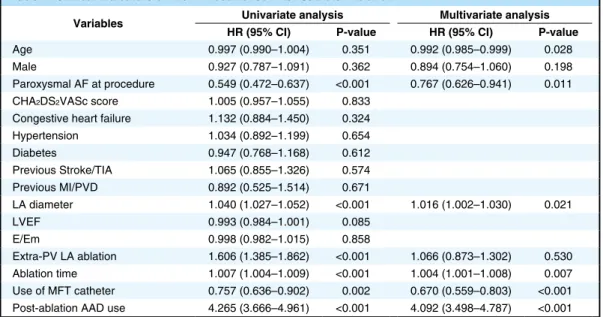
Table 4. Clinical Indicators of AF/AT Recurrence After Catheter Ablation†
Variables Univariate analysis Multivariate analysis
HR (95% CI) P-value HR (95% CI) P-value
Age 0.997 (0.990–1.004) 0.351 0.992 (0.985–0.999) 0.028 Male 0.927 (0.787–1.091) 0.362 0.894 (0.754–1.060) 0.198 Paroxysmal AF at procedure 0.549 (0.472–0.637) <0.001 0.767 (0.626–0.941) 0.011 CHA2DS2VASc score 1.005 (0.957–1.055) 0.833
Congestive heart failure 1.132 (0.884–1.450) 0.324 Hypertension 1.034 (0.892–1.199) 0.654 Diabetes 0.947 (0.768–1.168) 0.612 Previous Stroke/TIA 1.065 (0.855–1.326) 0.574 Previous MI/PVD 0.892 (0.525–1.514) 0.671 LA diameter 1.040 (1.027–1.052) <0.001 1.016 (1.002–1.030) 0.021 LVEF 0.993 (0.984–1.001) 0.085 E/Em 0.998 (0.982–1.015) 0.858 Extra-PV LA ablation 1.606 (1.385–1.862) <0.001 1.066 (0.873–1.302) 0.530 Ablation time 1.007 (1.004–1.009) <0.001 1.004 (1.001–1.008) 0.007 Use of MFT catheter 0.757 (0.636–0.902) 0.002 0.670 (0.559–0.803) <0.001
Post-ablation AAD use 4.265 (3.666–4.961) <0.001 4.092 (3.498–4.787) <0.001
ablation,6 CFAE-guided ablation,7 rotor ablation,8 and/or extra-PV trigger ablation in addition to the CPVI.9 In a significant proportion of cases, however, AF recurrence is caused not only by extra-PV foci, but also by electrical reconnections of the CPVI.10 In 2015, the STAR-AF2 investigators reported that extra-PV LA ablation with an additional linear ablation or CFAE ablation had no addi-tional clinical benefit as compared to that with PVI alone in the patients with persistent AF.3 Nonetheless, a recur-rence rate of 50% in 1 year did not seem to be a satisfactory outcome.
In this single-center cohort registry study, use of extra-PV ablation was significantly lower in both paroxysmal and persistent AF, but the 1-year recurrence rate somewhat improved after the publication of the STAR-AF2 report. This might be because the time required for extra-PV foci mapping and ablation was concentrated on the CPVI, and there were no PV potential reconnections at all in approx-imately 37% of patients who underwent repeat ablation procedures in that cohort.10 Therefore, it is necessary to study a more selective mapping and ablation of extra-PV triggers, rather than an empirical extra-PV LA ablation.11 Learning in the Past 9 Years
Over the past 9 years we learned that AF is a chronic progressive disease and not curable by catheter ablation. Although the development of efficient ablation catheters and sophisticated mapping systems has improved the outcome of AF ablation, the long-term recurrence rate is still close to 50%. Nonetheless, we were able to evaluate the present results because we performed consistent and steady rhythm monitoring based on the 2012 HRS/EHRA/ECAS Expert consensus statement guidelines.
Of the prognostic factors associated with the patient characteristics, young age and female sex,12 high pericardial fat volume,13 being overweight,14 longer PR interval,15 and high LA pressure16 were factors associated with a higher clinical recurrence rate after AF ablation. In particular, the outcome of catheter ablation in patients with long-standing persistent AF was affected by the pre-ablation external cardioversion energy17 or specific genetic factors, such as AF, we conducted a multivariate Cox regression analysis.
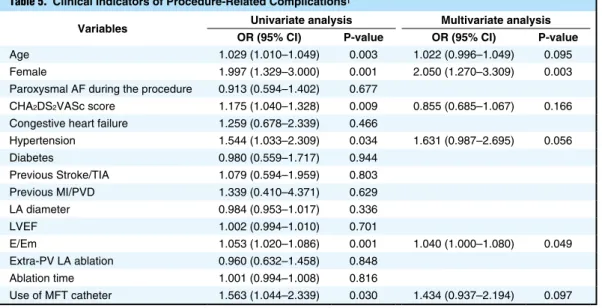
Age (hazard ratio [HR], 0.992; 95% CI: 0.985–0.999; P=0.028), paroxysmal AF at procedure (HR, 0.767; 95% CI: 0.626–0.941; P=0.011), LA diameter (HR, 1.016; 95% CI: 1.002–1.030; P=0.021), ablation time (HR, 1.004; 95% CI: 1.001–1.008; P=0.007), use of an MFT catheter (HR, 0.670; 95% CI: 0.559–0.803; P<0.001), and post-ablation AAD use (HR, 4.092; 95% CI: 3.498–4.787; P<0.001) were independently associated with clinical recurrence after AF ablation (Table 4). In terms of the procedure-related complications, female sex (odds ratio [OR], 2.050; 95% CI: 1.270–3.309; P=0.003) and diastolic dysfunction measured on E/Em (OR, 1.040; 95% CI: 1.000–1.080; P=0.049) were independently associated with complications on multivar-iate logistic regression analysis (Table 5).
Discussion
Major Findings
During the 9-year study period for AF catheter ablation at the present institution, empirical extra-PV LA ablation decreased and annual 1-year recurrence rate improved. In the persistent AF group, reduction in extra-PV LA ablation did not affect the rhythm outcome of AF ablation. The use of an MFT catheter with moderately increased RF power was independently associated with a better rhythm outcome, and female sex was independently associated with higher complication rate after AF ablation.
STAR-AF2 and Extra-PV LA Ablation
CPVI is recognized as a cornerstone of AF ablation. In addition to blocking the PV trigger, which is the main mechanism of AF,2 wide CPVI also reduces the atrial critical mass, which is one of the AF maintenance mecha-nisms,4 and contributes to autonomic neural modulation by ablating the ganglionate plexi located on the epicardial side of the PV antrum.5 Nonetheless, the recurrence rate after AF ablation is still high after CPVI, especially in the case of persistent AF with significant atria structural remodeling.1 For this reason, many operators have per-formed empirical extra-PV foci ablation such as linear
Table 5. Clinical Indicators of Procedure-Related Complications†
Variables Univariate analysis Multivariate analysis
OR (95% CI) P-value OR (95% CI) P-value
Age 1.029 (1.010–1.049) 0.003 1.022 (0.996–1.049) 0.095 Female 1.997 (1.329–3.000) 0.001 2.050 (1.270–3.309) 0.003 Paroxysmal AF during the procedure 0.913 (0.594–1.402) 0.677
CHA2DS2VASc score 1.175 (1.040–1.328) 0.009 0.855 (0.685–1.067) 0.166
Congestive heart failure 1.259 (0.678–2.339) 0.466
Hypertension 1.544 (1.033–2.309) 0.034 1.631 (0.987–2.695) 0.056 Diabetes 0.980 (0.559–1.717) 0.944 Previous Stroke/TIA 1.079 (0.594–1.959) 0.803 Previous MI/PVD 1.339 (0.410–4.371) 0.629 LA diameter 0.984 (0.953–1.017) 0.336 LVEF 1.002 (0.994–1.010) 0.701 E/Em 1.053 (1.020–1.086) 0.001 1.040 (1.000–1.080) 0.049 Extra-PV LA ablation 0.960 (0.632–1.458) 0.848 Ablation time 1.001 (0.994–1.008) 0.816 Use of MFT catheter 1.563 (1.044–2.339) 0.030 1.434 (0.937–2.194) 0.097
selective mapping and ablation of extra-PV triggers, rather than empirical extra-PV LA ablation.
Acknowledgments
This work was supported by a grant (HI18C0070) from the Korea Health 21 R&D Project, Ministry of Health and Welfare, and a grant (NRF-2017R1A2B4003983) from the Basic Science Research Program run by the National Research Foundation of Korea (NRF), which is funded by the Ministry of Science, ICT, and Future Planning (MSIP). We thank Mr. John Martin for his linguistic assistance.
Disclosures The authors declare no conflicts of interest.
References
1. Calkins H, Hindricks G, Cappato R, Kim YH, Saad EB, Aguinaga L, et al. 2017 HRS/EHRA/ECAS/APHRS/SOLAECE expert consensus statement on catheter and surgical ablation of atrial fibrillation. Europace 2018; 20: e1 – e160.
2. Haissaguerre M, Jais P, Shah DC, Takahashi A, Hocini M, Quiniou G, et al. Spontaneous initiation of atrial fibrillation by ectopic beats originating in the pulmonary veins. N Engl J Med 1998; 339: 659 – 666.
3. Verma A, Jiang CY, Betts TR, Chen J, Deisenhofer I, Mantovan R, et al. Approaches to catheter ablation for persistent atrial fibrillation. N Engl J Med 2015; 372: 1812 – 1822.
4. Hwang ES, Nam GB, Joung B, Park J, Lee JS, Shim J, et al. Significant reduction of atrial defibrillation threshold and inducibility by catheter ablation of atrial fibrillation. Pacing Clin
Electrophysiol 2012; 35: 1428 – 1435.
5. Kang KW, Pak HN, Park J, Park JG, Uhm JS, Joung B, et al. Additional linear ablation from the superior vena cava to right atrial septum after pulmonary vein isolation improves the clinical outcome in patients with paroxysmal atrial fibrillation: Prospec-tive randomized study. Europace 2014; 16: 1738 – 1745.
6. Haissaguerre M, Hocini M, Sanders P, Sacher F, Rotter M, Takahashi Y, et al. Catheter ablation of long-lasting persistent atrial fibrillation: Clinical outcome and mechanisms of subsequent arrhythmias. J Cardiovasc Electrophysiol 2005; 16: 1138 – 1147. 7. Nademanee K, McKenzie J, Kosar E, Schwab M,
Sunsaneewitayakul B, Vasavakul T, et al. A new approach for catheter ablation of atrial fibrillation: Mapping of the electro-physiologic substrate. J Am Coll Cardiol 2004; 43: 2044 – 2053. 8. Narayan SM, Baykaner T, Clopton P, Schricker A, Lalani GG,
Krummen DE, et al. Ablation of rotor and focal sources reduces late recurrence of atrial fibrillation compared with trigger ablation alone: Extended follow-up of the CONFIRM trial (Conventional Ablation for Atrial Fibrillation With or Without Focal Impulse and Rotor Modulation). J Am Coll Cardiol 2014; 63: 1761 – 1768. 9. Lee KN, Roh SY, Baek YS, Park HS, Ahn J, Kim DH, et al.
Long-term clinical comparison of procedural end points after pulmonary vein isolation in paroxysmal atrial fibrillation: Elimination of nonpulmonary vein triggers versus noninducibility.
Circ Arrhythm Electrophysiol 2018; 11: e005019.
10. Kim TH, Park J, Uhm JS, Joung B, Lee MH, Pak HN. Pulmonary vein reconnection predicts good clinical outcome after second catheter ablation for atrial fibrillation. Europace 2017; 19: 961 – 967.
11. Rolf S, Kircher S, Arya A, Eitel C, Sommer P, Richter S, et al. Tailored atrial substrate modification based on low-voltage areas in catheter ablation of atrial fibrillation. Circ Arrhythm
Electrophysiol 2014; 7: 825 – 833.
12. Yu HT, Yang PS, Kim TH, Uhm JS, Kim JY, Joung B, et al. Poor rhythm outcome of catheter ablation for early-onset atrial fibrillation in women: Mechanistic insight. Circ J 2018; 82: 2259 – 2268.
13. Kim TH, Park J, Park JK, Uhm JS, Joung B, Lee MH, et al. Pericardial fat volume is associated with clinical recurrence after catheter ablation for persistent atrial fibrillation, but not parox-ysmal atrial fibrillation: An analysis of over 600-patients. Int J
Cardiol 2014; 176: 841 – 846.
14. Baek YS, Yang PS, Kim TH, Uhm JS, Kim JY, Joung B, et al. Delayed recurrence of atrial fibrillation 2 years after catheter ablation is associated with metabolic syndrome. Int J Cardiol 2016; 223: 276 – 281.
15. Park J, Kim TH, Lee JS, Park JK, Uhm JS, Joung B, et al. Prolonged PR interval predicts clinical recurrence of atrial
the ZFHX3 genetic trait.18
Regarding the intra-procedural factors, CPVI alone proved sufficient in patients with paroxysmal AF,19 and appropriate parasympathetic modulation after AF ablation measured using heart rate variability (HRV)5 and absence of post-ablation extra-PV triggers9 were related to a good rhythm outcome after AF ablation. In the persistent AF group, recurrence was lower in those with posterior wall isolation in de novo ablation.20 For the patients who improved from persistent AF to paroxysmal AF, however, after using AAD, additional linear ablation after CPVI did not affect outcome.21 For the patients with longstanding persistent AF, additional CFAE ablation after CPVI plus linear ablation did not improve the rhythm outcome.22 In this study, the rate of procedure-related complications was higher in the female patients than in male patients.
An MFT catheter, which is designed to maintain high irrigation flow at the catheter-tissue contact surface, seems to be more efficient in generating a large transmural lesion.23,24 Moreover, we used moderately increased RF power (35 W on the anterior side of the PV antrum) with MFT catheter. That is why the MFT catheter was more effective for rhythm control than other catheters.
Future Directions
Studies on the sex-specific energy titration and outcomes of cryoballoon ablation, which requires a shorter procedure time and has a larger lesion size than RF ablation, are warranted. It is clear that earlier AF intervention guarantees a better outcome. A careful post-cardioversion extra-PV trigger mapping-based ablation, rather than empirical extra-PV ablation, might be a reasonable approach. The development of more efficient and safer energy sources and of patient selection based on precision medicine are also needed.
Study Limitations
This study was an observational cohort study from a single center that included highly selected patients referred for AF ablation. For this reason, despite propensity score matching, this study might have a selection bias for the patient baseline characteristics. Given the long-term study period of 9 years, some patients were lost to follow-up. Although we maintained a consistent rhythm follow-up protocol, 10.8% (247/2,297) of included patients either died or were missed over the 9 years of follow-up. Because we defined extra-PV LA ablation as additional linear ablation of the LA or a CFAE ablation, this study could not show the effect of other ablation strategies such as right atrial ablation. Although CPVI is appropriate for paroxysmal AF ablation, we conducted additional linear ablation in some patients with paroxysmal AF in the early 2010 s to determine the appropriate lesion set for paroxysmal AF by several clinical trials.5,19,25
Conclusions
During the past 9 years of performing AF catheter ablation in the Yonsei AF ablation cohort, the use of empirical extra-PV LA ablation has decreased and the annual 1-year recurrence rate has improved. Use of an MFT catheter with a moderately increased RF power was independently associated with better rhythm outcome, and female sex was independently associated with higher complication rate after AF ablation. It is necessary to investigate more
type with antiarrhythmic drug therapy: A multicenter, prospective, randomized study. Circ Arrhythm Electrophysiol 2017; 10: e004915.
22. Kim TH, Uhm JS, Kim JY, Joung B, Lee MH, Pak HN. Does additional electrogram-guided ablation after linear ablation reduce recurrence after catheter ablation for longstanding persis-tent atrial fibrillation? A prospective randomized study. J Am
Heart Assoc 2017; 6: e004811.
23. Peichl P, Kautzner J. Advances in irrigated tip catheter technology for treatment of cardiac arrhythmias. Recent Pat Cardiovasc
Drug Discov 2013; 8: 10 – 16.
24. Hussein AA, Oberti C, Wazni OM, Hegrenes JA, Sral JA, Lopez J, et al. Radiofrequency ablation with an enhanced-irrigation flexible-tip catheter versus a standard-irrigation rigid-tip catheter.
Pacing Clin Electrophysiol 2015; 38: 1151 – 1158.
25. Kim TH, Park J, Park JK, Uhm JS, Joung B, Hwang C, et al. Linear ablation in addition to circumferential pulmonary vein isolation (Dallas lesion set) does not improve clinical outcome in patients with paroxysmal atrial fibrillation: A prospective randomized study. Europace 2015; 17: 388 – 395.
Supplementary Files Please find supplementary file(s);
http://dx.doi.org/10.1253/circj.CJ-18-0928 fibrillation after catheter ablation. J Am Heart Assoc 2014; 3:
e001277.
16. Park J, Joung B, Uhm JS, Shim CY, Hwang C, Lee MH, et al. High left atrial pressures are associated with advanced electro-anatomical remodeling of left atrium and independent predictors for clinical recurrence of atrial fibrillation after catheter ablation.
Heart Rhythm 2014; 11: 953 – 960.
17. Kim IS, Kim TH, Yang PS, Uhm JS, Joung B, Lee MH, et al. Minimal energy requirement for external cardioversion and catheter ablation for long-standing persistent atrial fibrillation.
J Cardiol 2017; 69: 162 – 168.
18. Park JK, Lee JY, Yang PS, Kim TH, Shin E, Park J, et al. Good responders to catheter ablation for long-standing persistent atrial fibrillation: Clinical and genetic characteristics. J Cardiol 2017; 69: 584 – 590.
19. Mun HS, Joung B, Shim J, Hwang HJ, Kim JY, Lee MH, et al. Does additional linear ablation after circumferential pulmonary vein isolation improve clinical outcome in patients with paroxysmal atrial fibrillation?: Prospective randomised study. Heart 2012; 98: 480 – 484.
20. Kim TH, Park J, Uhm JS, Kim JY, Joung B, Lee MH, et al. Challenging achievement of bidirectional block after linear ablation affects the rhythm outcome in patients with persistent atrial fibrillation. J Am Heart Assoc 2016; 5: e003894.
21. Yu HT, Shim J, Park J, Kim IS, Kim TH, Uhm JS, et al. Pulmo-nary vein isolation alone versus additional linear ablation in patients with persistent atrial fibrillation converted to paroxysmal