• 검색 결과가 없습니다.

A Totally Thoracoscopic Ablation for Persistent Atrial FibrillationSung Sil Choi, M.D.

N/A
N/A
Protected

Academic year: 2021

Share "A Totally Thoracoscopic Ablation for Persistent Atrial FibrillationSung Sil Choi, M.D."

Copied!
3
0
0

로드 중.... (전체 텍스트 보기)

전체 글

(1)

Korean J Thorac Cardiovasc Surg 2013;46:461-463 □ Case Report □ http://dx.doi.org/10.5090/kjtcs.2013.46.6.461 ISSN: 2233-601X (Print) ISSN: 2093-6516 (Online)

− 461 −

Department of Thoracic and Cardiovascular Surgery, Bundang Jesaeng General Hospital Received: December 7, 2012, Revised: July 9, 2013, Accepted: July 15, 2013

Corresponding author: Sung Sil Choi, Department of Thoracic and Cardiovascular Surgery, Bundang Jesaeng General Hospital, 20 Seohyeon-ro 180beon-gil, Bundang-gu, Seongnam 463-774, Korea

(Tel) 82-31-779-0160 (Fax) 82-31-779-0169 (E-mail) [email protected]

C

The Korean Society for Thoracic and Cardiovascular Surgery. 2013. All right reserved.

CC
This is an open access article distributed under the terms of the Creative Commons Attribution Non-Commercial License (http://creative- commons.org/licenses/by-nc/3.0) which permits unrestricted non-commercial use, distribution, and reproduction in any medium, provided the original work is properly cited.

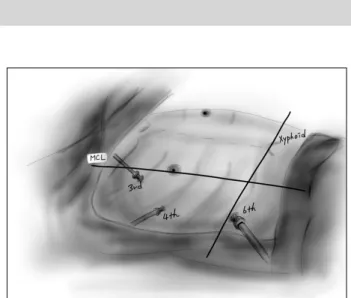
Fig. 1. Patient position for a total thoracoscopic ablation. MCL, midclavicular line.

A Totally Thoracoscopic Ablation for Persistent Atrial Fibrillation

Sung Sil Choi, M.D.

We report the case of a 72-year-old female with persistent atrial fibrillation who underwent a totally thoracoscopic ablation. A successful normal sinus conversion was achieved.

Key words: 1. Atrial fibrillation 2. Thoracoscopy 3. Ablation

CASE REPORT

A 72-year-old female visited the emergency room because of a suddenly developed headache. The brain imaging studies revealed acute cerebral infarction. Further, the electrocardio- graphy showed atrial fibrillation (AF). The echocardiography revealed that the mean left atrial dimension was 32.7 mm in the parasternal long axis view and 38.6 mm in the apical four-chamber view. The left ventricular ejection fraction was 86%. Transthoracic echocardiography revealed no intracardiac thrombus and normal valvular function. Amiodarone and cou- madine were begun and maintained for the following five months. Just before the operation, the electrocardiogram still showed AF and the patient complained of palpitation and chest discomfort. We decided to perform thoracoscopic ablation. We performed transesophageal echocardiography af- ter induction of anesthesia to rule out intracardiac thrombus.

Before induction, defibrillator pads were placed appropriately.

With the right lung deflated, the initial 10-mm port was placed in the sixth interspace at the anterior axillary line (Fig.

1). After thoracoscopic examination, two additional ports were inserted. Under thoracoscopic control, the pericardium

was opened by electrocautery approximately 2 cm anterior to

the right phrenic nerve. Pericardial traction was executed us-

ing an endoscopic suturing device (Endostitch; Covidien Inc.,

Norwalk, CT, USA). The oblique sinus was entered by gentle

blunt dissection through the pericardial reflections under the

inferior vena cava. A light dissector was used for encircling

the pulmonary venous antrum. The antral area was ablated

using a bipolar radiofrequency clamp (EMR; Atricure Inc.,

(2)

Sung Sil Choi

− 462 − Fig. 2. Thoracoscopic view during right pulmonary vein isolation with bipolar clamp. RSPV, right superior pulmonary vein; RIPV,

right inferior pulmonary vein; LA, left atrium; RA, right atrium. Fig. 3. Ablation lines. 1, left side pulmonary vein (LSPV) isola- tion; 2, right side pulmonary vein (RSPV) isolation; 3, superior line; 4, inferior line; 5, excised site of left atrial appendage; RIPV, right inferior pulmonary vein; RA, right atrium, SVC, superior vena cava; LIPV, left inferior pulmonary vein; IVC, inferior vena cava.

Cincinnati, OH, USA) (Fig. 2). The end point for pulmonary vein antral ablation was a complete exit block from the pul- monary veins. The autonomic ganglia plexuses (GPs) were ablated. High-frequency testing of the GPs was performed.

Each of the testing sites was stimulated at a rate of 1,000 Hz and an amplitude of 18 V with at least a doubling of the R-R interval qualifying as a positive response. The right GP travels toward the right pulmonary veins and the interarterial groove. The left GP travels in the direction of the base of the left atrial appendage and the left upper pulmonary vein.

Bipolar radiofrequency energy at 15 W was delivered through the bipolar pen (Isolator multifunctional pen; Atricure Inc.) to the GPs. After dissecting the transverse sinus, additional lines, which were a superior line through the transverse sinus and an inferior line through the oblique sinus, were made with the aid of a Cool Rail (Atricure Inc.). After the left lung was deflated, three trocars were inserted and were placed more posteriorly. Marshall’s ligament was divided after left pericardiotomy. The previously performed line of ablation (superior line) across the transverse sinus was easily vi- sualized and extended onto the left superior pulmonary vein, and the previously performed ablation line (inferior line) in the oblique sinus from the right chest was clearly identified.

The linear probe created a line of ablation connecting the caudal margins of the two pulmonary isolation boxes (Fig. 3).

The left atrial appendage exclusion was performed using a

stapler (Ethicon Endo-Surgery Inc., Cincinnati, OH, USA) af- ter the absence of flow was confirmed by intraoperative transesophageal echocardiography. Normal sinus rhythm was converted intraoperatively. A single chest tube was placed for draining each pleural space. The patient was extubated in the operating room. The operative time was 125 minutes.

Postoperatively, coumadine and amiodarone were continued.

The length of the hospital stay was 7 days. She resumed nor- mal sinus rhythm two months after total thoracoscopic abla- tion, which was confirmed by 24-hour electrocardiogram monitoring.

DISCUSSION

AF is the most common form of arrhythmia. Its prevalence

increases sharply with age, from approximately 1% among

people aged 55 to 59 years to more than 10% among those

in the age group of 80 or more years [1]. Although Cox

Maze III surgery is the gold standard for the surgical treat-

ment of AF, this procedure has failed to achieve widespread

adoption because of its complexity and highly invasive nature

[2]. As the electrophysiological mechanisms of AF have be-

come better understood, ablation strategies have been refined

(3)

A Totally Thoracoscopic Ablation for Persistent Atrial Fibrillation

− 463 − to target the pulmonary vein antrum. The landmark work of Haissaguerre et al. [3] identified the pulmonary veins as the sources of AF. Pulmonary vein isolation has emerged as a successful technique for the ablation of paroxysmal AF. In addition, Scherlag et al. [4] have demonstrated that the para- sympathetic and sympathetic efferent neurons present in epi- cardial ganglionic plexi and the intrinsic cardiac autonomic nervous system may play an important role in triggering pul- monary vein firing. Marshall’s ligament may also play a role in triggering AF in some individuals [5]. Catheter ablation has become an established invasive procedure in patients with AF. The efficacy of catheter ablation may vary considerably depending on the strategy and technology used and the stage of the electroanatomic disease. For paroxysmal AF, >70%

single-procedure efficacy is considered achievable, whereas for persistent AF, additional target ablation and multiple pro- cedures are required to achieve reasonable results. In 2006, Wolf et al. [6] described video-assisted thoracoscopic surgical ablation involving pulmonary vein isolation from the epi- cardial side with a bipolar radiofrequency clamp, ablation of the ganglia over the left atrial surface, and excision of the left atrial appendage. The initial efficacy of this minimally in- vasive surgery has been reported to be >90% in selected populations. In 2012, Boersma et al. [7] reported the first prospective randomized clinical trial to provide a head-to-head comparison of catheter ablation and minimal thoracoscopic ablation in a well-described population of AF patients. They reported that the primary efficacy end point of freedom from any left atrial arrhythmia of >30 s in the ab- sence of antiarrhythmic agents after 12 months was achieved in 36.5% of the catheter ablation and in 65.6% of the surgi- cal ablation group (p=0.0022). In the non-paroxysmal group, the efficacy was higher in the thoracoscopic ablation group than in the catheter ablation group. They noted that it was not proven whether additional lines and GP ablation were necessary. Our patient had non-paroxysmal AF. Although the

normal sinus rhythm conversion rate after ablation in non-par- oxysmal AF is lower, here, we report the acute procedural success of normal sinus conversion. As the follow-up period was short, however, we should obtain the longer outcomes.

Further, it is necessary to consider more cases in order to reach a definitive conclusion.

CONFLICT OF INTEREST

No potential conflict of interest relevant to this article was reported.

REFERENCES

1. Feinberg WM, Blackshear JL, Laupacis A, Kronmal R, Hart RG. Prevalence, age distribution, and gender of patients with atrial fibrillation: analysis and implications. Arch Intern Med 1995;155:469-73.

2. Prasad SM, Maniar HS, Camillo CJ, et al. The Cox maze III procedure for atrial fibrillation: long-term efficacy in pa- tients undergoing lone versus concomitant procedures. J Thorac Cardiovasc Surg 2003;126:1822-8.

3. Haissaguerre M, Jais P, Shah DC, et al. Spontaneous ini- tiation of atrial fibrillation by ectopic beats originating in the pulmonary veins. N Engl J Med 1998;339:659-66.

4. Scherlag BJ, Yamanashi W, Patel U, Lazzara R, Jackman WM. Autonomically induced conversion of pulmonary vein focal firing into atrial fibrillation. J Am Coll Cardiol 2005;

45:1878-86.

5. Tan AY, Chou CC, Zhou S, et al. Electrical connections be- tween left superior pulmonary vein, left atrium, and ligament of Marshall: implications for mechanisms of atrial fibrilla- tion. Am J Physiol Heart Circ Physiol 2006;290:H312-22.

6. Wolf RK, Schneeberger EW, Osterday R, et al. Video-as- sisted bilateral pulmonary vein isolation and left atrial ap- pendage exclusion for atrial fibrillation. J Thorac Cardiovasc Surg 2005;130:797-802.

7. Boersma LV, Castella M, van Boven W, et al. Atrial fi-

brillation catheter ablation versus surgical ablation treatment

(FAST): a 2-center randomized clinical trial. Circulation

2012;125:23-30.

수치

Fig. 1. Patient position for a total thoracoscopic ablation. MCL,  midclavicular line.

참조

관련 문서

멘토링 과정에서는 많은 어려움이 발생하기 때문에 초지일관 자신 감과참을성을 가지고 끈질기게 멘토링에 참여하는 것이 필요하다. 계획된 멘토링에 진지하고 헌신적으로

systemic circulation, in the right ventricle and oxygenated blood from the lungs, or pulmonary circulation, in the left ventricle, as in birds and mammals.. Two vessels,

*단어 사이의 공통성과

(1) Infuse fluid through a large vein: subclavian vein (high osmolarity) (2) Ensure proper placement of the line (chest X-ray after line insertion) (3) Precisely regulate

E04 Left Side Cover● Water Pump E05 Right Crankcase Cover● Shaft E06 Throttle Body.. E07 Transmission Pulley E08 Starting Motor● Generator E09 Crank

동결방지 조치를 취하여 등을 사용하여 적절한 우려가 있는 곳은 보온재 드레인 호스 설치시 동결.

[r]

**In matches where Round 3 requires a drill to be done on the Right side for half the round and Left side for the other half of the round, there will be a 10 second