• 검색 결과가 없습니다.

Pulmonary Vein to Esophageal Fistula after Staged Hybrid Totally Thoracoscopic Surgical and Percutaneous Radiofrequency Catheter Ablation: A Case Report

N/A
N/A
Protected

Academic year: 2021

Share "Pulmonary Vein to Esophageal Fistula after Staged Hybrid Totally Thoracoscopic Surgical and Percutaneous Radiofrequency Catheter Ablation: A Case Report"

Copied!
3
0
0

로드 중.... (전체 텍스트 보기)

전체 글

(1)

ISSN: 2233-601X (Print) ISSN: 2093-6516 (Online)

− 560 −

1

Department of Thoracic and Cardiovascular Surgery and

2

Division of Cardiology, Department of Internal Medicine, Samsung Medical Center, Sungkyunkwan University School of Medicine

Received: June 3, 2014, Revised: August 17, 2014, Accepted: September 3, 2014, Published online: December 5, 2014

Corresponding author: Dong Seop Jeong, Department of Thoracic and Cardiovascular Surgery, Samsung Medical Center, Sungkyunkwan University School of Medicine, 81 Irwon-ro, Gangnam-gu, Seoul 135-710, Korea

(Tel) 82-2-3410-1278 (Fax) 82-2-3410-1680 (E-mail) [email protected]

C

The Korean Society for Thoracic and Cardiovascular Surgery. 2014. All right reserved.

CC
This is an open access article distributed under the terms of the Creative Commons Attribution Non-Commercial License (http://creative- commons.org/licenses/by-nc/3.0) which permits unrestricted non-commercial use, distribution, and reproduction in any medium, provided the original work is properly cited.

Pulmonary Vein to Esophageal Fistula after Staged Hybrid Totally Thoracoscopic Surgical and Percutaneous Radiofrequency

Catheter Ablation: A Case Report

Byung-Jo Park, M.D.

1

, Yong Han Kim, M.D.

1

, Dong Seop Jeong, M.D., Ph.D.

1

, Yong Soo Choi, M.D., Ph.D.

1

, Young Keun On, M.D., Ph.D.

2

A case of a fistula running from the pulmonary vein to the esophagus after a staged hybrid procedure combining total thoracoscopic ablation and percutaneous radiofrequency catheter ablation has not been reported previously. We describe such a case in a 37-year-old man who was successfully treated by surgery.

Key words: 1. Pulmonary veins 2. Esophageal fistula

CASE REPORT

A 37-year-old man was admitted to our hospital with long-standing, persistent, lone atrial fibrillation refractory to medical therapy and several attempts of cardioversion. The patient underwent a total thoracoscopic epicardial ablation without any intraoperative or postoperative complications, fol- lowed by a percutaneous postprocedural electrophysiologic evaluation that included confirmation of pulmonary vein iso- lation and a cavotricuspid isthmus block on the tenth post- operative day. He was discharged in sinus rhythm six days after the hybrid procedure.

Two weeks after discharge, the patient was admitted to the emergency room with right-sided motor weakness and par- esthesia of both upper and lower extremities. His fever reached 40

o

C, and he had a white blood cell count of 17,690/L. An electrocardiogram showed atrial fibrillation. Computed tomog- raphy imaging of the chest and brain was performed. Chest

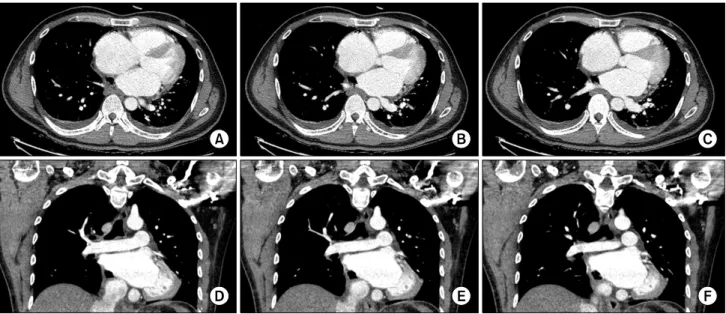
computed tomography imaging revealed a collection of locu- lated air measuring up to 2 cm in diameter between the right side of the left atrium and the esophagus, with no definitive evidence of a fistulous connection (Fig. 1). Brain computed tomography revealed an acute-onset left middle cerebral ar- tery infarction. Emergency echocardiography revealed many floating microbubbles.

An urgent surgical intervention was performed due to our high level of suspicion for a left atrial or pulmonary ve- nous-esophageal fistula. The right femoral area was prepared for the possibility of an emergent cardiopulmonary bypass.

The chest was opened through the fifth intercostal space via a right posterolateral thoracotomy under one-lung ventilation with a double lumen endotracheal tube. After anteriorly re- tracting the lung, a meticulous dissection of the posterior me- diastinum between the esophagus, right upper and lower pul- monary veins, and left atrium was performed. A fistula 2 to 3 mm in diameter was discovered between the right lower

Korean J Thorac Cardiovasc Surg 2014;47:560-562 □ Case Report □

http://dx.doi.org/10.5090/kjtcs.2014.47.6.560

(2)

Pulmonary Vein to Esophageal Fistula

− 561 −

Fig. 1. (A-C) Axial and (D-F) coronal views of computed tomography imaging show a loculated air density on the right side of the left atrium.

Fig. 2. Intraoperative photograph of the fistula between the ante- rior surface of the esophagus and the right lower pulmonary vein after division.

pulmonary vein and anterior surface of the esophagus. The fistula was divided with Metzenbaum scissors (Fig. 2).

Surprisingly, there was no bleeding from the fistula on the side of the right lower pulmonary vein. The internal orifice was very small, with a diameter of approximately 1 mm. The right lower pulmonary vein was repaired with a bovine peri- cardial patch, covered, and fixed with continuous poly- propylene sutures. After repairing the right lower pulmonary vein, we consulted our hospital’s thoracic surgeon about re- pairing the fistula opening on the esophageal side. He de-

cided to carry out a primary repair of this defect because the defect site was small and relatively clear. The fistula was carefully debrided and repaired with intermittent 4-0 black silk sutures.

The operation was successful and the postoperative course was uneventful. The patient’s rhythm was converted to sinus rhythm and sustained after cardioversion one day after surgery. The patient became alert on the third postoperative day, and was extubated on the fifth postoperative day. He was discharged 39 days postoperatively, with a motor power score of three out of five on the Medical Research Council scale after rehabilitation therapy. On his last outpatient visit, two and a half months after surgery, motor power was fully recovered without any sequelae.

DISCUSSION

A hybrid procedure of a total thoracoscopic epicardial abla- tion and percutaneous transvenous radiofrequency catheter ablation for lone atrial fibrillation, performed either simulta- neously as a single stage procedure or as a two-stage proce- dure, has been developed to overcome the limitations of each technique and result in better outcomes [1,2].

The success rate of this therapy varies according to the

(3)

Byung-Jo Park, et al

− 562 − specific goals of the intervention and the duration of atrial fi- brillation (paroxysmal or persistent). Pison et al. [1] reported conversion to sinus rhythm after a single stage procedure with a success rate of 83% after one year. Muneretto et al.

[2] reported conversion to sinus rhythm after a two-stage pro- cedure with a success rate of 91.6% at a mean follow-up of 30 months. After being performed for the first time in South Korea at the Samsung Medical Center in February 2012, we have performed 50 staged hybrid procedures to date with a successful conversion to sinus rhythm in 48 out of 50 patients.

Unfortunately, we experienced a potentially fatal case of a fistula running from the pulmonary vein to the esophagus fis- tula despite the high success rate of conversion to sinus rhythm. We believe our case of a right lower pulmonary ve- nous-esophageal fistula after thoracoscopic epicardial and transvenous catheter ablation to be the first reported in the literature. Even though the radiofrequency catheter ablation was performed after the total thoracoscopic epicardial ablation in a staged procedure, we think that there may have been some degree of infection or edema at the ablation sites due to the short (ten days) interval between the components of the hybrid procedure. The process of pulmonary vein iso- lation confirmation may injure this fragile tissue.

The most commonly reported esophageal complication after radiofrequency catheter ablation are left atrial-esophageal fis- tulas, with an incidence rate of up to 0.2% [3]. These fistulas result from the usual anatomical relationship of the esophagus to the left atrium and pulmonary veins. However, unusual variations where the esophagus is situated rightward in the posterior mediastinum near the right pulmonary veins have been described [4], as in our present case.

There is no definitive surgical approach for esophageal

fistulas. A median sternotomy or a right or left thoracotomy with or without cardiopulmonary bypass is possible depend- ing on the clinical situation and location of the fistula.

Surgical exposure in our case was achieved via a right post- erolateral thoracotomy to expose the suspicious right pulmo- nary veins and left atrium.

In light of this rare but potentially lethal event, we suggest the development of a better-defined consensus, based on fur- ther studies, on whether hybrid thoracoscopic epicardial and percutaneous catheter ablations should be performed simulta- neously or as a staged procedure.

CONFLICT OF INTEREST

No potential conflict of interest relevant to this article was reported.

REFERENCES

1. Pison L, La Meir M, van Opstal J, Blaauw Y, Maessen J, Crijns HJ. Hybrid thoracoscopic surgical and transvenous catheter ablation of atrial fibrillation. J Am Coll Cardiol 2012;60:54-61.

2. Muneretto C, Bisleri G, Bontempi L, Curnis A. Durable staged hybrid ablation with thoracoscopic and percutaneous approach for treatment of long-standing atrial fibrillation: a 30-month assessment with continuous monitoring. J Thorac Cardiovasc Surg 2012;144:1460-5.

3. Dagres N, Hindricks G, Kottkamp H, et al. Complications of atrial fibrillation ablation in a high-volume center in 1,000 procedures: still cause for concern? J Cardiovasc Electro- physiol 2009;20:1014-9.

4. Cury RC, Abbara S, Schmidt S, et al. Relationship of the esophagus and aorta to the left atrium and pulmonary veins:

implications for catheter ablation of atrial fibrillation. Heart

Rhythm 2005;2:1317-23.

수치

Fig. 1. (A-C) Axial and (D-F) coronal views of computed tomography imaging show a loculated air density on the right side of the left  atrium.

참조

관련 문서

Percutaneous polymethylmethacrylate vertebroplasty in the treatment of osteoporotic vertebral body compression fractures: technical aspects. Pulmonary embolism caused

Second, to see a similarity factor among the relation between a factor which forms peer group and the attitudes toward school life, in case of the

(Attached to a verb) This is used to show that the succeeding action takes place right after the preceding action.. (Attached to a verb) This is used to indicate a

The sublimation purification method is similar to the vapor deposition process ,in which crystallization occurs after evaporation from a solid state to a

The purpose of the study is to develop a sensor data collection and monitoring system with database using IoT techrology and to apply the ststem to three

In order to conduct a more detailed and dense analysis of the overall operation of the Creation & Production Center, the case of the creation

Post-surgical use of radioiodine (131I) in patients with papillary and follicular thyroid cancer and the issue of remnant ablation: a consensus

De-assertion causes the NB or external clock generator to turn on the processor, and that takes place (a) in a sleep state: after a wake-up event is triggered; (b) in