ABSTRACT
Background and Objectives: We aimed to investigate the relationship between the recurrence of atrial fibrillation (AF) and fibrosis marker soluble ST2 (sST2) in patients with nonvalvular paroxysmal AF (PAF).
Methods: We prospectively included 100 consecutive patients with PAF diagnosis and scheduled for cryoballoon catheter ablation for AF (47 males, 53 females; mean age 55.1±10.8 years). sST2 plasma levels were determined using the ASPECT-PLUS assay on ASPECT Reader device (Critical Diagnostics). The measurement range of these measurements was 12.5–250 ng/mL. Patients had regular follow-up visits with 12-lead electrocardiogram (ECG), medical history, and clinical evaluation. Twenty-four hours Holter ECG monitoring had been recorded 12 months after ablation.
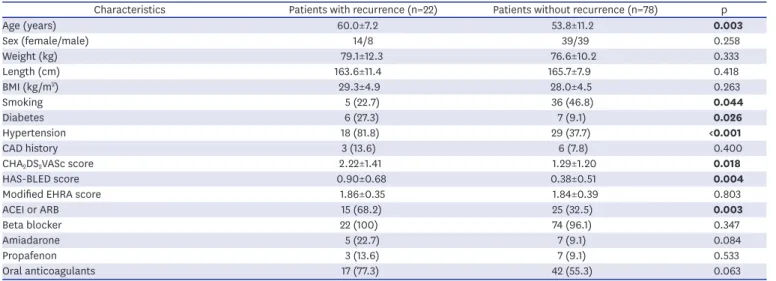
Results: AF recurrence was detected in 22 patients after 1 year. Age, smoking history, diabetes mellitus,hypertension frequency, angiotensin converting enzyme inhibitor- angiotensin receptor blocker use, CHA
2DS
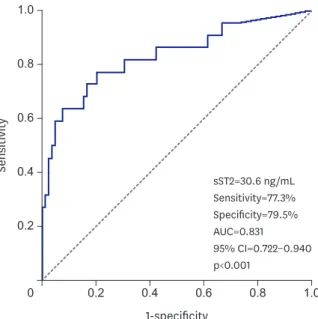
2VASc and HAS-BLED scores, serum sST2 level, left atrium (LA) end-diastolic diameter, LA volume and LA volume index were related to AF recurrence. In multivariable logistic regression analysis, sST2 was found to be only independent parameter for predicting AF recurrence (odds ratio, 1.085; p=0.001). Every 10-unit increase in sST2 was found to be associated with 2.103-fold increase in the risk of AF recurrence. The cut-off value of sST2 obtained by receiver operating characteristic curve analysis was 30.6 ng/mL for prediction of AF recurrence (sensitivity: 77.3%, specificity:
79.5%). The area under the curve was 0.831 (p<0.001).
Conclusions: sST2, which is associated with atrial fibrosis, can be thought to be a useful marker for detection of patients with high-grade fibrosis who will get less benefit from cryoablation.
Keywords: Soluble ST2; AF recurrence; Cryosurgery
Original Article
Received: Feb 7, 2018 Revised: Mar 18, 2018 Accepted: Apr 18, 2018 Correspondence to Onur Kaypakli, MD
Department of Cardiology, Mustafa Kemal University, Faculty of Medicine, Antakya 31060, Hatay, Turkey.
E-mail: [email protected] Copyright © 2018. The Korean Society of Cardiology
This is an Open Access article distributed under the terms of the Creative Commons Attribution Non-Commercial License (https://
creativecommons.org/licenses/by-nc/4.0) which permits unrestricted noncommercial use, distribution, and reproduction in any medium, provided the original work is properly cited.
ORCID iDs Sefa Okar
https://orcid.org/0000-0003-1413-7393 Onur Kaypakli
https://orcid.org/0000-0002-5065-3283 Durmuş Yıldıray Şahin
https://orcid.org/0000-0002-3519-0962 Mevlüt Koç
https://orcid.org/0000-0002-3000-4200 Conflict of Interest
The authors have no financial conflicts of interest.
Sefa Okar , MD
1, Onur Kaypakli , MD
2, Durmuş Yıldıray Şahin , MD
1, and Mevlüt Koç , MD
11
Department of Cardiology, University of Health Sciences, Adana Health Practices and Research Center, Adana, Turkey
2