EFFECT OF TIN COATING OF ABUTMENT SCREW ON DETORQUE FORCE
Hee-Jung Kim, D.D.S., Ph.D., Han-Cheol Choe1, D.D.S., Ph.D., Chae-Heon Chung, D.D.S., Ph.D.,
Department of Prosthodontics, College of Dentistry, Chosun University
1Department of Dental materials, College of Dentistry, Chosun University
Purpose.The aim of this study is to evaluate the effect of TiN coating of abutment screw on the unscrewing torque.
Material and methods.Titanium and Gold-Tite abutment screws were classified into two groups, Group A and C respectively, as control groups. Titanium abutment screws with TiN coatings were also classified into two groups, Group B and D, as experimental ones. Group A and B were tightened to 20 Ncm input torque, and Group C and D were tightened to 32 Ncm torque. Detorque values were measured with digital torque gauge during repeated closing and opening experiment.
Results. Abutment screws with TiN coating (Group B and D) showed statistically significant higher mean detorque values than those of Group A and C.
Discussion.Physical properties of TiN coating, such as low friction coefficient, high hard- ness and wear resistance, might contribute to higher detorque values.
Conclusion.It is suggested that TiN coating of abutment screw help to reduce the risk of screw loosening and improve the stability of screw joint.
Key Words
Abutment screw, TiN coating, Detorque force, Screw loosening
J Korean Acad Prosthodont : Volume 45, Number 3, 2007
M
ost of implant systems have more than one screw to connect the restoration or supras- tructure to an implant fixture. Screw loosening in such systems has been reported as one of the most common complications.1-3In the study by Jemt and associates,2abutment screw loosening was found to be as high as 45% with implant single crowns. Goodacre and associates3reported abut- ment screw loosening was detected in 6% (loos- ened 365 screws out of 6256 screws) of the pros-theses.
Factors related to screw loosening are various including poor tightening (inadequate preload), inaccurate fit of framework, poor component fit, flexure of framework, settling, debris trapped in screw receptor, screw design and bone elasticity.4 However, the most frequent cause of screw loos- ening is the loss of preload. Preload is tension with- in a tightened screw and is induced in a screw when torque is applied during tightening.4,5 When torque is applied to new screw, about
90% of input torque is used to overcome fric- tion and only 10% to induce preload.6
For that reason, a few manufacturers have altered the surface of abutment screw to reduce the friction coefficient and obtain the higher pre- load. The most well-known abutment screws are the Gold-Tite of 3i (3i/implant Innovations Inc, USA) and TorqTite of Steri-Oss(Novel Biocare USA, Yorba Linda, Calif.). Martin and associates7 reported that Gold-Tite and Torqtite abutment screws with enhanced surfaces helped reduce the friction coefficient and generated greater rotational angles and preload values than con- ventional screw. Drago8stated that use of Gold- Tite square abutment screws, torqued to 35 Ncm, showed stable implant/abutment connection resulting successful clinical practice for one year.
Extremely thin titanium nitride (TiN) coatings have been the most general and popular coating methods for improving the properties of metal- lic surface in industrial fields. The 2~3 ㎛ thickness layer makes scratch-proof surface and is con- sidered to be chemically stable. TiN has been used as a hard coating for metal cutting tools like drills and burs, and forming tools such as dies and punches because it has high hardness, low fric- tion coefficient (lubricity) and good resistance to adhesive wear.9Additionally, it has a golden appearance and is useful for ornamental pur- poses. These properties of TiN coating are expect- ed to increase the preload.
TiN coating has been applied to clinical dentistry
long since. The clinical trials which coated crown, partial fixed denture and removable prostheses made from casting dental alloy with TiN had been performed by several dentists.9At that time, most of researches focused on biological, mechanical and corrosive aspects of the coat- ing. Recently, Scarano10,11reported that TiN sur- faces showed a significant reduction of the pres- ence of bacteria and the bone healing around the TiN-coated implants was similar to that observed around the uncoated surfaces. The application of TiN coatings on abutment screw, however, has not been reported yet.
The aim of this study was to evaluate the effect of TiN coating of abutment screw on the unscrew- ing torque.
MATERIAL AND METHODS Sample Preparation
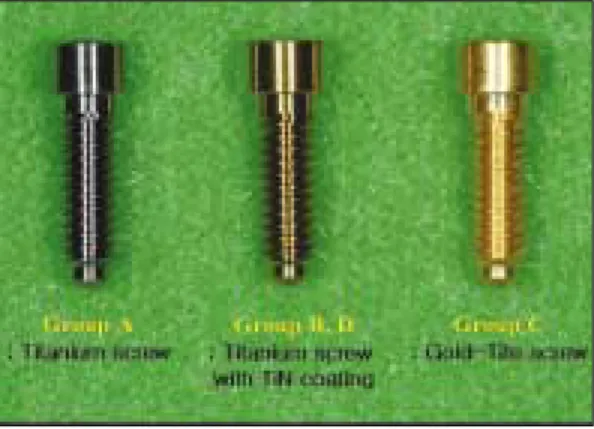
Abutment screws that used for this experi- ment were titanium hexed uniscrews(3i/ implant Innovations Inc, USA) and Gold-Tite abutment screws (3i/implant Innovations Inc, Palm Beach Gardens, Florida, USA). Randomly selected 21 tita- nium and 7 Gold-Tite, total twenty eight abutment screws, were used. Twenty-one titanium abutment screws were divided into 3 groups with even number, which were Group A, B, D. Group C was consisted with seven Gold-Tite abutment screws.
Titanium abutment screws in Group B and D
Table I. Classification of Groups
Group Abutment Screw Number(n) Applied torque(Ncm)
A* Titanium Hexed Uniscrew 7 20
B** Titanium Hexed Uniscrew with TiN coating 7 20
C* Gold-Tite Abutment screw 7 32
D** Titanium Hexed Uniscrew with TiN coating 7 32
*=control groups, **=experimental groups.
were coated with TiN as experimental group and Group A and C were used as control groups.
Abutment screws of experimental groups were coated with TiN by using radio frequency sput- tering physical vapour deposition (RF sputtering).
TiN film of 2-3 ㎛ thickness was deposited on the threads of abutment screw. Prior to deposition, all abutment screws were cleaned ultrasonically, in detergent, methanol and finally distilled water, and presputtering was carried out for 20 minutes using an RF power of 200 W. TiN coatings were made by RF sputtering of a titanium target in an
atmosphere of Ar and N2. The TiN film was pro- duced as a function of gas composition, basic and working pressure, substrate temperature, and coating thickness. The conditions for TiN coating of Group B and D were shown in Table II.
The implant fixtures selected in this study were external hexagonal extension threaded implants(OSSEOTITE Hexlock 4.0 mm in diam- eter ×13 mm in length; 3i implant Innovations Inc, USA, Fig. 2a). Abutments for this experiment were 3i GingiHueTM Post abument (4.1 mm in diameter ×5 mm in emergence profile ×2 mm in
Fig. 1. Kinds of abutment screws.
(Group A: Titanium abutment screw; Group B, D:
TiN coated titanium abutment screw; Group C: Gold abutment screw)
(a) (b)
Fig. 2. Fixture and abutment for this study(a) Hexlock 4.0mm in diametet ×13 mm in length, (b) 3i GingiHueTMPost abu- Table II. Deposition conditions of TiN Coatings
RF Power 200 W
sputtering Time 40 Min
N2Gas 40 sccm
Basic Pressure 1×10⁻⁶torr Working Pressure 2×10⁻²torr
Temperature 300℃
Coating thickness 2-3 ㎛
gingival height ; 3i implant Innovations Inc, USA, Fig. 2b). Twenty-eight pairs of implant fix- ture and abutment were selected. One fixture, one abutment and one abutment screw comprised a specimen.
Measurement of Detorque Value
The implant fixtures were perpendicularly mounted in liquid unsaturated polyesther with dental surveyor. The mounting media (Epovia, Cray Valley Inc, Jeonju, Korea) was a 2-part sys- tem made up of a resin and hardener. The two components were mixed together and poured and allowed to cure overnight. Mounted fixture block was fixed in the customized jig before closing and opening experiment (Figs. 3a to 3c).
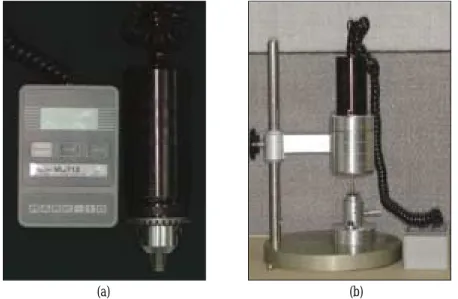
Each abutment was secured to the implant fixture by each abutment screw with recommended torque value using hand screw driver (PHD02N, 3i/implant Innovations Inc, USA) and electron- ic torque controller(Bra�nemark system DEA 020 Torque controller, Go¨teborg, Sweden, Figs 4a, 4b). Hand screw driver was used to fix the abut- ment screw till thread mating components were slightly contact. After that, electronic torque con- troller was used to tighten the screw to 20/32 Ncm.
It was used to insure that an accurate and repro- ducible force was applied to each abutment screw (Fig 4-b). According to manual of manu- facturer, 20 Ncm tightening torque was applied for titanium abutment screw group (Group A) and 32 Ncm for Gold-Tite abutment screw(Group C). Group B was torqued by 20 Ncm for the
(a) (b) (c) Fig. 3. Mounted sample(a) and customized jig{(b),(c)} for measurement of detorque value.
(a) (b) Fig. 4. Hand screw driver(a) and electronic torque controller(b).
comparison with Group A and Group D was tested to 32 Ncm torque for the comparison with Group C. Detorque values were measured with digital torque gauge (MGT 12�, Mark-10 Corp., New York, U.S.A, Fig. 5a). The abutment screws were repeatedly tightened and removed up to thir- ty trials. Identical measurements were repeat- edly performed 30 times in each sample. One operator who had experienced implant pros- thetic restorations performed this operation.
Statistical Analysis
SPSS statistical software for Windows (release 12.0, SPSS Inc., Chicago, U.S.A.) was used for statistical analysis. Repeated measure ANOVA (analysis of variances) and Student t-test were used for the comparison of the detorque values mea- sured from coating groups and non-coating ones.
Hierarchical cluster analysis was used to find a sta- tistical reduction point of detorque force of non- coating groups. Values of P<0.05 were considered statistically significant.
RESULTS
Fig. 6 and Table III show the mean detorque val- ues of each trial. As shown in Fig. 6, Group C and Group D, tested to 32 Ncm, had a higher mean detorque force than Group A and Group B. Three groups except Group C had a declining tenden- cy of detorque value as the closing and opening were repeated, while Group C had a slight ascending tendency. Cluster analysis revealed that the mean detorque values of only Group A were classified into two levels, high and low level, between 13th and 14th trial(Fig. 7).
The results from the measurements of detorque value at 20 Ncm were shown in Fig. 8 and Table IV. There was a statistically significant differ- ence between Group A and Group B (P < 0.05, repeated measure ANOVA). In the comparison of detorque values from 1st trial to thirteenth one, there was no statistically significant difference between Group A and Group B (P > 0.05, student t-test) (Fig. 9). However, the comparison of detorque values from 14th to 30th trial revealed (a) (b)
Fig. 5. Digital torque gauge(a) and measurement of detorque value(b).
Table III. Mean Detorque Value (Unit; Ncm)
Groups
Group A Group B Group C Group D
Trials
1 17.04 18.27 19.29 25.01
2 18.36 17.44 19.81 22.94
3 18.41 18.51 18.54 23.87
4 16.96 17.66 19.39 24.51
5 16.36 17.96 19.20 23.43
6 16.81 16.40 19.29 22.71
7 16.67 16.63 19.87 23.64
8 17.97 17.47 20.03 26.53
9 15.23 16.96 21.21 21.94
10 17.31 16.73 21.27 24.57
11 15.56 17.19 22.21 23.43
12 14.61 15.90 19.73 22.64
13 15.69 14.83 20.46 23.71
14 13.80 16.94 20.39 23.36
15 13.66 15.46 20.74 22.80
16 13.53 15.89 21.24 23.63
17 13.79 15.99 20.73 21.19
18 12.93 14.76 19.66 22.47
19 13.24 15.01 19.64 24.67
20 12.94 15.74 21.54 23.79
21 11.59 14.67 20.69 23.31
22 14.26 14.51 20.01 22.94
23 12.56 14.20 22.34 23.66
24 12.47 15.10 22.04 23.99
25 13.21 16.10 21.67 23.54
26 11.89 14.96 20.14 21.57
27 12.07 14.77 19.54 23.00
28 14.56 15.47 21.54 23.89
29 13.71 14.84 20.50 21.10
30 13.39 15.26 20.13 22.87
Mean 14.69 16.05 20.43 23.36
SD 2.03 1.23 0.99 1.12
Table IV. Mean Detorque Value of Group A
and B (Unit; Ncm)
Sample Number Group A Group B
1 14.74 15.65
2 14.05 17.09
3 14.54 16.23
4 15.18 15.57
5 15.65 15.34
6 14.87 16.22
7 13.78 16.28
Mean 14.69 16.05
SD 0.64 0.59
Fig. 6. Distribution of mean detorque value of all groups.
Fig. 8. Comparison of detoque value of Group A and Group B (P<0.05, ANOVA, n=7).
Fig. 7. Distribution of mean detorque value of Group A.
that Group B had statistically higher detorque val- ues than Group A (P < 0.05, student t-test) (Fig. 9).
The results of detorque values measured at 32Ncm were reported in Table V and Fig. 10.
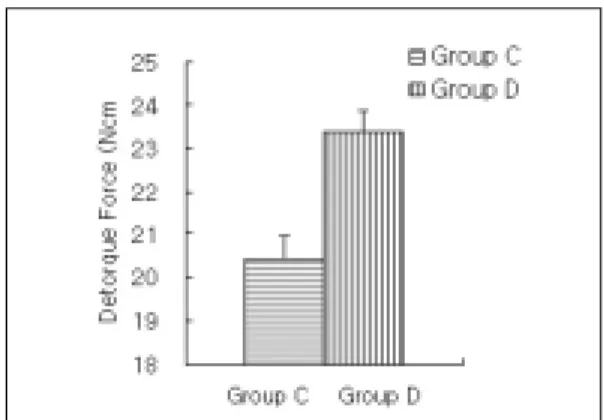
There was statistically significant difference between Group C and Group D (P<0.05, repeat- ed measure ANOVA) (Fig. 10). Detorque val- ues of Group D were statistically higher than those of Group C during every trial.
Table V.Mean Detorque Value of Group C and D (Unit; Ncm) Groups
Group C Group D
Trials
1 21.02 23.16
2 17.83 22.25
3 21.47 24.88
4 17.59 21.76
5 20.70 23.08
6 21.01 24.37
7 23.38 24.00
Mean 20.43 23.36
SD 2.06 1.13
Fig. 11. Photomicrograph of abutment screw threads of Group A and B in SEM (magnification ×10000).
Fig. 12. Photomicrograph of abutment screw threads of Group C and D in SEM (magnification ×10000).
Fig. 9. Detorque value of Group A and B. Fig. 10. Comparison of detoque value of Group C and Group D (P<0.05, ANOVA, n=7).
DISSCUSSION
Screw loosening has been frequently report- ed in implant dentistry and still remained as a potential problem. The prevalent method to reduce the screw loosening is the application of dry lubricant coating on abutment screw. The pur- pose of lubricant coating is to reduce a frictional coefficient and obtain a higher preload. The need for coating with lubricant has long since intro- duced.7
In this study, all abutment screws were repeat- edly closed and opened up to 30 trials. The num- ber of trials included several try-in of abutment screw up to final setting and long follow-up once or twice a year.
As shown in Table III, Group C and D tightened to 32Ncm had higher detorque values than Group A and B. Three groups except for Group C had a declining tendency of detorque value as the clos- ing and opening were repeated, while Group C had a ascending tendency. This might be attrib- uted to malleability and ductility of gold. Because gold has physical property such as the most malleable and ductile properties of any metal, and resistance to corrosion,12so space can be closed between screw and thread if pure gold is com- pressed slightly between titanium and gold alloy.13Furthermore, high ductility of gold lead- ed to decrease friction and settling when screw is tightened.14It is considered that such properties make the detorque values ascending in minute.
In the comparison of detorque values of Group A and B, there was a statistically significant dif- ference between Group A and Group B. Both Group A and B exhibited the gradual decrease of detorque values during the test. Especially, from the viewpoint of statistics, only Group A showed remarkable detorque value reduction from the 14th measurement of loosening. It might be attrib- uted to the severe decrease of friction coefficient
due to wear between mating components. In the study of Weiss and associates,15they sug- gested that wear caused by the repeated clos- ing/opening cycles decreased the friction coefficient of screw head, threads, and other mating com- ponents and consequently, resistance to opening force would be gradually decreased. As shown in Fig. 11, Group B with TiN coating had little changes in the thread surface of their abutment screws. The properties of TiN coating such as high hardness and wear resistance might contribute to preventing decrease of detorque values. In this study, the detorque value of titanium abutment screw in external hexed connection was found to decrease from 14th trials. However, the num- ber of specimen size was too small to suggest that the precise trial, from which detorque value starts to decline, be 14th. Further studies are needed to discover that.
Also in the comparison of Group C and D, Group D coated by TiN had higher mean detorque value than Group C. Gold-Tite screws showed low- er mean values than the screws with TiN coating in all trials, even though their detorque values maintained a stable and regular level. This may be attributed to the difference of friction coefficient and the surface treatment between pure gold and TiN. Abutment screws of Group C and D were coated by pure gold and TiN, respectively. Gold- Tite abutment screw is gold alloy with a 0.76㎛
pure gold coating and friction coefficient of the screw is 0.1516against titanium. In the SEM inves- tigation of the coating surface, there were notice- able changes on the threads of Gold-Tite screw (Fig.
12). A typical friction coefficient is 0.65 for TiN against steel. In the study of Pihosh and associates,17 friction coefficient of TiN prepared by RF mag- netron sputtering against steel ranged from 0.14~0.3 according to nitrogen gas consistence.
Friction coefficient of TiN coated screw (Group B and D) could not define because of too small
size of screw. SEM observation of Group D showed that there were moderate changes in the thread surface of screw unlikely as Group B (Fig. 12).
The most common method that gains a higher preload is to reduce the friction coefficient of screw using a dry lubricant. Appropriately dimin- ished frictional coefficient enables abutment screw to gain higher preload and therefore decrease the possibility of screw loosening.
However, excessive decrease of frictional coeffi- cient may cause the decrease of detorque force and more frequent screw loosening. Hagiwara and Ohashi18reported that the preload distributed throughout the screw joint increased as the fric- tion coefficient of friction between the threads decreased and abutment screw removal torque val- ues decreased with a reduction in the coefficient of friction.
About this phenomenon, Martin and associ- ates7mentioned that further studies are needed to test the point at which the reduction in friction was too high and thus might promote screw loos- ening. Although there are numerous factors affecting a friction coefficient, further studies are needed for such a optimal friction coeffi- cient that can obtain a higher preload and prevent the decrease of detorque force.
Beside friction coefficient, surface hardness and wear resistance are also important factors to decrease the detorque loss. In particular, such prop- erties can minimize settling or embedment relax- ation causing the preload loss. SEM investigation for Group B and D coated by TiN showed lesser changes than others in the threads of screw.
There were several experimental limitations in this study. The specimens were randomly selected and tested by one researcher. The num- ber of sample was small and the friction coefficient could not define because of small size of the screw. Finally, test was only performed under the
repeated closing and opening conditions without occlusal loading.
CONCLUSION
Above the results of this study, TiN coated titanium abutment screws scored higher means detorque value than both titanium abutment screw and Gold-Tite abutment screw. Additionally, abutment screws with TiN coatings showed higher wear resistance than titanium screw and Gold-Tite screw. Therefore, TiN coating to abut- ment screw could be proposed to reduce the risk of screw loosening and improve the stabili- ty of screw joint.
REFERENCES
1. Taylor TD. Prosthodontic problems and limitations associated with osseointegration. J Prosthet Dent 1998;79:74-78.
2. Jemt T, Pettersson P. A 3-year follow-up study on single implant treatment. J Dent 1993;21:203-208.
3. Goodacre CJ, Bernal G, Rungcharassaeng K, Kan JYK. Clinical complications with implants and implant prostheses. J Prosthet Dent 2003;90:121-132.
4. Binon PP, Sutter F, Beaty K, Brunski J, Gulbransen H, Weiner R. The role of screws in implant systems.
Int J Oral Maxillofac Implants (supplement) 1994;9:8-63.
5. Haack JE, Sakaguchi RL, Sun T, Coffey JP.
Elongation and preload stress in dental implant abutment screws. Int J Oral Maxillofac implants 1995;10:529-536.
6. Motosh N. Development of design charts for bolts preloaded up to the plastic range. J Eng Ind 1976;98:849-851.
7. Martin WC, Woody RD, Miller BM, Miller AW.
Implant abutment screw rorations and preloads for four different screw materials and surfaces. J Prosthet Dent 2001;86:24-32.
8. Drago CJ. A clinical study of the efficacy of gold- tite square abutment screws in cement-retained im- plant restorations. Int J Oral Maxillofac Implants 2003;18:273-278.
9. Mezger PR, Creugers NH. Titanium nitride coat- ings in clinical dentistry. J Dent 1992;20:342-344.
10. Scarano A, Piattelli M, Vrespa G, Petrone G, Iezzi G, Piattelli A. Bone healing around titanium and titanium nitride-coated dental implants with three surfaces: an experimental study in rats. Clin
Implant Dent Relat Res 2003;5:103-111.
11. Scarano A, Piattelli M, Vrespa G, Caputi S, Piattelli A. Bacterial adhesion on titanium nitride-coated and uncoated implants: an in vivo human study. J Oral Implantol 2003;29:80-85.
12. O’Brien WJ. Dental Materials and Their selec- tion. 2nd ed. 1997:16-17.
13. Jeong YT, Chung CH, Lee HT. Screw joit stability according to abutment screw materials. J Korean Acad Prosthodont 2001;39:297-305.
14. Park CI, Choe HC, Chung CH. Effect of surface coat- ing on the screw loosening of dental abutment screws. Metal Materials Int 2004;10:549-553.
15. Weiss EI, Kozak D, Gross MD. Effect of repeated closures on opening torque values in seven abut- ment-implant systems. J Prosthet Dent 2000;84:194- 199.
16. Bowden FP, Young L. Influence of interfacial po-
tential on friction and surface damage. Research 1950;3:235-237.
17. Pihosh Y, Goto M, Kasahara A, Oishi T, Tosa M.
Influence of reacting nitrogen gas consistence on the properties of TiN films prepared by rf. mag- netron sputtering. Appl Surf Sci 2005;244:244- 247.
18. Hagiwara M, Ohashi N. A new tightening technique for threaded fasteners. Mater Eng ASME 1992;371- 376.
Reprint request to:
CHAE-HEONCHUNG, D.D.S., M.S.D., PH.D.
DEPARTMENT OFPROSTHODONTICS,COLLEGE OFDENTISTRY,CHOSUNUNIVERSITY 375, SEOSUK-DONG,DONG-GU,GWANG-JU,501-759, SOUTHKOREA [email protected]