39(2) : 80 85 (2008)
80
전립선 비대증 유발 백서에서 복분자를 주성분으로 한 생약제제 KH-305 가 미치는 영향
김성대, 이병희, 손동완, 조용현, 이승민
1, 김정옥
1, 김세웅 *
가톨릭대학교 의과대학 비뇨기과학교실 , 1( 주 )KMSI 부설 한국의과학연구소
The Effect of Herbal Formulation KH-305 Mainly consisted of Rubus Coreanus on Benign Prostatic Hyperplasia-Induced Rat
Sung Dae Kim, Byung Hee Lee, Dong Wan Sohn, Yong-Hyun Cho, Seung Min Lee
1, Jeong Ok Kim
1, Sae Woong Kim*
From the Department of Urology, College of Medicine, The Catholic University of Korea, Seoul 150-713, Korea
1
Korea Medical Science Institute, Incheon 7-20, 406-130, Korea
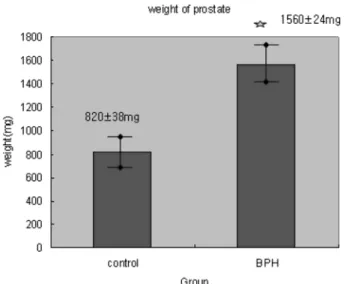
Abstract − Benign prostatic hyperplasia (BPH) is one of the common diseases in elderly men. Recently, the old-aged pop- ulation has increased, with the interest in the clinical importance of BPH ever growing. This study is designed to investigate the effects of KH-305 on BPH induced rat. The herb formulation KH-305 is consisted of Rubus coreanus, Cornus officinalis and Cuscuta chinensis. An experimental prostatic hyperplasia was induced in male rats by the administration of testosterone propionate, 3 mg/kg SC, for 2 months. The rats were divided into 3 experimental groups: the control, BPH-induced, oral KH- 305 ingestion group. After 2 months, the prostates were removed, and analyzed for their prostatic weight and histological exam- ination. The prostate weights were measured in each group, and found to be 820±38mg, 3140±26mg, 1880±21mg in the con- trol, BPH-induced, and oral KH-305 ingestion group, respectively. The BPH induced group showed statistically significant increases in their prostatic weights compared with control group( p <0.05) but oral KH-305 ingestion group showed more sig- nificant decreases than BPH-induced group statically( p< 0.05). Histologically injected testosterone lead to prostatic hyperplasia in rats, but oral KH-305 ingestion decreased this change. These results suggest that KH-305 may be effective in treatment of BPH, and complementary medicine of BPH.
key words − BPH (benign prostatic hyperplasia), rubus coreanus, rat model
전립선비대증은 노인 남성에서 발생하는 가장 흔한 질환 중의 하나이다 . 최근 노인 인구의 증가로 전립선비대증에
관한 관심이 증대되고 , 임상적 비중 또한 높아지고 있다 . 이
에도 불구하고 현재까지 전립선비대증의 병인에 관련된 분 자 생물학적인 기전에 대해서는 확실히 알려지지 않고 있 는 실정이며 , 노화와 고환의 존재가 원인 인자로 알려져 있
으나 ,1)이들의 기전도 명확하지는 않은 상태이다 . 또한 연
령의 증가와 함께 전립선비대증의 이환율이 증가됨을 알 수 있어 주로 성 호르몬을 비롯한 내분비의 변화와 노화가 전 립선 비대의 요소로 작용한다고 알려져 있다 .2) 전립선비대
증은 두 가지 기전에 의해서 방광하부폐색을 유발한다 . 즉
커진 전립선에 의한 해부학적인 폐색과 전립선평활근을 지 배하고 있는 신경조절에 의한 기능적 폐색에 의해서 환자 에게 고통스런 배뇨증상을 나타낸다 .
전립선비대증의 치료는 경요도적전립선절제술이 가장 보 편적인 치료방법이었으나 ,3)최근 수술치료에 대한 기피 경
향과 출혈 , 발기불능 , 요실금 등의 합병증 발생 가능성으로
인해 대체 치료를 선호하는 경향이다 .4)따라서 , 내과적 약
물요법은 전립선평활근을 지배하는 교감신경을 차단하여 평 활근을 이완시켜 증상의 호전을 기대할 수있으며 , 전립선
성장에 관여하는 내분비작용을 억제하여 전립선 크기를 경 감시켜 효과적인 치료를 할 수 있을 것이다 . 최근에는 전립
선비대증에 대해 효과적인 약물치료가 가능하게 되었으며 ,
가장 많이 쓰이는 약물로는 알파차단제와 5- 알파 환원효소
*교신저자(E-mail):[email protected]