Loosening torque of Universal Abutment screws after cyclic loading: influence of tightening technique and screw coating
Atais Bacchi1*, Alexandre Regalin1, Claudia Lopes Brilhante Bhering2, Rodrigo Alessandretti3, Aloisio Oro Spazzin1
1Meridional Faculty - IMED, School of Dentistry, Prosthodontics and Dental Materials, Brazil
2Piracicaba Dental School, Campinas State University, Prosthodontics and Periodontics, Brazil
3University of Passo Fundo, Post-graduate Program in Dentistry, Dental School, Brazil
PURPOSE. The purpose of this study was to evaluate the influence of tightening technique and the screw coating on the loosening torque of screws used for Universal Abutment fixation after cyclic loading. MATERIALS AND METHODS. Forty implants (Titamax Ti Cortical, HE, Neodent) (n=10) were submerged in acrylic resin and four tightening techniques for Universal Abutment fixation were evaluated: A – torque with 32 Ncm (control); B – torque with 32 Ncm holding the torque meter for 20 seconds; C – torque with 32 Ncm and retorque after 10 minutes; D – torque (32 Ncm) holding the torque meter for 20 seconds and retorque after 10 minutes as initially.
Samples were divided into subgroups according to the screw used: conventional titanium screw or diamond like carbon-coated (DLC) screw. Metallic crowns were fabricated for each abutment. Samples were submitted to cyclic loading at 106 cycles and 130 N of force. Data were analyzed by two-way ANOVA and Tukey’s test (5%).
RESULTS. The tightening technique did not show significant influence on the loosening torque of screws (P=.509). Conventional titanium screws showed significant higher loosening torque values than DLC (P=.000).
CONCLUSION. The use of conventional titanium screw is more important than the tightening techniques employed in this study to provide long-term stability to Universal Abutment screws. [J Adv Prosthodont 2015;7:375-9]
KEY WORDS: Single-tooth dental implant; Dental prosthesis retention; Implant-supported dental prosthesis;
Prosthesis loosening
INTRODUCTION
Implant-supported prostheses confectioned on external hexagon connections may be screwed (on the implant or on the abutment) or cemented on an abutment. The screwed prostheses are largely utilized for multiple and single units
because the screws can be easily accessed without damage to the prostheses. This is important because although his- torical clinical success of implant-supported rehabilitations, some adversities still occur, such as the loosening or frac- ture of the prosthetic screws.1,2
On the other way, for rehabilitations with single crowns in anterior region, the cemented prosthesis allows for the advantage of better contact with the opposite teeth, due to absence of a palatal hole (with is also an esthetic vantage depending on the implant inclination). It might also avoid the palatal overcontour of the crowns when implants are placed in more palatal region for a better bone implanta- tion.3 Still, the access hole takes a relevant part of the resto- ration when it is present in single crown, which might make the crown weaker than full-contour crowns.4 However, if one adversity such as the common screw loosening occurs, the confection of a hole in the cemented restoration is nec- essary for accessing the screw. So, the cemented implant-
Corresponding author:
Atais Bacchi
Department of Prosthodontics and Dental Materials, Meridional Faculty, School of Dentistry, Av. Senador Pinheiro, 304, Passo Fundo 99070-220, RS, Brazil
Tel. 55 54 3045 6100: e-mail, [email protected] Received May 12, 2015 / Last Revision August 21, 2015 / Accepted September 23, 2015
© 2015 The Korean Academy of Prosthodontics
This is an Open Access article distributed under the terms of the Creative Commons Attribution Non-Commercial License (http://creativecommons.
org/licenses/by-nc/3.0) which permits unrestricted non-commercial use, distribution, and reproduction in any medium, provided the original work is properly cited.
supported prosthesis is strictly dependent on the screw sta- bility for the success of the rehabilitation, while the screwed prosthesis allows the advantage of reversibility, easy maintenance and eventual repairs.
The stability of the retention screw is related to several factors such as the geometrical shape, the format of the threads, the fit of the prosthetic component, the frictional coefficient of the screw, the amount and properties of lubricant (if used), the speed of tightening, the tightening force used, the occlusal loads applied.5 Techniques have been proposed to provide greater screw stability, such as its retightening. This procedure has been employed because when the torque is applied to a screw, the energy is expend- ed in smoothing surface irregularities for maintaining the surfaces together. After thread engagement, surface asperi- ties are flattened and additional input torque is applied toward elongation of the screw and generation of preload.6 A previous study7 evaluated the effect of retightening sometime after initial tightening torque on the joint stability of the abutment screws, and concluded that it represents an easy and fast method to increase the joint stability. Still, it has been observed in the literature that holding the torque meter for a period during the tightening of the screws could provide elongation of the screw and increase the pre- load.8
Modifications in the screw surface have been proposed to promote greater preload stability. The coating of the screw surface with diamond-like carbon (DLC) film is one of the methods employed and already commercially avail- able. The principle of DLC coating is based on the use of a surficial material stronger, more durable and resistant to wear then titanium. Moreover, DLC has given to titanium surface a characteristic of lower friction resistance, impor- tant for increasing preload in the tightening process.9
The aim of the study was to evaluate the influence of the tightening technique and the screw coating on the loos- ening torque of the Universal Abutment screw for cement- ed implant-supported single crowns after cyclic loading.
The null hypothesis tested were that (I) there is no influ- ence of the tightening technique used and (II) the screw coating does not influence the loosening torque of the Universal Abutment screw.
MATERIALS AND METHODS
Forty external hexagon implants (Titamax Ti Cortical 4.1, Neodent, Paraná, Brazil) with 13 mm in length and 3.75 mm in diameter were submerged in poly(methyl) methacry- late (Jet, Clássico, São Paulo, Brazil) into hollow stainless steel cylinders. A surveyor (Delineator B2, Bio-art, São Paulo, Brazil) was used to standardize the implants’ inser- tion procedure.
On the implant platform, Universal Abutments (Slim Fit Rotational, 4.5 mm wide × 6 mm in length × 2 mm trans-mucosal neck) were screwed using two types of screws: conventional titanium screw or diamond like coat- ed-screw (DLC) (Neotorque, Neodent, Paraná, Brazil).
Different tightening techniques were also evaluated: A – torque with 32 Ncm (control); B – torque with 32 Ncm holding the torque meter for 20 s; C – torque with 32 Ncm and retorque after 10 minutes; D – torque (32 Ncm) hold- ing the torque meter for 20 seconds and retorque after 10 minutes as initially. Metallic crowns were confectioned and cemented on the universal abutments with resin cement (RelyX ARC, 3M ESPE, St. Paul, MN, USA).
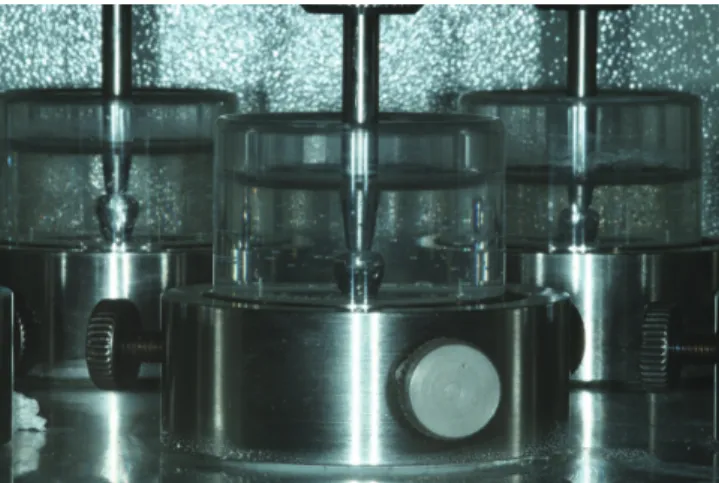
A digital torque meter with precision of 0.1-Ncm (TQ8800; Lutron, Taipei, Taiwan) was used to tighten the screws and evaluate the loosening torque after mechanical loading cycles. The cyclic loading was performed using the MSCM equipment (ME Instrument, São Carlos, Brazil) which has a stainless steel tip of 4 mm in diameter in con- tact with the central part of the metallic crowns. Samples were submitted to 106 mechanical cycles under a load of 130 N, at a rate of 2 Hz (Fig. 1).10 All procedures in the study were performed by the same operator. Data for each group were recorded and statistical analyze was carried out by two-way ANOVA (screw type vs tightening technique) and multiple comparison evaluated by Tukey’s test with 5%
significance level.
RESULTS
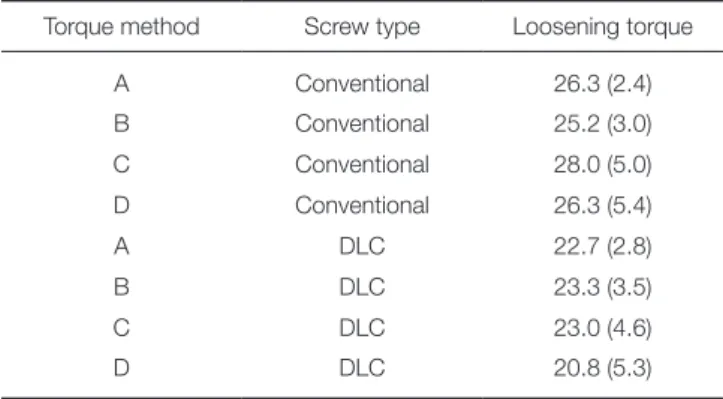
The mean values and standard deviation of loosening torque for the different experimental conditions are pre- sented in Table 1. The interaction between the factors tight- ening technique and type of screw was not significant (P = .516). The tightening technique (Table 2) did not show sig- nificant influence on the loosening torque of screws (P = .509). Conventional titanium screws promoted significantly higher loosening torque values than DLC (P = .000) for Universal Abutment fixation (Table 3).
Fig. 1. Samples under mechanical loading cycles.
DISCUSSION
This study evaluated the influence of four tightening meth- ods and DLC coated screws on the preload maintenance in Universal Abutments after cyclic loading application. The first null hypothesis of the study was accepted, as the tight- ening method did not influence the loosening torque val- ues. The simple application of a torque until reach the 32 Ncm was as effective as the long time torque applications and/or retorque methods. The previous emphasized retorque and long-time torque applications were based in the fact that during the manufacturer process the screw threads cannot be machined perfectly smooth,10 so that, part of the torque applied to the screws could have been
lost to smooth the irregularities in the screw threads and abutment threads.7,11 Therefore the application of a longer torque period or retorque once again after embedment relaxation or settling would act to regain preload and to increase contact area between the threads.
In contrast to the results of this study, Siamos et al.7 evaluated the effect of retorque on premachined abutments and advocated that retorque abutment screws 10 min after initial torque application should be performed routinely to abutment-implant connections. The high number of mechanical cycles applied in the present study (106) sug- gests that after long-term function the effects of pre-load and long-time torque application are not improved. Farina et al.11 also observed that the retorque application provided significantly higher loosening torque of prosthetic screws after mechanical cycles. Although, the study evaluated full- arch prostheses supported by five implants. Full-arch pros- theses are more likely to dissipate cyclic loading along all components, reducing the effect of loads on the screws in comparison to single-crowns. Another study has shown that retorque does not significantly interfere on the loosen- ing torque when the titanium screws are used in dentures with passive fit. On the other hand, the retorque signifi- cantly increased the loosening torque when these screws were used in dentures with misfit.8 According to these find- ings, the passive fit of cemented restorations used in the present study may have contributed to the similarity among the groups. A finite element study has shown that screw retightening reduces the settling effect and has an insignifi- cant effect on the preload.12 Different of the absence of significance by the retightening or by holding the torque meter for 20 seconds, one study has shown that increasing the tightening speed would be able to reduce the response rate to the frictional resistance, thus diminishing the coeffi- cient of friction and slightly increasing the preload.13
The second null hypothesis tested in this study that the screw coating does not influence the loosening torque of the Universal Abutment screw, was rejected. The conven- tional titanium screws have shown significantly higher loos- ening torque than DLC coated ones. DLC coated screws were introduced following the principle that a crystalline diamond coating can increase the wear resistance of titani- um.14 Yet, DLC has properties similar to those of real dia- mond, including hardness, wear resistance, and chemical stability.15 Moreover, low friction resistance and excellent wear resistance makes DLC one of the best materials for use as it acts as a protectant and lubricant, according to a previous study.9 Although these considerations, the lower loosening torque values are probably explained by the fact that besides the DLC coating reduces the friction during tightening to provide a higher preload, it may equally reduce the frictional resistance of the screw to removal.
Similar findings were observed by Park et al.,16 in a compa- rable investigation of metallic abutments screwed with coated or uncoated screws. In that study, initial loosening torque for titanium screws was significantly higher than titanium screws coated with tungsten carbide carbon.
Table 1. Mean values (Ncm) and standard deviations for the loosening torque in regard to tightening technique used and screw coating
Torque method Screw type Loosening torque
A Conventional 26.3 (2.4)
B Conventional 25.2 (3.0)
C Conventional 28.0 (5.0)
D Conventional 26.3 (5.4)
A DLC 22.7 (2.8)
B DLC 23.3 (3.5)
C DLC 23.0 (4.6)
D DLC 20.8 (5.3)
Table 2. Mean values (Ncm) and standard deviation in regard of the torque method
Torque method Loosening torque
A 24.4 (2.5) A
B 24.2 (1.3) A
C 25.5 (3.5) A
D 23.5 (3.9) A
Mean values followed by the same letter are statistical similar (P < .05).
Table 3. values and standard deviation of loosening torque (Ncm) in regard to screw type
Screw type Loosening Torque
Conventional 26.4 (1.16) A
DLC 22.4 (1.14) B
Mean followed by different letter are statistical significant (P < .05).
However, there is no consensus in the literature in regards to the benefits of coated screws for abutment fixa- tion. Other reports presented contrary finds to those of this study. They have shown that coated screws are able to promote preload maintenance similar to conventional tita- nium ones after 0.5 × 10⁶ mechanical loading cycles17 or, higher values of preload than conventional titanium screws after 106 cycles.16 The above mentioned studies suggest that coated screws may have lower reduction in preload after cyclic loading because the coated surface provides greater preload and more stable joints, thereby resulting in less screw vibration and micromotion during cyclic testing.17
The loosening torque of prosthetic screws was lower than the tightening toque in all groups of this study, which was also already observed in literature.7,18,19 Preload is lost because of the settling effect and it is hypothesized that this reduction is about 2% to 10% of the initial torque.20 In this process, thread friction is higher for the first tightening and loosening of a screw; after repeated tightening and loosening cycles, friction decreases.21 The result of the set- tling effect is that the torque necessary to remove a screw is less than the torque used to initially place the screw.22 It has therefore been suggested that the implant-abutment joint should be tightened after initial screw insertion and periodi- cally thereafter.7,23 Moreover, the mechanical cycling load applied promotes micromotion to the screw/implant inter- face favorably contributing to loose friction.
CONCLUSION
Within the limitations of this in vitro study, considering the materials and techniques evaluated, it was possible to con- clude that the use of conventional titanium screws for fixa- tion of Universal Abutments provides higher loosening torque values than DLC screws after cyclic loading irre- spective of the technique applied.
ORCID
Atais Bacchi http://orcid.org/0000-0002-9913-8290 Alexandre Regalin http://orcid.org/0000-0002-6176-9599 Claudia Lopes Brilhante Bhering http://orcid.org/0000-0001- 9667-308X
Rodrigo Alessandretti http://orcid.org/0000-0002-3997-9370 Aloisio Oro Spazzin http://orcid.org/0000-0002-2392-1836 REFERENCES
1. Jemt T, Lekholm U, Gröndahl K. 3-year followup study of early single implant restorations ad modum Brånemark. Int J Periodontics Restorative Dent 1990;10:340-9.
2. Jemt T, Laney WR, Harris D, Henry PJ, Krogh PH Jr, Polizzi G, Zarb GA, Herrmann I. Osseointegrated implants for sin- gle tooth replacement: a 1-year report from a multicenter prospective study. Int J Oral Maxillofac Implants 1991;6:29- 36.
3. Michalakis KX, Hirayama H, Garefis PD. Cement-retained
versus screw-retained implant restorations: a critical review.
Int J Oral Maxillofac Implants 2003;18:719-28.
4. Torrado E, Ercoli C, Al Mardini M, Graser GN, Tallents RH, Cordaro L. A comparison of the porcelain fracture resistance of screw-retained and cement-retained implant-supported metal-ceramic crowns. J Prosthet Dent 2004;91:532-7.
5. Binon PP. Evaluation of the effectiveness of a technique to prevent screw loosening. J Prosthet Dent 1998;79:430-2.
6. Weiss EI, Kozak D, Gross MD. Effect of repeated closures on opening torque values in seven abutment-implant systems.
J Prosthet Dent 2000;84:194-9.
7. Siamos G, Winkler S, Boberick KG. Relationship between implant preload and screw loosening on implant-supported prostheses. J Oral Implantol 2002;28:67-73.
8. Spazzin AO, Henrique GE, Nóbilo MA, Consani RL, Correr- Sobrinho L, Mesquita MF. Effect of retorque on loosening torque of prosthetic screws under two levels of fit of im- plant-supported dentures. Braz Dent J 2010;21:12-7.
9. Kim SK, Lee JB, Koak JY, Heo SJ, Lee KR, Cho LR, Lee SS.
An abutment screw loosening study of a Diamond Like Carbon-coated CP titanium implant. J Oral Rehabil 2005;32:
346-50.
10. Bhering CL, Takahashi JM, Luthi LF, Henriques GE, Consani RL, Mesquita MF. Influence of the casting tech- nique and dynamic loading on screw detorque and misfit of single unit implant-supported prostheses. Acta Odontol Scand 2013;71:404-9.
11. Farina AP, Spazzin AO, Consani RL, Mesquita MF. Screw joint stability after the application of retorque in implant- supported dentures under simulated masticatory conditions. J Prosthet Dent 2014;111:499-504.
12. Bulaqi HA, Mousavi Mashhadi M, Safari H, Samandari MM, Geramipanah F. Dynamic nature of abutment screw retight- ening: finite element study of the effect of retightening on the settling effect. J Prosthet Dent 2015;113:412-9.
13. Bulaqi HA, Mousavi Mashhadi M, Geramipanah F, Safari H, Paknejad M. Effect of the coefficient of friction and tighten- ing speed on the preload induced at the dental implant com- plex with the finite element method. J Prosthet Dent 2015;
113:405-11.
14. Montiès JR, Dion I, Havlik P, Rouais F, Trinkl J, Baquey C.
Cora rotary pump for implantable left ventricular assist de- vice: biomaterial aspects. Artif Organs 1997;21:730-4.
15. Tang L, Tsai C, Gerberich WW, Kruckeberg L, Kania DR.
Biocompatibility of chemical-vapour-deposited diamond.
Biomaterials 1995;16:483-8.
16. Park JK, Choi JU, Jeon YC, Choi KS, Jeong CM. Effects of abutment screw coating on implant preload. J Prosthodont 2010;19:458-64.
17. Basílio Mde A, Butignon LE, Arioli Filho J. Effectiveness of screw surface coating on the stability of zirconia abutments after cyclic loading. Int J Oral Maxillofac Implants 2012;27:
1061-7.
18. Cantwell A, Hobkirk JA. Preload loss in gold prosthesis-re- taining screws as a function of time. Int J Oral Maxillofac Implants 2004;19:124-32.
19. Jaarda MJ, Razzoog ME, Gratton DG. Providing optimum
torque to implant prostheses: a pilot study. Implant Dent 1993;2:50-2.
20. Dixon DL, Breeding LC, Sadler JP, McKay ML. Comparison of screw loosening, rotation, and deflection among three im- plant designs. J Prosthet Dent 1995;74:270-8.
21. Hagiwara M, Chashi N. New tightening technique for thread- ed fasteners. Materials and Engineering Proceedings of the International Offshore mechanics and Artic Engineering Symposium. New York; American Society of Mechanical Engineers 1992, p. 371-6.
22. Jaarda MJ, Razzoog ME, Gratton DG. Geometric compari- son of five interchangeable implant prosthetic retaining screws. J Prosthet Dent 1995;74:373-9.
23. Jaarda MJ, Razzoog ME, Gratton DG. Effect of preload torque on the ultimate tensile strength of implant prosthetic retaining screws. Implant Dent 1994;3:17-21.