• 검색 결과가 없습니다.

Trainees Can Safely Learn Video-Assisted Thoracic Surgery Lobectomy despite Limited Experience in Open Lobectomy

N/A
N/A
Protected

Academic year: 2021

Share "Trainees Can Safely Learn Video-Assisted Thoracic Surgery Lobectomy despite Limited Experience in Open Lobectomy"

Copied!
7
0
0

로드 중.... (전체 텍스트 보기)

전체 글

(1)

ISSN: 2233-601X (Print) ISSN: 2093-6516 (Online)

1

Department of Thoracic and Cardiovascular Surgery, Yonsei University College of Medicine,

2

Department of Thoracic Surgery, Armed Forces Capital Hospital

Received: July 16, 2014, Revised: November 6, 2014, Accepted: November 7, 2014, Published online: April 5, 2015

Corresponding author: Kyung Young Chung, Department of Thoracic and Cardiovascular Surgery, Yonsei University College of Medicine, 50 Yonsei-ro, Seodaemun-gu, Seoul 120-749, Korea

(Tel) 82-2-2228-2141 (Fax) 82-2-2228-2140 (E-mail) [email protected]

C

The Korean Society for Thoracic and Cardiovascular Surgery. 2015. All right reserved.

CC
This is an open access article distributed under the terms of the Creative Commons Attribution Non-Commercial License (http://creative- commons.org/licenses/by-nc/3.0) which permits unrestricted non-commercial use, distribution, and reproduction in any medium, provided the original work is properly cited.

Trainees Can Safely Learn Video-Assisted Thoracic Surgery Lobectomy despite Limited Experience in Open Lobectomy

Woo Sik Yu, M.D.

1

, Chang Young Lee, M.D.

1

, Seokkee Lee, M.D.

2

, Do Jung Kim, M.D.

1

, Kyung Young Chung, M.D.

1

Background: The aim of this study was to establish whether pulmonary lobectomy using video-assisted thoracic surgery (VATS) can be safely performed by trainees with limited experience with open lobectomy. Methods: Data were retrospectively collected from 251 patients who underwent VATS lobectomy at a single institution between October 2007 and April 2011. The surgical outcomes of the procedures that were performed by three trainee sur- geons were compared to the outcomes of procedures performed by a surgeon who had performed more than 150 VATS lobectomies. The cumulative failure graph of each trainee was used for quality assessment and learning curve analysis. Results: The surgery time, estimated blood loss, final pathologic stage, thoracotomy conversion rate, chest tube duration, duration of hospital stay, complication rate, and mortality rate were comparable between the expert surgeon and each trainee. Cumulative failure graphs showed that the performance of each trainee was ac- ceptable and that all trainees reached proficiency in performing VATS lobectomy after 40 cases. Conclusion: This study shows that trainees with limited experience with open lobectomy can safely learn to perform VATS lobectomy for the treatment of lung cancer under expert supervision without compromising outcomes.

Key words: 1. Education 2. Lobectomy 3. Lung neoplasms 4. Minimal invasive surgery 5. Thoracic surgery, video-assisted

INTRODUCTION

Video-assisted thoracic surgery (VATS) lobectomy was in- troduced in 1991 [1], and has become increasingly common in the treatment of lung cancer over the last decade. Recent review articles have suggested that VATS lobectomy in se- lected patients with early stage non-small cell lung cancer is a viable alternative to open lobectomy [2,3]. Furthermore,

VATS lobectomy has the advantage of involving decreased postoperative pain [4,5], reduced cytokine release [6], shorter chest tube duration and hospital stay, and, consequently, low- er hospital costs [7-9].

Several articles have reported that VATS lobectomy, which

is believed to be more complex and technically demanding

than open lobectomy, can be taught to new trainees without

compromising morbidity or mortality rates [10-13]. However,

http://dx.doi.org/10.5090/kjtcs.2015.48.2.105

(2)

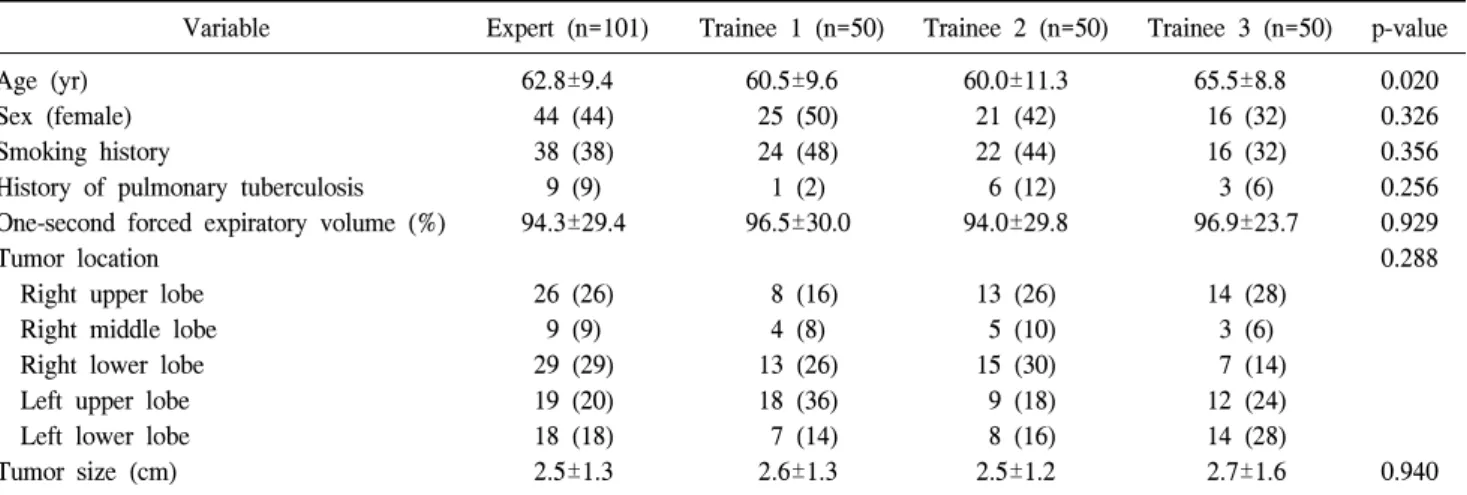
Table 1. Patient demographics by group

Variable Expert (n=101) Trainee 1 (n=50) Trainee 2 (n=50) Trainee 3 (n=50) p-value

Age (yr) 62.8±9.4 60.5±9.6 60.0±11.3 65.5±8.8 0.020

Sex (female) 44 (44) 25 (50) 21 (42) 16 (32) 0.326

Smoking history 38 (38) 24 (48) 22 (44) 16 (32) 0.356

History of pulmonary tuberculosis 9 (9) 1 (2) 6 (12) 3 (6) 0.256

One-second forced expiratory volume (%) 94.3±29.4 96.5±30.0 94.0±29.8 96.9±23.7 0.929

Tumor location 0.288

Right upper lobe 26 (26) 8 (16) 13 (26) 14 (28)

Right middle lobe 9 (9) 4 (8) 5 (10) 3 (6)

Right lower lobe 29 (29) 13 (26) 15 (30) 7 (14)

Left upper lobe 19 (20) 18 (36) 9 (18) 12 (24)

Left lower lobe 18 (18) 7 (14) 8 (16) 14 (28)

Tumor size (cm) 2.5±1.3 2.6±1.3 2.5±1.2 2.7±1.6 0.940

Values are presented as mean±standard deviation or number (%).

the trainees discussed in the above studies were experienced surgeons who were already proficient in performing open lobectomy. Moreover, several of the above studies discuss a stepwise approach to the transition from open lobectomy to VATS lobectomy. Since VATS lobectomy is becoming more popular, surgeons who have had little experience performing open lobectomy are finding it increasingly difficult to obtain opportunities to practice this procedure. Therefore, in this study, we investigated whether VATS lobectomy can be safe- ly performed by junior surgeons without extensive experience in performing open lobectomy.

METHODS 1) Patients

Data were retrospectively collected on consecutive patients who underwent pulmonary lobectomy for lung cancer be- tween October 2007 and April 2011. Three trainees were in- volved in this study. Each trainee had experience as the pri- mary surgeon in <five cases of open lobectomy, had per- formed >50 minor VATS procedures, and had assisted on

>50 VATS lobectomies.

Each patient was evaluated by chest radiography and a pul- monary function test, along with a thoracic computed tomog- raphy (CT) scan, a positron emission tomography (PET) scan, or a PET/CT scan. Cervical mediastinoscopy was performed only when metastasis to the N2 node was suspected based on

PET or PET/CT imaging. The preoperative patient character- istics recorded for each case included age, gender, history of smoking, history of pulmonary tuberculosis, one-second forced expiratory volume, and tumor location (Table 1).

2) Surgical technique

Each patient was placed in the lateral decubitus position, with flexion of the operating table in order to widen the inter- costal spaces. Intubation was performed using a double-lumen endotracheal tube to enable single-lung ventilation. A 3–5-cm utility incision was made, usually at the anterior axillary line over the fourth or fifth intercostal space, without spreading the ribs. Another two or three incisions were made to allow the insertion of a camera, stapler, and endoscopic instruments for the surgeon and assistant. Endoscopic instruments were used as frequently as possible. The operation was performed entirely with thoracoscopic visualization. The pulmonary ar- tery, pulmonary vein, and bronchus were individually dissected using endolinear staples, and systematic dissection of the me- diastinal lymph nodes was performed in all cases.

3) Trainees

The trainees were three fellows who had been members of

the department of thoracic surgery for at least one year. The

trainees had previously assisted in VATS lobectomy proce-

dures in Severance Hospital, thereby gaining proficiency in

the following steps of the VATS lobectomy procedure in

(3)

gradual increments under the constant supervision of an ac- complished mentor: proper trocar placement, gentle exposure of hilar structures, camera control, handling of endoscopic in- struments and staplers, pulmonary vein isolation, fissure de- velopment, and pulmonary artery isolation.

After the trainees achieved the prerequisite skills for per- forming VATS lobectomy by performing more than 50 minor VATS procedures and obtaining secondhand experience by assisting in multiple VATS lobectomies, they began perform- ing VATS lobectomy with the help of well-trained assistants under the supervision of expert surgeons. In the early stages of training, trainees were assigned cases with small tumors, tumors located in the lower lobes, and well-developed fissures.

As the trainees gained proficiency, cases involving upper lobe tumors or fused fissures were gradually introduced.

4) Assessment

The surgical outcomes of the VATS lobectomies performed by each of the three trainees under the supervision of a se- nior surgeon were compared to the outcomes of the same procedure performed by an expert surgeon who had per- formed more than 150 VATS lobectomies. In order to visual- ize the trainees’ learning curves with maximum clarity, the first 50 cases performed by the expert surgeon were excluded from this study.

The quality assessment and analysis of each learning curve was performed using cumulative failure graphs. For these analyses, we defined failure as the occurrence of any of the following: (1) major perioperative morbidity and mortality;

(2) intraoperative blood loss >1,000 mL in the absence of severe pleural adhesion, or blood loss greater than 2,000 mL in the presence of severe pleural adhesion; or (3) duration of surgery more than two standard deviations above the de- partmental average (>260 minutes in the absence of severe pleural adhesion or >320 minutes in the presence of severe pleural adhesion). Major morbidities were defined to include pulmonary complications requiring readmission to the in- tensive care unit, myocardial infarction, cerebrovascular path- ology, and hemorrhages requiring reoperation.

5) Statistical analysis

All statistical analyses were performed with PASW

Statistics for Windows ver. 18.0 (SPSS Inc., Chicago, IL, USA). Categorical variables were compared with the chi-square test or the Fisher’s exact test. The independent t-test was used for the comparison of continuous variables.

All p-values <0.05 were considered to indicate statistical significance. Cumulative failure graphs were drawn using SAS ver. 9.2 (SAS Institute Inc., Cary, NC, USA).

RESULTS 1) Preoperative demographics

Data from 251 patients were included in this study. The patient characteristics of each group (expert surgeon vs. each trainee) are presented in Table 1. Although the age of the pa- tients in the group treated by trainee 3 was higher than in other groups, individual parameters including smoking history, incidence of tuberculosis, pulmonary function, tumor location, and tumor size were not significantly different among the groups.

2) Surgical outcomes

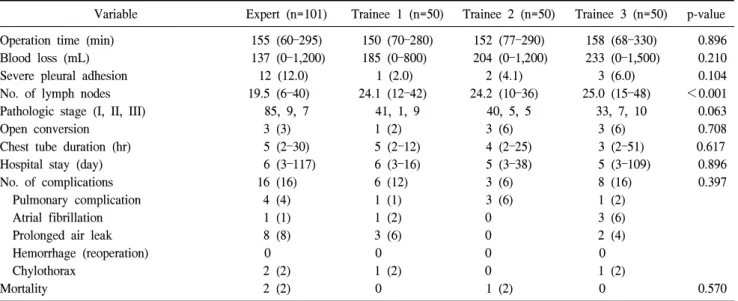
No significant difference was observed among the groups with respect to the presence of moderate to severe pleural symphysis during VATS lobectomy. The operative time, esti- mated blood loss, final pathologic stage, thoracotomy con- version rate, duration of chest tube support, duration of hospi- tal stay, complication rate, and mortality rate were also com- parable in each of the groups (Table 2). The number of re- trieved lymph nodes in the trainee groups was higher than in the expert surgeon group.

3) Cumulative failure graphs

Cumulative failure graphs for each group are shown in

Fig. 1. For trainee 1, the operative time was longer than the

arbitrary cutoff time of 260 minutes in one case without

moderate to severe pleural symphysis. In the group treated by

trainee 2, two surgical failures occurred: one patient, who had

contralateral lung disease, did not survive the procedure, and

in another case, the surgery lasted longer than the 260-minute

cutoff time. In the group treated by trainee 3, there were

three failures: one patient had more than 1,000 mL of intra-

operative blood loss, one operation lasted longer than 320 mi-

(4)

Table 2. Surgical outcomes by group

Variable Expert (n=101) Trainee 1 (n=50) Trainee 2 (n=50) Trainee 3 (n=50) p-value

Operation time (min) 155 (60–295) 150 (70–280) 152 (77–290) 158 (68–330) 0.896

Blood loss (mL) 137 (0–1,200) 185 (0–800) 204 (0–1,200) 233 (0–1,500) 0.210

Severe pleural adhesion 12 (12.0) 1 (2.0) 2 (4.1) 3 (6.0) 0.104

No. of lymph nodes 19.5 (6–40) 24.1 (12–42) 24.2 (10–36) 25.0 (15–48) <0.001

Pathologic stage (I, II, III) 85, 9, 7 41, 1, 9 40, 5, 5 33, 7, 10 0.063

Open conversion 3 (3) 1 (2) 3 (6) 3 (6) 0.708

Chest tube duration (hr) 5 (2–30) 5 (2–12) 4 (2–25) 3 (2–51) 0.617

Hospital stay (day) 6 (3–117) 6 (3–16) 5 (3–38) 5 (3–109) 0.896

No. of complications 16 (16) 6 (12) 3 (6) 8 (16) 0.397

Pulmonary complication 4 (4) 1 (1) 3 (6) 1 (2)

Atrial fibrillation 1 (1) 1 (2) 0 3 (6)

Prolonged air leak 8 (8) 3 (6) 0 2 (4)

Hemorrhage (reoperation) 0 0 0 0

Chylothorax 2 (2) 1 (2) 0 1 (2)

Mortality 2 (2) 0 1 (2) 0 0.570

Values are presented as mean (range), number (%), or mean±standard deviation.

Fig. 1. Cumulative failure graphs for each group. (A) Trainee 1.

(B) Trainee 2. (C) Trainee 3.

(5)

nutes (in the presence of severe pleural symphysis), and one patient suffered from atrial fibrillation and a subsequent cere- brovascular accident, requiring readmission to the intensive care unit.

DISCUSSION

This study demonstrates that new trainees can safely learn to perform VATS lobectomy for the treatment of lung cancer under expert supervision without compromising outcomes, even if they have limited experience performing open lobectomy.

Since 1991, when VATS lobectomy was first introduced [1], many studies have provided strong evidence that VATS lobectomy is an acceptable alternative to open lobectomy for early stage non-small cell lung cancer [2-9]. In addition, a re- cent propensity-matched analysis from the Society of Thoracic Surgeons database demonstrated that VATS lobec- tomy is associated with a lower incidence of complications than lobectomy via thoracotomy [14]. However, nearly 70%

of all lobectomies reported to the Society of Thoracic Surgeons database were still performed via open thoracotomy [15], even though approximately 90% of lobectomies can be performed via VATS [16]. Despite the fact that VATS lobec- tomy has several advantages, this technique has yet to be widely disseminated. One possible reason for the limited use of VATS lobectomy is that it is a more complex and techni- cally demanding procedure that requires intensive training.

Several articles about learning to perform VATS lobectomy have been published, directed towards experienced surgeons who had previously performed open lobectomy. Other articles outline a stepwise transition from open lobectomy to VATS lobectomy [10-13].

Previous experience with open lobectomy could potentially increase the surgeon’s confidence when performing hilar dis- section during VATS lobectomy. However, we postulated that even with limited experience performing open lobectomy, trainees should be able to learn VATS lobectomy in a step- wise fashion by obtaining experience assisting during VATS lobectomies.

Konge et al. [17] have recently reported that extensive ex- perience with open procedures was not needed to learn to per- form VATS lobectomy, much as we hypothesized. However,

our study included more trainees and more cases than their report, which means that it may be more likely for our study to facilitate the broader acceptance of this proposal.

Assessing the results of surgical training poses interesting challenges. Direct observation by supervisors is a way of mon- itoring individual competence, but is likely to be subjective.

The cumulative summation methodology, which has been suggested as a useful statistical technique to assess learning and training in physicians and surgeons [18], allows for the objective and quantitative monitoring of surgical performance using well-defined failure situations. In this study, each cu- mulative failure graph represents the outcome of 50 VATS lobectomies performed by each trainee. Even in the early pe- riod of training, no trainee’s cumulative failure plot extended above the threshold of minimum acceptability (the upper line), thus indicating that the performance of each trainee was acceptable during this period. The cumulative failure graph crossed the threshold of proficiency (lower line) after 15 cas- es treated by trainee 1, 20 cases treated by trainee 2, and 40 cases treated trainee 3, which indicates that each surgeon gained proficiency in performing VATS lobectomy after 15 to 40 cases. It is likely that more procedures were needed to reach the desired level of proficiency in trainee 3 because the indications for VATS lobectomy have recently been expanded in Severance Hospital, and cases involving advanced age or severe pleural adhesion were represented more frequently in the group treated by trainee 3.

The cumulative summation technique, however, offers no

panacea for assessing the competency of trainees [19]. Failure

can be defined in a somewhat arbitrary manner, as exempli-

fied by our criterion dealing with the amount of bleeding. On

one hand, 1,000 mL of blood loss might be considered quite

extensive, but the absolute amount of blood loss is less im-

portant than keeping vital signs stable and deciding whether

thoracotomy conversion should be performed in the face of

uncontrolled bleeding during VATS. Therefore, we also in-

cluded failure criteria involving major perioperative morbidity

and mortality, which can result from uncontrolled bleeding

during the operation. Moreover, determining what constitutes

an acceptable failure rate is difficult because there is a pauc-

ity of data in the literature relating to the failure rates of

trainees. In most clinical training settings, therefore, it is ap-

(6)

propriate to assess trainees based on comparison with the per- formance of their supervisors or colleagues with similar expe- rience levels. Thus, in this study, comparison with an expert was given priority over the application of the cumulative summation curve for the overall assessment of trainees.

Our results show that VATS lobectomy can be safely taught to trainees without compromising surgical outcomes, as reflected by parameters such as estimated blood loss, compli- cation rates, and mortality rates. Our outcomes, as quantified by the above parameters, were similar to the outcomes re- ported by two expert centers in the United States [20,21].

The number of retrieved lymph nodes in the groups treated by trainees was higher than in the group treated by the expert surgeon. We hypothesize that this difference may have stem- med from differences in some demographic category (for ex- ample, more old patients were included in the expert surgeon group), differences in the strategy of lymph node dissection according to the tumor location, and the presence of more pa- tients with bronchioloalveolar cell carcinoma in the group treated by trainee 1.

The fact that trainees, even with limited experience with open lobectomy, can achieve comparable surgical outcomes and follow the projected learning curve, may be due to sev- eral factors. First, port placement and overall surgical techni- que are performed in a similar fashion by the three senior surgeons in Severance Hospital. This provides consistency during second-hand training, which enables trainees to learn effectively without needing to develop skills to replicate dif- ferent techniques used by different surgeons. Second, surgical error, especially during hilar dissection and fissure develop- ment, was reduced by direct supervision using magnified im- ages of procedures performed by the expert surgeons. Finally, trainees were able to review video recordings of their per- formances, allowing them to correct and improve their skills in an efficient manner.

There is one major limitation in our study. Clear and ob- jective training assessment parameters were not established in the beginning of the training period. During this period, the only way of monitoring individual competency was poten- tially subjective observation by a supervisor Since the profi- ciency, learning curve, and cumulative failure graph of each trainee were retrospectively analyzed and compared to the

outcomes of procedures performed by an expert surgeon, it was not possible to thoroughly control for confounding varia- bles such as the degree of intervention by an expert surgeon, pre-existing differences in the degree of technical proficiency in the use of thoracoscopic instruments, or differences in the proficiency of assistants.

In conclusion, this study shows that trainees, even with limited experience in open lobectomy, can safely learn to per- form VATS lobectomy for the treatment of lung cancer under expert supervision, without compromising outcomes, after they established significant second-hand experience with VATS lobectomy and other minor VATS procedures. In the near future, objective assessment tools and procedure simu- lations are expected to be incorporated into resident and fel- lowship training programs.

CONFLICT OF INTEREST

No potential conflict of interest relevant to this article was reported.

ACKNOWLEDGMENTS

This study was supported by a Grant of the Samsung Vein Clinic Network (Daejeon, Anyang, Cheongju, Cheonan; Fund No. KTCS04-021).

REFERENCES

1. Roviaro G, Rebuffat C, Varoli F, Vergani C, Mariani C, Maciocco M. Videoendoscopic pulmonary lobectomy for cancer. Surg Laparosc Endosc 1992;2:244-7.

2. Cheng D, Downey RJ, Kernstine K, et al. Video-assisted thoracic surgery in lung cancer resection: a meta-analysis and systematic review of controlled trials. Innovations (Phila) 2007;2:261-92.

3. Whitson BA, Groth SS, Duval SJ, Swanson SJ, Maddaus MA. Surgery for early-stage non-small cell lung cancer: a systematic review of the video-assisted thoracoscopic surgery versus thoracotomy approaches to lobectomy. Ann Thorac Surg 2008;86:2008-16.

4. Yan TD, Black D, Bannon PG, McCaughan BC. Systematic

review and meta-analysis of randomized and nonrandomized

trials on safety and efficacy of video-assisted thoracic sur-

gery lobectomy for early-stage non-small-cell lung cancer. J

(7)

Clin Oncol 2009;27:2553-62.

5. Whitson BA, Andrade RS, Boettcher A, et al. Video-assisted thoracoscopic surgery is more favorable than thoracotomy for resection of clinical stage I non-small cell lung cancer.

Ann Thorac Surg 2007;83:1965-70.

6. Handy JR Jr, Asaph JW, Douville EC, Ott GY, Grunkemeier GL, Wu Y. Does video-assisted thoracoscopic lobectomy for lung cancer provide improved functional outcomes compared with open lobectomy? Eur J Cardiothorac Surg 2010;37:451-5.

7. Yim AP, Wan S, Lee TW, Arifi AA. VATS lobectomy re- duces cytokine responses compared with conventional surgery.

Ann Thorac Surg 2000;70:243-7.

8. Nagahiro I, Andou A, Aoe M, Sano Y, Date H, Shimizu N.

Pulmonary function, postoperative pain, and serum cytokine level after lobectomy: a comparison of VATS and conven- tional procedure. Ann Thorac Surg 2001;72:362-5.

9. Casali G, Walker WS. Video-assisted thoracic surgery lobec- tomy: can we afford it? Eur J Cardiothorac Surg 2009;35:

423-8.

10. Burfeind WR Jr, Jaik NP, Villamizar N, Toloza EM, Harpole DH Jr, D’Amico TA. A cost-minimisation analysis of lobectomy: thoracoscopic versus posterolateral thoracotomy.

Eur J Cardiothorac Surg 2010;37:827-32.

11. Swanson SJ, Meyers BF, Gunnarsson CL, et al. Video-as- sisted thoracoscopic lobectomy is less costly and morbid than open lobectomy: a retrospective multiinstitutional data- base analysis. Ann Thorac Surg 2012;93:1027-32.

12. Ferguson J, Walker W. Developing a VATS lobectomy pro- gramme: can VATS lobectomy be taught? Eur J Cardiothorac Surg 2006;29:806-9.

13. Wan IY, Thung KH, Hsin MK, Underwood MJ, Yim AP.

Video-assisted thoracic surgery major lung resection can be safely taught to trainees. Ann Thorac Surg 2008;85:416-9.

14. Reed MF, Lucia MW, Starnes SL, Merrill WH, Howington JA. Thoracoscopic lobectomy: introduction of a new techni- que into a thoracic surgery training program. J Thorac Cardiovasc Surg 2008;136:376-81.

15. Seder CW, Hanna K, Lucia V, et al. The safe transition from open to thoracoscopic lobectomy: a 5-year experience.

Ann Thorac Surg 2009;88:216-25.

16. Paul S, Altorki NK, Sheng S, et al. Thoracoscopic lobec- tomy is associated with lower morbidity than open lobec- tomy: a propensity-matched analysis from the STS database.

J Thorac Cardiovasc Surg 2010;139:366-78.

17. Konge L, Petersen RH, Hansen HJ, Ringsted C. No ex- tensive experience in open procedures is needed to learn lo- bectomy by video-assisted thoracic surgery. Interact Cardio- vasc Thorac Surg 2012;15:961-5.

18. Boffa DJ, Allen MS, Grab JD, Gaissert HA, Harpole DH, Wright CD. Data from The Society of Thoracic Surgeons General Thoracic Surgery database: the surgical management of primary lung tumors. J Thorac Cardiovasc Surg 2008;135:

247-54.

19. McKenna RJ Jr, Houck WV. New approaches to the mini- mally invasive treatment of lung cancer. Curr Opin Pulm Med 2005;11:282-6.

20. Yap CH, Colson ME, Watters DA. Cumulative sum techni- ques for surgeons: a brief review. ANZ J Surg 2007;77:583-6.

21. Bolsin S, Colson M. The use of the Cusum technique in the

assessment of trainee competence in new procedures. Int J

Qual Health Care 2000;12:433-8.

수치

Table 1. Patient demographics by  group
Table 2. Surgical outcomes by  group

참조

관련 문서

Herein, is reported a case of unilateral diffuse PAVM in an 18 year old female patient, who underwent a right pneumonectomy, under a video-assisted thoracic surgery

Serratus anterior plane block or thoracic paravertebral block for postoperative pain treatment after uniportal video-assisted thoracoscopic surgery: a

All patients received operation under a standard general an- esthesia protocol, with single lung ventilation by a double-lu- men endotracheal tube. VATS lobectomy

There is some debate regard- ing recurrence and survival rates after thoracoscopic lobec- tomy in patients with early stage non-small cell lung cancer... According

Our institute has been open since November 2008, but the general thoracic surgery service was not available until a thoracic surgeon joined the center in March

Comparison of the early robot-assisted lobectomy experience to video-assisted thora- cic surgery lobectomy for lung cancer: a single-institution case series matching

Intraoperative events can occur during video-assisted thoracoscopic surgery (VATS) lo- bectomy due to unfavorable surgical anatomy, such as dense adhesions or calcifications around

Purpose: The objectives of this study are to describe the outcome of adolescent idiopathic scoliosis (AIS) patients treated with Video Assisted Thoracoscopic Sur- gery (VATS)